GENETICS.
01. A closer look at cells.
Ian Anderson
Saint Ignatius College Geelong
KEY KNOWLEDGE & SKILLS
 Outline the cell theory.
 Compare prokaryotic and eukaryotic cells at light
and electron microscope levels.
 List the specialised parts of cells and describe their
roles.
 State the main differences between plant and
animal cells.
CELL THEORY.
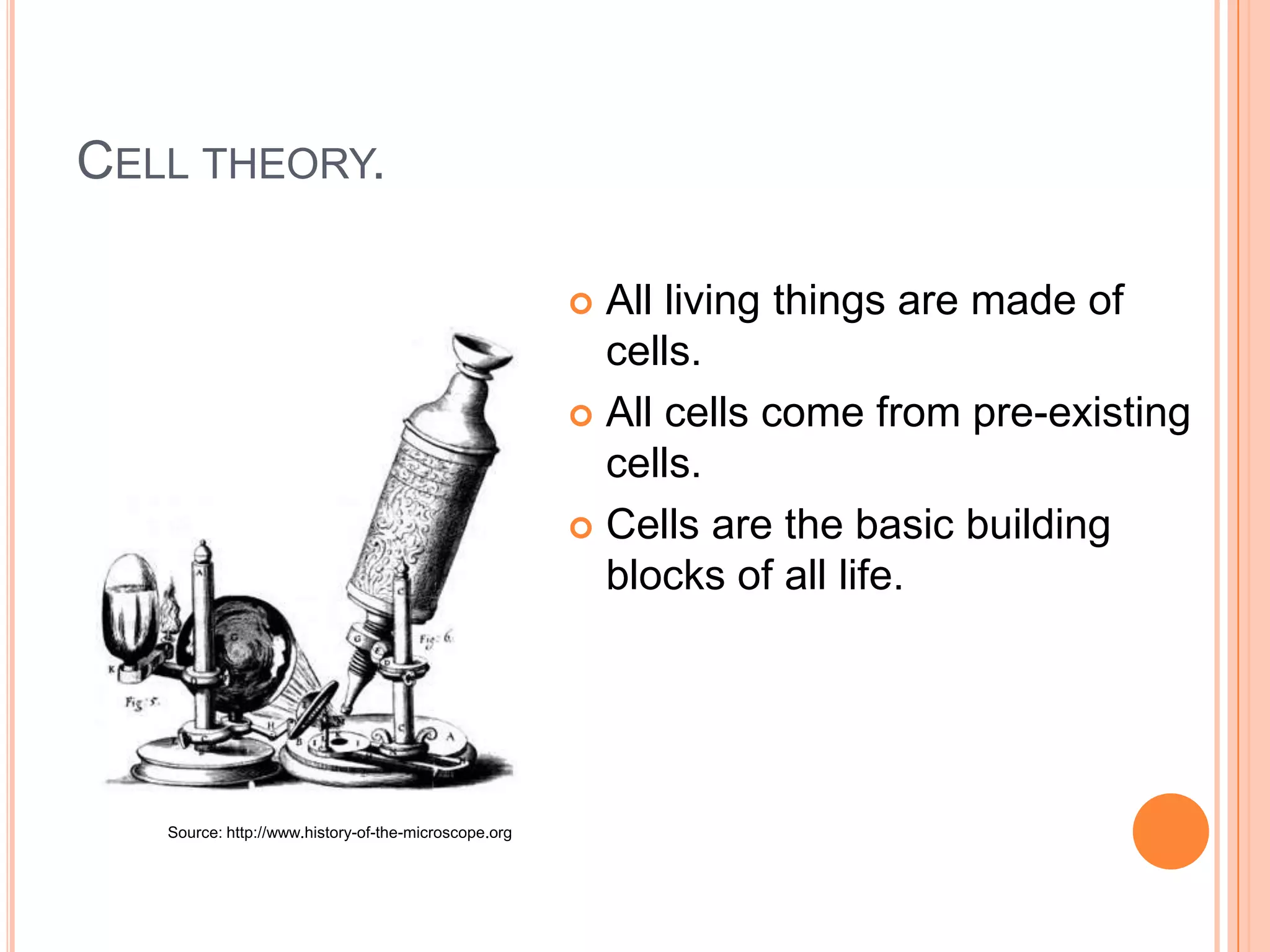
 All living things are made of
cells.
 All cells come from pre-existing
cells.
 Cells are the basic building
blocks of all life.
Source: http://www.history-of-the-microscope.org
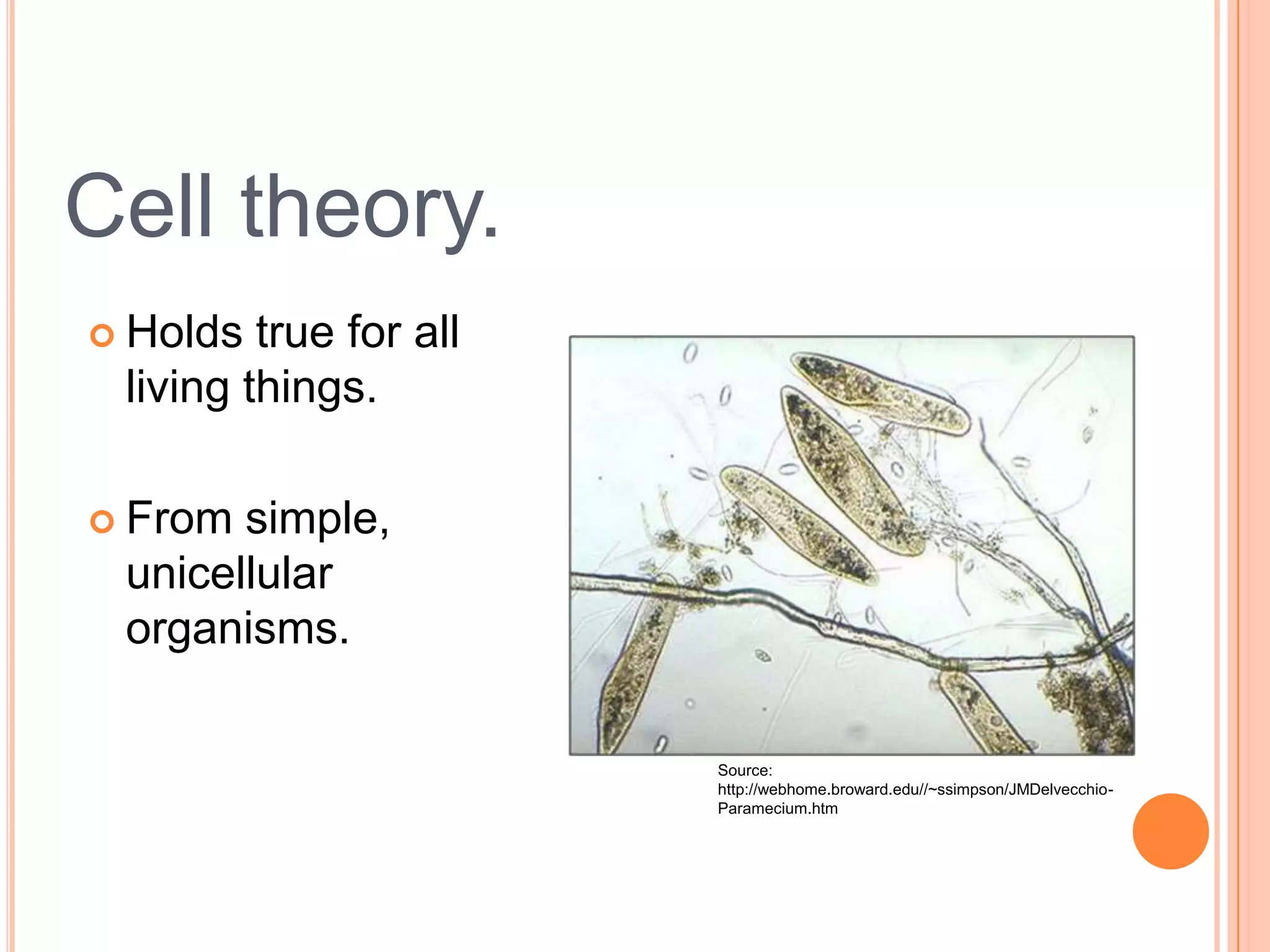
 Holds true for all
living things.
 From
simple, unicellular
organisms.
Cell theory.
Source:
http://webhome.broward.edu//~ssimpson/JMDelvecchio-
Paramecium.htm
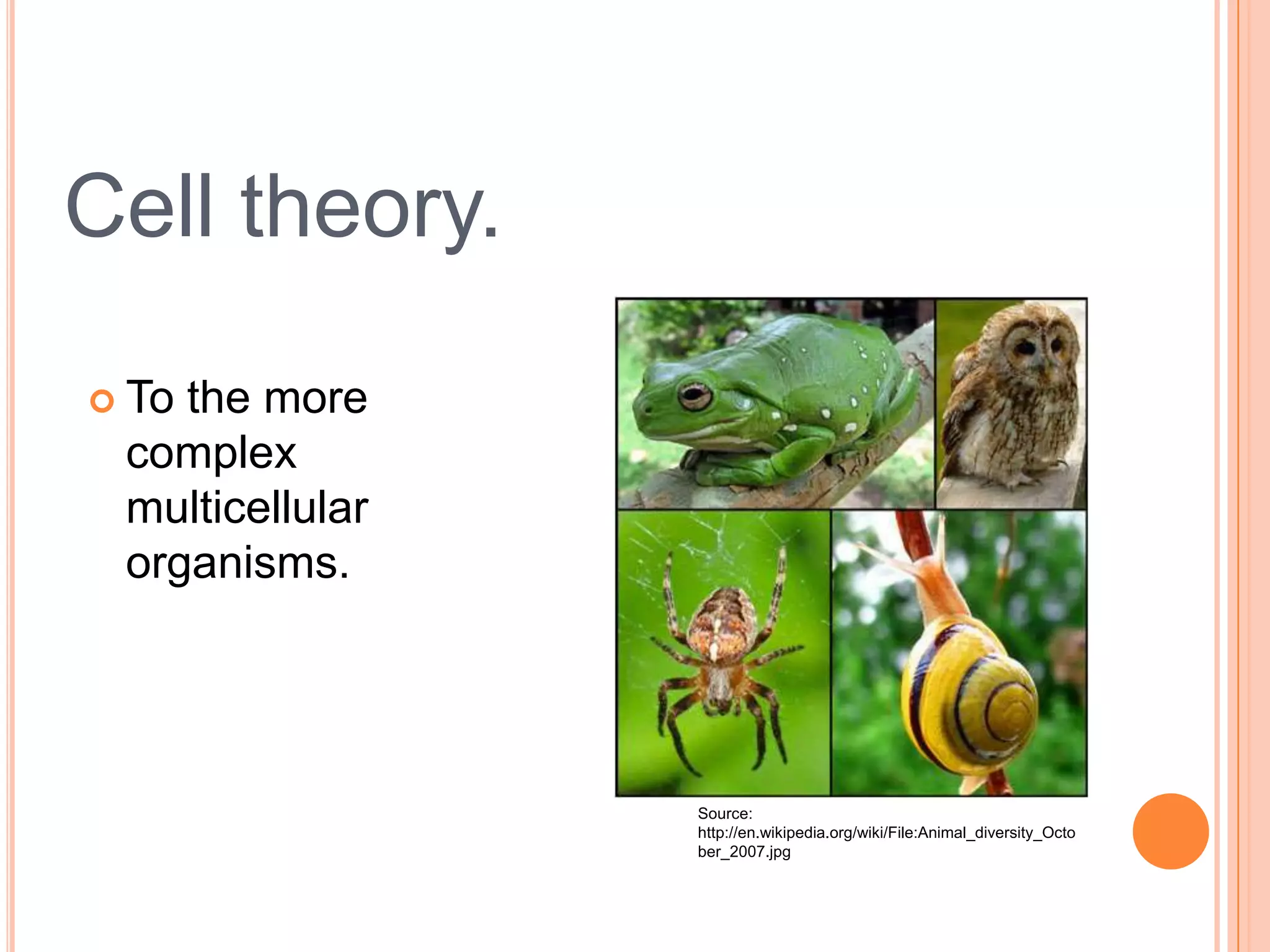
 To the more
complex
multicellular
organisms.
Cell theory.
Source:
http://en.wikipedia.org/wiki/File:Animal_diversity_Octo
ber_2007.jpg
CELL THEORY.
To understand life you need to understand how cells
work.
 Even though cells are specialised for many different
purposes, they share some common features.
 They all have a similar cell structure.
 They all perform similar basic functions.
 They are all made up of ‘the molecules of life’.
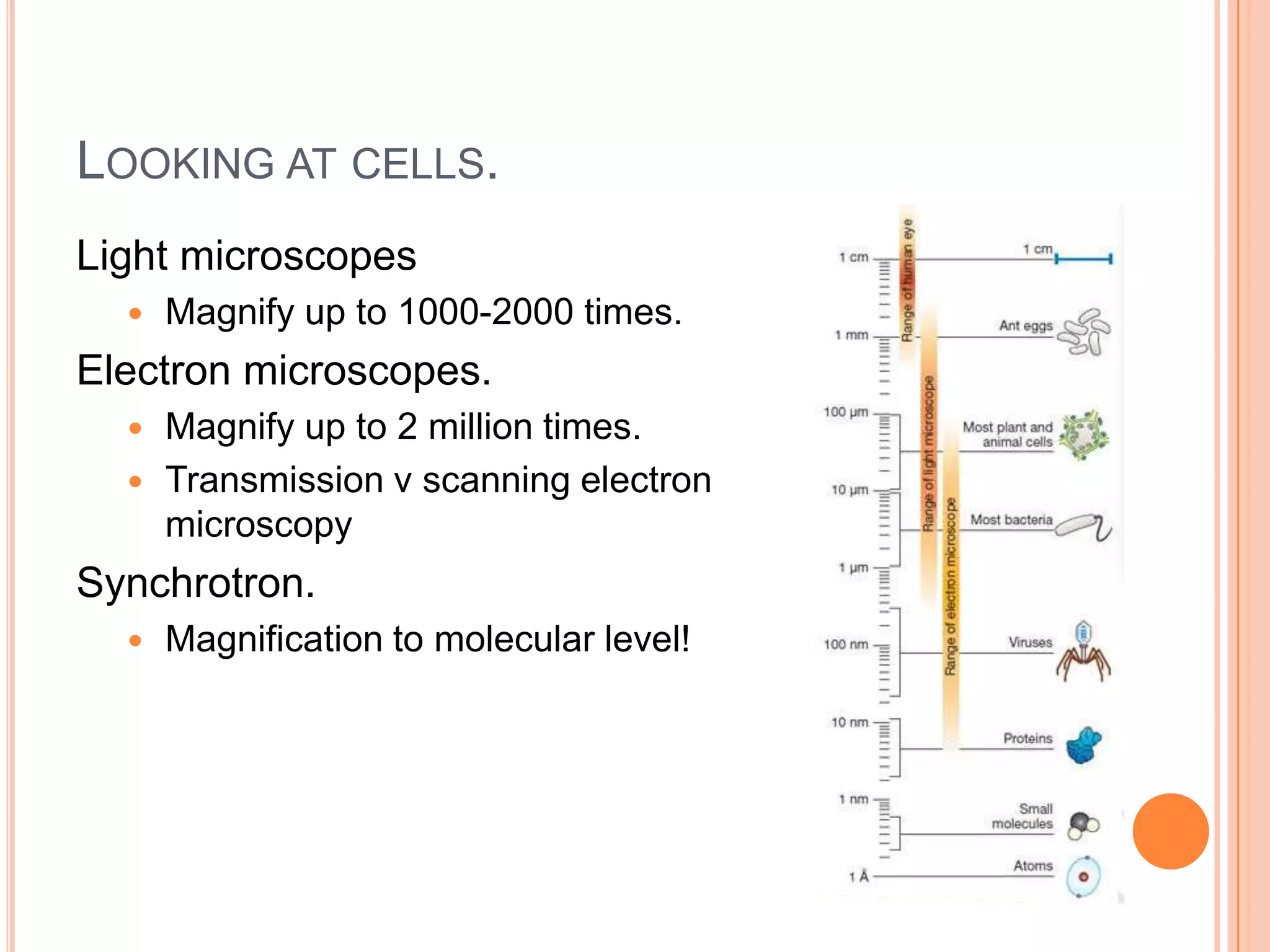
LOOKING AT CELLS.
Light microscopes
 Magnify up to 1000-2000 times.
Electron microscopes.
 Magnify up to 2 million times.
 Transmission v scanning electron
microscopy
Synchrotron.
 Magnification to molecular level!
CELL STRUCTURE.
Cells can be classified into two major types based on
their level of cell structure.
 Prokaryotic cells.
 Eukaryotic cells.
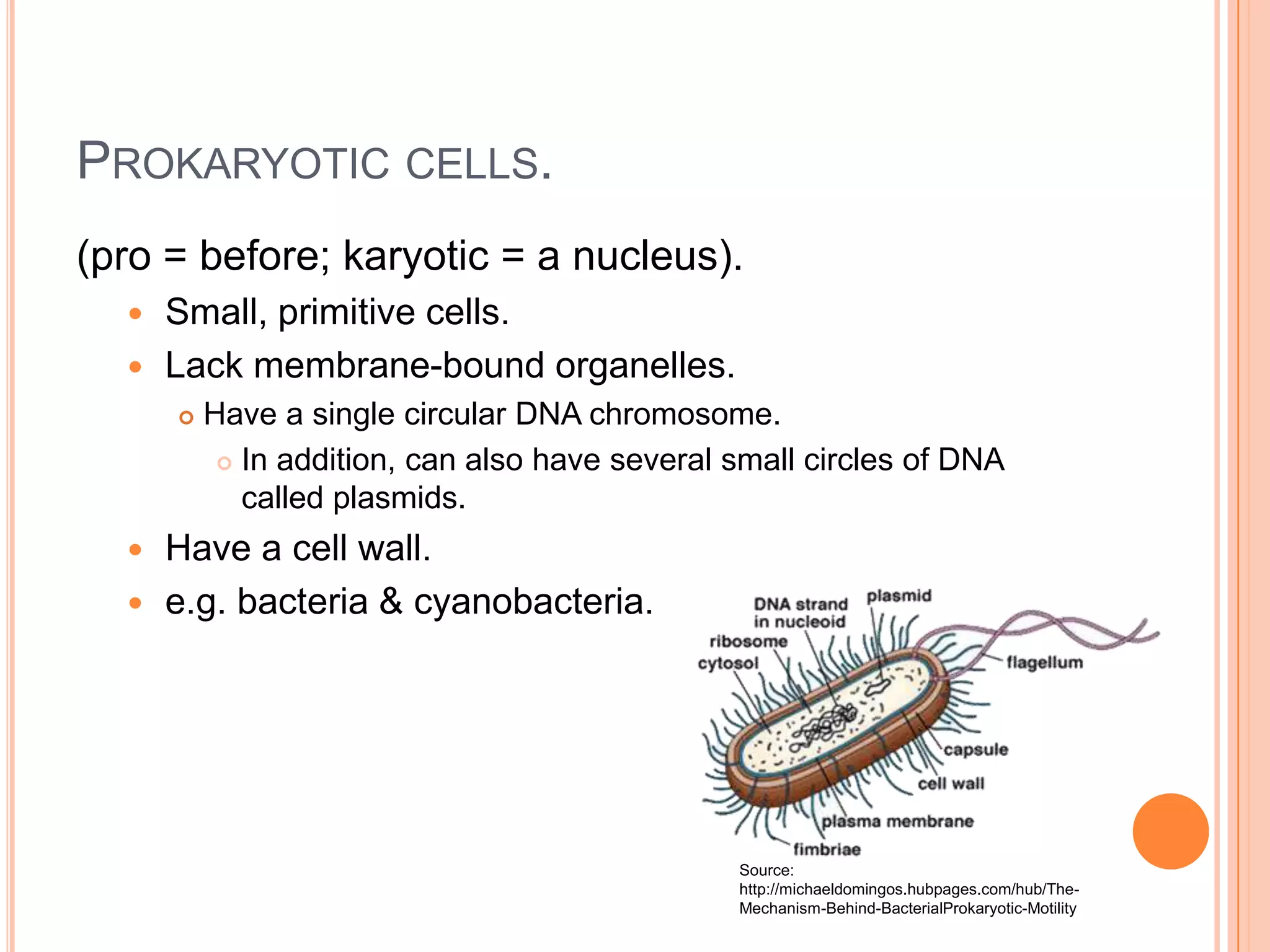
PROKARYOTIC CELLS.
(pro = before; karyotic = a nucleus).
 Small, primitive cells.
 Lack membrane-bound organelles.
 Have a single circular DNA chromosome.
 In addition, can also have several small circles of DNA
called plasmids.
 Have a cell wall.
 e.g. bacteria & cyanobacteria.
Source:
http://michaeldomingos.hubpages.com/hub/The-
Mechanism-Behind-BacterialProkaryotic-Motility
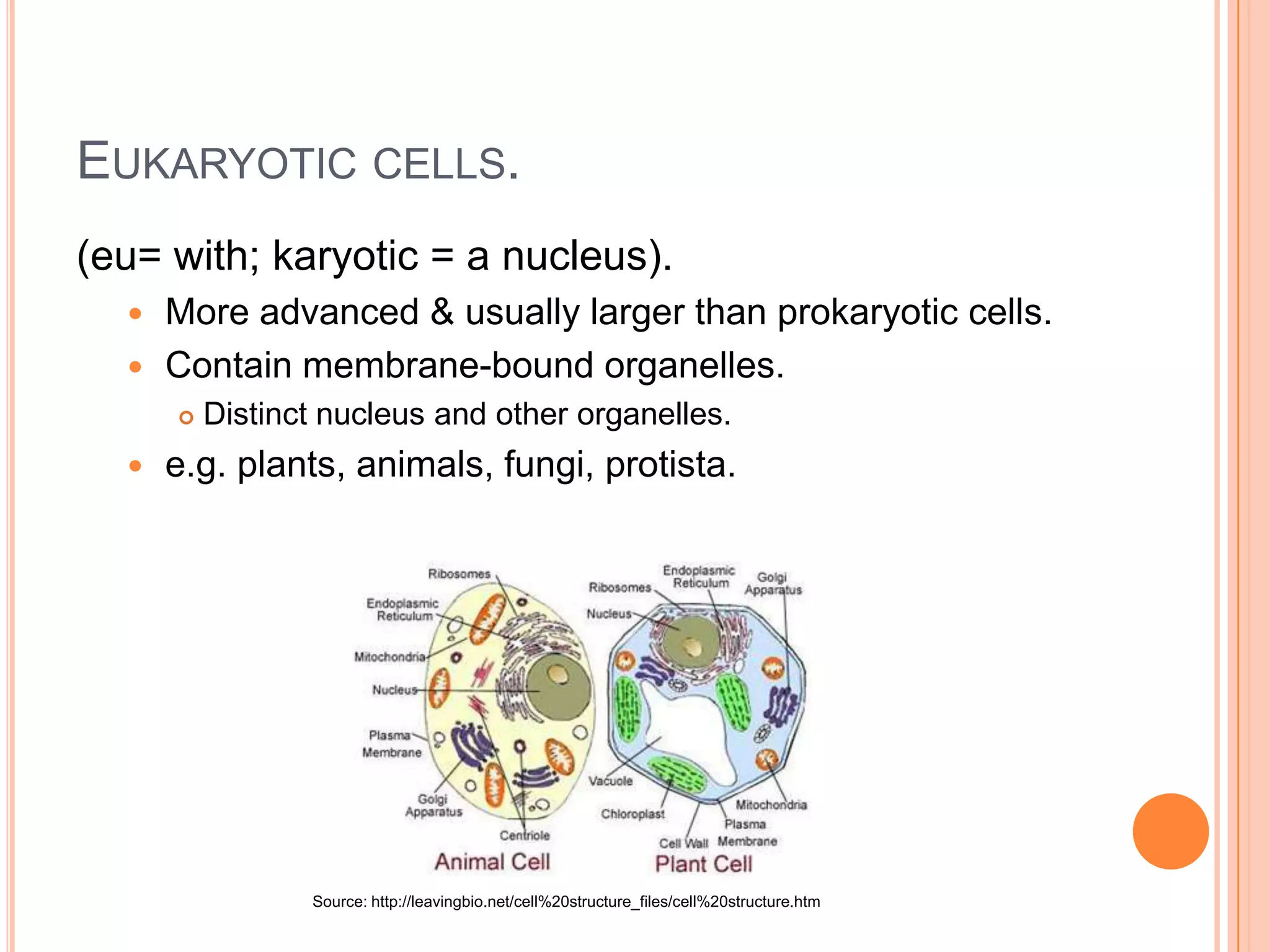
EUKARYOTIC CELLS.
(eu= with; karyotic = a nucleus).
 More advanced & usually larger than prokaryotic cells.
 Contain membrane-bound organelles.
 Distinct nucleus and other organelles.
 e.g. plants, animals, fungi, protista.
Source: http://leavingbio.net/cell%20structure_files/cell%20structure.htm
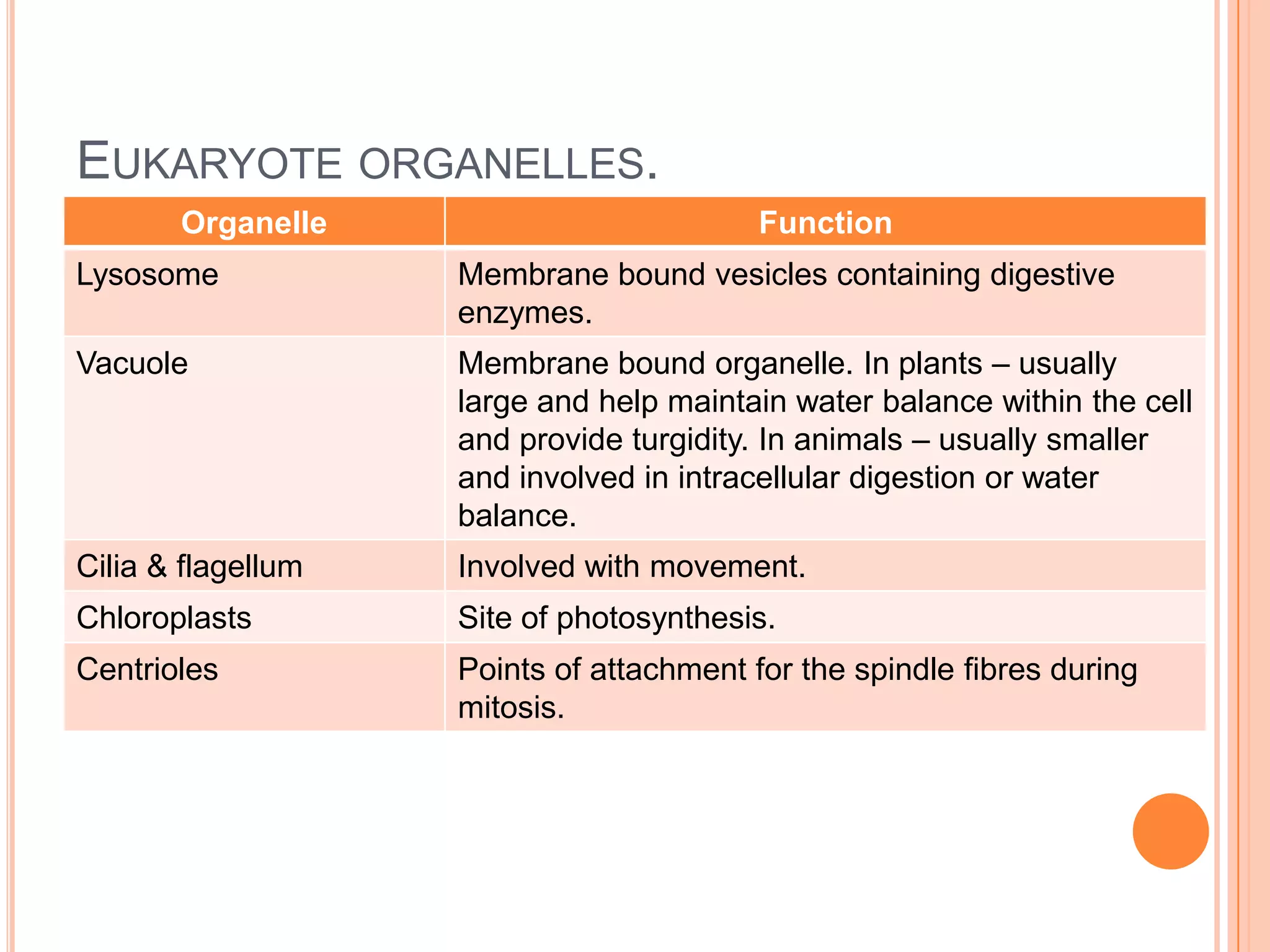
EUKARYOTE ORGANELLES.
Organelle Function
Plasma membrane Controls entry of substances into and out of the cell.
Nucleus Contains genetic material and controls cellular
activities.
Mitochondrion Involved in the energy transformations that release
energy for the cell.
Endoplasmic reticulum A network of intracellular membranes forming
channels through which proteins are moved.
Golgi apparatus Packages the protein into vesicles for transport
across the plasma membrane and out of the cell.
Ribosomes Sites of protein synthesis. [Also found in
prokaryotes].
EUKARYOTE ORGANELLES.
Organelle Function
Lysosome Membrane bound vesicles containing digestive
enzymes.
Vacuole Membrane bound organelle. In plants – usually
large and help maintain water balance within the cell
and provide turgidity. In animals – usually smaller
and involved in intracellular digestion or water
balance.
Cilia & flagellum Involved with movement.
Chloroplasts Site of photosynthesis.
Centrioles Points of attachment for the spindle fibres during
mitosis.
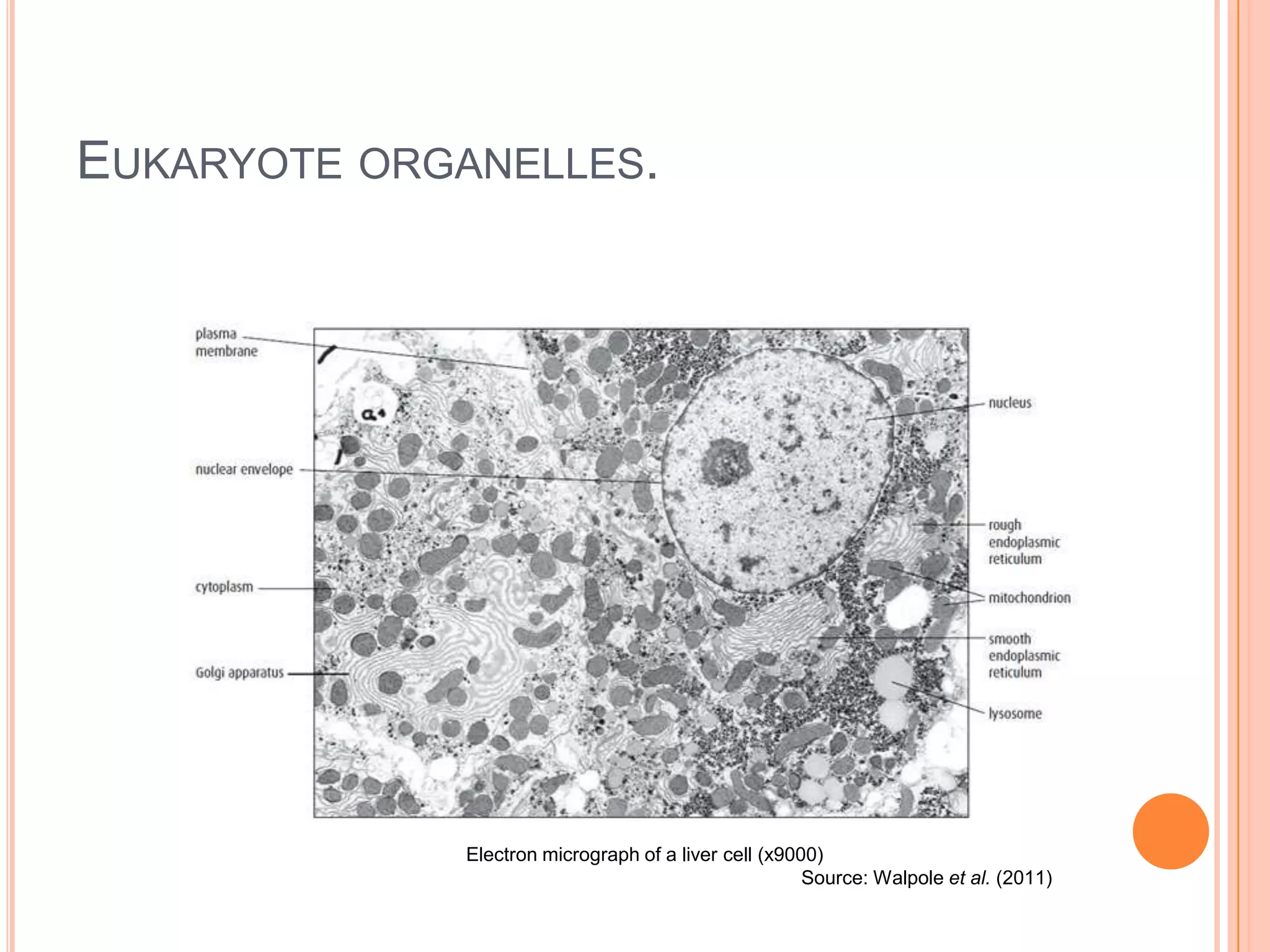
EUKARYOTE ORGANELLES.
Electron micrograph of a liver cell (x9000)
Source: Walpole et al. (2011)
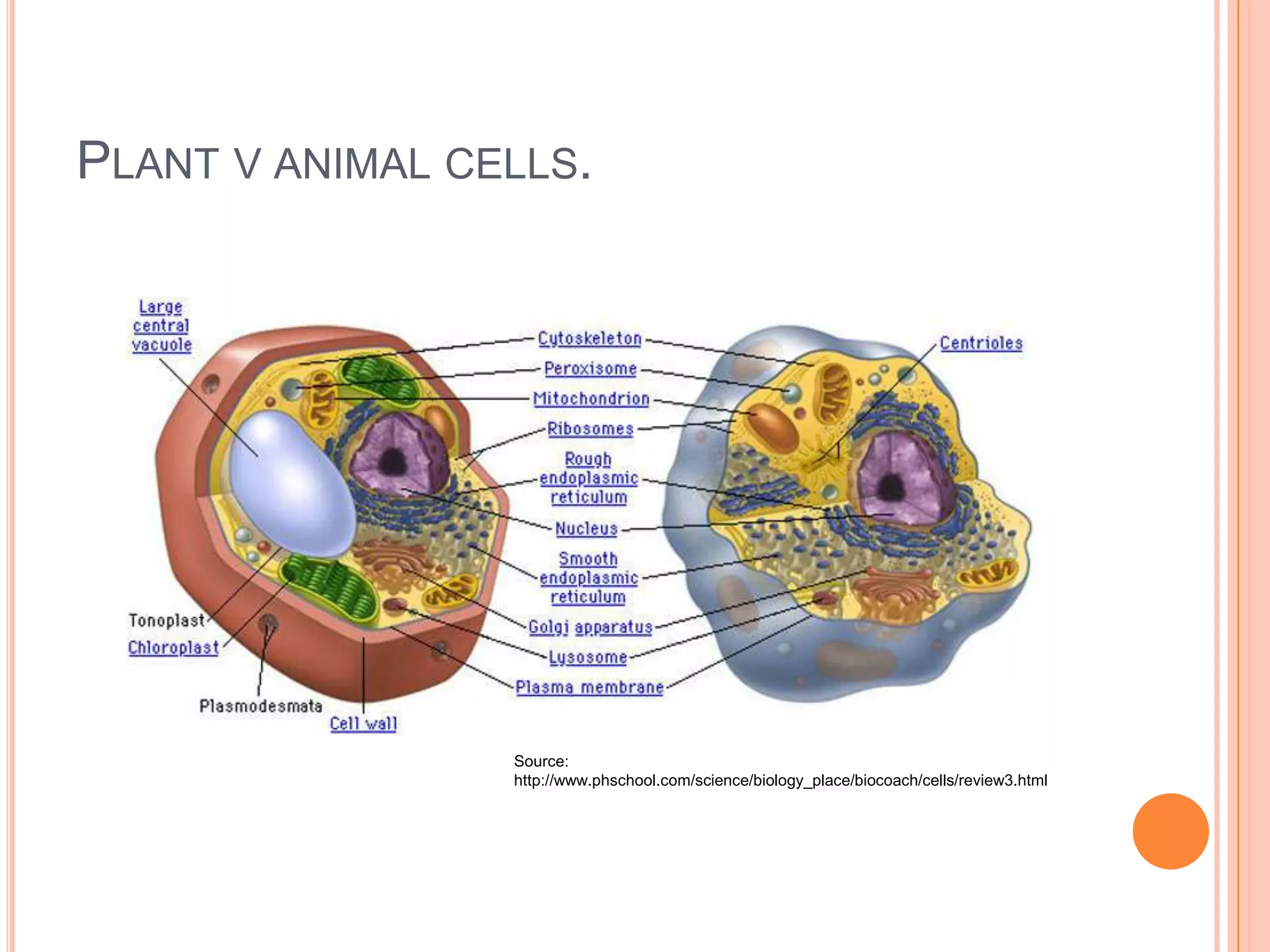
PLANT V ANIMAL CELLS.
Source:
http://www.phschool.com/science/biology_place/biocoach/cells/review3.html
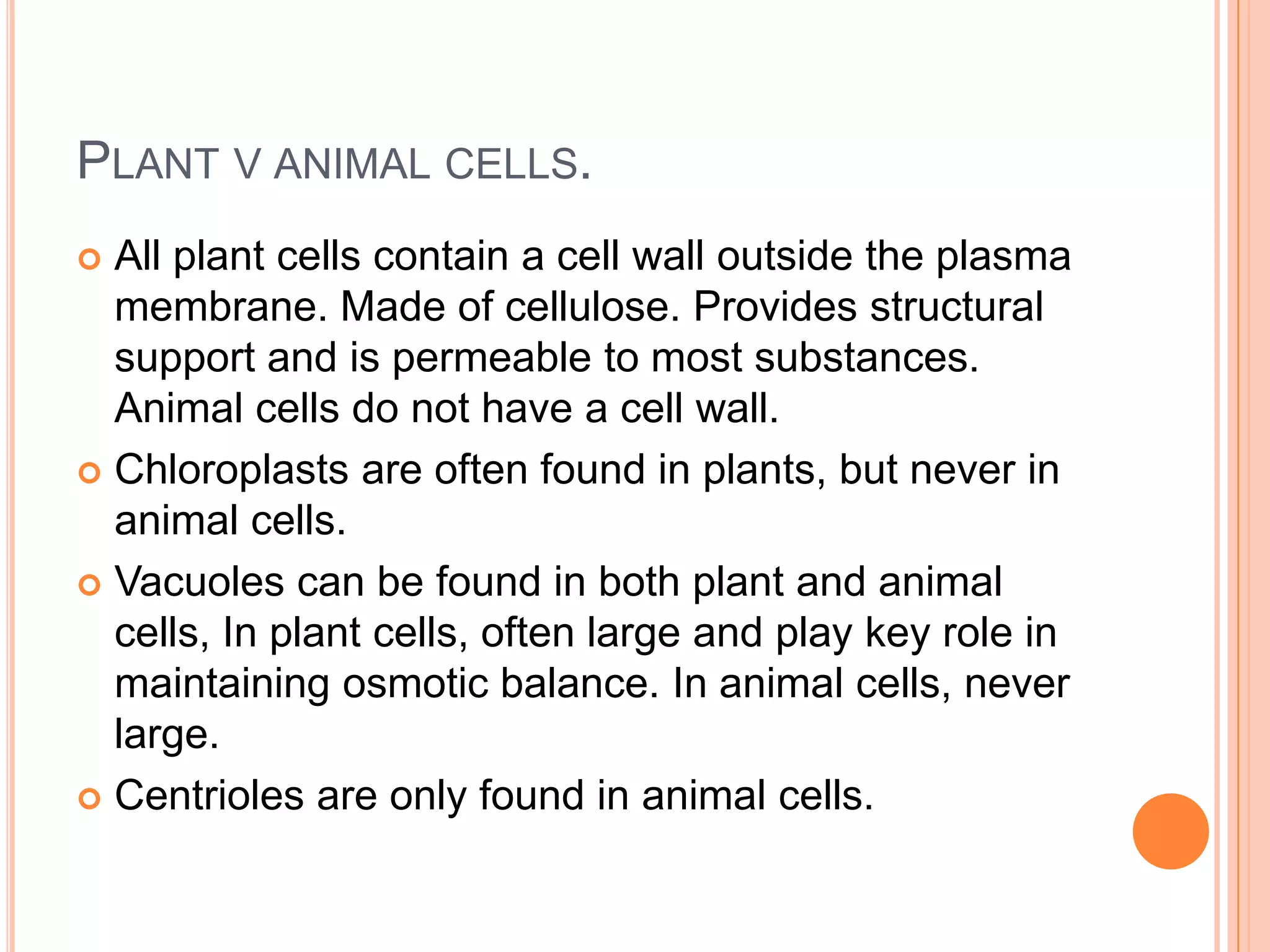
PLANT V ANIMAL CELLS.
 All plant cells contain a cell wall outside the plasma
membrane. Made of cellulose. Provides structural
support and is permeable to most substances.
Animal cells do not have a cell wall.
 Chloroplasts are often found in plants, but never in
animal cells.
 Vacuoles can be found in both plant and animal
cells, In plant cells, often large and play key role in
maintaining osmotic balance. In animal cells, never
large.
 Centrioles are only found in animal cells.
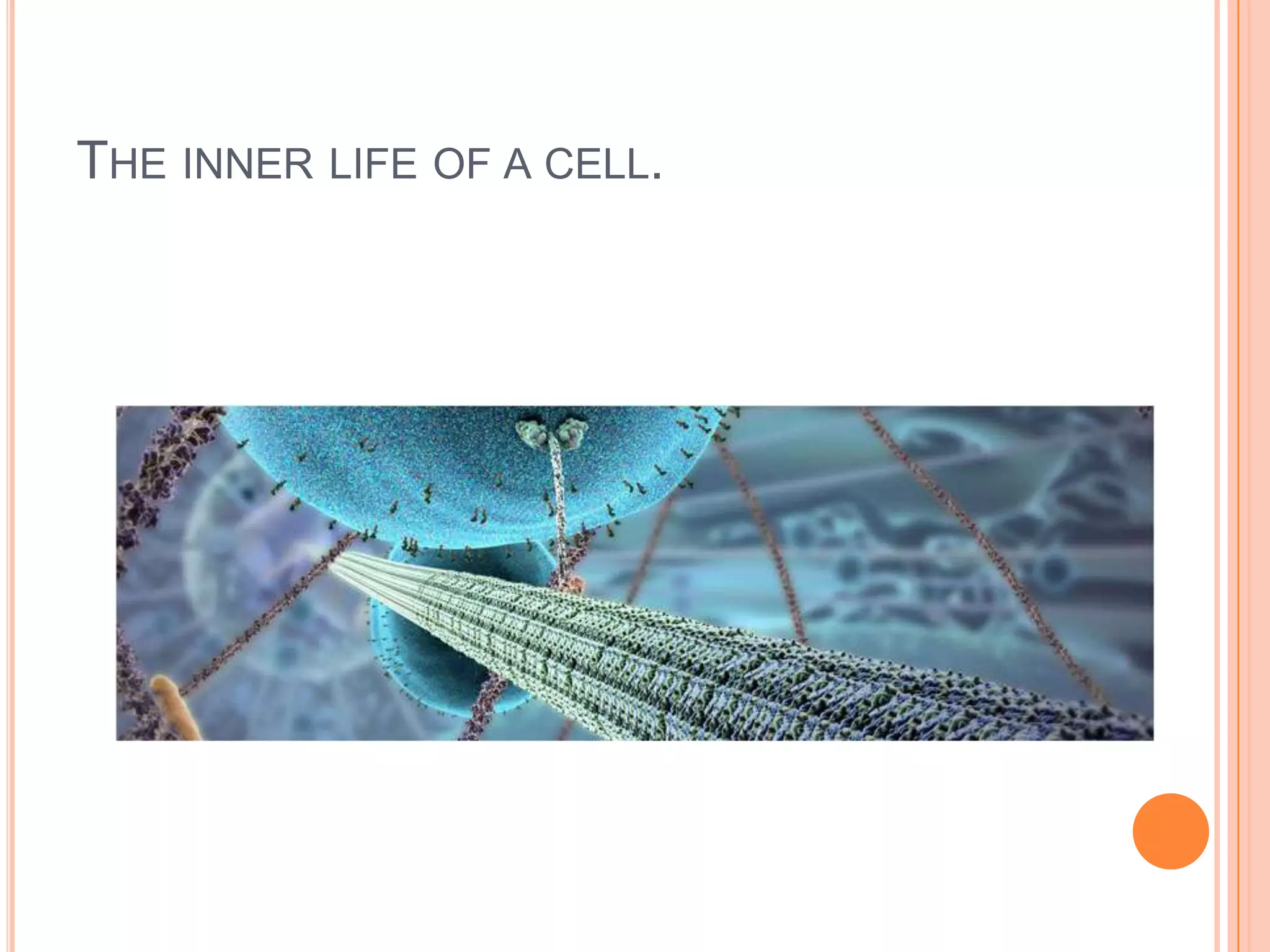
THE INNER LIFE OF A CELL.
Source: https://www.youtube.com/watch?v=wJyUtbn0O5Y
http://SICkScience10.wikispaces.com/

Genetics - 01 A closer look at cells

  • 1.
    GENETICS. 01. A closerlook at cells. Ian Anderson Saint Ignatius College Geelong
  • 2.
    KEY KNOWLEDGE &SKILLS  Outline the cell theory.  Compare prokaryotic and eukaryotic cells at light and electron microscope levels.  List the specialised parts of cells and describe their roles.  State the main differences between plant and animal cells.
  • 3.
    CELL THEORY.  Allliving things are made of cells.  All cells come from pre-existing cells.  Cells are the basic building blocks of all life. Source: http://www.history-of-the-microscope.org
  • 4.
     Holds truefor all living things.  From simple, unicellular organisms. Cell theory. Source: http://webhome.broward.edu//~ssimpson/JMDelvecchio- Paramecium.htm
  • 5.
     To themore complex multicellular organisms. Cell theory. Source: http://en.wikipedia.org/wiki/File:Animal_diversity_Octo ber_2007.jpg
  • 6.
    CELL THEORY. To understandlife you need to understand how cells work.  Even though cells are specialised for many different purposes, they share some common features.  They all have a similar cell structure.  They all perform similar basic functions.  They are all made up of ‘the molecules of life’.
  • 7.
    LOOKING AT CELLS. Lightmicroscopes  Magnify up to 1000-2000 times. Electron microscopes.  Magnify up to 2 million times.  Transmission v scanning electron microscopy Synchrotron.  Magnification to molecular level!
  • 8.
    CELL STRUCTURE. Cells canbe classified into two major types based on their level of cell structure.  Prokaryotic cells.  Eukaryotic cells.
  • 9.
    PROKARYOTIC CELLS. (pro =before; karyotic = a nucleus).  Small, primitive cells.  Lack membrane-bound organelles.  Have a single circular DNA chromosome.  In addition, can also have several small circles of DNA called plasmids.  Have a cell wall.  e.g. bacteria & cyanobacteria. Source: http://michaeldomingos.hubpages.com/hub/The- Mechanism-Behind-BacterialProkaryotic-Motility
  • 10.
    EUKARYOTIC CELLS. (eu= with;karyotic = a nucleus).  More advanced & usually larger than prokaryotic cells.  Contain membrane-bound organelles.  Distinct nucleus and other organelles.  e.g. plants, animals, fungi, protista. Source: http://leavingbio.net/cell%20structure_files/cell%20structure.htm
  • 11.
    EUKARYOTE ORGANELLES. Organelle Function Plasmamembrane Controls entry of substances into and out of the cell. Nucleus Contains genetic material and controls cellular activities. Mitochondrion Involved in the energy transformations that release energy for the cell. Endoplasmic reticulum A network of intracellular membranes forming channels through which proteins are moved. Golgi apparatus Packages the protein into vesicles for transport across the plasma membrane and out of the cell. Ribosomes Sites of protein synthesis. [Also found in prokaryotes].
  • 12.
    EUKARYOTE ORGANELLES. Organelle Function LysosomeMembrane bound vesicles containing digestive enzymes. Vacuole Membrane bound organelle. In plants – usually large and help maintain water balance within the cell and provide turgidity. In animals – usually smaller and involved in intracellular digestion or water balance. Cilia & flagellum Involved with movement. Chloroplasts Site of photosynthesis. Centrioles Points of attachment for the spindle fibres during mitosis.
  • 13.
    EUKARYOTE ORGANELLES. Electron micrographof a liver cell (x9000) Source: Walpole et al. (2011)
  • 14.
    PLANT V ANIMALCELLS. Source: http://www.phschool.com/science/biology_place/biocoach/cells/review3.html
  • 15.
    PLANT V ANIMALCELLS.  All plant cells contain a cell wall outside the plasma membrane. Made of cellulose. Provides structural support and is permeable to most substances. Animal cells do not have a cell wall.  Chloroplasts are often found in plants, but never in animal cells.  Vacuoles can be found in both plant and animal cells, In plant cells, often large and play key role in maintaining osmotic balance. In animal cells, never large.  Centrioles are only found in animal cells.
  • 16.
    THE INNER LIFEOF A CELL. Source: https://www.youtube.com/watch?v=wJyUtbn0O5Y
  • 17.

Editor's Notes

  • #4 Robert Hooke first discovered the cell in 1665 (cork cells), but not till 19th Century when Schann & Schleiden (1839) & then Virchow (1858) suggested that cells were the basic unit of life. Before this spontaneous generation believed.
  • #8 Transmission EM = electron beam travels through the sectionScanning EM = electron beam bounces off surface (that has been fixed by coating with gold)  higher resolution