




AGE OF DOCUMENTS
Questioned Document
By :
Shreyaskumar Jitendra Patel
En. No. : 181127107044
Bsc Sem IV
Batch A-2
Submitted to : Mr. Parth Lakhlani
CONTENT
• Introduction
• Age Estimation By :
 Paper Products
 Inks and Writing Instruments
 Typewriting
 Photocopiers
 Handwriting and Signatures
 Contents of a Document
 Computer-Printed Documents
 Facsimile Documents
• Summary
INTRODUCTION
• The misrepresentation of dates on documents is not a recent challenge faced by
forensic document examiners.
• For instance, the authenticity of a document purportedly written centuries or
decades ago may be at issue. In another case, there may be concerns about whether
the contents of a medical or legal file have been entirely rewritten some months or a
few years after the dates recorded in the file.
• A Dating may be accomplished by one of several techniques. The materials that
make up a document may tell something of the earliest possible date of preparation.
• A number of backdating methods have been employed in such situations. These range from a
relatively minor change to the final digit in a handwritten year to a far more sophisticated
endeavor where old paper stock, writing instruments, or pre-printed forms were employed.
• Several methodologies can be used to address such questions. The analyses are performed by
 Comparing the contested document to other similar documents from the same time frame,
 Intra-comparing various entries in a file or multi-page document to determine whether they are
the same,
 Referencing manufacturers’ and other technical information about the materials used, such as
inks, paper, computer printers, fax machines, etc., and
 Examining for accidental markings and indented impressions.
PAPER PRODUCTS
• We can determine the estimate date of document from Paper Products with the help
of following Features :
1. Watermarks
2. Paper Composition
3. Envelopes
PAPER PRODUCTS
1. Watermarks
• Watermarks are produced during the manufacture of paper by a thinning
out of the fibers in the required shape and area. When the paper is finally
completed, there is little reduction in the dimensional thickness, but
there are fewer fibers present. This makes the watermark more
translucent than the surrounding area and so creates the familiar effect
of the appearance of an image when the paper is held up to the light.
• The watermark can give clear information as to the origin of the paper.
From this, the manufacturer can be identified, and, if the design is
periodically changed and records of these changes kept, the period in
which the paper was made can be discovered.
• A few paper companies have intentionally changed the design of their
watermarks from time to time. Such watermarks are said to contain a
‘date tag’, which will often indicate the year that a sheet of paper was
produced.
• If a document bears a watermark that was not in existence when it was
allegedly dated, the genuineness of its date must surely be challenged.
Fig. 1 The short vertical bar
beneath the letters in their
watermarks to indicate the last
digit of the year in which the
paper was manufactured.
PAPER PRODUCTS
2. Paper Composition
• Over the years, different fillers, surface coating or chemical additives have been added
during the paper making process to improve the quality of the product. Other changes in
manufacturing processes have occurred for economic or environmental reasons.
• These innovations and modifications can establish the earliest date or period when a
particular sheet of paper was manufactured.
• Speciality papers can also contain information of dating significance.
• For e.g. : NCR (No Carbon Required) paper 1st appeared in US during 1954. The formula of
manufacturing this product was changed several times during the 1960s & 1970s. In 1970,
NCR developed a coding scheme to identify the source and the date of its papers. The dates
of documents produce on speciality paper that contain tags can be verified by taking such
information into account.
PAPER PRODUCTS
3. Envelopes
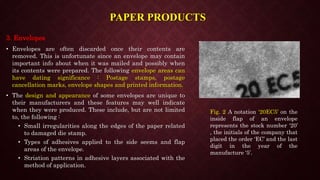
• Envelopes are often discarded once their contents are
removed. This is unfortunate since an envelope may contain
important info about when it was mailed and possibly when
its contents were prepared. The following envelope areas can
have dating significance : Postage stamps, postage
cancellation marks, envelope shapes and printed information.
• The design and appearance of some envelopes are unique to
their manufacturers and these features may well indicate
when they were produced. These include, but are not limited
to, the following :
• Small irregularities along the edges of the paper related
to damaged die stamp.
• Types of adhesives applied to the side seems and flap
areas of the envelope.
• Striation patterns in adhesive layers associated with the
method of application.
Fig. 2 A notation ‘20EC5’ on the
inside flap of an envelope
represents the stock number ‘20’
, the initials of the company that
placed the order ‘EC’ and the last
digit in the year of the
manufacture ‘5’.
INKS AND WRITING INSTRUMENTS
• One of the most challenging dating problems faced by the
document examiner is estimating when a particular
document was signed or written. If a document was
supposed to have been written many years ago, it may be
possible to prove it was backdated if the type of pen and
writing materials used where not available at that time.
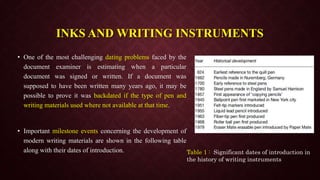
• Important milestone events concerning the development of
modern writing materials are shown in the following table
along with their dates of introduction. Table 1 : Significant dates of introduction in
the history of writing instruments
• Clues as to when a document was signed can also be found by analyzing the questioned writing ink. A small
sample of ink removed from a document can be separated into solid components by Thin Layer Chromatography
(TLC).
• The result of this analysis is a chromatogram that isolates the different dyes present in the ink formulation on a
coated glass or plastic plate. Success of this method relies on the different physical and chemical properties of
the ink and the existence of a sufficiently complete set of ink reference standards.
• Other testing methods rely on sophisticated analytical techniques such as Gas Chromatography- Mass
Spectrometry (GC/MS) to measure the concentration of volatile components in an ink sample.
• The described the methods are beyond all but a few specialist who possess the equipment knowledge and
experience needed to analyse and date writing inks. Some controversy still surrounds certain ink testing
methods and further validation studies could resolve these debates.
INKS AND WRITING INSTRUMENTS
TYPEWRITING
• Though the majority of type encountered today is computer generated, typewriting still
appears on a variety of documents, such as pre-printed forms, envelopes, receipts, deeds,
transfers, and other real estate-related forms. A study of the typestyle or design may lead to
identification of the typewriter, typeball, or typewheel manufacturer. Each design has a
specific date of introduction. It may be discovered that some aspect of the imprinting on the
document is inconsistent with the introduction of that typewriter or element.
• A Computerized databases of typestyles : doesn’t establish when the document was typed,
but can provide an earliest possible date of creation.
• Dating a document through study of the typescript : evolution of defects developed through
progressive wear and tear of the machine or element. These defects can include broken or
bent characters, filling in of letters and numerals, misalignments, bead defects, etc. As these
tend to develop over time, it may be possible to establish a defect chronology and, in turn,
date the questioned document with that chronology
TYPEWRITING
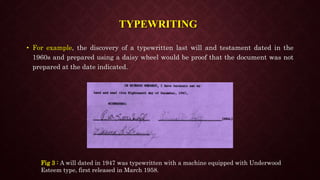
• For example, the discovery of a typewritten last will and testament dated in the
1960s and prepared using a daisy wheel would be proof that the document was not
prepared at the date indicated.
Fig 3 : A will dated in 1947 was typewritten with a machine equipped with Underwood
Esteem type, first released in March 1958.
TYPEWRITING
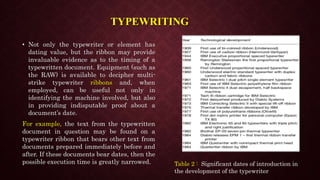
• Not only the typewriter or element has
dating value, but the ribbon may provide
invaluable evidence as to the timing of a
typewritten document. Equipment (such as
the RAW) is available to decipher multi-
strike typewriter ribbons and, when
employed, can be useful not only in
identifying the machine involved, but also
in providing indisputable proof about a
document’s date.
For example, the text from the typewritten
document in question may be found on a
typewriter ribbon that bears other text from
documents prepared immediately before and
after. If these documents bear dates, then the
possible execution time is greatly narrowed. Table 2 : Significant dates of introduction in
the development of the typewriter
TYPEWRITING
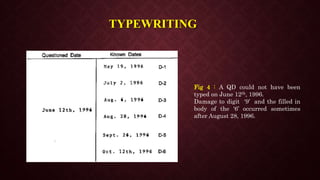
Fig 4 : A QD could not have been
typed on June 12th, 1996.
Damage to digit ‘9’ and the filled in
body of the ‘6’ occurred sometimes
after August 28, 1996.
• Three facts of photocopied documents that have dating significance include : the
copier technology used, the presence of copier defects, and the properties of the
toner and/or paper.
1. Copier Technology
• The date of a copied document can be checked against the release date of a
particular office technology was allegedly produced. Different copier technologies
are like : dual spectrum, stabilization, diffusion transfer, dye transfer, laser, etc.
• A Questioned copied document should be checked to ensure its date follows the
introductory date of the technology used to produce it.
PHOTOCOPIERS
PHOTOCOPIERS
2. Examination of the defects
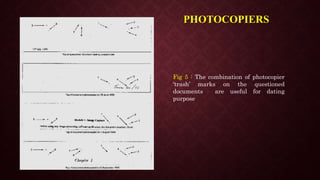
• The most straightforward means of dating photocopied relies on defects, ‘trash
marks’ or small flecks of toner that appear in ‘white’ areas of a copied document.
• These marks can originate from a dirt, foreign material or defects on the glass,
platen cover or photosensitive drum of the photocopier.
• Logs and service records maintained by repair technicians are also helpful in that
they often contain photocopies produced before and after copier repairs were made.
• It may be helpful to estimate the date of document.
PHOTOCOPIERS
Fig 5 : The combination of photocopier
‘trash’ marks on the questioned
documents are useful for dating
purpose
3. Toner Analysis
• Most photocopier toners consist of : a pigment; a binder which fixes the pigment to
the paper; and additives used to improve the properties of the toner.
• When any of these components are changed, the event can provide a useful means of
dating photocopied documents.
• A comprehensive library of the toners can be used to establish initial production
dates. In such cases, the manufacturer will confirm that a particular ingredient was
first used several years after the date the photocopy was supposed to be prepared.
PHOTOCOPIERS
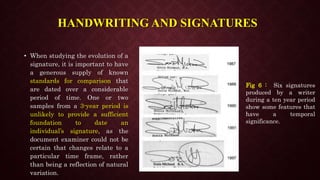
• When studying the evolution of a
signature, it is important to have
a generous supply of known
standards for comparison that
are dated over a considerable
period of time. One or two
samples from a 3-year period is
unlikely to provide a sufficient
foundation to date an
individual’s signature, as the
document examiner could not be
certain that changes relate to a
particular time frame, rather
than being a reflection of natural
variation.
HANDWRITING AND SIGNATURES
Fig 6 : Six signatures
produced by a writer
during a ten year period
show some features that
have a temporal
significance.
HANDWRITING AND SIGNATURES
• Changes in handwriting, and more particularly signatures, sometimes occur over
time. The evolution may be gradual or quite sudden, depending on the circumstances.
An accident, illness, or the influence of alcohol and drugs can result in a profound
change in writing ability.
• One example is a writer who finds himself or herself in an occupation that requires
the signing of his or her name numerous times throughout the workweek. It is not
uncommon to see such a person’s signature change from a fully legible style to one
that is more abbreviated and scrawled.
• The pictorial differences need not be so apparent, as subtle changes may be
introduced with time, often manifesting themselves in more stylized individual letters
or the joining of characters at the end of a signature. All have the potential to assist
in dating a document.
• Proof that a document was backdated or postdated can occasionally be found within its
contents. These details are often overlooked by the preparator as his attention is
focused on producing a document that contains the right information. Names, address,
postal codes, phone numbers, trade names, and job titles mentioned in a document
might provide evidence that it was produced at a different time.
• When preparing a postdated or backdated document, the writer may not remember
what verb tense to use.
e.g. When preparing business correspondence, the typist’s initials are often placed at the
bottom of the document. In fraudulent documents, the iitials of a typist who is currently
employed by a company may used instead of the person who held the position on the that
appears on the document.
CONTENTS OF A DOCUMENT
COMPUTER-PRINTED DOCUMENTS
• Dating Computer printed documents is approached in much the same manner as dating
typewritten documents. The debut of computer printer technologies is associated with date
of introduction.
• Some of the earliest copier models used a liquid toner. In later years dry toner became the
standard. Another change saw a move from analog to digital image processing. In the past
two decades, we have seen advances in inkjet technology such that it has taken a prominent
position alongside electrostatic imaging.
• A study of the document will generally reveal the printing method used. It may be possible
to determine that a document could not have been produced on the date suggested based on
the availability of the printing process at that time.
COMPUTER-PRINTED DOCUMENTS
1. Daisy-Wheel Printers
• The daisy-wheel printer, using a similar impact technology to the typewriter, bridged
the gap between typewriters and later generations of computer printers.
• Like their typewritten documents, document produced by daisy-wheel printers can be
dated by considering irregularities in the alignment of letters or damage to their
outlines through wear and tear.
• It should be kept in mind , however, that daisy-wheels can be easily removed,
discarded and replaced by a new element.
COMPUTER-PRINTED DOCUMENTS
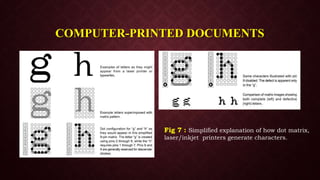
2. Dot-Matrix Printers
• Dot-matrix printers gained popularity during the early 1980s. Early models had nine
metal pins arranged along a vertical axis that struck the paper through an inked ribbon
while the printhead moved across the page.
• Printing produced by dot-matrix printers improved as 12, 18 and 24 pin models became
available.
• The dates when these progressive improvements occurred provide a further means of
limiting computer printed document to a particular period.
• Documents printed by dot-matrix printers can also be dated by the sudden appearance of
printing defects which are due to broken or bent pins, worn printhead housings , or
others caused by defective printer components.
COMPUTER-PRINTED DOCUMENTS
Fig 7 : Simplified explanation of how dot matrix,
laser/inkjet printers generate characters.
COMPUTER-PRINTED DOCUMENTS
2. Inkjet and laser Printers
• A computer-generated Document can often be associated to a
particular printer manufacturer based on the presence of class
characteristics. The Chemical composition of ink-jet ink or toner
can also be useful for determining if a document has been
backdated.
• Printer Control Language (PCL) defines how letters belonging to a
particular typestyle are shaped.
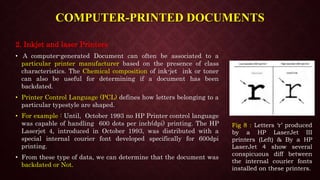
• For example : Until, October 1993 no HP Printer control language
was capable of handling 600 dots per inch(dpi) printing. The HP
Laserjet 4, introduced in October 1993, was distributed with a
special internal courier font developed specifically for 600dpi
printing.
• From these type of data, we can determine that the document was
backdated or Not.
Fig 8 : Letters ‘r’ produced
by a HP LaserJet III
printers (Left) & By a HP
LaserJet 4 show several
conspicuous diff between
the internal courier fonts
installed on these printers.
FACSIMILE DOCUMENTS
• Most modern offices now have one or more stand-alone, or multi-function, fax machines.
The popularity of faxes makes them the subject of scrutiny in many litigation cases where
issues arise about when a document was generated or transmitted. Establishing whether
a particular imaging system or model was available on the date at issue is an important
forensic inquiry.
• There have been cases where the printing technology postdates the disputed document’s
date.
• For example, an inkjet-printed facsimile supposedly transmitted in 1970 could not have
been, as at that time this printing method was not found in fax machines.
• Defects in either the sending or receiving machine may help to establish dating
parameters for the document in question. A representative sample of faxes, over a
reasonable time range, from both machines may allow for the development of a
chronology of defects.
• Such an examination is sometimes challenging because one or both of the machines
may be unavailable for inspection or it may be difficult to acquire samples that can be
definitively associated with a particular machine.
• This is especially true when a considerable period of time has passed between the
alleged production of the document and the time when suspicions arose.
FACSIMILE DOCUMENTS
SUMMARY
• There is no universal approach to verifying the date of a disputed document, but the
various techniques discussed have, under appropriate circumstances, resolved issues
about when a document was created. Not every document can be dated by laboratory
techniques.
• To establish from the document itself that it was prepared on a specific date is a rare
accomplishment, possible only under a unique set of circumstances. Far more often,
when any dating is possible, the findings must be expressed within a time bracket —
not before one date and not after a later one.
• It is such evidence that the document examiner strives to elicit from the conditions and
materials that surround and make up the document at hand.
REFERENCES
1. Document Analysis / Document Dating : from Encyclopedia Of Forensic Science
page no. 570 – 580.
2. Dating by Materials: Identification, Comparison, and Examination of Changes :
from Scientific Examination of Questioned Documents. Page no. 347 – 356.
3. Age of Documents : from Questioned Documents by Albert S. Osborn
4. MODULE No.14: Age of Documents from Epg Pathshala
Thank
You

Age of documents (Questioned Document)

  • 1.
    AGE OF DOCUMENTS QuestionedDocument By : Shreyaskumar Jitendra Patel En. No. : 181127107044 Bsc Sem IV Batch A-2 Submitted to : Mr. Parth Lakhlani
  • 2.
    CONTENT • Introduction • AgeEstimation By :  Paper Products  Inks and Writing Instruments  Typewriting  Photocopiers  Handwriting and Signatures  Contents of a Document  Computer-Printed Documents  Facsimile Documents • Summary
  • 3.
    INTRODUCTION • The misrepresentationof dates on documents is not a recent challenge faced by forensic document examiners. • For instance, the authenticity of a document purportedly written centuries or decades ago may be at issue. In another case, there may be concerns about whether the contents of a medical or legal file have been entirely rewritten some months or a few years after the dates recorded in the file. • A Dating may be accomplished by one of several techniques. The materials that make up a document may tell something of the earliest possible date of preparation.
  • 4.
    • A numberof backdating methods have been employed in such situations. These range from a relatively minor change to the final digit in a handwritten year to a far more sophisticated endeavor where old paper stock, writing instruments, or pre-printed forms were employed. • Several methodologies can be used to address such questions. The analyses are performed by  Comparing the contested document to other similar documents from the same time frame,  Intra-comparing various entries in a file or multi-page document to determine whether they are the same,  Referencing manufacturers’ and other technical information about the materials used, such as inks, paper, computer printers, fax machines, etc., and  Examining for accidental markings and indented impressions.
  • 5.
    PAPER PRODUCTS • Wecan determine the estimate date of document from Paper Products with the help of following Features : 1. Watermarks 2. Paper Composition 3. Envelopes
  • 6.
    PAPER PRODUCTS 1. Watermarks •Watermarks are produced during the manufacture of paper by a thinning out of the fibers in the required shape and area. When the paper is finally completed, there is little reduction in the dimensional thickness, but there are fewer fibers present. This makes the watermark more translucent than the surrounding area and so creates the familiar effect of the appearance of an image when the paper is held up to the light. • The watermark can give clear information as to the origin of the paper. From this, the manufacturer can be identified, and, if the design is periodically changed and records of these changes kept, the period in which the paper was made can be discovered. • A few paper companies have intentionally changed the design of their watermarks from time to time. Such watermarks are said to contain a ‘date tag’, which will often indicate the year that a sheet of paper was produced. • If a document bears a watermark that was not in existence when it was allegedly dated, the genuineness of its date must surely be challenged. Fig. 1 The short vertical bar beneath the letters in their watermarks to indicate the last digit of the year in which the paper was manufactured.
  • 7.
    PAPER PRODUCTS 2. PaperComposition • Over the years, different fillers, surface coating or chemical additives have been added during the paper making process to improve the quality of the product. Other changes in manufacturing processes have occurred for economic or environmental reasons. • These innovations and modifications can establish the earliest date or period when a particular sheet of paper was manufactured. • Speciality papers can also contain information of dating significance. • For e.g. : NCR (No Carbon Required) paper 1st appeared in US during 1954. The formula of manufacturing this product was changed several times during the 1960s & 1970s. In 1970, NCR developed a coding scheme to identify the source and the date of its papers. The dates of documents produce on speciality paper that contain tags can be verified by taking such information into account.
  • 8.
    PAPER PRODUCTS 3. Envelopes •Envelopes are often discarded once their contents are removed. This is unfortunate since an envelope may contain important info about when it was mailed and possibly when its contents were prepared. The following envelope areas can have dating significance : Postage stamps, postage cancellation marks, envelope shapes and printed information. • The design and appearance of some envelopes are unique to their manufacturers and these features may well indicate when they were produced. These include, but are not limited to, the following : • Small irregularities along the edges of the paper related to damaged die stamp. • Types of adhesives applied to the side seems and flap areas of the envelope. • Striation patterns in adhesive layers associated with the method of application. Fig. 2 A notation ‘20EC5’ on the inside flap of an envelope represents the stock number ‘20’ , the initials of the company that placed the order ‘EC’ and the last digit in the year of the manufacture ‘5’.
  • 9.
    INKS AND WRITINGINSTRUMENTS • One of the most challenging dating problems faced by the document examiner is estimating when a particular document was signed or written. If a document was supposed to have been written many years ago, it may be possible to prove it was backdated if the type of pen and writing materials used where not available at that time. • Important milestone events concerning the development of modern writing materials are shown in the following table along with their dates of introduction. Table 1 : Significant dates of introduction in the history of writing instruments
  • 10.
    • Clues asto when a document was signed can also be found by analyzing the questioned writing ink. A small sample of ink removed from a document can be separated into solid components by Thin Layer Chromatography (TLC). • The result of this analysis is a chromatogram that isolates the different dyes present in the ink formulation on a coated glass or plastic plate. Success of this method relies on the different physical and chemical properties of the ink and the existence of a sufficiently complete set of ink reference standards. • Other testing methods rely on sophisticated analytical techniques such as Gas Chromatography- Mass Spectrometry (GC/MS) to measure the concentration of volatile components in an ink sample. • The described the methods are beyond all but a few specialist who possess the equipment knowledge and experience needed to analyse and date writing inks. Some controversy still surrounds certain ink testing methods and further validation studies could resolve these debates. INKS AND WRITING INSTRUMENTS
  • 11.
    TYPEWRITING • Though themajority of type encountered today is computer generated, typewriting still appears on a variety of documents, such as pre-printed forms, envelopes, receipts, deeds, transfers, and other real estate-related forms. A study of the typestyle or design may lead to identification of the typewriter, typeball, or typewheel manufacturer. Each design has a specific date of introduction. It may be discovered that some aspect of the imprinting on the document is inconsistent with the introduction of that typewriter or element. • A Computerized databases of typestyles : doesn’t establish when the document was typed, but can provide an earliest possible date of creation. • Dating a document through study of the typescript : evolution of defects developed through progressive wear and tear of the machine or element. These defects can include broken or bent characters, filling in of letters and numerals, misalignments, bead defects, etc. As these tend to develop over time, it may be possible to establish a defect chronology and, in turn, date the questioned document with that chronology
  • 12.
    TYPEWRITING • For example,the discovery of a typewritten last will and testament dated in the 1960s and prepared using a daisy wheel would be proof that the document was not prepared at the date indicated. Fig 3 : A will dated in 1947 was typewritten with a machine equipped with Underwood Esteem type, first released in March 1958.
  • 13.
    TYPEWRITING • Not onlythe typewriter or element has dating value, but the ribbon may provide invaluable evidence as to the timing of a typewritten document. Equipment (such as the RAW) is available to decipher multi- strike typewriter ribbons and, when employed, can be useful not only in identifying the machine involved, but also in providing indisputable proof about a document’s date. For example, the text from the typewritten document in question may be found on a typewriter ribbon that bears other text from documents prepared immediately before and after. If these documents bear dates, then the possible execution time is greatly narrowed. Table 2 : Significant dates of introduction in the development of the typewriter
  • 14.
    TYPEWRITING Fig 4 :A QD could not have been typed on June 12th, 1996. Damage to digit ‘9’ and the filled in body of the ‘6’ occurred sometimes after August 28, 1996.
  • 15.
    • Three factsof photocopied documents that have dating significance include : the copier technology used, the presence of copier defects, and the properties of the toner and/or paper. 1. Copier Technology • The date of a copied document can be checked against the release date of a particular office technology was allegedly produced. Different copier technologies are like : dual spectrum, stabilization, diffusion transfer, dye transfer, laser, etc. • A Questioned copied document should be checked to ensure its date follows the introductory date of the technology used to produce it. PHOTOCOPIERS
  • 16.
    PHOTOCOPIERS 2. Examination ofthe defects • The most straightforward means of dating photocopied relies on defects, ‘trash marks’ or small flecks of toner that appear in ‘white’ areas of a copied document. • These marks can originate from a dirt, foreign material or defects on the glass, platen cover or photosensitive drum of the photocopier. • Logs and service records maintained by repair technicians are also helpful in that they often contain photocopies produced before and after copier repairs were made. • It may be helpful to estimate the date of document.
  • 17.
    PHOTOCOPIERS Fig 5 :The combination of photocopier ‘trash’ marks on the questioned documents are useful for dating purpose
  • 18.
    3. Toner Analysis •Most photocopier toners consist of : a pigment; a binder which fixes the pigment to the paper; and additives used to improve the properties of the toner. • When any of these components are changed, the event can provide a useful means of dating photocopied documents. • A comprehensive library of the toners can be used to establish initial production dates. In such cases, the manufacturer will confirm that a particular ingredient was first used several years after the date the photocopy was supposed to be prepared. PHOTOCOPIERS
  • 19.
    • When studyingthe evolution of a signature, it is important to have a generous supply of known standards for comparison that are dated over a considerable period of time. One or two samples from a 3-year period is unlikely to provide a sufficient foundation to date an individual’s signature, as the document examiner could not be certain that changes relate to a particular time frame, rather than being a reflection of natural variation. HANDWRITING AND SIGNATURES Fig 6 : Six signatures produced by a writer during a ten year period show some features that have a temporal significance.
  • 20.
    HANDWRITING AND SIGNATURES •Changes in handwriting, and more particularly signatures, sometimes occur over time. The evolution may be gradual or quite sudden, depending on the circumstances. An accident, illness, or the influence of alcohol and drugs can result in a profound change in writing ability. • One example is a writer who finds himself or herself in an occupation that requires the signing of his or her name numerous times throughout the workweek. It is not uncommon to see such a person’s signature change from a fully legible style to one that is more abbreviated and scrawled. • The pictorial differences need not be so apparent, as subtle changes may be introduced with time, often manifesting themselves in more stylized individual letters or the joining of characters at the end of a signature. All have the potential to assist in dating a document.
  • 21.
    • Proof thata document was backdated or postdated can occasionally be found within its contents. These details are often overlooked by the preparator as his attention is focused on producing a document that contains the right information. Names, address, postal codes, phone numbers, trade names, and job titles mentioned in a document might provide evidence that it was produced at a different time. • When preparing a postdated or backdated document, the writer may not remember what verb tense to use. e.g. When preparing business correspondence, the typist’s initials are often placed at the bottom of the document. In fraudulent documents, the iitials of a typist who is currently employed by a company may used instead of the person who held the position on the that appears on the document. CONTENTS OF A DOCUMENT
  • 22.
    COMPUTER-PRINTED DOCUMENTS • DatingComputer printed documents is approached in much the same manner as dating typewritten documents. The debut of computer printer technologies is associated with date of introduction. • Some of the earliest copier models used a liquid toner. In later years dry toner became the standard. Another change saw a move from analog to digital image processing. In the past two decades, we have seen advances in inkjet technology such that it has taken a prominent position alongside electrostatic imaging. • A study of the document will generally reveal the printing method used. It may be possible to determine that a document could not have been produced on the date suggested based on the availability of the printing process at that time.
  • 23.
    COMPUTER-PRINTED DOCUMENTS 1. Daisy-WheelPrinters • The daisy-wheel printer, using a similar impact technology to the typewriter, bridged the gap between typewriters and later generations of computer printers. • Like their typewritten documents, document produced by daisy-wheel printers can be dated by considering irregularities in the alignment of letters or damage to their outlines through wear and tear. • It should be kept in mind , however, that daisy-wheels can be easily removed, discarded and replaced by a new element.
  • 24.
    COMPUTER-PRINTED DOCUMENTS 2. Dot-MatrixPrinters • Dot-matrix printers gained popularity during the early 1980s. Early models had nine metal pins arranged along a vertical axis that struck the paper through an inked ribbon while the printhead moved across the page. • Printing produced by dot-matrix printers improved as 12, 18 and 24 pin models became available. • The dates when these progressive improvements occurred provide a further means of limiting computer printed document to a particular period. • Documents printed by dot-matrix printers can also be dated by the sudden appearance of printing defects which are due to broken or bent pins, worn printhead housings , or others caused by defective printer components.
  • 25.
    COMPUTER-PRINTED DOCUMENTS Fig 7: Simplified explanation of how dot matrix, laser/inkjet printers generate characters.
  • 26.
    COMPUTER-PRINTED DOCUMENTS 2. Inkjetand laser Printers • A computer-generated Document can often be associated to a particular printer manufacturer based on the presence of class characteristics. The Chemical composition of ink-jet ink or toner can also be useful for determining if a document has been backdated. • Printer Control Language (PCL) defines how letters belonging to a particular typestyle are shaped. • For example : Until, October 1993 no HP Printer control language was capable of handling 600 dots per inch(dpi) printing. The HP Laserjet 4, introduced in October 1993, was distributed with a special internal courier font developed specifically for 600dpi printing. • From these type of data, we can determine that the document was backdated or Not. Fig 8 : Letters ‘r’ produced by a HP LaserJet III printers (Left) & By a HP LaserJet 4 show several conspicuous diff between the internal courier fonts installed on these printers.
  • 27.
    FACSIMILE DOCUMENTS • Mostmodern offices now have one or more stand-alone, or multi-function, fax machines. The popularity of faxes makes them the subject of scrutiny in many litigation cases where issues arise about when a document was generated or transmitted. Establishing whether a particular imaging system or model was available on the date at issue is an important forensic inquiry. • There have been cases where the printing technology postdates the disputed document’s date. • For example, an inkjet-printed facsimile supposedly transmitted in 1970 could not have been, as at that time this printing method was not found in fax machines.
  • 28.
    • Defects ineither the sending or receiving machine may help to establish dating parameters for the document in question. A representative sample of faxes, over a reasonable time range, from both machines may allow for the development of a chronology of defects. • Such an examination is sometimes challenging because one or both of the machines may be unavailable for inspection or it may be difficult to acquire samples that can be definitively associated with a particular machine. • This is especially true when a considerable period of time has passed between the alleged production of the document and the time when suspicions arose. FACSIMILE DOCUMENTS
  • 29.
    SUMMARY • There isno universal approach to verifying the date of a disputed document, but the various techniques discussed have, under appropriate circumstances, resolved issues about when a document was created. Not every document can be dated by laboratory techniques. • To establish from the document itself that it was prepared on a specific date is a rare accomplishment, possible only under a unique set of circumstances. Far more often, when any dating is possible, the findings must be expressed within a time bracket — not before one date and not after a later one. • It is such evidence that the document examiner strives to elicit from the conditions and materials that surround and make up the document at hand.
  • 30.
    REFERENCES 1. Document Analysis/ Document Dating : from Encyclopedia Of Forensic Science page no. 570 – 580. 2. Dating by Materials: Identification, Comparison, and Examination of Changes : from Scientific Examination of Questioned Documents. Page no. 347 – 356. 3. Age of Documents : from Questioned Documents by Albert S. Osborn 4. MODULE No.14: Age of Documents from Epg Pathshala
  • 31.