
DRYSDALE CSI
Fingerprints.
Ian Anderson
Saint Ignatius College Geelong
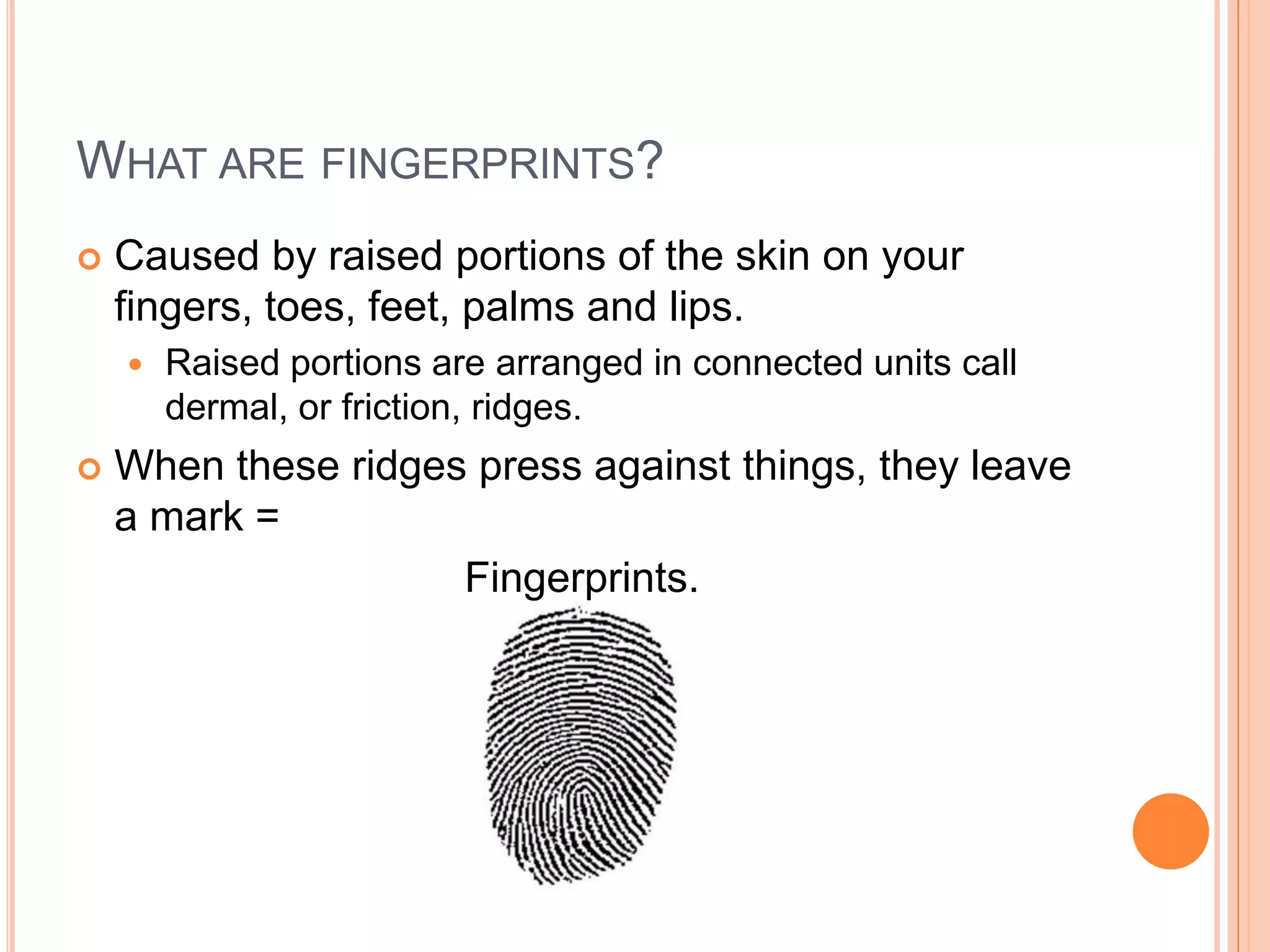
WHAT ARE FINGERPRINTS?
 Caused by raised portions of the skin on your
fingers, toes, feet, palms and lips.
 Raised portions are arranged in connected units call
dermal, or friction, ridges.
 When these ridges press against things, they leave
a mark =
Fingerprints.
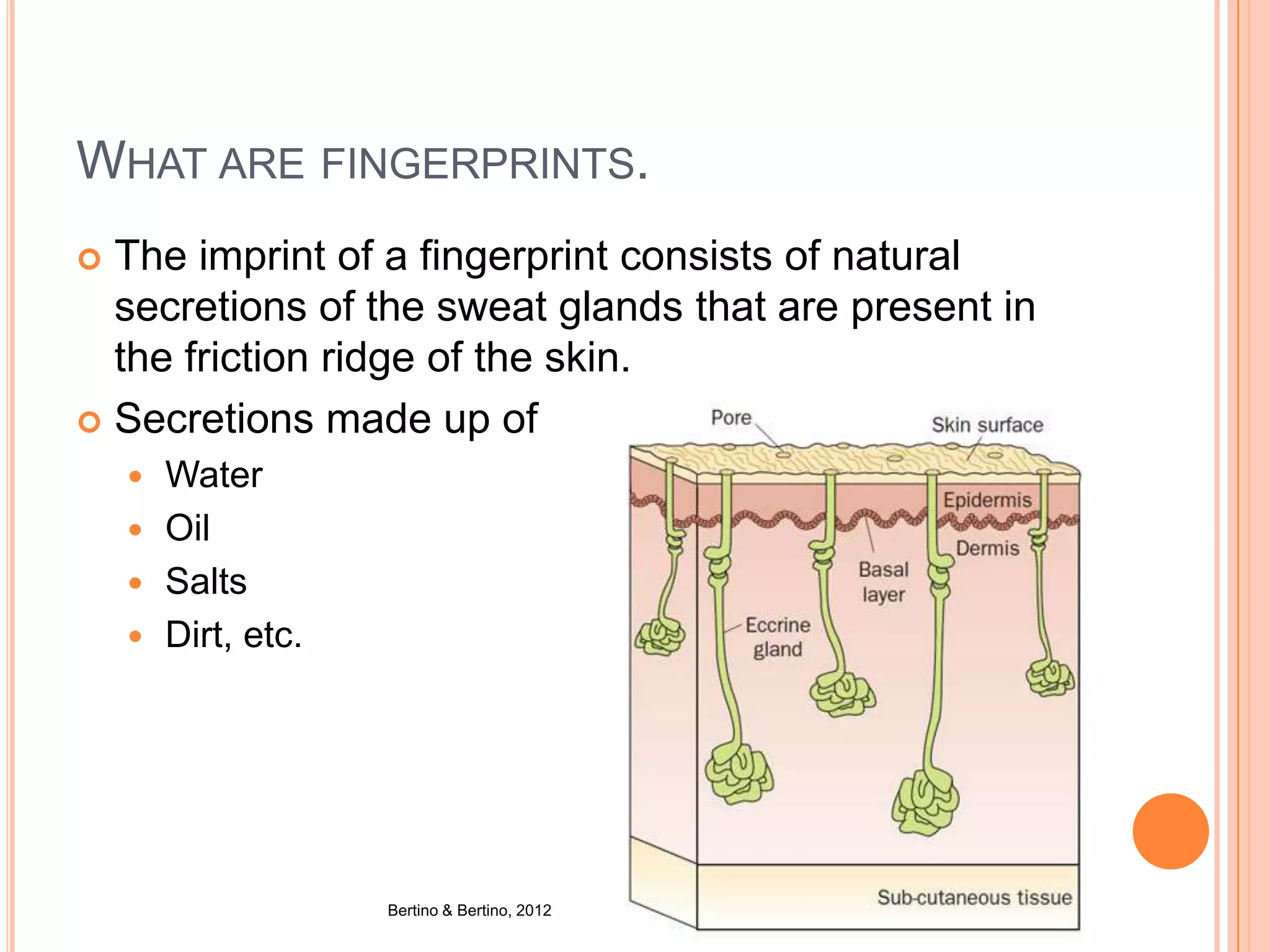
WHAT ARE FINGERPRINTS.
 The imprint of a fingerprint consists of natural
secretions of the sweat glands that are present in
the friction ridge of the skin.
 Secretions made up of
 Water
 Oil
 Salts
 Dirt, etc.
Bertino & Bertino, 2012
HOW ARE FINGERPRINTS FORMED?
 Fingerprint patterns are probably formed at the
beginning of the 10th week of pregnancy.
 When the foetus is ~8cm long!
 The basal layer of skin (a special layer within the
epidermis where new skin cells are produced) grows
faster than the skin layers above and below it, resulting
in it collapsing and folding in different directions,
creating intricate shapes between the other skin layers.
 Fingerprint patterns cannot be altered or destroyed
permanently by skin injuries, because it is protected
by the outer layers.
CHARACTERISTICS OF FINGERPRINTS.
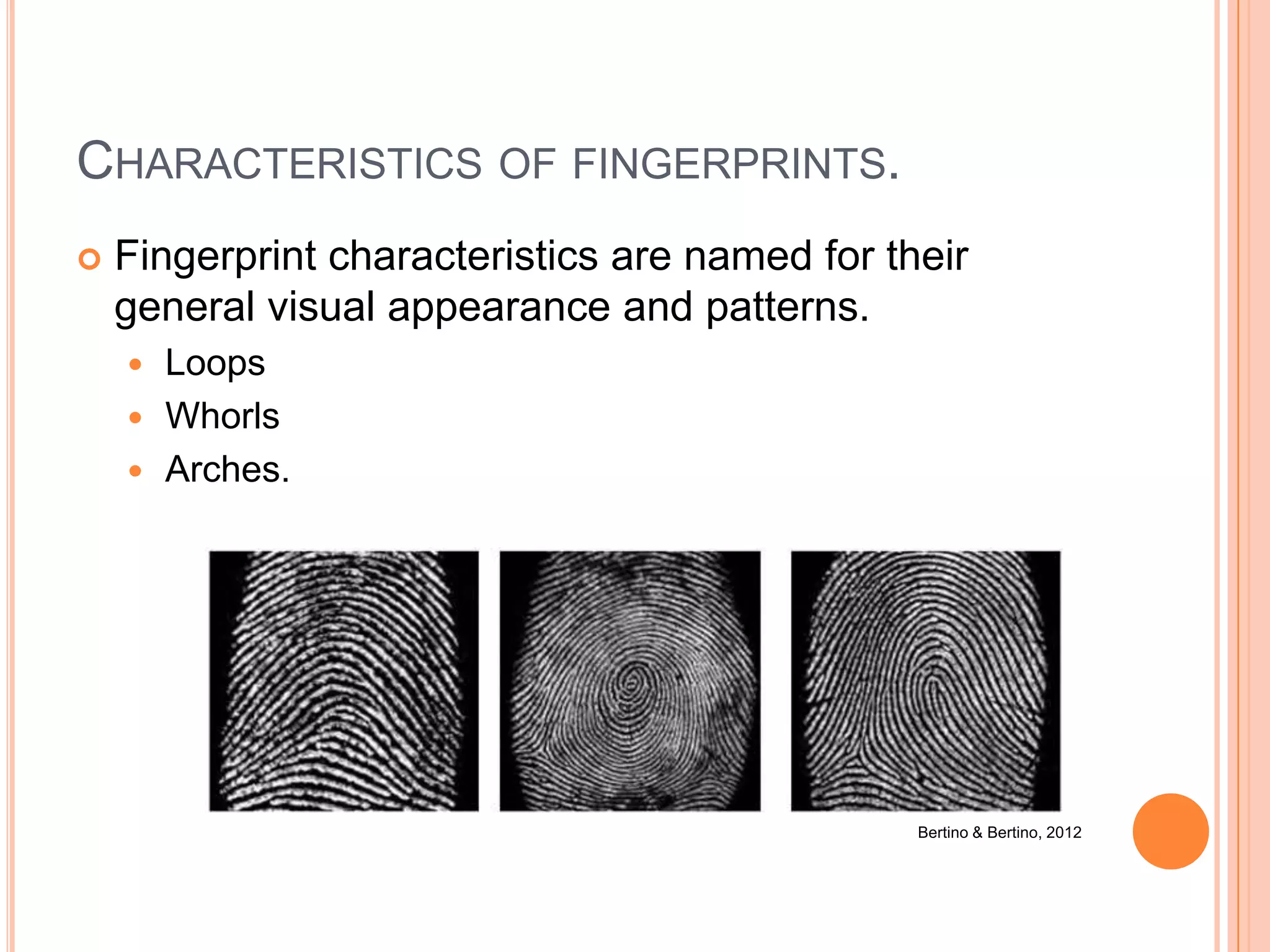
 Fingerprint characteristics are named for their
general visual appearance and patterns.
 Loops
 Whorls
 Arches.
Bertino & Bertino, 2012
CHARACTERISTICS OF FINGERPRINTS.
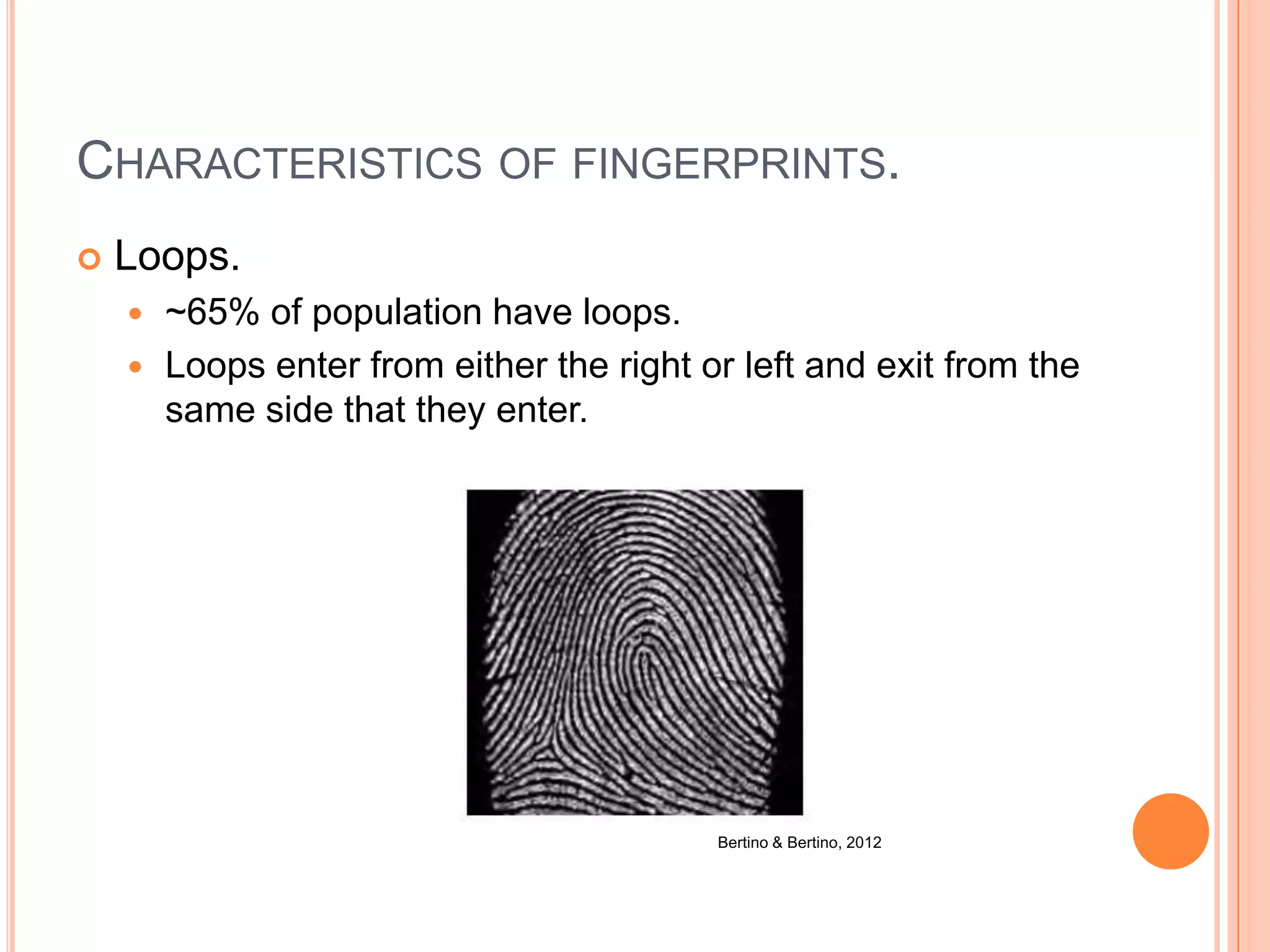
 Loops.
 ~65% of population have loops.
 Loops enter from either the right or left and exit from the
same side that they enter.
Bertino & Bertino, 2012
CHARACTERISTICS OF FINGERPRINTS.
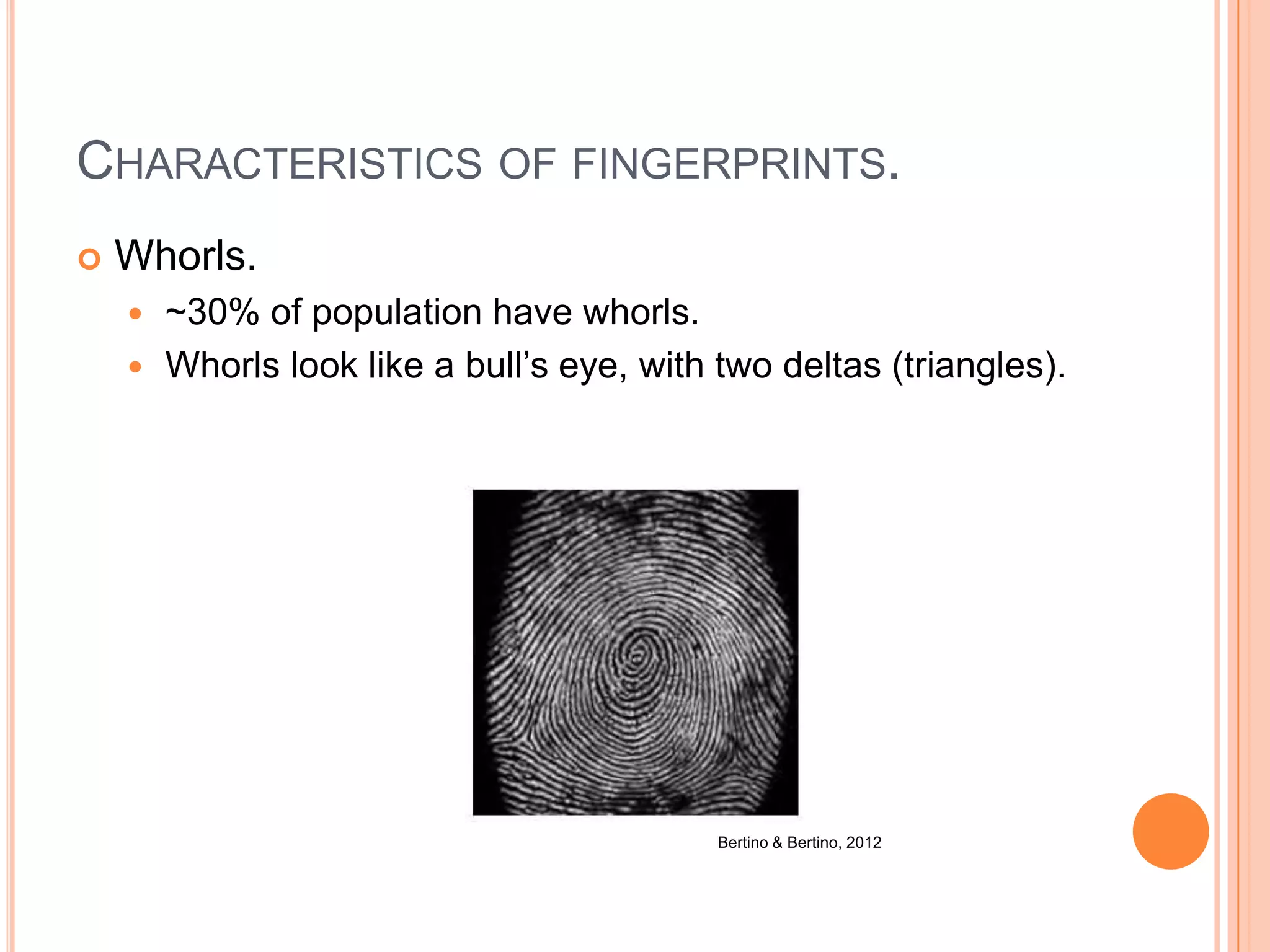
 Whorls.
 ~30% of population have whorls.
 Whorls look like a bull’s eye, with two deltas (triangles).
Bertino & Bertino, 2012
CHARACTERISTICS OF FINGERPRINTS.
 Arches.
 ~5% of population have whorls.
 Arches have ridges that enter from one side of the
fingerprint and leave from the other side, with a rise in
the centre.
Bertino & Bertino, 2012
CHARACTERISTICS OF FINGERPRINTS.
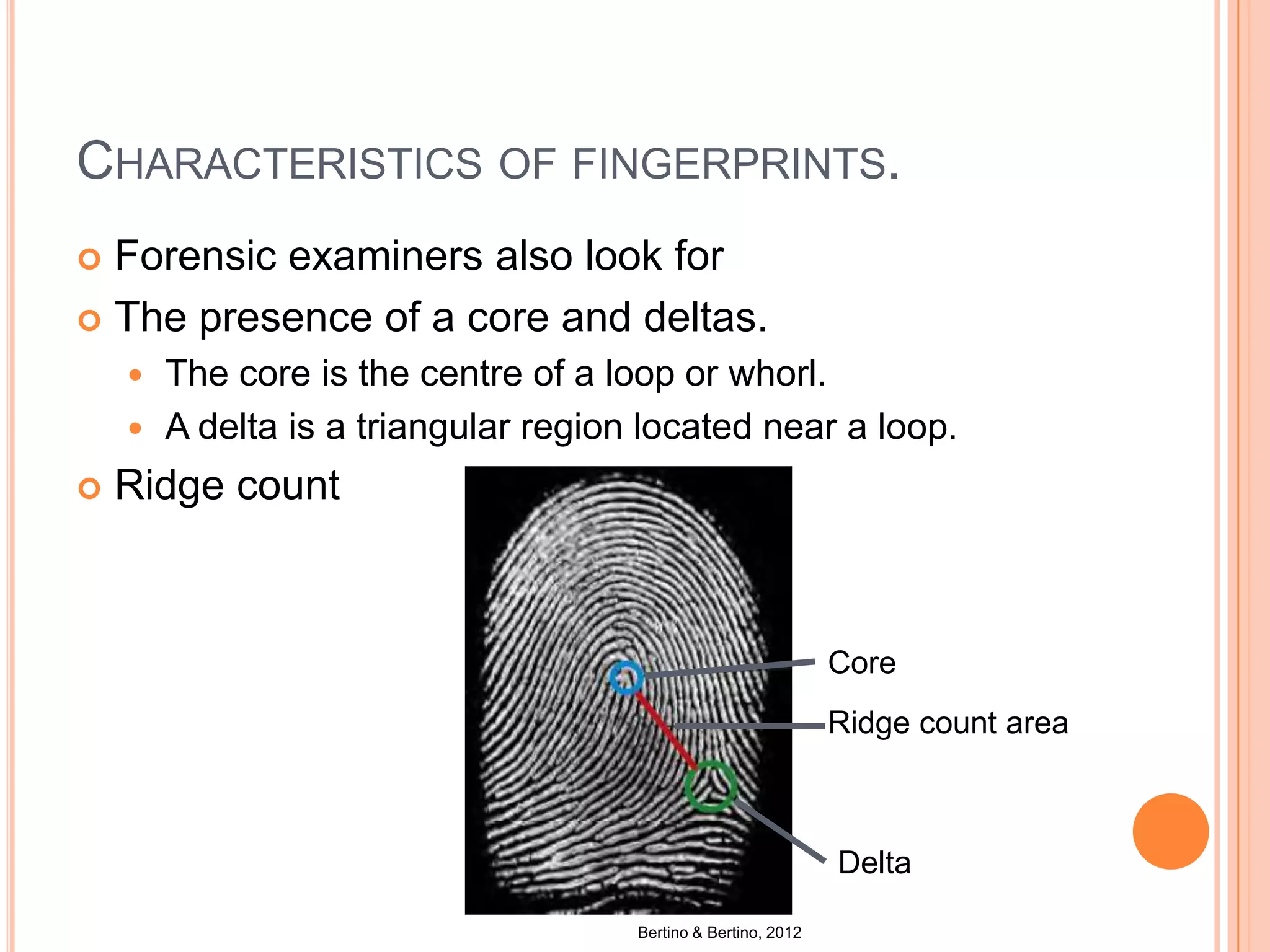
 Forensic examiners also look for
 The presence of a core and deltas.
 The core is the centre of a loop or whorl.
 A delta is a triangular region located near a loop.
 Ridge count
Bertino & Bertino, 2012
Core
Ridge count area
Delta
CHARACTERISTICS OF FINGERPRINTS.
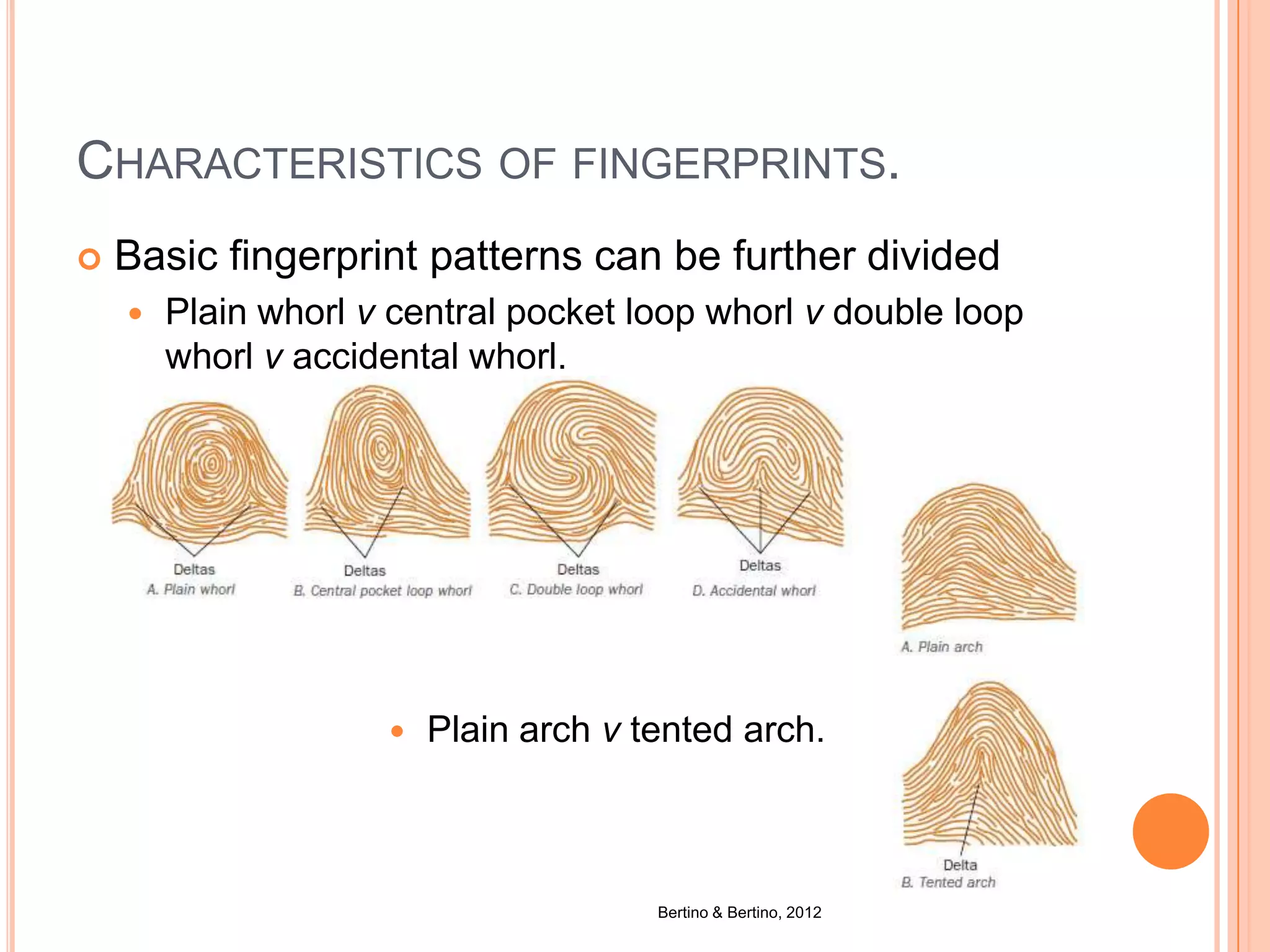
 Basic fingerprint patterns can be further divided
 Plain whorl v central pocket loop whorl v double loop
whorl v accidental whorl.
 Plain arch v tented arch.
Bertino & Bertino, 2012
CHARACTERISTICS OF FINGERPRINTS.
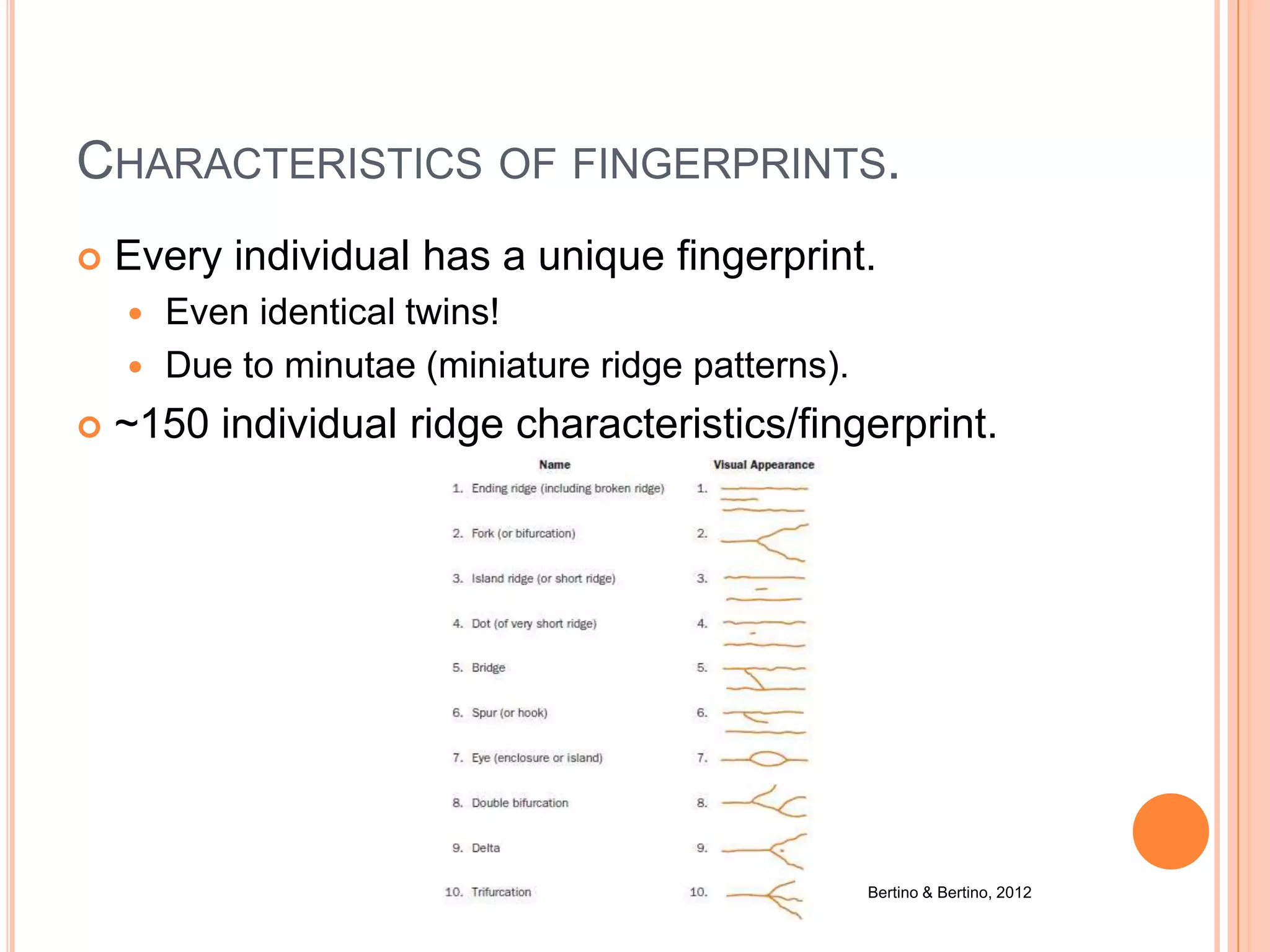
 Every individual has a unique fingerprint.
 Even identical twins!
 Due to minutae (miniature ridge patterns).
 ~150 individual ridge characteristics/fingerprint.
Bertino & Bertino, 2012
TYPES OF FINGERPRINTS.
 Three types of fingerprints.
 Patent fingerprints.
 Visible prints left on smooth surfaces when blood, ink, etc.
comes in contact with the hands and is then transferred to that
surface.
 Plastic fingerprints.
 Indentations left in soft materials such as clay, putty or wax.
 Latent fingerprints.
 Hidden fingerprints, caused by the transfer of oils and other
body secretions onto a surface.
FINGERPRINT FORENSIC FAQ.
 Can fingerprints be altered or disguised?
 Fingerprints grow back!
 How reliable is fingerprinting as a means of
identification?
 Misidentification when using fingerprints usually due to
human error.
 How are fingerprints analysed?
 Fingerprint database of previously convicted criminals
can be computer analysed.
 How are latent fingerprints collected?
 Surface area is dusted with fine carbon powder to make
prints visible. Prints lifted using stickytape.
 Other chemicals used for rough surfaces.
THINK CRITICALLY.
“To get a conviction, I would rather have one good
fingerprint than a pound of hair and fibre evidence.”
 Do you agree or disagree?
 Why?
http://sick9CSI.wikispaces.com

Forensic Science - 05 Fingerprints

  • 1.
  • 2.
    WHAT ARE FINGERPRINTS? Caused by raised portions of the skin on your fingers, toes, feet, palms and lips.  Raised portions are arranged in connected units call dermal, or friction, ridges.  When these ridges press against things, they leave a mark = Fingerprints.
  • 3.
    WHAT ARE FINGERPRINTS. The imprint of a fingerprint consists of natural secretions of the sweat glands that are present in the friction ridge of the skin.  Secretions made up of  Water  Oil  Salts  Dirt, etc. Bertino & Bertino, 2012
  • 4.
    HOW ARE FINGERPRINTSFORMED?  Fingerprint patterns are probably formed at the beginning of the 10th week of pregnancy.  When the foetus is ~8cm long!  The basal layer of skin (a special layer within the epidermis where new skin cells are produced) grows faster than the skin layers above and below it, resulting in it collapsing and folding in different directions, creating intricate shapes between the other skin layers.  Fingerprint patterns cannot be altered or destroyed permanently by skin injuries, because it is protected by the outer layers.
  • 5.
    CHARACTERISTICS OF FINGERPRINTS. Fingerprint characteristics are named for their general visual appearance and patterns.  Loops  Whorls  Arches. Bertino & Bertino, 2012
  • 6.
    CHARACTERISTICS OF FINGERPRINTS. Loops.  ~65% of population have loops.  Loops enter from either the right or left and exit from the same side that they enter. Bertino & Bertino, 2012
  • 7.
    CHARACTERISTICS OF FINGERPRINTS. Whorls.  ~30% of population have whorls.  Whorls look like a bull’s eye, with two deltas (triangles). Bertino & Bertino, 2012
  • 8.
    CHARACTERISTICS OF FINGERPRINTS. Arches.  ~5% of population have whorls.  Arches have ridges that enter from one side of the fingerprint and leave from the other side, with a rise in the centre. Bertino & Bertino, 2012
  • 9.
    CHARACTERISTICS OF FINGERPRINTS. Forensic examiners also look for  The presence of a core and deltas.  The core is the centre of a loop or whorl.  A delta is a triangular region located near a loop.  Ridge count Bertino & Bertino, 2012 Core Ridge count area Delta
  • 10.
    CHARACTERISTICS OF FINGERPRINTS. Basic fingerprint patterns can be further divided  Plain whorl v central pocket loop whorl v double loop whorl v accidental whorl.  Plain arch v tented arch. Bertino & Bertino, 2012
  • 11.
    CHARACTERISTICS OF FINGERPRINTS. Every individual has a unique fingerprint.  Even identical twins!  Due to minutae (miniature ridge patterns).  ~150 individual ridge characteristics/fingerprint. Bertino & Bertino, 2012
  • 12.
    TYPES OF FINGERPRINTS. Three types of fingerprints.  Patent fingerprints.  Visible prints left on smooth surfaces when blood, ink, etc. comes in contact with the hands and is then transferred to that surface.  Plastic fingerprints.  Indentations left in soft materials such as clay, putty or wax.  Latent fingerprints.  Hidden fingerprints, caused by the transfer of oils and other body secretions onto a surface.
  • 13.
    FINGERPRINT FORENSIC FAQ. Can fingerprints be altered or disguised?  Fingerprints grow back!  How reliable is fingerprinting as a means of identification?  Misidentification when using fingerprints usually due to human error.  How are fingerprints analysed?  Fingerprint database of previously convicted criminals can be computer analysed.  How are latent fingerprints collected?  Surface area is dusted with fine carbon powder to make prints visible. Prints lifted using stickytape.  Other chemicals used for rough surfaces.
  • 14.
    THINK CRITICALLY. “To geta conviction, I would rather have one good fingerprint than a pound of hair and fibre evidence.”  Do you agree or disagree?  Why?
  • 15.