Ian Anderson (2013)
Saint Ignatius College Geelong
06. Energy transformations.
Energy.
 All living organisms require a constant supply of
energy to survive e.g. for cellular processes (incl.
protein synthesis, active transport, digestion
etc.), growth, movement, reproduction, etc.
 Energy = capacity to do work.
Energy.
 In plants and animals glucose is the main source of
chemical energy.
 If there is insufficient glucose available, fatty acids and
amino acids can be used instead.
 Chemical energy is present in the chemical bonds.
 When the bonds break, energy is released (i.e. exergonic
reaction).
ATP – ADP cycle.
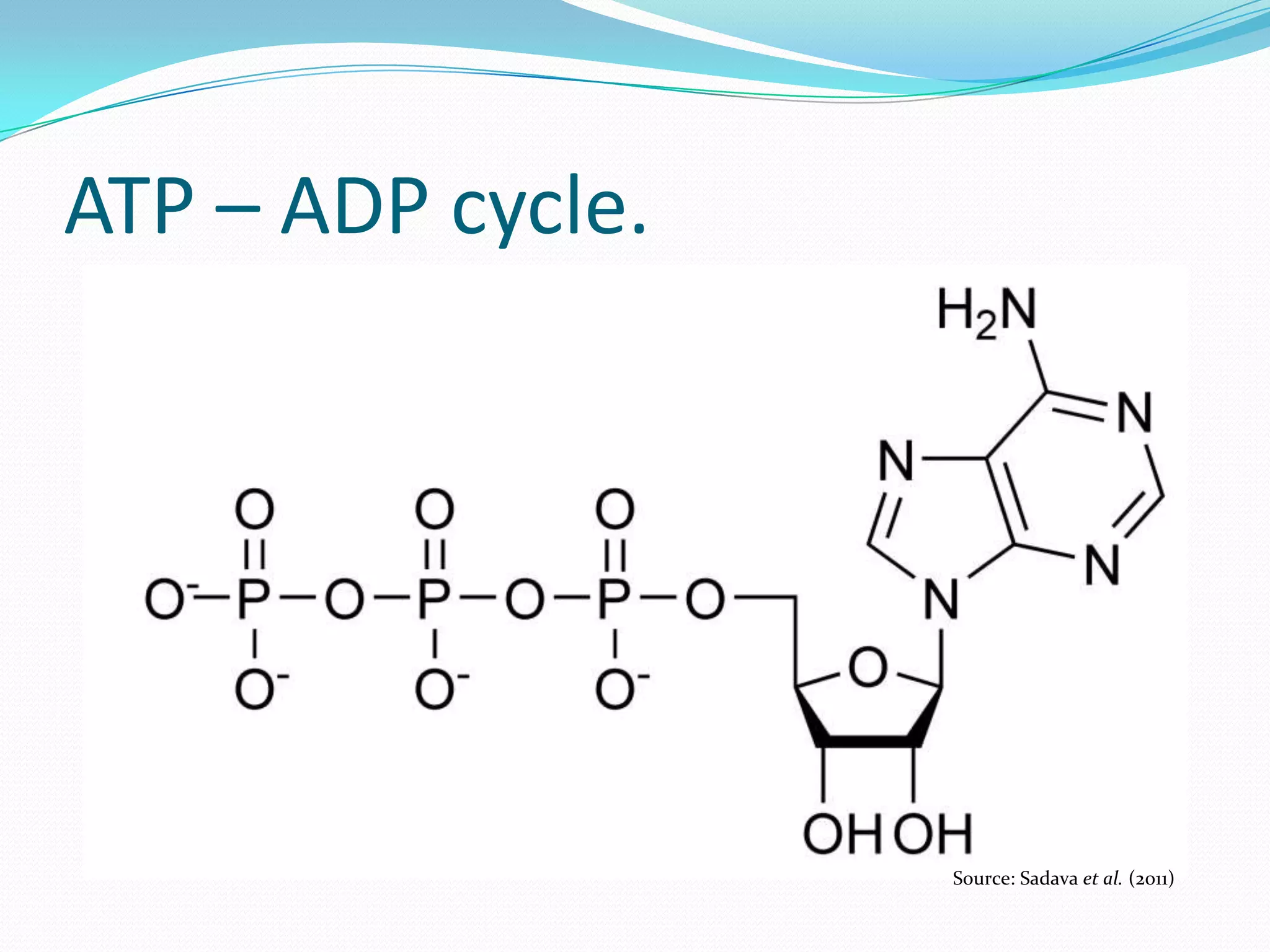
 Adenosine triphosphate (ATP) is the energy currency
of a cell.
 ATP is needed for every activity that requires energy.
 ATP structure – adenosine attached to a sugar group
(ribose), which is bound to a chain of three phosphate
groups.
 = nucleotide (sugar, N containing base and a phosphate
group).
 Immediate energy source lies in the energy rich bond
holding the third phosphate to the rest of the
molecule.
ATP – ADP cycle.
Source: Sadava et al. (2011)
ATP – ADP cycle.
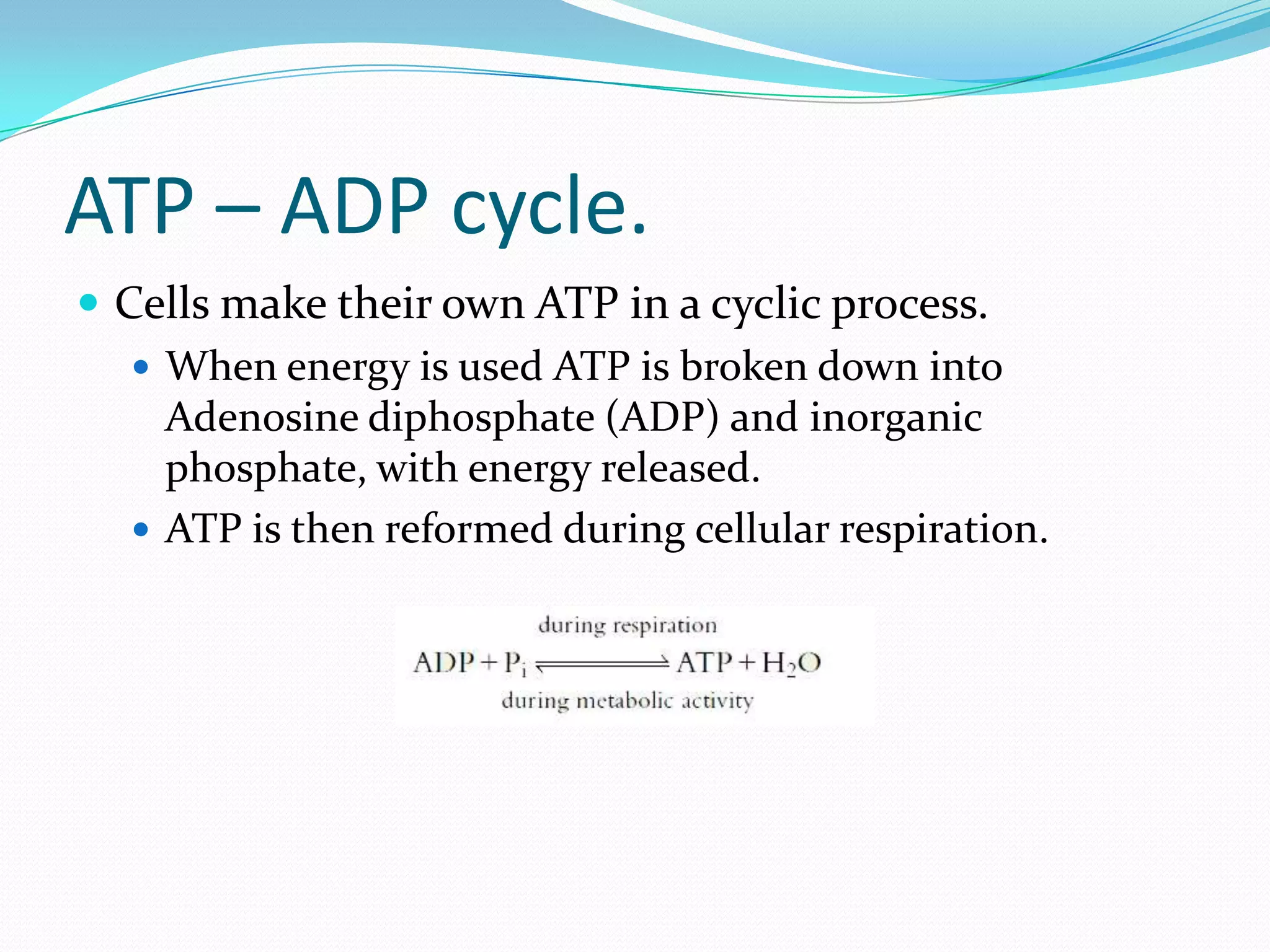
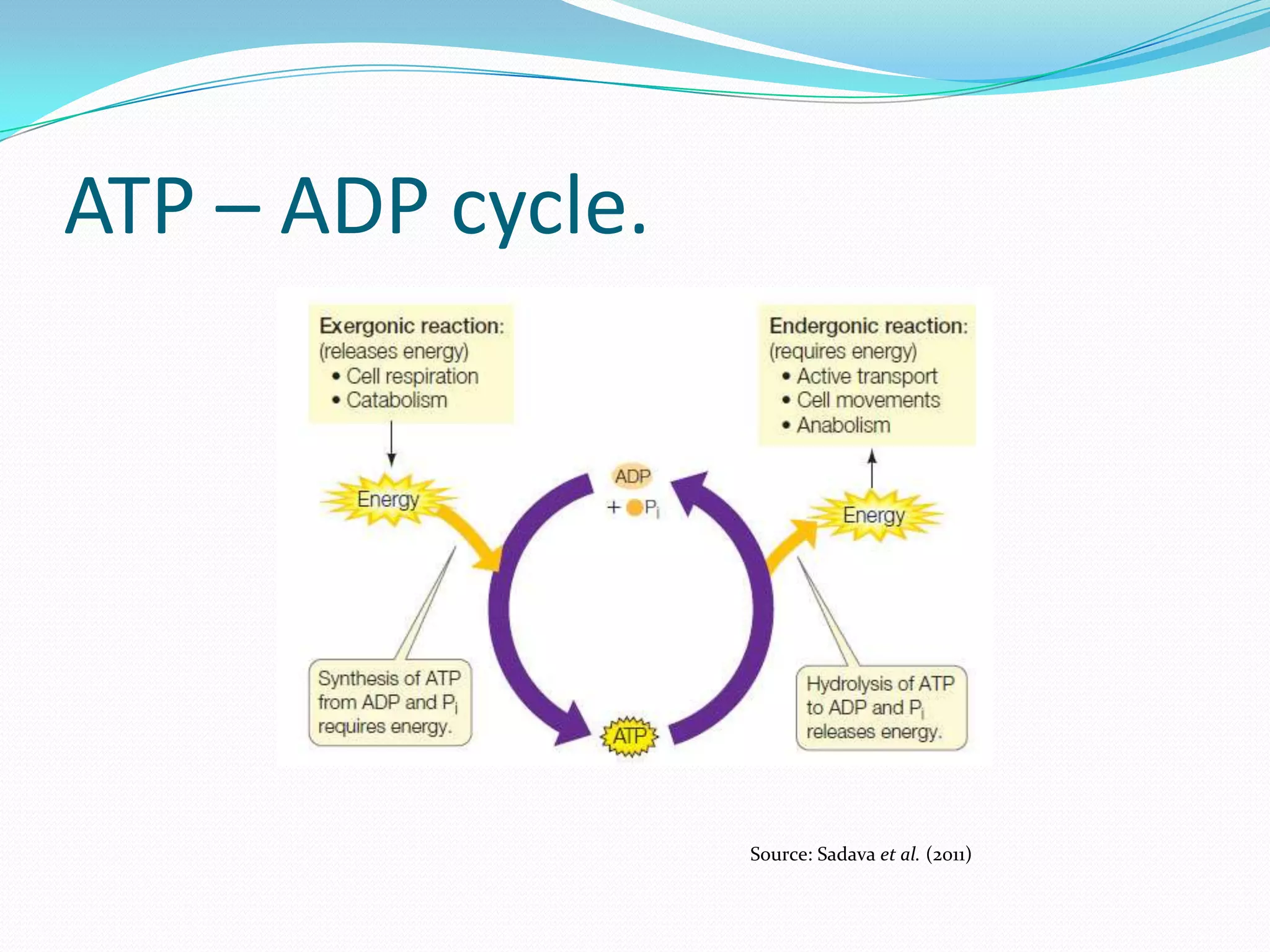
 Cells make their own ATP in a cyclic process.
 When energy is used ATP is broken down into
Adenosine diphosphate (ADP) and inorganic
phosphate, with energy released.
 ATP is then reformed during cellular respiration.
ATP – ADP cycle.
Source: Sadava et al. (2011)
Cellular respiration.
 The process that releases energy from glucose
molecules in the form of ATP.
 Cellular respiration is the most important and
common catabolic reaction to all living organisms.
 Occurs in several stages
 [Biochemical/metabolic pathway = each step begins
with a substrate, which is then converted to a
product, which then becomes the substrate for another
chemical reaction (each enzyme controlled)].
Source: Campbell et al. (2011)
Cellular respiration.
 First stage = Glycolysis.
 Occurs in cytosol.
 Anaerobic (without oxygen) pathway.
 Glucose is broken down into two pyruvate
molecules, with a net production of two ATP molecules.
 H+ and e- are released as glucose is split and collected by
electron carrier molecule (nictoninamide adenine
dinucleotide).
Glucose  2 pyruvate + 2H2O + 2NADH + 2ATP
(6 carbon sugar) (2 x 3 carbon sugar)
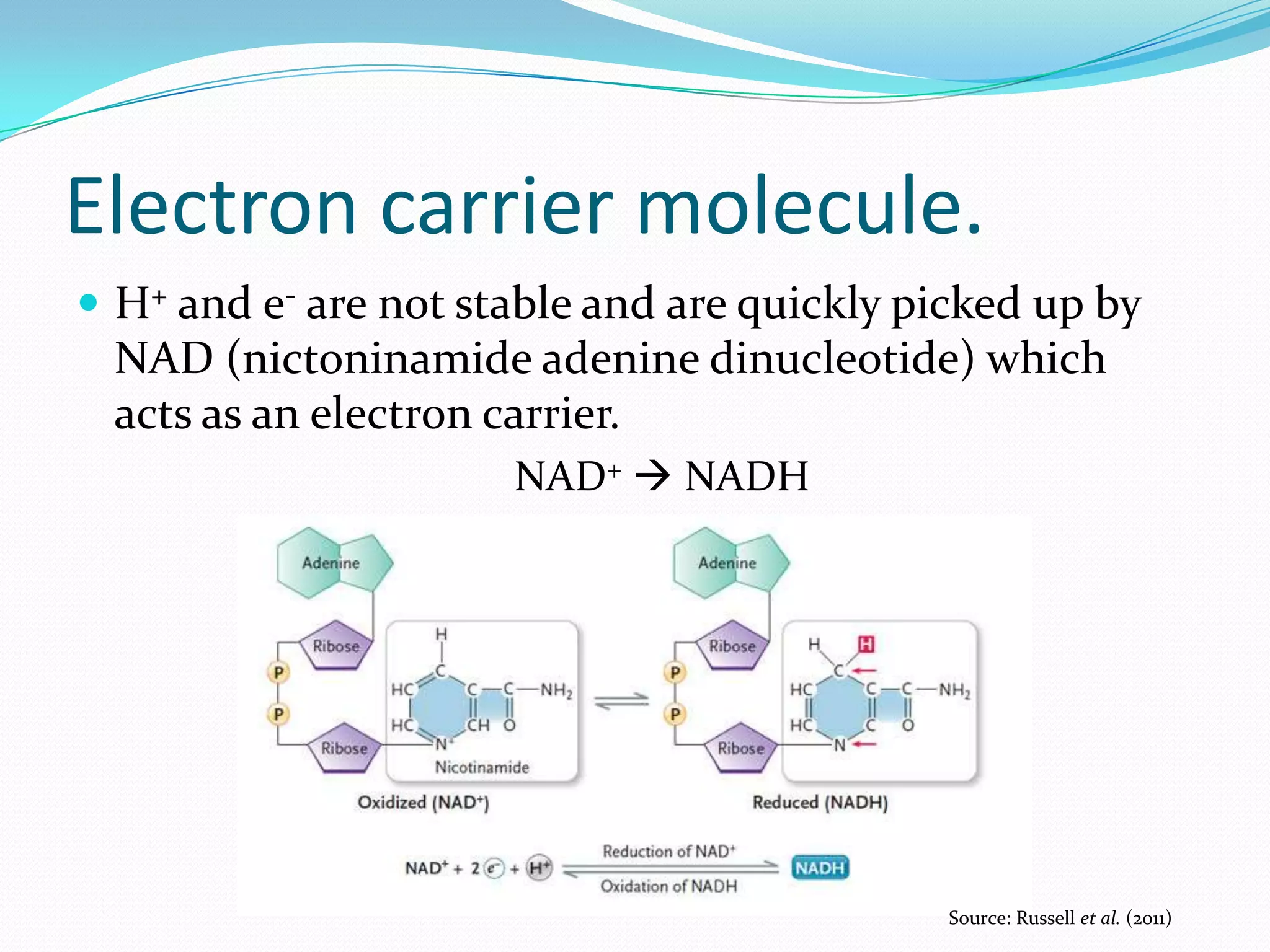
Electron carrier molecule.
 H+ and e- are not stable and are quickly picked up by
NAD (nictoninamide adenine dinucleotide) which
acts as an electron carrier.
NAD+  NADH
Source: Russell et al. (2011)
Cellular respiration.
Next stage of cellular respiration depends on whether or
not oxygen is available.
 Oxygen available  aerobic pathway.
 Oxygen not available  anaerobic pathway.
Cellular respiration
– aerobic pathway.
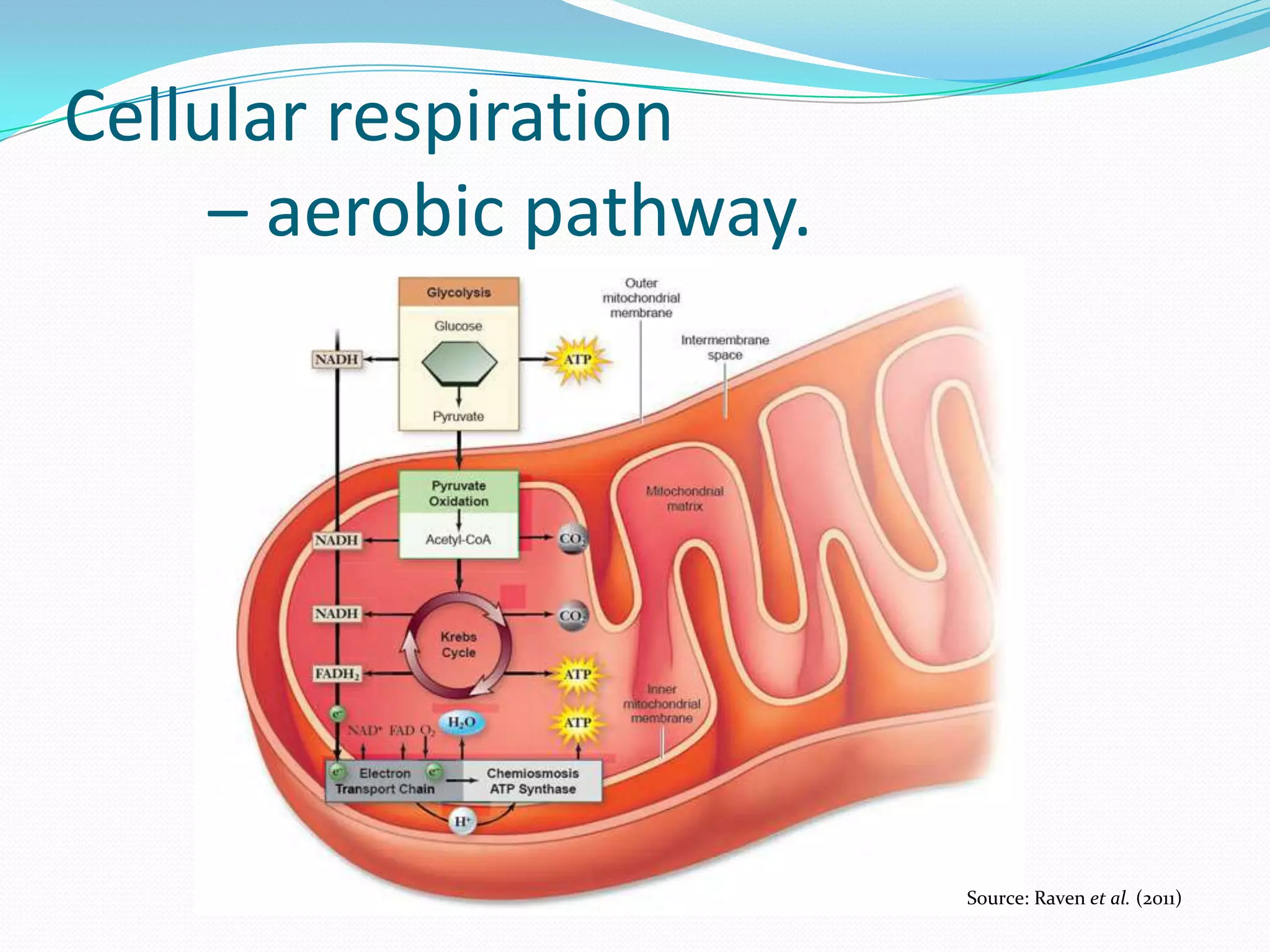
 Most efficient way of producing ATP.
 Occurs in mitochondria in eukaryotes.
 Pyruvate enters via active transport.
 (Occurs in cytoplasm of prokaryotes).
 Involves two steps
 Krebs cycle (Citric acid cycle).
 Electron-transport chain.
Cellular respiration
– aerobic pathway.
Krebs cycle.
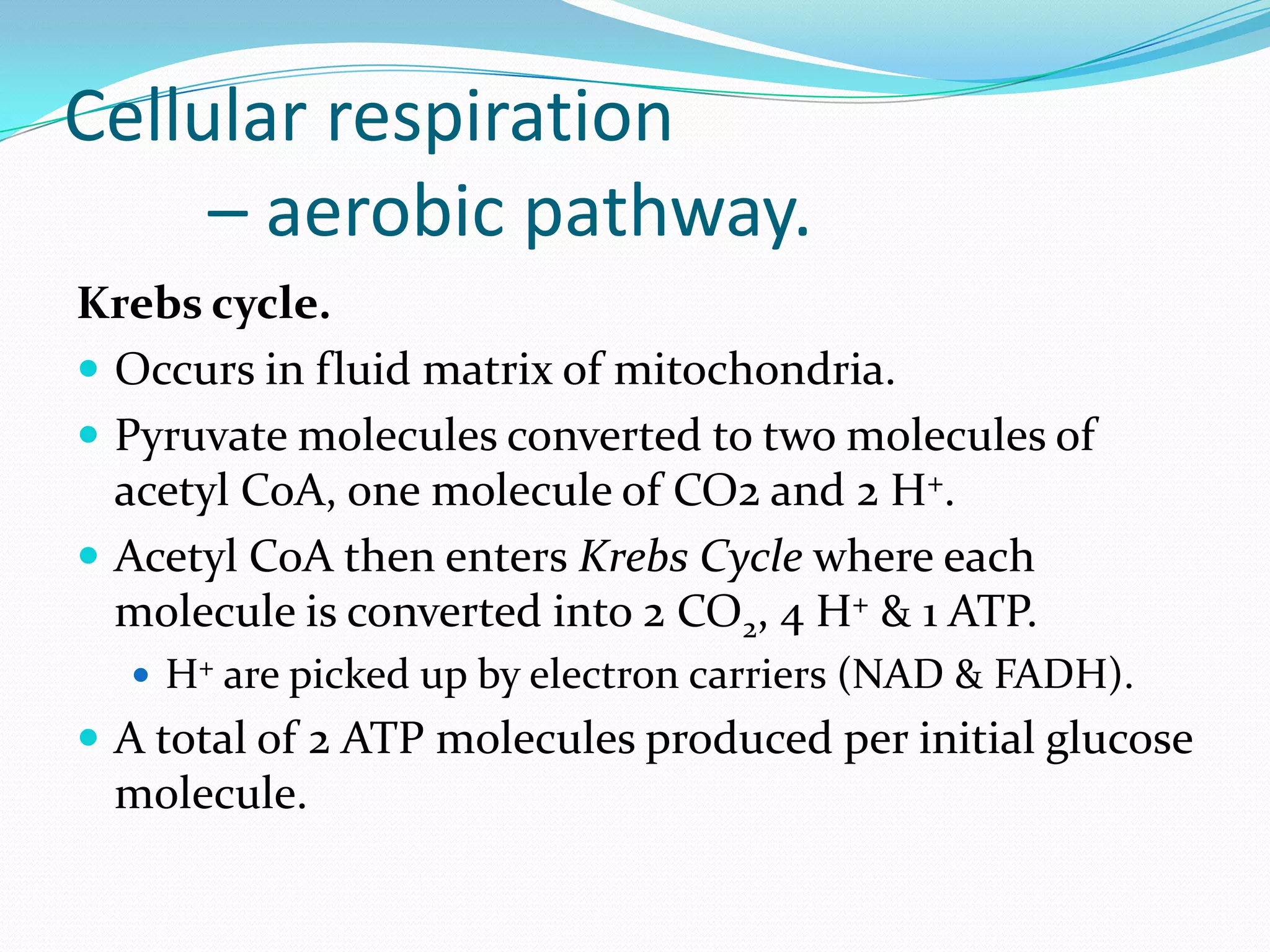
 Occurs in fluid matrix of mitochondria.
 Pyruvate molecules converted to two molecules of
acetyl CoA, one molecule of CO2 and 2 H+.
 Acetyl CoA then enters Krebs Cycle where each
molecule is converted into 2 CO2, 4 H+ & 1 ATP.
 H+ are picked up by electron carriers (NAD & FADH).
 A total of 2 ATP molecules produced per initial glucose
molecule.
Cellular respiration
– aerobic pathway.
Electron-transport chain.
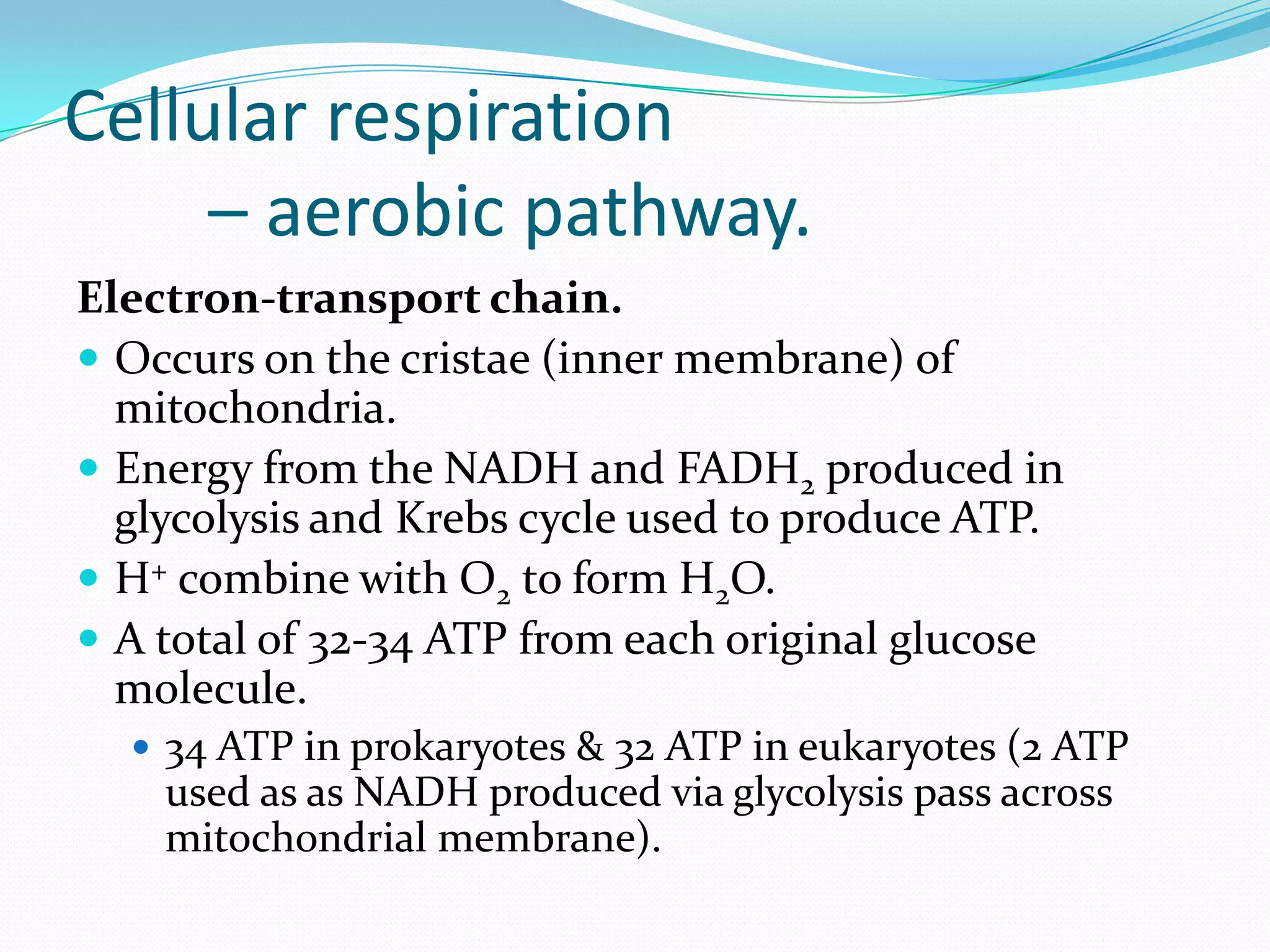
 Occurs on the cristae (inner membrane) of
mitochondria.
 Energy from the NADH and FADH2 produced in
glycolysis and Krebs cycle used to produce ATP.
 H+ combine with O2 to form H2O.
 A total of 32-34 ATP from each original glucose
molecule.
 34 ATP in prokaryotes & 32 ATP in eukaryotes (2 ATP
used as as NADH produced via glycolysis pass across
mitochondrial membrane).
Cellular respiration
– aerobic pathway.
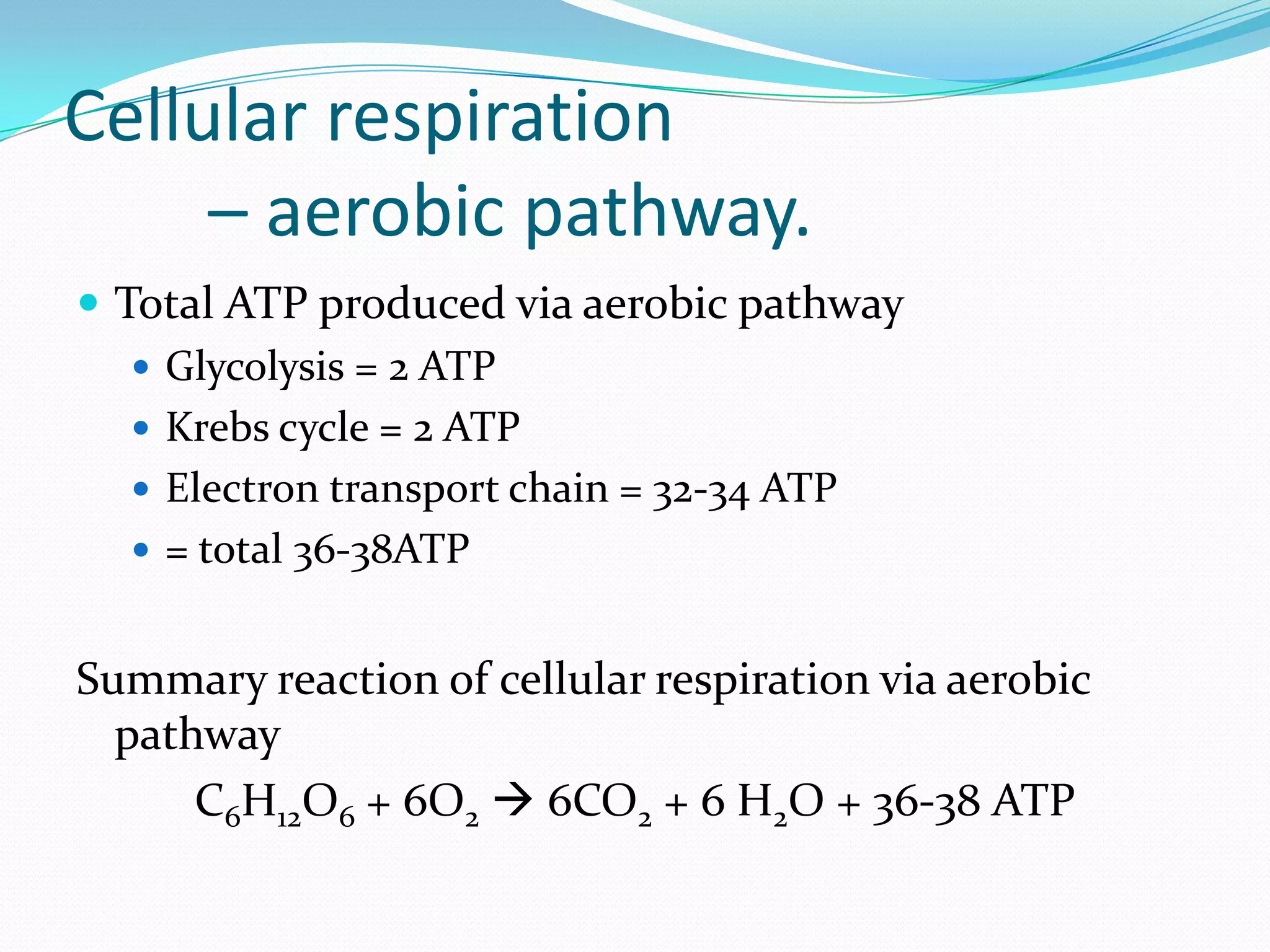
 Total ATP produced via aerobic pathway
 Glycolysis = 2 ATP
 Krebs cycle = 2 ATP
 Electron transport chain = 32-34 ATP
 = total 36-38ATP
Summary reaction of cellular respiration via aerobic
pathway
C6H12O6 + 6O2  6CO2 + 6 H2O + 36-38 ATP
Cellular respiration
– aerobic pathway.
Source: Raven et al. (2011)
Cellular respiration
– anaerobic pathway.
 Occurs in the cytoplasm of cells.
 No further ATP is produced during the anaerobic
pathway.
 i.e. only 2 ATP produced as a result of glycolysis.
 Anaerobic pathway known as fermentation.
Cellular respiration
– anaerobic pathway.
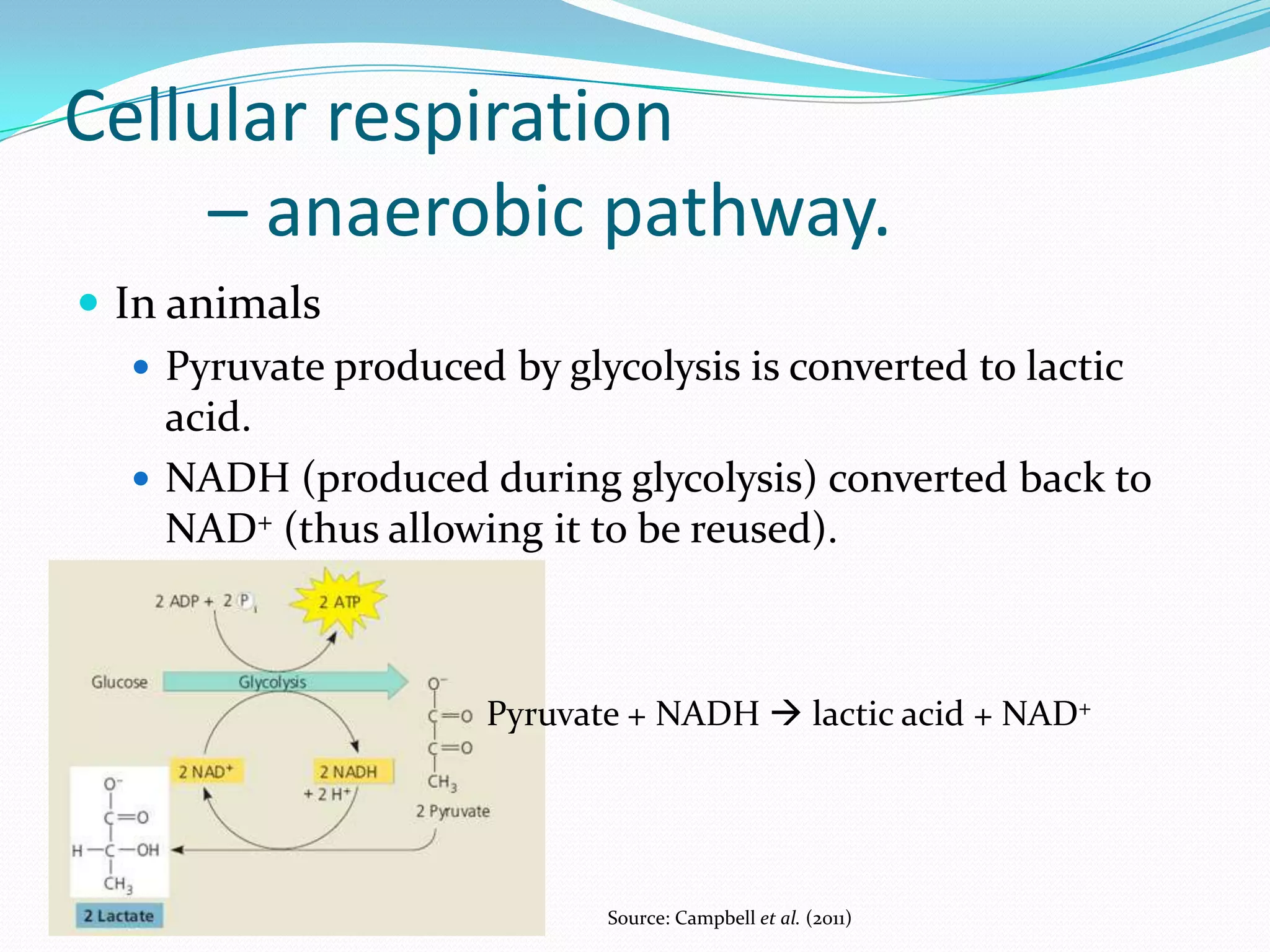
 In animals
 Pyruvate produced by glycolysis is converted to lactic
acid.
 NADH (produced during glycolysis) converted back to
NAD+ (thus allowing it to be reused).
Pyruvate + NADH  lactic acid + NAD+
Source: Campbell et al. (2011)
Cellular respiration
– anaerobic pathway.
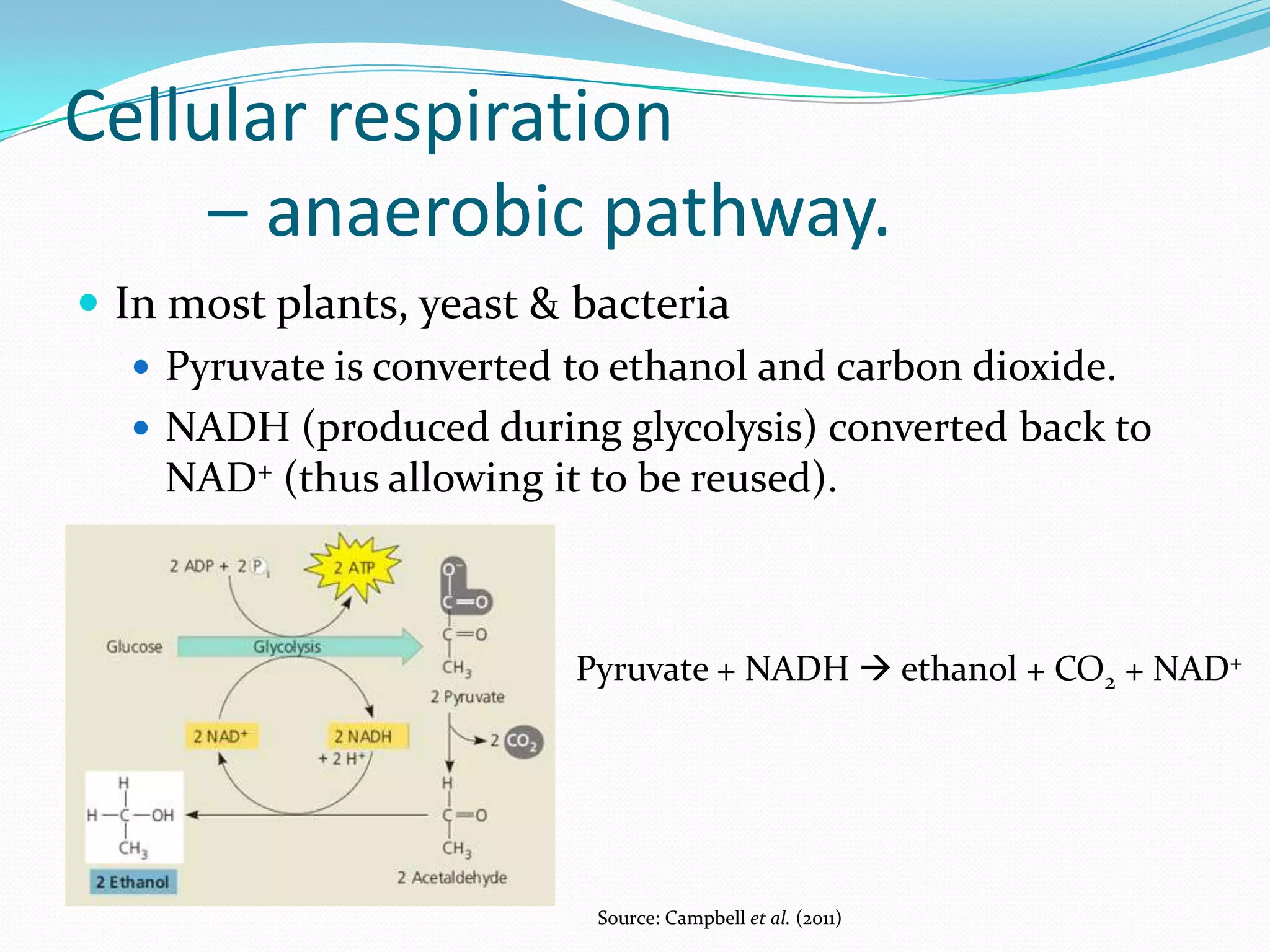
 In most plants, yeast & bacteria
 Pyruvate is converted to ethanol and carbon dioxide.
 NADH (produced during glycolysis) converted back to
NAD+ (thus allowing it to be reused).
Source: Campbell et al. (2011)
Pyruvate + NADH  ethanol + CO2 + NAD+
Energy.
 The sun provides this energy either directly or
indirectly for nearly all life forms.
 Autotrophs – manufacture organic material from
inorganic material [self feeding] e.g. plants, algae &
cyanobacteria.
 Heterotrophs – obtain organic material by feeding on
other organisms (or their products) [feed on others] e.g.
animals, fungi, most bacteria & some protists.
Photosynthesis.
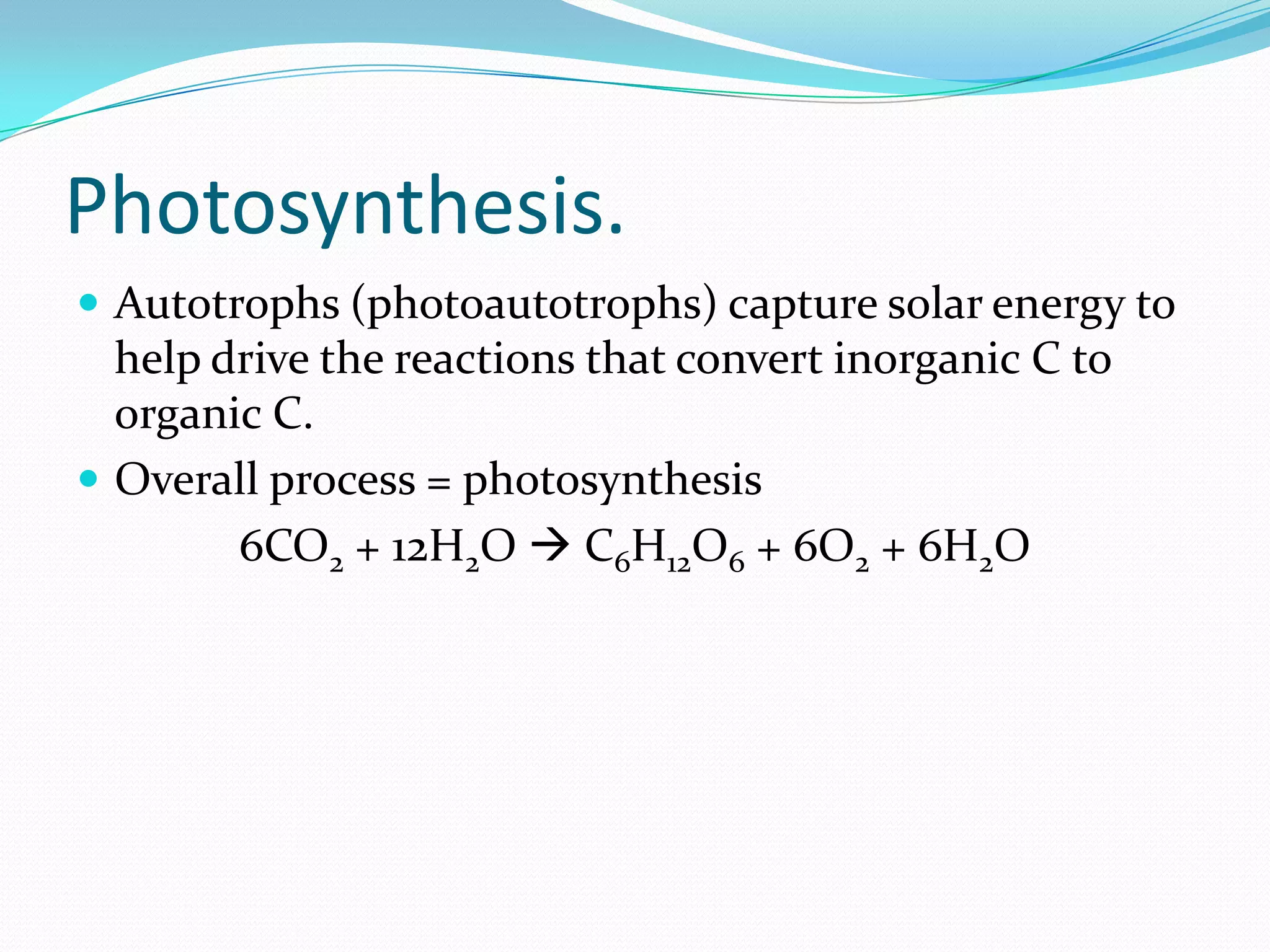
 Autotrophs (photoautotrophs) capture solar energy to
help drive the reactions that convert inorganic C to
organic C.
 Overall process = photosynthesis
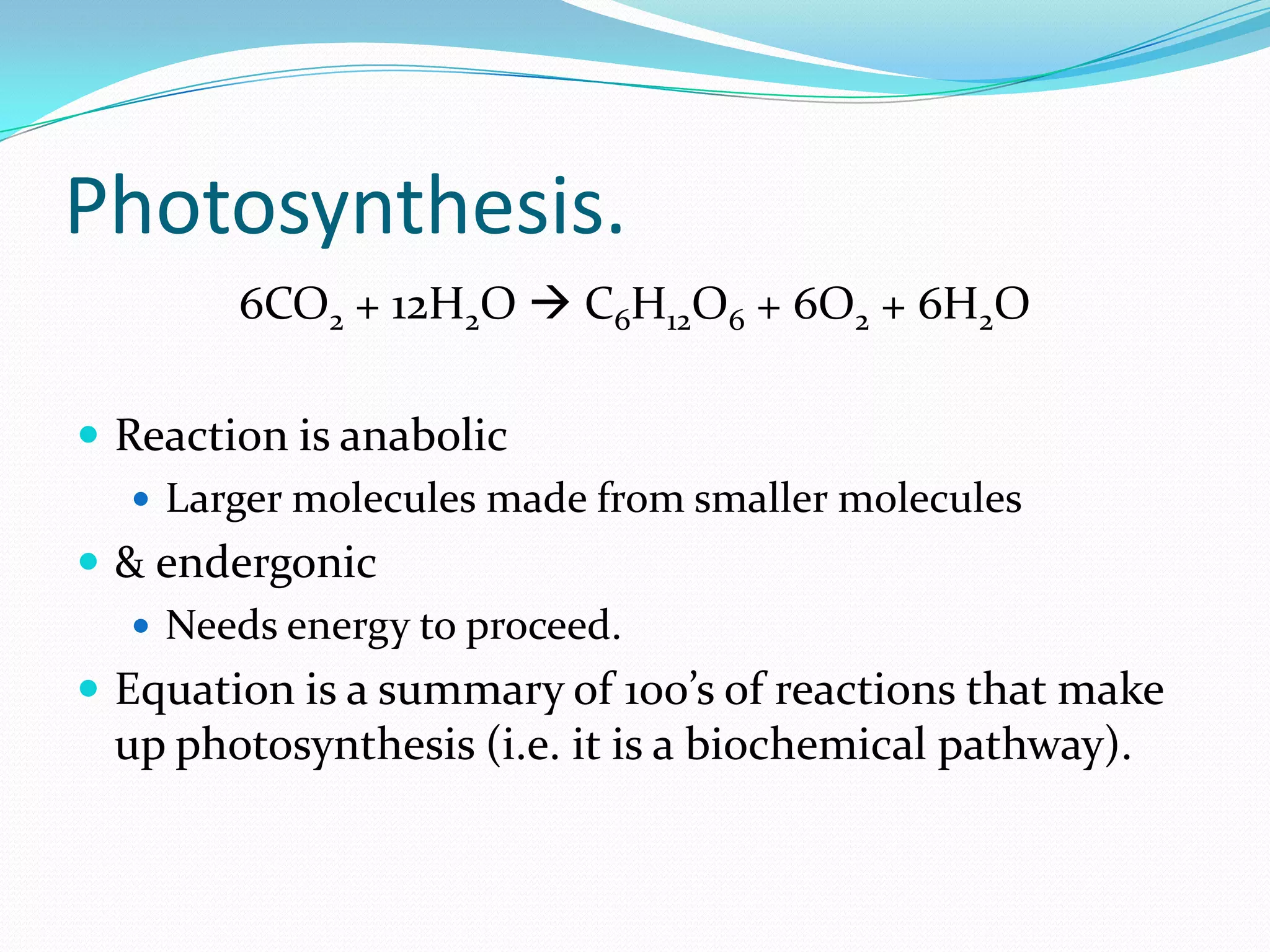
6CO2 + 12H2O  C6H12O6 + 6O2 + 6H2O
Photosynthesis.
6CO2 + 12H2O  C6H12O6 + 6O2 + 6H2O
 Reaction is anabolic
 Larger molecules made from smaller molecules
 & endergonic
 Needs energy to proceed.
 Equation is a summary of 100’s of reactions that make
up photosynthesis (i.e. it is a biochemical pathway).
Photosynthesis.
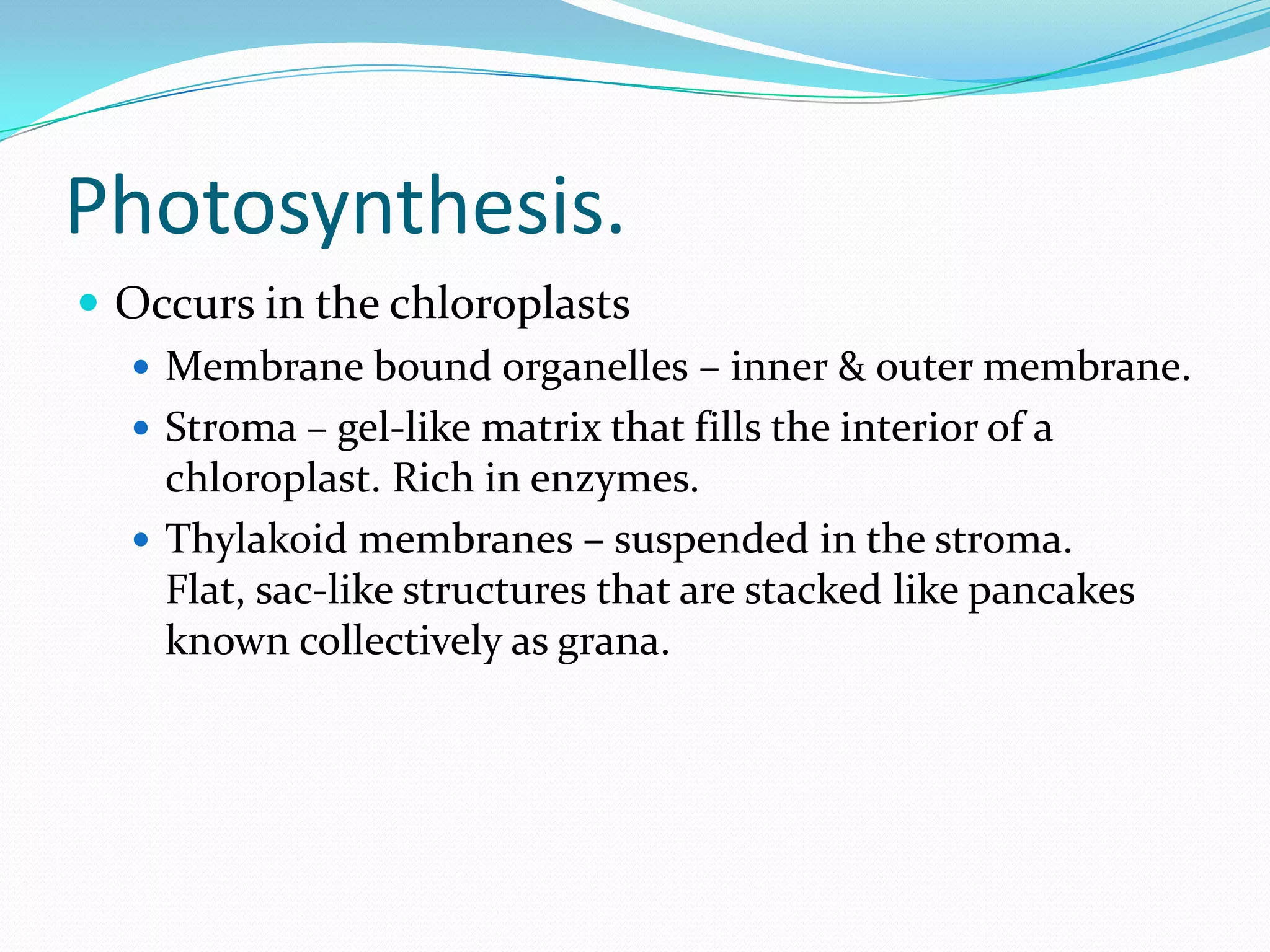
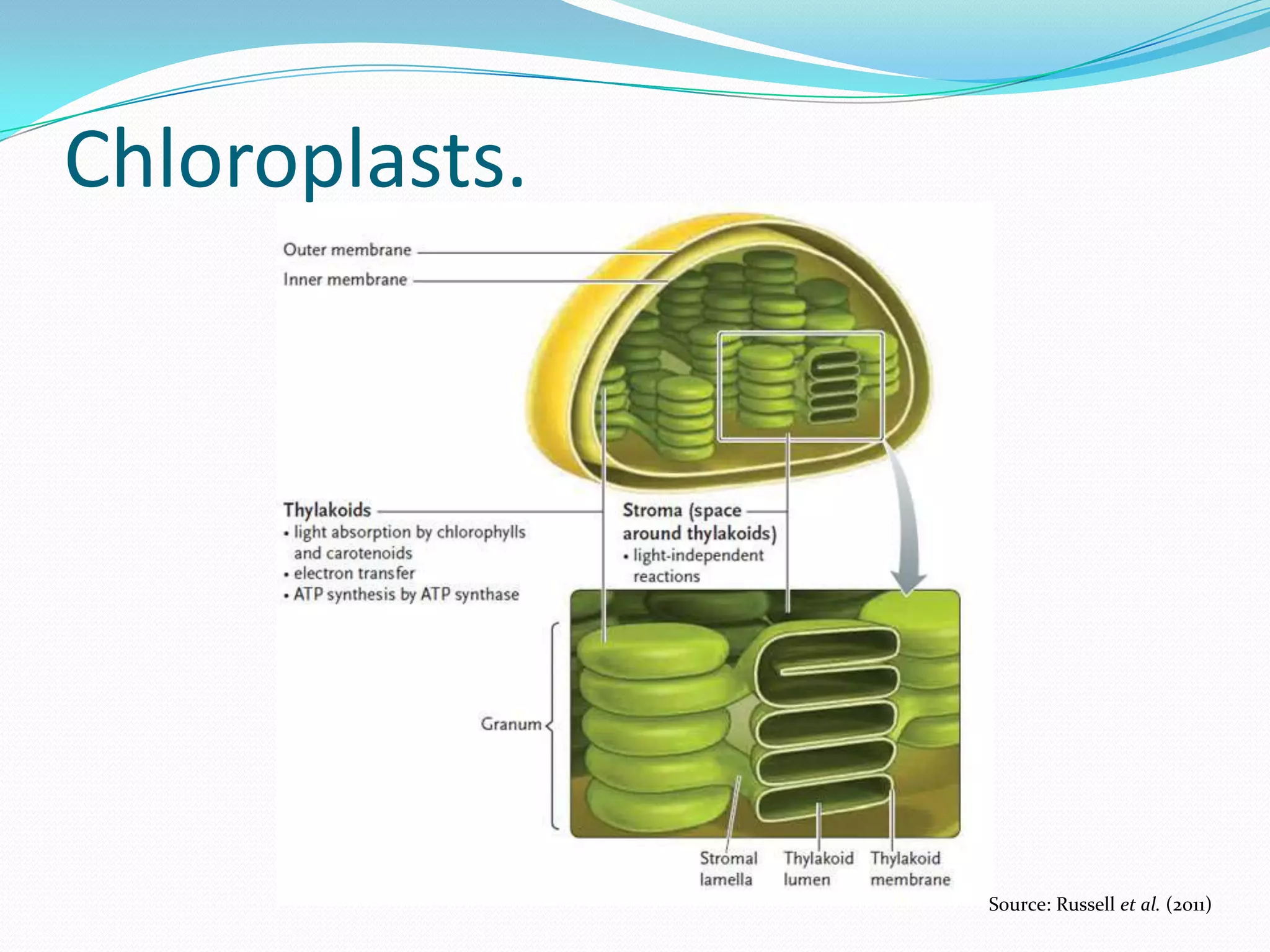
 Occurs in the chloroplasts
 Membrane bound organelles – inner & outer membrane.
 Stroma – gel-like matrix that fills the interior of a
chloroplast. Rich in enzymes.
 Thylakoid membranes – suspended in the stroma.
Flat, sac-like structures that are stacked like pancakes
known collectively as grana.
Chloroplasts.
Source: Russell et al. (2011)
Photosynthesis.
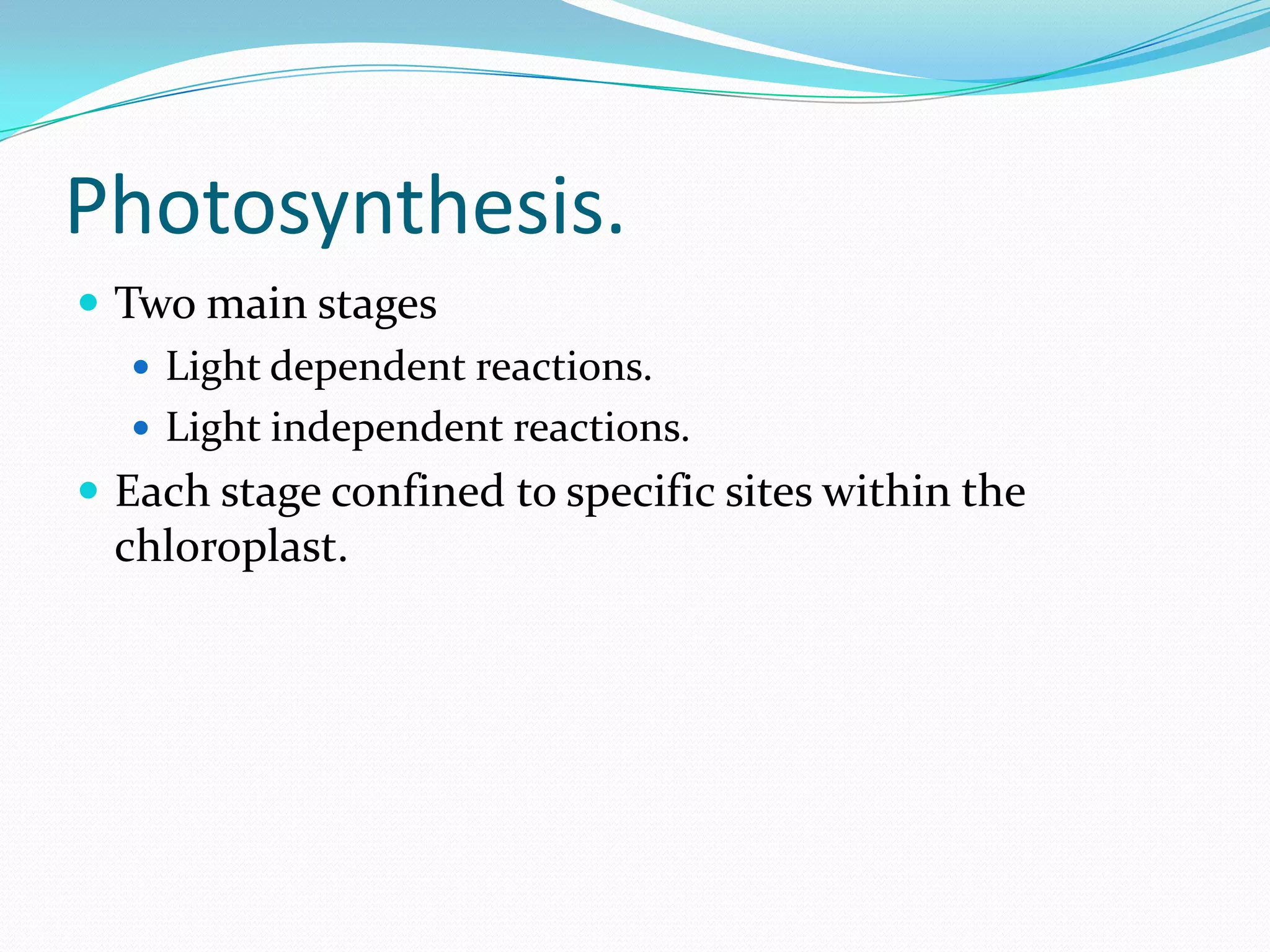
 Two main stages
 Light dependent reactions.
 Light independent reactions.
 Each stage confined to specific sites within the
chloroplast.
Photosynthesis
- Light dependent reactions.
 Light is essential for these reactions to occur.
 Occurs on the thylakoid membranes of the
chloroplast.
 Chlorophyl absorbs light energy, which is then used to
produce ATP and split water molecules into H+ ions
and O2 gas.
 O2 gas is a waste product.
 ATP, H+ ions and electrons are used in the light
independent reactions.
Photosynthesis
- Light independent reactions.
 Also know as the Calvin Cycle.
 Occurs in the stroma of the chloroplast.
 Carbon dioxide is combined with the H+ ions using
energy provided by ATP, to form glucose and water.
Photosynthesis.
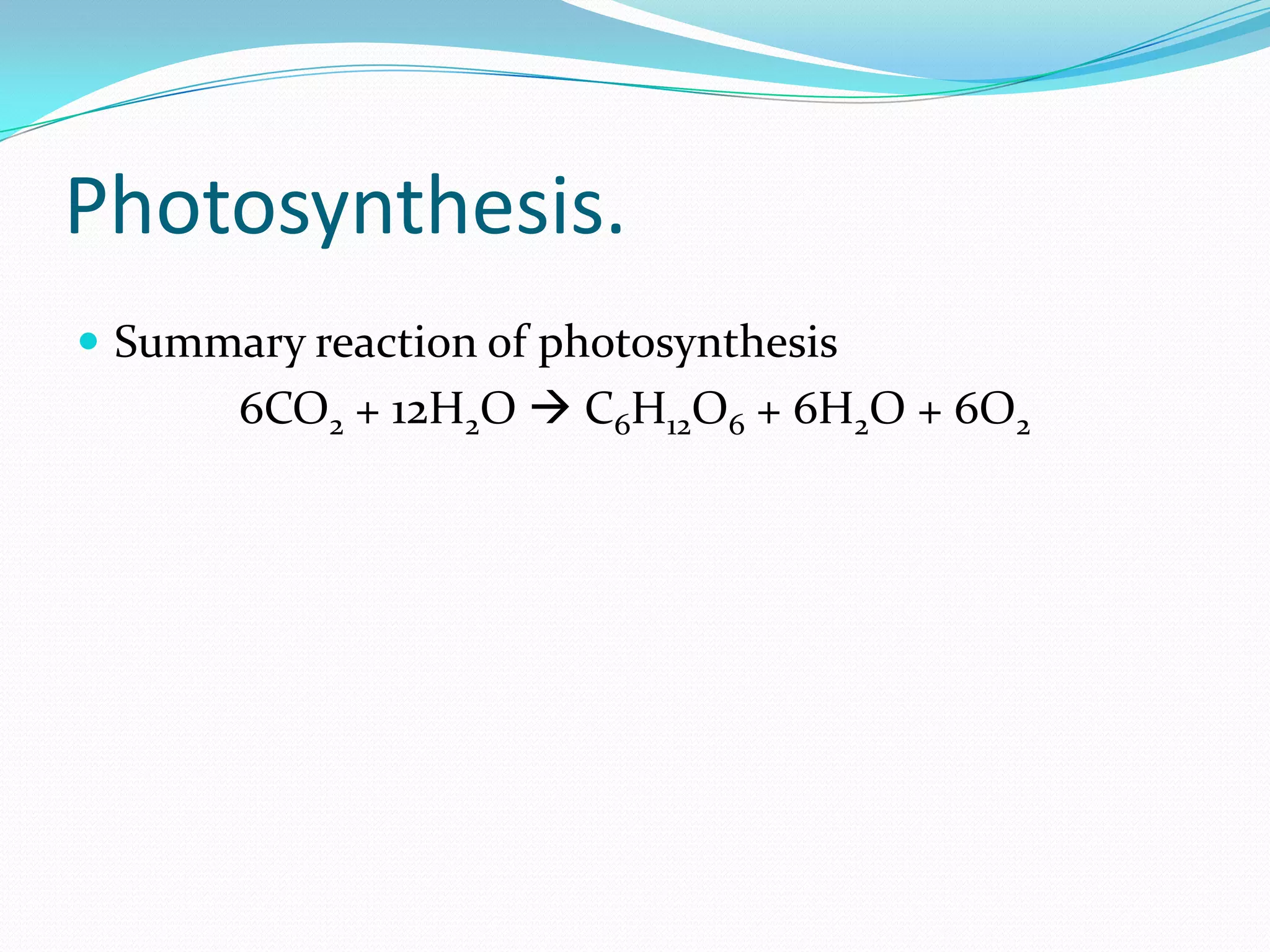
 Summary reaction of photosynthesis
6CO2 + 12H2O  C6H12O6 + 6H2O + 6O2
Photosynthesis.
Factors that affect the rate of photosynthesis.
 Light intensity
 CO2 availability
 Temperature
 Indirect factors
 Lacking nitrogen/magnesium reduces the amount of
chlorophyll produced.
 Dehydration causes stomata to close.
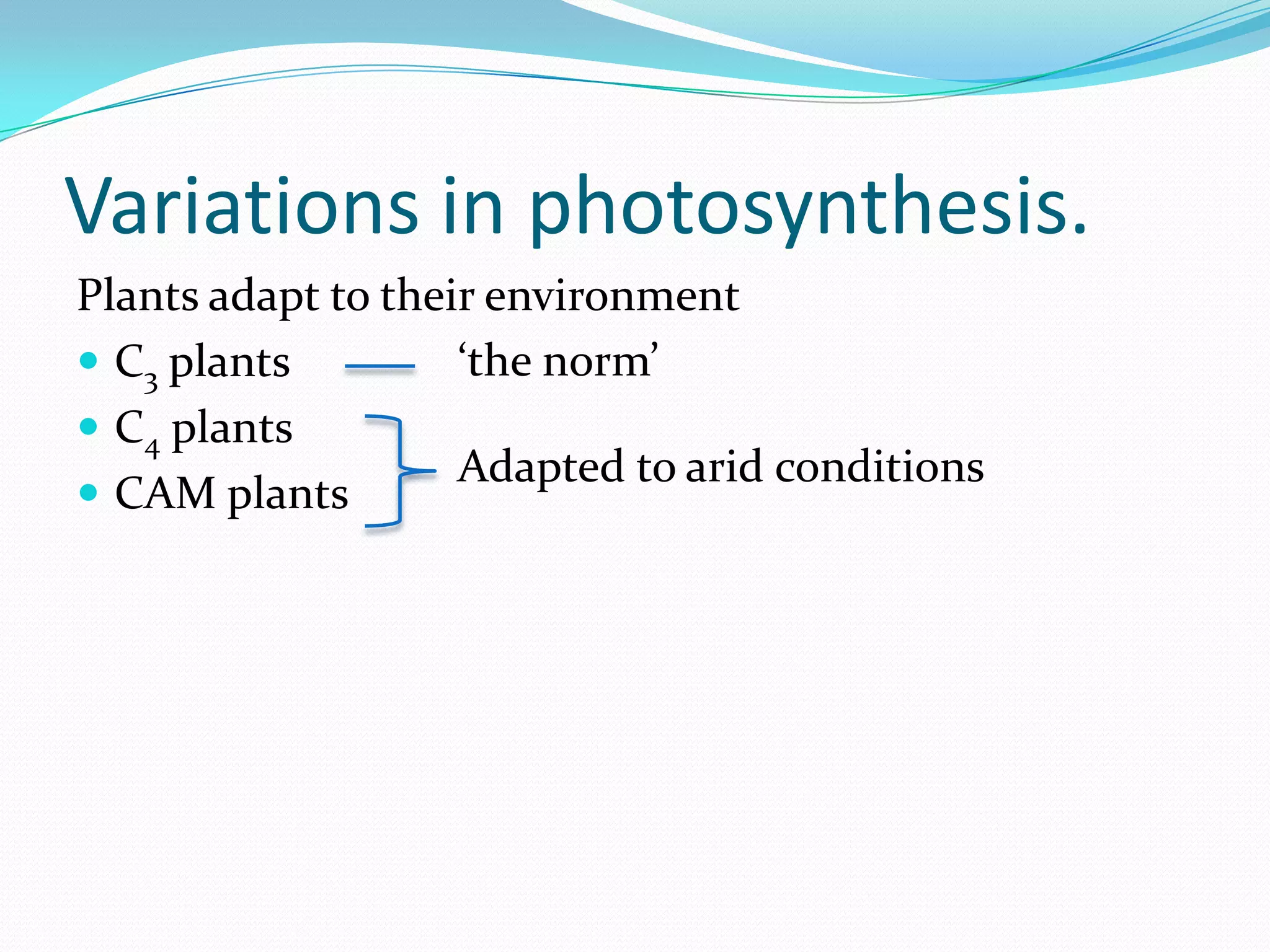
Variations in photosynthesis.
Plants adapt to their environment
 C3 plants
 C4 plants
 CAM plants
‘the norm’
Adapted to arid conditions
C3 plants.
 Called C3 because the CO2 is first incorporated into a
3-carbon compound.
 Stomata are open during the day.
 Photosynthesis takes place throughout the leaf.
 Adaptive value = more efficient than C4 and CAM
plants under cool and moist conditions and under
normal light because requires less machinery (fewer
enzymes and no specialized anatomy)..
 Most plants are C3.
C4 plants.
 Called C4 because the CO2 is first incorporated into a
4-carbon compound.
 Use a different enzyme to capture & convert CO2.
 Adaptive value = reduces the time the stomates are
open and therefore reduces water loss.
 C4 plants include several thousand species in at least
19 plant families. E.g. fourwing saltbush, corn, and
many of our summer annual plants.
CAM plants.
 Open their stomates at night.
 Convert the CO2 to an acid that is stored.
 During the day the acid is broken down back into CO2
and used during photosynthesis.
 Adaptive value = stomates are not open during day and
therefore reduces water loss.
 CAM plants include succulents, some orchids and
some bromeliads.
Energy transformations in cells

Energy transformations in cells

  • 1.
    Ian Anderson (2013) SaintIgnatius College Geelong 06. Energy transformations.
  • 2.
    Energy.  All livingorganisms require a constant supply of energy to survive e.g. for cellular processes (incl. protein synthesis, active transport, digestion etc.), growth, movement, reproduction, etc.  Energy = capacity to do work.
  • 3.
    Energy.  In plantsand animals glucose is the main source of chemical energy.  If there is insufficient glucose available, fatty acids and amino acids can be used instead.  Chemical energy is present in the chemical bonds.  When the bonds break, energy is released (i.e. exergonic reaction).
  • 4.
    ATP – ADPcycle.  Adenosine triphosphate (ATP) is the energy currency of a cell.  ATP is needed for every activity that requires energy.  ATP structure – adenosine attached to a sugar group (ribose), which is bound to a chain of three phosphate groups.  = nucleotide (sugar, N containing base and a phosphate group).  Immediate energy source lies in the energy rich bond holding the third phosphate to the rest of the molecule.
  • 5.
    ATP – ADPcycle. Source: Sadava et al. (2011)
  • 6.
    ATP – ADPcycle.  Cells make their own ATP in a cyclic process.  When energy is used ATP is broken down into Adenosine diphosphate (ADP) and inorganic phosphate, with energy released.  ATP is then reformed during cellular respiration.
  • 7.
    ATP – ADPcycle. Source: Sadava et al. (2011)
  • 8.
    Cellular respiration.  Theprocess that releases energy from glucose molecules in the form of ATP.  Cellular respiration is the most important and common catabolic reaction to all living organisms.  Occurs in several stages  [Biochemical/metabolic pathway = each step begins with a substrate, which is then converted to a product, which then becomes the substrate for another chemical reaction (each enzyme controlled)]. Source: Campbell et al. (2011)
  • 9.
    Cellular respiration.  Firststage = Glycolysis.  Occurs in cytosol.  Anaerobic (without oxygen) pathway.  Glucose is broken down into two pyruvate molecules, with a net production of two ATP molecules.  H+ and e- are released as glucose is split and collected by electron carrier molecule (nictoninamide adenine dinucleotide). Glucose  2 pyruvate + 2H2O + 2NADH + 2ATP (6 carbon sugar) (2 x 3 carbon sugar)
  • 10.
    Electron carrier molecule. H+ and e- are not stable and are quickly picked up by NAD (nictoninamide adenine dinucleotide) which acts as an electron carrier. NAD+  NADH Source: Russell et al. (2011)
  • 11.
    Cellular respiration. Next stageof cellular respiration depends on whether or not oxygen is available.  Oxygen available  aerobic pathway.  Oxygen not available  anaerobic pathway.
  • 12.
    Cellular respiration – aerobicpathway.  Most efficient way of producing ATP.  Occurs in mitochondria in eukaryotes.  Pyruvate enters via active transport.  (Occurs in cytoplasm of prokaryotes).  Involves two steps  Krebs cycle (Citric acid cycle).  Electron-transport chain.
  • 13.
    Cellular respiration – aerobicpathway. Krebs cycle.  Occurs in fluid matrix of mitochondria.  Pyruvate molecules converted to two molecules of acetyl CoA, one molecule of CO2 and 2 H+.  Acetyl CoA then enters Krebs Cycle where each molecule is converted into 2 CO2, 4 H+ & 1 ATP.  H+ are picked up by electron carriers (NAD & FADH).  A total of 2 ATP molecules produced per initial glucose molecule.
  • 14.
    Cellular respiration – aerobicpathway. Electron-transport chain.  Occurs on the cristae (inner membrane) of mitochondria.  Energy from the NADH and FADH2 produced in glycolysis and Krebs cycle used to produce ATP.  H+ combine with O2 to form H2O.  A total of 32-34 ATP from each original glucose molecule.  34 ATP in prokaryotes & 32 ATP in eukaryotes (2 ATP used as as NADH produced via glycolysis pass across mitochondrial membrane).
  • 15.
    Cellular respiration – aerobicpathway.  Total ATP produced via aerobic pathway  Glycolysis = 2 ATP  Krebs cycle = 2 ATP  Electron transport chain = 32-34 ATP  = total 36-38ATP Summary reaction of cellular respiration via aerobic pathway C6H12O6 + 6O2  6CO2 + 6 H2O + 36-38 ATP
  • 16.
    Cellular respiration – aerobicpathway. Source: Raven et al. (2011)
  • 17.
    Cellular respiration – anaerobicpathway.  Occurs in the cytoplasm of cells.  No further ATP is produced during the anaerobic pathway.  i.e. only 2 ATP produced as a result of glycolysis.  Anaerobic pathway known as fermentation.
  • 18.
    Cellular respiration – anaerobicpathway.  In animals  Pyruvate produced by glycolysis is converted to lactic acid.  NADH (produced during glycolysis) converted back to NAD+ (thus allowing it to be reused). Pyruvate + NADH  lactic acid + NAD+ Source: Campbell et al. (2011)
  • 19.
    Cellular respiration – anaerobicpathway.  In most plants, yeast & bacteria  Pyruvate is converted to ethanol and carbon dioxide.  NADH (produced during glycolysis) converted back to NAD+ (thus allowing it to be reused). Source: Campbell et al. (2011) Pyruvate + NADH  ethanol + CO2 + NAD+
  • 20.
    Energy.  The sunprovides this energy either directly or indirectly for nearly all life forms.  Autotrophs – manufacture organic material from inorganic material [self feeding] e.g. plants, algae & cyanobacteria.  Heterotrophs – obtain organic material by feeding on other organisms (or their products) [feed on others] e.g. animals, fungi, most bacteria & some protists.
  • 21.
    Photosynthesis.  Autotrophs (photoautotrophs)capture solar energy to help drive the reactions that convert inorganic C to organic C.  Overall process = photosynthesis 6CO2 + 12H2O  C6H12O6 + 6O2 + 6H2O
  • 22.
    Photosynthesis. 6CO2 + 12H2O C6H12O6 + 6O2 + 6H2O  Reaction is anabolic  Larger molecules made from smaller molecules  & endergonic  Needs energy to proceed.  Equation is a summary of 100’s of reactions that make up photosynthesis (i.e. it is a biochemical pathway).
  • 23.
    Photosynthesis.  Occurs inthe chloroplasts  Membrane bound organelles – inner & outer membrane.  Stroma – gel-like matrix that fills the interior of a chloroplast. Rich in enzymes.  Thylakoid membranes – suspended in the stroma. Flat, sac-like structures that are stacked like pancakes known collectively as grana.
  • 24.
  • 25.
    Photosynthesis.  Two mainstages  Light dependent reactions.  Light independent reactions.  Each stage confined to specific sites within the chloroplast.
  • 26.
    Photosynthesis - Light dependentreactions.  Light is essential for these reactions to occur.  Occurs on the thylakoid membranes of the chloroplast.  Chlorophyl absorbs light energy, which is then used to produce ATP and split water molecules into H+ ions and O2 gas.  O2 gas is a waste product.  ATP, H+ ions and electrons are used in the light independent reactions.
  • 27.
    Photosynthesis - Light independentreactions.  Also know as the Calvin Cycle.  Occurs in the stroma of the chloroplast.  Carbon dioxide is combined with the H+ ions using energy provided by ATP, to form glucose and water.
  • 28.
    Photosynthesis.  Summary reactionof photosynthesis 6CO2 + 12H2O  C6H12O6 + 6H2O + 6O2
  • 29.
    Photosynthesis. Factors that affectthe rate of photosynthesis.  Light intensity  CO2 availability  Temperature  Indirect factors  Lacking nitrogen/magnesium reduces the amount of chlorophyll produced.  Dehydration causes stomata to close.
  • 30.
    Variations in photosynthesis. Plantsadapt to their environment  C3 plants  C4 plants  CAM plants ‘the norm’ Adapted to arid conditions
  • 31.
    C3 plants.  CalledC3 because the CO2 is first incorporated into a 3-carbon compound.  Stomata are open during the day.  Photosynthesis takes place throughout the leaf.  Adaptive value = more efficient than C4 and CAM plants under cool and moist conditions and under normal light because requires less machinery (fewer enzymes and no specialized anatomy)..  Most plants are C3.
  • 32.
    C4 plants.  CalledC4 because the CO2 is first incorporated into a 4-carbon compound.  Use a different enzyme to capture & convert CO2.  Adaptive value = reduces the time the stomates are open and therefore reduces water loss.  C4 plants include several thousand species in at least 19 plant families. E.g. fourwing saltbush, corn, and many of our summer annual plants.
  • 33.
    CAM plants.  Opentheir stomates at night.  Convert the CO2 to an acid that is stored.  During the day the acid is broken down back into CO2 and used during photosynthesis.  Adaptive value = stomates are not open during day and therefore reduces water loss.  CAM plants include succulents, some orchids and some bromeliads.

Editor's Notes

  • #10 http://www.sumanasinc.com/webcontent/animations/content/cellularrespiration.html
  • #13 http://www.sumanasinc.com/webcontent/animations/content/cellularrespiration.html
  • #21 Photoautotrophs – capture solar energyChemoautotrphs – use inorganic molecules to produce storable chemical energy
  • #29 Limiting factors
  • #30 Limiting factors