1
INTRODUCTION OF DNA
• DNA is a double stranded molecule that is
twisted into a Helix
• DNA are macromolecular structures
composed of regular repeating polymers
formed from nucleotides.
• DNA is a complex molecule that contains of
the information necessary to build and
organism
COMPONENTS
OF NUCLOTIDE
Nitrogenous Bases
Deoxyribose Sugar
Phosphate Group
3
NITROGENOUS
BASE
CYTOSINE
THYMINE
ADENINE GUANINE
• CYTOSINE
• THYMINE
PYRIMIDINE
• ADENINE
• GUANINE
PURINE
4
DEOXYRIBOSE
SUGAR
• The sugars found in
nucleic acids are pentose
sugar ; a pentose sugar
has five carbon atoms.
• Deoxyribose, found in
DNA , is a modified
sugar , lacking one
oxygen atom (hence the
name “deoxy”).
5
PHOSPHATE
GROUP
• A phosphate group is
just a phosphorus atom
bound to four oxygen
atoms , but it has many
important roles.Along
with sugars and bases, it
makes up nucleic acids.
6
THE SECONDARY
STRUCTURE OF DNA
• The sides of the ladder are made up of
alternating molecules of phosphate
and deoxyribose.
• The bases make up the rungs of the
ladder are attracted by a weak
chemical bonds called hydrogen
bonds.
Watson and Crick Model
7
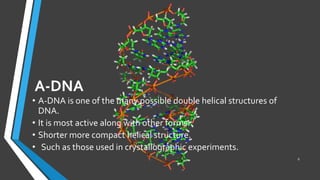
A-DNA
• A-DNA is one of the many possible double helical structures of
DNA.
• It is most active along with other forms.
• Shorter more compact helical structure.
• Such as those used in crystallographic experiments.
8
B-DNA
• Helical sense : right handed.
• Base pairs : almost perpendicular to the ,helix axis ; 3.4
angstrom apart.
• One turn of the helix : 36 angstrom; which is equals to 10.4
base pairs. 9
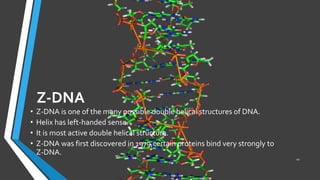
Z-DNA
• Z-DNA is one of the many possible double helical structures of DNA.
• Helix has left-handed sense.
• It is most active double helical structure.
• Z-DNA was first discovered in 1979,certain proteins bind very strongly to
Z-DNA.
10
11

DNA STRUCTURE AND TYPES.pptx

  • 1.
  • 2.
    INTRODUCTION OF DNA •DNA is a double stranded molecule that is twisted into a Helix • DNA are macromolecular structures composed of regular repeating polymers formed from nucleotides. • DNA is a complex molecule that contains of the information necessary to build and organism
  • 3.
  • 4.
    NITROGENOUS BASE CYTOSINE THYMINE ADENINE GUANINE • CYTOSINE •THYMINE PYRIMIDINE • ADENINE • GUANINE PURINE 4
  • 5.
    DEOXYRIBOSE SUGAR • The sugarsfound in nucleic acids are pentose sugar ; a pentose sugar has five carbon atoms. • Deoxyribose, found in DNA , is a modified sugar , lacking one oxygen atom (hence the name “deoxy”). 5
  • 6.
    PHOSPHATE GROUP • A phosphategroup is just a phosphorus atom bound to four oxygen atoms , but it has many important roles.Along with sugars and bases, it makes up nucleic acids. 6
  • 7.
    THE SECONDARY STRUCTURE OFDNA • The sides of the ladder are made up of alternating molecules of phosphate and deoxyribose. • The bases make up the rungs of the ladder are attracted by a weak chemical bonds called hydrogen bonds. Watson and Crick Model 7
  • 8.
    A-DNA • A-DNA isone of the many possible double helical structures of DNA. • It is most active along with other forms. • Shorter more compact helical structure. • Such as those used in crystallographic experiments. 8
  • 9.
    B-DNA • Helical sense: right handed. • Base pairs : almost perpendicular to the ,helix axis ; 3.4 angstrom apart. • One turn of the helix : 36 angstrom; which is equals to 10.4 base pairs. 9
  • 10.
    Z-DNA • Z-DNA isone of the many possible double helical structures of DNA. • Helix has left-handed sense. • It is most active double helical structure. • Z-DNA was first discovered in 1979,certain proteins bind very strongly to Z-DNA. 10
  • 11.