Department of Biotechnology
Student code: BWU/BBT/19/022
Roll no:19010310021
Registration no:19013000367
Department of Biotechnology
Student code: BWU/BBT/19/022
Roll no:19010310021
Registration no:19013000367
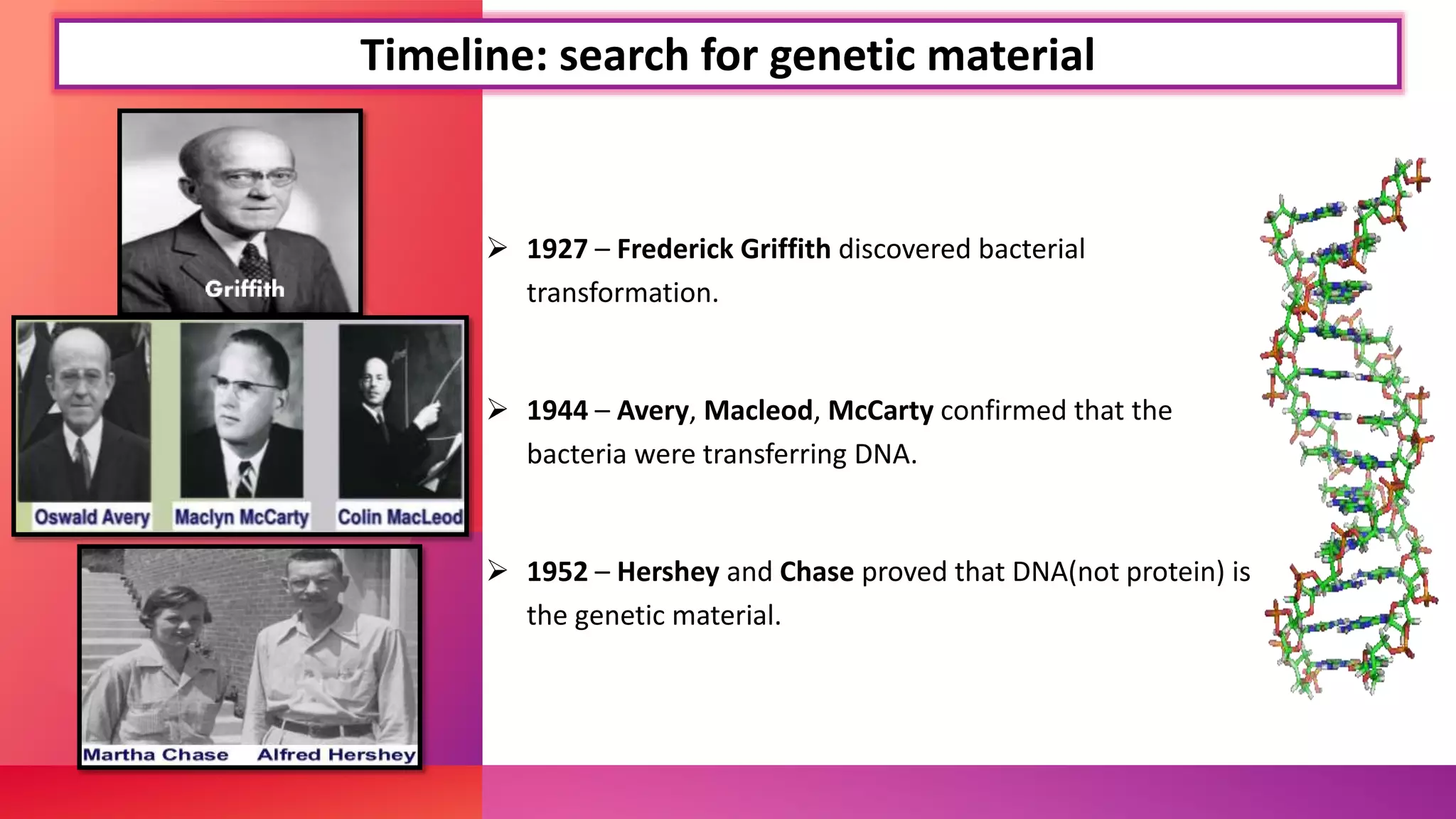
 1927 – Frederick Griffith discovered bacterial
transformation.
 1944 – Avery, Macleod, McCarty confirmed that the
bacteria were transferring DNA.
 1952 – Hershey and Chase proved that DNA(not protein) is
the genetic material.
Timeline: search for genetic material
Sample
Footer
Text
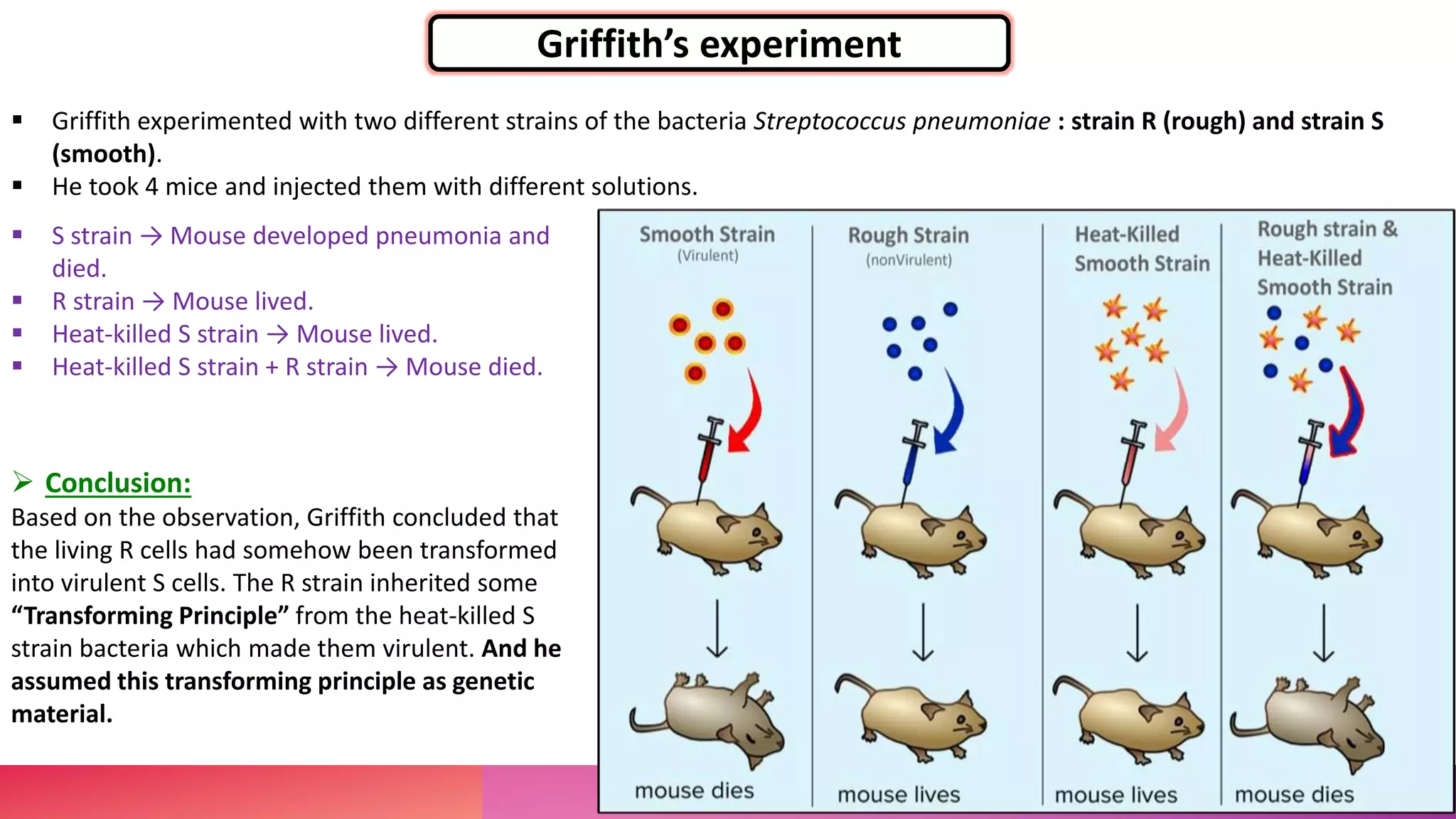
 S strain → Mouse developed pneumonia and
died.
 R strain → Mouse lived.
 Heat-killed S strain → Mouse lived.
 Heat-killed S strain + R strain → Mouse died.
 Conclusion:
Based on the observation, Griffith concluded that
the living R cells had somehow been transformed
into virulent S cells. The R strain inherited some
“Transforming Principle” from the heat-killed S
strain bacteria which made them virulent. And he
assumed this transforming principle as genetic
material.
 Griffith experimented with two different strains of the bacteria Streptococcus pneumoniae : strain R (rough) and strain S
(smooth).
 He took 4 mice and injected them with different solutions.
Griffith’s experiment
Sample
Footer
Text
 They first treated the heat-killed S strain with proteases to
break down proteins. Subsequently, they treated it with
RNAses and then DNAses to break down RNA and DNA,
respectively.
 Both protease and RNAse treatments did not affect the
transformation of the R strain into the virulent one. Finally,
treatment with DNAses inhibited the transformation of the R
strain.
 Conclusion: They concluded that the genetic material is not
protein or RNA, but it is DNA. However, this discovery was
not accepted by all biologists.
Avery, MacLeod, and McCarty purified DNA, RNA, and proteins from the heat-killed S strain and determined which
macromolecule converted the R strain into the S strain.
Avery, Macleod, McCarty Experiment
 Viruses (T2 bacteriophage) were grown in one of two isotopic mediums in order to radioactively label a specific viral
component.
 Viruses grown in radioactive sulfur (35S) had radio-labelled proteins.
 Viruses grown in radioactive phosphorus (32P) had radiolabeled DNA.
 The bacterial pellet was found to be
radioactive when infected by the 32P–
viruses (DNA) but not the 35S–viruses
(protein).
 Conclusion: Hershey & Chase concluded
that DNA, not protein, was the genetic
material because DNA was transferred to
the bacteria.
Experiments of Hershey and Chase
DNA IS GENETIC METERIAL.pptx

DNA IS GENETIC METERIAL.pptx

  • 1.
    Department of Biotechnology Studentcode: BWU/BBT/19/022 Roll no:19010310021 Registration no:19013000367 Department of Biotechnology Student code: BWU/BBT/19/022 Roll no:19010310021 Registration no:19013000367
  • 2.
     1927 –Frederick Griffith discovered bacterial transformation.  1944 – Avery, Macleod, McCarty confirmed that the bacteria were transferring DNA.  1952 – Hershey and Chase proved that DNA(not protein) is the genetic material. Timeline: search for genetic material
  • 3.
    Sample Footer Text  S strain→ Mouse developed pneumonia and died.  R strain → Mouse lived.  Heat-killed S strain → Mouse lived.  Heat-killed S strain + R strain → Mouse died.  Conclusion: Based on the observation, Griffith concluded that the living R cells had somehow been transformed into virulent S cells. The R strain inherited some “Transforming Principle” from the heat-killed S strain bacteria which made them virulent. And he assumed this transforming principle as genetic material.  Griffith experimented with two different strains of the bacteria Streptococcus pneumoniae : strain R (rough) and strain S (smooth).  He took 4 mice and injected them with different solutions. Griffith’s experiment
  • 4.
    Sample Footer Text  They firsttreated the heat-killed S strain with proteases to break down proteins. Subsequently, they treated it with RNAses and then DNAses to break down RNA and DNA, respectively.  Both protease and RNAse treatments did not affect the transformation of the R strain into the virulent one. Finally, treatment with DNAses inhibited the transformation of the R strain.  Conclusion: They concluded that the genetic material is not protein or RNA, but it is DNA. However, this discovery was not accepted by all biologists. Avery, MacLeod, and McCarty purified DNA, RNA, and proteins from the heat-killed S strain and determined which macromolecule converted the R strain into the S strain. Avery, Macleod, McCarty Experiment
  • 5.
     Viruses (T2bacteriophage) were grown in one of two isotopic mediums in order to radioactively label a specific viral component.  Viruses grown in radioactive sulfur (35S) had radio-labelled proteins.  Viruses grown in radioactive phosphorus (32P) had radiolabeled DNA.  The bacterial pellet was found to be radioactive when infected by the 32P– viruses (DNA) but not the 35S–viruses (protein).  Conclusion: Hershey & Chase concluded that DNA, not protein, was the genetic material because DNA was transferred to the bacteria. Experiments of Hershey and Chase