   The absorption and subsequent re-radiation of light by organic and inorganic
    specimens is typically the result of well-established physical phenomena
    described as being either fluorescence or phosphorescence. The emission of
    light through the fluorescence process is nearly simultaneous with the
    absorption of the excitation light due to a relatively short time delay between
    photon absorption and emission, ranging usually less than a microsecond in
    duration. When emission persists longer after the excitation light has been
    extinguished, the phenomenon is referred to as phosphorescence.
British scientist Sir George G. Stokes first described fluorescence in 1852 and was
   responsible for coining the term when he observed that the mineral fluorspar
   emitted red light when it was illuminated by ultraviolet excitation. Stokes noted that
   fluorescence emission always occurred at a longer wavelength than that of the
   excitation light. Early investigations in the 19th century showed that many specimens
   (including minerals, crystals, resins, crude drugs, butter, chlorophyll, vitamins, and
   inorganic compounds) fluoresce when irradiated with ultraviolet light. However, it
   was not until the 1930s that the use of fluorochromes was initiated in biological
   investigations to stain tissue components, bacteria, and other pathogens. Several of
   these stains were highly specific and stimulated the development of the fluorescence
   microscopeThe technique of fluorescence microscopy has become an essential tool
   in biology and the biomedical sciences, as well as in materials science due to
   attributes that are not readily available in other contrast modes with traditional
   optical microscope
   Fluorescence microscopy is a very powerful technology
    that can be used in many fields of science, particularly
    medical sciences. This technology is based on the
    natural phenomena of fluorescence, which is the
    absorption and release of light by organisms. A
    fluorescence microscope is able to detect this emission
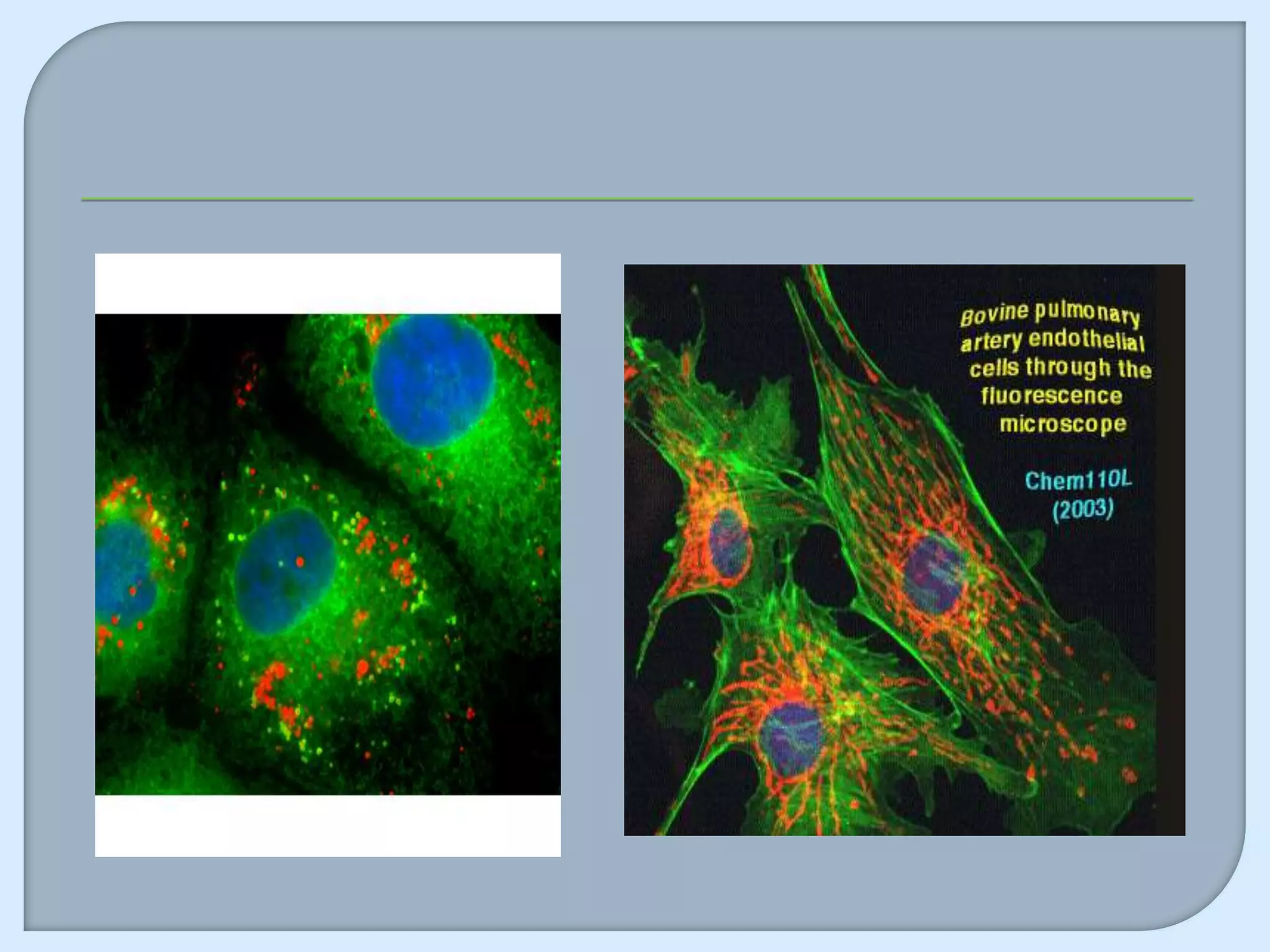
    of light from an organism. If an organism or sample
    does not naturally have fluorescence, various dyes and
    even genes can be inserted into their genome such that
    they can emit light. Due to the nature of the organism
    emitting light, images are seen against a dark
    background, allowing for very specific and sensitive
    measurements and observations.
Principle of Fluorescence
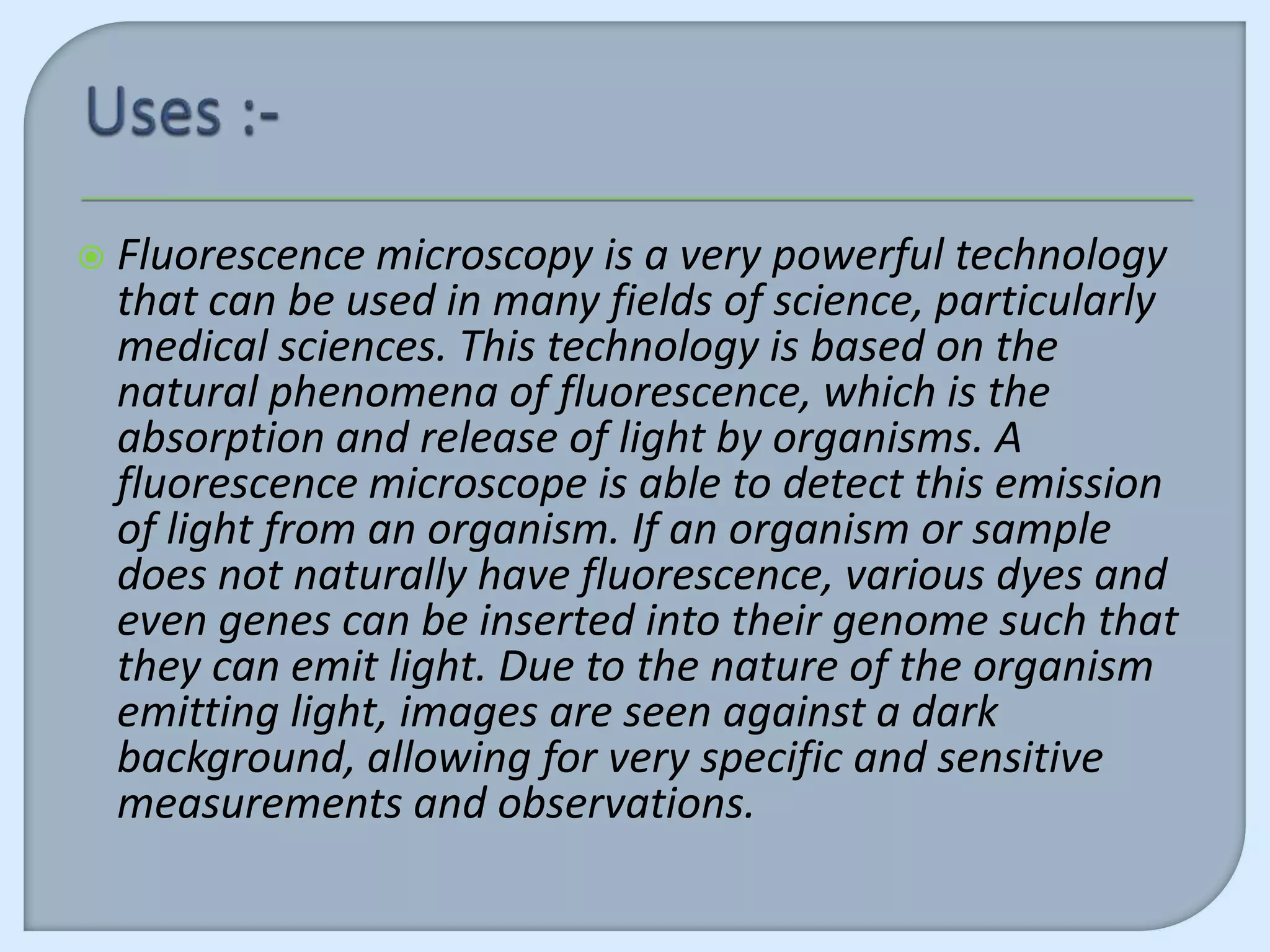
    The specimen is illuminated with light of a specific wavelength (or
    wavelengths) which is absorbed by the fluorophores, causing them
    to emit light of longer wavelengths (i.e., of a different color than the
    absorbed light). The illumination light is separated from the much
    weaker emitted fluorescence through the use of a spectral emission
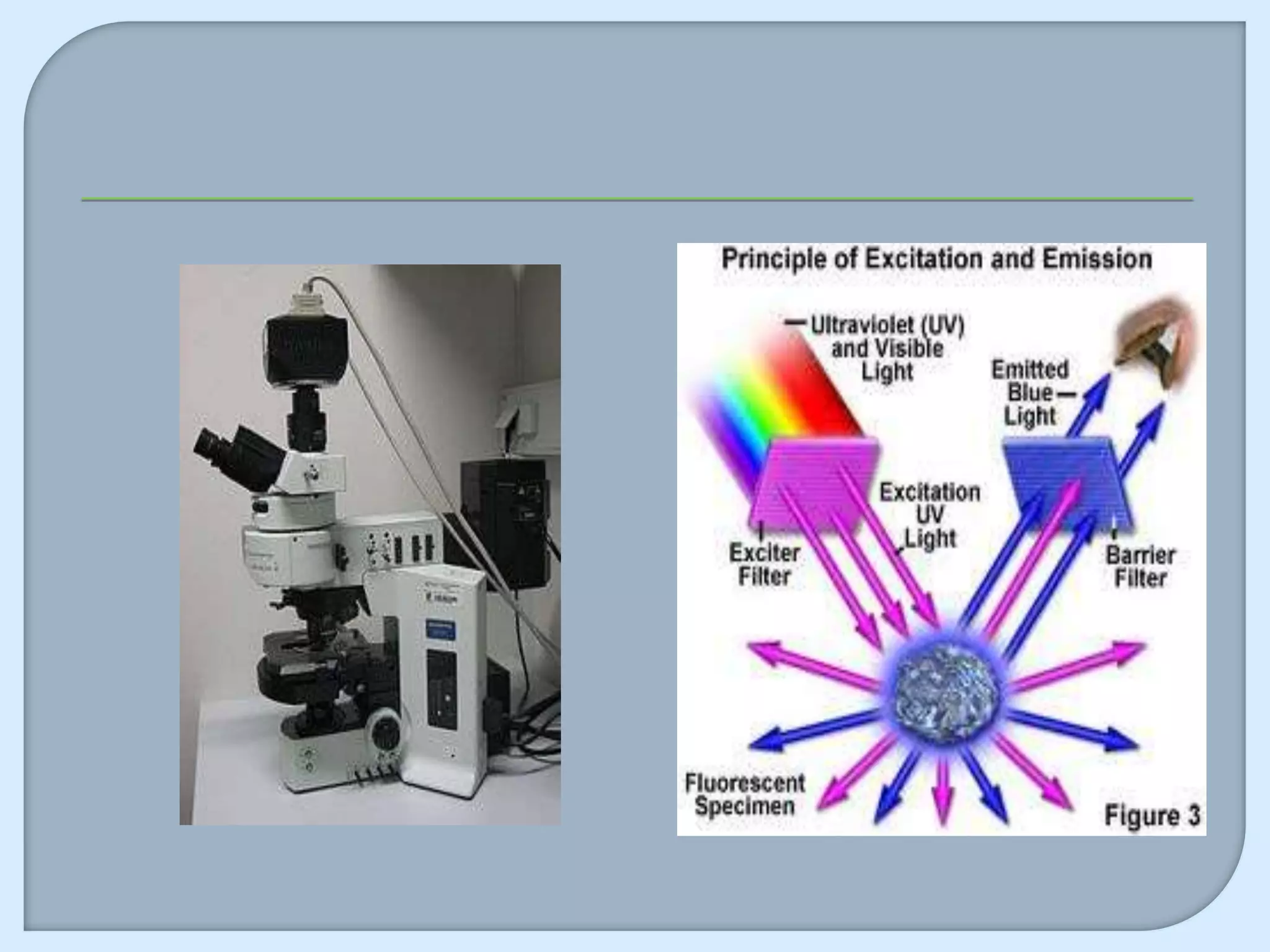
    filter. Typical components of a fluorescence microscope are a light
    source (xenon arc lamp or mercury-vapor lamp), the excitation
    filter, the dichroic mirror (or dichroic beamsplitter), and theemission
    filter (see figure below). The filters and the dichroic are chosen to
    match the spectral excitation and emission characteristics of the
    fluorophore used to label the specimen.[1] In this manner, the
    distribution of a single fluorophore (color) is imaged at a time.
    Multi-color images of several types of fluorophores must be
    composed by combining several single-color images.[1]
   Most fluorescence microscopes in use are epifluorescence
    microscopes (i.e., excitation and observation of the fluorescence are
    from above (epi–) the specimen). These microscopes have become
    an important part in the field of biology, opening the doors for more
    advanced microscope designs, such as the confocal microscope and
    the total internal reflection fluorescence microscope (TIRF).
  A. fluorescence micsoscopy can be used with any light microscope
B. fluorescence micsoscopy can be used with live specimens
C. fluorescence micsoscopy can be used with an electron microscope
D. fluorescence micsoscopy is less expensive and easier to use

DISADVANTAGES:-
Photobleaching and also some limitations arise from
  1) the availability of target specific antibodies. If they are not
  commercially available you have to make them which is time
  and money consuming.
  2) Specificity of the antibody. Sometimes the antibody will
  bind other targets not intended for visualization and make it
  difficult to locate the target.
  3) Ability of the antibody to diffuse to the target. Sometimes
  the target protein it sequestered in a location that is difficult
  to reach with the antibody.

123456

  • 1.
    The absorption and subsequent re-radiation of light by organic and inorganic specimens is typically the result of well-established physical phenomena described as being either fluorescence or phosphorescence. The emission of light through the fluorescence process is nearly simultaneous with the absorption of the excitation light due to a relatively short time delay between photon absorption and emission, ranging usually less than a microsecond in duration. When emission persists longer after the excitation light has been extinguished, the phenomenon is referred to as phosphorescence. British scientist Sir George G. Stokes first described fluorescence in 1852 and was responsible for coining the term when he observed that the mineral fluorspar emitted red light when it was illuminated by ultraviolet excitation. Stokes noted that fluorescence emission always occurred at a longer wavelength than that of the excitation light. Early investigations in the 19th century showed that many specimens (including minerals, crystals, resins, crude drugs, butter, chlorophyll, vitamins, and inorganic compounds) fluoresce when irradiated with ultraviolet light. However, it was not until the 1930s that the use of fluorochromes was initiated in biological investigations to stain tissue components, bacteria, and other pathogens. Several of these stains were highly specific and stimulated the development of the fluorescence microscopeThe technique of fluorescence microscopy has become an essential tool in biology and the biomedical sciences, as well as in materials science due to attributes that are not readily available in other contrast modes with traditional optical microscope
  • 3.
    Fluorescence microscopy is a very powerful technology that can be used in many fields of science, particularly medical sciences. This technology is based on the natural phenomena of fluorescence, which is the absorption and release of light by organisms. A fluorescence microscope is able to detect this emission of light from an organism. If an organism or sample does not naturally have fluorescence, various dyes and even genes can be inserted into their genome such that they can emit light. Due to the nature of the organism emitting light, images are seen against a dark background, allowing for very specific and sensitive measurements and observations.
  • 5.
    Principle of Fluorescence  The specimen is illuminated with light of a specific wavelength (or wavelengths) which is absorbed by the fluorophores, causing them to emit light of longer wavelengths (i.e., of a different color than the absorbed light). The illumination light is separated from the much weaker emitted fluorescence through the use of a spectral emission filter. Typical components of a fluorescence microscope are a light source (xenon arc lamp or mercury-vapor lamp), the excitation filter, the dichroic mirror (or dichroic beamsplitter), and theemission filter (see figure below). The filters and the dichroic are chosen to match the spectral excitation and emission characteristics of the fluorophore used to label the specimen.[1] In this manner, the distribution of a single fluorophore (color) is imaged at a time. Multi-color images of several types of fluorophores must be composed by combining several single-color images.[1]  Most fluorescence microscopes in use are epifluorescence microscopes (i.e., excitation and observation of the fluorescence are from above (epi–) the specimen). These microscopes have become an important part in the field of biology, opening the doors for more advanced microscope designs, such as the confocal microscope and the total internal reflection fluorescence microscope (TIRF).
  • 6.
     A.fluorescence micsoscopy can be used with any light microscope B. fluorescence micsoscopy can be used with live specimens C. fluorescence micsoscopy can be used with an electron microscope D. fluorescence micsoscopy is less expensive and easier to use DISADVANTAGES:- Photobleaching and also some limitations arise from 1) the availability of target specific antibodies. If they are not commercially available you have to make them which is time and money consuming. 2) Specificity of the antibody. Sometimes the antibody will bind other targets not intended for visualization and make it difficult to locate the target. 3) Ability of the antibody to diffuse to the target. Sometimes the target protein it sequestered in a location that is difficult to reach with the antibody.