A N Khudaiwala (L.M.E) G.P.PORBANDAR
Objectives Have a deeper understanding of laminar and
turbulent flow in pipes and the analysis of fully
developed flow.
 Calculate the major and minor losses associated with
pipe flow in piping networks and determine the
pumping power requirements.
A N Khudaiwala (L.M.E) G.P.PORBANDAR
Introduction
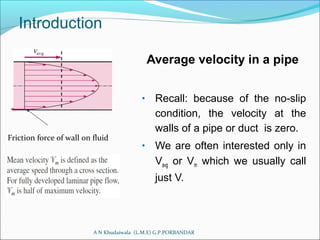
Average velocity in a pipe
• Recall: because of the no-slip
condition, the velocity at the
walls of a pipe or duct is zero.
• We are often interested only in
Vavg or Vm which we usually call
just V.
A N Khudaiwala (L.M.E) G.P.PORBANDAR
Friction force of wall on fluid
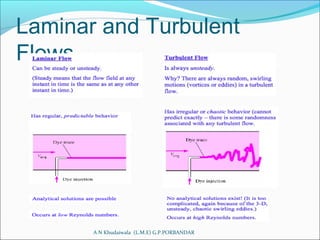
Laminar and Turbulent
Flows
A N Khudaiwala (L.M.E) G.P.PORBANDAR
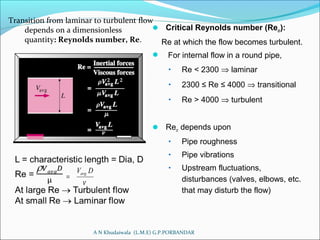
 Critical Reynolds number (Recr):
Re at which the flow becomes turbulent.
 For internal flow in a round pipe,
• Re < 2300 ⇒ laminar
• 2300 ≤ Re ≤ 4000 ⇒ transitional
• Re > 4000 ⇒ turbulent
 Recr depends upon
• Pipe roughness
• Pipe vibrations
• Upstream fluctuations,
disturbances (valves, elbows, etc.
that may disturb the flow)
A N Khudaiwala (L.M.E) G.P.PORBANDAR
Transition from laminar to turbulent flow
depends on a dimensionless
quantity: Reynolds number, Re.
ν
DVavg
=
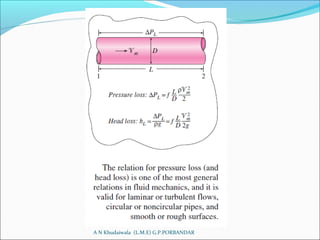
Head Loss
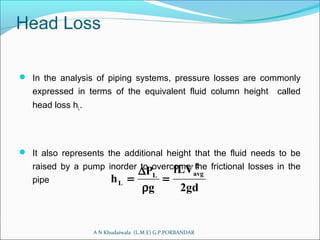
 In the analysis of piping systems, pressure losses are commonly
expressed in terms of the equivalent fluid column height called
head loss hL.
 It also represents the additional height that the fluid needs to be
raised by a pump inorder to overcome the frictional losses in the
pipe
A N Khudaiwala (L.M.E) G.P.PORBANDAR
gd2
fLV
g
P
h
2
avgL
L =
ρ
∆
=
A N Khudaiwala (L.M.E) G.P.PORBANDAR
Water Hammer Phenomenon in pipelines
A sudden change of flow rate in a large pipeline (due to
valve closure, pump turnoff, etc.) may involve a great mass
of water moving inside the pipe.
The force resulting from changing the speed of the water
mass may cause a pressure rise in the pipe with a magnitude
several times greater than the normal static pressure in the
pipe.
The excessive pressure may fracture the pipe walls or cause
other damage to the pipeline system.
This phenomenon is commonly known as the water hammer
phenomenon A N Khudaiwala (L.M.E) G.P.PORBANDAR
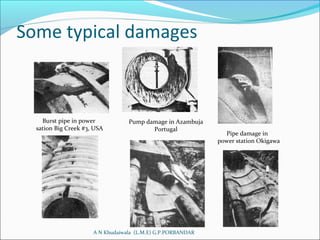
Some typical damages
A N Khudaiwala (L.M.E) G.P.PORBANDAR
Pipe damage in
power station Okigawa
Burst pipe in power
sation Big Creek #3, USA
Pump damage in Azambuja
Portugal
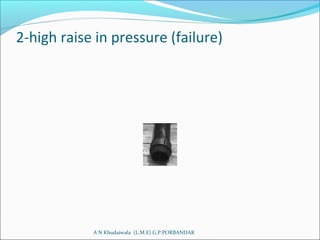
2-high raise in pressure (failure)
A N Khudaiwala (L.M.E) G.P.PORBANDAR
Water Hammer
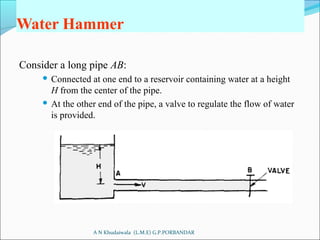
Consider a long pipe AB:
 Connected at one end to a reservoir containing water at a height
H from the center of the pipe.
 At the other end of the pipe, a valve to regulate the flow of water
is provided.
A N Khudaiwala (L.M.E) G.P.PORBANDAR
 If the valve is suddenly closed, the flowing water
will be obstructed and momentum will be destroyed
and consequently a wave of high pressure will be
created which travels back and forth starting at the
valve, traveling to the reservoir, and returning back
to the valve and so on.
This wave of high pressureThis wave of high pressure::
1. Has a very high speed (called celerity, C ) which
may reach the speed of sound wave and may create
noise called knocking,
2. Has the effect of hammering action on the walls of
the pipe and hence is commonly known as the water
hammer phenomenon.
A N Khudaiwala (L.M.E) G.P.PORBANDAR
The kinetic energy of the water moving through the
pipe is converted into potential energy stored in the
water and the walls of the pipe through the elastic
deformation of both.
The water is compressed and the pipe material is
stretched.
The following figure illustrates the formation and
transition of the pressure wave due to the sudden
closure of the valve
A N Khudaiwala (L.M.E) G.P.PORBANDAR
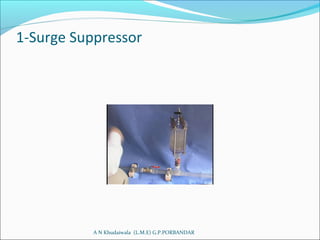
1-Surge Suppressor
A N Khudaiwala (L.M.E) G.P.PORBANDAR

Flow through pipe

  • 1.
    A N Khudaiwala(L.M.E) G.P.PORBANDAR
  • 2.
    Objectives Have adeeper understanding of laminar and turbulent flow in pipes and the analysis of fully developed flow.  Calculate the major and minor losses associated with pipe flow in piping networks and determine the pumping power requirements. A N Khudaiwala (L.M.E) G.P.PORBANDAR
  • 3.
    Introduction Average velocity ina pipe • Recall: because of the no-slip condition, the velocity at the walls of a pipe or duct is zero. • We are often interested only in Vavg or Vm which we usually call just V. A N Khudaiwala (L.M.E) G.P.PORBANDAR Friction force of wall on fluid
  • 4.
    Laminar and Turbulent Flows AN Khudaiwala (L.M.E) G.P.PORBANDAR
  • 5.
     Critical Reynoldsnumber (Recr): Re at which the flow becomes turbulent.  For internal flow in a round pipe, • Re < 2300 ⇒ laminar • 2300 ≤ Re ≤ 4000 ⇒ transitional • Re > 4000 ⇒ turbulent  Recr depends upon • Pipe roughness • Pipe vibrations • Upstream fluctuations, disturbances (valves, elbows, etc. that may disturb the flow) A N Khudaiwala (L.M.E) G.P.PORBANDAR Transition from laminar to turbulent flow depends on a dimensionless quantity: Reynolds number, Re. ν DVavg =
  • 6.
    Head Loss  Inthe analysis of piping systems, pressure losses are commonly expressed in terms of the equivalent fluid column height called head loss hL.  It also represents the additional height that the fluid needs to be raised by a pump inorder to overcome the frictional losses in the pipe A N Khudaiwala (L.M.E) G.P.PORBANDAR gd2 fLV g P h 2 avgL L = ρ ∆ =
  • 7.
    A N Khudaiwala(L.M.E) G.P.PORBANDAR
  • 8.
    A N Khudaiwala(L.M.E) G.P.PORBANDAR
  • 9.
    Water Hammer Phenomenonin pipelines A sudden change of flow rate in a large pipeline (due to valve closure, pump turnoff, etc.) may involve a great mass of water moving inside the pipe. The force resulting from changing the speed of the water mass may cause a pressure rise in the pipe with a magnitude several times greater than the normal static pressure in the pipe. The excessive pressure may fracture the pipe walls or cause other damage to the pipeline system. This phenomenon is commonly known as the water hammer phenomenon A N Khudaiwala (L.M.E) G.P.PORBANDAR
  • 10.
    Some typical damages AN Khudaiwala (L.M.E) G.P.PORBANDAR Pipe damage in power station Okigawa Burst pipe in power sation Big Creek #3, USA Pump damage in Azambuja Portugal
  • 11.
    2-high raise inpressure (failure) A N Khudaiwala (L.M.E) G.P.PORBANDAR
  • 12.
    Water Hammer Consider along pipe AB:  Connected at one end to a reservoir containing water at a height H from the center of the pipe.  At the other end of the pipe, a valve to regulate the flow of water is provided. A N Khudaiwala (L.M.E) G.P.PORBANDAR
  • 13.
     If thevalve is suddenly closed, the flowing water will be obstructed and momentum will be destroyed and consequently a wave of high pressure will be created which travels back and forth starting at the valve, traveling to the reservoir, and returning back to the valve and so on. This wave of high pressureThis wave of high pressure:: 1. Has a very high speed (called celerity, C ) which may reach the speed of sound wave and may create noise called knocking, 2. Has the effect of hammering action on the walls of the pipe and hence is commonly known as the water hammer phenomenon. A N Khudaiwala (L.M.E) G.P.PORBANDAR
  • 14.
    The kinetic energyof the water moving through the pipe is converted into potential energy stored in the water and the walls of the pipe through the elastic deformation of both. The water is compressed and the pipe material is stretched. The following figure illustrates the formation and transition of the pressure wave due to the sudden closure of the valve A N Khudaiwala (L.M.E) G.P.PORBANDAR
  • 15.
    1-Surge Suppressor A NKhudaiwala (L.M.E) G.P.PORBANDAR