Unsteady Flow in Pipes
The Islamic University of Gaza
Faculty of Engineering
Civil Engineering Department
Hydraulics - ECIV 3322
Chapter 4
• A sudden change of flow rate in a large pipeline (due to
valve closure, pump turnoff, etc.) may involve a great mass
of water moving inside the pipe.
• The force resulting from changing the speed of the water
mass may cause a pressure rise in the pipe with a magnitude
several times greater than the normal static pressure in the
pipe.
• The excessive pressure may fracture the pipe walls or cause
other damage to the pipeline system.
• This phenomenon is commonly known as the water hammer
phenomenon
Water Hammer Phenomenon in
pipelines
Some typical damages
Pipe damage in
power station Okigawa
Burst pipe in power
sation Big Creek #3, USA
Pump damage in Azambuja
Portugal
Water Hammer
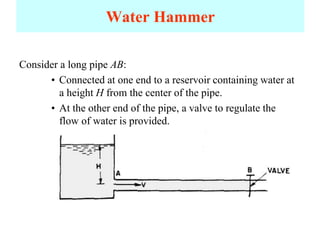
Consider a long pipe AB:
• Connected at one end to a reservoir containing water at
a height H from the center of the pipe.
• At the other end of the pipe, a valve to regulate the
flow of water is provided.
• If the valve is suddenly closed, the flowing water
will be obstructed and momentum will be destroyed
and consequently a wave of high pressure will be
created which travels back and forth starting at the
valve, traveling to the reservoir, and returning back
to the valve and so on.
This wave of high pressure:
1. Has a very high speed (called celerity, C ) which
may reach the speed of sound wave and may create
noise called knocking,
2. Has the effect of hammering action on the walls of
the pipe and hence is commonly known as the water
hammer phenomenon.
• The kinetic energy of the water moving through the
pipe is converted into potential energy stored in the
water and the walls of the pipe through the elastic
deformation of both.
• The water is compressed and the pipe material is
stretched.
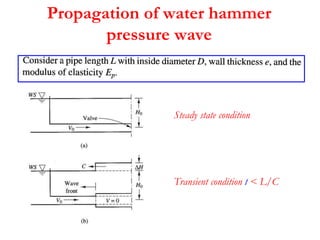
• The following figure illustrates the formation and
transition of the pressure wave due to the sudden
closure of the valve
Propagation of water hammer
pressure wave
Steady state condition
Transient condition t < L/C
Transient condition t = L/C
Transient condition L/C >t >2L/C
Transient condition t =2L/C
Transient condition t = 3L/C
Transient condition 2L/C >t >3L/C
Transient condition 3L/C >t >4L/C
Transient condition t = 4L/C
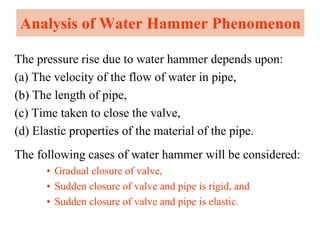
Analysis of Water Hammer Phenomenon
The pressure rise due to water hammer depends upon:
(a) The velocity of the flow of water in pipe,
(b) The length of pipe,
(c) Time taken to close the valve,
(d) Elastic properties of the material of the pipe.
The following cases of water hammer will be considered:
• Gradual closure of valve,
• Sudden closure of valve and pipe is rigid, and
• Sudden closure of valve and pipe is elastic.
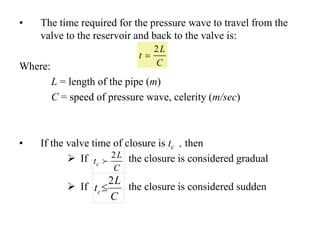
• The time required for the pressure wave to travel from the
valve to the reservoir and back to the valve is:
Where:
L = length of the pipe (m)
C = speed of pressure wave, celerity (m/sec)
• If the valve time of closure is tc , then
 If the closure is considered gradual
 If the closure is considered sudden
t
L
C

2
t
L
C
c 
2
C
L
tc
2

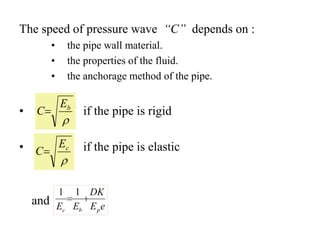
The speed of pressure wave “C” depends on :
• the pipe wall material.
• the properties of the fluid.
• the anchorage method of the pipe.
• if the pipe is rigid
• if the pipe is elastic
and

b
E
C

c
E
C
e
E
K
D
E
E p
b
c


1
1
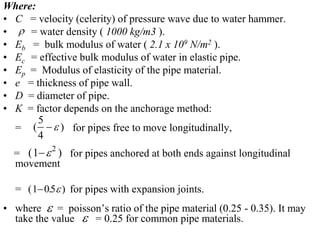
Where:
• C = velocity (celerity) of pressure wave due to water hammer.
• = water density ( 1000 kg/m3 ).
• Eb = bulk modulus of water ( 2.1 x 10⁹ N/m2 ).
• Ec = effective bulk modulus of water in elastic pipe.
• Ep = Modulus of elasticity of the pipe material.
• e = thickness of pipe wall.
• D = diameter of pipe.
• K = factor depends on the anchorage method:
= for pipes free to move longitudinally,
= for pipes anchored at both ends against longitudinal
movement
= for pipes with expansion joints.
• where = poisson’s ratio of the pipe material (0.25 - 0.35). It may
take the value = 0.25 for common pipe materials.

( )
5
4

( )
1 2

( . )
1 05
 


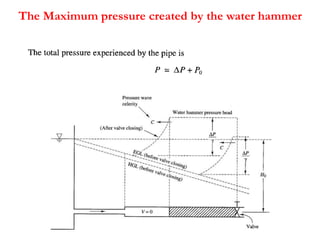
The Maximum pressure created by the water hammer
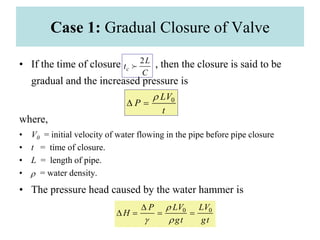
Case 1: Gradual Closure of Valve
• If the time of closure , then the closure is said to be
gradual and the increased pressure is
where,
• V0 = initial velocity of water flowing in the pipe before pipe closure
• t = time of closure.
• L = length of pipe.
• = water density.
• The pressure head caused by the water hammer is
t
L
C
c 
2
 P
LV
t

 0



H
P LV
gt
LV
gt
  



0 0
 
N
P
P N
N
o 


 4
2
2









t
P
LV
N
o
o

Another method for closure time (t > 2 L/C)
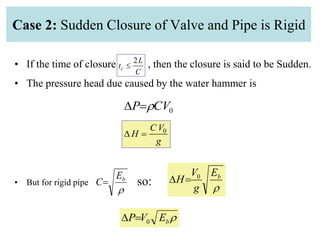
Case 2: Sudden Closure of Valve and Pipe is Rigid
• If the time of closure , then the closure is said to be Sudden.
• The pressure head due caused by the water hammer is
• But for rigid pipe so:
t
L
C
c 
2
 H
C V
g
 0

b
E
g
V
H 0



b
E
V
P 0


0
CV
P 



b
E
C
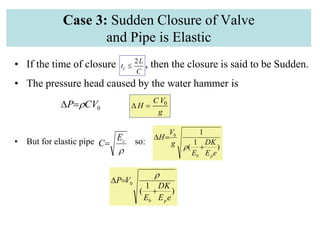
Case 3: Sudden Closure of Valve
and Pipe is Elastic
• If the time of closure , then the closure is said to be Sudden.
• The pressure head caused by the water hammer is
• But for elastic pipe so:
t
L
C
c 
2
 H
C V
g
 0
0
CV
P 


)
1
(
1
0
e
E
K
D
E
g
V
H
p
b




)
1
(
0
e
E
K
D
E
V
P
p
b





c
E
C
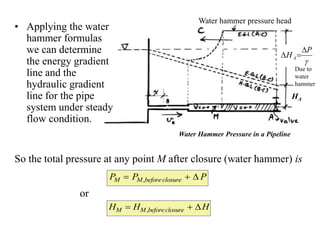
• Applying the water
hammer formulas
we can determine
the energy gradient
line and the
hydraulic gradient
line for the pipe
system under steady
flow condition.
Water Hammer Pressure in a Pipeline
So the total pressure at any point M after closure (water hammer) is
P P P
M M before closure
 
, 
or
H H H
M M beforeclosure
 
, 
Water hammer pressure head
HA

P
HA



Due to
water
hammer
Time History of Pressure Wave
(Water Hammer)
• The time history of the pressure wave for a specific
point on the pipe is a graph that simply shows the
relation between the pressure increase ( ) and
time during the propagation of the water hammer
pressure waves.
 P
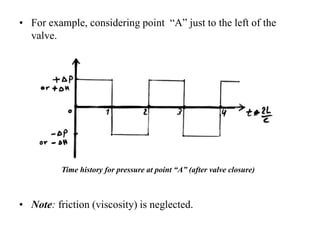
• For example, considering point “A” just to the left of the
valve.
• Note: friction (viscosity) is neglected.
Time history for pressure at point “A” (after valve closure)
1
The time history for point “M” (at midpoint of the pipe)
Note: friction (viscosity) is neglected.
1
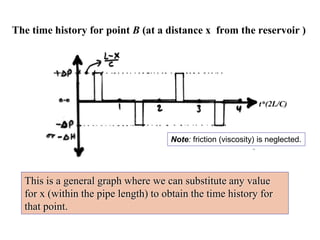
The time history for point B (at a distance x from the reservoir )
1
This is a general graph where we can substitute any value
for x (within the pipe length) to obtain the time history for
that point.
Note: friction (viscosity) is neglected.
t*(2L/C)
In real practice friction effects are considered and hence a
damping effect occurs and the pressure wave dies out, i.e.;
energy is dissipated.
the time history for pressure at point “A”
when friction (viscosity) is included
Damping effect of friction
t*(2L/C)
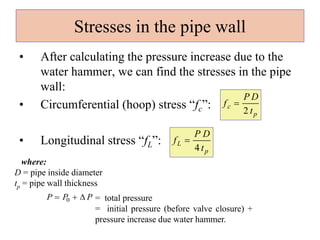
Stresses in the pipe wall
• After calculating the pressure increase due to the
water hammer, we can find the stresses in the pipe
wall:
• Circumferential (hoop) stress “fc :
”
• Longitudinal stress “fL”:
f
P D
t
c
p

2
f
P D
t
L
p

4
where:
D = pipe inside diameter
tp = pipe wall thickness
P P P
 
0  = total pressure
= initial pressure (before valve closure) +
pressure increase due water hammer.
Example 1
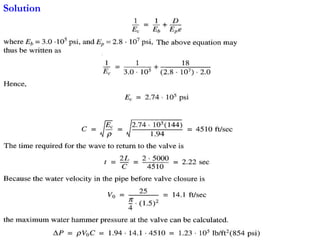
Solution
To keep the water hammer pressure within
manageable limits, valves are commonly design
with closure times considerably greater than
2L/C
Example
• A cast iron pipe with 20 cm diameter and 15 mm wall
thickness is carrying water from a reservoir. At the end
of the pipe a valve is installed to regulate the flow. The
following data are available:
• e = 0.15 mm (absolute roughness) ,
• L = 1500 m (length of pipe),
• Q = 40 l/sec (design flow) ,
• K = 2.1 x 10⁹ N/m2 (bulk modulus of water),
• E = 2.1 x 10¹¹ N/m2 (modulus of elasticity of cast iron),
• = 0.25 (poisson’s ratio),
• = 1000 kg/m3
• T = 150 C.


Find , , fc , and fL due to the water hammer
produced for the following cases:
a) Assuming rigid pipe when tc = 10 seconds, and tc = 1.5
seconds.
b) Assuming elastic pipe when tc = 10 seconds, and tc = 1.5
seconds, if:
1. the pipe is free to move longitudinally,
2. the pipe is anchored at both ends and throughout its
length,
3. the pipe has expansion joints.
c) Draw the time history of the pressure wave for the case (b-3) at:
1. a point just to the left of the valve, and
2. a distance x = 0.35 L from the reservoir.
d) Find the total pressure for all the cases in (b-3).
 P  H

CHAPTER_4C-Water-Hammer.ppt

  • 1.
    Unsteady Flow inPipes The Islamic University of Gaza Faculty of Engineering Civil Engineering Department Hydraulics - ECIV 3322 Chapter 4
  • 2.
    • A suddenchange of flow rate in a large pipeline (due to valve closure, pump turnoff, etc.) may involve a great mass of water moving inside the pipe. • The force resulting from changing the speed of the water mass may cause a pressure rise in the pipe with a magnitude several times greater than the normal static pressure in the pipe. • The excessive pressure may fracture the pipe walls or cause other damage to the pipeline system. • This phenomenon is commonly known as the water hammer phenomenon Water Hammer Phenomenon in pipelines
  • 3.
    Some typical damages Pipedamage in power station Okigawa Burst pipe in power sation Big Creek #3, USA Pump damage in Azambuja Portugal
  • 5.
    Water Hammer Consider along pipe AB: • Connected at one end to a reservoir containing water at a height H from the center of the pipe. • At the other end of the pipe, a valve to regulate the flow of water is provided.
  • 6.
    • If thevalve is suddenly closed, the flowing water will be obstructed and momentum will be destroyed and consequently a wave of high pressure will be created which travels back and forth starting at the valve, traveling to the reservoir, and returning back to the valve and so on. This wave of high pressure: 1. Has a very high speed (called celerity, C ) which may reach the speed of sound wave and may create noise called knocking, 2. Has the effect of hammering action on the walls of the pipe and hence is commonly known as the water hammer phenomenon.
  • 7.
    • The kineticenergy of the water moving through the pipe is converted into potential energy stored in the water and the walls of the pipe through the elastic deformation of both. • The water is compressed and the pipe material is stretched. • The following figure illustrates the formation and transition of the pressure wave due to the sudden closure of the valve
  • 8.
    Propagation of waterhammer pressure wave Steady state condition Transient condition t < L/C
  • 9.
    Transient condition t= L/C Transient condition L/C >t >2L/C Transient condition t =2L/C
  • 10.
    Transient condition t= 3L/C Transient condition 2L/C >t >3L/C
  • 11.
    Transient condition 3L/C>t >4L/C Transient condition t = 4L/C
  • 12.
    Analysis of WaterHammer Phenomenon The pressure rise due to water hammer depends upon: (a) The velocity of the flow of water in pipe, (b) The length of pipe, (c) Time taken to close the valve, (d) Elastic properties of the material of the pipe. The following cases of water hammer will be considered: • Gradual closure of valve, • Sudden closure of valve and pipe is rigid, and • Sudden closure of valve and pipe is elastic.
  • 13.
    • The timerequired for the pressure wave to travel from the valve to the reservoir and back to the valve is: Where: L = length of the pipe (m) C = speed of pressure wave, celerity (m/sec) • If the valve time of closure is tc , then  If the closure is considered gradual  If the closure is considered sudden t L C  2 t L C c  2 C L tc 2 
  • 14.
    The speed ofpressure wave “C” depends on : • the pipe wall material. • the properties of the fluid. • the anchorage method of the pipe. • if the pipe is rigid • if the pipe is elastic and  b E C  c E C e E K D E E p b c   1 1
  • 15.
    Where: • C =velocity (celerity) of pressure wave due to water hammer. • = water density ( 1000 kg/m3 ). • Eb = bulk modulus of water ( 2.1 x 10⁹ N/m2 ). • Ec = effective bulk modulus of water in elastic pipe. • Ep = Modulus of elasticity of the pipe material. • e = thickness of pipe wall. • D = diameter of pipe. • K = factor depends on the anchorage method: = for pipes free to move longitudinally, = for pipes anchored at both ends against longitudinal movement = for pipes with expansion joints. • where = poisson’s ratio of the pipe material (0.25 - 0.35). It may take the value = 0.25 for common pipe materials.  ( ) 5 4  ( ) 1 2  ( . ) 1 05    
  • 17.
    The Maximum pressurecreated by the water hammer
  • 18.
    Case 1: GradualClosure of Valve • If the time of closure , then the closure is said to be gradual and the increased pressure is where, • V0 = initial velocity of water flowing in the pipe before pipe closure • t = time of closure. • L = length of pipe. • = water density. • The pressure head caused by the water hammer is t L C c  2  P LV t   0    H P LV gt LV gt       0 0
  • 19.
      N P P N N o    4 2 2          t P LV N o o  Another method for closure time (t > 2 L/C)
  • 20.
    Case 2: SuddenClosure of Valve and Pipe is Rigid • If the time of closure , then the closure is said to be Sudden. • The pressure head due caused by the water hammer is • But for rigid pipe so: t L C c  2  H C V g  0  b E g V H 0    b E V P 0   0 CV P     b E C
  • 21.
    Case 3: SuddenClosure of Valve and Pipe is Elastic • If the time of closure , then the closure is said to be Sudden. • The pressure head caused by the water hammer is • But for elastic pipe so: t L C c  2  H C V g  0 0 CV P    ) 1 ( 1 0 e E K D E g V H p b     ) 1 ( 0 e E K D E V P p b      c E C
  • 22.
    • Applying thewater hammer formulas we can determine the energy gradient line and the hydraulic gradient line for the pipe system under steady flow condition. Water Hammer Pressure in a Pipeline So the total pressure at any point M after closure (water hammer) is P P P M M before closure   ,  or H H H M M beforeclosure   ,  Water hammer pressure head HA  P HA    Due to water hammer
  • 23.
    Time History ofPressure Wave (Water Hammer) • The time history of the pressure wave for a specific point on the pipe is a graph that simply shows the relation between the pressure increase ( ) and time during the propagation of the water hammer pressure waves.  P
  • 24.
    • For example,considering point “A” just to the left of the valve. • Note: friction (viscosity) is neglected. Time history for pressure at point “A” (after valve closure) 1
  • 25.
    The time historyfor point “M” (at midpoint of the pipe) Note: friction (viscosity) is neglected. 1
  • 26.
    The time historyfor point B (at a distance x from the reservoir ) 1 This is a general graph where we can substitute any value for x (within the pipe length) to obtain the time history for that point. Note: friction (viscosity) is neglected. t*(2L/C)
  • 27.
    In real practicefriction effects are considered and hence a damping effect occurs and the pressure wave dies out, i.e.; energy is dissipated. the time history for pressure at point “A” when friction (viscosity) is included Damping effect of friction t*(2L/C)
  • 28.
    Stresses in thepipe wall • After calculating the pressure increase due to the water hammer, we can find the stresses in the pipe wall: • Circumferential (hoop) stress “fc : ” • Longitudinal stress “fL”: f P D t c p  2 f P D t L p  4 where: D = pipe inside diameter tp = pipe wall thickness P P P   0  = total pressure = initial pressure (before valve closure) + pressure increase due water hammer.
  • 29.
  • 30.
  • 31.
    To keep thewater hammer pressure within manageable limits, valves are commonly design with closure times considerably greater than 2L/C
  • 32.
    Example • A castiron pipe with 20 cm diameter and 15 mm wall thickness is carrying water from a reservoir. At the end of the pipe a valve is installed to regulate the flow. The following data are available: • e = 0.15 mm (absolute roughness) , • L = 1500 m (length of pipe), • Q = 40 l/sec (design flow) , • K = 2.1 x 10⁹ N/m2 (bulk modulus of water), • E = 2.1 x 10¹¹ N/m2 (modulus of elasticity of cast iron), • = 0.25 (poisson’s ratio), • = 1000 kg/m3 • T = 150 C.  
  • 33.
    Find , ,fc , and fL due to the water hammer produced for the following cases: a) Assuming rigid pipe when tc = 10 seconds, and tc = 1.5 seconds. b) Assuming elastic pipe when tc = 10 seconds, and tc = 1.5 seconds, if: 1. the pipe is free to move longitudinally, 2. the pipe is anchored at both ends and throughout its length, 3. the pipe has expansion joints. c) Draw the time history of the pressure wave for the case (b-3) at: 1. a point just to the left of the valve, and 2. a distance x = 0.35 L from the reservoir. d) Find the total pressure for all the cases in (b-3).  P  H