FLOW IN PIPES
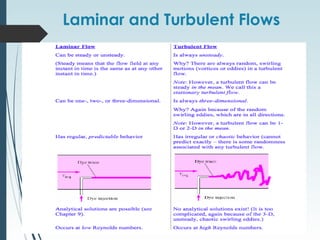
Laminar and Turbulent Flows
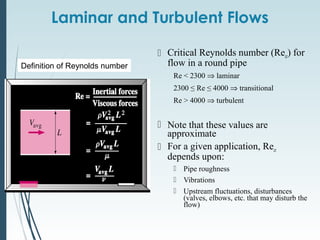
 Critical Reynolds number (Recr) for
flow in a round pipe
Re < 2300 ⇒ laminar
2300 ≤ Re ≤ 4000 ⇒ transitional
Re > 4000 ⇒ turbulent
 Note that these values are
approximate
 For a given application, Recr
depends upon:
 Pipe roughness
 Vibrations
 Upstream fluctuations, disturbances
(valves, elbows, etc. that may disturb the
flow)
Definition of Reynolds number
Laminar and Turbulent Flows
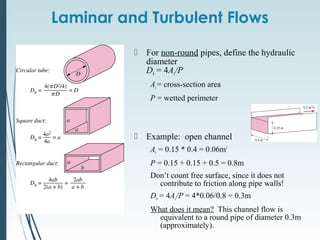
 For non-round pipes, define the hydraulic
diameter
Dh = 4Ac/P
Ac= cross-section area
P = wetted perimeter
 Example: open channel
Ac = 0.15 * 0.4 = 0.06m2
P = 0.15 + 0.15 + 0.5 = 0.8m
Don’t count free surface, since it does not
contribute to friction along pipe walls!
Dh = 4Ac/P = 4*0.06/0.8 = 0.3m
What does it mean? This channel flow is
equivalent to a round pipe of diameter 0.3m
(approximately).
The Entrance Region
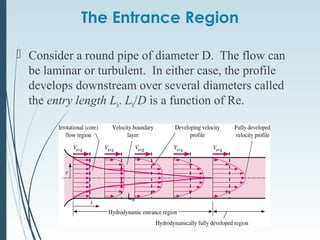
 Consider a round pipe of diameter D. The flow can
be laminar or turbulent. In either case, the profile
develops downstream over several diameters called
the entry length Lh. Lh/D is a function of Re.
Lh
Fully Developed Pipe Flow
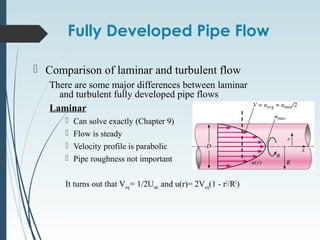
 Comparison of laminar and turbulent flow
There are some major differences between laminar
and turbulent fully developed pipe flows
Laminar
 Can solve exactly (Chapter 9)
 Flow is steady
 Velocity profile is parabolic
 Pipe roughness not important
It turns out that Vavg= 1/2Umax and u(r)= 2Vavg(1 - r2
/R2
)
Fully Developed Pipe Flow
Turbulent
 Cannot solve exactly (too complex)
 Flow is unsteady (3D swirling eddies), but it is steady in the mean
 Mean velocity profile is fuller (shape more like a top-hat profile, with very
sharp slope at the wall)
 Pipe roughness is very important
 Vavg 85% of Umax (depends on Re a bit)
 No analytical solution, but there are some good semi-empirical expressions
that approximate the velocity profile shape. See text
Logarithmic law (Eq. 8-46)
Power law (Eq. 8-49)
Instantaneous
profiles
Fully Developed Pipe Flow
Wall-shear stress
 Recall, for simple shear flows u=u(y), we had
τ = µdu/dy
 In fully developed pipe flow, it turns out that
τ = µdu/dr
slope
slope
Laminar Turbulent
τw
τw
τw,turb > τw,lam
τw = shear stress at the wall,
acting on the fluid
Fully Developed Pipe Flow
Pressure drop
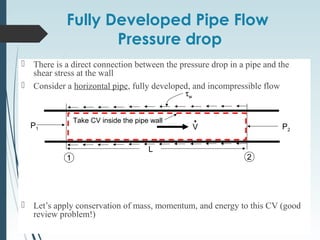
 There is a direct connection between the pressure drop in a pipe and the
shear stress at the wall
 Consider a horizontal pipe, fully developed, and incompressible flow
 Let’s apply conservation of mass, momentum, and energy to this CV (good
review problem!)
1 2
L
τw
P1 P2V
Take CV inside the pipe wall
Fully Developed Pipe Flow
Pressure drop
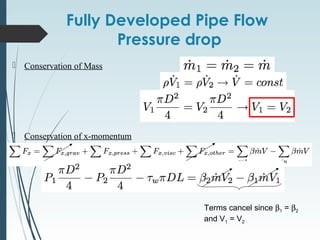
 Conservation of Mass
 Conservation of x-momentum
Terms cancel since β1 = β2
and V1 = V2
Fully Developed Pipe Flow
Pressure drop
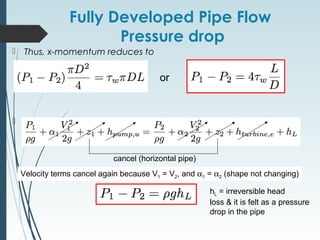
 Thus, x-momentum reduces to
 Energy equation (in head form)
or
cancel (horizontal pipe)
Velocity terms cancel again because V1 = V2, and α1 = α2 (shape not changing)
hL = irreversible head
loss & it is felt as a pressure
drop in the pipe
Fully Developed Pipe Flow
Friction Factor
 From momentum CV analysis
 From energy CV analysis
 Equating the two gives
 To predict head loss, we need to be able to calculate τw. How?
 Laminar flow: solve exactly
 Turbulent flow: rely on empirical data (experiments)
 In either case, we can benefit from dimensional analysis!
Fully Developed Pipe Flow
Friction Factor
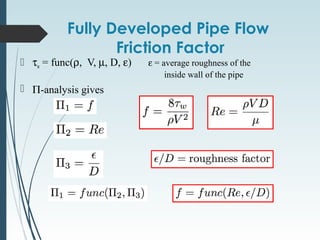
 τw = func(ρ, V, µ, D, ε) ε = average roughness of the
inside wall of the pipe
 Π-analysis gives
Fully Developed Pipe Flow
Friction Factor
 Now go back to equation for hLand substitute f for τw
 Our problem is now reduced to solving for Darcy friction factor f
 Recall
 Therefore
 Laminar flow: f = 64/Re (exact)
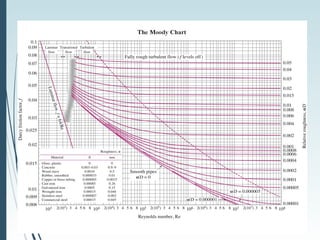
 Turbulent flow: Use charts or empirical equations (Moody Chart, a famous plot of f vs. Re
But for laminar flow, roughness
does not affect the flow unless it
is huge
Fully Developed Pipe Flow
Friction Factor
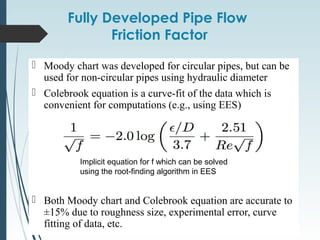
 Moody chart was developed for circular pipes, but can be
used for non-circular pipes using hydraulic diameter
 Colebrook equation is a curve-fit of the data which is
convenient for computations (e.g., using EES)
 Both Moody chart and Colebrook equation are accurate to
±15% due to roughness size, experimental error, curve
fitting of data, etc.
Implicit equation for f which can be solved
using the root-finding algorithm in EES
Types of Fluid Flow Problems
 In design and analysis of piping systems, 3
problem types are encountered:
1. Determine ∆p (or hL) given L, D, V (or flow rate)
Can be solved directly using Moody chart and Colebrook equation
1. Determine V, given L, D, ∆p
2. Determine D, given L, ∆p, V (or flow rate)
Types 2 and 3 are common engineering design
problems, i.e., selection of pipe diameters to minimize
construction and pumping costs
However, iterative approach required since both V and D
are in the Reynolds number.
Types of Fluid Flow Problems
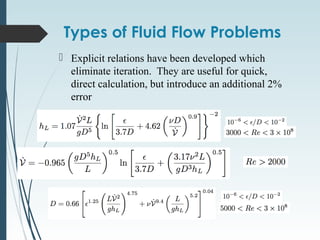
 Explicit relations have been developed which
eliminate iteration. They are useful for quick,
direct calculation, but introduce an additional 2%
error
Minor Losses
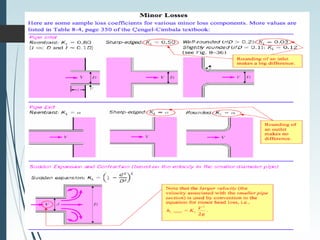
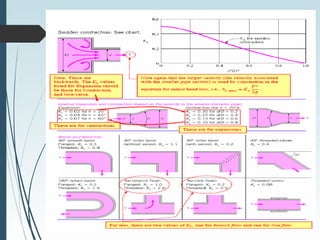
 Piping systems include fittings, valves, bends, elbows, tees,
inlets, exits, enlargements, and contractions.
 These components interrupt the smooth flow of fluid and cause
additional losses because of flow separation and mixing
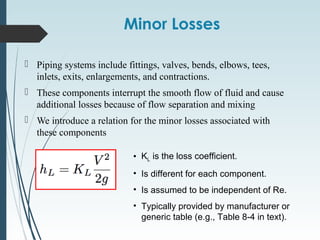
 We introduce a relation for the minor losses associated with
these components
• KL is the loss coefficient.
• Is different for each component.
• Is assumed to be independent of Re.
• Typically provided by manufacturer or
generic table (e.g., Table 8-4 in text).
Minor Losses
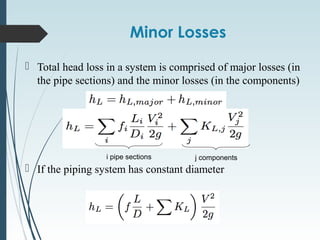
 Total head loss in a system is comprised of major losses (in
the pipe sections) and the minor losses (in the components)
 If the piping system has constant diameter
i pipe sections j components
Piping Networks and Pump
Selection
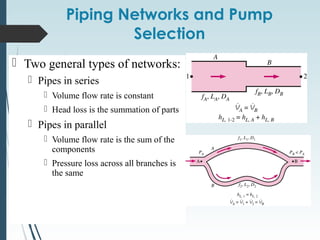
 Two general types of networks:
 Pipes in series
 Volume flow rate is constant
 Head loss is the summation of parts
 Pipes in parallel
 Volume flow rate is the sum of the
components
 Pressure loss across all branches is
the same
Piping Networks and Pump
Selection
 For parallel pipes, perform CV analysis between points A and B
 Since ∆p is the same for all branches, head loss in all branches is
the same
Piping Networks and Pump
Selection
 Head loss relationship between branches allows the following
ratios to be developed
 Real pipe systems result in a system of non-linear equations.
Very easy to solve with EES!
 Note: the analogy with electrical circuits should be obvious
 Flow flow rate (VA) : current (I)
 Pressure gradient (∆p) : electrical potential (V)
 Head loss (hL): resistance (R), however hL is very nonlinear
Piping Networks and Pump Selection
 When a piping system involves pumps and/or turbines, pump
and turbine head must be included in the energy equation
 The useful head of the pump (hpump,u) or the head extracted by the
turbine (hturbine,e), are functions of volume flow rate, i.e., they are
not constants.
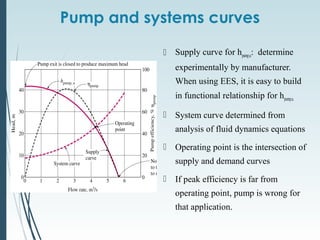
 Operating point of system is where the system is in balance, e.g.,
where pump head is equal to the head losses.
Pump and systems curves
 Supply curve for hpump,u: determine
experimentally by manufacturer.
When using EES, it is easy to build
in functional relationship for hpump,u.
 System curve determined from
analysis of fluid dynamics equations
 Operating point is the intersection of
supply and demand curves
 If peak efficiency is far from
operating point, pump is wrong for
that application.

Flow In Pipes

  • 1.
  • 2.
  • 3.
    Laminar and TurbulentFlows  Critical Reynolds number (Recr) for flow in a round pipe Re < 2300 ⇒ laminar 2300 ≤ Re ≤ 4000 ⇒ transitional Re > 4000 ⇒ turbulent  Note that these values are approximate  For a given application, Recr depends upon:  Pipe roughness  Vibrations  Upstream fluctuations, disturbances (valves, elbows, etc. that may disturb the flow) Definition of Reynolds number
  • 4.
    Laminar and TurbulentFlows  For non-round pipes, define the hydraulic diameter Dh = 4Ac/P Ac= cross-section area P = wetted perimeter  Example: open channel Ac = 0.15 * 0.4 = 0.06m2 P = 0.15 + 0.15 + 0.5 = 0.8m Don’t count free surface, since it does not contribute to friction along pipe walls! Dh = 4Ac/P = 4*0.06/0.8 = 0.3m What does it mean? This channel flow is equivalent to a round pipe of diameter 0.3m (approximately).
  • 5.
    The Entrance Region Consider a round pipe of diameter D. The flow can be laminar or turbulent. In either case, the profile develops downstream over several diameters called the entry length Lh. Lh/D is a function of Re. Lh
  • 6.
    Fully Developed PipeFlow  Comparison of laminar and turbulent flow There are some major differences between laminar and turbulent fully developed pipe flows Laminar  Can solve exactly (Chapter 9)  Flow is steady  Velocity profile is parabolic  Pipe roughness not important It turns out that Vavg= 1/2Umax and u(r)= 2Vavg(1 - r2 /R2 )
  • 7.
    Fully Developed PipeFlow Turbulent  Cannot solve exactly (too complex)  Flow is unsteady (3D swirling eddies), but it is steady in the mean  Mean velocity profile is fuller (shape more like a top-hat profile, with very sharp slope at the wall)  Pipe roughness is very important  Vavg 85% of Umax (depends on Re a bit)  No analytical solution, but there are some good semi-empirical expressions that approximate the velocity profile shape. See text Logarithmic law (Eq. 8-46) Power law (Eq. 8-49) Instantaneous profiles
  • 8.
    Fully Developed PipeFlow Wall-shear stress  Recall, for simple shear flows u=u(y), we had τ = µdu/dy  In fully developed pipe flow, it turns out that τ = µdu/dr slope slope Laminar Turbulent τw τw τw,turb > τw,lam τw = shear stress at the wall, acting on the fluid
  • 9.
    Fully Developed PipeFlow Pressure drop  There is a direct connection between the pressure drop in a pipe and the shear stress at the wall  Consider a horizontal pipe, fully developed, and incompressible flow  Let’s apply conservation of mass, momentum, and energy to this CV (good review problem!) 1 2 L τw P1 P2V Take CV inside the pipe wall
  • 10.
    Fully Developed PipeFlow Pressure drop  Conservation of Mass  Conservation of x-momentum Terms cancel since β1 = β2 and V1 = V2
  • 11.
    Fully Developed PipeFlow Pressure drop  Thus, x-momentum reduces to  Energy equation (in head form) or cancel (horizontal pipe) Velocity terms cancel again because V1 = V2, and α1 = α2 (shape not changing) hL = irreversible head loss & it is felt as a pressure drop in the pipe
  • 12.
    Fully Developed PipeFlow Friction Factor  From momentum CV analysis  From energy CV analysis  Equating the two gives  To predict head loss, we need to be able to calculate τw. How?  Laminar flow: solve exactly  Turbulent flow: rely on empirical data (experiments)  In either case, we can benefit from dimensional analysis!
  • 13.
    Fully Developed PipeFlow Friction Factor  τw = func(ρ, V, µ, D, ε) ε = average roughness of the inside wall of the pipe  Π-analysis gives
  • 14.
    Fully Developed PipeFlow Friction Factor  Now go back to equation for hLand substitute f for τw  Our problem is now reduced to solving for Darcy friction factor f  Recall  Therefore  Laminar flow: f = 64/Re (exact)  Turbulent flow: Use charts or empirical equations (Moody Chart, a famous plot of f vs. Re But for laminar flow, roughness does not affect the flow unless it is huge
  • 16.
    Fully Developed PipeFlow Friction Factor  Moody chart was developed for circular pipes, but can be used for non-circular pipes using hydraulic diameter  Colebrook equation is a curve-fit of the data which is convenient for computations (e.g., using EES)  Both Moody chart and Colebrook equation are accurate to ±15% due to roughness size, experimental error, curve fitting of data, etc. Implicit equation for f which can be solved using the root-finding algorithm in EES
  • 17.
    Types of FluidFlow Problems  In design and analysis of piping systems, 3 problem types are encountered: 1. Determine ∆p (or hL) given L, D, V (or flow rate) Can be solved directly using Moody chart and Colebrook equation 1. Determine V, given L, D, ∆p 2. Determine D, given L, ∆p, V (or flow rate) Types 2 and 3 are common engineering design problems, i.e., selection of pipe diameters to minimize construction and pumping costs However, iterative approach required since both V and D are in the Reynolds number.
  • 18.
    Types of FluidFlow Problems  Explicit relations have been developed which eliminate iteration. They are useful for quick, direct calculation, but introduce an additional 2% error
  • 19.
    Minor Losses  Pipingsystems include fittings, valves, bends, elbows, tees, inlets, exits, enlargements, and contractions.  These components interrupt the smooth flow of fluid and cause additional losses because of flow separation and mixing  We introduce a relation for the minor losses associated with these components • KL is the loss coefficient. • Is different for each component. • Is assumed to be independent of Re. • Typically provided by manufacturer or generic table (e.g., Table 8-4 in text).
  • 20.
    Minor Losses  Totalhead loss in a system is comprised of major losses (in the pipe sections) and the minor losses (in the components)  If the piping system has constant diameter i pipe sections j components
  • 23.
    Piping Networks andPump Selection  Two general types of networks:  Pipes in series  Volume flow rate is constant  Head loss is the summation of parts  Pipes in parallel  Volume flow rate is the sum of the components  Pressure loss across all branches is the same
  • 24.
    Piping Networks andPump Selection  For parallel pipes, perform CV analysis between points A and B  Since ∆p is the same for all branches, head loss in all branches is the same
  • 25.
    Piping Networks andPump Selection  Head loss relationship between branches allows the following ratios to be developed  Real pipe systems result in a system of non-linear equations. Very easy to solve with EES!  Note: the analogy with electrical circuits should be obvious  Flow flow rate (VA) : current (I)  Pressure gradient (∆p) : electrical potential (V)  Head loss (hL): resistance (R), however hL is very nonlinear
  • 26.
    Piping Networks andPump Selection  When a piping system involves pumps and/or turbines, pump and turbine head must be included in the energy equation  The useful head of the pump (hpump,u) or the head extracted by the turbine (hturbine,e), are functions of volume flow rate, i.e., they are not constants.  Operating point of system is where the system is in balance, e.g., where pump head is equal to the head losses.
  • 27.
    Pump and systemscurves  Supply curve for hpump,u: determine experimentally by manufacturer. When using EES, it is easy to build in functional relationship for hpump,u.  System curve determined from analysis of fluid dynamics equations  Operating point is the intersection of supply and demand curves  If peak efficiency is far from operating point, pump is wrong for that application.