NUCLEAR POWER PLANT
A.N.KHUDAIWALA (L.M.E) G.P.PORBANDAR
• Define and apply the concepts ofDefine and apply the concepts of mass numbermass number,, atomic numberatomic number,,
andand isotopesisotopes..
• Define and apply concepts ofDefine and apply concepts of radioactive decayradioactive decay andand nuclear reactionsnuclear reactions..
• Calculate theCalculate the mass defectmass defect and theand the binding energy per nucleonbinding energy per nucleon for afor a
particular isotope.particular isotope.
• State the variousState the various conservation lawsconservation laws, and discuss their application for, and discuss their application for
nuclear reactions.nuclear reactions.
A.N.KHUDAIWALA (L.M.E) G.P.PORBANDAR
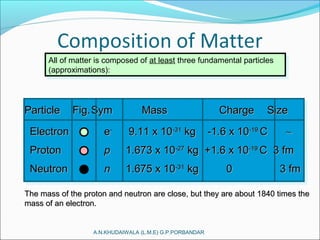
All of matter is composed of at least three fundamental particles
(approximations):
All of matter is composed of at least three fundamental particles
(approximations):
ParticleParticle Fig.Fig.SymSym MassMass ChargeCharge SizeSize
The mass of the proton and neutron are close, but they are about 1840 times theThe mass of the proton and neutron are close, but they are about 1840 times the
mass of an electron.mass of an electron.
ElectronElectron ee--
9.11 x 109.11 x 10-31-31
kgkg -1.6 x 10-1.6 x 10-19-19
CC ∼∼
ProtonProton pp 1.673 x 101.673 x 10-27-27
kg +1.6 x 10kg +1.6 x 10⁻¹⁹-19
C 3 fmC 3 fm
NeutronNeutron nn 1.675 x 101.675 x 10-31-31
kgkg 00 3 fm3 fm
A.N.KHUDAIWALA (L.M.E) G.P.PORBANDAR
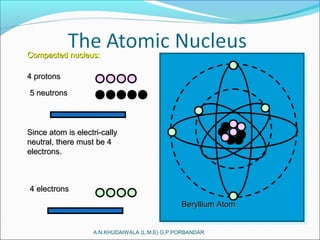
Beryllium AtomBeryllium Atom
Compacted nucleus:Compacted nucleus:
4 protons4 protons
5 neutrons5 neutrons
Since atom is electri-callySince atom is electri-cally
neutral, there must be 4neutral, there must be 4
electrons.electrons.
4 electrons4 electrons
A.N.KHUDAIWALA (L.M.E) G.P.PORBANDAR
AA nucleonnucleon is a general term to denote a nuclear particle - that is, either ais a general term to denote a nuclear particle - that is, either a
proton or a neutron.proton or a neutron.
TheThe atomic numberatomic number ZZ of an element is equal to the number of protons in theof an element is equal to the number of protons in the
nucleus of that element.nucleus of that element.
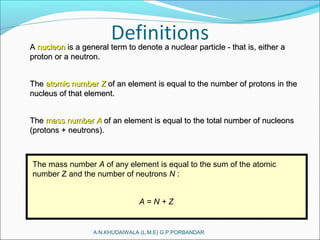
TheThe mass numbermass number AA of an element is equal to the total number of nucleonsof an element is equal to the total number of nucleons
(protons + neutrons).(protons + neutrons).
The mass number A of any element is equal to the sum of the atomic
number Z and the number of neutrons N :
A = N + Z
A.N.KHUDAIWALA (L.M.E) G.P.PORBANDAR
A convenient way of describing an element is by giving its mass number andA convenient way of describing an element is by giving its mass number and
its atomic number, along with the chemical symbol for that element.its atomic number, along with the chemical symbol for that element.
A convenient way of describing an element is by giving its mass number andA convenient way of describing an element is by giving its mass number and
its atomic number, along with the chemical symbol for that element.its atomic number, along with the chemical symbol for that element.
[ ]A Mass number
Z Atomic numberX Symbol=
For example, consider beryllium (Be): 9
4 Be
A.N.KHUDAIWALA (L.M.E) G.P.PORBANDAR
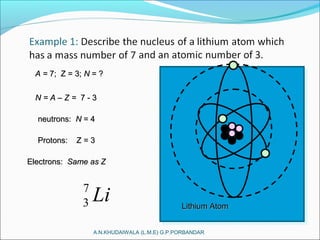
Lithium AtomLithium Atom
N = A – Z =N = A – Z = 7 - 37 - 3
A =A = 7; Z = 3;7; Z = 3; NN = ?= ?
Protons: Z = 3Protons: Z = 3
neutrons:neutrons: NN = 4= 4
Electrons:Electrons: Same as ZSame as Z
7
3 Li
A.N.KHUDAIWALA (L.M.E) G.P.PORBANDAR
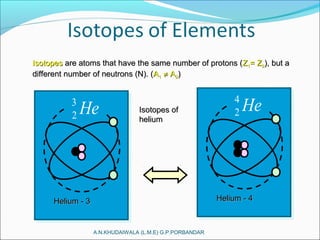
IsotopesIsotopes are atoms that have the same number of protons (are atoms that have the same number of protons (ZZ11= Z= Z22), but a), but a
different number of neutrons (N). (different number of neutrons (N). (AA11 ≠≠ AA22))
Helium - 4Helium - 4
4
2 He
Helium - 3Helium - 3
3
2 He Isotopes ofIsotopes of
heliumhelium
A.N.KHUDAIWALA (L.M.E) G.P.PORBANDAR
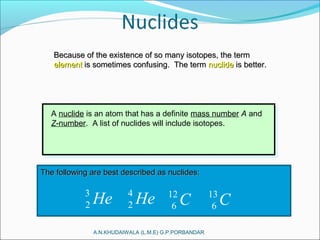
Because of the existence of so many isotopes, the termBecause of the existence of so many isotopes, the term
elementelement is sometimes confusing. The termis sometimes confusing. The term nuclidenuclide is better.is better.
A nuclide is an atom that has a definite mass number A and
Z-number. A list of nuclides will include isotopes.
The following are best described as nuclides:The following are best described as nuclides:
3
2 He 4
2 He 12
6 C 13
6 C
A.N.KHUDAIWALA (L.M.E) G.P.PORBANDAR
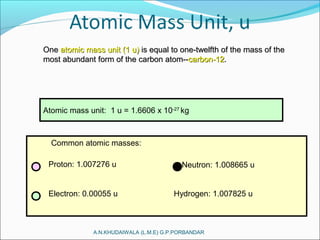
OneOne atomic mass unitatomic mass unit (1 u)(1 u) is equal to one-twelfth of the mass of theis equal to one-twelfth of the mass of the
most abundant form of the carbon atom--most abundant form of the carbon atom--carbon-12carbon-12..
Atomic mass unit: 1 u = 1.6606 x 10⁻²⁷
kg
Common atomic masses:
Proton: 1.007276 u Neutron: 1.008665 u
Electron: 0.00055 u Hydrogen: 1.007825 u
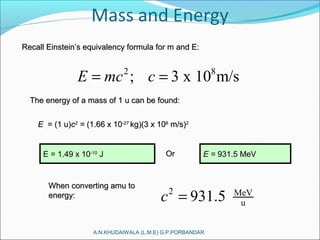
2 8
; 3 x 10 m/sE mc c= =
A.N.KHUDAIWALA (L.M.E) G.P.PORBANDAR
Recall Einstein’s equivalency formula for m and E:Recall Einstein’s equivalency formula for m and E:
The energy of a mass of 1 u can be found:The energy of a mass of 1 u can be found:
EE = (1 u)= (1 u)cc22
== (1.66 x 10(1.66 x 10⁻²⁷-27
kg)(3 x 10kg)(3 x 1088
m/s)m/s)22
E = 1.49 x 10⁻¹⁰
J OrOr E = 931.5 MeV
When converting amu toWhen converting amu to
energy:energy: 2 MeV
u931.5c =
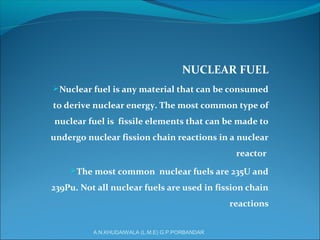
NUCLEAR FUEL
Nuclear fuel is any material that can be consumed
to derive nuclear energy. The most common type of
nuclear fuel is fissile elements that can be made to
undergo nuclear fission chain reactions in a nuclear
reactor
The most common nuclear fuels are 235U and
239Pu. Not all nuclear fuels are used in fission chain
reactions
A.N.KHUDAIWALA (L.M.E) G.P.PORBANDAR
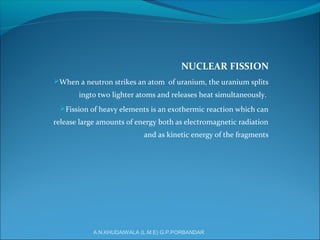
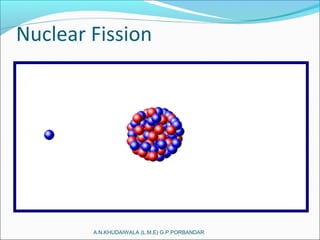
NUCLEAR FISSION
When a neutron strikes an atom of uranium, the uranium splits
ingto two lighter atoms and releases heat simultaneously.
Fission of heavy elements is an exothermic reaction which can
release large amounts of energy both as electromagnetic radiation
and as kinetic energy of the fragments
A.N.KHUDAIWALA (L.M.E) G.P.PORBANDAR
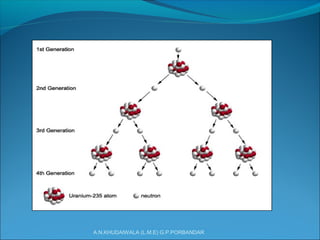
NUCLEAR CHAIN REACTIONS
A chain reaction refers to a process in which neutrons released
in fission produce an additional fission in at least one further
nucleus. This nucleus in turn produces neutrons, and the process
repeats. If the process is controlled it is used for nuclear power
or if uncontrolled it is used for nuclear weapons
A.N.KHUDAIWALA (L.M.E) G.P.PORBANDAR
U235 + n fission + 2 or 3 n + 200 MeV→
If each neutron releases two more neutrons, then the
number of fissions doubles each generation. In that case,
in 10 generations there are 1,024 fissions and in 80
generations about 6 x 10 23 (a mole) fissions.
A.N.KHUDAIWALA (L.M.E) G.P.PORBANDAR
Nuclear Fission
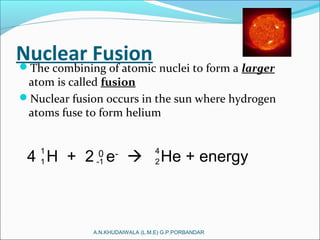
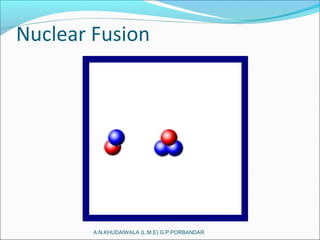
Nuclear FusionThe combining of atomic nuclei to form a larger
atom is called fusion
Nuclear fusion occurs in the sun where hydrogen
atoms fuse to form helium
A.N.KHUDAIWALA (L.M.E) G.P.PORBANDAR
4 H + 2 0
e-
 He + energy1
1
-1 2
4
A.N.KHUDAIWALA (L.M.E) G.P.PORBANDAR
Nuclear Fusion
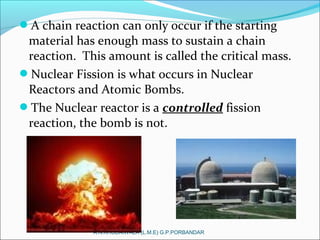
A chain reaction can only occur if the starting
material has enough mass to sustain a chain
reaction. This amount is called the critical mass.
Nuclear Fission is what occurs in Nuclear
Reactors and Atomic Bombs.
The Nuclear reactor is a controlled fission
reaction, the bomb is not.
A.N.KHUDAIWALA (L.M.E) G.P.PORBANDAR
Review
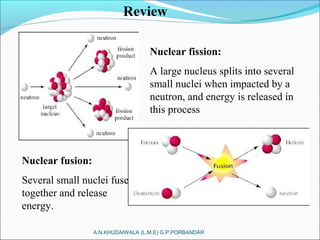
Nuclear fission:
A large nucleus splits into several
small nuclei when impacted by a
neutron, and energy is released in
this process
Nuclear fusion:
Several small nuclei fuse
together and release
energy.
A.N.KHUDAIWALA (L.M.E) G.P.PORBANDAR
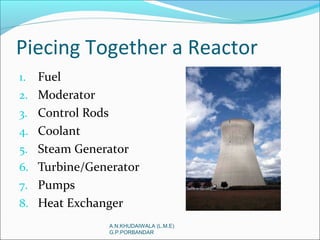
Piecing Together a Reactor
1. Fuel
2. Moderator
3. Control Rods
4. Coolant
5. Steam Generator
6. Turbine/Generator
7. Pumps
8. Heat Exchanger
A.N.KHUDAIWALA (L.M.E)
G.P.PORBANDAR
A.N.KHUDAIWALA (L.M.E) G.P.PORBANDAR
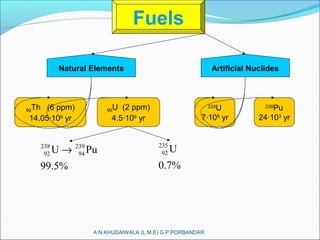
90U (2 ppm)
4.5∙109
yr
90Th (6 ppm)
14.05∙109
yr
238 239
92 94U Pu
99.5%
→
235
92 U
0.7%
Fuels
Natural Elements
233
U
7∙108
yr
Artificial Nuclides
239
Pu
24∙103
yr
A.N.KHUDAIWALA (L.M.E) G.P.PORBANDAR
Between thorium (Z=90) and bismuth (Z=83), the isotope with the longest half-
life is 226
Ra (T½=1600 years), and therefore there are no fuel candidates, quite
apart from the issue of fissionability. Uranium and Thorium are the only natural
elements available for use as reactor fuels. In addition, 233
U and 239
Pu can be
produced from capture on 232
Th and 238
U in reactors. Of fissile materials, only U
is both fissile and found in nature in useful amounts.
A.N.KHUDAIWALA (L.M.E) G.P.PORBANDAR
Fuels
Few ”natural” nuclides that can be used as reactor fuels
Uranium (Z=92). This is the main fuel in actual use, especially 235
U which is fissile.
In addition, 238
U is important in reactors, primarily as a fertile fuel for 239
Pu
production, and 233
U could be used as a fissile fuel, formed by neutron capture in
232
Th.
Protactinium (Z=91). The longest-lived isotope of Pa ( 231
Pa) has a half-life of 3.3
x104
yr, and therefore there is essentially no Pa in nature. Further, there is no
stable A =230 nuclide that could be used to produce 231
Pa in a reactor.
Thorium (Z=90). Thorium is found entirely as 232
Th, which is not fissile (for thermal
neutrons). It can be used as a fertile fuel for production of fissile 233
U.
A.N.KHUDAIWALA (L.M.E) G.P.PORBANDAR
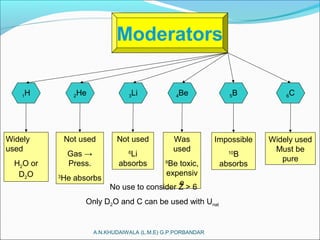
Moderators
1H
Widely
used
H2O or
D2O
2He
Not used
Gas →
Press.
3
He absorbs
3Li
Not used
6
Li
absorbs
4Be
Was
used
9
Be toxic,
expensiv
e
5B
Impossible
10
B
absorbs
6C
Widely used
Must be
pure
No use to consider Z > 6
Only D2O and C can be used with Unat
A.N.KHUDAIWALA (L.M.E) G.P.PORBANDAR
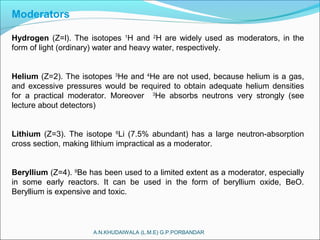
Moderators
Hydrogen (Z=l). The isotopes 1
H and 2
H are widely used as moderators, in the
form of light (ordinary) water and heavy water, respectively.
Helium (Z=2). The isotopes 3
He and 4
He are not used, because helium is a gas,
and excessive pressures would be required to obtain adequate helium densities
for a practical moderator. Moreover 3
He absorbs neutrons very strongly (see
lecture about detectors)
Lithium (Z=3). The isotope 6
Li (7.5% abundant) has a large neutron-absorption
cross section, making lithium impractical as a moderator.
Beryllium (Z=4). 9
Be has been used to a limited extent as a moderator, especially
in some early reactors. It can be used in the form of beryllium oxide, BeO.
Beryllium is expensive and toxic.
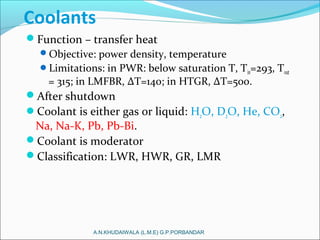
Coolants
Function – transfer heat
Objective: power density, temperature
Limitations: in PWR: below saturation T, Tin=293, Tout
= 315; in LMFBR, ΔT=140; in HTGR, ΔT=500.
After shutdown
Coolant is either gas or liquid: H2O, D2O, He, CO2,
Na, Na-K, Pb, Pb-Bi.
Coolant is moderator
Classification: LWR, HWR, GR, LMR
A.N.KHUDAIWALA (L.M.E) G.P.PORBANDAR
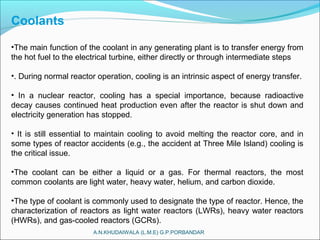
Coolants
•The main function of the coolant in any generating plant is to transfer energy from
the hot fuel to the electrical turbine, either directly or through intermediate steps
•. During normal reactor operation, cooling is an intrinsic aspect of energy transfer.
• In a nuclear reactor, cooling has a special importance, because radioactive
decay causes continued heat production even after the reactor is shut down and
electricity generation has stopped.
• It is still essential to maintain cooling to avoid melting the reactor core, and in
some types of reactor accidents (e.g., the accident at Three Mile Island) cooling is
the critical issue.
•The coolant can be either a liquid or a gas. For thermal reactors, the most
common coolants are light water, heavy water, helium, and carbon dioxide.
•The type of coolant is commonly used to designate the type of reactor. Hence, the
characterization of reactors as light water reactors (LWRs), heavy water reactors
(HWRs), and gas-cooled reactors (GCRs).
A.N.KHUDAIWALA (L.M.E) G.P.PORBANDAR
• Control materials are materials with large thermal neutron-absorption
cross sections, used as controllable poisons to adjust the level of
reactivity.
• They serve a variety of purposes:
• To achieve intentional changes in reactor operating conditions, including
turning the reactor on and off
• To compensate for changes in reactor operating conditions, including
changes in the fissile and poison content of the fuel
• To provide a means for turning the reactor off rapidly, in case of
emergency
A.N.KHUDAIWALA (L.M.E) G.P.PORBANDAR
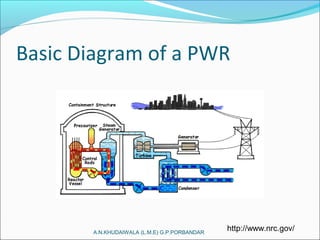
PWR. The pressurized water reactor accounts for almost two-thirds of all
capacity and is the only LWR used in some countries, for example, France,
the former Soviet Union, and South Korea.
BWR. The boiling water reactor is a major alternative to the PWR, and both
are used in, for example, Sweden, the United States and Japan.
PHWR. The pressurized heavy water reactor uses heavy water for both the
coolant and moderator and operates with natural uranium fuel. It has been
developed in Canada and is commonly referred to as the CANDU. CANDU
units are also in operation in India and are being built in Romania and South
Korea.
32
3232
Classification of reactorsClassification of reactors
Classification of reactors by purpose:
Power reactors
Research reactors
Material test reactors
Propulsion reactors
Production reactors
Space reactors
Radiation Protection Workshop-Cairo Univ.- NSPA - 15 Jan - 2 Feb, 201218 January 2012
33
3333
Classification of reactors (Cont)
Classification of reactors by
neutron spectrum:
Thermal spectrum
Fast spectrum
Radiation Protection Workshop-Cairo Univ.- NSPA - 15 Jan - 2 Feb, 201218 January 2012
34
3434
Classification of reactors (Cont)
Classification of reactors by coolant
Light water
Heavy water
Gas
Liquid metal
Radiation Protection Workshop-Cairo Univ.- NSPA - 15 Jan - 2 Feb, 201218 January 2012
35
3535
Classification of reactors (Cont)
Classification of reactors by moderator:
Light water reactors
Heavy water reactors
Graphite moderated reactors
Radiation Protection Workshop-Cairo Univ.- NSPA - 15 Jan - 2 Feb, 201218 January 2012
Basic Diagram of a PWR
A.N.KHUDAIWALA (L.M.E) G.P.PORBANDAR
http://www.nrc.gov/
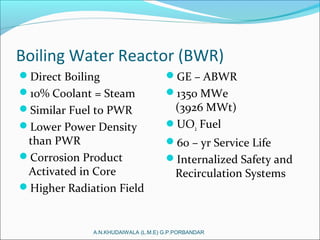
Boiling Water Reactor (BWR)
Direct Boiling
10% Coolant = Steam
Similar Fuel to PWR
Lower Power Density
than PWR
Corrosion Product
Activated in Core
Higher Radiation Field
GE – ABWR
1350 MWe
(3926 MWt)
UO2 Fuel
60 – yr Service Life
Internalized Safety and
Recirculation Systems
A.N.KHUDAIWALA (L.M.E) G.P.PORBANDAR
38
3838
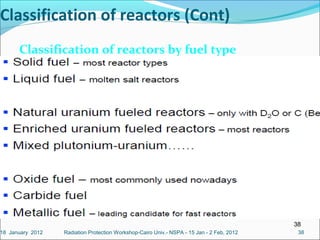
Classification of reactors (Cont)
Classification of reactors by fuel type
Radiation Protection Workshop-Cairo Univ.- NSPA - 15 Jan - 2 Feb, 201218 January 2012
39
3939
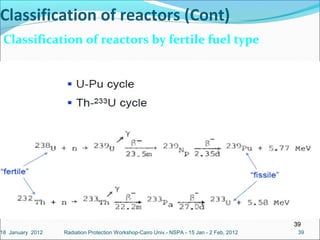
Classification of reactors (Cont)
Classification of reactors by fertile fuel type
Radiation Protection Workshop-Cairo Univ.- NSPA - 15 Jan - 2 Feb, 201218 January 2012
40
4040
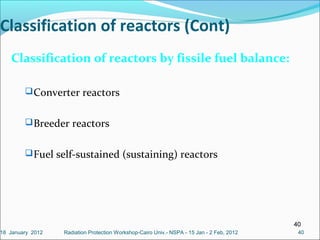
Classification of reactors (Cont)
Classification of reactors by fissile fuel balance:
Converter reactors
Breeder reactors
Fuel self-sustained (sustaining) reactors
Radiation Protection Workshop-Cairo Univ.- NSPA - 15 Jan - 2 Feb, 201218 January 2012
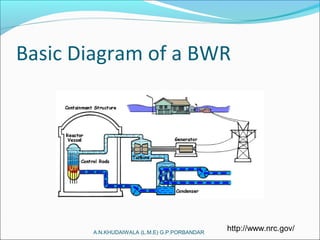
Basic Diagram of a BWR
A.N.KHUDAIWALA (L.M.E) G.P.PORBANDAR
http://www.nrc.gov/
A.N.KHUDAIWALA (L.M.E) G.P.PORBANDAR
Classifications of Reactors
Thermal Reactors and Fast Reactors
Reactors designed to operate with slow, thermalized neutrons (to take
advantage of increase of cross-sections with neutron energy decrease) are
termed thermal reactors. However, it is also possible to operate a reactor with
”fast” neutrons, at energies in the neighborhood of 1 MeV or higher. These
reactors are called fast-neutron reactors or just fast reactors. The only
prominent example of a fast reactor is the liquid-metal breeder reactor.
Homogeneous and Heterogeneous Reactors
All reactors used today for power generation are HETEROGENEOUS, i.e. fuel,
coolant and/or moderator are physically different entities with non-uniform and
anisotropic composition.
STEAM GENERATORS
Steam generators are heat exchangers used to convert
water into steam from heat produced in a nuclear reactor
core.
Either ordinary water or heavy water is used as the
coolant.
A.N.KHUDAIWALA (L.M.E) G.P.PORBANDAR
STEAM TURBINE
A steam turbine is a mechanical device that extracts
thermal energy from pressurized steam, and converts it
into useful mechanical
 Various high-performance alloys and superalloys have
been used for steam generator tubing.
A.N.KHUDAIWALA (L.M.E) G.P.PORBANDAR
COOLANT PUMP
The coolant pump pressurizes the coolant to pressures
of the orderof 155bar.
The pressue of the coolant loop is maintained almost
constant with the help of the pump and a pressurizer unit.
A.N.KHUDAIWALA (L.M.E) G.P.PORBANDAR
FEED PUMP
Steam coming out of the turbine, flows
through the condenser for condensation and
recirculated for the next cycle of operation.
The feed pump circulates the condensed
water in the working fluid loop.
A.N.KHUDAIWALA (L.M.E) G.P.PORBANDAR
CONDENSER
Condenser is a device or unit which is used to condense
vapor into liquid.
The objective of the condenser are to reduce the turbine
exhaust pressure to increase the efficiency and to recover
high qyuality feed water in the form of condensate & feed
back it to the steam generator without any further
treatment.
A.N.KHUDAIWALA (L.M.E) G.P.PORBANDAR
COOLING TOWER
Cooling towers are heat removal devices used to transfer
process waste heat to the atmosphere.
Water cirulating throughthe codeser is taken to the
cooling tower for cooling and reuse
A.N.KHUDAIWALA (L.M.E) G.P.PORBANDAR
ADVANTAGES
Nuclear power generation does emit relatively low amounts of
carbon dioxide (CO2). The emissions of green house gases and
therefore the contribution of nuclear power plants to global
warming is therefore relatively little.
This technology is readily available, it does not have to be
developed first.
It is possible to generate a high amount of electrical energy in
one single plant
A.N.KHUDAIWALA (L.M.E) G.P.PORBANDAR
DISADVANTAGES
The problem of radioactive waste is still an unsolved one.
High risks: It is technically impossible to build a plant with
100% security.
The energy source for nuclear energy is Uranium. Uranium is a
scarce resource, its supply is estimated to last only for the next 30
to 60 years depending on the actual demand.
A.N.KHUDAIWALA (L.M.E) G.P.PORBANDAR
DISADVANTAGES
Nuclear power plants as well as nuclear waste could be
preferred targets for terrorist attacks..
During the operation of nuclear power plants,
radioactive waste is produced, which in turn can be used
for the production of nuclear weapons.
A.N.KHUDAIWALA (L.M.E) G.P.PORBANDAR
What is a CANDU reactor?
CANDU stands for Canada Deuterium
Uranium. Deuterium is another name for heavy
water, which occurs naturally in all bodies of
water. In Lake Huron, it occurs one part in
every 7,000. Once extracted, heavy water is 10
per cent heavier than ordinary water due to an
extra neutron in its nucleus giving it added
weight.
Developed in Canada, the first CANDU reactor
came on line in 1962. There are now 22
CANDU reactors in Canada and 17 abroad.
A.N.KHUDAIWALA (L.M.E) G.P.PORBANDAR
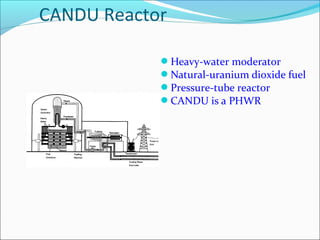
CANDU Reactor
Heavy-water moderator
Natural-uranium dioxide fuel
Pressure-tube reactor
CANDU is a PHWR
A.N.KHUDAIWALA (L.M.E) G.P.PORBANDAR
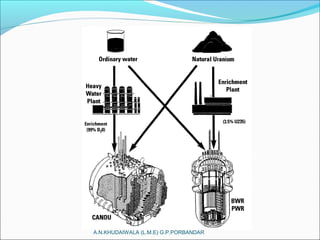
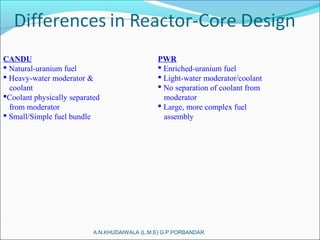
CANDU
 Natural-uranium fuel
 Heavy-water moderator &
coolant
Coolant physically separated
from moderator
 Small/Simple fuel bundle
PWR
 Enriched-uranium fuel
 Light-water moderator/coolant
 No separation of coolant from
moderator
 Large, more complex fuel
assembly
Where were the first nuclear
power stations sited and when?
Issues:Issues:
distance from urban centres
access to national grid
good water supply for cooling
absence of natural hazards
transport links
proximity to both civil airports and military
installations
A.N.KHUDAIWALA (L.M.E) G.P.PORBANDAR
Distance from urban centres and access to the national
grid
Early on, everyone knew that radiation was dangerous. Most
of those alive could remember what happened to Japan when
the H-bombs were dropped and the devastating after effects.
So long as there were concerns about the safety of nuclear
power plants, it was felt that it was essential that they were as
remote as possible from the big cities.
However, in terms of cost and efficiency this had a downside.
Remote areas would not have the heavy duty transmission
lines necessary to take all the electricity generated by the
power station to the grid.
The only feasible way to get it there was by carrying it in huge
ugly pylons that stretch far over the country in a visually
intrusive way.
These remote areas were often near National Parks. The
National parks did not appreciate their presence.
A.N.KHUDAIWALA (L.M.E) G.P.PORBANDAR
Distance from urban centres and
access to the national grid
But generally the overhead power transmission is very reliable, although
overhead power lines are vulnerable to:
 lightning strikes;
 high winds;
 heavy snowfall.
But the cost of burying and the difficulty in repairing underground cables
if things did go wrong meant that this means of transmitting electricity
almost impossible.
Another problem is that electricity does loose power over distance. So the
electricity from these remote sites did not provide as much energy to the
public as electricity from a power station nearer to centres of population.
So once a design was tested and deemed to be safe, the inclination was to
build the ones that came after closer to centres of population. This cut
down on the number and cost of transmission lines and was a more
efficient use of the electricity.
But when any new technology was developed, the tendency was again to
go for the remoter sites.
A.N.KHUDAIWALA (L.M.E) G.P.PORBANDAR
Good water supply for cooling
Because of the heat generated by the process, often
more than by coal or gas fired stations, there was a
need for vast quantities of water to carry out the
cooling process.
Cooling towers had been used for coal fired power
stations.
Bigger, tall more intrusive versions would have
required for nuclear power, provide the site was near
enough to a good water supply, like a large river for
example.
The other solution was to put the power station near
the sea, where no cooler tower would be needed. The
sea would always bring in more water to cool the
steam down.
A.N.KHUDAIWALA (L.M.E) G.P.PORBANDAR
Transport links
For both the building and maintenance of nuclear power
stations, good transport links were a priority.
All nuclear power stations have a rail link, often a side line
from a main line not too far away and very often the roads
have had to be reinforced to take the heavy loads that enter
and leave the power station.
These are massive structures to build, which need very heavy
machinery and vast quantities of raw materials to build them.
Once on-line, the fuel rods which are radioactive have to be
changed regularly. This was the main use of the railway. It
was not acceptable to take these in and out by road as there
could accidents or even terrorism attacks were considered.
A.N.KHUDAIWALA (L.M.E) G.P.PORBANDAR
Proximity to both civil airports and
military installations
Whilst the buildings that house the nuclear power
stations are extremely strong, aircraft crashing into
them or stray shells falling nearby was not something
the authorities wished to happen.
So military training grounds nearby was a definite
NO.
As 75% of all accidents to planes happen close to
take-off or landing, nuclear power plants could not
be sited under the landing or take-off paths of major
airports.
A.N.KHUDAIWALA (L.M.E) G.P.PORBANDAR
Absence of natural hazards
Release of radio active materials was the main worry,
so the buildings containing the process could not be
allowed to be damaged by natural hazards, such as
earthquakes, fault lines, floods.
In addition places which liable to high winds,
extremes of temperature or drought, all of which in
excess cause land movements also had to be watched
out for.
However, now that sea levels are rising due to global
warming, this could be problems for those power
stations built near the sea.
A.N.KHUDAIWALA (L.M.E) G.P.PORBANDAR
•Recently nuclear power has entered many discussions as world energy needs
rise and oil reserves diminish.
•Most opponents of nuclear power point to two main arguments: meltdowns and
nuclear waste.
•Nuclear waste is any form of byproduct or end product that releases
radioactivity.
•How to safely dispose of nuclear waste is pivotal for the continued operation of
nuclear power plants, safety of people living around dump sites, and prevention
of proliferation of nuclear materials to non-nuclear states.
Classifications
Nuclear waste is segregated into several
classifications.
Low level waste is not dangerous but sometimes
requires shielding during handling.
Intermediate level waste typically is chemical
sludge and other products from reactors.
High level waste consists of fissionable elements
from reactor cores and transuranic wastes.
Transuranic waste is any waste with transuranic
alpha emitting radionuclides that have half-lives
longer than 20 years.
A.N.KHUDAIWALA (L.M.E) G.P.PORBANDAR
Low Level Waste
LLW
Low level waste is any waste that could be from a
high activity area.
90% volume of waste
It does not necessarily carry any radioactivity.
Split into four catagories: A, B, C, and GTCC.
A.N.KHUDAIWALA (L.M.E) G.P.PORBANDAR
Intermediate Level Waste
ILW
Intermediate level waste requires shielding when
being handled.
7% volume of waste
Dependent on the amount of activity it can be buried
in shallow repositories.
Not recognized in the United States.
A.N.KHUDAIWALA (L.M.E) G.P.PORBANDAR
High Level Waste
HLW
High level waste has a large amount of radioactive
activity and is thermally hot.
3% volume of waste
95% of radioactivity
Current levels of HLW are increasing about 12,000
metric tons per year.
Most HLW consists of Pu-238, 239, 240, 241, 242, Np-
237, U-236
A.N.KHUDAIWALA (L.M.E) G.P.PORBANDAR
Transuranic Waste TRUW
Transuranic waste consists of all waste that has
radionuclides above uranium.
TRUWs typically have longer half-lives than other
forms of waste.
Typically a byproduct of weapons manufacturing.
Only recognized in the United States.
A.N.KHUDAIWALA (L.M.E) G.P.PORBANDAR
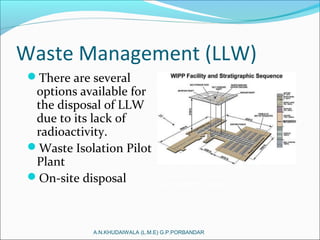
Waste Management (LLW)
There are several
options available for
the disposal of LLW
due to its lack of
radioactivity.
Waste Isolation Pilot
Plant
On-site disposal
A.N.KHUDAIWALA (L.M.E) G.P.PORBANDAR
Map of WIPP Facility
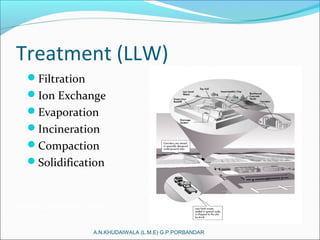
Treatment (LLW)
Filtration
Ion Exchange
Evaporation
Incineration
Compaction
Solidification
A.N.KHUDAIWALA (L.M.E) G.P.PORBANDAR
Typical LLW treatment facility.
Treatment
Most common initial treatment of waste is
vitrification.
Waste is first mixed with sugar and then passed
through a heated tube to de-nitrite the material.
This material is then fed into a furnace and mixed with
glass.
The molten glass mixture is poured into steel cylinders
and welded shut.
A.N.KHUDAIWALA (L.M.E) G.P.PORBANDAR
Treatment (Cont.)
Mid level active waste is commonly treated with ion
exchange
Process reduces the bulk volume of radioactive
material.
Typically, mixed with concrete for a solid storage
form.
A.N.KHUDAIWALA (L.M.E) G.P.PORBANDAR
Treatment (Cont.)
Synroc is a new method for storing nuclear waste
developed in 1978 by Ted Ringwood.
Attempts to hold radioactive material in a crystalline
matrix.
Currently in use for military waste management at
Savannah River Site.
Can hold 50%-70% volume of waste.
A.N.KHUDAIWALA (L.M.E) G.P.PORBANDAR
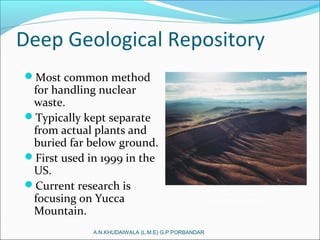
Deep Geological Repository
Most common method
for handling nuclear
waste.
Typically kept separate
from actual plants and
buried far below ground.
First used in 1999 in the
US.
Current research is
focusing on Yucca
Mountain.
A.N.KHUDAIWALA (L.M.E) G.P.PORBANDAR
Yucca Mountain Site
Reuse of Nuclear Waste
Research is being performed to find uses for nuclear
waste.
Caesium-137 and strontium-90 already used in
industrial applications.
Some waste can be used for radioisotope
thermoelectric generators (RTGs).
Overall can reduce total HLW but not eliminate it.
A.N.KHUDAIWALA (L.M.E) G.P.PORBANDAR
Nuclear Plant Future
The countries of the world are each planning their own
course of nuclear plant development or decline
Nuclear power is competitive with natural gas
It is non-polluting
It does not contribute to global warming
Obtaining the fuel only takes 5% of the energy output
Plant licenses have been extended from 20 years to an
additional 20 years
A.N.KHUDAIWALA (L.M.E) G.P.PORBANDAR
Nuclear Plant Future
Newer designs are being sought to make them more
economical and safer
Preapproval of a few designs will hasten development
Disposal of high level radioactive waste still being
studied, but scientists believe deep burial would work
Because they are have large electrical output, their cost
at $2 billion is hard to obtain and guarantee with banks
Replacing plants may be cheaper using the same sites
and containment vessels
A.N.KHUDAIWALA (L.M.E) G.P.PORBANDAR
78A.N.KHUDAIWALA (L.M.E) G.P.PORBANDAR

Nuclear power plant

  • 1.
  • 2.
    A.N.KHUDAIWALA (L.M.E) G.P.PORBANDAR •Define and apply the concepts ofDefine and apply the concepts of mass numbermass number,, atomic numberatomic number,, andand isotopesisotopes.. • Define and apply concepts ofDefine and apply concepts of radioactive decayradioactive decay andand nuclear reactionsnuclear reactions.. • Calculate theCalculate the mass defectmass defect and theand the binding energy per nucleonbinding energy per nucleon for afor a particular isotope.particular isotope. • State the variousState the various conservation lawsconservation laws, and discuss their application for, and discuss their application for nuclear reactions.nuclear reactions.
  • 3.
    A.N.KHUDAIWALA (L.M.E) G.P.PORBANDAR Allof matter is composed of at least three fundamental particles (approximations): All of matter is composed of at least three fundamental particles (approximations): ParticleParticle Fig.Fig.SymSym MassMass ChargeCharge SizeSize The mass of the proton and neutron are close, but they are about 1840 times theThe mass of the proton and neutron are close, but they are about 1840 times the mass of an electron.mass of an electron. ElectronElectron ee-- 9.11 x 109.11 x 10-31-31 kgkg -1.6 x 10-1.6 x 10-19-19 CC ∼∼ ProtonProton pp 1.673 x 101.673 x 10-27-27 kg +1.6 x 10kg +1.6 x 10⁻¹⁹-19 C 3 fmC 3 fm NeutronNeutron nn 1.675 x 101.675 x 10-31-31 kgkg 00 3 fm3 fm
  • 4.
    A.N.KHUDAIWALA (L.M.E) G.P.PORBANDAR BerylliumAtomBeryllium Atom Compacted nucleus:Compacted nucleus: 4 protons4 protons 5 neutrons5 neutrons Since atom is electri-callySince atom is electri-cally neutral, there must be 4neutral, there must be 4 electrons.electrons. 4 electrons4 electrons
  • 5.
    A.N.KHUDAIWALA (L.M.E) G.P.PORBANDAR AAnucleonnucleon is a general term to denote a nuclear particle - that is, either ais a general term to denote a nuclear particle - that is, either a proton or a neutron.proton or a neutron. TheThe atomic numberatomic number ZZ of an element is equal to the number of protons in theof an element is equal to the number of protons in the nucleus of that element.nucleus of that element. TheThe mass numbermass number AA of an element is equal to the total number of nucleonsof an element is equal to the total number of nucleons (protons + neutrons).(protons + neutrons). The mass number A of any element is equal to the sum of the atomic number Z and the number of neutrons N : A = N + Z
  • 6.
    A.N.KHUDAIWALA (L.M.E) G.P.PORBANDAR Aconvenient way of describing an element is by giving its mass number andA convenient way of describing an element is by giving its mass number and its atomic number, along with the chemical symbol for that element.its atomic number, along with the chemical symbol for that element. A convenient way of describing an element is by giving its mass number andA convenient way of describing an element is by giving its mass number and its atomic number, along with the chemical symbol for that element.its atomic number, along with the chemical symbol for that element. [ ]A Mass number Z Atomic numberX Symbol= For example, consider beryllium (Be): 9 4 Be
  • 7.
    A.N.KHUDAIWALA (L.M.E) G.P.PORBANDAR LithiumAtomLithium Atom N = A – Z =N = A – Z = 7 - 37 - 3 A =A = 7; Z = 3;7; Z = 3; NN = ?= ? Protons: Z = 3Protons: Z = 3 neutrons:neutrons: NN = 4= 4 Electrons:Electrons: Same as ZSame as Z 7 3 Li
  • 8.
    A.N.KHUDAIWALA (L.M.E) G.P.PORBANDAR IsotopesIsotopesare atoms that have the same number of protons (are atoms that have the same number of protons (ZZ11= Z= Z22), but a), but a different number of neutrons (N). (different number of neutrons (N). (AA11 ≠≠ AA22)) Helium - 4Helium - 4 4 2 He Helium - 3Helium - 3 3 2 He Isotopes ofIsotopes of heliumhelium
  • 9.
    A.N.KHUDAIWALA (L.M.E) G.P.PORBANDAR Becauseof the existence of so many isotopes, the termBecause of the existence of so many isotopes, the term elementelement is sometimes confusing. The termis sometimes confusing. The term nuclidenuclide is better.is better. A nuclide is an atom that has a definite mass number A and Z-number. A list of nuclides will include isotopes. The following are best described as nuclides:The following are best described as nuclides: 3 2 He 4 2 He 12 6 C 13 6 C
  • 10.
    A.N.KHUDAIWALA (L.M.E) G.P.PORBANDAR OneOneatomic mass unitatomic mass unit (1 u)(1 u) is equal to one-twelfth of the mass of theis equal to one-twelfth of the mass of the most abundant form of the carbon atom--most abundant form of the carbon atom--carbon-12carbon-12.. Atomic mass unit: 1 u = 1.6606 x 10⁻²⁷ kg Common atomic masses: Proton: 1.007276 u Neutron: 1.008665 u Electron: 0.00055 u Hydrogen: 1.007825 u
  • 11.
    2 8 ; 3x 10 m/sE mc c= = A.N.KHUDAIWALA (L.M.E) G.P.PORBANDAR Recall Einstein’s equivalency formula for m and E:Recall Einstein’s equivalency formula for m and E: The energy of a mass of 1 u can be found:The energy of a mass of 1 u can be found: EE = (1 u)= (1 u)cc22 == (1.66 x 10(1.66 x 10⁻²⁷-27 kg)(3 x 10kg)(3 x 1088 m/s)m/s)22 E = 1.49 x 10⁻¹⁰ J OrOr E = 931.5 MeV When converting amu toWhen converting amu to energy:energy: 2 MeV u931.5c =
  • 12.
    NUCLEAR FUEL Nuclear fuelis any material that can be consumed to derive nuclear energy. The most common type of nuclear fuel is fissile elements that can be made to undergo nuclear fission chain reactions in a nuclear reactor The most common nuclear fuels are 235U and 239Pu. Not all nuclear fuels are used in fission chain reactions A.N.KHUDAIWALA (L.M.E) G.P.PORBANDAR
  • 13.
    NUCLEAR FISSION When aneutron strikes an atom of uranium, the uranium splits ingto two lighter atoms and releases heat simultaneously. Fission of heavy elements is an exothermic reaction which can release large amounts of energy both as electromagnetic radiation and as kinetic energy of the fragments A.N.KHUDAIWALA (L.M.E) G.P.PORBANDAR
  • 14.
    NUCLEAR CHAIN REACTIONS Achain reaction refers to a process in which neutrons released in fission produce an additional fission in at least one further nucleus. This nucleus in turn produces neutrons, and the process repeats. If the process is controlled it is used for nuclear power or if uncontrolled it is used for nuclear weapons A.N.KHUDAIWALA (L.M.E) G.P.PORBANDAR
  • 15.
  • 16.
    U235 + nfission + 2 or 3 n + 200 MeV→ If each neutron releases two more neutrons, then the number of fissions doubles each generation. In that case, in 10 generations there are 1,024 fissions and in 80 generations about 6 x 10 23 (a mole) fissions. A.N.KHUDAIWALA (L.M.E) G.P.PORBANDAR
  • 17.
  • 18.
    Nuclear FusionThe combiningof atomic nuclei to form a larger atom is called fusion Nuclear fusion occurs in the sun where hydrogen atoms fuse to form helium A.N.KHUDAIWALA (L.M.E) G.P.PORBANDAR 4 H + 2 0 e-  He + energy1 1 -1 2 4
  • 19.
  • 20.
    A chain reactioncan only occur if the starting material has enough mass to sustain a chain reaction. This amount is called the critical mass. Nuclear Fission is what occurs in Nuclear Reactors and Atomic Bombs. The Nuclear reactor is a controlled fission reaction, the bomb is not. A.N.KHUDAIWALA (L.M.E) G.P.PORBANDAR
  • 21.
    Review Nuclear fission: A largenucleus splits into several small nuclei when impacted by a neutron, and energy is released in this process Nuclear fusion: Several small nuclei fuse together and release energy. A.N.KHUDAIWALA (L.M.E) G.P.PORBANDAR
  • 22.
    Piecing Together aReactor 1. Fuel 2. Moderator 3. Control Rods 4. Coolant 5. Steam Generator 6. Turbine/Generator 7. Pumps 8. Heat Exchanger A.N.KHUDAIWALA (L.M.E) G.P.PORBANDAR
  • 23.
    A.N.KHUDAIWALA (L.M.E) G.P.PORBANDAR 90U(2 ppm) 4.5∙109 yr 90Th (6 ppm) 14.05∙109 yr 238 239 92 94U Pu 99.5% → 235 92 U 0.7% Fuels Natural Elements 233 U 7∙108 yr Artificial Nuclides 239 Pu 24∙103 yr
  • 24.
    A.N.KHUDAIWALA (L.M.E) G.P.PORBANDAR Betweenthorium (Z=90) and bismuth (Z=83), the isotope with the longest half- life is 226 Ra (T½=1600 years), and therefore there are no fuel candidates, quite apart from the issue of fissionability. Uranium and Thorium are the only natural elements available for use as reactor fuels. In addition, 233 U and 239 Pu can be produced from capture on 232 Th and 238 U in reactors. Of fissile materials, only U is both fissile and found in nature in useful amounts.
  • 25.
    A.N.KHUDAIWALA (L.M.E) G.P.PORBANDAR Fuels Few”natural” nuclides that can be used as reactor fuels Uranium (Z=92). This is the main fuel in actual use, especially 235 U which is fissile. In addition, 238 U is important in reactors, primarily as a fertile fuel for 239 Pu production, and 233 U could be used as a fissile fuel, formed by neutron capture in 232 Th. Protactinium (Z=91). The longest-lived isotope of Pa ( 231 Pa) has a half-life of 3.3 x10⁴ yr, and therefore there is essentially no Pa in nature. Further, there is no stable A =230 nuclide that could be used to produce 231 Pa in a reactor. Thorium (Z=90). Thorium is found entirely as 232 Th, which is not fissile (for thermal neutrons). It can be used as a fertile fuel for production of fissile 233 U.
  • 26.
    A.N.KHUDAIWALA (L.M.E) G.P.PORBANDAR Moderators 1H Widely used H2Oor D2O 2He Not used Gas → Press. 3 He absorbs 3Li Not used 6 Li absorbs 4Be Was used 9 Be toxic, expensiv e 5B Impossible 10 B absorbs 6C Widely used Must be pure No use to consider Z > 6 Only D2O and C can be used with Unat
  • 27.
    A.N.KHUDAIWALA (L.M.E) G.P.PORBANDAR Moderators Hydrogen(Z=l). The isotopes 1 H and 2 H are widely used as moderators, in the form of light (ordinary) water and heavy water, respectively. Helium (Z=2). The isotopes 3 He and 4 He are not used, because helium is a gas, and excessive pressures would be required to obtain adequate helium densities for a practical moderator. Moreover 3 He absorbs neutrons very strongly (see lecture about detectors) Lithium (Z=3). The isotope 6 Li (7.5% abundant) has a large neutron-absorption cross section, making lithium impractical as a moderator. Beryllium (Z=4). 9 Be has been used to a limited extent as a moderator, especially in some early reactors. It can be used in the form of beryllium oxide, BeO. Beryllium is expensive and toxic.
  • 28.
    Coolants Function – transferheat Objective: power density, temperature Limitations: in PWR: below saturation T, Tin=293, Tout = 315; in LMFBR, ΔT=140; in HTGR, ΔT=500. After shutdown Coolant is either gas or liquid: H2O, D2O, He, CO2, Na, Na-K, Pb, Pb-Bi. Coolant is moderator Classification: LWR, HWR, GR, LMR A.N.KHUDAIWALA (L.M.E) G.P.PORBANDAR
  • 29.
    A.N.KHUDAIWALA (L.M.E) G.P.PORBANDAR Coolants •Themain function of the coolant in any generating plant is to transfer energy from the hot fuel to the electrical turbine, either directly or through intermediate steps •. During normal reactor operation, cooling is an intrinsic aspect of energy transfer. • In a nuclear reactor, cooling has a special importance, because radioactive decay causes continued heat production even after the reactor is shut down and electricity generation has stopped. • It is still essential to maintain cooling to avoid melting the reactor core, and in some types of reactor accidents (e.g., the accident at Three Mile Island) cooling is the critical issue. •The coolant can be either a liquid or a gas. For thermal reactors, the most common coolants are light water, heavy water, helium, and carbon dioxide. •The type of coolant is commonly used to designate the type of reactor. Hence, the characterization of reactors as light water reactors (LWRs), heavy water reactors (HWRs), and gas-cooled reactors (GCRs).
  • 30.
    A.N.KHUDAIWALA (L.M.E) G.P.PORBANDAR •Control materials are materials with large thermal neutron-absorption cross sections, used as controllable poisons to adjust the level of reactivity. • They serve a variety of purposes: • To achieve intentional changes in reactor operating conditions, including turning the reactor on and off • To compensate for changes in reactor operating conditions, including changes in the fissile and poison content of the fuel • To provide a means for turning the reactor off rapidly, in case of emergency
  • 31.
    A.N.KHUDAIWALA (L.M.E) G.P.PORBANDAR PWR.The pressurized water reactor accounts for almost two-thirds of all capacity and is the only LWR used in some countries, for example, France, the former Soviet Union, and South Korea. BWR. The boiling water reactor is a major alternative to the PWR, and both are used in, for example, Sweden, the United States and Japan. PHWR. The pressurized heavy water reactor uses heavy water for both the coolant and moderator and operates with natural uranium fuel. It has been developed in Canada and is commonly referred to as the CANDU. CANDU units are also in operation in India and are being built in Romania and South Korea.
  • 32.
    32 3232 Classification of reactorsClassificationof reactors Classification of reactors by purpose: Power reactors Research reactors Material test reactors Propulsion reactors Production reactors Space reactors Radiation Protection Workshop-Cairo Univ.- NSPA - 15 Jan - 2 Feb, 201218 January 2012
  • 33.
    33 3333 Classification of reactors(Cont) Classification of reactors by neutron spectrum: Thermal spectrum Fast spectrum Radiation Protection Workshop-Cairo Univ.- NSPA - 15 Jan - 2 Feb, 201218 January 2012
  • 34.
    34 3434 Classification of reactors(Cont) Classification of reactors by coolant Light water Heavy water Gas Liquid metal Radiation Protection Workshop-Cairo Univ.- NSPA - 15 Jan - 2 Feb, 201218 January 2012
  • 35.
    35 3535 Classification of reactors(Cont) Classification of reactors by moderator: Light water reactors Heavy water reactors Graphite moderated reactors Radiation Protection Workshop-Cairo Univ.- NSPA - 15 Jan - 2 Feb, 201218 January 2012
  • 36.
    Basic Diagram ofa PWR A.N.KHUDAIWALA (L.M.E) G.P.PORBANDAR http://www.nrc.gov/
  • 37.
    Boiling Water Reactor(BWR) Direct Boiling 10% Coolant = Steam Similar Fuel to PWR Lower Power Density than PWR Corrosion Product Activated in Core Higher Radiation Field GE – ABWR 1350 MWe (3926 MWt) UO2 Fuel 60 – yr Service Life Internalized Safety and Recirculation Systems A.N.KHUDAIWALA (L.M.E) G.P.PORBANDAR
  • 38.
    38 3838 Classification of reactors(Cont) Classification of reactors by fuel type Radiation Protection Workshop-Cairo Univ.- NSPA - 15 Jan - 2 Feb, 201218 January 2012
  • 39.
    39 3939 Classification of reactors(Cont) Classification of reactors by fertile fuel type Radiation Protection Workshop-Cairo Univ.- NSPA - 15 Jan - 2 Feb, 201218 January 2012
  • 40.
    40 4040 Classification of reactors(Cont) Classification of reactors by fissile fuel balance: Converter reactors Breeder reactors Fuel self-sustained (sustaining) reactors Radiation Protection Workshop-Cairo Univ.- NSPA - 15 Jan - 2 Feb, 201218 January 2012
  • 41.
    Basic Diagram ofa BWR A.N.KHUDAIWALA (L.M.E) G.P.PORBANDAR http://www.nrc.gov/
  • 42.
    A.N.KHUDAIWALA (L.M.E) G.P.PORBANDAR Classificationsof Reactors Thermal Reactors and Fast Reactors Reactors designed to operate with slow, thermalized neutrons (to take advantage of increase of cross-sections with neutron energy decrease) are termed thermal reactors. However, it is also possible to operate a reactor with ”fast” neutrons, at energies in the neighborhood of 1 MeV or higher. These reactors are called fast-neutron reactors or just fast reactors. The only prominent example of a fast reactor is the liquid-metal breeder reactor. Homogeneous and Heterogeneous Reactors All reactors used today for power generation are HETEROGENEOUS, i.e. fuel, coolant and/or moderator are physically different entities with non-uniform and anisotropic composition.
  • 43.
    STEAM GENERATORS Steam generatorsare heat exchangers used to convert water into steam from heat produced in a nuclear reactor core. Either ordinary water or heavy water is used as the coolant. A.N.KHUDAIWALA (L.M.E) G.P.PORBANDAR
  • 44.
    STEAM TURBINE A steamturbine is a mechanical device that extracts thermal energy from pressurized steam, and converts it into useful mechanical  Various high-performance alloys and superalloys have been used for steam generator tubing. A.N.KHUDAIWALA (L.M.E) G.P.PORBANDAR
  • 45.
    COOLANT PUMP The coolantpump pressurizes the coolant to pressures of the orderof 155bar. The pressue of the coolant loop is maintained almost constant with the help of the pump and a pressurizer unit. A.N.KHUDAIWALA (L.M.E) G.P.PORBANDAR
  • 46.
    FEED PUMP Steam comingout of the turbine, flows through the condenser for condensation and recirculated for the next cycle of operation. The feed pump circulates the condensed water in the working fluid loop. A.N.KHUDAIWALA (L.M.E) G.P.PORBANDAR
  • 47.
    CONDENSER Condenser is adevice or unit which is used to condense vapor into liquid. The objective of the condenser are to reduce the turbine exhaust pressure to increase the efficiency and to recover high qyuality feed water in the form of condensate & feed back it to the steam generator without any further treatment. A.N.KHUDAIWALA (L.M.E) G.P.PORBANDAR
  • 48.
    COOLING TOWER Cooling towersare heat removal devices used to transfer process waste heat to the atmosphere. Water cirulating throughthe codeser is taken to the cooling tower for cooling and reuse A.N.KHUDAIWALA (L.M.E) G.P.PORBANDAR
  • 49.
    ADVANTAGES Nuclear power generationdoes emit relatively low amounts of carbon dioxide (CO2). The emissions of green house gases and therefore the contribution of nuclear power plants to global warming is therefore relatively little. This technology is readily available, it does not have to be developed first. It is possible to generate a high amount of electrical energy in one single plant A.N.KHUDAIWALA (L.M.E) G.P.PORBANDAR
  • 50.
    DISADVANTAGES The problem ofradioactive waste is still an unsolved one. High risks: It is technically impossible to build a plant with 100% security. The energy source for nuclear energy is Uranium. Uranium is a scarce resource, its supply is estimated to last only for the next 30 to 60 years depending on the actual demand. A.N.KHUDAIWALA (L.M.E) G.P.PORBANDAR
  • 51.
    DISADVANTAGES Nuclear power plantsas well as nuclear waste could be preferred targets for terrorist attacks.. During the operation of nuclear power plants, radioactive waste is produced, which in turn can be used for the production of nuclear weapons. A.N.KHUDAIWALA (L.M.E) G.P.PORBANDAR
  • 52.
    What is aCANDU reactor? CANDU stands for Canada Deuterium Uranium. Deuterium is another name for heavy water, which occurs naturally in all bodies of water. In Lake Huron, it occurs one part in every 7,000. Once extracted, heavy water is 10 per cent heavier than ordinary water due to an extra neutron in its nucleus giving it added weight. Developed in Canada, the first CANDU reactor came on line in 1962. There are now 22 CANDU reactors in Canada and 17 abroad. A.N.KHUDAIWALA (L.M.E) G.P.PORBANDAR
  • 53.
    CANDU Reactor Heavy-water moderator Natural-uraniumdioxide fuel Pressure-tube reactor CANDU is a PHWR
  • 54.
  • 55.
    A.N.KHUDAIWALA (L.M.E) G.P.PORBANDAR CANDU Natural-uranium fuel  Heavy-water moderator & coolant Coolant physically separated from moderator  Small/Simple fuel bundle PWR  Enriched-uranium fuel  Light-water moderator/coolant  No separation of coolant from moderator  Large, more complex fuel assembly
  • 56.
    Where were thefirst nuclear power stations sited and when? Issues:Issues: distance from urban centres access to national grid good water supply for cooling absence of natural hazards transport links proximity to both civil airports and military installations A.N.KHUDAIWALA (L.M.E) G.P.PORBANDAR
  • 57.
    Distance from urbancentres and access to the national grid Early on, everyone knew that radiation was dangerous. Most of those alive could remember what happened to Japan when the H-bombs were dropped and the devastating after effects. So long as there were concerns about the safety of nuclear power plants, it was felt that it was essential that they were as remote as possible from the big cities. However, in terms of cost and efficiency this had a downside. Remote areas would not have the heavy duty transmission lines necessary to take all the electricity generated by the power station to the grid. The only feasible way to get it there was by carrying it in huge ugly pylons that stretch far over the country in a visually intrusive way. These remote areas were often near National Parks. The National parks did not appreciate their presence. A.N.KHUDAIWALA (L.M.E) G.P.PORBANDAR
  • 58.
    Distance from urbancentres and access to the national grid But generally the overhead power transmission is very reliable, although overhead power lines are vulnerable to:  lightning strikes;  high winds;  heavy snowfall. But the cost of burying and the difficulty in repairing underground cables if things did go wrong meant that this means of transmitting electricity almost impossible. Another problem is that electricity does loose power over distance. So the electricity from these remote sites did not provide as much energy to the public as electricity from a power station nearer to centres of population. So once a design was tested and deemed to be safe, the inclination was to build the ones that came after closer to centres of population. This cut down on the number and cost of transmission lines and was a more efficient use of the electricity. But when any new technology was developed, the tendency was again to go for the remoter sites. A.N.KHUDAIWALA (L.M.E) G.P.PORBANDAR
  • 59.
    Good water supplyfor cooling Because of the heat generated by the process, often more than by coal or gas fired stations, there was a need for vast quantities of water to carry out the cooling process. Cooling towers had been used for coal fired power stations. Bigger, tall more intrusive versions would have required for nuclear power, provide the site was near enough to a good water supply, like a large river for example. The other solution was to put the power station near the sea, where no cooler tower would be needed. The sea would always bring in more water to cool the steam down. A.N.KHUDAIWALA (L.M.E) G.P.PORBANDAR
  • 60.
    Transport links For boththe building and maintenance of nuclear power stations, good transport links were a priority. All nuclear power stations have a rail link, often a side line from a main line not too far away and very often the roads have had to be reinforced to take the heavy loads that enter and leave the power station. These are massive structures to build, which need very heavy machinery and vast quantities of raw materials to build them. Once on-line, the fuel rods which are radioactive have to be changed regularly. This was the main use of the railway. It was not acceptable to take these in and out by road as there could accidents or even terrorism attacks were considered. A.N.KHUDAIWALA (L.M.E) G.P.PORBANDAR
  • 61.
    Proximity to bothcivil airports and military installations Whilst the buildings that house the nuclear power stations are extremely strong, aircraft crashing into them or stray shells falling nearby was not something the authorities wished to happen. So military training grounds nearby was a definite NO. As 75% of all accidents to planes happen close to take-off or landing, nuclear power plants could not be sited under the landing or take-off paths of major airports. A.N.KHUDAIWALA (L.M.E) G.P.PORBANDAR
  • 62.
    Absence of naturalhazards Release of radio active materials was the main worry, so the buildings containing the process could not be allowed to be damaged by natural hazards, such as earthquakes, fault lines, floods. In addition places which liable to high winds, extremes of temperature or drought, all of which in excess cause land movements also had to be watched out for. However, now that sea levels are rising due to global warming, this could be problems for those power stations built near the sea. A.N.KHUDAIWALA (L.M.E) G.P.PORBANDAR
  • 63.
    A.N.KHUDAIWALA (L.M.E) G.P.PORBANDAR •Recentlynuclear power has entered many discussions as world energy needs rise and oil reserves diminish. •Most opponents of nuclear power point to two main arguments: meltdowns and nuclear waste. •Nuclear waste is any form of byproduct or end product that releases radioactivity. •How to safely dispose of nuclear waste is pivotal for the continued operation of nuclear power plants, safety of people living around dump sites, and prevention of proliferation of nuclear materials to non-nuclear states.
  • 64.
    Classifications Nuclear waste issegregated into several classifications. Low level waste is not dangerous but sometimes requires shielding during handling. Intermediate level waste typically is chemical sludge and other products from reactors. High level waste consists of fissionable elements from reactor cores and transuranic wastes. Transuranic waste is any waste with transuranic alpha emitting radionuclides that have half-lives longer than 20 years. A.N.KHUDAIWALA (L.M.E) G.P.PORBANDAR
  • 65.
    Low Level Waste LLW Lowlevel waste is any waste that could be from a high activity area. 90% volume of waste It does not necessarily carry any radioactivity. Split into four catagories: A, B, C, and GTCC. A.N.KHUDAIWALA (L.M.E) G.P.PORBANDAR
  • 66.
    Intermediate Level Waste ILW Intermediatelevel waste requires shielding when being handled. 7% volume of waste Dependent on the amount of activity it can be buried in shallow repositories. Not recognized in the United States. A.N.KHUDAIWALA (L.M.E) G.P.PORBANDAR
  • 67.
    High Level Waste HLW Highlevel waste has a large amount of radioactive activity and is thermally hot. 3% volume of waste 95% of radioactivity Current levels of HLW are increasing about 12,000 metric tons per year. Most HLW consists of Pu-238, 239, 240, 241, 242, Np- 237, U-236 A.N.KHUDAIWALA (L.M.E) G.P.PORBANDAR
  • 68.
    Transuranic Waste TRUW Transuranicwaste consists of all waste that has radionuclides above uranium. TRUWs typically have longer half-lives than other forms of waste. Typically a byproduct of weapons manufacturing. Only recognized in the United States. A.N.KHUDAIWALA (L.M.E) G.P.PORBANDAR
  • 69.
    Waste Management (LLW) Thereare several options available for the disposal of LLW due to its lack of radioactivity. Waste Isolation Pilot Plant On-site disposal A.N.KHUDAIWALA (L.M.E) G.P.PORBANDAR Map of WIPP Facility
  • 70.
  • 71.
    Treatment Most common initialtreatment of waste is vitrification. Waste is first mixed with sugar and then passed through a heated tube to de-nitrite the material. This material is then fed into a furnace and mixed with glass. The molten glass mixture is poured into steel cylinders and welded shut. A.N.KHUDAIWALA (L.M.E) G.P.PORBANDAR
  • 72.
    Treatment (Cont.) Mid levelactive waste is commonly treated with ion exchange Process reduces the bulk volume of radioactive material. Typically, mixed with concrete for a solid storage form. A.N.KHUDAIWALA (L.M.E) G.P.PORBANDAR
  • 73.
    Treatment (Cont.) Synroc isa new method for storing nuclear waste developed in 1978 by Ted Ringwood. Attempts to hold radioactive material in a crystalline matrix. Currently in use for military waste management at Savannah River Site. Can hold 50%-70% volume of waste. A.N.KHUDAIWALA (L.M.E) G.P.PORBANDAR
  • 74.
    Deep Geological Repository Mostcommon method for handling nuclear waste. Typically kept separate from actual plants and buried far below ground. First used in 1999 in the US. Current research is focusing on Yucca Mountain. A.N.KHUDAIWALA (L.M.E) G.P.PORBANDAR Yucca Mountain Site
  • 75.
    Reuse of NuclearWaste Research is being performed to find uses for nuclear waste. Caesium-137 and strontium-90 already used in industrial applications. Some waste can be used for radioisotope thermoelectric generators (RTGs). Overall can reduce total HLW but not eliminate it. A.N.KHUDAIWALA (L.M.E) G.P.PORBANDAR
  • 76.
    Nuclear Plant Future Thecountries of the world are each planning their own course of nuclear plant development or decline Nuclear power is competitive with natural gas It is non-polluting It does not contribute to global warming Obtaining the fuel only takes 5% of the energy output Plant licenses have been extended from 20 years to an additional 20 years A.N.KHUDAIWALA (L.M.E) G.P.PORBANDAR
  • 77.
    Nuclear Plant Future Newerdesigns are being sought to make them more economical and safer Preapproval of a few designs will hasten development Disposal of high level radioactive waste still being studied, but scientists believe deep burial would work Because they are have large electrical output, their cost at $2 billion is hard to obtain and guarantee with banks Replacing plants may be cheaper using the same sites and containment vessels A.N.KHUDAIWALA (L.M.E) G.P.PORBANDAR
  • 78.

Editor's Notes

  • #58 These looked at together as they are linked
  • #59 These looked at together as they are linked