STEAM PRIME MOVERS
A device which convert any source of energy into
Mechanical work is defined prime movers.
Steam Engine.
Steam turbine.
1A.N.KHUDAIWALA (L.M.E) G.P.PORBANDAR
 Nozzle is duct of smoothly varying cross-sectional
area in which a steadily flowing fluid can be made to
accelerate by a pressure drop along the duct.
Applications:
steam and gas turbines
Jet engines
Rocket motors
Flow measurement
2A.N.KHUDAIWALA (L.M.E) G.P.PORBANDAR
 When a fluid is decelerated in a duct
causing a rise in pressure along the stream,
then the duct is called a diffuser.
 Two applications in practice in which a
diffuser is
used are :
The centrifugal compressor
Ramjet
Diffuser
3A.N.KHUDAIWALA (L.M.E) G.P.PORBANDAR
Steam Nozzle
Steam nozzle is an insulated
passage of varying cross-sectional area
through which heat energy (Enthalpy),
pressure of steam is converted into
kinetic energy.
4A.N.KHUDAIWALA (L.M.E) G.P.PORBANDAR
Functions of Nozzle :-
1) The main function of the steam nozzle is to
convert heat energy to kinetic energy.
2) To direct the steam at high velocity into
blades of turbine at required angle.
Applications :-
1) Steam & gas turbines are used to produces a
high velocity jet.
2) Jet engines and rockets to produce thrust
(propulsive force) 5A.N.KHUDAIWALA (L.M.E) G.P.PORBANDAR
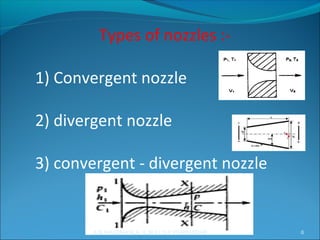
Types of nozzles :-
1) Convergent nozzle
2) divergent nozzle
3) convergent - divergent nozzle
6A.N.KHUDAIWALA (L.M.E) G.P.PORBANDAR
1) Convergent nozzle :-
It is a nozzle with large entrance and tapers gradually to a smallest section at
exit. It has no diverging portion.
2) Divergent nozzle :-
It is a nozzle with small entrance and tapers gradually to a large section at
exit. It has no converging portion at entry.
3) convergent - divergent nozzle :-
convergent - divergent nozzle is widely used in steam turbines. The nozzle
converges first to the smallest section and then diverges up to exit. The smallest
section of the nozzle is called throat. The divergent portion of nozzle allows higher
expansion ratio i.e., increases pressure drop. The taper of diverging sides of the nozzle
ranges from 60
to 150
. If the taper is above 150
turbulent is increased. However if it is
less than 60
, the length of the nozzle will increases.
7A.N.KHUDAIWALA (L.M.E) G.P.PORBANDAR
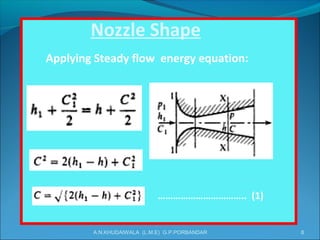
Nozzle Shape
Applying Steady flow energy equation:
…………………………….. (1)
8A.N.KHUDAIWALA (L.M.E) G.P.PORBANDAR
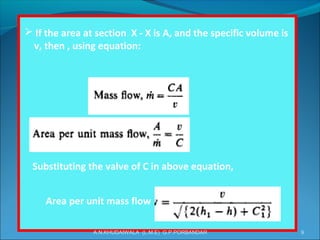
 If the area at section X - X is A, and the specific volume is
v, then , using equation:
Substituting the valve of C in above equation,
Area per unit mass flow
9A.N.KHUDAIWALA (L.M.E) G.P.PORBANDAR
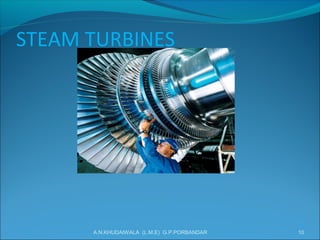
STEAM TURBINES
10A.N.KHUDAIWALA (L.M.E) G.P.PORBANDAR
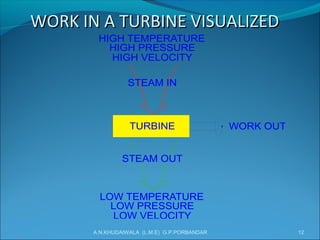
“Steam Turbine is a prime-mover in which Pressure energy of
steam is transformed into Kinetic energy, and later in its turn
is transformed into the mechanical energy of rotation of
turbine shaft”
11
A.N.KHUDAIWALA (L.M.E) G.P.PORBANDAR
WORK IN A TURBINE VISUALIZEDWORK IN A TURBINE VISUALIZED
12A.N.KHUDAIWALA (L.M.E) G.P.PORBANDAR
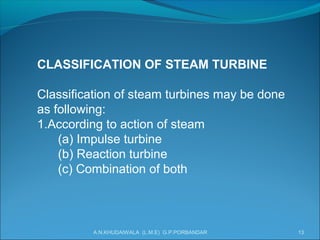
CLASSIFICATION OF STEAM TURBINE
Classification of steam turbines may be done
as following:
1.According to action of steam
(a) Impulse turbine
(b) Reaction turbine
(c) Combination of both
A.N.KHUDAIWALA (L.M.E) G.P.PORBANDAR 13
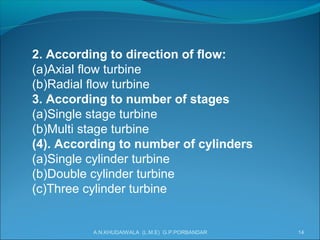
2. According to direction of flow:
(a)Axial flow turbine
(b)Radial flow turbine
3. According to number of stages
(a)Single stage turbine
(b)Multi stage turbine
(4). According to number of cylinders
(a)Single cylinder turbine
(b)Double cylinder turbine
(c)Three cylinder turbine
A.N.KHUDAIWALA (L.M.E) G.P.PORBANDAR 14
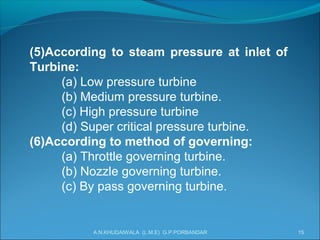
(5)According to steam pressure at inlet of
Turbine:
(a) Low pressure turbine
(b) Medium pressure turbine.
(c) High pressure turbine
(d) Super critical pressure turbine.
(6)According to method of governing:
(a) Throttle governing turbine.
(b) Nozzle governing turbine.
(c) By pass governing turbine.
A.N.KHUDAIWALA (L.M.E) G.P.PORBANDAR 15
(7) According to usage in industry:
(a) Stationary turbine with constant speed.
(b) Stationary turbine with variable speed.
(c) Non stationary turbines.
A.N.KHUDAIWALA (L.M.E) G.P.PORBANDAR 16
Classification based on
Principle of Action
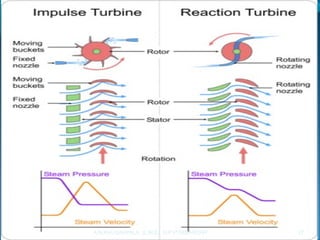
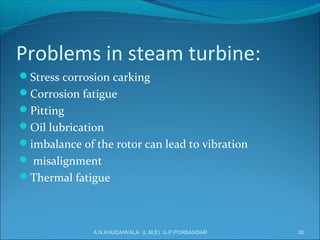
1.Impulse Turbine
 Pressure energy of Steam is converted into Kinetic Energy.
 Impulse action of high velocity jet of steam, due to change in its
direction is used to rotate the turbine shaft.
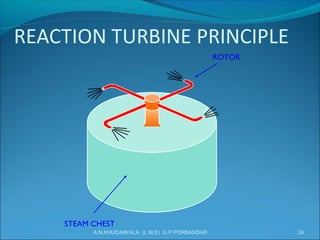
2.Reaction Turbine
 Reaction force due to expansion of high pressure steam when it
passes through a set of moving and fixed blades is used to rotate
the turbine shaft.
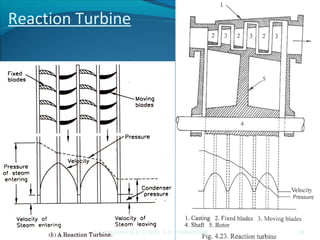
 Due to expansion of steam, pressure drop occurs continuously over
both fixed and moving blades.
 This pressure difference exerts a thrust on the blades.
 The resulting reaction force imparts rotary motion.
msstevesimon@gmail.com 17A.N.KHUDAIWALA (L.M.E) G.P.PORBANDAR
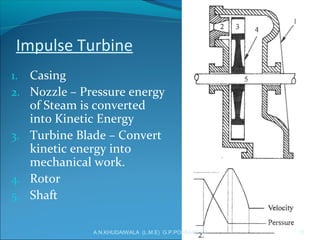
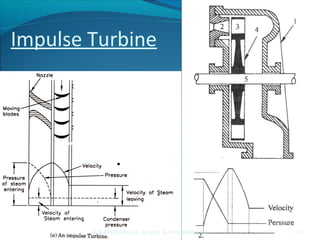
Impulse Turbine
1. Casing
2. Nozzle – Pressure energy
of Steam is converted
into Kinetic Energy
3. Turbine Blade – Convert
kinetic energy into
mechanical work.
4. Rotor
5. Shaft
18A.N.KHUDAIWALA (L.M.E) G.P.PORBANDAR
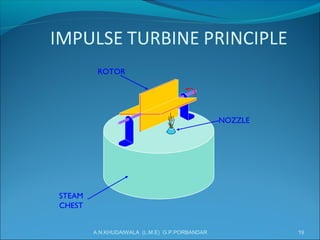
A.N.KHUDAIWALA (L.M.E) G.P.PORBANDAR 19
NOZZLE
STEAM
CHEST
ROTOR
Impulse turbine - Working
High pressure steam from boiler is supplied to
fixed nozzles.
Nozzle – Pressure falls from boiler pressure to
condenser pressure
Reduction in pressure increases velocity.
High velocity steam impinges on moving curved
vanes
Causes change in momentum Impulsive force
on blades.
Pressure remains constant when steam flows
through blades.
Eg: De Lavel Turbine 20A.N.KHUDAIWALA (L.M.E) G.P.PORBANDAR
Impulse Turbine
21A.N.KHUDAIWALA (L.M.E) G.P.PORBANDAR
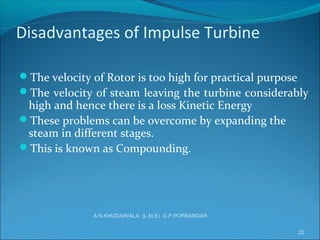
Disadvantages of Impulse Turbine
The velocity of Rotor is too high for practical purpose
The velocity of steam leaving the turbine considerably
high and hence there is a loss Kinetic Energy
These problems can be overcome by expanding the
steam in different stages.
This is known as Compounding.
22
A.N.KHUDAIWALA (L.M.E) G.P.PORBANDAR
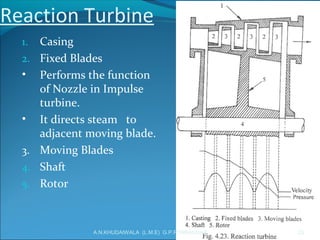
Reaction Turbine
1. Casing
2. Fixed Blades
• Performs the function
of Nozzle in Impulse
turbine.
• It directs steam to
adjacent moving blade.
3. Moving Blades
4. Shaft
5. Rotor
23A.N.KHUDAIWALA (L.M.E) G.P.PORBANDAR
A.N.KHUDAIWALA (L.M.E) G.P.PORBANDAR 24
STEAM CHEST
ROTOR
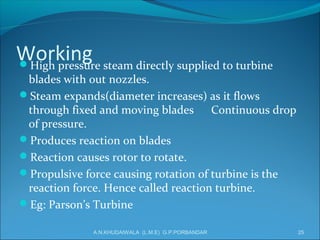
WorkingHigh pressure steam directly supplied to turbine
blades with out nozzles.
Steam expands(diameter increases) as it flows
through fixed and moving blades Continuous drop
of pressure.
Produces reaction on blades
Reaction causes rotor to rotate.
Propulsive force causing rotation of turbine is the
reaction force. Hence called reaction turbine.
Eg: Parson’s Turbine
25A.N.KHUDAIWALA (L.M.E) G.P.PORBANDAR
Reaction Turbine
26A.N.KHUDAIWALA (L.M.E) G.P.PORBANDAR
27A.N.KHUDAIWALA (L.M.E) G.P.PORBANDAR
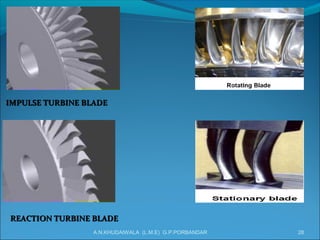
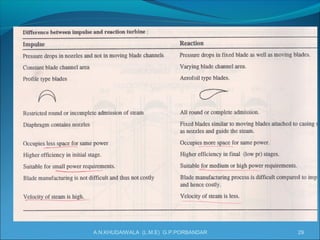
IMPULSE TURBINE BLADEIMPULSE TURBINE BLADE
REACTION TURBINE BLADEREACTION TURBINE BLADE
28A.N.KHUDAIWALA (L.M.E) G.P.PORBANDAR
A.N.KHUDAIWALA (L.M.E) G.P.PORBANDAR 29
Problems in steam turbine:
Stress corrosion carking
Corrosion fatigue
Pitting
Oil lubrication
imbalance of the rotor can lead to vibration
 misalignment
Thermal fatigue
30A.N.KHUDAIWALA (L.M.E) G.P.PORBANDAR
Compounding of Impulse Turbine
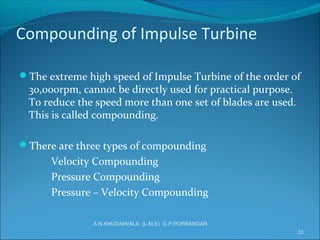
The extreme high speed of Impulse Turbine of the order of
30,000rpm, cannot be directly used for practical purpose.
To reduce the speed more than one set of blades are used.
This is called compounding.
There are three types of compounding
Velocity Compounding
Pressure Compounding
Pressure – Velocity Compounding
31
A.N.KHUDAIWALA (L.M.E) G.P.PORBANDAR
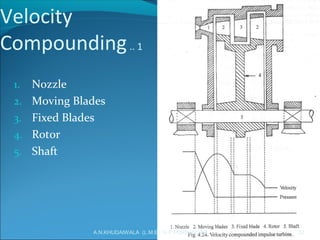
Velocity
Compounding.. 1
1. Nozzle
2. Moving Blades
3. Fixed Blades
4. Rotor
5. Shaft
32A.N.KHUDAIWALA (L.M.E) G.P.PORBANDAR
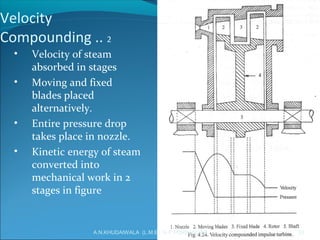
Velocity
Compounding .. 2
• Velocity of steam
absorbed in stages
• Moving and fixed
blades placed
alternatively.
• Entire pressure drop
takes place in nozzle.
• Kinetic energy of steam
converted into
mechanical work in 2
stages in figure
33A.N.KHUDAIWALA (L.M.E) G.P.PORBANDAR
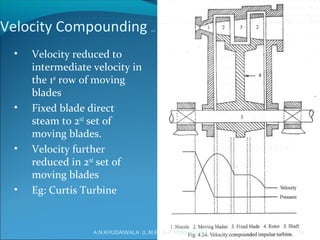
Velocity Compounding ..
• Velocity reduced to
intermediate velocity in
the 1st
row of moving
blades
• Fixed blade direct
steam to 2nd
set of
moving blades.
• Velocity further
reduced in 2nd
set of
moving blades
• Eg: Curtis Turbine
34A.N.KHUDAIWALA (L.M.E) G.P.PORBANDAR
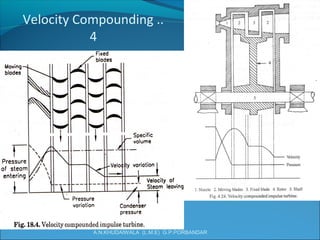
Velocity Compounding ..
4
A.N.KHUDAIWALA (L.M.E) G.P.PORBANDAR
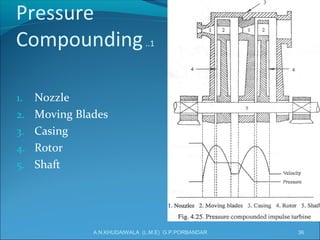
Pressure
Compounding..1
1. Nozzle
2. Moving Blades
3. Casing
4. Rotor
5. Shaft
36A.N.KHUDAIWALA (L.M.E) G.P.PORBANDAR
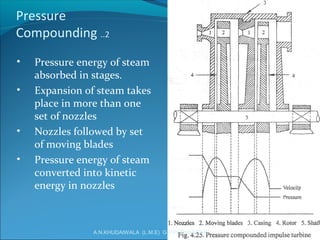
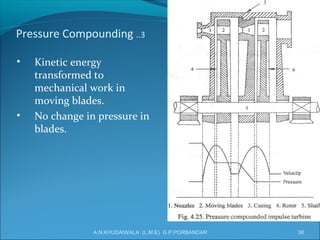
Pressure
Compounding ..2
• Pressure energy of steam
absorbed in stages.
• Expansion of steam takes
place in more than one
set of nozzles
• Nozzles followed by set
of moving blades
• Pressure energy of steam
converted into kinetic
energy in nozzles
37A.N.KHUDAIWALA (L.M.E) G.P.PORBANDAR
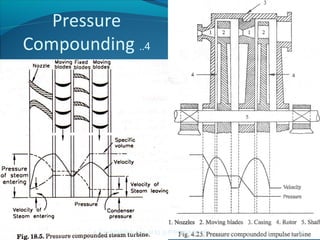
Pressure Compounding ..3
• Kinetic energy
transformed to
mechanical work in
moving blades.
• No change in pressure in
blades.
38A.N.KHUDAIWALA (L.M.E) G.P.PORBANDAR
Pressure
Compounding ..4
39A.N.KHUDAIWALA (L.M.E) G.P.PORBANDAR
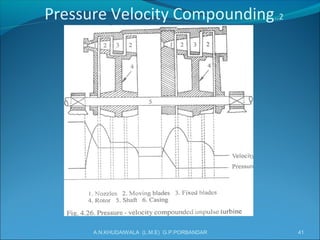
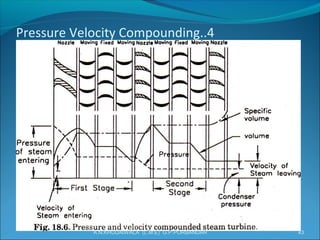
Pressure Velocity Compounding..1
Combination of pressure compounding and velocity
compounding.
In a 2 stage pressure velocity compounded turbine –
total drop in steam pressure carried out in 2 stages.
Velocity obtained in each stage is compounded.
40
A.N.KHUDAIWALA (L.M.E) G.P.PORBANDAR
Pressure Velocity Compounding..2
41A.N.KHUDAIWALA (L.M.E) G.P.PORBANDAR
Pressure Velocity Compounding..3
1st
stage and 2nd
stage taken separately are identical to
velocity compounded turbine.
Combines advantages of pressure and velocity
compounding.
42
A.N.KHUDAIWALA (L.M.E) G.P.PORBANDAR
Pressure Velocity Compounding..4
43A.N.KHUDAIWALA (L.M.E) G.P.PORBANDAR
44A.N.KHUDAIWALA (L.M.E) G.P.PORBANDAR
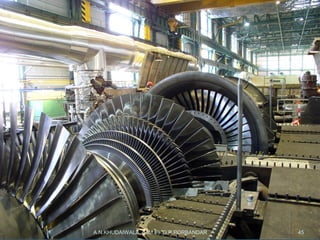
45A.N.KHUDAIWALA (L.M.E) G.P.PORBANDAR
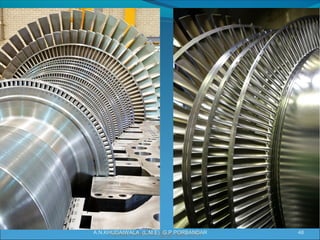
msstevesimon@gmail.com 46A.N.KHUDAIWALA (L.M.E) G.P.PORBANDAR
47
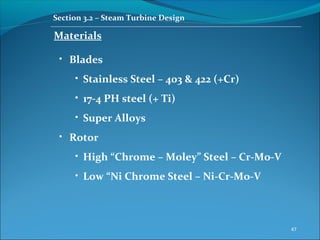
Section 3.2 – Steam Turbine Design
Materials
• Blades
• Stainless Steel – 403 & 422 (+Cr)
• 17-4 PH steel (+ Ti)
• Super Alloys
• Rotor
• High “Chrome – Moley” Steel – Cr-Mo-V
• Low “Ni Chrome Steel – Ni-Cr-Mo-V
48A.N.KHUDAIWALA (L.M.E) G.P.PORBANDAR

Steam prime movers

  • 1.
    STEAM PRIME MOVERS Adevice which convert any source of energy into Mechanical work is defined prime movers. Steam Engine. Steam turbine. 1A.N.KHUDAIWALA (L.M.E) G.P.PORBANDAR
  • 2.
     Nozzle isduct of smoothly varying cross-sectional area in which a steadily flowing fluid can be made to accelerate by a pressure drop along the duct. Applications: steam and gas turbines Jet engines Rocket motors Flow measurement 2A.N.KHUDAIWALA (L.M.E) G.P.PORBANDAR
  • 3.
     When afluid is decelerated in a duct causing a rise in pressure along the stream, then the duct is called a diffuser.  Two applications in practice in which a diffuser is used are : The centrifugal compressor Ramjet Diffuser 3A.N.KHUDAIWALA (L.M.E) G.P.PORBANDAR
  • 4.
    Steam Nozzle Steam nozzleis an insulated passage of varying cross-sectional area through which heat energy (Enthalpy), pressure of steam is converted into kinetic energy. 4A.N.KHUDAIWALA (L.M.E) G.P.PORBANDAR
  • 5.
    Functions of Nozzle:- 1) The main function of the steam nozzle is to convert heat energy to kinetic energy. 2) To direct the steam at high velocity into blades of turbine at required angle. Applications :- 1) Steam & gas turbines are used to produces a high velocity jet. 2) Jet engines and rockets to produce thrust (propulsive force) 5A.N.KHUDAIWALA (L.M.E) G.P.PORBANDAR
  • 6.
    Types of nozzles:- 1) Convergent nozzle 2) divergent nozzle 3) convergent - divergent nozzle 6A.N.KHUDAIWALA (L.M.E) G.P.PORBANDAR
  • 7.
    1) Convergent nozzle:- It is a nozzle with large entrance and tapers gradually to a smallest section at exit. It has no diverging portion. 2) Divergent nozzle :- It is a nozzle with small entrance and tapers gradually to a large section at exit. It has no converging portion at entry. 3) convergent - divergent nozzle :- convergent - divergent nozzle is widely used in steam turbines. The nozzle converges first to the smallest section and then diverges up to exit. The smallest section of the nozzle is called throat. The divergent portion of nozzle allows higher expansion ratio i.e., increases pressure drop. The taper of diverging sides of the nozzle ranges from 60 to 150 . If the taper is above 150 turbulent is increased. However if it is less than 60 , the length of the nozzle will increases. 7A.N.KHUDAIWALA (L.M.E) G.P.PORBANDAR
  • 8.
    Nozzle Shape Applying Steadyflow energy equation: …………………………….. (1) 8A.N.KHUDAIWALA (L.M.E) G.P.PORBANDAR
  • 9.
     If thearea at section X - X is A, and the specific volume is v, then , using equation: Substituting the valve of C in above equation, Area per unit mass flow 9A.N.KHUDAIWALA (L.M.E) G.P.PORBANDAR
  • 10.
  • 11.
    “Steam Turbine isa prime-mover in which Pressure energy of steam is transformed into Kinetic energy, and later in its turn is transformed into the mechanical energy of rotation of turbine shaft” 11 A.N.KHUDAIWALA (L.M.E) G.P.PORBANDAR
  • 12.
    WORK IN ATURBINE VISUALIZEDWORK IN A TURBINE VISUALIZED 12A.N.KHUDAIWALA (L.M.E) G.P.PORBANDAR
  • 13.
    CLASSIFICATION OF STEAMTURBINE Classification of steam turbines may be done as following: 1.According to action of steam (a) Impulse turbine (b) Reaction turbine (c) Combination of both A.N.KHUDAIWALA (L.M.E) G.P.PORBANDAR 13
  • 14.
    2. According todirection of flow: (a)Axial flow turbine (b)Radial flow turbine 3. According to number of stages (a)Single stage turbine (b)Multi stage turbine (4). According to number of cylinders (a)Single cylinder turbine (b)Double cylinder turbine (c)Three cylinder turbine A.N.KHUDAIWALA (L.M.E) G.P.PORBANDAR 14
  • 15.
    (5)According to steampressure at inlet of Turbine: (a) Low pressure turbine (b) Medium pressure turbine. (c) High pressure turbine (d) Super critical pressure turbine. (6)According to method of governing: (a) Throttle governing turbine. (b) Nozzle governing turbine. (c) By pass governing turbine. A.N.KHUDAIWALA (L.M.E) G.P.PORBANDAR 15
  • 16.
    (7) According tousage in industry: (a) Stationary turbine with constant speed. (b) Stationary turbine with variable speed. (c) Non stationary turbines. A.N.KHUDAIWALA (L.M.E) G.P.PORBANDAR 16
  • 17.
    Classification based on Principleof Action 1.Impulse Turbine  Pressure energy of Steam is converted into Kinetic Energy.  Impulse action of high velocity jet of steam, due to change in its direction is used to rotate the turbine shaft. 2.Reaction Turbine  Reaction force due to expansion of high pressure steam when it passes through a set of moving and fixed blades is used to rotate the turbine shaft.  Due to expansion of steam, pressure drop occurs continuously over both fixed and moving blades.  This pressure difference exerts a thrust on the blades.  The resulting reaction force imparts rotary motion. msstevesimon@gmail.com 17A.N.KHUDAIWALA (L.M.E) G.P.PORBANDAR
  • 18.
    Impulse Turbine 1. Casing 2.Nozzle – Pressure energy of Steam is converted into Kinetic Energy 3. Turbine Blade – Convert kinetic energy into mechanical work. 4. Rotor 5. Shaft 18A.N.KHUDAIWALA (L.M.E) G.P.PORBANDAR
  • 19.
    A.N.KHUDAIWALA (L.M.E) G.P.PORBANDAR19 NOZZLE STEAM CHEST ROTOR
  • 20.
    Impulse turbine -Working High pressure steam from boiler is supplied to fixed nozzles. Nozzle – Pressure falls from boiler pressure to condenser pressure Reduction in pressure increases velocity. High velocity steam impinges on moving curved vanes Causes change in momentum Impulsive force on blades. Pressure remains constant when steam flows through blades. Eg: De Lavel Turbine 20A.N.KHUDAIWALA (L.M.E) G.P.PORBANDAR
  • 21.
  • 22.
    Disadvantages of ImpulseTurbine The velocity of Rotor is too high for practical purpose The velocity of steam leaving the turbine considerably high and hence there is a loss Kinetic Energy These problems can be overcome by expanding the steam in different stages. This is known as Compounding. 22 A.N.KHUDAIWALA (L.M.E) G.P.PORBANDAR
  • 23.
    Reaction Turbine 1. Casing 2.Fixed Blades • Performs the function of Nozzle in Impulse turbine. • It directs steam to adjacent moving blade. 3. Moving Blades 4. Shaft 5. Rotor 23A.N.KHUDAIWALA (L.M.E) G.P.PORBANDAR
  • 24.
  • 25.
    WorkingHigh pressure steamdirectly supplied to turbine blades with out nozzles. Steam expands(diameter increases) as it flows through fixed and moving blades Continuous drop of pressure. Produces reaction on blades Reaction causes rotor to rotate. Propulsive force causing rotation of turbine is the reaction force. Hence called reaction turbine. Eg: Parson’s Turbine 25A.N.KHUDAIWALA (L.M.E) G.P.PORBANDAR
  • 26.
  • 27.
  • 28.
    IMPULSE TURBINE BLADEIMPULSETURBINE BLADE REACTION TURBINE BLADEREACTION TURBINE BLADE 28A.N.KHUDAIWALA (L.M.E) G.P.PORBANDAR
  • 29.
  • 30.
    Problems in steamturbine: Stress corrosion carking Corrosion fatigue Pitting Oil lubrication imbalance of the rotor can lead to vibration  misalignment Thermal fatigue 30A.N.KHUDAIWALA (L.M.E) G.P.PORBANDAR
  • 31.
    Compounding of ImpulseTurbine The extreme high speed of Impulse Turbine of the order of 30,000rpm, cannot be directly used for practical purpose. To reduce the speed more than one set of blades are used. This is called compounding. There are three types of compounding Velocity Compounding Pressure Compounding Pressure – Velocity Compounding 31 A.N.KHUDAIWALA (L.M.E) G.P.PORBANDAR
  • 32.
    Velocity Compounding.. 1 1. Nozzle 2.Moving Blades 3. Fixed Blades 4. Rotor 5. Shaft 32A.N.KHUDAIWALA (L.M.E) G.P.PORBANDAR
  • 33.
    Velocity Compounding .. 2 •Velocity of steam absorbed in stages • Moving and fixed blades placed alternatively. • Entire pressure drop takes place in nozzle. • Kinetic energy of steam converted into mechanical work in 2 stages in figure 33A.N.KHUDAIWALA (L.M.E) G.P.PORBANDAR
  • 34.
    Velocity Compounding .. •Velocity reduced to intermediate velocity in the 1st row of moving blades • Fixed blade direct steam to 2nd set of moving blades. • Velocity further reduced in 2nd set of moving blades • Eg: Curtis Turbine 34A.N.KHUDAIWALA (L.M.E) G.P.PORBANDAR
  • 35.
  • 36.
    Pressure Compounding..1 1. Nozzle 2. MovingBlades 3. Casing 4. Rotor 5. Shaft 36A.N.KHUDAIWALA (L.M.E) G.P.PORBANDAR
  • 37.
    Pressure Compounding ..2 • Pressureenergy of steam absorbed in stages. • Expansion of steam takes place in more than one set of nozzles • Nozzles followed by set of moving blades • Pressure energy of steam converted into kinetic energy in nozzles 37A.N.KHUDAIWALA (L.M.E) G.P.PORBANDAR
  • 38.
    Pressure Compounding ..3 •Kinetic energy transformed to mechanical work in moving blades. • No change in pressure in blades. 38A.N.KHUDAIWALA (L.M.E) G.P.PORBANDAR
  • 39.
  • 40.
    Pressure Velocity Compounding..1 Combinationof pressure compounding and velocity compounding. In a 2 stage pressure velocity compounded turbine – total drop in steam pressure carried out in 2 stages. Velocity obtained in each stage is compounded. 40 A.N.KHUDAIWALA (L.M.E) G.P.PORBANDAR
  • 41.
  • 42.
    Pressure Velocity Compounding..3 1st stageand 2nd stage taken separately are identical to velocity compounded turbine. Combines advantages of pressure and velocity compounding. 42 A.N.KHUDAIWALA (L.M.E) G.P.PORBANDAR
  • 43.
  • 44.
  • 45.
  • 46.
  • 47.
    47 Section 3.2 –Steam Turbine Design Materials • Blades • Stainless Steel – 403 & 422 (+Cr) • 17-4 PH steel (+ Ti) • Super Alloys • Rotor • High “Chrome – Moley” Steel – Cr-Mo-V • Low “Ni Chrome Steel – Ni-Cr-Mo-V
  • 48.