



Unit-6:
Losses in Pipes
SYLLABUS:
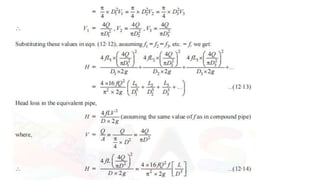
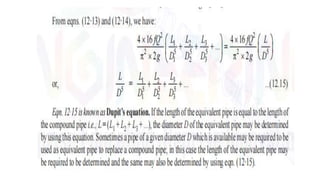
A. Major and Minor Losses, Darcy-Wiesbach Equation, Concept of Equivalent Pipe,
Dupit’s Equation.
B. Pipes in Series, Parallel and Syphon, Two Reservoir Problems, Three Reservoir
Problems Concept of Water hammer. Surge Tanks (Function, Location and Uses).
FLOW THROUGH PIPE
• A pipe is a closed conduit (generally of circular section)
which is used for carrying fluids under pressure. The flow
in a pipe is termed pipe flow only when the fluid
completely fills the cross-section and there is no free
surface of fluid. The pipe running partially full (in such a
case atmospheric pressure exists inside the pipe)
behaves like an open channel.
LOSS OF ENERGY (OR HEAD) IN PIPES
• When water flows in a pipe, it experiences some resistance to its motion, due
to which its velocity and ultimately the head of water available is reduced.
This loss of energy (or head) is classified as follows :
A. Major Energy Losses
• This loss is due to friction.
B. Minor Energy Losses
• These losses are due to :
1. Sudden enlargement of pipe,
2. Sudden contraction of pipe,
3. Bend of pipe,
4. An obstruction in pipe,
5. Pipe fittings, etc.
MAJOR ENERGY LOSSES
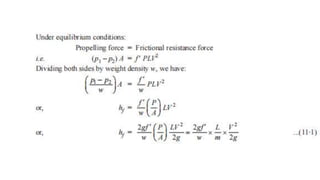
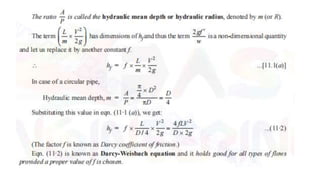
• These losses which are due to friction are calculated by :
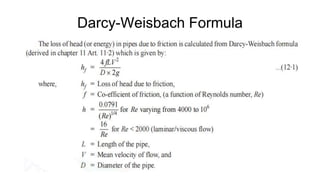
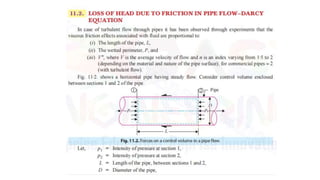
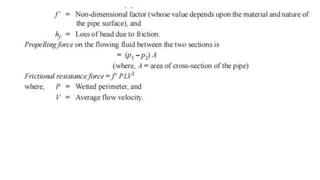
1. Darcy-Weisbach formula
2. Chezy’s formula.
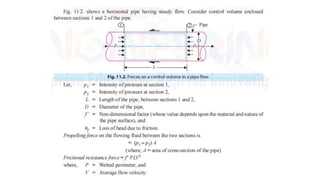
Darcy-Weisbach Formula
Chezy’s Formula for Loss of Head due to Friction
Minor Losses
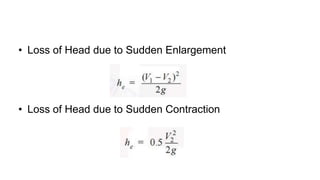
• Loss of Head due to Sudden Enlargement
• Loss of Head due to Sudden Contraction
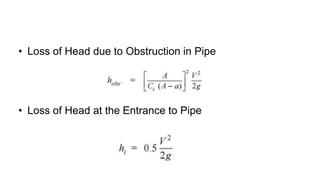
• Loss of Head due to Obstruction in Pipe
• Loss of Head at the Entrance to Pipe
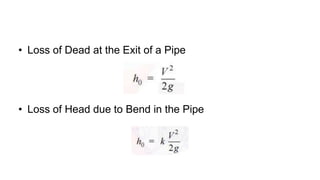
• Loss of Dead at the Exit of a Pipe
• Loss of Head due to Bend in the Pipe
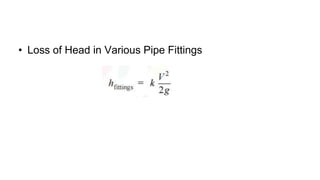
• Loss of Head in Various Pipe Fittings
Equivalent Pipe
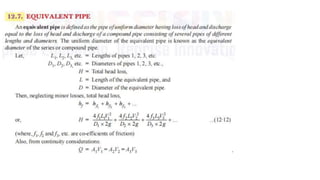
• Equivalent pipes refer to imaginary pipes which are used
to determine the head loss and flow of discharge
considering that the flow of discharge and head loss in the
actual piping system is same as that of the equivalent
pipe. It is a technique used to decrease the large number
of attached pipe systems into an individual pipe system
such that the piping system analysis can be made easier.
• In equivalent pipe structure, the major properties of pipe
such as length of pipe, diameter of pipe and roughness
factor of pipe are required to do the analysis.
4.6 Pipe Flow Analysis
•Pipeline system used in water distribution, industrial
application and in many engineering systems may
range from simple arrangement to extremely
complex one.
•Problems regarding pipelines are usually tackled by
the use of continuity and energy equations.
•The head loss due to friction is usually calculated
using the D-W equation while the minor losses are
computed using equations depending on the
appropriate conditions.
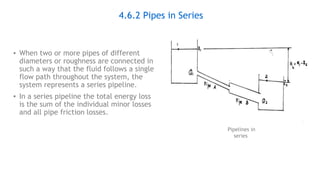
4.6.2 Pipes in Series
▪ When two or more pipes of different
diameters or roughness are connected in
such a way that the fluid follows a single
flow path throughout the system, the
system represents a series pipeline.
▪ In a series pipeline the total energy loss
is the sum of the individual minor losses
and all pipe friction losses.
Pipelines in
series
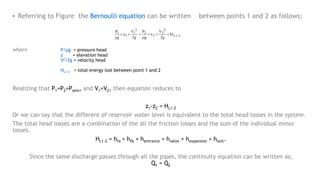
▪ Referring to Figure the Bernoulli equation can be written between points 1 and 2 as follows;
where P/ρg = pressure head
z = elevation head
V2/2g = velocity head
HL1-2 = total energy lost between point 1 and 2
Realizing that P1=P2=Patm, and V1=V2, then equation reduces to
z1-z2 = HL1-2
Or we can say that the different of reservoir water level is equivalent to the total head losses in the system.
The total head losses are a combination of the all the friction losses and the sum of the individual minor
losses.
HL1-2 = hfa + hfb + hentrance + hvalve + hexpansion + hexit.
Since the same discharge passes through all the pipes, the continuity equation can be written as;
Q1 = Q2
4.6.3 Pipes in Parallel
Pipelines in parallel
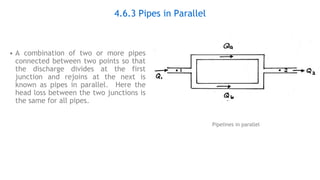
• A combination of two or more pipes
connected between two points so that
the discharge divides at the first
junction and rejoins at the next is
known as pipes in parallel. Here the
head loss between the two junctions is
the same for all pipes.
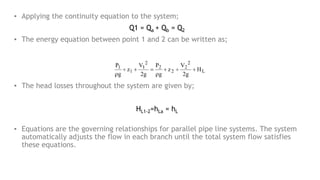
▪ Applying the continuity equation to the system;
Q1 = Qa + Qb = Q2
▪ The energy equation between point 1 and 2 can be written as;
▪ The head losses throughout the system are given by;
HL1-2=hLa = hL
▪ Equations are the governing relationships for parallel pipe line systems. The system
automatically adjusts the flow in each branch until the total system flow satisfies
these equations.

Losses in Pipe

  • 1.
    Unit-6: Losses in Pipes SYLLABUS: A.Major and Minor Losses, Darcy-Wiesbach Equation, Concept of Equivalent Pipe, Dupit’s Equation. B. Pipes in Series, Parallel and Syphon, Two Reservoir Problems, Three Reservoir Problems Concept of Water hammer. Surge Tanks (Function, Location and Uses).
  • 2.
    FLOW THROUGH PIPE •A pipe is a closed conduit (generally of circular section) which is used for carrying fluids under pressure. The flow in a pipe is termed pipe flow only when the fluid completely fills the cross-section and there is no free surface of fluid. The pipe running partially full (in such a case atmospheric pressure exists inside the pipe) behaves like an open channel.
  • 3.
    LOSS OF ENERGY(OR HEAD) IN PIPES • When water flows in a pipe, it experiences some resistance to its motion, due to which its velocity and ultimately the head of water available is reduced. This loss of energy (or head) is classified as follows : A. Major Energy Losses • This loss is due to friction. B. Minor Energy Losses • These losses are due to : 1. Sudden enlargement of pipe, 2. Sudden contraction of pipe, 3. Bend of pipe, 4. An obstruction in pipe, 5. Pipe fittings, etc.
  • 4.
    MAJOR ENERGY LOSSES •These losses which are due to friction are calculated by : 1. Darcy-Weisbach formula 2. Chezy’s formula.
  • 6.
  • 7.
    Chezy’s Formula forLoss of Head due to Friction
  • 12.
  • 13.
    • Loss ofHead due to Sudden Enlargement • Loss of Head due to Sudden Contraction
  • 14.
    • Loss ofHead due to Obstruction in Pipe • Loss of Head at the Entrance to Pipe
  • 15.
    • Loss ofDead at the Exit of a Pipe • Loss of Head due to Bend in the Pipe
  • 16.
    • Loss ofHead in Various Pipe Fittings
  • 17.
    Equivalent Pipe • Equivalentpipes refer to imaginary pipes which are used to determine the head loss and flow of discharge considering that the flow of discharge and head loss in the actual piping system is same as that of the equivalent pipe. It is a technique used to decrease the large number of attached pipe systems into an individual pipe system such that the piping system analysis can be made easier. • In equivalent pipe structure, the major properties of pipe such as length of pipe, diameter of pipe and roughness factor of pipe are required to do the analysis.
  • 22.
    4.6 Pipe FlowAnalysis •Pipeline system used in water distribution, industrial application and in many engineering systems may range from simple arrangement to extremely complex one. •Problems regarding pipelines are usually tackled by the use of continuity and energy equations. •The head loss due to friction is usually calculated using the D-W equation while the minor losses are computed using equations depending on the appropriate conditions.
  • 23.
    4.6.2 Pipes inSeries ▪ When two or more pipes of different diameters or roughness are connected in such a way that the fluid follows a single flow path throughout the system, the system represents a series pipeline. ▪ In a series pipeline the total energy loss is the sum of the individual minor losses and all pipe friction losses. Pipelines in series
  • 24.
    ▪ Referring toFigure the Bernoulli equation can be written between points 1 and 2 as follows; where P/ρg = pressure head z = elevation head V2/2g = velocity head HL1-2 = total energy lost between point 1 and 2 Realizing that P1=P2=Patm, and V1=V2, then equation reduces to z1-z2 = HL1-2 Or we can say that the different of reservoir water level is equivalent to the total head losses in the system. The total head losses are a combination of the all the friction losses and the sum of the individual minor losses. HL1-2 = hfa + hfb + hentrance + hvalve + hexpansion + hexit. Since the same discharge passes through all the pipes, the continuity equation can be written as; Q1 = Q2
  • 25.
    4.6.3 Pipes inParallel Pipelines in parallel • A combination of two or more pipes connected between two points so that the discharge divides at the first junction and rejoins at the next is known as pipes in parallel. Here the head loss between the two junctions is the same for all pipes.
  • 26.
    ▪ Applying thecontinuity equation to the system; Q1 = Qa + Qb = Q2 ▪ The energy equation between point 1 and 2 can be written as; ▪ The head losses throughout the system are given by; HL1-2=hLa = hL ▪ Equations are the governing relationships for parallel pipe line systems. The system automatically adjusts the flow in each branch until the total system flow satisfies these equations.