Flow through pipes
When the fluid flows through the pipes two
types of losses will occur

Minor losses.

Major losses.
Object




Determination of Darcy-Weisbach friction
coefficient ‘f’ for (two) given pipes.
To obtain log f vs. log Re graph for (two)
different pipes and mention the value of
κ/D on each.
Theory





As the fluid (here water) flows through a pipe, the
viscosity of fluid and surface (inside) or pipe offer
resistance to the flow, and in overcoming the same,
energy of the flowing water is lost. this loss of energy
per unit weight of water, called loss of head due to
friction ‘Hf) is given by the following Darcy's Weisbach
formula
Hf = (fL/D) x( v2/2g)
Where U is the mean velocity of fluid in the pipe of
diameter D and length L (across which Hf was
measured) and f is known as Darcy's friction coefficient’.
For a horizontal pipe with constant discharge, this loss
of head will appears the difference of pressure at two
sections L apart.
When a real fluid flows through a pipe, it has
been experimentally shown by Reynolds,
there exit two distinctly different regimes of
flow under. Of course under a set of
circumstances- these are, laminar flow,
usually at low velocities and turbulent flow,
at higher velocities, laminar flow has a little
significance. Turbulent flow has different
stages of flow, three sub regions of flow,
namely smooth turbulent flow rough
turbulent flow and transition between
smooth and turbulent flow.
A complete dimensional analysis of pipe
friction phenomenon on comparison with
Darcy's Eqn, reveals that Darcy's friction
factor depends on (i) Re and (ii) relative, κ/D
where κ is the average height of surface
roughness of pipe. κ is defined as the
diameter of such uniform sand grains, which
when coated on pipe wall, yields the same
limiting value, for rough conditions, as given
by the pipe.
Re = ρUd/ υ = 4Q/πdυ
A graphical plot between log f and Re for different
values of κ/D will offer a complete a revelation of
the nature of pipe friction phenomenon for all
three sub regions of turbulent flow. It will be
found that the value of f depends on (i) Re alone
I smooth turbulent flow, (ii) κ/D alone in rough
turbulent flow and (iii) κ /D and re both in
transition flow. The value off for rough turbulent
flow is given by eqn

1/√f = 1.14 –log κ /D

This eqn can be used to find k provided ‘f’ is known
and flow is definitely rough turbulent flow.
Working






In experiment we have assembly of five pipes of
different diameters.
Each pipe is connected to the differential
manometer at its entry and exit.
As the fluid flows from the pipes there occur a
friction loss which is measured by calculating
differential head of each pipe, directly from the
differential manometer.
Experimental set up



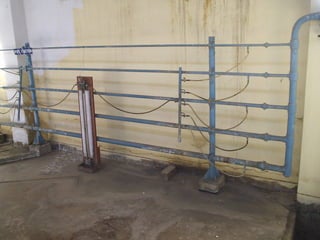
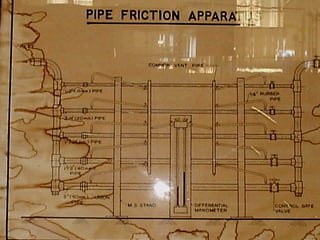
The set up consist of a no. of pipe, 12.5 mm to
38 mm dia and nearly 5m long, connected to a
main pipe of 38 mm diameter. An inlet valve is
provided in the main pipe to regulate the
discharge to different pipes. A valve is also fitted
at the outlet of each pipe to regulate the flow in it.
A u-tube manometer may be fitted between two
suitably located pressure tapings A and B on
each pipe to measure the head loss hf. A
collecting tank is required to measure the
discharge.
Procedure
1.
2.

3.

4.
5.
6.
7.

Check the pressure connections to the pipe in question
and determine its length and diameter. (col.1)
Allow a small discharge to flow through the pipe and
note the pressure difference (col.7)when it becomes
constant.
Collect the flow in a collecting tank for a suitable time
note the initial and final water levels and the time taken.
(col.3,4,5)
Note the manometer reading. (col. 7)
Change the delivery valve opening and adjust another
discharges.
repeat the above procedure for successive pipes.
Record the laboratory temperature and hence
corresponding value of kinematic viscosity.
Calculations
1.

2.
3.
4.

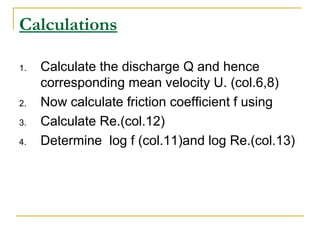
Calculate the discharge Q and hence
corresponding mean velocity U. (col.6,8)
Now calculate friction coefficient f using
Calculate Re.(col.12)
Determine log f (col.11)and log Re.(col.13)
Formula used


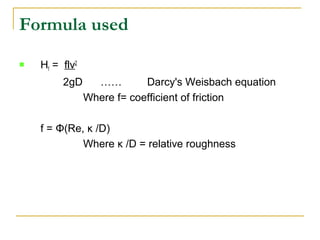
Hf = flv2
2gD

……
Darcy's Weisbach equation
Where f= coefficient of friction

f = Φ(Re, κ /D)
Where κ /D = relative roughness
Presentation of result









Find for each pipe the arithmetic mean of the value of f
(col.10)as its final value. Draw a graph between Hf
(col.7)and U2 (col.9)and show that f is a constant for all
velocities. Also find the graph the value of F
F for ……….. M diameter pipe =
Plot the values of log f (col.11) as ordinates against log
Re as abscissa separately for different types of flow. For
two values of corresponding to maximum discharges
through each pipe and using Eq 3 calculate the value of
κ /D. Mention the same on the corresponding curve in
the graph in the rough turbulent flow zone.
κ /D for ……………. In diameter pipe =
Observations
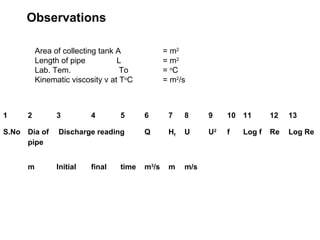
Area of collecting tank A
Length of pipe
L
Lab. Tem.
To
Kinematic viscosity v at ToC

1

2

S.No Dia of
pipe
m

3

4

= m2
= m2
= oC
= m2/s

5

6

7

8

9

10

11

12

13

Discharge reading

Q

Hf

U

U2

f

Log f

Re

Log Re

Initial

m3/s

m

m/s

final

time
Viva- voce
1.

2.

3.

4.

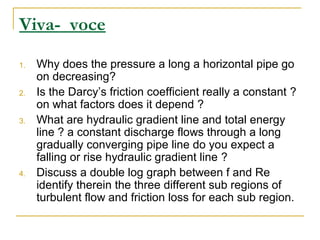
Why does the pressure a long a horizontal pipe go
on decreasing?
Is the Darcy’s friction coefficient really a constant ?
on what factors does it depend ?
What are hydraulic gradient line and total energy
line ? a constant discharge flows through a long
gradually converging pipe line do you expect a
falling or rise hydraulic gradient line ?
Discuss a double log graph between f and Re
identify therein the three different sub regions of
turbulent flow and friction loss for each sub region.

Flow in pipes

  • 1.
    Flow through pipes Whenthe fluid flows through the pipes two types of losses will occur  Minor losses.  Major losses.
  • 2.
    Object   Determination of Darcy-Weisbachfriction coefficient ‘f’ for (two) given pipes. To obtain log f vs. log Re graph for (two) different pipes and mention the value of κ/D on each.
  • 3.
    Theory    As the fluid(here water) flows through a pipe, the viscosity of fluid and surface (inside) or pipe offer resistance to the flow, and in overcoming the same, energy of the flowing water is lost. this loss of energy per unit weight of water, called loss of head due to friction ‘Hf) is given by the following Darcy's Weisbach formula Hf = (fL/D) x( v2/2g) Where U is the mean velocity of fluid in the pipe of diameter D and length L (across which Hf was measured) and f is known as Darcy's friction coefficient’. For a horizontal pipe with constant discharge, this loss of head will appears the difference of pressure at two sections L apart.
  • 4.
    When a realfluid flows through a pipe, it has been experimentally shown by Reynolds, there exit two distinctly different regimes of flow under. Of course under a set of circumstances- these are, laminar flow, usually at low velocities and turbulent flow, at higher velocities, laminar flow has a little significance. Turbulent flow has different stages of flow, three sub regions of flow, namely smooth turbulent flow rough turbulent flow and transition between smooth and turbulent flow.
  • 5.
    A complete dimensionalanalysis of pipe friction phenomenon on comparison with Darcy's Eqn, reveals that Darcy's friction factor depends on (i) Re and (ii) relative, κ/D where κ is the average height of surface roughness of pipe. κ is defined as the diameter of such uniform sand grains, which when coated on pipe wall, yields the same limiting value, for rough conditions, as given by the pipe. Re = ρUd/ υ = 4Q/πdυ
  • 6.
    A graphical plotbetween log f and Re for different values of κ/D will offer a complete a revelation of the nature of pipe friction phenomenon for all three sub regions of turbulent flow. It will be found that the value of f depends on (i) Re alone I smooth turbulent flow, (ii) κ/D alone in rough turbulent flow and (iii) κ /D and re both in transition flow. The value off for rough turbulent flow is given by eqn 1/√f = 1.14 –log κ /D This eqn can be used to find k provided ‘f’ is known and flow is definitely rough turbulent flow.
  • 7.
    Working    In experiment wehave assembly of five pipes of different diameters. Each pipe is connected to the differential manometer at its entry and exit. As the fluid flows from the pipes there occur a friction loss which is measured by calculating differential head of each pipe, directly from the differential manometer.
  • 8.
    Experimental set up  Theset up consist of a no. of pipe, 12.5 mm to 38 mm dia and nearly 5m long, connected to a main pipe of 38 mm diameter. An inlet valve is provided in the main pipe to regulate the discharge to different pipes. A valve is also fitted at the outlet of each pipe to regulate the flow in it. A u-tube manometer may be fitted between two suitably located pressure tapings A and B on each pipe to measure the head loss hf. A collecting tank is required to measure the discharge.
  • 11.
    Procedure 1. 2. 3. 4. 5. 6. 7. Check the pressureconnections to the pipe in question and determine its length and diameter. (col.1) Allow a small discharge to flow through the pipe and note the pressure difference (col.7)when it becomes constant. Collect the flow in a collecting tank for a suitable time note the initial and final water levels and the time taken. (col.3,4,5) Note the manometer reading. (col. 7) Change the delivery valve opening and adjust another discharges. repeat the above procedure for successive pipes. Record the laboratory temperature and hence corresponding value of kinematic viscosity.
  • 12.
    Calculations 1. 2. 3. 4. Calculate the dischargeQ and hence corresponding mean velocity U. (col.6,8) Now calculate friction coefficient f using Calculate Re.(col.12) Determine log f (col.11)and log Re.(col.13)
  • 13.
    Formula used  Hf =flv2 2gD …… Darcy's Weisbach equation Where f= coefficient of friction f = Φ(Re, κ /D) Where κ /D = relative roughness
  • 14.
    Presentation of result       Findfor each pipe the arithmetic mean of the value of f (col.10)as its final value. Draw a graph between Hf (col.7)and U2 (col.9)and show that f is a constant for all velocities. Also find the graph the value of F F for ……….. M diameter pipe = F for ……….. M diameter pipe = Plot the values of log f (col.11) as ordinates against log Re as abscissa separately for different types of flow. For two values of corresponding to maximum discharges through each pipe and using Eq 3 calculate the value of κ /D. Mention the same on the corresponding curve in the graph in the rough turbulent flow zone. κ /D for ……………. In diameter pipe = κ /D for ……………. In diameter pipe =
  • 15.
    Observations Area of collectingtank A Length of pipe L Lab. Tem. To Kinematic viscosity v at ToC 1 2 S.No Dia of pipe m 3 4 = m2 = m2 = oC = m2/s 5 6 7 8 9 10 11 12 13 Discharge reading Q Hf U U2 f Log f Re Log Re Initial m3/s m m/s final time
  • 16.
    Viva- voce 1. 2. 3. 4. Why doesthe pressure a long a horizontal pipe go on decreasing? Is the Darcy’s friction coefficient really a constant ? on what factors does it depend ? What are hydraulic gradient line and total energy line ? a constant discharge flows through a long gradually converging pipe line do you expect a falling or rise hydraulic gradient line ? Discuss a double log graph between f and Re identify therein the three different sub regions of turbulent flow and friction loss for each sub region.