Chapter 7
Pressure Control and Speed
Regulation
Hydropower Engineering I
Contents
1. Water Hammer theory and Analysis
2. Pressure Control Systems
3. Speed Terminology
4. Speed Control and Governors
2 CH 7 PC & SR
Introduction
 Sudden shutdowns of hydroelectric plants or
changes in water flow through hydraulic turbines
may cause problems ranging from rupture of
penstocks due to water hammer to runner speed
changes that cause the line current of the generators
to vary from the desired frequency.
 Regulating the water flow and coping with Sudden
closure of gates and valves require special
equipment such as governors, pressure relief valves,
and surge tanks.
 Solving the problems of pressure control and speed
regulation requires a thorough understanding of the
basic theory of water hammer.
3 CH 7 PC & SR
Introduction
 Let us consider a simple case of fluid flowing with
a certain velocity and brought to rest by closing a
valve at the downstream end. If the fluid is
entirely incompressible and the wall of the pipe is
perfectly rigid, then all the fluid particles would
have come to rest instantaneously. However,
fluids are compressible to a certain extent, thus
particles will not decelerate uniformly. Only those
particles adjacent to the valve would stop
instantaneously; Other particles will come to rest
later.
 Recall Newton's second law: F = m(dv/dt); the
more rapid the deceleration the greater would be
4 CH 7 PC & SR
1 Water hammer theory and analysis
 Water hammer is a phenomenon of pressure change
in closed pipes caused when flowing water in a
pipeline is decelerated or accelerated by closing or
opening a valve or changing the velocity of the water
rapidly in some other manner. The phenomenon is
accompanied by a series of positive and negative
pressure waves which travel back and forth in the
pipe system until they are damped out by friction.
 When a valve in a pipe or penstock carrying water is
closed, the pressure head immediately upstream of
the valve is increased, and a pulse of high pressure
is propagated upstream to the nearest open water
surface. On the downstream side of the valve a
lowered pressure moves in a downstream direction
5 CH 7 PC & SR
 Flow is changing from one steady-state to another
over a very, very short time.
 Causes of rapid changes in flow
(acceleration/deceleration):
 Sudden opening or closing of control valves
 Starting or stopping of pumps
 Rejecting or accepting load by hydraulic turbine
 Rapid change in velocity results in change in
momentum causing pressure fluctuations (waves)
– Water Hammer
 There are two theories in analyzing water
hammer:
 Elastic water column (EWC) theory
 Rigid water column (RWC) theory
6 CH 7 PC & SR
Propagation of pressure
wave due to valve
closure
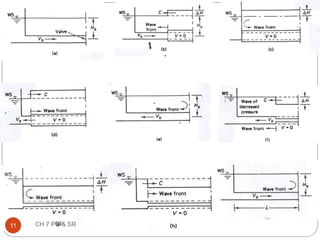
a. Steady state
prior to valve
closure
b. Rapid valve
closure – pressure
increase, pipe
walls expand,
liquid
compression;
transient
conditions
propagate
Elastic water column (EWC) theory
7 CH 7 PC & SR
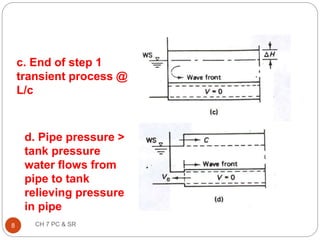
c. End of step 1
transient process @
L/c
d. Pipe pressure >
tank pressure
water flows from
pipe to tank
relieving pressure
in pipe
8 CH 7 PC & SR
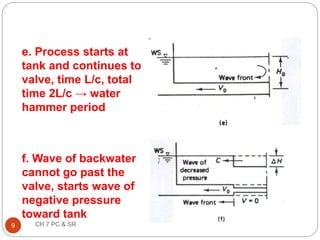
e. Process starts at
tank and continues to
valve, time L/c, total
time 2L/c → water
hammer period
f. Wave of backwater
cannot go past the
valve, starts wave of
negative pressure
toward tank
9 CH 7 PC & SR
g & h. Pressure
difference causes
water to flow toward
valve
i. One full cycle,
4L/c
10 CH 7 PC & SR
11 CH 7 PC & SR
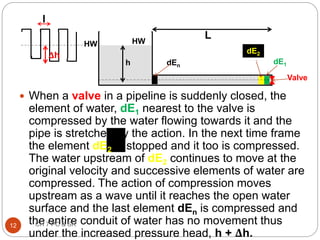
 When a valve in a pipeline is suddenly closed, the
element of water, dE1 nearest to the valve is
compressed by the water flowing towards it and the
pipe is stretched by the action. In the next time frame
the element dE2 is stopped and it too is compressed.
The water upstream of dE2 continues to move at the
original velocity and successive elements of water are
compressed. The action of compression moves
upstream as a wave until it reaches the open water
surface and the last element dEn is compressed and
the entire conduit of water has no movement thus
under the increased pressure head, h + Δh.
dE1
dEn
dE2
Valve
L
h
HW
Δh
l
HW
12 CH 7 PC & SR
 The pressure pulse or wave moves at a velocity, c,
which is essentially the velocity of sound in water.
Thus the pressure wave reaches the open water
surface in time, t = L/c. At that time the kinetic energy
of the moving water has been converted to elastic
energy in compressing the water and stretching the
pipe.
 At the open water surface the last element, dEn
expands to its original state, followed by other
elements, causing a reverse or negative pressure
wave. As this wave travels downstream, conditions
change from zero velocity to a negative velocity and
from the increased water pressure head, h + Δh, back
to the normal pressure head, h. When the pressure
wave reaches the valve, the pressure in the pipeline
has returned to normal and a time t = 2L/c has
elapsed.
 The water moving away from the valve now causes a
13 CH 7 PC & SR
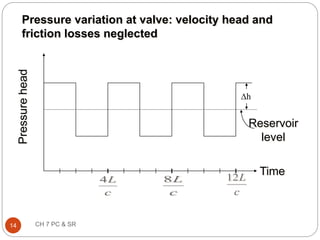
Pressure variation at valve: velocity head and
friction losses neglected
Reservoir
level
c
L
4
c
L
8
c
L
12
Dh
Time
Pressure
head
14 CH 7 PC & SR
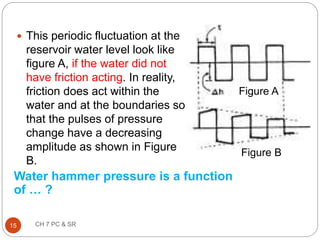
 This periodic fluctuation at the
reservoir water level look like
figure A, if the water did not
have friction acting. In reality,
friction does act within the
water and at the boundaries so
that the pulses of pressure
change have a decreasing
amplitude as shown in Figure
B.
Figure A
Figure B
Water hammer pressure is a function
of … ?
15 CH 7 PC & SR
 Process Considerations
 Pressure wave, resulting from compression of water,
travels at speed of sound (sonic) in water
 Pressure change due to change in velocity
 Pressure increase moderated by expansion of the
pipe wall due to increase in pressure
 Pipe Support Conditions
1. Pipe supported at one end, pipe is allowed to move
and pressure increase generates both axial and
lateral stresses
2. Pipe anchored against axial movement throughout,
no axial movement but axial stress still generated
3. No axial movement plus expansion joints at regular
intervals, axial stress is taken up by play in joints
16 CH 7 PC & SR
Theory & terms
 Δh = increase in head relative to original head (assume
frictionless flow)
 Assume vo is actual velocity in pipe based on friction,
steady state prior to valve closure
 Increase in pressure due to water hammer must be
added to the steady-state pressure prevailing just
before valve closure
 To find c (speed of pressure wave) need to relate the
volume of water entering the pipe to the increased pipe
volume due to pipe expansion and the reduced volume
of water because of compression
E = modulus of elasticity of pipe material
K = bulk modulus of elasticity of fluid
c = speed of pressure wave, celerity
Δh = increase in pressure head above initial conditions
17 CH 7 PC & SR
 Volume of water added during period L/c the
rate of water entering is vo x A. Therefore
additional volume of water added:
 Change in Pipe Volume due to added lateral
stress
c
L
A
v
Vol o
added 
t
hD
t
pD
2
2
D

D



tE
hD
E 2
D





t
r
p


Lateral strain: Hooke’s
Law
Generates elongation of diameter to D +
D
Pipe area
increase:
  2
2
4
4
D
D
D
A






D
18 CH 7 PC & SR
 The 2 term is dropped (very small) giving:


 A
D
A 2
5
.
0 2


D
Over the length, L, the change in pipe volume is:
tE
hD
LA
LA
Volpipe
D


D


2
 Reduction in the volume of water within the pipe
is based on compressibility of water
Vol
dVol
dp
d
dp
K 




Defined in terms of
relative decrease in
volume
K
h
LA
K
p
V
Vwater
D

D

D


19 CH 7 PC & SR
Volume of water added = increase in pipe
volume + increase in volume due to
compression







D


D

D
 1
1 C
t
D
E
K
K
h
c
v
K
h
LA
tE
hD
LA
c
LAV o
o 


C1 coefficient added to enable evaluation of
different pipe support systems
20 CH 7 PC & SR
 Momentum: Now we need second equation relating c
and Δh, momentum equation. From control volume
 Over time period Dt the pressure wave moves a distance
Dx, mass of water stopped during this time is cDt A
 The velocity change is –vo
 Therefore time rate of change in momentum is -Avoc
Momentum Equation
   
o
o
o
o
o
o
o
cv
h
p
or
g
cv
h
v
c
For
c
v
g
cv
h
c
AV
c
AV
hA






D

D

D



D




D
 ,
1
0
substitute for Δh into volume balance
2
1
1
1




















 C
t
D
E
K
K
c

  

v
p
v
E
c
E
d
E
c
c
Singh
Sherif
Cruise


 '
2
'
;
1
,
,
,
21 CH 7 PC & SR
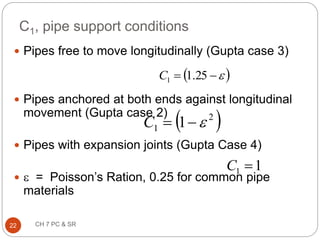
C1, pipe support conditions
 Pipes free to move longitudinally (Gupta case 3)
 Pipes anchored at both ends against longitudinal
movement (Gupta case 2)
 Pipes with expansion joints (Gupta Case 4)
  = Poisson’s Ration, 0.25 for common pipe
materials
 


 25
.
1
1
C
 
2
1 1 


C
1
1 
C
22 CH 7 PC & SR
 According to Parmakian (1955), the velocity of the
pressure wave, c, in a pipe is given by the following
formula:
 where ρ = density of the water; K =volume modulus of
water; d = diameter of pipe; t = thickness of pipe; E =
pipe’s Young's modulus of elasticity; C1 = factor for
anchorage and support of pipe
 C1 = 0.95 for pipe anchored at upper end and without
expansion joints
 C1 = 0.91 for pipe anchored against longitudinal
movement
 C1 = 0.85 for pipe with expansion joints.
 The maximum water hammer head is computed
5
.
0
1
1















tE
d
C
K
c 
g
c
v
h o
wm 
23 CH 7 PC & SR
 Example: How long does it take for a pressure
wave to travel 500 m after a rapid valve closure in
a 1 m diameter pipe without expansion joint, 1 cm
wall thickness, steel pipeline? The initial flow
velocity was 5 m/s. E for steel is 200 Gpa. K is
2.2 Gpa. What is the increase in pressure?
 c = 1066.3 m/s
 500/1066.3 = 0.47 seconds to travel
 hwm = 543.5 m or increase in pressure = 5331.5
KN/m2
5
.
0
1
1















tE
d
C
K
c 
g
c
v
h o
wm 
24 CH 7 PC & SR
Rigid water column (RWC) theory
 This pressure swings the normal hydraulic gradient
to a position shown in the doted lines. The pressure
at the reservoir is atmospheric and hence constant.
The +ve swing results from the pressure build up
due to the retarded water flow.
gh
vo 2

• If the head losses in
the pipe is neglected
the velocity of flow is
given by:
• If the valve at the end
is closed, the water in
the pipe retards and
hence there is a
pressure increase.
L
h
HW hw
hw
A
25 CH 7 PC & SR
 As the water flows to the reservoir it creates partial
vacuum conditions and the pressure in the pipe
swings in the –ve direction. This induces the
reservoir water to flow in to the pipe. But the valve
being partially closed, much of this water again
retarded giving rise to a +ve swing pressure again.
Thus a valve closure brings about pressure
oscillations.
 The maximum additional water hammer head hw can
be worked out from Newton's second law:
 
w
w
w
w
w h
h
g
v
dt
dv
g
L
h
h
p
dt
dv
g
AL
A
p
F 



















 2
;
; 

26 CH 7 PC & SR
 If the total time of closure of the valve is T, then for
complete closure, assuming uniform gate movement, the
maximum water hammer head hwm is given by:












ghT
Lv
k
k
k
k
h
h o
wm
1
2
1
1
1
;
25
.
0
2

 

i
i
i
A
L
A
L
L
L ;
27 CH 7 PC & SR
 The velocity of the pressure wave, c, in a pipe
according to RWC theory is given by the following
formula:
 where ρ = density of the water; K = Bulk volume
modulus of elasticity of water;
• Limitations of RWC:
• Ignores elastic property due to sudden pressure
rise
• In the above derivation friction effects were
ignored and the conduit was assumed to have
equal x-section.
• In case of variable x-sectioned conduit, it shall be
converted in to an equivalent conduit:

K
c 
 Example: Find the speed of a pressure wave in a
water pipeline assuming rigid walls.
 K=2.2 Gpa (Bulk modulus of elasticity of water)
 ρ= 1000 kg/m3
 c = (2.2 x 10⁹/1000)0.5 = 1483 m/s (speed of sound in
water.)
28 CH 7 PC & SR
Burst section of Penstock: Oigawa
Power Station, Japan
29 CH 7 PC & SR
Collapsed section of Penstock: Oigawa
Power Station, Japan
30 CH 7 PC & SR
Sake of Interest: Ram Pumps
 There is an old technology that
used hydraulic transients to lift
water from a stream to a higher
elevation. The device was called a
“Ram Pump” and it made a
rhythmic clacking noise.
 How did it work? High pressure pipe
Stream
Ram Pump
Source pipe
Water inlet
Air Chamber
Rapid valve
2. Pressure control systems
 Hydraulic transients and pressure changes such as
water hammer can be controlled in several ways.
 Gate controls and governor regulation can limit the
gate or valve closure time so that there is no
damaging pressure head rise. Pressure regulator
valves located near the turbine can be used. The
relief valve can be connected to the turbine spiral
case and controlled by the turbine gate mechanism
to prevent excessive pressure by maintaining a
nearly constant water velocity in the penstock. The
relief valve may be designed to close at a rate which
limits pressure rise to an acceptable value.
33 CH 7 PC & SR
Design Considerations
 Specify a slow closure time
 Safety factor by doubling the minimum closure
time
 Automatic valves programmed to prevent rapid
closure
 Surge tanks
34 CH 7 PC & SR
Valve Closure rate
 Full pressure wave
does not develop
c
o
est
c
t
c
L
g
cv
h
c
L
t
c
L
2
20
2


D


• Rapid Valve Closure
o
o
c
cv
p
or
g
cv
h
c
L
t


D

D

,
2
  









D
c
o
o
o t
p
Lv
N
where
N
N
N
p
p

,
25
.
0
5
.
0 2
Slow Closure after Lorenzo & Allievi
35 CH 7 PC & SR
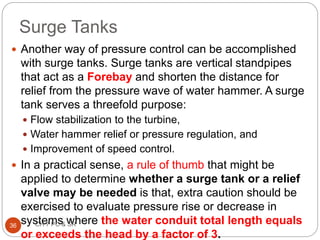
 Another way of pressure control can be accomplished
with surge tanks. Surge tanks are vertical standpipes
that act as a Forebay and shorten the distance for
relief from the pressure wave of water hammer. A surge
tank serves a threefold purpose:
 Flow stabilization to the turbine,
 Water hammer relief or pressure regulation, and
 Improvement of speed control.
 In a practical sense, a rule of thumb that might be
applied to determine whether a surge tank or a relief
valve may be needed is that, extra caution should be
exercised to evaluate pressure rise or decrease in
systems where the water conduit total length equals
or exceeds the head by a factor of 3.
36 CH 7 PC & SR
Surge Tanks
Surge Tanks
37 CH 7 PC & SR
 Surge tanks
are usually not
economical
unless most of
the drop in
elevation in the
penstock
occurs near the
turbine.
 Three slightly
different types
of surge tanks
are used.
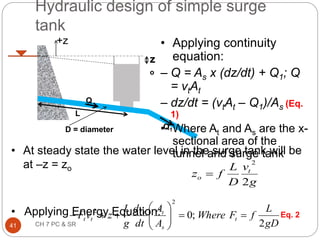
 A simple surge tank is a vertical standpipe connected
to the penstock with an opening large enough so that
there is no appreciable loss in head as the water
enters the surge tank. This is the most efficient surge
tank to provide a ready water supply to the turbine
when it is being accelerated, and especially when the
initial loading is being applied. However, it is the most
hydraulically unstable.
38 CH 7 PC & SR
 A restricted-orifice surge tank is connected in such
a way that there is a restricted opening between the
tank and the penstock that develops appreciable
head loss in the water that flows into or out of the
tank. Thus the orifice tank does not supply or accept
excess penstock flow, but it is more hydraulically
stable.
39 CH 7 PC & SR
 The differential surge tank is a combination of a
simple tank and a restricted-orifice tank. An internal
riser of smaller diameter than the full connection to
the penstock is built to extend up through the tank
while an outer tank is connected by a simple pipe
connection to the penstock. The riser may also have a
flow restrictor or orifice inside. Thus one part of the
tank responds with a minimum of head loss while the
outer tank offers resistance to rapid flow into the tank.
40 CH 7 PC & SR
Q
Q1
z
o
L
+z
D = diameter
• At steady state the water level in the surge tank will be
at –z = zo
• Applying Energy Equation:
Hydraulic design of simple surge
tank
g
v
D
L
f
z t
o
2
2

Eq. 2
• Applying continuity
equation:
– Q = As x (dz/dt) + Q1; Q
= vtAt
– dz/dt = (vtAt – Q1)/As (Eq.
1)
• Where At and As are the x-
sectional area of the
tunnel and surge tank
gD
L
f
F
Where
A
A
dt
dv
g
L
z
v
F t
s
t
t
t
t
2
;
0
2
2













41 CH 7 PC & SR
 If throated head loss in the throat is also
considered:
0
2
2
2













s
t
s
S
t
t
A
A
dt
dv
g
L
z
v
F
v
F
• From Eq. 1 if Q1 is zero:
• dz/dt = vt At /As → d2z/dt2 = (At /As)dvt/dt (Eq. 3)
g
A
L
A
T
g
A
L
A
v
z
Where
T
t
z
z
s
t
s
t
t 







 ;
;
sin max
max
• For simplest case of full closure and negligible
friction the solution to eq. 2 has the following form:
• Where zmax is the maximum up surge or down
surge.
• Since the velocity is changing its sign after every
half cycle, there is no general solution for the
differential equation (Eq. 2). Usually a numerical
solution is adopted.
42 CH 7 PC & SR
 However; Jaeger has recommended use of the
following approximate formula for the calculation of up
surge in cases where friction is taken in to account:
 The above formula is applicable for conditions where ko
is less than 0.7.
 Calame and Gaden have given the following
approximate formula suitable for computation of the
lowest water reached after the first up ward swing.
 Where zup and zdown are maximum and minimum water
level in the surge chamber
g
A
L
A
v
z
z
v
F
k
k
k
z
z
s
t
t
t
t
o
o
o
up




 max
max
2
2
max
;
;
9
3
2
1
o
down
k
z
z
2
1
max



43 CH 7 PC & SR
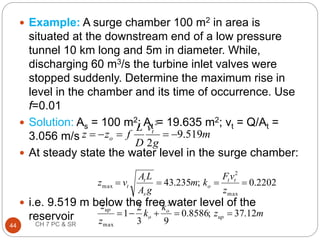
 Example: A surge chamber 100 m2 in area is
situated at the downstream end of a low pressure
tunnel 10 km long and 5m in diameter. While,
discharging 60 m3/s the turbine inlet valves were
stopped suddenly. Determine the maximum rise in
level in the chamber and its time of occurrence. Use
f=0.01
 Solution: As = 100 m2; At = 19.635 m2; vt = Q/At =
3.056 m/s
 At steady state the water level in the surge chamber:
 i.e. 9.519 m below the free water level of the
reservoir
m
g
v
D
L
f
z
z t
o 519
.
9
2
2





44 CH 7 PC & SR
m
z
k
k
z
z
z
v
F
k
m
g
A
L
A
v
z
up
o
o
up
t
t
o
s
t
t
12
.
37
;
8586
.
0
9
3
2
1
2202
.
0
;
235
.
43
2
max
max
2
max









• At any time t the velocity in the surge chamber vs
= dz/dt
• Applying continuity equation:
sec
732
.
77
12
.
37
519
.
9
6
.
0
519
.
9
519
.
9
0
;
6
.
0
6
.
0
6
.
0
;
0
; 1
1





















t
m
z
for
thus
t
z
m
c
m
z
t
at
c
t
z
dt
dz
v
v
Q
But
Q
Q
v
A
A
v
s
s
s
s
t
t
45 CH 7 PC & SR
3. Speed terminology
 A speed term that is important in the safety of
hydropower plants is the runaway speed. It is the
speed attained by turbine and generator (if directly
connected)
 After a load rejection,
 If for some reason the shutdown mechanism fails to shut
down the unit or
 If the rate of shutdown is not fast enough.
 Runaway speed may reach 170 to 300% of normal
operating speed. The magnitude of runaway speed is
related to turbine design, operation, and setting of the
turbine and will vary with the windage and friction that
the runner and generator rotor offer as a revolving
mass.
46 CH 7 PC & SR
 For some adjustable blade propeller turbines the
maximum runaway speed may be as high as 300% of
normal operating speed.
 Accurate numbers for defining runaway speed values
must be based on model tests conducted by the
turbine manufacturers.
Type of
runner
Runaway speed (%
of normal speed)
Acceptable head
Variation
Minimum Maximu
m
Impulse 170-190 65 125
Francis 200-220 50 150
Propeller 250-300 50 150
47 CH 7 PC & SR
 The U.S. Department of the Interior (1976) gives
empirical equations for estimating runaway speed
based on several model tests of units installed by the
Bureau of Reclamation. The equations are:
 where
 nr = runaway speed at best efficiency head and full
gate, rpm;
 n = normal rotational speed, rpm;
 nmax= runaway speed at maximum head;
 ns = specific speed based on full gate output at best
efficiency head;
 hd = design head;
 hmax = maximum head.
d
r
s
s
s
r
h
h
n
n
units
metric
in
nN
n
nn
n
max
max
2
.
0
2
.
0
63
.
0
;
85
.
0



48 CH 7 PC & SR
 Another term is over-speed. It is the speed attained
under transient conditions by a turbine after load
rejection, while the governing and gate closure
mechanisms are going into action.
 The rapidity with which the shutoff operates controls
how much the over-speed will be.
 In very slow moving gate mechanisms over-speed can
approach runaway speed.
49 CH 7 PC & SR
4. Speed control and governors
 Regulating the quantity of water admitted to the
turbine runner is the usual means of regulating and
maintaining a constant speed to drive the generator
and to regulate the power output. This is done by
operating wicket gates or valves. Such action
requires a mechanism to control the wicket gates,
which is the governor or governor system.
 The function of the governor is to detect any error in
speed between actual and desired values and to
effect a change in the turbine output. This is done so
that the system load is in equilibrium with the
generating unit output at the desired speed.
50 CH 7 PC & SR
CH 7 PC & SR
51
 The function of the governor is to keep the speed
of the prime mover constant irrespective of load
variation.
 The governor is then controls the amount of water
flowing through the turbine.
 Since the governor has to deal with water coming
at very large force and in huge quantity, it should
be very strong.
 To achieve this all types of turbines use oil
pressure governor.
Speed droop
 If two or more generating units are operating to
govern a system, it is impossible for them to maintain
exactly the same speed. The governor with the
higher speed will try to bring the system up to its
speed, and take on load until it either achieves this or
the turbine reaches full-gate position. If it is able to
raise the system frequency, the other governor will
sense too high speed and begin to drop load. The
governors will therefore oppose each other. To avoid
this situation, governors are built with a feature called
speed droop.
 Speed droop reduces the governor sensing speed as
the gate opening or load increases. It is defined as
the difference in speed (in percent) permitted when
the units are operating between zero gate opening
and 100% gate opening.
52 CH 7 PC & SR

CH7 PC and SR.pptx

  • 1.
    Chapter 7 Pressure Controland Speed Regulation Hydropower Engineering I
  • 2.
    Contents 1. Water Hammertheory and Analysis 2. Pressure Control Systems 3. Speed Terminology 4. Speed Control and Governors 2 CH 7 PC & SR
  • 3.
    Introduction  Sudden shutdownsof hydroelectric plants or changes in water flow through hydraulic turbines may cause problems ranging from rupture of penstocks due to water hammer to runner speed changes that cause the line current of the generators to vary from the desired frequency.  Regulating the water flow and coping with Sudden closure of gates and valves require special equipment such as governors, pressure relief valves, and surge tanks.  Solving the problems of pressure control and speed regulation requires a thorough understanding of the basic theory of water hammer. 3 CH 7 PC & SR
  • 4.
    Introduction  Let usconsider a simple case of fluid flowing with a certain velocity and brought to rest by closing a valve at the downstream end. If the fluid is entirely incompressible and the wall of the pipe is perfectly rigid, then all the fluid particles would have come to rest instantaneously. However, fluids are compressible to a certain extent, thus particles will not decelerate uniformly. Only those particles adjacent to the valve would stop instantaneously; Other particles will come to rest later.  Recall Newton's second law: F = m(dv/dt); the more rapid the deceleration the greater would be 4 CH 7 PC & SR
  • 5.
    1 Water hammertheory and analysis  Water hammer is a phenomenon of pressure change in closed pipes caused when flowing water in a pipeline is decelerated or accelerated by closing or opening a valve or changing the velocity of the water rapidly in some other manner. The phenomenon is accompanied by a series of positive and negative pressure waves which travel back and forth in the pipe system until they are damped out by friction.  When a valve in a pipe or penstock carrying water is closed, the pressure head immediately upstream of the valve is increased, and a pulse of high pressure is propagated upstream to the nearest open water surface. On the downstream side of the valve a lowered pressure moves in a downstream direction 5 CH 7 PC & SR
  • 6.
     Flow ischanging from one steady-state to another over a very, very short time.  Causes of rapid changes in flow (acceleration/deceleration):  Sudden opening or closing of control valves  Starting or stopping of pumps  Rejecting or accepting load by hydraulic turbine  Rapid change in velocity results in change in momentum causing pressure fluctuations (waves) – Water Hammer  There are two theories in analyzing water hammer:  Elastic water column (EWC) theory  Rigid water column (RWC) theory 6 CH 7 PC & SR
  • 7.
    Propagation of pressure wavedue to valve closure a. Steady state prior to valve closure b. Rapid valve closure – pressure increase, pipe walls expand, liquid compression; transient conditions propagate Elastic water column (EWC) theory 7 CH 7 PC & SR
  • 8.
    c. End ofstep 1 transient process @ L/c d. Pipe pressure > tank pressure water flows from pipe to tank relieving pressure in pipe 8 CH 7 PC & SR
  • 9.
    e. Process startsat tank and continues to valve, time L/c, total time 2L/c → water hammer period f. Wave of backwater cannot go past the valve, starts wave of negative pressure toward tank 9 CH 7 PC & SR
  • 10.
    g & h.Pressure difference causes water to flow toward valve i. One full cycle, 4L/c 10 CH 7 PC & SR
  • 11.
    11 CH 7PC & SR
  • 12.
     When avalve in a pipeline is suddenly closed, the element of water, dE1 nearest to the valve is compressed by the water flowing towards it and the pipe is stretched by the action. In the next time frame the element dE2 is stopped and it too is compressed. The water upstream of dE2 continues to move at the original velocity and successive elements of water are compressed. The action of compression moves upstream as a wave until it reaches the open water surface and the last element dEn is compressed and the entire conduit of water has no movement thus under the increased pressure head, h + Δh. dE1 dEn dE2 Valve L h HW Δh l HW 12 CH 7 PC & SR
  • 13.
     The pressurepulse or wave moves at a velocity, c, which is essentially the velocity of sound in water. Thus the pressure wave reaches the open water surface in time, t = L/c. At that time the kinetic energy of the moving water has been converted to elastic energy in compressing the water and stretching the pipe.  At the open water surface the last element, dEn expands to its original state, followed by other elements, causing a reverse or negative pressure wave. As this wave travels downstream, conditions change from zero velocity to a negative velocity and from the increased water pressure head, h + Δh, back to the normal pressure head, h. When the pressure wave reaches the valve, the pressure in the pipeline has returned to normal and a time t = 2L/c has elapsed.  The water moving away from the valve now causes a 13 CH 7 PC & SR
  • 14.
    Pressure variation atvalve: velocity head and friction losses neglected Reservoir level c L 4 c L 8 c L 12 Dh Time Pressure head 14 CH 7 PC & SR
  • 15.
     This periodicfluctuation at the reservoir water level look like figure A, if the water did not have friction acting. In reality, friction does act within the water and at the boundaries so that the pulses of pressure change have a decreasing amplitude as shown in Figure B. Figure A Figure B Water hammer pressure is a function of … ? 15 CH 7 PC & SR
  • 16.
     Process Considerations Pressure wave, resulting from compression of water, travels at speed of sound (sonic) in water  Pressure change due to change in velocity  Pressure increase moderated by expansion of the pipe wall due to increase in pressure  Pipe Support Conditions 1. Pipe supported at one end, pipe is allowed to move and pressure increase generates both axial and lateral stresses 2. Pipe anchored against axial movement throughout, no axial movement but axial stress still generated 3. No axial movement plus expansion joints at regular intervals, axial stress is taken up by play in joints 16 CH 7 PC & SR
  • 17.
    Theory & terms Δh = increase in head relative to original head (assume frictionless flow)  Assume vo is actual velocity in pipe based on friction, steady state prior to valve closure  Increase in pressure due to water hammer must be added to the steady-state pressure prevailing just before valve closure  To find c (speed of pressure wave) need to relate the volume of water entering the pipe to the increased pipe volume due to pipe expansion and the reduced volume of water because of compression E = modulus of elasticity of pipe material K = bulk modulus of elasticity of fluid c = speed of pressure wave, celerity Δh = increase in pressure head above initial conditions 17 CH 7 PC & SR
  • 18.
     Volume ofwater added during period L/c the rate of water entering is vo x A. Therefore additional volume of water added:  Change in Pipe Volume due to added lateral stress c L A v Vol o added  t hD t pD 2 2 D  D    tE hD E 2 D      t r p   Lateral strain: Hooke’s Law Generates elongation of diameter to D + D Pipe area increase:   2 2 4 4 D D D A       D 18 CH 7 PC & SR
  • 19.
     The 2term is dropped (very small) giving:    A D A 2 5 . 0 2   D Over the length, L, the change in pipe volume is: tE hD LA LA Volpipe D   D   2  Reduction in the volume of water within the pipe is based on compressibility of water Vol dVol dp d dp K      Defined in terms of relative decrease in volume K h LA K p V Vwater D  D  D   19 CH 7 PC & SR
  • 20.
    Volume of wateradded = increase in pipe volume + increase in volume due to compression        D   D  D  1 1 C t D E K K h c v K h LA tE hD LA c LAV o o    C1 coefficient added to enable evaluation of different pipe support systems 20 CH 7 PC & SR  Momentum: Now we need second equation relating c and Δh, momentum equation. From control volume  Over time period Dt the pressure wave moves a distance Dx, mass of water stopped during this time is cDt A  The velocity change is –vo  Therefore time rate of change in momentum is -Avoc
  • 21.
    Momentum Equation    o o o o o o o cv h p or g cv h v c For c v g cv h c AV c AV hA       D  D  D    D     D  , 1 0 substitute for Δh into volume balance 2 1 1 1                      C t D E K K c      v p v E c E d E c c Singh Sherif Cruise    ' 2 ' ; 1 , , , 21 CH 7 PC & SR
  • 22.
    C1, pipe supportconditions  Pipes free to move longitudinally (Gupta case 3)  Pipes anchored at both ends against longitudinal movement (Gupta case 2)  Pipes with expansion joints (Gupta Case 4)   = Poisson’s Ration, 0.25 for common pipe materials      25 . 1 1 C   2 1 1    C 1 1  C 22 CH 7 PC & SR
  • 23.
     According toParmakian (1955), the velocity of the pressure wave, c, in a pipe is given by the following formula:  where ρ = density of the water; K =volume modulus of water; d = diameter of pipe; t = thickness of pipe; E = pipe’s Young's modulus of elasticity; C1 = factor for anchorage and support of pipe  C1 = 0.95 for pipe anchored at upper end and without expansion joints  C1 = 0.91 for pipe anchored against longitudinal movement  C1 = 0.85 for pipe with expansion joints.  The maximum water hammer head is computed 5 . 0 1 1                tE d C K c  g c v h o wm  23 CH 7 PC & SR
  • 24.
     Example: Howlong does it take for a pressure wave to travel 500 m after a rapid valve closure in a 1 m diameter pipe without expansion joint, 1 cm wall thickness, steel pipeline? The initial flow velocity was 5 m/s. E for steel is 200 Gpa. K is 2.2 Gpa. What is the increase in pressure?  c = 1066.3 m/s  500/1066.3 = 0.47 seconds to travel  hwm = 543.5 m or increase in pressure = 5331.5 KN/m2 5 . 0 1 1                tE d C K c  g c v h o wm  24 CH 7 PC & SR
  • 25.
    Rigid water column(RWC) theory  This pressure swings the normal hydraulic gradient to a position shown in the doted lines. The pressure at the reservoir is atmospheric and hence constant. The +ve swing results from the pressure build up due to the retarded water flow. gh vo 2  • If the head losses in the pipe is neglected the velocity of flow is given by: • If the valve at the end is closed, the water in the pipe retards and hence there is a pressure increase. L h HW hw hw A 25 CH 7 PC & SR
  • 26.
     As thewater flows to the reservoir it creates partial vacuum conditions and the pressure in the pipe swings in the –ve direction. This induces the reservoir water to flow in to the pipe. But the valve being partially closed, much of this water again retarded giving rise to a +ve swing pressure again. Thus a valve closure brings about pressure oscillations.  The maximum additional water hammer head hw can be worked out from Newton's second law:   w w w w w h h g v dt dv g L h h p dt dv g AL A p F                      2 ; ;   26 CH 7 PC & SR  If the total time of closure of the valve is T, then for complete closure, assuming uniform gate movement, the maximum water hammer head hwm is given by:             ghT Lv k k k k h h o wm 1 2 1 1 1 ; 25 . 0 2
  • 27.
        i i i A L A L L L ; 27CH 7 PC & SR  The velocity of the pressure wave, c, in a pipe according to RWC theory is given by the following formula:  where ρ = density of the water; K = Bulk volume modulus of elasticity of water; • Limitations of RWC: • Ignores elastic property due to sudden pressure rise • In the above derivation friction effects were ignored and the conduit was assumed to have equal x-section. • In case of variable x-sectioned conduit, it shall be converted in to an equivalent conduit:  K c 
  • 28.
     Example: Findthe speed of a pressure wave in a water pipeline assuming rigid walls.  K=2.2 Gpa (Bulk modulus of elasticity of water)  ρ= 1000 kg/m3  c = (2.2 x 10⁹/1000)0.5 = 1483 m/s (speed of sound in water.) 28 CH 7 PC & SR
  • 29.
    Burst section ofPenstock: Oigawa Power Station, Japan 29 CH 7 PC & SR
  • 30.
    Collapsed section ofPenstock: Oigawa Power Station, Japan 30 CH 7 PC & SR
  • 31.
    Sake of Interest:Ram Pumps  There is an old technology that used hydraulic transients to lift water from a stream to a higher elevation. The device was called a “Ram Pump” and it made a rhythmic clacking noise.  How did it work? High pressure pipe Stream Ram Pump Source pipe
  • 32.
  • 33.
    2. Pressure controlsystems  Hydraulic transients and pressure changes such as water hammer can be controlled in several ways.  Gate controls and governor regulation can limit the gate or valve closure time so that there is no damaging pressure head rise. Pressure regulator valves located near the turbine can be used. The relief valve can be connected to the turbine spiral case and controlled by the turbine gate mechanism to prevent excessive pressure by maintaining a nearly constant water velocity in the penstock. The relief valve may be designed to close at a rate which limits pressure rise to an acceptable value. 33 CH 7 PC & SR
  • 34.
    Design Considerations  Specifya slow closure time  Safety factor by doubling the minimum closure time  Automatic valves programmed to prevent rapid closure  Surge tanks 34 CH 7 PC & SR
  • 35.
    Valve Closure rate Full pressure wave does not develop c o est c t c L g cv h c L t c L 2 20 2   D   • Rapid Valve Closure o o c cv p or g cv h c L t   D  D  , 2             D c o o o t p Lv N where N N N p p  , 25 . 0 5 . 0 2 Slow Closure after Lorenzo & Allievi 35 CH 7 PC & SR
  • 36.
     Another wayof pressure control can be accomplished with surge tanks. Surge tanks are vertical standpipes that act as a Forebay and shorten the distance for relief from the pressure wave of water hammer. A surge tank serves a threefold purpose:  Flow stabilization to the turbine,  Water hammer relief or pressure regulation, and  Improvement of speed control.  In a practical sense, a rule of thumb that might be applied to determine whether a surge tank or a relief valve may be needed is that, extra caution should be exercised to evaluate pressure rise or decrease in systems where the water conduit total length equals or exceeds the head by a factor of 3. 36 CH 7 PC & SR Surge Tanks
  • 37.
    Surge Tanks 37 CH7 PC & SR  Surge tanks are usually not economical unless most of the drop in elevation in the penstock occurs near the turbine.  Three slightly different types of surge tanks are used.
  • 38.
     A simplesurge tank is a vertical standpipe connected to the penstock with an opening large enough so that there is no appreciable loss in head as the water enters the surge tank. This is the most efficient surge tank to provide a ready water supply to the turbine when it is being accelerated, and especially when the initial loading is being applied. However, it is the most hydraulically unstable. 38 CH 7 PC & SR
  • 39.
     A restricted-orificesurge tank is connected in such a way that there is a restricted opening between the tank and the penstock that develops appreciable head loss in the water that flows into or out of the tank. Thus the orifice tank does not supply or accept excess penstock flow, but it is more hydraulically stable. 39 CH 7 PC & SR
  • 40.
     The differentialsurge tank is a combination of a simple tank and a restricted-orifice tank. An internal riser of smaller diameter than the full connection to the penstock is built to extend up through the tank while an outer tank is connected by a simple pipe connection to the penstock. The riser may also have a flow restrictor or orifice inside. Thus one part of the tank responds with a minimum of head loss while the outer tank offers resistance to rapid flow into the tank. 40 CH 7 PC & SR
  • 41.
    Q Q1 z o L +z D = diameter •At steady state the water level in the surge tank will be at –z = zo • Applying Energy Equation: Hydraulic design of simple surge tank g v D L f z t o 2 2  Eq. 2 • Applying continuity equation: – Q = As x (dz/dt) + Q1; Q = vtAt – dz/dt = (vtAt – Q1)/As (Eq. 1) • Where At and As are the x- sectional area of the tunnel and surge tank gD L f F Where A A dt dv g L z v F t s t t t t 2 ; 0 2 2              41 CH 7 PC & SR
  • 42.
     If throatedhead loss in the throat is also considered: 0 2 2 2              s t s S t t A A dt dv g L z v F v F • From Eq. 1 if Q1 is zero: • dz/dt = vt At /As → d2z/dt2 = (At /As)dvt/dt (Eq. 3) g A L A T g A L A v z Where T t z z s t s t t          ; ; sin max max • For simplest case of full closure and negligible friction the solution to eq. 2 has the following form: • Where zmax is the maximum up surge or down surge. • Since the velocity is changing its sign after every half cycle, there is no general solution for the differential equation (Eq. 2). Usually a numerical solution is adopted. 42 CH 7 PC & SR
  • 43.
     However; Jaegerhas recommended use of the following approximate formula for the calculation of up surge in cases where friction is taken in to account:  The above formula is applicable for conditions where ko is less than 0.7.  Calame and Gaden have given the following approximate formula suitable for computation of the lowest water reached after the first up ward swing.  Where zup and zdown are maximum and minimum water level in the surge chamber g A L A v z z v F k k k z z s t t t t o o o up      max max 2 2 max ; ; 9 3 2 1 o down k z z 2 1 max    43 CH 7 PC & SR
  • 44.
     Example: Asurge chamber 100 m2 in area is situated at the downstream end of a low pressure tunnel 10 km long and 5m in diameter. While, discharging 60 m3/s the turbine inlet valves were stopped suddenly. Determine the maximum rise in level in the chamber and its time of occurrence. Use f=0.01  Solution: As = 100 m2; At = 19.635 m2; vt = Q/At = 3.056 m/s  At steady state the water level in the surge chamber:  i.e. 9.519 m below the free water level of the reservoir m g v D L f z z t o 519 . 9 2 2      44 CH 7 PC & SR m z k k z z z v F k m g A L A v z up o o up t t o s t t 12 . 37 ; 8586 . 0 9 3 2 1 2202 . 0 ; 235 . 43 2 max max 2 max         
  • 45.
    • At anytime t the velocity in the surge chamber vs = dz/dt • Applying continuity equation: sec 732 . 77 12 . 37 519 . 9 6 . 0 519 . 9 519 . 9 0 ; 6 . 0 6 . 0 6 . 0 ; 0 ; 1 1                      t m z for thus t z m c m z t at c t z dt dz v v Q But Q Q v A A v s s s s t t 45 CH 7 PC & SR
  • 46.
    3. Speed terminology A speed term that is important in the safety of hydropower plants is the runaway speed. It is the speed attained by turbine and generator (if directly connected)  After a load rejection,  If for some reason the shutdown mechanism fails to shut down the unit or  If the rate of shutdown is not fast enough.  Runaway speed may reach 170 to 300% of normal operating speed. The magnitude of runaway speed is related to turbine design, operation, and setting of the turbine and will vary with the windage and friction that the runner and generator rotor offer as a revolving mass. 46 CH 7 PC & SR
  • 47.
     For someadjustable blade propeller turbines the maximum runaway speed may be as high as 300% of normal operating speed.  Accurate numbers for defining runaway speed values must be based on model tests conducted by the turbine manufacturers. Type of runner Runaway speed (% of normal speed) Acceptable head Variation Minimum Maximu m Impulse 170-190 65 125 Francis 200-220 50 150 Propeller 250-300 50 150 47 CH 7 PC & SR
  • 48.
     The U.S.Department of the Interior (1976) gives empirical equations for estimating runaway speed based on several model tests of units installed by the Bureau of Reclamation. The equations are:  where  nr = runaway speed at best efficiency head and full gate, rpm;  n = normal rotational speed, rpm;  nmax= runaway speed at maximum head;  ns = specific speed based on full gate output at best efficiency head;  hd = design head;  hmax = maximum head. d r s s s r h h n n units metric in nN n nn n max max 2 . 0 2 . 0 63 . 0 ; 85 . 0    48 CH 7 PC & SR
  • 49.
     Another termis over-speed. It is the speed attained under transient conditions by a turbine after load rejection, while the governing and gate closure mechanisms are going into action.  The rapidity with which the shutoff operates controls how much the over-speed will be.  In very slow moving gate mechanisms over-speed can approach runaway speed. 49 CH 7 PC & SR
  • 50.
    4. Speed controland governors  Regulating the quantity of water admitted to the turbine runner is the usual means of regulating and maintaining a constant speed to drive the generator and to regulate the power output. This is done by operating wicket gates or valves. Such action requires a mechanism to control the wicket gates, which is the governor or governor system.  The function of the governor is to detect any error in speed between actual and desired values and to effect a change in the turbine output. This is done so that the system load is in equilibrium with the generating unit output at the desired speed. 50 CH 7 PC & SR
  • 51.
    CH 7 PC& SR 51  The function of the governor is to keep the speed of the prime mover constant irrespective of load variation.  The governor is then controls the amount of water flowing through the turbine.  Since the governor has to deal with water coming at very large force and in huge quantity, it should be very strong.  To achieve this all types of turbines use oil pressure governor.
  • 52.
    Speed droop  Iftwo or more generating units are operating to govern a system, it is impossible for them to maintain exactly the same speed. The governor with the higher speed will try to bring the system up to its speed, and take on load until it either achieves this or the turbine reaches full-gate position. If it is able to raise the system frequency, the other governor will sense too high speed and begin to drop load. The governors will therefore oppose each other. To avoid this situation, governors are built with a feature called speed droop.  Speed droop reduces the governor sensing speed as the gate opening or load increases. It is defined as the difference in speed (in percent) permitted when the units are operating between zero gate opening and 100% gate opening. 52 CH 7 PC & SR

Editor's Notes

  • #16 The water hammer is a function of: Pipeline characteristics: diameter, thickness, and modulus of elasticity, length of pipeline, frictional characteristics Presence and location of other control devices: pressure relief valves, surge tanks, reservoirs