SHEET METAL WORKING
12/31/2016
JIT 1
Unit-III
 By:
Zoha Nasir
Assistant Professor
JIT, Barabanki
 Products made of sheet metals are all around us.
 They include a very wide range of consumer and industrial
products, such as beverage cans, cookware, file cabinets, metal
desks, appliances, car bodies, trailers, and aircraft fuselages Sheet
forming dates back to about 5000 B.C., when household utensils and
jewelry were made by hammering and stamping gold, silver, and
copper.
 Compared to those made by casting and by forging, sheet-metal
parts offer the advantages of light weight and versatile shape.
 However, the term press working or press forming is used
commonly in industry to describe general sheet-forming operations,
because they typically are performed on presses.
Sheet metal working
12/31/2016
JIT 2
The basic mechanism of sheet metal processes are
stretching and bending. The major factor that influence the
overall operation are:
Elongation
Yield point elongation
Anisotropy
Grain size
Residual stresses
Spring back and
Wrinkling
12/31/2016 JIT 3
 It is a mass production process.
 Low labour cost.
 Production rates are rapid.
 Very low production cost.
Advantages
12/31/2016
JIT 4
Generally, production requirements in excess.
Set up times are lengthy.
Disadvantages
12/31/2016
JIT 5
Presses shape work piece without cutting away material,
that is, without making chips.
Presses are equipped with dies and punches designed for
such operations as forming, punching and shearing.
Presses
12/31/2016
JIT 6
Proper selection of a press is necessary for successful and
economical operation.
Press is a costly machine, and the return on investment depends
upon how well it performs the job.
There is no press that can provide maximum productively and
economy for all application so, when a press is required to be
used for several widely varying jobs, compromise is generally
made between economy and productivity.
 Important factors affecting the selection of a press are size,
force, energy and speed requirements.
Selection of presses
12/31/2016
JIT 7
Types of presses for sheet metal working can be
classified by one or a combination of characteristics,
such as source of power, number of slides, type of frame
and construction, type of drive, and intended
applications.
Types of presses
12/31/2016
JIT 8
Hand press
Power press
Mechanical press
Hydraulic press
Crank
Cam etc…
Classification of presses
12/31/2016
JIT 9
In a typical die and punch set used for blanking operation the
sheet metal used is called strip or stock.
The punch which is held in the punch holder is bolted to the press
ram while die is bolted on the press table.
During the working stroke, the punch penetrates the strip, and on
the return stroke of the press ram the strip is lifted with the punch,
but it is removed from the punch by the stripper plate.
 The stop pin is a gage and it sets the advance of the strip stock
within the punch and die.
The strip stock is butted against the back stop acting as a datum
location for the center of the blank.
DIE AND PUNCH ASSEMBLY
12/31/2016
JIT 10
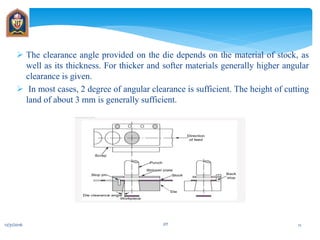
 The clearance angle provided on the die depends on the material of stock, as
well as its thickness. For thicker and softer materials generally higher angular
clearance is given.
 In most cases, 2 degree of angular clearance is sufficient. The height of cutting
land of about 3 mm is generally sufficient.
12/31/2016 JIT 11
The three methods of working sheet metal in presses are:
Shearing
Deep drawing
Bending
Press work methods
12/31/2016
JIT 12
This process involves cutting sheet metal by subjecting
it to shear stress, usually between punch and die.
The major variables in this process are:
Punch force
Speed of punch, lubrications
Edge condition of the sheet
Punch and die materials.
Shearing
12/31/2016
JIT 13
Blanking
Piercing
Slitting
Notching
Perforating
Nibbling
Shaving
Slotting
Trimming
lancing
Shearing operations
12/31/2016
JIT 14
Progressive dies
Compound dies
Combination dies
Shearing dies
12/31/2016
JIT 15
 Parts requiring multiple operations to produce can be
made at high production rates in progressive dies.
 The sheet metal is fed through as a coil strip, and a
different operation (such as punching, blanking, and
notching) is performed at the same station of the
machine with each stroke of a series of punches.
Progressive die
12/31/2016
JIT 16
Progressive dies are made with two or more stations arranged
in a sequence. Each station performs an operation on the
work piece, or provides an idler station, so that the work
piece is completed when the last operation has been
accomplished.
Thereafter each stroke of the ram produces a finished part.
Thus after the fourth stroke of a four – station die, each
successive stroke will produce a finished part. Operations
which may be carried out in a progressive die are piercing,
blanking, forming, drawing, cut – off, etc.
 Progressive dies are used where higher production rates are
desired and the material is neither too thick nor too thin.
Their use helps in cutting down the material handling costs.
12/31/2016 JIT 17
Several operations on the same sheet may be performed
in one stroke at one station with a compound die.
 Such combined operations usually are limited to
relatively simple shapes, because
(a) the process is somewhat slow and
(b) the dies rapidly become much more expensive to
produce than those for individual shearing operations,
especially for complex dies.
Compound die
12/31/2016
JIT 18
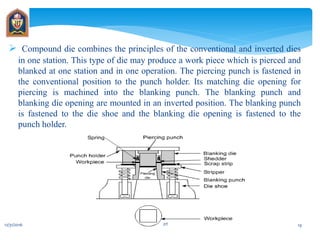
 Compound die combines the principles of the conventional and inverted dies
in one station. This type of die may produce a work piece which is pierced and
blanked at one station and in one operation. The piercing punch is fastened in
the conventional position to the punch holder. Its matching die opening for
piercing is machined into the blanking punch. The blanking punch and
blanking die opening are mounted in an inverted position. The blanking punch
is fastened to the die shoe and the blanking die opening is fastened to the
punch holder.
12/31/2016 JIT 19
This type of die is similar to that of a compound die
except that here non cutting operations such as bending
and forming are also included as part of the operation.
Combination die
12/31/2016
JIT 20
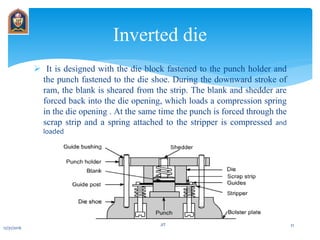
 It is designed with the die block fastened to the punch holder and
the punch fastened to the die shoe. During the downward stroke of
ram, the blank is sheared from the strip. The blank and shedder are
forced back into the die opening, which loads a compression spring
in the die opening . At the same time the punch is forced through the
scrap strip and a spring attached to the stripper is compressed and
loaded
Inverted die
12/31/2016
JIT 21
Numerous parts made of sheet metal are cylindrical or box
shaped, such as pots and pans, all types of containers for food
and beverages, stainless-steel kitchen sinks, canisters, and
automotive fuel tanks.
 Such parts usually are made by process in which a punch
forces a flat sheet-metal blank into a die cavity.
 Although the process generally is called deep drawing
(because of its capability for producing deep parts), it also is
used to make parts that are shallow or have moderate depth.
 It is one of the most important metalworking processes
because of its widespread use.
Deep drawing
12/31/2016
JIT 22
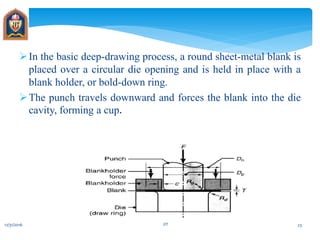
In the basic deep-drawing process, a round sheet-metal blank is
placed over a circular die opening and is held in place with a
blank holder, or bold-down ring.
The punch travels downward and forces the blank into the die
cavity, forming a cup.
12/31/2016 JIT 23
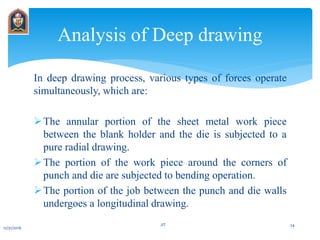
In deep drawing process, various types of forces operate
simultaneously, which are:
The annular portion of the sheet metal work piece
between the blank holder and the die is subjected to a
pure radial drawing.
The portion of the work piece around the corners of
punch and die are subjected to bending operation.
The portion of the job between the punch and die walls
undergoes a longitudinal drawing.
Analysis of Deep drawing
12/31/2016
JIT 24
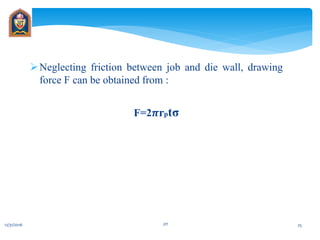
Neglecting friction between job and die wall, drawing
force F can be obtained from :
F=2𝝅𝐫ptσ
12/31/2016 JIT 25
Bending is one of the most common industrial forming
operations. We merely have to look at an automobile
body, appliance, paper clip, or file cabinet to appreciate
how many parts are shaped by bending. Furthermore,
bending also imparts stiffness to the part by increasing
its moment of inertia
Bending
12/31/2016
JIT 26
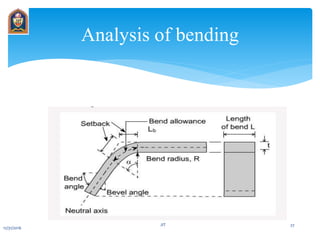
Analysis of bending
12/31/2016
JIT 27
It is the length of the neutral axis in the bend, . This
determines the blank length needed for a bent part. It
can be approximately estimated from the relation
Lb = a ( R + k t )
where, Lb = bend allowance (mm)
a = bend angle (radian)
R = bend radius (mm)
t = thickness of sheet (mm), and
k = constant, whose value may be taken as 1/3 when
R < 2t, and as 1/2 when R ³ 2t.
Bend Allowance
12/31/2016
JIT 28
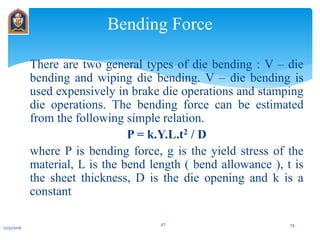
There are two general types of die bending : V – die
bending and wiping die bending. V – die bending is
used expensively in brake die operations and stamping
die operations. The bending force can be estimated
from the following simple relation.
P = k.Y.L.t2 / D
where P is bending force, g is the yield stress of the
material, L is the bend length ( bend allowance ), t is
the sheet thickness, D is the die opening and k is a
constant
Bending Force
12/31/2016
JIT 29
 Punching or blanking is a process in which the punch
removes a portion of material from the larger piece or a
strip of sheet metal.
 If the small removed piece is discarded, the operation is
called punching,
whereas if the small removed piece is the useful part and
the rest is scrap, the operation is called blanking
Blanking/Punching
12/31/2016
JIT 30
 The clearance between the die and punch can be
determined as c = 0.003 t. t where t is the sheet
thickness and t is the shear strength of sheet material.
For blanking operation, die size = blank size, and the
punch is made smaller, by considering the clearance.
 The maximum force, P required to be exerted by
the punch to shear out a blank from the sheet can be
estimated as
P = t. L. t
 where t is the sheet thickness, L is the total length
sheared (such as the perimeter of hole), and t is the
shear strength of the sheet material.
CONTINUED…
12/31/2016
JIT 31
It is a process by which a hole is cut (or torn) in metal.
It is different from punching in that piercing does not generate
a slug. Instead, the metal is pushed back to form a jagged
flange on the back side of the hole.
A pierced hole looks somewhat like a bullet hole in a sheet of
metal.
Piercing
12/31/2016
JIT 32

Sheet metal working

  • 1.
    SHEET METAL WORKING 12/31/2016 JIT1 Unit-III  By: Zoha Nasir Assistant Professor JIT, Barabanki
  • 2.
     Products madeof sheet metals are all around us.  They include a very wide range of consumer and industrial products, such as beverage cans, cookware, file cabinets, metal desks, appliances, car bodies, trailers, and aircraft fuselages Sheet forming dates back to about 5000 B.C., when household utensils and jewelry were made by hammering and stamping gold, silver, and copper.  Compared to those made by casting and by forging, sheet-metal parts offer the advantages of light weight and versatile shape.  However, the term press working or press forming is used commonly in industry to describe general sheet-forming operations, because they typically are performed on presses. Sheet metal working 12/31/2016 JIT 2
  • 3.
    The basic mechanismof sheet metal processes are stretching and bending. The major factor that influence the overall operation are: Elongation Yield point elongation Anisotropy Grain size Residual stresses Spring back and Wrinkling 12/31/2016 JIT 3
  • 4.
     It isa mass production process.  Low labour cost.  Production rates are rapid.  Very low production cost. Advantages 12/31/2016 JIT 4
  • 5.
    Generally, production requirementsin excess. Set up times are lengthy. Disadvantages 12/31/2016 JIT 5
  • 6.
    Presses shape workpiece without cutting away material, that is, without making chips. Presses are equipped with dies and punches designed for such operations as forming, punching and shearing. Presses 12/31/2016 JIT 6
  • 7.
    Proper selection ofa press is necessary for successful and economical operation. Press is a costly machine, and the return on investment depends upon how well it performs the job. There is no press that can provide maximum productively and economy for all application so, when a press is required to be used for several widely varying jobs, compromise is generally made between economy and productivity.  Important factors affecting the selection of a press are size, force, energy and speed requirements. Selection of presses 12/31/2016 JIT 7
  • 8.
    Types of pressesfor sheet metal working can be classified by one or a combination of characteristics, such as source of power, number of slides, type of frame and construction, type of drive, and intended applications. Types of presses 12/31/2016 JIT 8
  • 9.
    Hand press Power press Mechanicalpress Hydraulic press Crank Cam etc… Classification of presses 12/31/2016 JIT 9
  • 10.
    In a typicaldie and punch set used for blanking operation the sheet metal used is called strip or stock. The punch which is held in the punch holder is bolted to the press ram while die is bolted on the press table. During the working stroke, the punch penetrates the strip, and on the return stroke of the press ram the strip is lifted with the punch, but it is removed from the punch by the stripper plate.  The stop pin is a gage and it sets the advance of the strip stock within the punch and die. The strip stock is butted against the back stop acting as a datum location for the center of the blank. DIE AND PUNCH ASSEMBLY 12/31/2016 JIT 10
  • 11.
     The clearanceangle provided on the die depends on the material of stock, as well as its thickness. For thicker and softer materials generally higher angular clearance is given.  In most cases, 2 degree of angular clearance is sufficient. The height of cutting land of about 3 mm is generally sufficient. 12/31/2016 JIT 11
  • 12.
    The three methodsof working sheet metal in presses are: Shearing Deep drawing Bending Press work methods 12/31/2016 JIT 12
  • 13.
    This process involvescutting sheet metal by subjecting it to shear stress, usually between punch and die. The major variables in this process are: Punch force Speed of punch, lubrications Edge condition of the sheet Punch and die materials. Shearing 12/31/2016 JIT 13
  • 14.
  • 15.
    Progressive dies Compound dies Combinationdies Shearing dies 12/31/2016 JIT 15
  • 16.
     Parts requiringmultiple operations to produce can be made at high production rates in progressive dies.  The sheet metal is fed through as a coil strip, and a different operation (such as punching, blanking, and notching) is performed at the same station of the machine with each stroke of a series of punches. Progressive die 12/31/2016 JIT 16
  • 17.
    Progressive dies aremade with two or more stations arranged in a sequence. Each station performs an operation on the work piece, or provides an idler station, so that the work piece is completed when the last operation has been accomplished. Thereafter each stroke of the ram produces a finished part. Thus after the fourth stroke of a four – station die, each successive stroke will produce a finished part. Operations which may be carried out in a progressive die are piercing, blanking, forming, drawing, cut – off, etc.  Progressive dies are used where higher production rates are desired and the material is neither too thick nor too thin. Their use helps in cutting down the material handling costs. 12/31/2016 JIT 17
  • 18.
    Several operations onthe same sheet may be performed in one stroke at one station with a compound die.  Such combined operations usually are limited to relatively simple shapes, because (a) the process is somewhat slow and (b) the dies rapidly become much more expensive to produce than those for individual shearing operations, especially for complex dies. Compound die 12/31/2016 JIT 18
  • 19.
     Compound diecombines the principles of the conventional and inverted dies in one station. This type of die may produce a work piece which is pierced and blanked at one station and in one operation. The piercing punch is fastened in the conventional position to the punch holder. Its matching die opening for piercing is machined into the blanking punch. The blanking punch and blanking die opening are mounted in an inverted position. The blanking punch is fastened to the die shoe and the blanking die opening is fastened to the punch holder. 12/31/2016 JIT 19
  • 20.
    This type ofdie is similar to that of a compound die except that here non cutting operations such as bending and forming are also included as part of the operation. Combination die 12/31/2016 JIT 20
  • 21.
     It isdesigned with the die block fastened to the punch holder and the punch fastened to the die shoe. During the downward stroke of ram, the blank is sheared from the strip. The blank and shedder are forced back into the die opening, which loads a compression spring in the die opening . At the same time the punch is forced through the scrap strip and a spring attached to the stripper is compressed and loaded Inverted die 12/31/2016 JIT 21
  • 22.
    Numerous parts madeof sheet metal are cylindrical or box shaped, such as pots and pans, all types of containers for food and beverages, stainless-steel kitchen sinks, canisters, and automotive fuel tanks.  Such parts usually are made by process in which a punch forces a flat sheet-metal blank into a die cavity.  Although the process generally is called deep drawing (because of its capability for producing deep parts), it also is used to make parts that are shallow or have moderate depth.  It is one of the most important metalworking processes because of its widespread use. Deep drawing 12/31/2016 JIT 22
  • 23.
    In the basicdeep-drawing process, a round sheet-metal blank is placed over a circular die opening and is held in place with a blank holder, or bold-down ring. The punch travels downward and forces the blank into the die cavity, forming a cup. 12/31/2016 JIT 23
  • 24.
    In deep drawingprocess, various types of forces operate simultaneously, which are: The annular portion of the sheet metal work piece between the blank holder and the die is subjected to a pure radial drawing. The portion of the work piece around the corners of punch and die are subjected to bending operation. The portion of the job between the punch and die walls undergoes a longitudinal drawing. Analysis of Deep drawing 12/31/2016 JIT 24
  • 25.
    Neglecting friction betweenjob and die wall, drawing force F can be obtained from : F=2𝝅𝐫ptσ 12/31/2016 JIT 25
  • 26.
    Bending is oneof the most common industrial forming operations. We merely have to look at an automobile body, appliance, paper clip, or file cabinet to appreciate how many parts are shaped by bending. Furthermore, bending also imparts stiffness to the part by increasing its moment of inertia Bending 12/31/2016 JIT 26
  • 27.
  • 28.
    It is thelength of the neutral axis in the bend, . This determines the blank length needed for a bent part. It can be approximately estimated from the relation Lb = a ( R + k t ) where, Lb = bend allowance (mm) a = bend angle (radian) R = bend radius (mm) t = thickness of sheet (mm), and k = constant, whose value may be taken as 1/3 when R < 2t, and as 1/2 when R ³ 2t. Bend Allowance 12/31/2016 JIT 28
  • 29.
    There are twogeneral types of die bending : V – die bending and wiping die bending. V – die bending is used expensively in brake die operations and stamping die operations. The bending force can be estimated from the following simple relation. P = k.Y.L.t2 / D where P is bending force, g is the yield stress of the material, L is the bend length ( bend allowance ), t is the sheet thickness, D is the die opening and k is a constant Bending Force 12/31/2016 JIT 29
  • 30.
     Punching orblanking is a process in which the punch removes a portion of material from the larger piece or a strip of sheet metal.  If the small removed piece is discarded, the operation is called punching, whereas if the small removed piece is the useful part and the rest is scrap, the operation is called blanking Blanking/Punching 12/31/2016 JIT 30
  • 31.
     The clearancebetween the die and punch can be determined as c = 0.003 t. t where t is the sheet thickness and t is the shear strength of sheet material. For blanking operation, die size = blank size, and the punch is made smaller, by considering the clearance.  The maximum force, P required to be exerted by the punch to shear out a blank from the sheet can be estimated as P = t. L. t  where t is the sheet thickness, L is the total length sheared (such as the perimeter of hole), and t is the shear strength of the sheet material. CONTINUED… 12/31/2016 JIT 31
  • 32.
    It is aprocess by which a hole is cut (or torn) in metal. It is different from punching in that piercing does not generate a slug. Instead, the metal is pushed back to form a jagged flange on the back side of the hole. A pierced hole looks somewhat like a bullet hole in a sheet of metal. Piercing 12/31/2016 JIT 32