 Definition
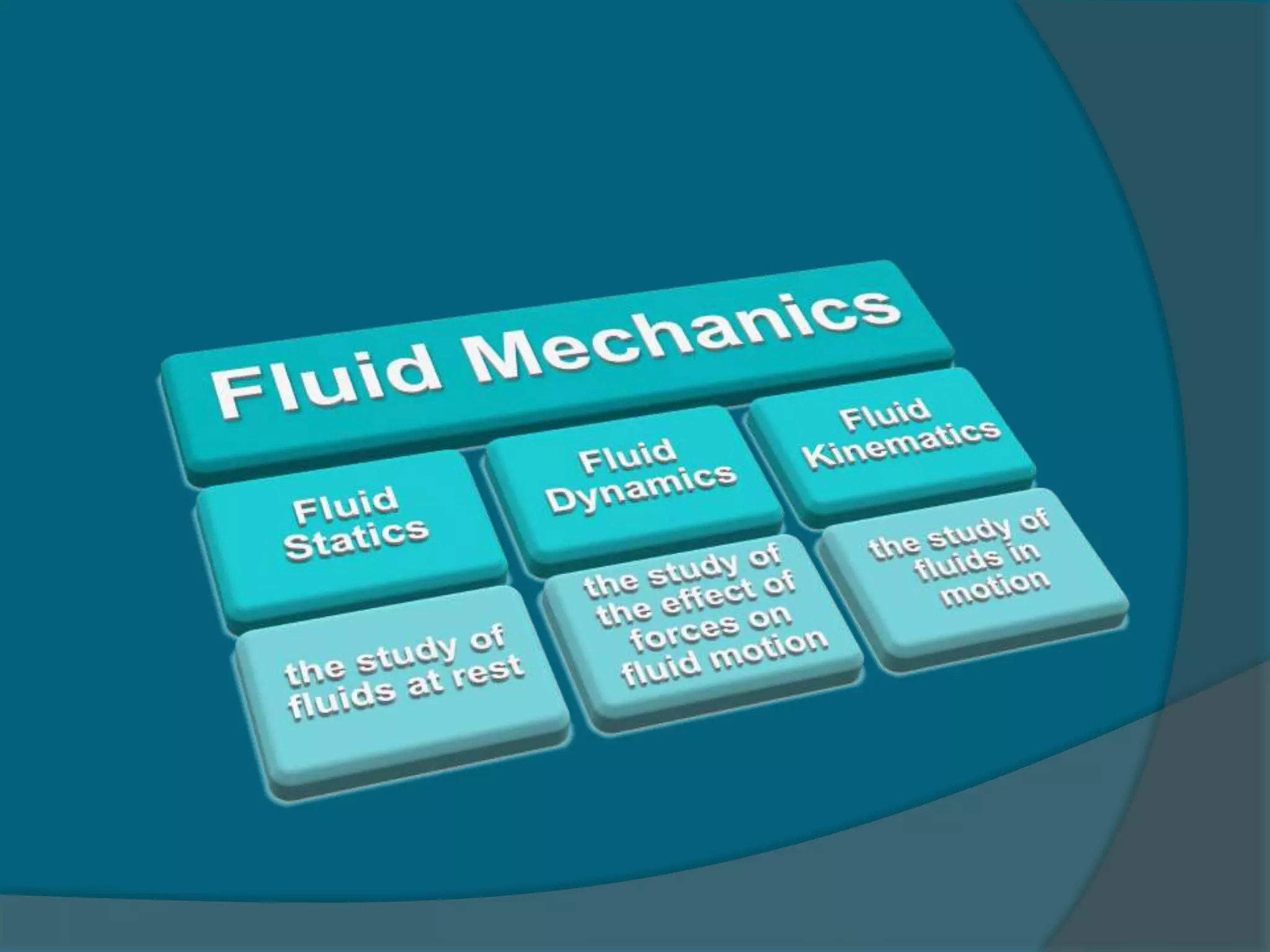
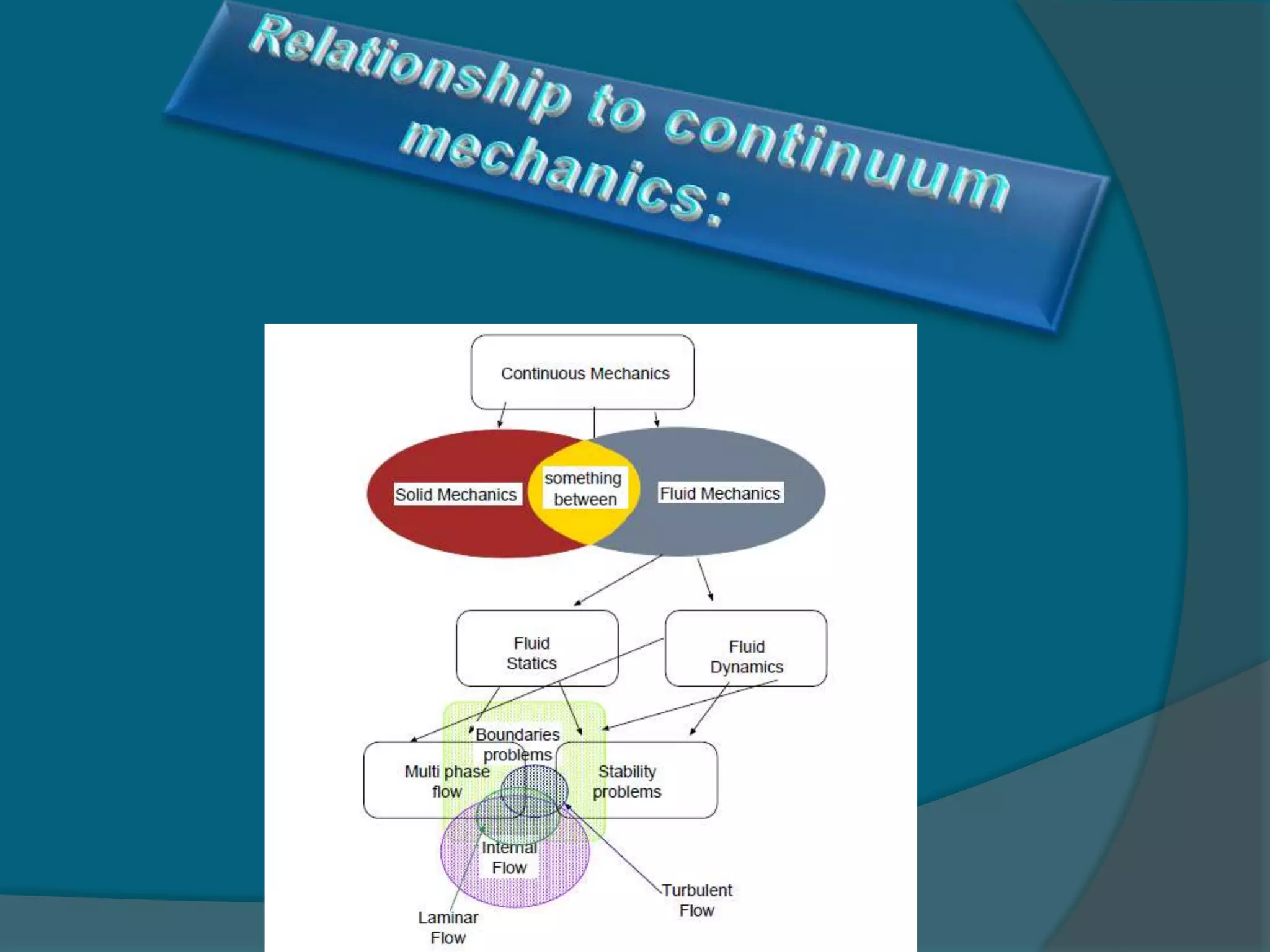
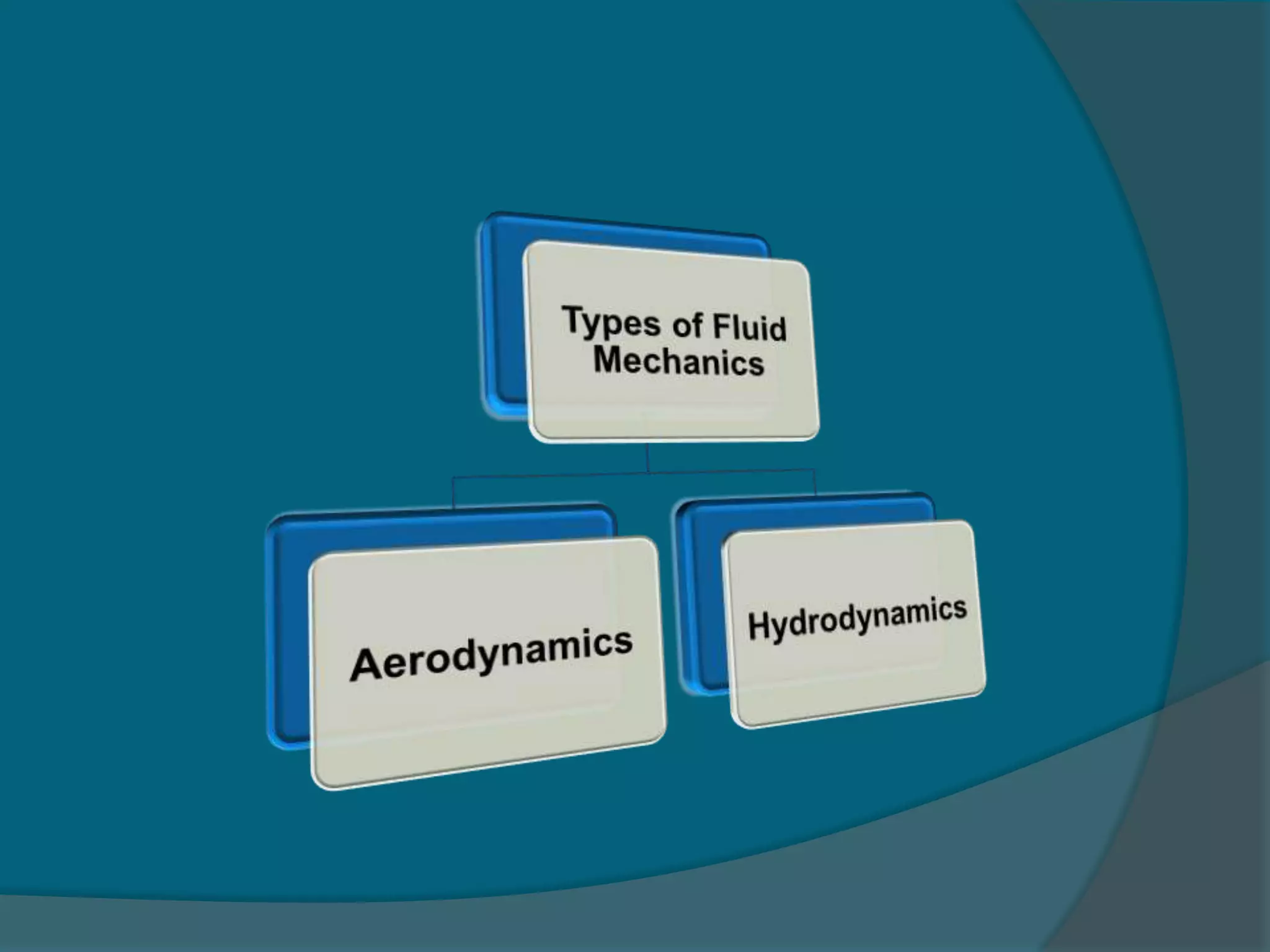
 Fluid mechanics is the study of fluids
and the forces on them. (Fluids include
liquids, gases, and plasmas.)
 The history of fluid mechanics, the study
of how fluids move and the forces on
them, dates back to the Ancient Greeks.
Archimedes:
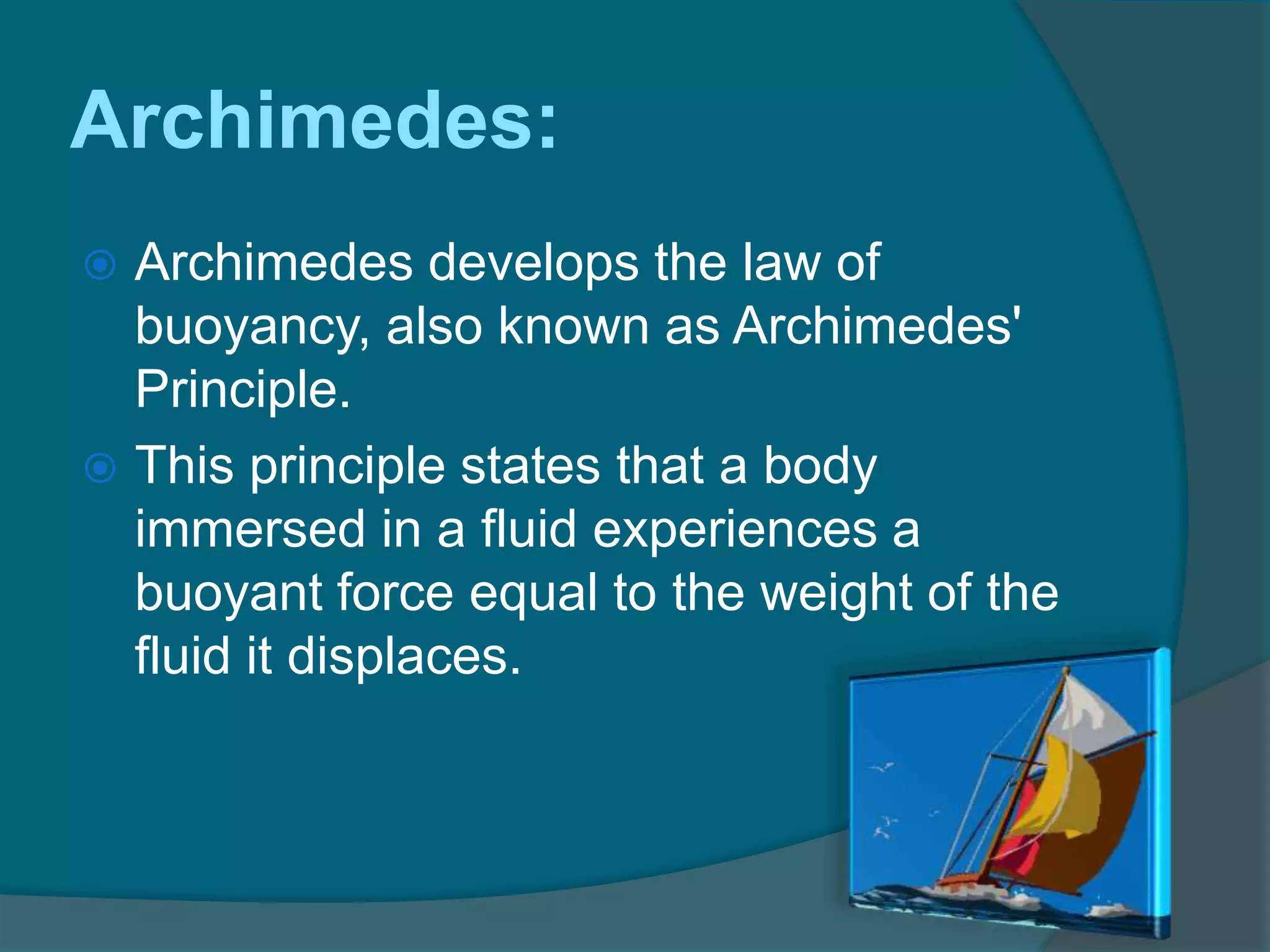
 Archimedes develops the law of
buoyancy, also known as Archimedes'
Principle.
 This principle states that a body
immersed in a fluid experiences a
buoyant force equal to the weight of the
fluid it displaces.
 Islamicate physicists
 Islamicate scientists, particularly Abu
RayhanBiruni (973–1048) and later Al-
Khazini (fl. 11151–130), were the first to
apply experimentalscientific methods to
fluid mechanics, especially in the field of
fluid statics, such as for determining
specific weights.
 In fluid statics, Biruni discovered that
there is a correlation between the
specific gravity of an object and the
volume of water it displaces. He also
introduced the method of checking tests
during experiments and measured the
weights of various liquids.
 Blaise Pascal
 In the hands of Blaise Pascal hydrostatics
assumed the dignity of a science, and in a
treatise on the equilibrium of liquids (Sur
l'equilibre des liqueurs), found among his
manuscripts after his death and published
in 1663, the laws of the equilibrium of
liquids were demonstrated in the most
simple manner, and amply confirmed by
experiments.
Studies by Isaac Newton
 The effects of friction and viscosity in diminishing the
velocity of running water were noticed in the Principia
of Sir Isaac Newton, who threw much light upon
several branches of hydromechanics.
 At a time when the Cartesian system of vortices
universally prevailed, he found it necessary to
investigate that hypothesis, and in the course of his
investigations he showed that the velocity of any
stratum of the vortex is an arithmetical mean between
the velocities of the strata which enclose it; and from
this it evidently follows that the velocity of a filament of
water moving in a pipe is an arithmetical mean
between the velocities of the filaments which surround
it.
Leonhard Euler
 The resolution of the questions
concerning the motion of fluids was
effected by means of Leonhard Euler's
partial differential coefficients. This
calculus was first applied to the motion
of water by d'Alembert, and enabled
both him and Euler to represent the
theory of fluids in formulae restricted by
no particular hypothesis.
Nineteenth century
 Hermann von Helmholtz
 In his paper Helmholtz established his
three "laws of vortex motion" in much the
same way one finds them in any advanced
textbook of fluid mechanics today. This
work established the significance of
vorticity to fluid mechanics and science in
general.
Real-Life Applications
 Bernoulli's Principle in Action
 As fluid moves from a wider pipe to a narrower
one, the volume of the fluid that moves a given
distance in a given time period does not change.
But since the width of the narrower pipe is
smaller, the fluid must move faster (that is, with
greater dynamic pressure) in order to move the
same amount of fluid the same distance in the
same amount of time. Observe the behavior of a
river: in a wide, unconstricted region, it flows
slowly, but if its flow is narrowed by canyon
walls, it speeds up dramatically.
 Among the most famous applications of
Bernoulli's principle is its use in
aerodynamics, and this is discussed in
the context of aerodynamics itself
elsewhere in this book. Likewise, a
number of other applications of
Bernoulli's principle are examined in an
essay devoted to that topic.
A Wind Tunnel
 The above scenario of wind flowing
through a room describes a rudimentary
wind tunnel. A wind tunnel is a chamber
built for the purpose of examining the
characteristics of airflow in contact with
solid objects, such as aircraft and
automobiles.
FLUID MECHANICS FOR
PERFORMING WORK
 Though applications of Bernoulli's principle
are among the most dramatic examples of
fluid mechanics in operation, the everyday
world is filled with instances of other ideas
at work. Pascal's principle, for
instance, can be seen in the operation of
any number of machines that represent
variations on the idea of a hydraulic press.
Among these is the hydraulic jack used to
raise a car off the floor of an auto
mechanic's shop.
 A pump is a device made for moving fluid, and it
does so by utilizing a pressure difference, causing
the fluid to move from an area of higher pressure
to one of lower pressure. Its operation is based on
aspects both of Pascal's and Bernoulli's
principles—though, of course, humans were using
pumps thousands of years before either man was
born.
Fluid mechanics applications

Fluid mechanics applications

  • 2.
     Definition  Fluidmechanics is the study of fluids and the forces on them. (Fluids include liquids, gases, and plasmas.)
  • 4.
     The historyof fluid mechanics, the study of how fluids move and the forces on them, dates back to the Ancient Greeks.
  • 5.
    Archimedes:  Archimedes developsthe law of buoyancy, also known as Archimedes' Principle.  This principle states that a body immersed in a fluid experiences a buoyant force equal to the weight of the fluid it displaces.
  • 6.
     Islamicate physicists Islamicate scientists, particularly Abu RayhanBiruni (973–1048) and later Al- Khazini (fl. 11151–130), were the first to apply experimentalscientific methods to fluid mechanics, especially in the field of fluid statics, such as for determining specific weights.
  • 7.
     In fluidstatics, Biruni discovered that there is a correlation between the specific gravity of an object and the volume of water it displaces. He also introduced the method of checking tests during experiments and measured the weights of various liquids.
  • 8.
     Blaise Pascal In the hands of Blaise Pascal hydrostatics assumed the dignity of a science, and in a treatise on the equilibrium of liquids (Sur l'equilibre des liqueurs), found among his manuscripts after his death and published in 1663, the laws of the equilibrium of liquids were demonstrated in the most simple manner, and amply confirmed by experiments.
  • 9.
    Studies by IsaacNewton  The effects of friction and viscosity in diminishing the velocity of running water were noticed in the Principia of Sir Isaac Newton, who threw much light upon several branches of hydromechanics.  At a time when the Cartesian system of vortices universally prevailed, he found it necessary to investigate that hypothesis, and in the course of his investigations he showed that the velocity of any stratum of the vortex is an arithmetical mean between the velocities of the strata which enclose it; and from this it evidently follows that the velocity of a filament of water moving in a pipe is an arithmetical mean between the velocities of the filaments which surround it.
  • 10.
    Leonhard Euler  Theresolution of the questions concerning the motion of fluids was effected by means of Leonhard Euler's partial differential coefficients. This calculus was first applied to the motion of water by d'Alembert, and enabled both him and Euler to represent the theory of fluids in formulae restricted by no particular hypothesis.
  • 11.
    Nineteenth century  Hermannvon Helmholtz  In his paper Helmholtz established his three "laws of vortex motion" in much the same way one finds them in any advanced textbook of fluid mechanics today. This work established the significance of vorticity to fluid mechanics and science in general.
  • 14.
    Real-Life Applications  Bernoulli'sPrinciple in Action  As fluid moves from a wider pipe to a narrower one, the volume of the fluid that moves a given distance in a given time period does not change. But since the width of the narrower pipe is smaller, the fluid must move faster (that is, with greater dynamic pressure) in order to move the same amount of fluid the same distance in the same amount of time. Observe the behavior of a river: in a wide, unconstricted region, it flows slowly, but if its flow is narrowed by canyon walls, it speeds up dramatically.
  • 15.
     Among themost famous applications of Bernoulli's principle is its use in aerodynamics, and this is discussed in the context of aerodynamics itself elsewhere in this book. Likewise, a number of other applications of Bernoulli's principle are examined in an essay devoted to that topic.
  • 16.
    A Wind Tunnel The above scenario of wind flowing through a room describes a rudimentary wind tunnel. A wind tunnel is a chamber built for the purpose of examining the characteristics of airflow in contact with solid objects, such as aircraft and automobiles.
  • 17.
    FLUID MECHANICS FOR PERFORMINGWORK  Though applications of Bernoulli's principle are among the most dramatic examples of fluid mechanics in operation, the everyday world is filled with instances of other ideas at work. Pascal's principle, for instance, can be seen in the operation of any number of machines that represent variations on the idea of a hydraulic press. Among these is the hydraulic jack used to raise a car off the floor of an auto mechanic's shop.
  • 18.
     A pumpis a device made for moving fluid, and it does so by utilizing a pressure difference, causing the fluid to move from an area of higher pressure to one of lower pressure. Its operation is based on aspects both of Pascal's and Bernoulli's principles—though, of course, humans were using pumps thousands of years before either man was born.