PROPERTIES OF FLUID
NISHCHAL GIRI
CONTENTS:-
 PROPERTIES OF FLUID
 VISCOSITY
 APPLICATION OFVISCOSITY
 SURFACETENSION
 APPLICATION OF SURFACETENSION
 CAPILLARY ACTION
 APPLICATION OF CAPILLARYACTION
 CONCLUSION
PROPERTIES OF FLUIDS:-
 Matter exists in two states- the solid state and
the fluid state.This classification of matter is
based on the spacing between different
molecules of matter as well as on the behavior of
matter when subjected to stresses. Because
molecules in solid state are spaced very closely,
solids possess compactness and rigidity of form.
The molecules in fluid can move more freely
within the fluid mass and therefore the fluids do
not possess any rigidity of form.
THE PROPERTIES OF FLUIDS ARE:-
 VISCOSITY
 SURFACETENSION
 COMPRESSIBILITY
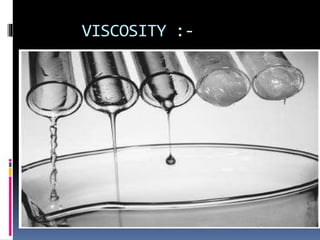
VISCOSITY :-
Viscosity is a measure of a fluid's
resistance to flow. It describes the internal
friction of a moving fluid. A fluid with large
viscosity resists motion because its molecular
makeup gives it a lot of internal friction. A
fluid with low viscosity flows easily because
its molecular makeup results in very little
friction when it is in motion. Gases also have
viscosity, although it is a little harder to
notice it in ordinary circumstances.
APPLICATION OF VISCOSITY :-
1. Transparent and storing facilities for fluids ie,
pipes, tanks
2. Bitumen used for road construction.
3. Designing of the sewer line or any other pipe
flow viscosity play an important role in finding
out its flow behaviour.
4. Drilling for oil and gas requires sensitive
viscosity.
5. To maintain the performance of machine and
automobiles by determining thickness of
lubricating oil or motor oil.
TO MAINTAIN THE PERFORMANCE
OF MACHINE AND AUTOMOBILES:-
Oil viscosity needs to suit the right ambient temperatures. If
it’s too thick when the engine is cold, it won’t move around the
engine. And if it becomes too thin when the engine is hot, it won’t
give the right protection to the engine parts.Optimising an oil’s
viscosity, or thickness, helps maximise energy efficiency while
avoiding component wear. Viscosity modifiers increase the viscosity
of your oil at high temperature but have little effect on low-
temperature viscosity. These enable your oil to flow properly when
cold and also to remain thick enough to protect your engine
components at high temperatures.
Lower-viscosity grades of oil such as Shell Helix Ultra, make it
easier for your engine to start from cold because they present less
resistance to moving parts and hence take less power from your
engine.This also means that you get enhanced fuel economy.
TYPES OF VISCOMETER :-
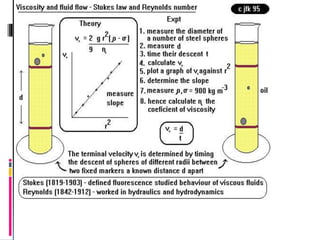
 Laboratory viscometers for fluid
U-tube
Falling sphere
 Falling PistonViscometers
 Falling SphereViscometers
U-TUBE MANOMETER
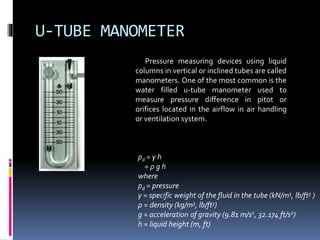
Pressure measuring devices using liquid
columns in vertical or inclined tubes are called
manometers. One of the most common is the
water filled u-tube manometer used to
measure pressure difference in pitot or
orifices located in the airflow in air handling
or ventilation system.
pd = Îł h
= ρ g h
where
pd = pressure
Îł = specific weight of the fluid in the tube (kN/m3, lb/ft3 )
ρ = density (kg/m3, lb/ft3)
g = acceleration of gravity (9.81 m/s2, 32.174 ft/s2)
h = liquid height (m, ft)
SURFACE TENSION
Surface tension is a contractive tendency
of the surface of a fluid that allows it to resist
an external force. Surface tension is an
important property that markebly influences
the ecosystems.
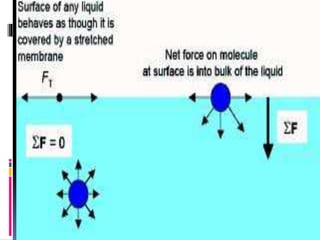
Whenever a fluid is left to itself, the fluid
tends to attend the minimum surface area
possible. The reason behind this is that while
a molecule inside the fluid is pulled in each
and every direction by the adjacent
molecules in the surface of the fluid , the case
is different. the adhesive forces causes
downward pull on the molecule due to
cohesent. So the molecule on the surface
tends to move down but it is repelled by the
molecules below it.
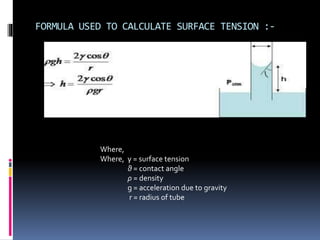
FORMULA USED TO CALCULATE SURFACE TENSION :-
Where,
Where, Îł = surface tension
θ = contact angle
ρ = density
g = acceleration due to gravity
r = radius of tube
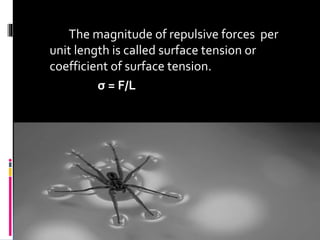
The magnitude of repulsive forces per
unit length is called surface tension or
coefficient of surface tension.
σ = F/L
APPLICATION OF SURFACE TENSION :-
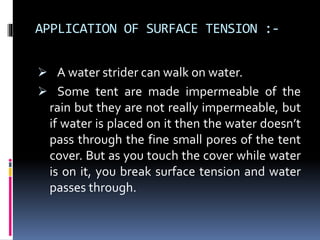
 A water strider can walk on water.
 Some tent are made impermeable of the
rain but they are not really impermeable, but
if water is placed on it then the water doesn’t
pass through the fine small pores of the tent
cover. But as you touch the cover while water
is on it, you break surface tension and water
passes through.
CAPILLARY ACTION :-
Capillary action is the ability of a fluid to flow in
narrow spaces without the assistance of, and in
opposition to, external forces like gravity.
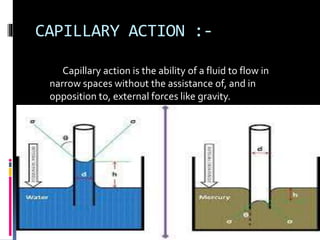
A common apparatus used to demonstrate
the first phenomenon is the capillary tube. When
the lower end of a vertical glass tube is placed in
a fluid, such as water a concave meniscus forms.
Adhesion occurs between the fluid and the solid
inner wall pulling the fluid column up until there
is a sufficient mass of fluid for gravitational
forces to overcome these intermolecular forces.
The contact length between the top of the fluid
column and the tube is proportional to the
diameter of the tube, while the weight of the
fluid column is proportional to the square of
tube’s diameter. So, a narrow tube will draw a
fluid column higher than a wider tube will.
APPLICATION OF CAPILLARY ACTION :-
 Capillary action is found in thermometer
where fluid used in it automatically rises
when comes in contact with higher
temperature or falls down with lower ones.
 Capillary action can be performed to transfer
fluid from one vessel to another on its own.
 Capillary action can be experienced in the half
dipped cloth as well as on lantern.
CAPILLARY ACTION ON LANTERN :-
Capillary action works by drawing the
kerosene/oil out of the fount to the tip of the
wick where the flame heats the oil to a gas
and ignites it.
When one end of the cloth kept in
contact with the oil and another at the top to
burn, the oil rises upward with the help of the
cloth. Due to the capillary action, the oil
simply travels to the top and ignites

Properties of fluid.ppt

  • 1.
  • 2.
    CONTENTS:-  PROPERTIES OFFLUID  VISCOSITY  APPLICATION OFVISCOSITY  SURFACETENSION  APPLICATION OF SURFACETENSION  CAPILLARY ACTION  APPLICATION OF CAPILLARYACTION  CONCLUSION
  • 3.
    PROPERTIES OF FLUIDS:- Matter exists in two states- the solid state and the fluid state.This classification of matter is based on the spacing between different molecules of matter as well as on the behavior of matter when subjected to stresses. Because molecules in solid state are spaced very closely, solids possess compactness and rigidity of form. The molecules in fluid can move more freely within the fluid mass and therefore the fluids do not possess any rigidity of form.
  • 4.
    THE PROPERTIES OFFLUIDS ARE:-  VISCOSITY  SURFACETENSION  COMPRESSIBILITY
  • 5.
  • 6.
    Viscosity is ameasure of a fluid's resistance to flow. It describes the internal friction of a moving fluid. A fluid with large viscosity resists motion because its molecular makeup gives it a lot of internal friction. A fluid with low viscosity flows easily because its molecular makeup results in very little friction when it is in motion. Gases also have viscosity, although it is a little harder to notice it in ordinary circumstances.
  • 8.
    APPLICATION OF VISCOSITY:- 1. Transparent and storing facilities for fluids ie, pipes, tanks 2. Bitumen used for road construction. 3. Designing of the sewer line or any other pipe flow viscosity play an important role in finding out its flow behaviour. 4. Drilling for oil and gas requires sensitive viscosity. 5. To maintain the performance of machine and automobiles by determining thickness of lubricating oil or motor oil.
  • 9.
    TO MAINTAIN THEPERFORMANCE OF MACHINE AND AUTOMOBILES:- Oil viscosity needs to suit the right ambient temperatures. If it’s too thick when the engine is cold, it won’t move around the engine. And if it becomes too thin when the engine is hot, it won’t give the right protection to the engine parts.Optimising an oil’s viscosity, or thickness, helps maximise energy efficiency while avoiding component wear. Viscosity modifiers increase the viscosity of your oil at high temperature but have little effect on low- temperature viscosity. These enable your oil to flow properly when cold and also to remain thick enough to protect your engine components at high temperatures. Lower-viscosity grades of oil such as Shell Helix Ultra, make it easier for your engine to start from cold because they present less resistance to moving parts and hence take less power from your engine.This also means that you get enhanced fuel economy.
  • 10.
    TYPES OF VISCOMETER:-  Laboratory viscometers for fluid U-tube Falling sphere  Falling PistonViscometers  Falling SphereViscometers
  • 11.
    U-TUBE MANOMETER Pressure measuringdevices using liquid columns in vertical or inclined tubes are called manometers. One of the most common is the water filled u-tube manometer used to measure pressure difference in pitot or orifices located in the airflow in air handling or ventilation system. pd = γ h = ρ g h where pd = pressure γ = specific weight of the fluid in the tube (kN/m3, lb/ft3 ) ρ = density (kg/m3, lb/ft3) g = acceleration of gravity (9.81 m/s2, 32.174 ft/s2) h = liquid height (m, ft)
  • 12.
    SURFACE TENSION Surface tensionis a contractive tendency of the surface of a fluid that allows it to resist an external force. Surface tension is an important property that markebly influences the ecosystems.
  • 13.
    Whenever a fluidis left to itself, the fluid tends to attend the minimum surface area possible. The reason behind this is that while a molecule inside the fluid is pulled in each and every direction by the adjacent molecules in the surface of the fluid , the case is different. the adhesive forces causes downward pull on the molecule due to cohesent. So the molecule on the surface tends to move down but it is repelled by the molecules below it.
  • 14.
    FORMULA USED TOCALCULATE SURFACE TENSION :- Where, Where, γ = surface tension θ = contact angle ρ = density g = acceleration due to gravity r = radius of tube
  • 15.
    The magnitude ofrepulsive forces per unit length is called surface tension or coefficient of surface tension. σ = F/L
  • 16.
    APPLICATION OF SURFACETENSION :-  A water strider can walk on water.  Some tent are made impermeable of the rain but they are not really impermeable, but if water is placed on it then the water doesn’t pass through the fine small pores of the tent cover. But as you touch the cover while water is on it, you break surface tension and water passes through.
  • 18.
    CAPILLARY ACTION :- Capillaryaction is the ability of a fluid to flow in narrow spaces without the assistance of, and in opposition to, external forces like gravity.
  • 19.
    A common apparatusused to demonstrate the first phenomenon is the capillary tube. When the lower end of a vertical glass tube is placed in a fluid, such as water a concave meniscus forms. Adhesion occurs between the fluid and the solid inner wall pulling the fluid column up until there is a sufficient mass of fluid for gravitational forces to overcome these intermolecular forces. The contact length between the top of the fluid column and the tube is proportional to the diameter of the tube, while the weight of the fluid column is proportional to the square of tube’s diameter. So, a narrow tube will draw a fluid column higher than a wider tube will.
  • 20.
    APPLICATION OF CAPILLARYACTION :-  Capillary action is found in thermometer where fluid used in it automatically rises when comes in contact with higher temperature or falls down with lower ones.  Capillary action can be performed to transfer fluid from one vessel to another on its own.  Capillary action can be experienced in the half dipped cloth as well as on lantern.
  • 21.
    CAPILLARY ACTION ONLANTERN :- Capillary action works by drawing the kerosene/oil out of the fount to the tip of the wick where the flame heats the oil to a gas and ignites it. When one end of the cloth kept in contact with the oil and another at the top to burn, the oil rises upward with the help of the cloth. Due to the capillary action, the oil simply travels to the top and ignites