FLUID
MECHANICS
FLOW
THROUGH
PIPES
CONTENTS
Introduction
Head Losses through pipe
Types of Losses
Major Losses
Hydraulic Grade Line
Pipes in Series
Pipes in Parallel
Syphons
Power Transmission Through Pipe
Flow Through Nozzle at End of Pipe
Water Hammer in Pipes
INTRODUCTION
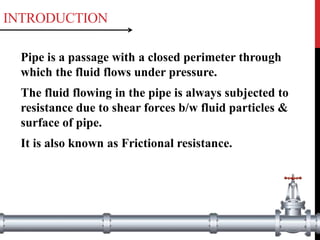
Pipe is a passage with a closed perimeter through
which the fluid flows under pressure.
The fluid flowing in the pipe is always subjected to
resistance due to shear forces b/w fluid particles &
surface of pipe.
It is also known as Frictional resistance.
HEAD LOSSES THROUGH
PIPE
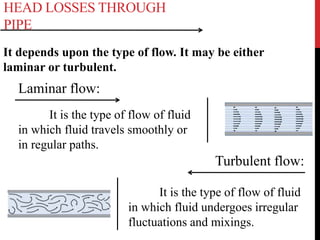
It depends upon the type of flow. It may be either
laminar or turbulent.
It is the type of flow of fluid
in which fluid undergoes irregular
fluctuations and mixings.
Laminar flow:
It is the type of flow of fluid
in which fluid travels smoothly or
in regular paths.
Turbulent flow:
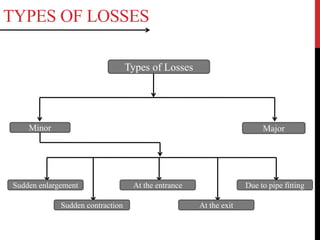
TYPES OF LOSSES
Minor Major
Types of Losses
Sudden enlargement
Sudden contraction
At the entrance
At the exit
Due to pipe fitting
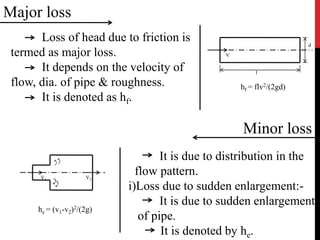
Major loss
Loss of head due to friction is
termed as major loss.
It depends on the velocity of
flow, dia. of pipe & roughness.
It is denoted as hf.
V
l
d
hf = flv2/(2gd)
Minor loss
It is due to distribution in the
flow pattern.
i)Loss due to sudden enlargement:-
It is due to sudden enlargement
of pipe.
It is denoted by he.
V1 V2
he = (v1-v2)2/(2g)
ii)Loss due to sudden contraction:-
It is due to sudden contraction
of pipe.
It is denoted by hc.
V
hc = [(1/Cc)-1]2 x v2/(2g)
iii)Loss at the exit:-
It is head loss at the exit of
the pipe.
It is denoted by hex.
V
hex = v2/(2g)
iv)Loss due to pipe fittings:-
It is due to pipe fittings like
elbows, valves etc.
It is denoted by hb.
hb= K[v2/(2g)]
v)Loss at entrance :-
It is head loss at the entrance of
the pipe.
It is denoted by hen.
V
hen = 0.5[v2/(2g)]
Hydraulic Grade Line
It is the line joining all the liquid
levels in piezometers.
It is the sum of pressure head &
datum head [(P/γ)+z].
Slope of HGL is called as
hydraulic gradient.
Total Energy Line
It is graphical representation of total
head at various points along pipe.
It is the sum of pressure head, velocity
head & datum head.
[(P/γ)+(v2/2g)+z].
If datum is 0 then energy grade line is
TEL.
PIPES IN SERIES
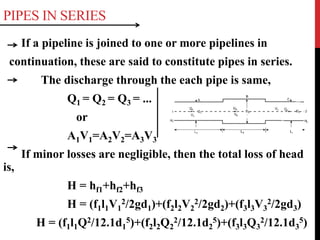
If a pipeline is joined to one or more pipelines in
continuation, these are said to constitute pipes in series.
The discharge through the each pipe is same,
Q1 = Q2 = Q3 = ...
or
A1V1=A2V2=A3V3
If minor losses are negligible, then the total loss of head
is,
H = hf1+hf2+hf3
H = (f1l1V1
2/2gd1)+(f2l2V2
2/2gd2)+(f3l3V3
2/2gd3)
H = (f1l1Q2/12.1d1
5)+(f2l2Q2
2/12.1d2
5)+(f3l3Q3
2/12.1d3
5)
PIPES IN PARALLEL
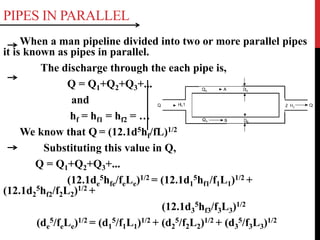
When a man pipeline divided into two or more parallel pipes
it is known as pipes in parallel.
The discharge through the each pipe is,
Q = Q1+Q2+Q3+...
and
hf = hf1 = hf2 = …
We know that Q = (12.1d5hf/fL)1/2
Substituting this value in Q,
Q = Q1+Q2+Q3+...
(12.1de
5hfe/feLe)1/2 = (12.1d1
5hf1/f1L1)1/2 +
(12.1d2
5hf2/f2L2)1/2 +
(12.1d3
5hf3/f3L3)1/2
(de
5/feLe)1/2 = (d1
5/f1L1)1/2 + (d2
5/f2L2)1/2 + (d3
5/f3L3)1/2
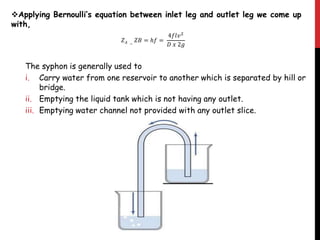
SYPHON SYPHON IS LONG BENT PIPE WHICH IS USED TO CONVEY
LIQUID FROM A RESERVOIR AT A HIGHER ELEVATION WHEN
THE TWO ARE SEPARATED BY A HIGH LEVEL GROUND OR HILL.
 THE HIGHEST POINT OF THE SYPHON I.E. A POINT ABOVE FREE
SURFACE OF RESERVOIR IS KNOWN AS SUMMIT.
 THE PORTION OF SYPHON WHICH IS CONNECTED WITH SOURCE
RESERVOIR IS CALLED INLET LEG AND THE OUTPUT RESERVOIR
IS CALLED OUTLET LEG.
 THE FLOW THROUGH THE SYPHON IS ONLY POSSIBLE IF THE
PRESSURE AT THE SUMMIT IS BELOW ATMOSPHERIC PRESSURE.
 HOWEVER PRESSURE AT SUMMIT SHOULD NOT FALL BELOW THE
SATURATION PRESSURE OF THE LIQUID OTHERWISE VAPOR
WILL START FORMING, CAUSING THE CAVITATION IN SYPHON
AND FLOW OF WATER WILL BE OBSTRUCTED.
 APPLYING BERNOULLI’S THEOREM BETWEEN INLET LEG AND
SUMMIT WE COME UP WITH,
𝑙 𝑖 =
𝑔 𝑥 𝐷 [ℎ𝑎𝑡𝑚 − ℎ𝑠 − ℎ𝑖 −
𝑣2
2𝑔
]
2𝑓𝑣2
Applying Bernoulli’s equation between inlet leg and outlet leg we come up
with,
𝑍 𝐴 −
𝑍𝐵 = ℎ𝑓 =
4𝑓𝑙𝑣2
𝐷 𝑥 2𝑔
The syphon is generally used to
i. Carry water from one reservoir to another which is separated by hill or
bridge.
ii. Emptying the liquid tank which is not having any outlet.
iii. Emptying water channel not provided with any outlet slice.
Condition of maximum power :
Power transmitted will be maximum when
𝑑𝑝
𝑑𝑣
= 0 and we will come up with,
∴ ℎ 𝑓 =
𝐻
3
It is the condition for maximum transmission of power as loss of friction
head is one third of the total head.
Efficiency of power transmission :
𝛼 =
𝑃𝑜𝑤𝑒𝑟 𝑎𝑣𝑎𝑖𝑙𝑎𝑏𝑙𝑒 𝑎𝑡 𝑜𝑢𝑡𝑙𝑒𝑡 𝑜𝑓 𝑝𝑖𝑝𝑒
𝑃𝑜𝑤𝑒𝑟 𝑎𝑣𝑎𝑖𝑙𝑎𝑏𝑙𝑒 𝑎𝑡 𝑖𝑛𝑙𝑒𝑡 𝑜𝑓 𝑡ℎ𝑒 𝑡ℎ𝑒 𝑝𝑖𝑝𝑒
Therefore, 𝛼 =
𝐻−ℎ𝑓
𝐻
Thus the maximum efficiency will be obtained when ℎ 𝑓 =
𝐻
3
∴ 𝛼 max = 66.67%
POWER TRANSMISSION THROUGH
PIPE
Power can be transmitted by liquid which is flowing through pipes.
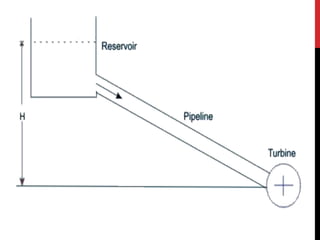
Power transmission through pipes is commonly used to convey water from
a high level reservoir to turbine house and in operation of hydraulic
equipments such as hydraulic press, crane jack , etc.
The power transmitted depends upon the weight of liquid flowing through
pipe and total head available at end of pipe.
Thus, Power transmitted through pipe
𝑃 = 𝑤𝑒𝑖𝑔ℎ𝑡 𝑜𝑓 𝑤𝑎𝑡𝑒𝑟 𝑓𝑙𝑜𝑤 𝑡ℎ𝑟𝑜𝑢𝑔ℎ 𝑝𝑖𝑝𝑒 𝑥 𝐻𝑒𝑎𝑑 𝑎𝑣𝑎𝑖𝑙𝑎𝑏𝑙𝑒 𝑎𝑡 𝑜𝑢𝑡𝑙𝑒𝑡 𝑜𝑓 𝑝𝑖𝑝𝑒
= 𝑊 𝑥 [𝐻 − ℎ𝑓]
= 𝑚𝑔 𝑥 [𝐻 − ℎ𝑓]
= 𝜌. 𝐴. 𝑉. 𝑔 𝑥 [𝐻 − ℎ𝑓]
∴ P = 𝜌. 𝑔.
𝛱𝐷2
4
. 𝑉 𝑥 [𝐻 −
4𝑓𝑙𝑣2
𝐷 𝑥 2𝑔
] W
FLOW THROUGH NOZZLE AT END OF
PIPE
The function of nozzle is to convert total energy of liquid into kinetic
energy.
Nozzle is used where higher velocity of liquid is required as in pelton
wheel, for fire fighting, mining power developments, etc.
Since water is flowing continuously through pipe and nozzle we can apply
law of continuity,
∴ 𝑄 = 𝐴𝑉 = 𝑎𝑣 → 𝑉 =
𝑎
𝐴
. 𝑣
Head at inlet of nozzle = 𝐻 − ℎ𝑓 (neglecting minor losses)
Head at outlet of nozzle = kinetic head =
𝑣2
2𝑔
According to Bernoulli’s equation head at inlet = head at outlet
(neglecting losses)
∴ 𝐻 − ℎ𝑓 =
𝑣2
2𝑔
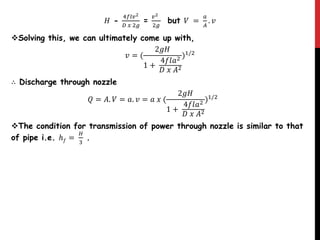
𝐻 -
4𝑓𝑙𝑣2
𝐷 𝑥 2𝑔
=
𝑣2
2𝑔
but 𝑉 =
𝑎
𝐴
. 𝑣
Solving this, we can ultimately come up with,
𝑣 = (
2𝑔𝐻
1 +
4𝑓𝑙𝑎2
𝐷 𝑥 𝐴2
)1/2
∴ Discharge through nozzle
𝑄 = 𝐴. 𝑉 = 𝑎. 𝑣 = 𝑎 𝑥 (
2𝑔𝐻
1 +
4𝑓𝑙𝑎2
𝐷 𝑥 𝐴2
)1/2
The condition for transmission of power through nozzle is similar to that
of pipe i.e. ℎ 𝑓 =
𝐻
3
.
WATER HAMMER IN PIPES
Water while flowing in pipe possesses momentum due to some velocity of
water.
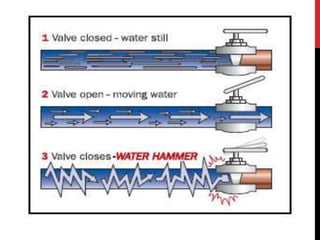
If the flowing water is suddenly brought to rest by closing the valve, its
momentum is destroyed ,which causes a very high pressure waves.
This high pressure waves will be transmitted along the pipe with a
velocity equal to the velocity of sound wave, and it may create noise which
is called knocking.
Also this wave of high pressure has the effect of hammering action on
the walls of the pipe and thus is known as water hammer.
There are three cases of water hammer depending upon the time taken
in closing valve and they are as follows :
1.Water hammer when valve is closed gradually closed
2.Water hammer when the valve is suddenly closed and pipe is rigid
3.Water hammer when the valve is suddenly closed and elastic pipe.
Flow through pipes

Flow through pipes

  • 1.
  • 2.
    CONTENTS Introduction Head Losses throughpipe Types of Losses Major Losses Hydraulic Grade Line Pipes in Series Pipes in Parallel Syphons Power Transmission Through Pipe Flow Through Nozzle at End of Pipe Water Hammer in Pipes
  • 3.
    INTRODUCTION Pipe is apassage with a closed perimeter through which the fluid flows under pressure. The fluid flowing in the pipe is always subjected to resistance due to shear forces b/w fluid particles & surface of pipe. It is also known as Frictional resistance.
  • 4.
    HEAD LOSSES THROUGH PIPE Itdepends upon the type of flow. It may be either laminar or turbulent. It is the type of flow of fluid in which fluid undergoes irregular fluctuations and mixings. Laminar flow: It is the type of flow of fluid in which fluid travels smoothly or in regular paths. Turbulent flow:
  • 5.
    TYPES OF LOSSES MinorMajor Types of Losses Sudden enlargement Sudden contraction At the entrance At the exit Due to pipe fitting
  • 6.
    Major loss Loss ofhead due to friction is termed as major loss. It depends on the velocity of flow, dia. of pipe & roughness. It is denoted as hf. V l d hf = flv2/(2gd) Minor loss It is due to distribution in the flow pattern. i)Loss due to sudden enlargement:- It is due to sudden enlargement of pipe. It is denoted by he. V1 V2 he = (v1-v2)2/(2g)
  • 7.
    ii)Loss due tosudden contraction:- It is due to sudden contraction of pipe. It is denoted by hc. V hc = [(1/Cc)-1]2 x v2/(2g) iii)Loss at the exit:- It is head loss at the exit of the pipe. It is denoted by hex. V hex = v2/(2g)
  • 8.
    iv)Loss due topipe fittings:- It is due to pipe fittings like elbows, valves etc. It is denoted by hb. hb= K[v2/(2g)] v)Loss at entrance :- It is head loss at the entrance of the pipe. It is denoted by hen. V hen = 0.5[v2/(2g)]
  • 9.
    Hydraulic Grade Line Itis the line joining all the liquid levels in piezometers. It is the sum of pressure head & datum head [(P/γ)+z]. Slope of HGL is called as hydraulic gradient. Total Energy Line It is graphical representation of total head at various points along pipe. It is the sum of pressure head, velocity head & datum head. [(P/γ)+(v2/2g)+z]. If datum is 0 then energy grade line is TEL.
  • 10.
    PIPES IN SERIES Ifa pipeline is joined to one or more pipelines in continuation, these are said to constitute pipes in series. The discharge through the each pipe is same, Q1 = Q2 = Q3 = ... or A1V1=A2V2=A3V3 If minor losses are negligible, then the total loss of head is, H = hf1+hf2+hf3 H = (f1l1V1 2/2gd1)+(f2l2V2 2/2gd2)+(f3l3V3 2/2gd3) H = (f1l1Q2/12.1d1 5)+(f2l2Q2 2/12.1d2 5)+(f3l3Q3 2/12.1d3 5)
  • 11.
    PIPES IN PARALLEL Whena man pipeline divided into two or more parallel pipes it is known as pipes in parallel. The discharge through the each pipe is, Q = Q1+Q2+Q3+... and hf = hf1 = hf2 = … We know that Q = (12.1d5hf/fL)1/2 Substituting this value in Q, Q = Q1+Q2+Q3+... (12.1de 5hfe/feLe)1/2 = (12.1d1 5hf1/f1L1)1/2 + (12.1d2 5hf2/f2L2)1/2 + (12.1d3 5hf3/f3L3)1/2 (de 5/feLe)1/2 = (d1 5/f1L1)1/2 + (d2 5/f2L2)1/2 + (d3 5/f3L3)1/2
  • 12.
    SYPHON SYPHON ISLONG BENT PIPE WHICH IS USED TO CONVEY LIQUID FROM A RESERVOIR AT A HIGHER ELEVATION WHEN THE TWO ARE SEPARATED BY A HIGH LEVEL GROUND OR HILL.  THE HIGHEST POINT OF THE SYPHON I.E. A POINT ABOVE FREE SURFACE OF RESERVOIR IS KNOWN AS SUMMIT.  THE PORTION OF SYPHON WHICH IS CONNECTED WITH SOURCE RESERVOIR IS CALLED INLET LEG AND THE OUTPUT RESERVOIR IS CALLED OUTLET LEG.  THE FLOW THROUGH THE SYPHON IS ONLY POSSIBLE IF THE PRESSURE AT THE SUMMIT IS BELOW ATMOSPHERIC PRESSURE.  HOWEVER PRESSURE AT SUMMIT SHOULD NOT FALL BELOW THE SATURATION PRESSURE OF THE LIQUID OTHERWISE VAPOR WILL START FORMING, CAUSING THE CAVITATION IN SYPHON AND FLOW OF WATER WILL BE OBSTRUCTED.  APPLYING BERNOULLI’S THEOREM BETWEEN INLET LEG AND SUMMIT WE COME UP WITH, 𝑙 𝑖 = 𝑔 𝑥 𝐷 [ℎ𝑎𝑡𝑚 − ℎ𝑠 − ℎ𝑖 − 𝑣2 2𝑔 ] 2𝑓𝑣2
  • 13.
    Applying Bernoulli’s equationbetween inlet leg and outlet leg we come up with, 𝑍 𝐴 − 𝑍𝐵 = ℎ𝑓 = 4𝑓𝑙𝑣2 𝐷 𝑥 2𝑔 The syphon is generally used to i. Carry water from one reservoir to another which is separated by hill or bridge. ii. Emptying the liquid tank which is not having any outlet. iii. Emptying water channel not provided with any outlet slice.
  • 14.
    Condition of maximumpower : Power transmitted will be maximum when 𝑑𝑝 𝑑𝑣 = 0 and we will come up with, ∴ ℎ 𝑓 = 𝐻 3 It is the condition for maximum transmission of power as loss of friction head is one third of the total head. Efficiency of power transmission : 𝛼 = 𝑃𝑜𝑤𝑒𝑟 𝑎𝑣𝑎𝑖𝑙𝑎𝑏𝑙𝑒 𝑎𝑡 𝑜𝑢𝑡𝑙𝑒𝑡 𝑜𝑓 𝑝𝑖𝑝𝑒 𝑃𝑜𝑤𝑒𝑟 𝑎𝑣𝑎𝑖𝑙𝑎𝑏𝑙𝑒 𝑎𝑡 𝑖𝑛𝑙𝑒𝑡 𝑜𝑓 𝑡ℎ𝑒 𝑡ℎ𝑒 𝑝𝑖𝑝𝑒 Therefore, 𝛼 = 𝐻−ℎ𝑓 𝐻 Thus the maximum efficiency will be obtained when ℎ 𝑓 = 𝐻 3 ∴ 𝛼 max = 66.67%
  • 15.
    POWER TRANSMISSION THROUGH PIPE Powercan be transmitted by liquid which is flowing through pipes. Power transmission through pipes is commonly used to convey water from a high level reservoir to turbine house and in operation of hydraulic equipments such as hydraulic press, crane jack , etc. The power transmitted depends upon the weight of liquid flowing through pipe and total head available at end of pipe. Thus, Power transmitted through pipe 𝑃 = 𝑤𝑒𝑖𝑔ℎ𝑡 𝑜𝑓 𝑤𝑎𝑡𝑒𝑟 𝑓𝑙𝑜𝑤 𝑡ℎ𝑟𝑜𝑢𝑔ℎ 𝑝𝑖𝑝𝑒 𝑥 𝐻𝑒𝑎𝑑 𝑎𝑣𝑎𝑖𝑙𝑎𝑏𝑙𝑒 𝑎𝑡 𝑜𝑢𝑡𝑙𝑒𝑡 𝑜𝑓 𝑝𝑖𝑝𝑒 = 𝑊 𝑥 [𝐻 − ℎ𝑓] = 𝑚𝑔 𝑥 [𝐻 − ℎ𝑓] = 𝜌. 𝐴. 𝑉. 𝑔 𝑥 [𝐻 − ℎ𝑓] ∴ P = 𝜌. 𝑔. 𝛱𝐷2 4 . 𝑉 𝑥 [𝐻 − 4𝑓𝑙𝑣2 𝐷 𝑥 2𝑔 ] W
  • 17.
    FLOW THROUGH NOZZLEAT END OF PIPE The function of nozzle is to convert total energy of liquid into kinetic energy. Nozzle is used where higher velocity of liquid is required as in pelton wheel, for fire fighting, mining power developments, etc. Since water is flowing continuously through pipe and nozzle we can apply law of continuity, ∴ 𝑄 = 𝐴𝑉 = 𝑎𝑣 → 𝑉 = 𝑎 𝐴 . 𝑣 Head at inlet of nozzle = 𝐻 − ℎ𝑓 (neglecting minor losses) Head at outlet of nozzle = kinetic head = 𝑣2 2𝑔 According to Bernoulli’s equation head at inlet = head at outlet (neglecting losses) ∴ 𝐻 − ℎ𝑓 = 𝑣2 2𝑔
  • 18.
    𝐻 - 4𝑓𝑙𝑣2 𝐷 𝑥2𝑔 = 𝑣2 2𝑔 but 𝑉 = 𝑎 𝐴 . 𝑣 Solving this, we can ultimately come up with, 𝑣 = ( 2𝑔𝐻 1 + 4𝑓𝑙𝑎2 𝐷 𝑥 𝐴2 )1/2 ∴ Discharge through nozzle 𝑄 = 𝐴. 𝑉 = 𝑎. 𝑣 = 𝑎 𝑥 ( 2𝑔𝐻 1 + 4𝑓𝑙𝑎2 𝐷 𝑥 𝐴2 )1/2 The condition for transmission of power through nozzle is similar to that of pipe i.e. ℎ 𝑓 = 𝐻 3 .
  • 19.
    WATER HAMMER INPIPES Water while flowing in pipe possesses momentum due to some velocity of water. If the flowing water is suddenly brought to rest by closing the valve, its momentum is destroyed ,which causes a very high pressure waves. This high pressure waves will be transmitted along the pipe with a velocity equal to the velocity of sound wave, and it may create noise which is called knocking. Also this wave of high pressure has the effect of hammering action on the walls of the pipe and thus is known as water hammer. There are three cases of water hammer depending upon the time taken in closing valve and they are as follows : 1.Water hammer when valve is closed gradually closed 2.Water hammer when the valve is suddenly closed and pipe is rigid 3.Water hammer when the valve is suddenly closed and elastic pipe.