Name:-PRAJAPATI TIRATH A.
• BRANCH:-CIVIL (B)
• ENROLLMENT NO:-151240106066
• SUBJECT:-FLUID MECHANICS(2130602)
• TOPIC:-ORIFICE TYPES
• Guided by:- VIKRAM PANCHAL
ORIFICE
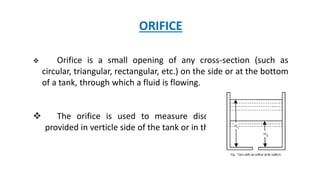
 Orifice is a small opening of any cross-section (such as
circular, triangular, rectangular, etc.) on the side or at the bottom
of a tank, through which a fluid is flowing.
 The orifice is used to measure discharge. An orifice is
provided in verticle side of the tank or in the base.
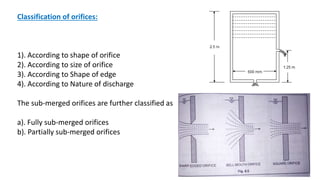
Classification of orifices:
1). According to shape of orifice
2). According to size of orifice
3). According to Shape of edge
4). According to Nature of discharge
The sub-merged orifices are further classified as
a). Fully sub-merged orifices
b). Partially sub-merged orifices
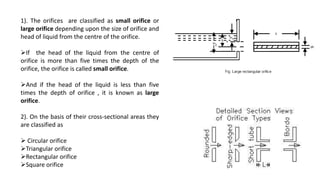
1). The orifices are classified as small orifice or
large orifice depending upon the size of orifice and
head of liquid from the centre of the orifice.
If the head of the liquid from the centre of
orifice is more than five times the depth of the
orifice, the orifice is called small orifice.
And if the head of the liquid is less than five
times the depth of orifice , it is known as large
orifice.
2). On the basis of their cross-sectional areas they
are classified as
 Circular orifice
Triangular orifice
Rectangular orifice
Square orifice
SUBMERGED ORIFICE
• A submerged orifice and the same orifice discharging freely have nearly the same
coefficient of discharge.
• Submerging an orifice provides the capability to measure relatively large flows
with a small drop in water surface, conserving delivery head compared with
weirs.
• However, the submerged orifice requires head measurements upstream and
downstream.
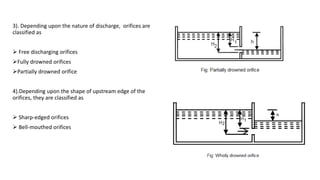
3). Depending upon the nature of discharge, orifices are
classified as
 Free discharging orifices
Fully drowned orifices
Partially drowned orifice
4).Depending upon the shape of upstream edge of the
orifices, they are classified as
 Sharp-edged orifices
 Bell-mouthed orifices
Working
Orifice meter is device used to determine the rate of flow through pipe.
It consist of flat circular plate which has a sharp edged circular hole called
orifice.
It is fixed concentric to pipe.
The orifice diameter is generally kept half of the diameter of the pipe.
It is based on the same principle as explained in venturimeter.
The value of Cd varies between 0.60 to 0.65.
It is a economical and less space is required for fitting.
Advantages of orifice meter
• Orifices are small plates and easy to install/remove.
• Offer very little pressure drop of which 60% to 65% is recovered.
• Orifice meter can be easily maintained.
• Measures a wide range of flow rates.
• They have a simple construction.
• They have easily fitted between flanges.
• They are most suitable for most gases and liquids.
• They are inexpensive.
• Price does not increase dramatically with size.
Disadvantages of orifice meter
• Requires homogeneous fluid.
• Requires single phase liquid.
• Requires axial velocity vector flow.
• Causes a pressure drop in fluid.
• Their accuracy is affected by density , pressure and viscosity fluid.
• Fluid viscosity limits measuring range.
• Requires straight pipe runs to ensure accuracy is maintained.
• Pipe line must be fully especially for liquid flow measurement.
• They have low range-ability.
MOUTHPIECES
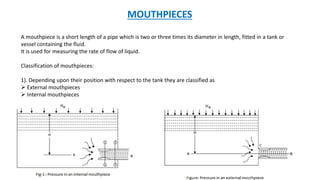
A mouthpiece is a short length of a pipe which is two or three times its diameter in length, fitted in a tank or
vessel containing the fluid.
It is used for measuring the rate of flow of liquid.
Classification of mouthpieces:
1). Depending upon their position with respect to the tank they are classified as
 External mouthpieces
 Internal mouthpieces
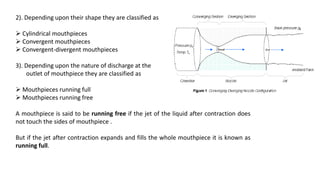
2). Depending upon their shape they are classified as
 Cylindrical mouthpieces
 Convergent mouthpieces
 Convergent-divergent mouthpieces
3). Depending upon the nature of discharge at the
outlet of mouthpiece they are classified as
 Mouthpieces running full
 Mouthpieces running free
A mouthpiece is said to be running free if the jet of the liquid after contraction does
not touch the sides of mouthpiece .
But if the jet after contraction expands and fills the whole mouthpiece it is known as
running full.
Types orifice and mouthpiece

Types orifice and mouthpiece

  • 2.
    Name:-PRAJAPATI TIRATH A. •BRANCH:-CIVIL (B) • ENROLLMENT NO:-151240106066 • SUBJECT:-FLUID MECHANICS(2130602) • TOPIC:-ORIFICE TYPES • Guided by:- VIKRAM PANCHAL
  • 3.
    ORIFICE  Orifice isa small opening of any cross-section (such as circular, triangular, rectangular, etc.) on the side or at the bottom of a tank, through which a fluid is flowing.  The orifice is used to measure discharge. An orifice is provided in verticle side of the tank or in the base.
  • 4.
    Classification of orifices: 1).According to shape of orifice 2). According to size of orifice 3). According to Shape of edge 4). According to Nature of discharge The sub-merged orifices are further classified as a). Fully sub-merged orifices b). Partially sub-merged orifices
  • 5.
    1). The orificesare classified as small orifice or large orifice depending upon the size of orifice and head of liquid from the centre of the orifice. If the head of the liquid from the centre of orifice is more than five times the depth of the orifice, the orifice is called small orifice. And if the head of the liquid is less than five times the depth of orifice , it is known as large orifice. 2). On the basis of their cross-sectional areas they are classified as  Circular orifice Triangular orifice Rectangular orifice Square orifice
  • 6.
    SUBMERGED ORIFICE • Asubmerged orifice and the same orifice discharging freely have nearly the same coefficient of discharge. • Submerging an orifice provides the capability to measure relatively large flows with a small drop in water surface, conserving delivery head compared with weirs. • However, the submerged orifice requires head measurements upstream and downstream.
  • 7.
    3). Depending uponthe nature of discharge, orifices are classified as  Free discharging orifices Fully drowned orifices Partially drowned orifice 4).Depending upon the shape of upstream edge of the orifices, they are classified as  Sharp-edged orifices  Bell-mouthed orifices
  • 8.
    Working Orifice meter isdevice used to determine the rate of flow through pipe. It consist of flat circular plate which has a sharp edged circular hole called orifice. It is fixed concentric to pipe. The orifice diameter is generally kept half of the diameter of the pipe. It is based on the same principle as explained in venturimeter. The value of Cd varies between 0.60 to 0.65. It is a economical and less space is required for fitting.
  • 9.
    Advantages of orificemeter • Orifices are small plates and easy to install/remove. • Offer very little pressure drop of which 60% to 65% is recovered. • Orifice meter can be easily maintained. • Measures a wide range of flow rates. • They have a simple construction. • They have easily fitted between flanges. • They are most suitable for most gases and liquids. • They are inexpensive. • Price does not increase dramatically with size.
  • 10.
    Disadvantages of orificemeter • Requires homogeneous fluid. • Requires single phase liquid. • Requires axial velocity vector flow. • Causes a pressure drop in fluid. • Their accuracy is affected by density , pressure and viscosity fluid. • Fluid viscosity limits measuring range. • Requires straight pipe runs to ensure accuracy is maintained. • Pipe line must be fully especially for liquid flow measurement. • They have low range-ability.
  • 11.
    MOUTHPIECES A mouthpiece isa short length of a pipe which is two or three times its diameter in length, fitted in a tank or vessel containing the fluid. It is used for measuring the rate of flow of liquid. Classification of mouthpieces: 1). Depending upon their position with respect to the tank they are classified as  External mouthpieces  Internal mouthpieces
  • 12.
    2). Depending upontheir shape they are classified as  Cylindrical mouthpieces  Convergent mouthpieces  Convergent-divergent mouthpieces 3). Depending upon the nature of discharge at the outlet of mouthpiece they are classified as  Mouthpieces running full  Mouthpieces running free A mouthpiece is said to be running free if the jet of the liquid after contraction does not touch the sides of mouthpiece . But if the jet after contraction expands and fills the whole mouthpiece it is known as running full.