SHREE SA’D VIDYA MANDAL
INSTITUTE OF TECHNOLOGY
DEPARTMENT OF CIVIL
ENGINEERING
Subject:-
Fluid
Mechanics
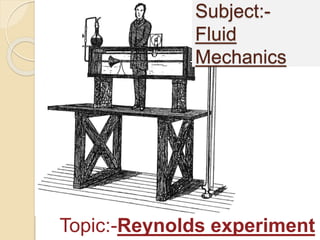
Topic:-Reynolds experiment
-:PRESENTED BY:-
Name
 Arvindsai
 Dhaval
 Fahim Patel
 Navazhushen Patel
 M.Asfak Patel
Enrollment no.
130454106002
130454106001
140453106005
140453106008
140453106007
INTRODUCTION
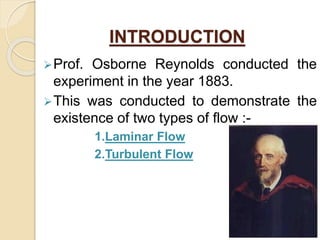
Prof. Osborne Reynolds conducted the
experiment in the year 1883.
This was conducted to demonstrate the
existence of two types of flow :-
1.Laminar Flow
2.Turbulent Flow
1.Laminar Flow:-
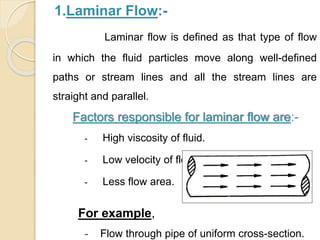
Laminar flow is defined as that type of flow
in which the fluid particles move along well-defined
paths or stream lines and all the stream lines are
straight and parallel.
Factors responsible for laminar flow are:-
- High viscosity of fluid.
- Low velocity of flow.
- Less flow area.
For example,
‐ Flow through pipe of uniform cross-section.
2.Turbulent Flow:-
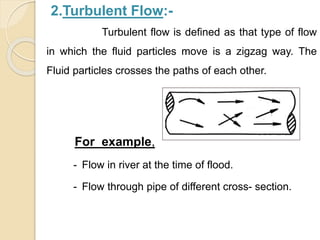
Turbulent flow is defined as that type of flow
in which the fluid particles move is a zigzag way. The
Fluid particles crosses the paths of each other.
For example,
- Flow in river at the time of flood.
- Flow through pipe of different cross- section.
What is Reynolds Number ?
 The ratio of inertia force to viscous force
is said to be the Reynolds number (RN).
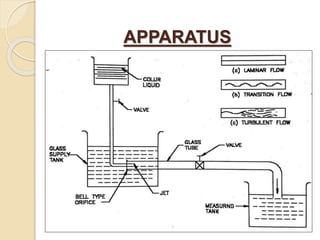
APPARATUS
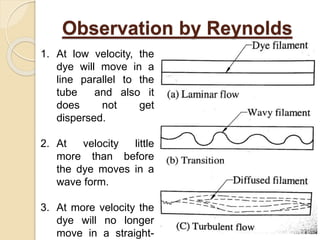
Observation by Reynolds
1. At low velocity, the
dye will move in a
line parallel to the
tube and also it
does not get
dispersed.
2. At velocity little
more than before
the dye moves in a
wave form.
3. At more velocity the
dye will no longer
move in a straight-
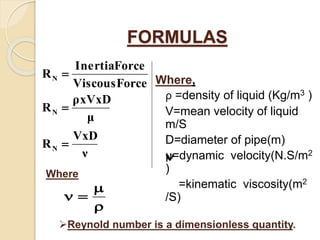
FORMULAS
Where,
ρ =density of liquid (Kg/m3 )
V=mean velocity of liquid
m/S
D=diameter of pipe(m)
µ=dynamic velocity(N.S/m2
)
=kinematic viscosity(m2
/S)
Where
Reynold number is a dimensionless quantity.
ν
VxD
R
μ
ρxVxD
R
ForceViscous
ForceInertia
R
N
N
N







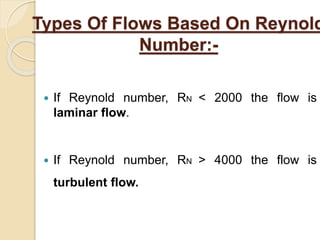
Types Of Flows Based On Reynold
Number:-
 If Reynold number, RN < 2000 the flow is
laminar flow.
 If Reynold number, RN > 4000 the flow is
turbulent flow.
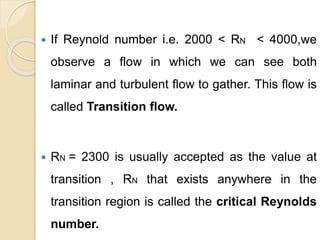
 If Reynold number i.e. 2000 < RN < 4000,we
observe a flow in which we can see both
laminar and turbulent flow to gather. This flow is
called Transition flow.
 RN = 2300 is usually accepted as the value at
transition , RN that exists anywhere in the
transition region is called the critical Reynolds
number.
EXAMPLE
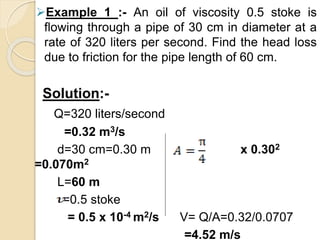
Example 1 :- An oil of viscosity 0.5 stoke is
flowing through a pipe of 30 cm in diameter at a
rate of 320 liters per second. Find the head loss
due to friction for the pipe length of 60 cm.
Solution:-
Q=320 liters/second
=0.32 m3/s
d=30 cm=0.30 m x 0.302
=0.070m2
L=60 m
=0.5 stoke
= 0.5 x 10⁻⁴ m2/s V= Q/A=0.32/0.0707
=4.52 m/s
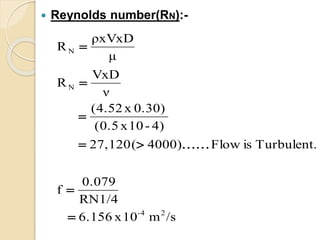
 Reynolds number(RN):-
/sm10x6.156
RN1/4
0.079
f
Turbulent.isFlow4000)(27,120
4)-10x(0.5
0.30)x(4.52
ν
VxD
R
μ
ρxVxD
R
24-
N
N






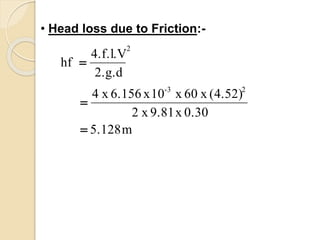
• Head loss due to Friction:-
m5.128
0.30x9.81x2
(4.52)x60x10x6.156x4
2.g.d
4.f.l.V
hf
23-
2



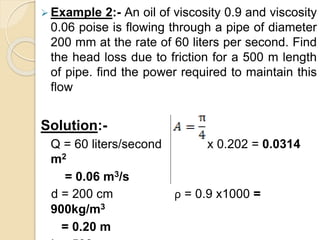
 Example 2:- An oil of viscosity 0.9 and viscosity
0.06 poise is flowing through a pipe of diameter
200 mm at the rate of 60 liters per second. Find
the head loss due to friction for a 500 m length
of pipe. find the power required to maintain this
flow
Solution:-
Q = 60 liters/second x 0.202 = 0.0314
m2
= 0.06 m3/s
d = 200 cm ρ = 0.9 x1000 =
900kg/m3
= 0.20 m
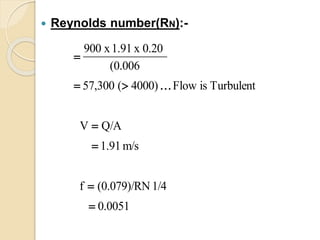
 Reynolds number(RN):-
0.0051
1/4(0.079)/RNf
m/s1.91
Q/AV
TurbulentisFlow4000)(57,300
(0.006
0.20x1.91x900






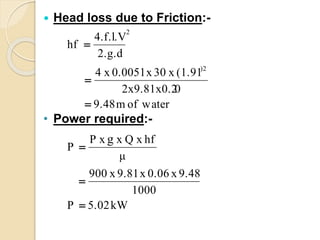
 Head loss due to Friction:-
• Power required:-
kW5.02P
1000
9.48x0.06x9.81x900
μ
hfxQxxP
P
waterofm9.48
02x9.81x0.2
(1.91x30x0.0051x4
2.g.d
4.f.l.V
hf
g
)2
2






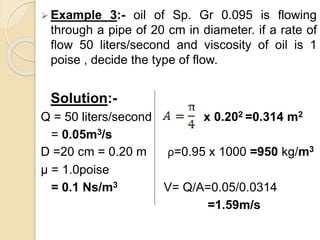
 Example 3:- oil of Sp. Gr 0.095 is flowing
through a pipe of 20 cm in diameter. if a rate of
flow 50 liters/second and viscosity of oil is 1
poise , decide the type of flow.
Solution:-
Q = 50 liters/second x 0.202 =0.314 m2
= 0.05m3/s
D =20 cm = 0.20 m ρ=0.95 x 1000 =950 kg/m3
µ = 1.0poise
= 0.1 Ns/m3 V= Q/A=0.05/0.0314
=1.59m/s
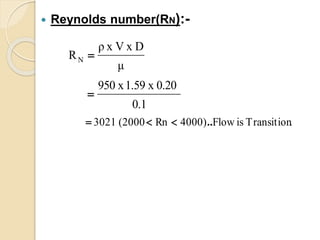
 Reynolds number(RN):-
.TransitionisFlow4000)Rn(20003021
0.1
0.20x1.59x950
μ
DxVxρ
RN
..


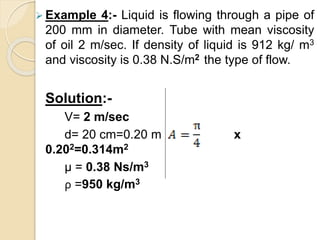
 Example 4:- Liquid is flowing through a pipe of
200 mm in diameter. Tube with mean viscosity
of oil 2 m/sec. If density of liquid is 912 kg/ m3
and viscosity is 0.38 N.S/m2 the type of flow.
Solution:-
V= 2 m/sec
d= 20 cm=0.20 m x
0.202=0.314m2
µ = 0.38 Ns/m3
ρ =950 kg/m3
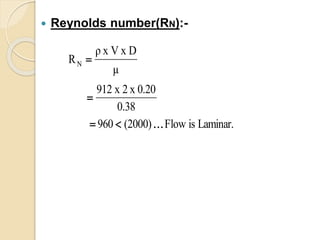
 Reynolds number(RN):-
Laminar.isFlow(2000)960
0.38
0.20x2x912
μ
DxVxρ
RN



Reynold number (Fluid Mechanics)(FM)

Reynold number (Fluid Mechanics)(FM)