Fiscal Policy
Introduction to Fiscal Policy
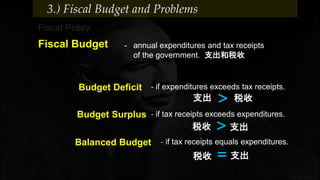
3.) Fiscal Budget and Problems
1.) Goals and Types of Fiscal Policy
2.) How Fiscal Policy is Done
4.) Fiscal Policy Limitations
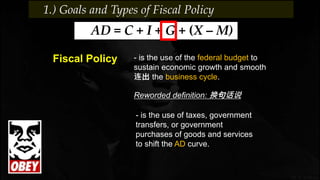
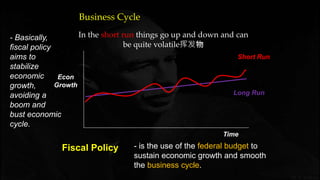
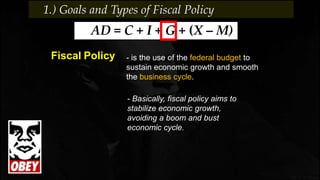
- is the use of the federal budget to
sustain economic growth and smooth
连出 the business cycle.
Fiscal Policy
AD = C + I + G + (X – M)
- is the use of taxes, government
transfers, or government
purchases of goods and services
to shift the AD curve.
Reworded definition: 换句话说
1.) Goals and Types of Fiscal Policy
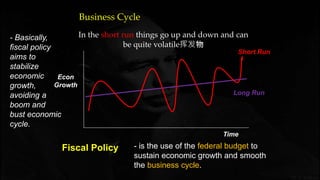
Time
Long Run
Short Run
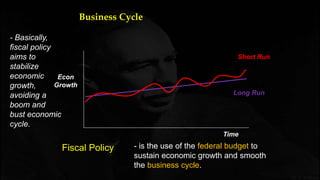
In the short run things go up and down and can
be quite volatile挥发物
Business Cycle
Econ
Growth
- is the use of the federal budget to
sustain economic growth and smooth
the business cycle.
Fiscal Policy
- Basically,
fiscal policy
aims to
stabilize
economic
growth,
avoiding a
boom and
bust economic
cycle.
Time
Long Run
Short Run
In the short run things go up and down and can
be quite volatile挥发物
Business Cycle
Econ
Growth
- is the use of the federal budget to
sustain economic growth and smooth
the business cycle.
Fiscal Policy
- Basically,
fiscal policy
aims to
stabilize
economic
growth,
avoiding a
boom and
bust economic
cycle.
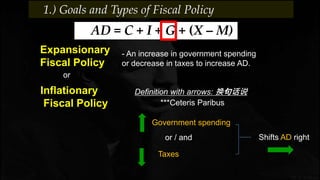
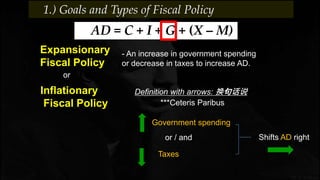
- An increase in government spending
or decrease in taxes to increase AD.
Expansionary
Fiscal Policy
AD = C + I + G + (X – M)
Inflationary
Fiscal Policy
or
Government spending
Taxes
***Ceteris Paribus
Definition with arrows: 换句话说
Shifts AD rightor / and
1.) Goals and Types of Fiscal Policy
AD = C + I + G + (X – M)
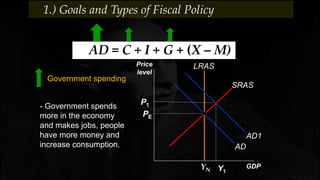
Government spending
Price
level
GDP
AD
SRAS
PE
LRAS
YN Y1
P1
AD1
1.) Goals and Types of Fiscal Policy
- Government spends
more in the economy
and makes jobs, people
have more money and
increase consumption.
AD = C + I + G + (X – M)
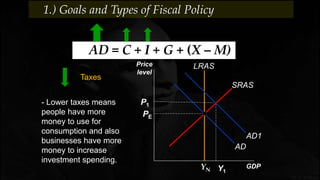
Taxes
Price
level
GDP
AD
SRAS
PE
LRAS
YN Y1
P1
AD1
1.) Goals and Types of Fiscal Policy
- Lower taxes means
people have more
money to use for
consumption and also
businesses have more
money to increase
investment spending.
AD = C + I + G + (X – M)
or
Government spending
Taxes
***Ceteris Paribus
Definition with arrows: 换句话说
Shifts AD rightor / and
1.) Goals and Types of Fiscal Policy
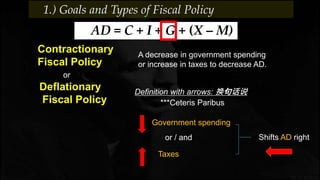
Contractionary
Fiscal Policy
Deflationary
Fiscal Policy
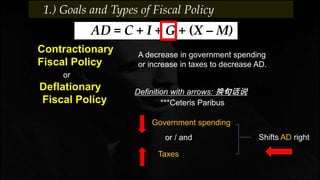
A decrease in government spending
or increase in taxes to decrease AD.
Time
Long Run
Short Run
Econ
Growth
- is the use of the federal budget to
sustain economic growth and smooth
the business cycle.
Fiscal Policy
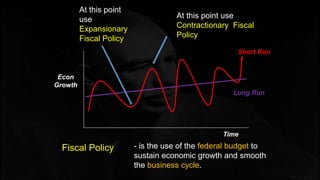
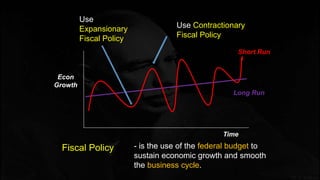
At this point use
Contractionary Fiscal
Policy
At this point
use
Expansionary
Fiscal Policy
Time
Long Run
Short Run
Business Cycle
Econ
Growth
- is the use of the federal budget to
sustain economic growth and smooth
the business cycle.
Fiscal Policy
- Basically,
fiscal policy
aims to
stabilize
economic
growth,
avoiding a
boom and
bust economic
cycle.
Introduction to Fiscal Policy
3.) Fiscal Budget and Problems
1.) Goals and Types of Fiscal Policy
2.) How Fiscal Policy is Done
4.) Fiscal Policy Limitations
2.) How Fiscal Policy is Done
Automatic
Stabilizers
Discretionary
Fiscal Policy
Two ways the policy is implemented. Either
automatically without having to change policy or
by the direct change by lawmakers in response to
economic changes.
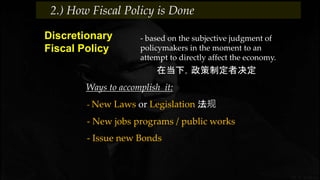
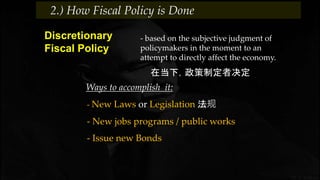
- based on the subjective judgment of
policymakers in the moment to an
attempt to directly affect the economy.
Discretionary
Fiscal Policy
在当下,政策制定者决定
Ways to accomplish it:
- New Laws or Legislation 法规
2.) How Fiscal Policy is Done
- New jobs programs / public works
- Issue new Bonds
Ways to accomplish it:
2.) How Fiscal Policy is Done
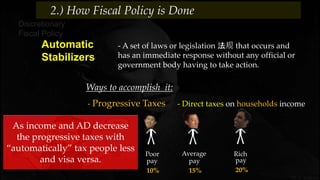
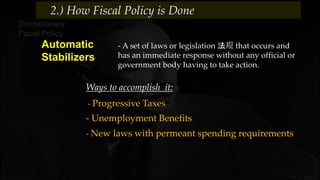
- A set of laws or legislation 法规 that occurs and
has an immediate response without any official or
government body having to take action.
Discretionary
Fiscal Policy
Automatic
Stabilizers
- Progressive Taxes - Direct taxes on households income
Poor RichAverage
pay
10%
pay
15%
pay
20%
As income and AD decrease
the progressive taxes with
“automatically” tax people less
and visa versa.
16
Types of Taxes
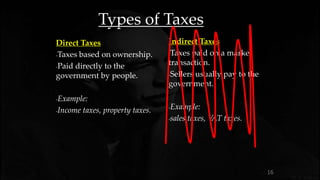
Direct Taxes
-Taxes based on ownership.
-Paid directly to the
government by people.
-Example:
-Income taxes, property taxes.
Indirect Taxes
-Taxes paid on a market
transaction.
-Sellers usually pay to the
government.
-Example:
-sales taxes, VAT taxes.
Ways to accomplish it:
2.) How Fiscal Policy is Done
- A set of laws or legislation 法规 that occurs and
has an immediate response without any official or
government body having to take action.
Discretionary
Fiscal Policy
Automatic
Stabilizers
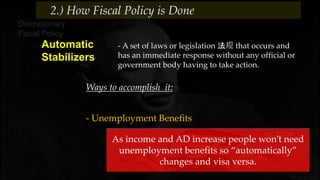
- Unemployment Benefits
As income and AD increase people won’t need
unemployment benefits so “automatically”
changes and visa versa.
Ways to accomplish it:
2.) How Fiscal Policy is Done
- A set of laws or legislation 法规 that occurs and
has an immediate response without any official or
government body having to take action.
Discretionary
Fiscal Policy
Automatic
Stabilizers
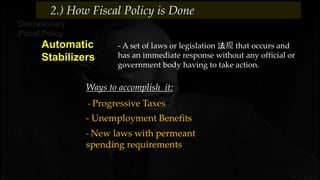
- Progressive Taxes
- Unemployment Benefits
- New laws with permeant
spending requirements
Introduction to Fiscal Policy
3.) Fiscal Budget and Problems
1.) Goals and Types of Fiscal Policy
2.) How Fiscal Policy is Done
4.) Fiscal Policy Limitations
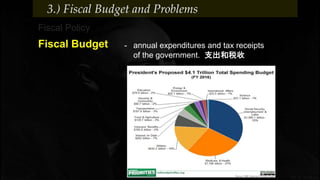
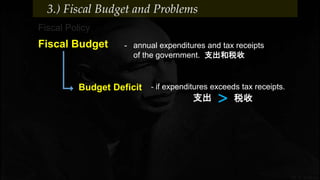
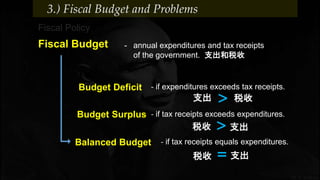
- annual expenditures and tax receipts
of the government. 支出和税收
Fiscal Policy
Fiscal Budget
3.) Fiscal Budget and Problems
- annual expenditures and tax receipts
of the government. 支出和税收
Fiscal Policy
Fiscal Budget
3.) Fiscal Budget and Problems
- if expenditures exceeds tax receipts.Budget Deficit
支出 税收>
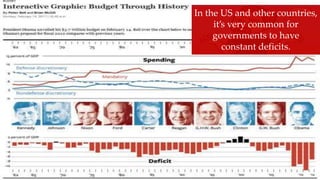
In the US and other countries,
it’s very common for
governments to have
constant deficits.
- annual expenditures and tax receipts
of the government. 支出和税收
Fiscal Policy
Fiscal Budget
3.) Fiscal Budget and Problems
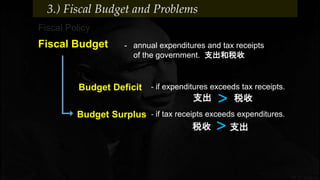
- if expenditures exceeds tax receipts.Budget Deficit
支出 税收>
- if tax receipts exceeds expenditures.Budget Surplus
支出税收 >
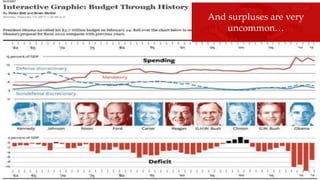
And surpluses are very
uncommon…
- annual expenditures and tax receipts
of the government. 支出和税收
Fiscal Policy
Fiscal Budget
3.) Fiscal Budget and Problems
- if expenditures exceeds tax receipts.Budget Deficit
支出 税收>
- if tax receipts exceeds expenditures.Budget Surplus
支出税收 >
Balanced Budget - if tax receipts equals expenditures.
支出税收 =
Insert a
Government
Balance Budget
graph here
Ha Ha! I can’t find a picture
for this, it almost never
happens!
Fiscal Budget
3.) Fiscal Budget and Problems
Budget Deficit vs. Budget Surplus
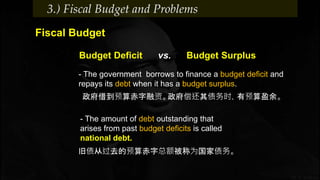
- The government borrows to finance a budget deficit and
repays its debt when it has a budget surplus.
政府借到预算赤字融资。政府偿还其债务时,有预算盈余。
- The amount of debt outstanding that
arises from past budget deficits is called
national debt.
旧债从过去的预算赤字总额被称为国家债务。
Introduction to Fiscal Policy
3.) Fiscal Budget and Problems
1.) Goals and Types of Fiscal Policy
2.) How Fiscal Policy is Done
4.) Fiscal Policy Limitations
3.1) Budget Deficit Problems
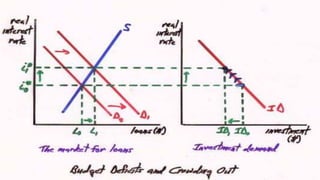
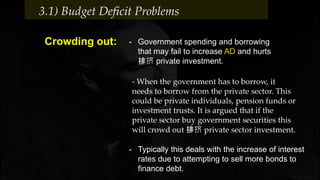
Crowding out: - Government spending and borrowing
that may fail to increase AD and hurts
排挤 private investment.
- When the government has to borrow, it
needs to borrow from the private sector. This
could be private individuals, pension funds or
investment trusts. It is argued that if the
private sector buy government securities this
will crowd out 排挤 private sector investment.
- Typically this deals with the increase of interest
rates due to attempting to sell more bonds to
finance debt.
3.1) Budget Deficit Problems
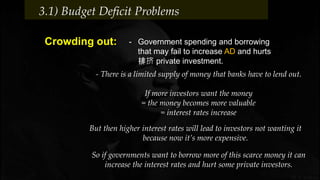
Crowding out: - Government spending and borrowing
that may fail to increase AD and hurts
排挤 private investment.
- There is a limited supply of money that banks have to lend out.
If more investors want the money
= the money becomes more valuable
= interest rates increase
But then higher interest rates will lead to investors not wanting it
because now it’s more expensive.
So if governments want to borrow more of this scarce money it can
increase the interest rates and hurt some private investors.
3.1) Budget Deficit Problems
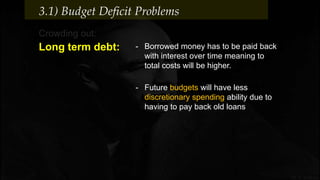
Long term debt: - Borrowed money has to be paid back
with interest over time meaning to
total costs will be higher.
- Future budgets will have less
discretionary spending ability due to
having to pay back old loans
Crowding out:
Introduction to Fiscal Policy
3.) Fiscal Budget and Problems
1.) Goals and Types of Fiscal Policy
2.) How Fiscal Policy is Done
4.) Fiscal Policy Limitations
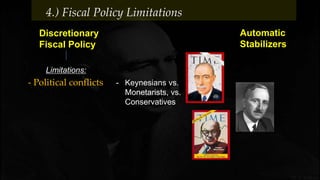
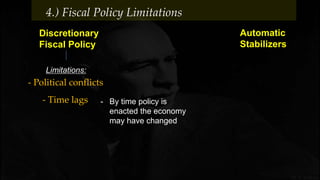
Discretionary
Fiscal Policy
Limitations:
- Political conflicts - Keynesians vs.
Monetarists, vs.
Conservatives
Automatic
Stabilizers
4.) Fiscal Policy Limitations
Remember short run ideas…
versus long run ideas…
Discretionary
Fiscal Policy
Limitations:
- Political conflicts
Automatic
Stabilizers
4.) Fiscal Policy Limitations
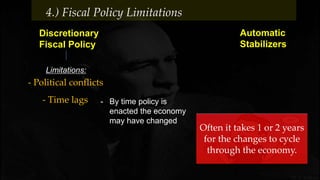
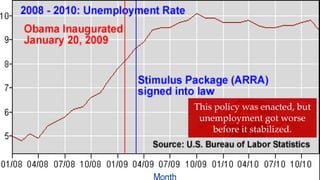
- By time policy is
enacted the economy
may have changed
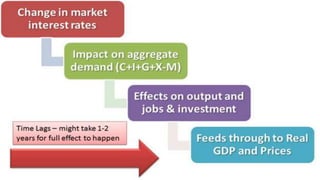
- Time lags
Often it takes 1 or 2 years
for the changes to cycle
through the economy.
This policy was enacted, but
unemployment got worse
before it stabilized.
Discretionary
Fiscal Policy
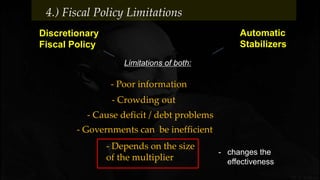
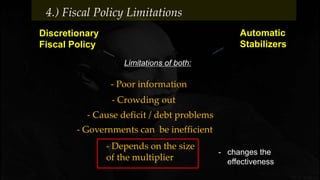
Limitations of both:
Automatic
Stabilizers
4.) Fiscal Policy Limitations
- Poor information
- Crowding out
- Cause deficit / debt problems
- Governments can be inefficient
- changes the
effectiveness
- Depends on the size
of the multiplier
So to summarize…..
- is the use of the federal budget to
sustain economic growth and smooth
the business cycle.
Fiscal Policy
AD = C + I + G + (X – M)
- Basically, fiscal policy aims to
stabilize economic growth,
avoiding a boom and bust
economic cycle.
1.) Goals and Types of Fiscal Policy
- An increase in government spending
or decrease in taxes to increase AD.
Expansionary
Fiscal Policy
AD = C + I + G + (X – M)
Inflationary
Fiscal Policy
or
Government spending
Taxes
***Ceteris Paribus
Definition with arrows: 换句话说
Shifts AD rightor / and
1.) Goals and Types of Fiscal Policy
AD = C + I + G + (X – M)
or
Government spending
Taxes
***Ceteris Paribus
Definition with arrows: 换句话说
Shifts AD rightor / and
1.) Goals and Types of Fiscal Policy
Contractionary
Fiscal Policy
Deflationary
Fiscal Policy
A decrease in government spending
or increase in taxes to decrease AD.
Time
Long Run
Short Run
Econ
Growth
- is the use of the federal budget to
sustain economic growth and smooth
the business cycle.
Fiscal Policy
Use Contractionary
Fiscal Policy
Use
Expansionary
Fiscal Policy
- based on the subjective judgment of
policymakers in the moment to an
attempt to directly affect the economy.
Discretionary
Fiscal Policy
在当下,政策制定者决定
Ways to accomplish it:
- New Laws or Legislation 法规
2.) How Fiscal Policy is Done
- New jobs programs / public works
- Issue new Bonds
Ways to accomplish it:
2.) How Fiscal Policy is Done
- A set of laws or legislation 法规 that occurs and
has an immediate response without any official or
government body having to take action.
Discretionary
Fiscal Policy
Automatic
Stabilizers
- Progressive Taxes
- Unemployment Benefits
- New laws with permeant spending requirements
- annual expenditures and tax receipts
of the government. 支出和税收
Fiscal Policy
Fiscal Budget
3.) Fiscal Budget and Problems
- if expenditures exceeds tax receipts.Budget Deficit
支出 税收>
- if tax receipts exceeds expenditures.Budget Surplus
支出税收 >
Balanced Budget - if tax receipts equals expenditures.
支出税收 =
Discretionary
Fiscal Policy
Limitations:
- Political conflicts
Automatic
Stabilizers
4.) Fiscal Policy Limitations
- By time policy is
enacted the economy
may have changed
- Time lags
Discretionary
Fiscal Policy
Limitations of both:
Automatic
Stabilizers
4.) Fiscal Policy Limitations
- Poor information
- Crowding out
- Cause deficit / debt problems
- Governments can be inefficient
- changes the
effectiveness
- Depends on the size
of the multiplier
The End – but don’t forget
the multiplier
Thanks 

Fiscal policy SFLS

  • 1.
  • 2.
    Introduction to FiscalPolicy 3.) Fiscal Budget and Problems 1.) Goals and Types of Fiscal Policy 2.) How Fiscal Policy is Done 4.) Fiscal Policy Limitations
  • 3.
    - is theuse of the federal budget to sustain economic growth and smooth 连出 the business cycle. Fiscal Policy AD = C + I + G + (X – M) - is the use of taxes, government transfers, or government purchases of goods and services to shift the AD curve. Reworded definition: 换句话说 1.) Goals and Types of Fiscal Policy
  • 4.
    Time Long Run Short Run Inthe short run things go up and down and can be quite volatile挥发物 Business Cycle Econ Growth - is the use of the federal budget to sustain economic growth and smooth the business cycle. Fiscal Policy - Basically, fiscal policy aims to stabilize economic growth, avoiding a boom and bust economic cycle.
  • 5.
    Time Long Run Short Run Inthe short run things go up and down and can be quite volatile挥发物 Business Cycle Econ Growth - is the use of the federal budget to sustain economic growth and smooth the business cycle. Fiscal Policy - Basically, fiscal policy aims to stabilize economic growth, avoiding a boom and bust economic cycle.
  • 6.
    - An increasein government spending or decrease in taxes to increase AD. Expansionary Fiscal Policy AD = C + I + G + (X – M) Inflationary Fiscal Policy or Government spending Taxes ***Ceteris Paribus Definition with arrows: 换句话说 Shifts AD rightor / and 1.) Goals and Types of Fiscal Policy
  • 7.
    AD = C+ I + G + (X – M) Government spending Price level GDP AD SRAS PE LRAS YN Y1 P1 AD1 1.) Goals and Types of Fiscal Policy - Government spends more in the economy and makes jobs, people have more money and increase consumption.
  • 8.
    AD = C+ I + G + (X – M) Taxes Price level GDP AD SRAS PE LRAS YN Y1 P1 AD1 1.) Goals and Types of Fiscal Policy - Lower taxes means people have more money to use for consumption and also businesses have more money to increase investment spending.
  • 9.
    AD = C+ I + G + (X – M) or Government spending Taxes ***Ceteris Paribus Definition with arrows: 换句话说 Shifts AD rightor / and 1.) Goals and Types of Fiscal Policy Contractionary Fiscal Policy Deflationary Fiscal Policy A decrease in government spending or increase in taxes to decrease AD.
  • 10.
    Time Long Run Short Run Econ Growth -is the use of the federal budget to sustain economic growth and smooth the business cycle. Fiscal Policy At this point use Contractionary Fiscal Policy At this point use Expansionary Fiscal Policy
  • 11.
    Time Long Run Short Run BusinessCycle Econ Growth - is the use of the federal budget to sustain economic growth and smooth the business cycle. Fiscal Policy - Basically, fiscal policy aims to stabilize economic growth, avoiding a boom and bust economic cycle.
  • 12.
    Introduction to FiscalPolicy 3.) Fiscal Budget and Problems 1.) Goals and Types of Fiscal Policy 2.) How Fiscal Policy is Done 4.) Fiscal Policy Limitations
  • 13.
    2.) How FiscalPolicy is Done Automatic Stabilizers Discretionary Fiscal Policy Two ways the policy is implemented. Either automatically without having to change policy or by the direct change by lawmakers in response to economic changes.
  • 14.
    - based onthe subjective judgment of policymakers in the moment to an attempt to directly affect the economy. Discretionary Fiscal Policy 在当下,政策制定者决定 Ways to accomplish it: - New Laws or Legislation 法规 2.) How Fiscal Policy is Done - New jobs programs / public works - Issue new Bonds
  • 15.
    Ways to accomplishit: 2.) How Fiscal Policy is Done - A set of laws or legislation 法规 that occurs and has an immediate response without any official or government body having to take action. Discretionary Fiscal Policy Automatic Stabilizers - Progressive Taxes - Direct taxes on households income Poor RichAverage pay 10% pay 15% pay 20% As income and AD decrease the progressive taxes with “automatically” tax people less and visa versa.
  • 16.
    16 Types of Taxes DirectTaxes -Taxes based on ownership. -Paid directly to the government by people. -Example: -Income taxes, property taxes. Indirect Taxes -Taxes paid on a market transaction. -Sellers usually pay to the government. -Example: -sales taxes, VAT taxes.
  • 17.
    Ways to accomplishit: 2.) How Fiscal Policy is Done - A set of laws or legislation 法规 that occurs and has an immediate response without any official or government body having to take action. Discretionary Fiscal Policy Automatic Stabilizers - Unemployment Benefits As income and AD increase people won’t need unemployment benefits so “automatically” changes and visa versa.
  • 18.
    Ways to accomplishit: 2.) How Fiscal Policy is Done - A set of laws or legislation 法规 that occurs and has an immediate response without any official or government body having to take action. Discretionary Fiscal Policy Automatic Stabilizers - Progressive Taxes - Unemployment Benefits - New laws with permeant spending requirements
  • 19.
    Introduction to FiscalPolicy 3.) Fiscal Budget and Problems 1.) Goals and Types of Fiscal Policy 2.) How Fiscal Policy is Done 4.) Fiscal Policy Limitations
  • 20.
    - annual expendituresand tax receipts of the government. 支出和税收 Fiscal Policy Fiscal Budget 3.) Fiscal Budget and Problems
  • 21.
    - annual expendituresand tax receipts of the government. 支出和税收 Fiscal Policy Fiscal Budget 3.) Fiscal Budget and Problems - if expenditures exceeds tax receipts.Budget Deficit 支出 税收>
  • 22.
    In the USand other countries, it’s very common for governments to have constant deficits.
  • 23.
    - annual expendituresand tax receipts of the government. 支出和税收 Fiscal Policy Fiscal Budget 3.) Fiscal Budget and Problems - if expenditures exceeds tax receipts.Budget Deficit 支出 税收> - if tax receipts exceeds expenditures.Budget Surplus 支出税收 >
  • 24.
    And surpluses arevery uncommon…
  • 25.
    - annual expendituresand tax receipts of the government. 支出和税收 Fiscal Policy Fiscal Budget 3.) Fiscal Budget and Problems - if expenditures exceeds tax receipts.Budget Deficit 支出 税收> - if tax receipts exceeds expenditures.Budget Surplus 支出税收 > Balanced Budget - if tax receipts equals expenditures. 支出税收 =
  • 26.
    Insert a Government Balance Budget graphhere Ha Ha! I can’t find a picture for this, it almost never happens!
  • 27.
    Fiscal Budget 3.) FiscalBudget and Problems Budget Deficit vs. Budget Surplus - The government borrows to finance a budget deficit and repays its debt when it has a budget surplus. 政府借到预算赤字融资。政府偿还其债务时,有预算盈余。 - The amount of debt outstanding that arises from past budget deficits is called national debt. 旧债从过去的预算赤字总额被称为国家债务。
  • 28.
    Introduction to FiscalPolicy 3.) Fiscal Budget and Problems 1.) Goals and Types of Fiscal Policy 2.) How Fiscal Policy is Done 4.) Fiscal Policy Limitations 3.1) Budget Deficit Problems
  • 29.
    3.1) Budget DeficitProblems Crowding out: - Government spending and borrowing that may fail to increase AD and hurts 排挤 private investment. - When the government has to borrow, it needs to borrow from the private sector. This could be private individuals, pension funds or investment trusts. It is argued that if the private sector buy government securities this will crowd out 排挤 private sector investment. - Typically this deals with the increase of interest rates due to attempting to sell more bonds to finance debt.
  • 30.
    3.1) Budget DeficitProblems Crowding out: - Government spending and borrowing that may fail to increase AD and hurts 排挤 private investment. - There is a limited supply of money that banks have to lend out. If more investors want the money = the money becomes more valuable = interest rates increase But then higher interest rates will lead to investors not wanting it because now it’s more expensive. So if governments want to borrow more of this scarce money it can increase the interest rates and hurt some private investors.
  • 32.
    3.1) Budget DeficitProblems Long term debt: - Borrowed money has to be paid back with interest over time meaning to total costs will be higher. - Future budgets will have less discretionary spending ability due to having to pay back old loans Crowding out:
  • 33.
    Introduction to FiscalPolicy 3.) Fiscal Budget and Problems 1.) Goals and Types of Fiscal Policy 2.) How Fiscal Policy is Done 4.) Fiscal Policy Limitations
  • 34.
    Discretionary Fiscal Policy Limitations: - Politicalconflicts - Keynesians vs. Monetarists, vs. Conservatives Automatic Stabilizers 4.) Fiscal Policy Limitations
  • 35.
  • 36.
  • 37.
    Discretionary Fiscal Policy Limitations: - Politicalconflicts Automatic Stabilizers 4.) Fiscal Policy Limitations - By time policy is enacted the economy may have changed - Time lags Often it takes 1 or 2 years for the changes to cycle through the economy.
  • 39.
    This policy wasenacted, but unemployment got worse before it stabilized.
  • 40.
    Discretionary Fiscal Policy Limitations ofboth: Automatic Stabilizers 4.) Fiscal Policy Limitations - Poor information - Crowding out - Cause deficit / debt problems - Governments can be inefficient - changes the effectiveness - Depends on the size of the multiplier
  • 41.
  • 42.
    - is theuse of the federal budget to sustain economic growth and smooth the business cycle. Fiscal Policy AD = C + I + G + (X – M) - Basically, fiscal policy aims to stabilize economic growth, avoiding a boom and bust economic cycle. 1.) Goals and Types of Fiscal Policy
  • 43.
    - An increasein government spending or decrease in taxes to increase AD. Expansionary Fiscal Policy AD = C + I + G + (X – M) Inflationary Fiscal Policy or Government spending Taxes ***Ceteris Paribus Definition with arrows: 换句话说 Shifts AD rightor / and 1.) Goals and Types of Fiscal Policy
  • 44.
    AD = C+ I + G + (X – M) or Government spending Taxes ***Ceteris Paribus Definition with arrows: 换句话说 Shifts AD rightor / and 1.) Goals and Types of Fiscal Policy Contractionary Fiscal Policy Deflationary Fiscal Policy A decrease in government spending or increase in taxes to decrease AD.
  • 45.
    Time Long Run Short Run Econ Growth -is the use of the federal budget to sustain economic growth and smooth the business cycle. Fiscal Policy Use Contractionary Fiscal Policy Use Expansionary Fiscal Policy
  • 46.
    - based onthe subjective judgment of policymakers in the moment to an attempt to directly affect the economy. Discretionary Fiscal Policy 在当下,政策制定者决定 Ways to accomplish it: - New Laws or Legislation 法规 2.) How Fiscal Policy is Done - New jobs programs / public works - Issue new Bonds
  • 47.
    Ways to accomplishit: 2.) How Fiscal Policy is Done - A set of laws or legislation 法规 that occurs and has an immediate response without any official or government body having to take action. Discretionary Fiscal Policy Automatic Stabilizers - Progressive Taxes - Unemployment Benefits - New laws with permeant spending requirements
  • 48.
    - annual expendituresand tax receipts of the government. 支出和税收 Fiscal Policy Fiscal Budget 3.) Fiscal Budget and Problems - if expenditures exceeds tax receipts.Budget Deficit 支出 税收> - if tax receipts exceeds expenditures.Budget Surplus 支出税收 > Balanced Budget - if tax receipts equals expenditures. 支出税收 =
  • 49.
    Discretionary Fiscal Policy Limitations: - Politicalconflicts Automatic Stabilizers 4.) Fiscal Policy Limitations - By time policy is enacted the economy may have changed - Time lags
  • 50.
    Discretionary Fiscal Policy Limitations ofboth: Automatic Stabilizers 4.) Fiscal Policy Limitations - Poor information - Crowding out - Cause deficit / debt problems - Governments can be inefficient - changes the effectiveness - Depends on the size of the multiplier
  • 51.
    The End –but don’t forget the multiplier Thanks 