GOVernment in the economy
Part I: The Effects of Fiscal Policy
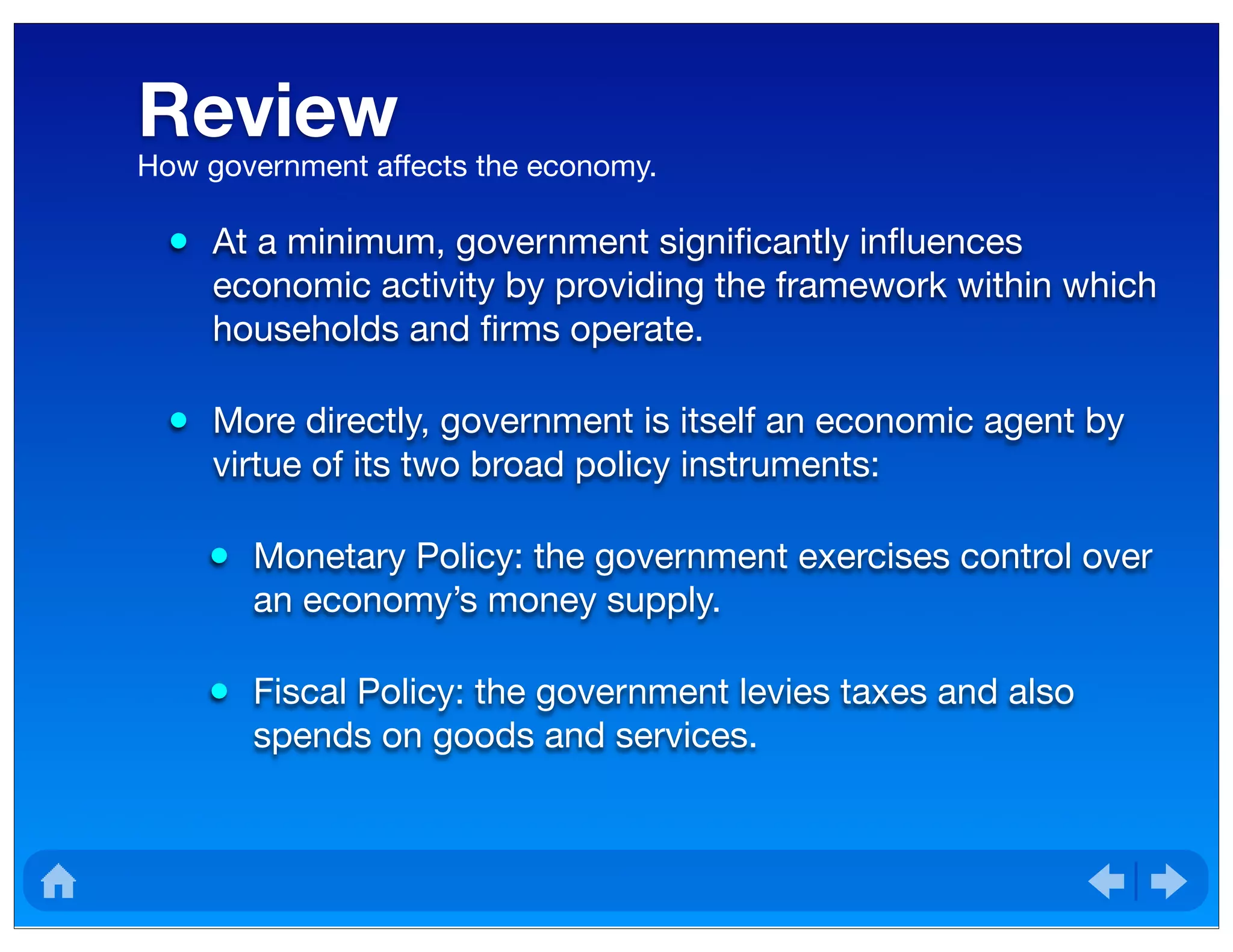
Review
• At a minimum, government significantly influences
economic activity by providing the framework within which
households and firms operate.
• More directly, government is itself an economic agent by
virtue of its two broad policy instruments:
• Monetary Policy: the government exercises control over
an economy’s money supply.
• Fiscal Policy: the government levies taxes and also
spends on goods and services.
How government affects the economy.
Taxation
• Taxes represent funds that have to be paid to the
government out of our income.
• This means that our incomes have to be divided not just
between savings and consumption, but taxes as well:
Y = C + S + T
• The taxes that government collects (T) are what finance
government expenditure (G).
• If G < T, the government is running a surplus.
• If G > T, the government is running a deficit.
• If G = T, we have a balanced budget.
Some insights into how taxes factor into economic analysis.
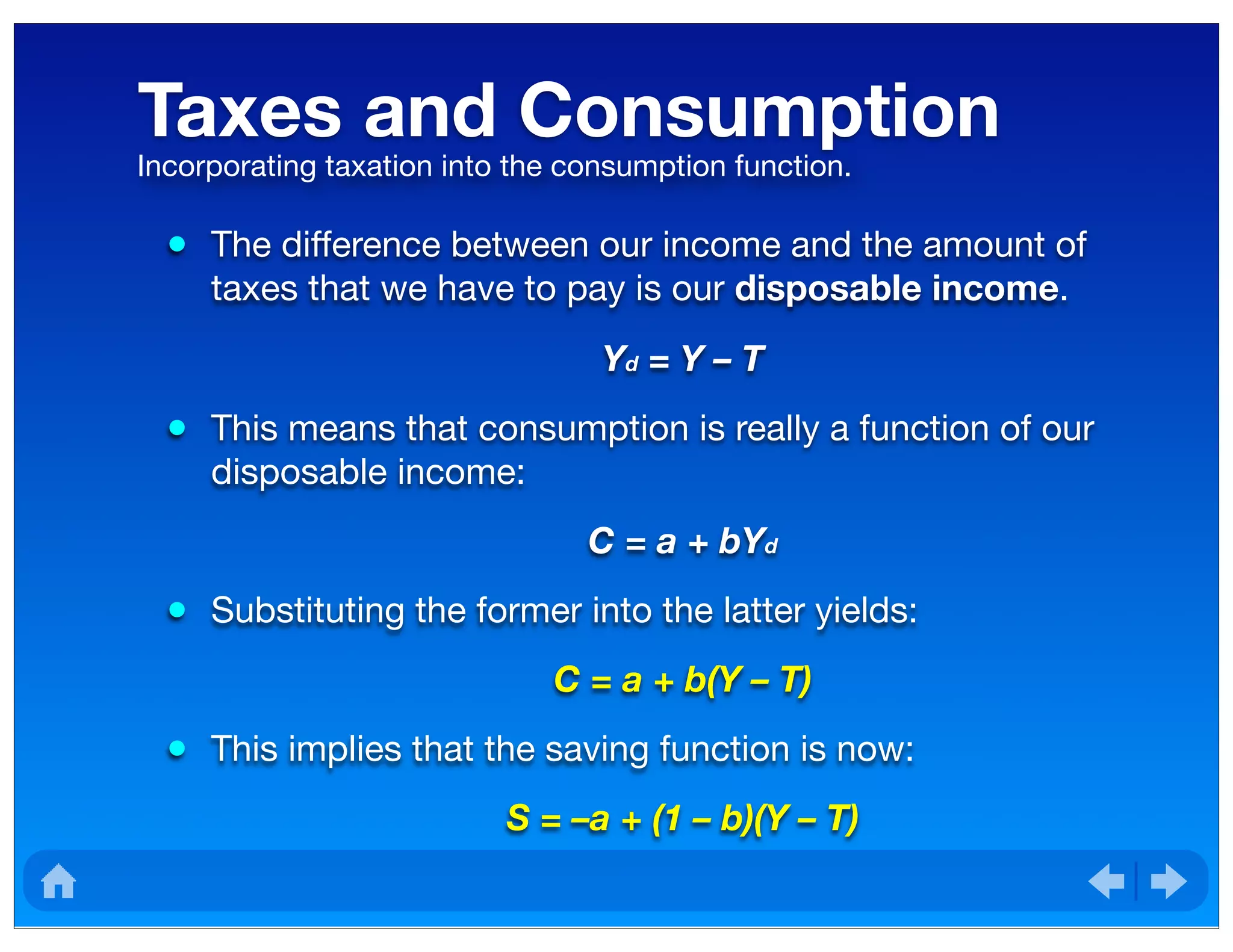
Taxes and Consumption
• The difference between our income and the amount of
taxes that we have to pay is our disposable income.
Yd = Y – T
• This means that consumption is really a function of our
disposable income:
C = a + bYd
• Substituting the former into the latter yields:
C = a + b(Y – T)
• This implies that the saving function is now:
S = –a + (1 – b)(Y – T)
Incorporating taxation into the consumption function.
Government Spending
• Consider: whether government spends or not does not
necessarily have anything to do with how the economy is
doing.
• Government projects can be undertaken for political
rather than economic reasons.
• Government can (hypothetically) spend whether or not it
has the necessary funds to finance its projects.
• If this is the case, we can consider government spending
as another autonomous variable.
Putting the “G” in Planned Aggregate Expenditure (i.e. C + I + G).
Output and Fiscal Policy
• A more complete model of planned aggregate expenditure:
AE = C + I + G
• Substituting:
AE = a + b (Y – T) + I + G
• The equilibrium condition:
Y = AE
• Thus (and rearranging):
Y = (a + I + G) + bY – bT
Putting it all together.
Output and Fiscal Policy
Putting it all together.
We have now derived the equilbrium condition:
Y = 1 ( a + I + G – bT)
1 – b
Consider:
Any change in government
spending changes equilibrium
output by:
Any change in taxation
changes equilibrium output by:
1 – b
1
1 – b
b
–
Output and Fiscal Policy
Putting it all together.
We have now derived the equilbrium condition:
Y = 1 ( a + I + G – bT)
1 – b
Consider:
Any change in government
spending changes equilibrium
output by:
Any change in taxation
changes equilibrium output by:
MPS
1
MPS
MPC
–
Output and Fiscal Policy
Putting it all together.
We have now derived the equilbrium condition:
Y = 1 ( a + I + G – bT)
1 – b
The Government
Spending Multiplier:
The Tax Multiplier:
MPS
1
MPS
MPC
–
Fiscal Stimuli
• Recessions represent a downturn in economic performance.
• Recall: they are defined as a decline in output over two
consecutive quarters.
• If ouput declines, it must mean that investments have
declined.
• Government spending can be an effective tool to offset
recessions.
Case 1: Recession
1
MPS
– ∆ I
1
MPS
∆ G
Decrease in Planned
Investments
Increase in Government
Spending
+ = 0
Fiscal Stimuli
• An economy may be said to be “overheating” when
economic performance leads to rapidly rising output and
income over a short interval.
• The immediate consequence of this is rising inflation and a
rising cost of living.
• Overheating is often kept in check by a commensurate
increase in taxes.
• Fiscal Drag: with rising incomes come rising tax revenue.
Case 2: “Overheating”
Fiscal Stimuli
Case 3: Balanced Budget Spending
∆ G = ∆ T
What would happen if the govenrment finances an
increase in expenditure by an equal increase in taxes?
From the multiplier:
The change in equilibrium output from a
change in taxes is given by:
MPS
MPC
– ∆ T
The change in equilibrium output from a
change in government spending is given by: MPS
1
∆ G
Fiscal Stimuli
Case 3: Balanced Budget Spending
The total change in output from “balanced budget spending”:
∆ Y =
MPS
MPC
– ∆ T
MPS
1
∆ G
Since ∆ G = ∆ T:
∆ Y =
MPS
MPC
– ∆ G
MPS
1
∆ G
Fiscal Stimuli
Case 3: Balanced Budget Spending
Simplifying:
∆ Y =
MPS
1 - MPC
∆ G
However, (1 – MPC) = MPS! Therefore:
∆ Y =
MPS
MPS
∆ G
∆ Y = ∆G

Macroeconomics: Fiscal Policy

  • 1.
    GOVernment in theeconomy Part I: The Effects of Fiscal Policy
  • 2.
    Review • At aminimum, government significantly influences economic activity by providing the framework within which households and firms operate. • More directly, government is itself an economic agent by virtue of its two broad policy instruments: • Monetary Policy: the government exercises control over an economy’s money supply. • Fiscal Policy: the government levies taxes and also spends on goods and services. How government affects the economy.
  • 3.
    Taxation • Taxes representfunds that have to be paid to the government out of our income. • This means that our incomes have to be divided not just between savings and consumption, but taxes as well: Y = C + S + T • The taxes that government collects (T) are what finance government expenditure (G). • If G < T, the government is running a surplus. • If G > T, the government is running a deficit. • If G = T, we have a balanced budget. Some insights into how taxes factor into economic analysis.
  • 4.
    Taxes and Consumption •The difference between our income and the amount of taxes that we have to pay is our disposable income. Yd = Y – T • This means that consumption is really a function of our disposable income: C = a + bYd • Substituting the former into the latter yields: C = a + b(Y – T) • This implies that the saving function is now: S = –a + (1 – b)(Y – T) Incorporating taxation into the consumption function.
  • 5.
    Government Spending • Consider:whether government spends or not does not necessarily have anything to do with how the economy is doing. • Government projects can be undertaken for political rather than economic reasons. • Government can (hypothetically) spend whether or not it has the necessary funds to finance its projects. • If this is the case, we can consider government spending as another autonomous variable. Putting the “G” in Planned Aggregate Expenditure (i.e. C + I + G).
  • 6.
    Output and FiscalPolicy • A more complete model of planned aggregate expenditure: AE = C + I + G • Substituting: AE = a + b (Y – T) + I + G • The equilibrium condition: Y = AE • Thus (and rearranging): Y = (a + I + G) + bY – bT Putting it all together.
  • 7.
    Output and FiscalPolicy Putting it all together. We have now derived the equilbrium condition: Y = 1 ( a + I + G – bT) 1 – b Consider: Any change in government spending changes equilibrium output by: Any change in taxation changes equilibrium output by: 1 – b 1 1 – b b –
  • 8.
    Output and FiscalPolicy Putting it all together. We have now derived the equilbrium condition: Y = 1 ( a + I + G – bT) 1 – b Consider: Any change in government spending changes equilibrium output by: Any change in taxation changes equilibrium output by: MPS 1 MPS MPC –
  • 9.
    Output and FiscalPolicy Putting it all together. We have now derived the equilbrium condition: Y = 1 ( a + I + G – bT) 1 – b The Government Spending Multiplier: The Tax Multiplier: MPS 1 MPS MPC –
  • 10.
    Fiscal Stimuli • Recessionsrepresent a downturn in economic performance. • Recall: they are defined as a decline in output over two consecutive quarters. • If ouput declines, it must mean that investments have declined. • Government spending can be an effective tool to offset recessions. Case 1: Recession 1 MPS – ∆ I 1 MPS ∆ G Decrease in Planned Investments Increase in Government Spending + = 0
  • 11.
    Fiscal Stimuli • Aneconomy may be said to be “overheating” when economic performance leads to rapidly rising output and income over a short interval. • The immediate consequence of this is rising inflation and a rising cost of living. • Overheating is often kept in check by a commensurate increase in taxes. • Fiscal Drag: with rising incomes come rising tax revenue. Case 2: “Overheating”
  • 12.
    Fiscal Stimuli Case 3:Balanced Budget Spending ∆ G = ∆ T What would happen if the govenrment finances an increase in expenditure by an equal increase in taxes? From the multiplier: The change in equilibrium output from a change in taxes is given by: MPS MPC – ∆ T The change in equilibrium output from a change in government spending is given by: MPS 1 ∆ G
  • 13.
    Fiscal Stimuli Case 3:Balanced Budget Spending The total change in output from “balanced budget spending”: ∆ Y = MPS MPC – ∆ T MPS 1 ∆ G Since ∆ G = ∆ T: ∆ Y = MPS MPC – ∆ G MPS 1 ∆ G
  • 14.
    Fiscal Stimuli Case 3:Balanced Budget Spending Simplifying: ∆ Y = MPS 1 - MPC ∆ G However, (1 – MPC) = MPS! Therefore: ∆ Y = MPS MPS ∆ G ∆ Y = ∆G