Balance of Payments
Part 3
5.) States of Equilibrium
Balance of Payments:
1.) Some Vocabulary
2.) The Accounts
3.) Balance between Accounts
4.) Balance between Countries
6.) Problems with Deficit/Surplus PPT 3
7.) Disequilibrium
Balance of Payments:
Goal:
The (typical) goal of (almost) every country is to
have a balanced trade. (usually)
The balance of payments is the way the measure
trade between countries and one of the main
components 部件 of measuring economies
generally.
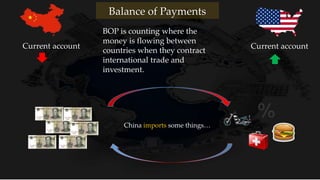
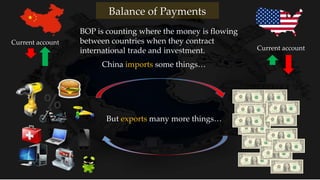
BOP is counting where the
money is flowing between
countries when they contract
international trade and
investment.
Current accountCurrent account
China imports some things…
Balance of Payments
BOP is counting where the money is flowing
between countries when they contract
international trade and investment. Current account
Current account
China imports some things…
But exports many more things…
Balance of Payments
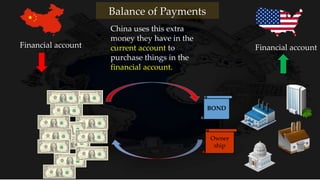
China uses this extra
money they have in the
current account to
purchase things in the
financial account.
Owner
ship
BOND
Financial accountFinancial account
Balance of Payments
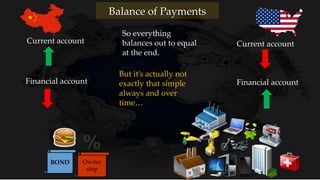
But it’s actually not
exactly that simple
always and over
time…
Current accountCurrent account
Owner
ship
BOND
Financial accountFinancial account
So everything
balances out to equal
at the end.
Balance of Payments
Balance of Payments
Is it a problem not to be balanced?
5.) States of Equilibrium
It very difficult, next to impossible for the actual accounts in real
life to equal zero.
- They do they don’t stay that way for long.
- The world never stops spinning.
There are three basic states the BOP can be in.
Balance of Payments
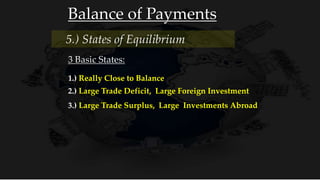
3 Basic States:
5.) States of Equilibrium
1.) Really Close to Balance
2.) Large Trade Deficit, Large Foreign Investment
3.) Large Trade Surplus, Large Investments Abroad
5.) States of Equilibrium
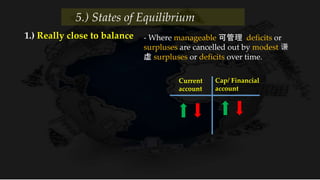
1.) Really close to balance
Current
account
Cap/ Financial
account
- Where manageable 可管理 deficits or
surpluses are cancelled out by modest 谦
虚 surpluses or deficits over time.
Time
Current
Account
0
Cap/Financial
Account
5.) States of Equilibrium
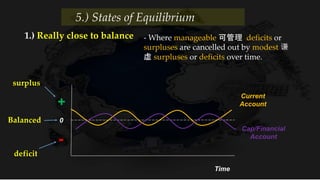
1.) Really close to balance - Where manageable 可管理 deficits or
surpluses are cancelled out by modest 谦
虚 surpluses or deficits over time.
+
-
surplus
deficit
Balanced
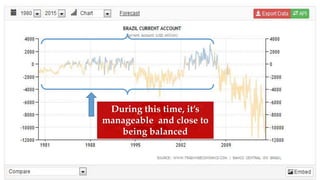
During this time, it’s
manageable and close to
being balanced
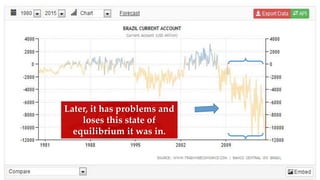
Later, it has problems and
loses this state of
equilibrium it was in.
5.) States of Equilibrium
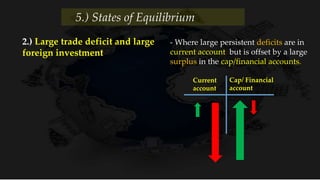
2.) Large trade deficit and large
foreign investment
Current
account
Cap/ Financial
account
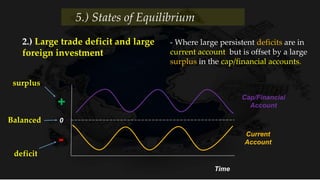
- Where large persistent deficits are in
current account but is offset by a large
surplus in the cap/financial accounts.
Time
Current
Account
0
Cap/Financial
Account
5.) States of Equilibrium
+
-
surplus
deficit
Balanced
2.) Large trade deficit and large
foreign investment
- Where large persistent deficits are in
current account but is offset by a large
surplus in the cap/financial accounts.
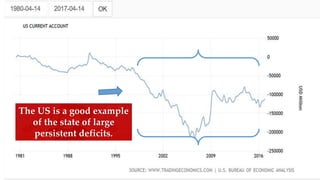
The US is a good example
of the state of large
persistent deficits.
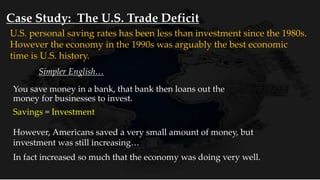
Case Study: The U.S. Trade Deficit
U.S. personal saving rates has been less than investment since the 1980s.
However the economy in the 1990s was arguably the best economic
time is U.S. history.
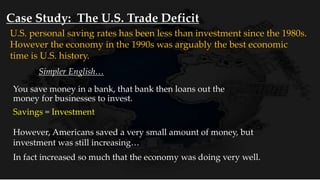
You save money in a bank, that bank then loans out the
money for businesses to invest.
Savings = Investment
However, Americans saved a very small amount of money, but
investment was still increasing…
In fact increased so much that the economy was doing very well.
Simpler English…
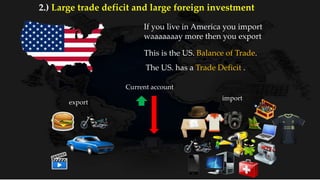
If you live in America you import
waaaaaaay more then you export
Current account
export
import
This is the US. Balance of Trade.
The US. has a Trade Deficit .
2.) Large trade deficit and large foreign investment
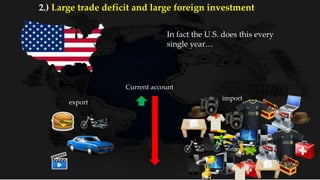
In fact the U.S. does this every
single year…
Current account
export
import
2.) Large trade deficit and large foreign investment
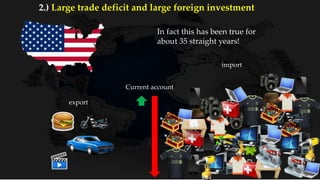
In fact this has been true for
about 35 straight years!
Current account
export
import
2.) Large trade deficit and large foreign investment
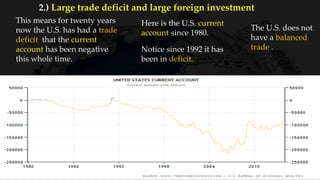
This means for twenty years
now the U.S. has had a trade
deficit that the current
account has been negative
this whole time.
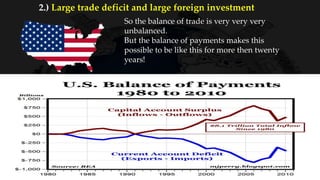
Here is the U.S. current
account since 1980.
Notice since 1992 it has
been in deficit.
The U.S. does not
have a balanced
trade .
2.) Large trade deficit and large foreign investment
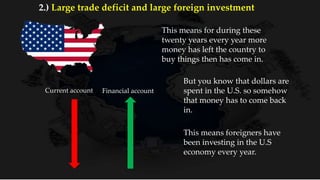
This means for during these
twenty years every year more
money has left the country to
buy things then has come in.
But you know that dollars are
spent in the U.S. so somehow
that money has to come back
in.
Current account Financial account
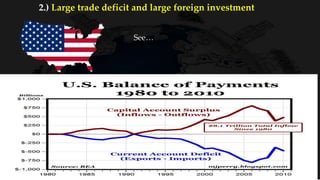
This means foreigners have
been investing in the U.S
economy every year.
2.) Large trade deficit and large foreign investment
See…
2.) Large trade deficit and large foreign investment
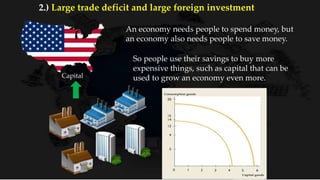
An economy needs people to spend money, but
an economy also needs people to save money.
So people use their savings to buy more
expensive things, such as capital that can be
used to grow an economy even more.Capital
2.) Large trade deficit and large foreign investment
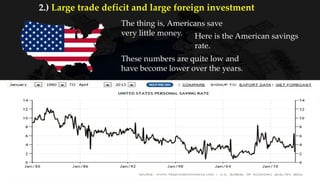
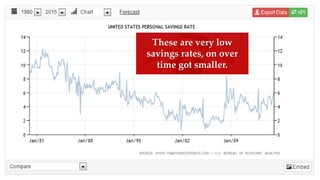
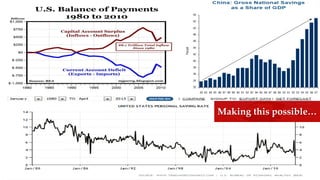
The thing is, Americans save
very little money. Here is the American savings
rate.
These numbers are quite low and
have become lower over the years.
2.) Large trade deficit and large foreign investment
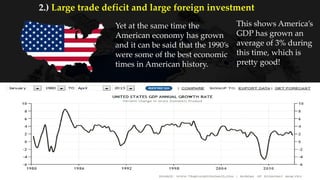
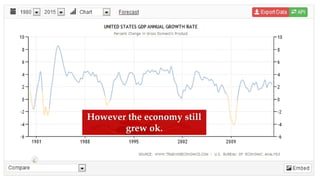
Yet at the same time the
American economy has grown
and it can be said that the 1990’s
were some of the best economic
times in American history.
This shows America’s
GDP has grown an
average of 3% during
this time, which is
pretty good!
2.) Large trade deficit and large foreign investment
Types of Equilibrium
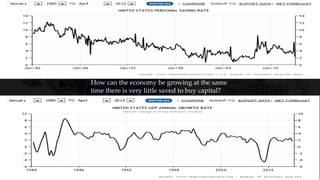
How can the economy be growing at the same
time there is very little saved to buy capital?
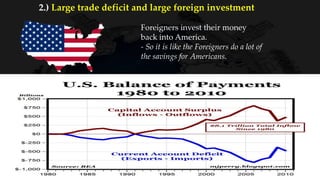
Foreigners invest their money
back into America.
- So it is like the Foreigners do a lot of
the savings for Americans.
2.) Large trade deficit and large foreign investment
So the balance of trade is very very very
unbalanced.
But the balance of payments makes this
possible to be like this for more then twenty
years!
2.) Large trade deficit and large foreign investment
Case Study: The U.S. Trade Deficit
U.S. personal saving rates has been less than investment since the 1980s.
However the economy in the 1990s was arguably the best economic
time is U.S. history.
You save money in a bank, that bank then loans out the
money for businesses to invest.
Savings = Investment
However, Americans saved a very small amount of money, but
investment was still increasing…
In fact increased so much that the economy was doing very well.
Simpler English…
These are very low
savings rates, on over
time got smaller.
However the economy still
grew ok.
Case Study: The U.S. Trade Deficit
Why U.S. saving has been less than
investment:
 In the 1980s and early 2000s,
huge government budget deficits and low private
saving by citizens reduced national saving.
 In the 1990s,
national saving increased as the economy grew,
but domestic investment increased even faster
due to the information technology boom.
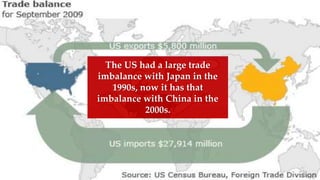
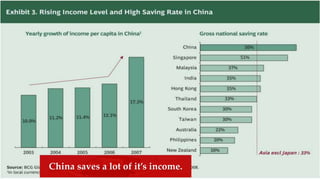
The US had a large trade
imbalance with Japan in the
1990s, now it has that
imbalance with China in the
2000s.
China saves a lot of it’s income.
Making this possible…
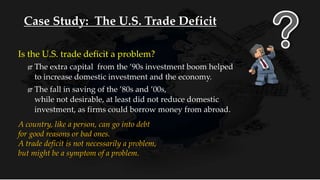
Is the U.S. trade deficit a problem?
 The extra capital from the ’90s investment boom helped
to increase domestic investment and the economy.
 The fall in saving of the ’80s and ’00s,
while not desirable, at least did not reduce domestic
investment, as firms could borrow money from abroad.
A country, like a person, can go into debt
for good reasons or bad ones.
A trade deficit is not necessarily a problem,
but might be a symptom of a problem.
Case Study: The U.S. Trade Deficit
5.) States of Equilibrium
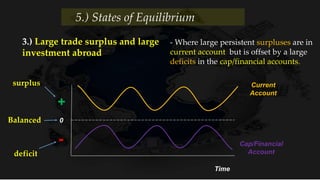
3.) Large trade surplus and large
investment abroad
Current
account
Cap/ Financial
account
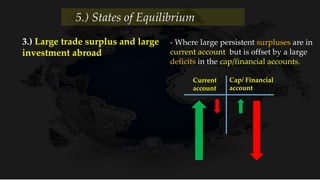
- Where large persistent surpluses are in
current account but is offset by a large
deficits in the cap/financial accounts.
Time
Current
Account
0
Cap/Financial
Account
+
-
surplus
deficit
Balanced
5.) States of Equilibrium
3.) Large trade surplus and large
investment abroad
- Where large persistent surpluses are in
current account but is offset by a large
deficits in the cap/financial accounts.
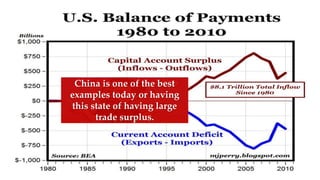
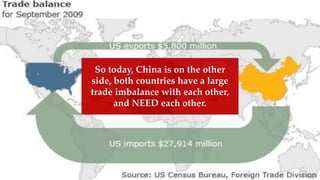
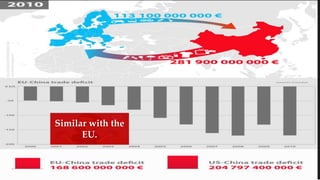
China is one of the best
examples today or having
this state of having large
trade surplus.
So today, China is on the other
side, both countries have a large
trade imbalance with each other,
and NEED each other.
Similar with the
EU.
5.) States of Equilibrium
Balance of Payments:
1.) Some Vocabulary
2.) The Accounts
3.) Balance between Accounts
4.) Balance between Countries
6.) Problems with Deficit/Surplus
7.) Disequilibrium
Balance of Payments
Is it a problem not to have a
balanced trade?
Balance of Trade
Is it a problem to have a current account
deficit?
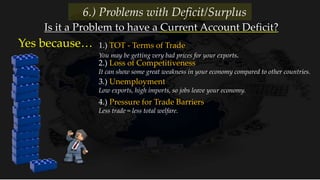
1.) TOT - Terms of Trade
You may be getting very bad prices for your exports.
Yes because…
Is it a Problem to have a Current Account Deficit?
6.) Problems with Deficit/Surplus
______________________
2.) Loss of Competitiveness
It can show some great weakness in your economy compared to other countries.
3.) Unemployment
Low exports, high imports, so jobs leave your economy.
4.) Pressure for Trade Barriers
Less trade = less total welfare.
Yes because…
Is it a Problem to have a Current Account Deficit?
6.) Problems with Deficit/Surplus
______________________
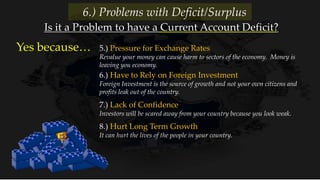
5.) Pressure for Exchange Rates
Revalue your money can cause harm to sectors of the economy. Money is
leaving you economy.
6.) Have to Rely on Foreign Investment
Foreign Investment is the source of growth and not your own citizens and
profits leak out of the country.
7.) Lack of Confidence
Investors will be scared away from your country because you look weak.
8.) Hurt Long Term Growth
It can hurt the lives of the people in your country.
Balance of Trade
Is it a problem to have a current account
deficit?
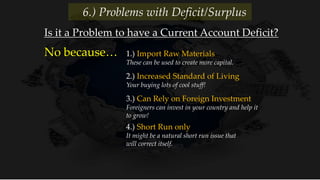
1.) Import Raw Materials
These can be used to create more capital.
No because…
Is it a Problem to have a Current Account Deficit?
6.) Problems with Deficit/Surplus
2.) Increased Standard of Living
Your buying lots of cool stuff!
3.) Can Rely on Foreign Investment
Foreigners can invest in your country and help it
to grow!
4.) Short Run only
It might be a natural short run issue that
will correct itself.
Balance of Trade
Is it a problem to have a current account
surplus?
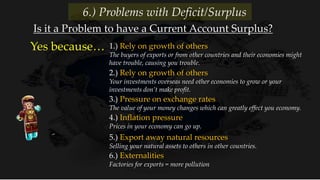
1.) Rely on growth of others
The buyers of exports or from other countries and their economies might
have trouble, causing you trouble.
Yes because…
Is it a Problem to have a Current Account Surplus?
6.) Problems with Deficit/Surplus
2.) Rely on growth of others
Your investments overseas need other economies to grow or your
investments don’t make profit.
3.) Pressure on exchange rates
The value of your money changes which can greatly effect you economy.
4.) Inflation pressure
Prices in your economy can go up.
5.) Export away natural resources
Selling your natural assets to others in other countries.
6.) Externalities
Factories for exports = more pollution
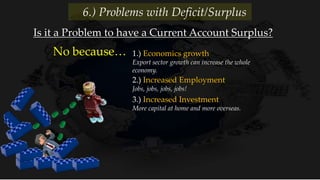
1.) Economics growth
Export sector growth can increase the whole
economy.
No because…
Is it a Problem to have a Current Account Surplus?
6.) Problems with Deficit/Surplus
2.) Increased Employment
Jobs, jobs, jobs, jobs!
3.) Increased Investment
More capital at home and more overseas.
Is it a problem not to have a
balanced trade?
So to summarize…
6.) Problems with Deficit/Surplus
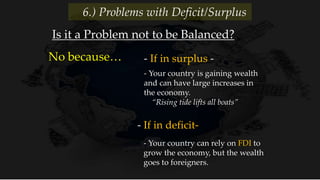
Is it a Problem not to be Balanced?
- Your country can rely on FDI to
grow the economy, but the wealth
goes to foreigners.
No because…
- Your country is gaining wealth
and can have large increases in
the economy.
“Rising tide lifts all boats”
- If in surplus -
- If in deficit-
6.) Problems with Deficit/Surplus
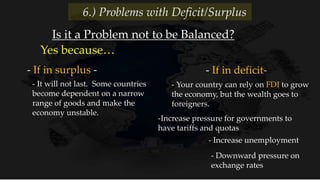
Yes because…
- If in surplus -
- It will not last. Some countries
become dependent on a narrow
range of goods and make the
economy unstable.
- Downward pressure on
exchange rates
-Increase pressure for governments to
have tariffs and quotas
- Increase unemployment
- If in deficit-
- Your country can rely on FDI to grow
the economy, but the wealth goes to
foreigners.
Is it a Problem not to be Balanced?
6.) Problems with Deficit/Surplus
5.) States of Equilibrium
Balance of Payments:
1.) Some Vocabulary
2.) The Accounts
3.) Balance between Accounts
4.) Balance between Countries
6.) Problems with Deficit/Surplus
7.) Disequilibrium
1.) Economic Disequilibrium
Structural - changes in some sectors of the
economy alter 更改 the demand
and supply forces influencing
exports and imports
7.) Disequilibrium
1.) Economic Disequilibrium
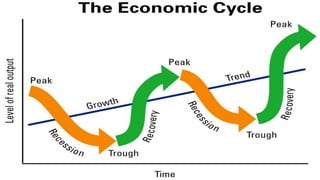
Cyclical - Patterns of income changes
with the business cycle.
ex.) agricultural output
Structural
7.) Disequilibrium
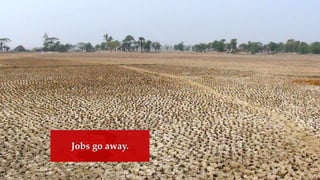
Crops grow…
Jobs are created…
Jobs go away.
1.) Economic Disequilibrium
Cyclical
High incomes during prosperity 景气
= more imports
Low incomes during depression 不景气
= less imports
a.) Change in YED
7.) Disequilibrium
1.) Economic Disequilibrium
Cyclical
a.) Change in YED
b.) Change in PED
When prices rise in prosperity, and with
more elastic demand for imports.
= less imports
When prices decline in depression, and
with more elastic demand for imports.
= more imports
( Inflation problems )
7.) Disequilibrium
1.) Economic Disequilibrium
2.) Political Disequilibrium
A lack of confidence by investors
means less people are willing to
invest and decreases capital and
financial accounts.
Scared investors = decrease
capital/financial investment
7.) Disequilibrium
1.) Economic Disequilibrium
2.) Political Disequilibrium
3.) Social Disequilibrium
People just don’t want your
stuff.
Changes in the tastes, preferences and
fashions, may affect imports and exports
and thereby affect the balance of
payments.
7.) Disequilibrium
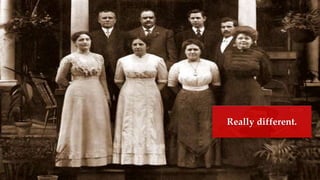
Today…
Different from the
past…
Really different.
1.) Economic Disequilibrium
2.) Political Disequilibrium
3.) Social Disequilibrium
- Cyclical
- Structural
a.) Change in YED
b.) Change in PED
7.) Disequilibrium
Finally, the End.
Thank you.

BOP SFLS part 3 disequilbrium

  • 1.
  • 2.
    5.) States ofEquilibrium Balance of Payments: 1.) Some Vocabulary 2.) The Accounts 3.) Balance between Accounts 4.) Balance between Countries 6.) Problems with Deficit/Surplus PPT 3 7.) Disequilibrium
  • 3.
    Balance of Payments: Goal: The(typical) goal of (almost) every country is to have a balanced trade. (usually) The balance of payments is the way the measure trade between countries and one of the main components 部件 of measuring economies generally.
  • 4.
    BOP is countingwhere the money is flowing between countries when they contract international trade and investment. Current accountCurrent account China imports some things… Balance of Payments
  • 5.
    BOP is countingwhere the money is flowing between countries when they contract international trade and investment. Current account Current account China imports some things… But exports many more things… Balance of Payments
  • 6.
    China uses thisextra money they have in the current account to purchase things in the financial account. Owner ship BOND Financial accountFinancial account Balance of Payments
  • 7.
    But it’s actuallynot exactly that simple always and over time… Current accountCurrent account Owner ship BOND Financial accountFinancial account So everything balances out to equal at the end. Balance of Payments
  • 8.
    Balance of Payments Isit a problem not to be balanced? 5.) States of Equilibrium It very difficult, next to impossible for the actual accounts in real life to equal zero. - They do they don’t stay that way for long. - The world never stops spinning. There are three basic states the BOP can be in.
  • 9.
    Balance of Payments 3Basic States: 5.) States of Equilibrium 1.) Really Close to Balance 2.) Large Trade Deficit, Large Foreign Investment 3.) Large Trade Surplus, Large Investments Abroad
  • 10.
    5.) States ofEquilibrium 1.) Really close to balance Current account Cap/ Financial account - Where manageable 可管理 deficits or surpluses are cancelled out by modest 谦 虚 surpluses or deficits over time.
  • 11.
    Time Current Account 0 Cap/Financial Account 5.) States ofEquilibrium 1.) Really close to balance - Where manageable 可管理 deficits or surpluses are cancelled out by modest 谦 虚 surpluses or deficits over time. + - surplus deficit Balanced
  • 12.
    During this time,it’s manageable and close to being balanced
  • 13.
    Later, it hasproblems and loses this state of equilibrium it was in.
  • 14.
    5.) States ofEquilibrium 2.) Large trade deficit and large foreign investment Current account Cap/ Financial account - Where large persistent deficits are in current account but is offset by a large surplus in the cap/financial accounts.
  • 15.
    Time Current Account 0 Cap/Financial Account 5.) States ofEquilibrium + - surplus deficit Balanced 2.) Large trade deficit and large foreign investment - Where large persistent deficits are in current account but is offset by a large surplus in the cap/financial accounts.
  • 16.
    The US isa good example of the state of large persistent deficits.
  • 17.
    Case Study: TheU.S. Trade Deficit U.S. personal saving rates has been less than investment since the 1980s. However the economy in the 1990s was arguably the best economic time is U.S. history. You save money in a bank, that bank then loans out the money for businesses to invest. Savings = Investment However, Americans saved a very small amount of money, but investment was still increasing… In fact increased so much that the economy was doing very well. Simpler English…
  • 18.
    If you livein America you import waaaaaaay more then you export Current account export import This is the US. Balance of Trade. The US. has a Trade Deficit . 2.) Large trade deficit and large foreign investment
  • 19.
    In fact theU.S. does this every single year… Current account export import 2.) Large trade deficit and large foreign investment
  • 20.
    In fact thishas been true for about 35 straight years! Current account export import 2.) Large trade deficit and large foreign investment
  • 21.
    This means fortwenty years now the U.S. has had a trade deficit that the current account has been negative this whole time. Here is the U.S. current account since 1980. Notice since 1992 it has been in deficit. The U.S. does not have a balanced trade . 2.) Large trade deficit and large foreign investment
  • 22.
    This means forduring these twenty years every year more money has left the country to buy things then has come in. But you know that dollars are spent in the U.S. so somehow that money has to come back in. Current account Financial account This means foreigners have been investing in the U.S economy every year. 2.) Large trade deficit and large foreign investment
  • 23.
    See… 2.) Large tradedeficit and large foreign investment
  • 24.
    An economy needspeople to spend money, but an economy also needs people to save money. So people use their savings to buy more expensive things, such as capital that can be used to grow an economy even more.Capital 2.) Large trade deficit and large foreign investment
  • 25.
    The thing is,Americans save very little money. Here is the American savings rate. These numbers are quite low and have become lower over the years. 2.) Large trade deficit and large foreign investment
  • 26.
    Yet at thesame time the American economy has grown and it can be said that the 1990’s were some of the best economic times in American history. This shows America’s GDP has grown an average of 3% during this time, which is pretty good! 2.) Large trade deficit and large foreign investment
  • 27.
    Types of Equilibrium Howcan the economy be growing at the same time there is very little saved to buy capital?
  • 28.
    Foreigners invest theirmoney back into America. - So it is like the Foreigners do a lot of the savings for Americans. 2.) Large trade deficit and large foreign investment
  • 29.
    So the balanceof trade is very very very unbalanced. But the balance of payments makes this possible to be like this for more then twenty years! 2.) Large trade deficit and large foreign investment
  • 30.
    Case Study: TheU.S. Trade Deficit U.S. personal saving rates has been less than investment since the 1980s. However the economy in the 1990s was arguably the best economic time is U.S. history. You save money in a bank, that bank then loans out the money for businesses to invest. Savings = Investment However, Americans saved a very small amount of money, but investment was still increasing… In fact increased so much that the economy was doing very well. Simpler English…
  • 31.
    These are verylow savings rates, on over time got smaller.
  • 32.
    However the economystill grew ok.
  • 33.
    Case Study: TheU.S. Trade Deficit Why U.S. saving has been less than investment:  In the 1980s and early 2000s, huge government budget deficits and low private saving by citizens reduced national saving.  In the 1990s, national saving increased as the economy grew, but domestic investment increased even faster due to the information technology boom.
  • 34.
    The US hada large trade imbalance with Japan in the 1990s, now it has that imbalance with China in the 2000s.
  • 35.
    China saves alot of it’s income.
  • 36.
  • 37.
    Is the U.S.trade deficit a problem?  The extra capital from the ’90s investment boom helped to increase domestic investment and the economy.  The fall in saving of the ’80s and ’00s, while not desirable, at least did not reduce domestic investment, as firms could borrow money from abroad. A country, like a person, can go into debt for good reasons or bad ones. A trade deficit is not necessarily a problem, but might be a symptom of a problem. Case Study: The U.S. Trade Deficit
  • 38.
    5.) States ofEquilibrium 3.) Large trade surplus and large investment abroad Current account Cap/ Financial account - Where large persistent surpluses are in current account but is offset by a large deficits in the cap/financial accounts.
  • 39.
    Time Current Account 0 Cap/Financial Account + - surplus deficit Balanced 5.) States ofEquilibrium 3.) Large trade surplus and large investment abroad - Where large persistent surpluses are in current account but is offset by a large deficits in the cap/financial accounts.
  • 40.
    China is oneof the best examples today or having this state of having large trade surplus.
  • 41.
    So today, Chinais on the other side, both countries have a large trade imbalance with each other, and NEED each other.
  • 42.
  • 43.
    5.) States ofEquilibrium Balance of Payments: 1.) Some Vocabulary 2.) The Accounts 3.) Balance between Accounts 4.) Balance between Countries 6.) Problems with Deficit/Surplus 7.) Disequilibrium
  • 44.
    Balance of Payments Isit a problem not to have a balanced trade?
  • 45.
    Balance of Trade Isit a problem to have a current account deficit?
  • 46.
    1.) TOT -Terms of Trade You may be getting very bad prices for your exports. Yes because… Is it a Problem to have a Current Account Deficit? 6.) Problems with Deficit/Surplus ______________________ 2.) Loss of Competitiveness It can show some great weakness in your economy compared to other countries. 3.) Unemployment Low exports, high imports, so jobs leave your economy. 4.) Pressure for Trade Barriers Less trade = less total welfare.
  • 47.
    Yes because… Is ita Problem to have a Current Account Deficit? 6.) Problems with Deficit/Surplus ______________________ 5.) Pressure for Exchange Rates Revalue your money can cause harm to sectors of the economy. Money is leaving you economy. 6.) Have to Rely on Foreign Investment Foreign Investment is the source of growth and not your own citizens and profits leak out of the country. 7.) Lack of Confidence Investors will be scared away from your country because you look weak. 8.) Hurt Long Term Growth It can hurt the lives of the people in your country.
  • 48.
    Balance of Trade Isit a problem to have a current account deficit?
  • 49.
    1.) Import RawMaterials These can be used to create more capital. No because… Is it a Problem to have a Current Account Deficit? 6.) Problems with Deficit/Surplus 2.) Increased Standard of Living Your buying lots of cool stuff! 3.) Can Rely on Foreign Investment Foreigners can invest in your country and help it to grow! 4.) Short Run only It might be a natural short run issue that will correct itself.
  • 50.
    Balance of Trade Isit a problem to have a current account surplus?
  • 51.
    1.) Rely ongrowth of others The buyers of exports or from other countries and their economies might have trouble, causing you trouble. Yes because… Is it a Problem to have a Current Account Surplus? 6.) Problems with Deficit/Surplus 2.) Rely on growth of others Your investments overseas need other economies to grow or your investments don’t make profit. 3.) Pressure on exchange rates The value of your money changes which can greatly effect you economy. 4.) Inflation pressure Prices in your economy can go up. 5.) Export away natural resources Selling your natural assets to others in other countries. 6.) Externalities Factories for exports = more pollution
  • 52.
    1.) Economics growth Exportsector growth can increase the whole economy. No because… Is it a Problem to have a Current Account Surplus? 6.) Problems with Deficit/Surplus 2.) Increased Employment Jobs, jobs, jobs, jobs! 3.) Increased Investment More capital at home and more overseas.
  • 53.
    Is it aproblem not to have a balanced trade? So to summarize… 6.) Problems with Deficit/Surplus
  • 54.
    Is it aProblem not to be Balanced? - Your country can rely on FDI to grow the economy, but the wealth goes to foreigners. No because… - Your country is gaining wealth and can have large increases in the economy. “Rising tide lifts all boats” - If in surplus - - If in deficit- 6.) Problems with Deficit/Surplus
  • 55.
    Yes because… - Ifin surplus - - It will not last. Some countries become dependent on a narrow range of goods and make the economy unstable. - Downward pressure on exchange rates -Increase pressure for governments to have tariffs and quotas - Increase unemployment - If in deficit- - Your country can rely on FDI to grow the economy, but the wealth goes to foreigners. Is it a Problem not to be Balanced? 6.) Problems with Deficit/Surplus
  • 56.
    5.) States ofEquilibrium Balance of Payments: 1.) Some Vocabulary 2.) The Accounts 3.) Balance between Accounts 4.) Balance between Countries 6.) Problems with Deficit/Surplus 7.) Disequilibrium
  • 57.
    1.) Economic Disequilibrium Structural- changes in some sectors of the economy alter 更改 the demand and supply forces influencing exports and imports 7.) Disequilibrium
  • 60.
    1.) Economic Disequilibrium Cyclical- Patterns of income changes with the business cycle. ex.) agricultural output Structural 7.) Disequilibrium
  • 62.
  • 63.
  • 64.
  • 65.
    1.) Economic Disequilibrium Cyclical Highincomes during prosperity 景气 = more imports Low incomes during depression 不景气 = less imports a.) Change in YED 7.) Disequilibrium
  • 66.
    1.) Economic Disequilibrium Cyclical a.)Change in YED b.) Change in PED When prices rise in prosperity, and with more elastic demand for imports. = less imports When prices decline in depression, and with more elastic demand for imports. = more imports ( Inflation problems ) 7.) Disequilibrium
  • 67.
    1.) Economic Disequilibrium 2.)Political Disequilibrium A lack of confidence by investors means less people are willing to invest and decreases capital and financial accounts. Scared investors = decrease capital/financial investment 7.) Disequilibrium
  • 68.
    1.) Economic Disequilibrium 2.)Political Disequilibrium 3.) Social Disequilibrium People just don’t want your stuff. Changes in the tastes, preferences and fashions, may affect imports and exports and thereby affect the balance of payments. 7.) Disequilibrium
  • 69.
  • 70.
  • 71.
  • 72.
    1.) Economic Disequilibrium 2.)Political Disequilibrium 3.) Social Disequilibrium - Cyclical - Structural a.) Change in YED b.) Change in PED 7.) Disequilibrium
  • 73.