Impact of Fiscal
Policy on
Economy
Group 3
1. Ashish Kumawat
2. Amit Kumar
3. Vikas Mishra
4. Prateek Darjee
5. Deepak Memane
Introduction
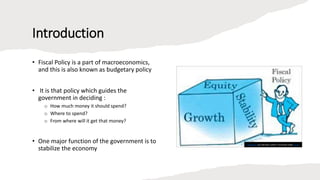
• Fiscal Policy is a part of macroeconomics,
and this is also known as budgetary policy
• It is that policy which guides the
government in deciding :
o How much money it should spend?
o Where to spend?
o From where will it get that money?
• One major function of the government is to
stabilize the economy
This Photo by Unknown author is licensed under CC BY.
Definition
• The word fisc means 'state treasury' and fiscal policy refers to
policy concerning the use of 'state treasury' or the
government finances to achieve the macroeconomic goals.
• Fiscal policy governed by government's finance ministry. It
refers to the use of government spending and tax policies to
influence economic conditions
• It is sister strategy to monetary policy through which a central
bank influences a nation's money supply
Objectives of Fiscal Policy
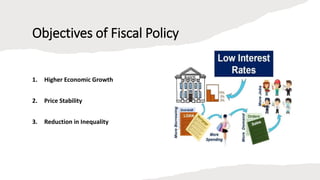
1. Higher Economic Growth
2. Price Stability
3. Reduction in Inequality
Components of Fiscal Policy
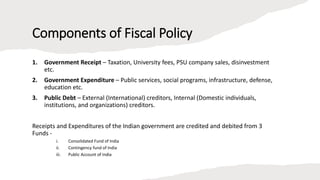
1. Government Receipt – Taxation, University fees, PSU company sales, disinvestment
etc.
2. Government Expenditure – Public services, social programs, infrastructure, defense,
education etc.
3. Public Debt – External (International) creditors, Internal (Domestic individuals,
institutions, and organizations) creditors.
Receipts and Expenditures of the Indian government are credited and debited from 3
Funds -
i. Consolidated Fund of India
ii. Contingency fund of India
iii. Public Account of India
Instruments of Fiscal Policy
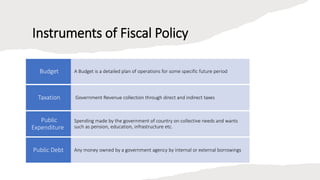
A Budget is a detailed plan of operations for some specific future period
Budget
Government Revenue collection through direct and indirect taxes
Taxation
Spending made by the government of country on collective needs and wants
such as pension, education, infrastructure etc.
Public
Expenditure
Any money owned by a government agency by internal or external borrowings
Public Debt
Types of Fiscal Policy
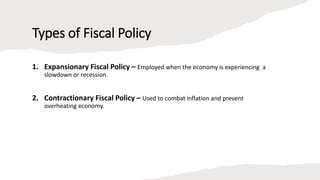
1. Expansionary Fiscal Policy – Employed when the economy is experiencing a
slowdown or recession.
2. Contractionary Fiscal Policy – Used to combat inflation and prevent
overheating economy.
Expansionary
Fiscal Policy
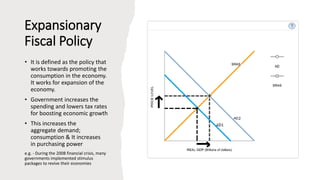
• It is defined as the policy that
works towards promoting the
consumption in the economy.
It works for expansion of the
economy.
• Government increases the
spending and lowers tax rates
for boosting economic growth
• This increases the
aggregate demand;
consumption & It increases
in purchasing power
e.g. - During the 2008 financial crisis, many
governments implemented stimulus
packages to revive their economies
Contractionary
Fiscal Policy
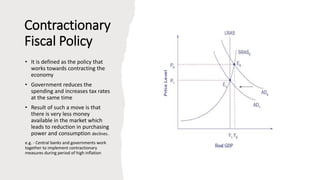
• It is defined as the policy that
works towards contracting the
economy
• Government reduces the
spending and increases tax rates
at the same time
• Result of such a move is that
there is very less money
available in the market which
leads to reduction in purchasing
power and consumption declines.
e.g. - Central banks and governments work
together to implement contractionary
measures during period of high inflation
Case Studies
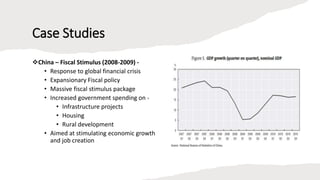
China – Fiscal Stimulus (2008-2009) -
• Response to global financial crisis
• Expansionary Fiscal policy
• Massive fiscal stimulus package
• Increased government spending on -
• Infrastructure projects
• Housing
• Rural development
• Aimed at stimulating economic growth
and job creation
Case Studies
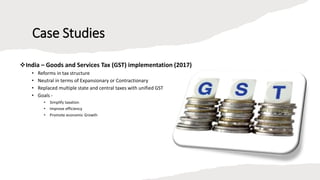
India – Goods and Services Tax (GST) implementation (2017)
• Reforms in tax structure
• Neutral in terms of Expansionary or Contractionary
• Replaced multiple state and central taxes with unified GST
• Goals -
• Simplify taxation
• Improve efficiency
• Promote economic Growth
Fiscal Deficits and Surpluses
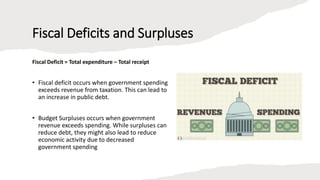
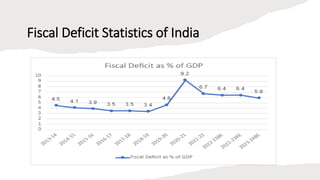
Fiscal Deficit = Total expenditure – Total receipt
• Fiscal deficit occurs when government spending
exceeds revenue from taxation. This can lead to
an increase in public debt.
• Budget Surpluses occurs when government
revenue exceeds spending. While surpluses can
reduce debt, they might also lead to reduce
economic activity due to decreased
government spending
Fiscal Deficit Statistics of India
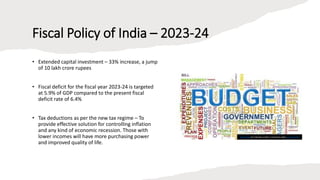
Fiscal Policy of India – 2023-24
• Extended capital investment – 33% increase, a jump
of 10 lakh crore rupees
• Fiscal deficit for the fiscal year 2023-24 is targeted
at 5.9% of GDP compared to the present fiscal
deficit rate of 6.4%
• Tax deductions as per the new tax regime – To
provide effective solution for controlling inflation
and any kind of economic recession. Those with
lower incomes will have more purchasing power
and improved quality of life.
This Photo by Unknown author is licensed under CC BY-NC-ND.
Challenges of Fiscal Policy
• Time Lags – Delayed effects due to implementation and economic
response time
• Political influence – Short term political goals may override long
term economic considerations
• Coordination challenges – Complexities in aligning policies across
different levels of government
• Budget Constraints – Deficit spending can lead to high public debt
and limit future flexibility
• Inflation – Expansionary policy might contribute to demand-pull
inflation
• Crowding Out – Government borrowing can increase interest rates,
impacting private investment
• Global factors – External conditions can influence policy
effectiveness
• Size of Economy – Large Economy require significant policies for
meaningful impact
Conclusion
Fiscal Policy is a powerful tool that governments
use to shape economic conditions.
By strategically adjusting government spending
and taxation, policymakers can influence
economic growth, employment, inflation, and
overall stability.
However, finding the right balance and timing is
essential to ensure positive outcomes.
THANK YOU
Economics is the efficient allocation of limited resources to
satisfy unlimited wants – Thomas Sowell

ME_PPT_Impact_of_Fiscal_Policy_on_Economy.pptx

  • 1.
    Impact of Fiscal Policyon Economy Group 3 1. Ashish Kumawat 2. Amit Kumar 3. Vikas Mishra 4. Prateek Darjee 5. Deepak Memane
  • 2.
    Introduction • Fiscal Policyis a part of macroeconomics, and this is also known as budgetary policy • It is that policy which guides the government in deciding : o How much money it should spend? o Where to spend? o From where will it get that money? • One major function of the government is to stabilize the economy This Photo by Unknown author is licensed under CC BY.
  • 3.
    Definition • The wordfisc means 'state treasury' and fiscal policy refers to policy concerning the use of 'state treasury' or the government finances to achieve the macroeconomic goals. • Fiscal policy governed by government's finance ministry. It refers to the use of government spending and tax policies to influence economic conditions • It is sister strategy to monetary policy through which a central bank influences a nation's money supply
  • 4.
    Objectives of FiscalPolicy 1. Higher Economic Growth 2. Price Stability 3. Reduction in Inequality
  • 5.
    Components of FiscalPolicy 1. Government Receipt – Taxation, University fees, PSU company sales, disinvestment etc. 2. Government Expenditure – Public services, social programs, infrastructure, defense, education etc. 3. Public Debt – External (International) creditors, Internal (Domestic individuals, institutions, and organizations) creditors. Receipts and Expenditures of the Indian government are credited and debited from 3 Funds - i. Consolidated Fund of India ii. Contingency fund of India iii. Public Account of India
  • 6.
    Instruments of FiscalPolicy A Budget is a detailed plan of operations for some specific future period Budget Government Revenue collection through direct and indirect taxes Taxation Spending made by the government of country on collective needs and wants such as pension, education, infrastructure etc. Public Expenditure Any money owned by a government agency by internal or external borrowings Public Debt
  • 7.
    Types of FiscalPolicy 1. Expansionary Fiscal Policy – Employed when the economy is experiencing a slowdown or recession. 2. Contractionary Fiscal Policy – Used to combat inflation and prevent overheating economy.
  • 8.
    Expansionary Fiscal Policy • Itis defined as the policy that works towards promoting the consumption in the economy. It works for expansion of the economy. • Government increases the spending and lowers tax rates for boosting economic growth • This increases the aggregate demand; consumption & It increases in purchasing power e.g. - During the 2008 financial crisis, many governments implemented stimulus packages to revive their economies
  • 9.
    Contractionary Fiscal Policy • Itis defined as the policy that works towards contracting the economy • Government reduces the spending and increases tax rates at the same time • Result of such a move is that there is very less money available in the market which leads to reduction in purchasing power and consumption declines. e.g. - Central banks and governments work together to implement contractionary measures during period of high inflation
  • 10.
    Case Studies China –Fiscal Stimulus (2008-2009) - • Response to global financial crisis • Expansionary Fiscal policy • Massive fiscal stimulus package • Increased government spending on - • Infrastructure projects • Housing • Rural development • Aimed at stimulating economic growth and job creation
  • 11.
    Case Studies India –Goods and Services Tax (GST) implementation (2017) • Reforms in tax structure • Neutral in terms of Expansionary or Contractionary • Replaced multiple state and central taxes with unified GST • Goals - • Simplify taxation • Improve efficiency • Promote economic Growth
  • 12.
    Fiscal Deficits andSurpluses Fiscal Deficit = Total expenditure – Total receipt • Fiscal deficit occurs when government spending exceeds revenue from taxation. This can lead to an increase in public debt. • Budget Surpluses occurs when government revenue exceeds spending. While surpluses can reduce debt, they might also lead to reduce economic activity due to decreased government spending
  • 13.
  • 14.
    Fiscal Policy ofIndia – 2023-24 • Extended capital investment – 33% increase, a jump of 10 lakh crore rupees • Fiscal deficit for the fiscal year 2023-24 is targeted at 5.9% of GDP compared to the present fiscal deficit rate of 6.4% • Tax deductions as per the new tax regime – To provide effective solution for controlling inflation and any kind of economic recession. Those with lower incomes will have more purchasing power and improved quality of life. This Photo by Unknown author is licensed under CC BY-NC-ND.
  • 15.
    Challenges of FiscalPolicy • Time Lags – Delayed effects due to implementation and economic response time • Political influence – Short term political goals may override long term economic considerations • Coordination challenges – Complexities in aligning policies across different levels of government • Budget Constraints – Deficit spending can lead to high public debt and limit future flexibility • Inflation – Expansionary policy might contribute to demand-pull inflation • Crowding Out – Government borrowing can increase interest rates, impacting private investment • Global factors – External conditions can influence policy effectiveness • Size of Economy – Large Economy require significant policies for meaningful impact
  • 16.
    Conclusion Fiscal Policy isa powerful tool that governments use to shape economic conditions. By strategically adjusting government spending and taxation, policymakers can influence economic growth, employment, inflation, and overall stability. However, finding the right balance and timing is essential to ensure positive outcomes.
  • 17.
    THANK YOU Economics isthe efficient allocation of limited resources to satisfy unlimited wants – Thomas Sowell