Macro Economic Goals
2.) Goals
Macroeconomic Goals
1.) Review Intro
Microeconomics
Focuses on how decisions are made by individuals
and firms and the consequences of those decisions.
Example: How much it would cost for a university or
college to offer a new course ─ the cost of the instructor’s
salary, the classroom facilities, the class materials, and so
on.
Having determined the cost, the school can then decide
whether or not to offer the course by weighing the costs
and benefits.
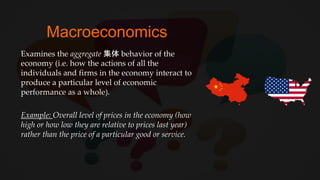
Macroeconomics
Examines the aggregate 集体 behavior of the
economy (i.e. how the actions of all the
individuals and firms in the economy interact to
produce a particular level of economic
performance as a whole).
Example: Overall level of prices in the economy (how
high or how low they are relative to prices last year)
rather than the price of a particular good or service.
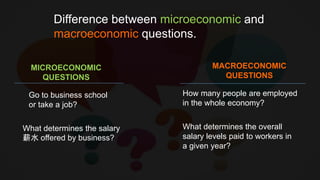
Difference between microeconomic and
macroeconomic questions.
MICROECONOMIC
QUESTIONS
MACROECONOMIC
QUESTIONS
Go to business school
or take a job?
How many people are employed
in the whole economy?
What determines the salary
薪水 offered by business?
What determines the overall
salary levels paid to workers in
a given year?
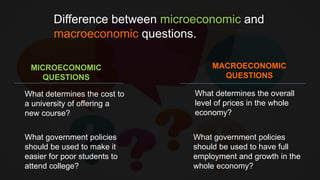
Difference between microeconomic and
macroeconomic questions.
What determines the cost to
a university of offering a
new course?
What determines the overall
level of prices in the whole
economy?
What government policies
should be used to make it
easier for poor students to
attend college?
What government policies
should be used to have full
employment and growth in the
whole economy?
MICROECONOMIC
QUESTIONS
MACROECONOMIC
QUESTIONS
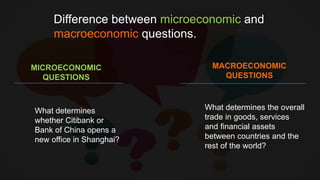
Difference between microeconomic and
macroeconomic questions.
What determines
whether Citibank or
Bank of China opens a
new office in Shanghai?
What determines the overall
trade in goods, services
and financial assets
between countries and the
rest of the world?
MICROECONOMIC
QUESTIONS
MACROECONOMIC
QUESTIONS
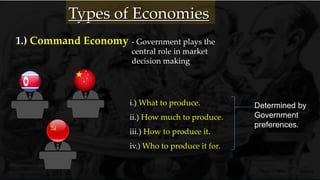
1.) Command Economy - Government plays the
central role in market
decision making
i.) What to produce.
ii.) How much to produce.
iii.) How to produce it.
iv.) Who to produce it for.
Determined by
Government
preferences.
Types of Economies
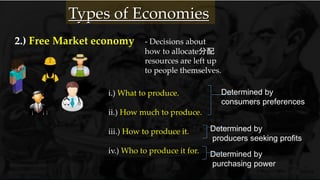
2.) Free Market economy - Decisions about
how to allocate分配
resources are left up
to people themselves.
Types of Economies
i.) What to produce.
ii.) How much to produce.
iii.) How to produce it.
iv.) Who to produce it for.
Determined by
consumers preferences
Determined by
producers seeking profits
Determined by
purchasing power
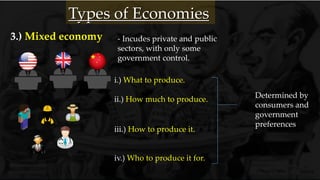
3.) Mixed economy - Incudes private and public
sectors, with only some
government control.
Types of Economies
i.) What to produce.
ii.) How much to produce.
iii.) How to produce it.
iv.) Who to produce it for.
Determined by
consumers and
government
preferences
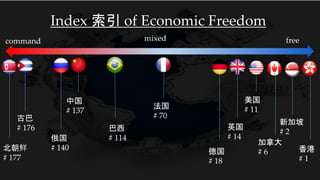
Index 索引 of Economic Freedom
free
北朝鲜
# 177
command mixed
古巴
# 176
香港
# 1
新加坡
# 2
美国
# 11
中国
# 137
加拿大
# 6
英国
# 14俄国
# 140 德国
# 18
法国
# 70
巴西
# 114
Ways to interpret Economic theory
Positive economics
is the study of what is
结果是基于数据
Normative economics
is the study of what should be
是基于你的愿望是什么结果
2.) Goals
Macroeconomic Goals
1.) Review Intro
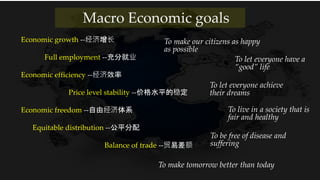
Economic growth --经济增长
Full employment --充分就业
Economic efficiency --经济效率
Price level stability --价格水平的稳定
Economic freedom --自由经济体系
Equitable distribution --公平分配
Balance of trade --贸易差额
Macro Economic goals
To make our citizens as happy
as possible
To let everyone have a
“good” life
To let everyone achieve
their dreams
To live in a society that is
fair and healthy
To be free of disease and
suffering
To make tomorrow better than today
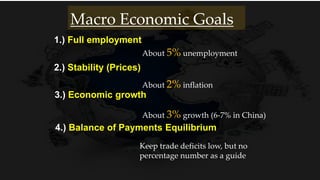
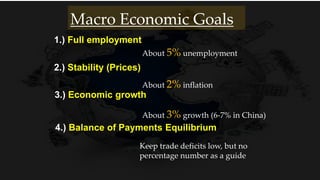
1.) Full employment
About 5% unemployment
2.) Stability (Prices)
3.) Economic growth
4.) Balance of Payments Equilibrium
About 2% inflation
About 3% growth (6-7% in China)
Keep trade deficits low, but no
percentage number as a guide
Macro Economic Goals
1.) Full employment
Macro Economic Goals
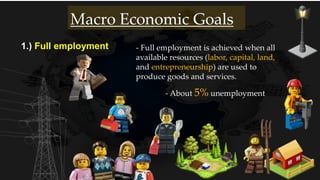
- Full employment is achieved when all
available resources (labor, capital, land,
and entrepreneurship) are used to
produce goods and services.
- About 5% unemployment
1.) Full employment
2.) Stability (Prices)
- About 2% inflation
Macro Economic Goals
- Stability is achieved by avoiding or
limiting fluctuations in production,
employment, and prices.
- Stability seeks to avoid the
recessionary declines and inflationary
expansions of business cycles..
1.) Full employment
2.) Stability (Prices)
3.) Economic growth
- About 3% growth (6-7% in China)
Macro Economic Goals
- Economic growth is achieved by
increasing the economy's ability to
produce goods and services.
- This goal is best indicated by
measuring the growth rate of
production.
0
1,000
2,000
3,000
4,000
5,000
6,000
0 100 200 300 400 500 600
AxisTitle
Axis Title
Consumption
goods
Capital
goods
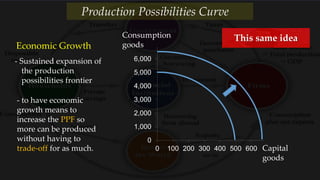
Economic Growth
- Sustained expansion of
the production
possibilities frontier
- to have economic
growth means to
increase the PPF so
more can be produced
without having to
trade-off for as much.
Production Possibilities Curve
This same idea
Time
Short Run
Econ
Growth
Long Run
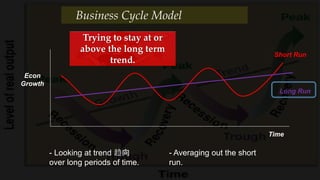
- Looking at trend 趋向
over long periods of time.
- Averaging out the short
run.
Business Cycle Model
Trying to stay at or
above the long term
trend.
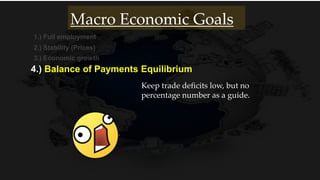
1.) Full employment
2.) Stability (Prices)
3.) Economic growth
4.) Balance of Payments Equilibrium
Keep trade deficits low, but no
percentage number as a guide.
Macro Economic Goals
1.) Full employment
About 5% unemployment
2.) Stability (Prices)
3.) Economic growth
4.) Balance of Payments Equilibrium
About 2% inflation
About 3% growth (6-7% in China)
Keep trade deficits low, but no
percentage number as a guide
Macro Economic Goals

macrostart SFLS

  • 1.
  • 2.
  • 3.
    Microeconomics Focuses on howdecisions are made by individuals and firms and the consequences of those decisions. Example: How much it would cost for a university or college to offer a new course ─ the cost of the instructor’s salary, the classroom facilities, the class materials, and so on. Having determined the cost, the school can then decide whether or not to offer the course by weighing the costs and benefits.
  • 4.
    Macroeconomics Examines the aggregate集体 behavior of the economy (i.e. how the actions of all the individuals and firms in the economy interact to produce a particular level of economic performance as a whole). Example: Overall level of prices in the economy (how high or how low they are relative to prices last year) rather than the price of a particular good or service.
  • 5.
    Difference between microeconomicand macroeconomic questions. MICROECONOMIC QUESTIONS MACROECONOMIC QUESTIONS Go to business school or take a job? How many people are employed in the whole economy? What determines the salary 薪水 offered by business? What determines the overall salary levels paid to workers in a given year?
  • 6.
    Difference between microeconomicand macroeconomic questions. What determines the cost to a university of offering a new course? What determines the overall level of prices in the whole economy? What government policies should be used to make it easier for poor students to attend college? What government policies should be used to have full employment and growth in the whole economy? MICROECONOMIC QUESTIONS MACROECONOMIC QUESTIONS
  • 7.
    Difference between microeconomicand macroeconomic questions. What determines whether Citibank or Bank of China opens a new office in Shanghai? What determines the overall trade in goods, services and financial assets between countries and the rest of the world? MICROECONOMIC QUESTIONS MACROECONOMIC QUESTIONS
  • 8.
    1.) Command Economy- Government plays the central role in market decision making i.) What to produce. ii.) How much to produce. iii.) How to produce it. iv.) Who to produce it for. Determined by Government preferences. Types of Economies
  • 9.
    2.) Free Marketeconomy - Decisions about how to allocate分配 resources are left up to people themselves. Types of Economies i.) What to produce. ii.) How much to produce. iii.) How to produce it. iv.) Who to produce it for. Determined by consumers preferences Determined by producers seeking profits Determined by purchasing power
  • 10.
    3.) Mixed economy- Incudes private and public sectors, with only some government control. Types of Economies i.) What to produce. ii.) How much to produce. iii.) How to produce it. iv.) Who to produce it for. Determined by consumers and government preferences
  • 11.
    Index 索引 ofEconomic Freedom free 北朝鲜 # 177 command mixed 古巴 # 176 香港 # 1 新加坡 # 2 美国 # 11 中国 # 137 加拿大 # 6 英国 # 14俄国 # 140 德国 # 18 法国 # 70 巴西 # 114
  • 12.
    Ways to interpretEconomic theory Positive economics is the study of what is 结果是基于数据 Normative economics is the study of what should be 是基于你的愿望是什么结果
  • 13.
  • 14.
    Economic growth --经济增长 Fullemployment --充分就业 Economic efficiency --经济效率 Price level stability --价格水平的稳定 Economic freedom --自由经济体系 Equitable distribution --公平分配 Balance of trade --贸易差额 Macro Economic goals To make our citizens as happy as possible To let everyone have a “good” life To let everyone achieve their dreams To live in a society that is fair and healthy To be free of disease and suffering To make tomorrow better than today
  • 15.
    1.) Full employment About5% unemployment 2.) Stability (Prices) 3.) Economic growth 4.) Balance of Payments Equilibrium About 2% inflation About 3% growth (6-7% in China) Keep trade deficits low, but no percentage number as a guide Macro Economic Goals
  • 16.
    1.) Full employment MacroEconomic Goals - Full employment is achieved when all available resources (labor, capital, land, and entrepreneurship) are used to produce goods and services. - About 5% unemployment
  • 17.
    1.) Full employment 2.)Stability (Prices) - About 2% inflation Macro Economic Goals - Stability is achieved by avoiding or limiting fluctuations in production, employment, and prices. - Stability seeks to avoid the recessionary declines and inflationary expansions of business cycles..
  • 18.
    1.) Full employment 2.)Stability (Prices) 3.) Economic growth - About 3% growth (6-7% in China) Macro Economic Goals - Economic growth is achieved by increasing the economy's ability to produce goods and services. - This goal is best indicated by measuring the growth rate of production.
  • 19.
    0 1,000 2,000 3,000 4,000 5,000 6,000 0 100 200300 400 500 600 AxisTitle Axis Title Consumption goods Capital goods Economic Growth - Sustained expansion of the production possibilities frontier - to have economic growth means to increase the PPF so more can be produced without having to trade-off for as much. Production Possibilities Curve This same idea
  • 20.
    Time Short Run Econ Growth Long Run -Looking at trend 趋向 over long periods of time. - Averaging out the short run. Business Cycle Model Trying to stay at or above the long term trend.
  • 21.
    1.) Full employment 2.)Stability (Prices) 3.) Economic growth 4.) Balance of Payments Equilibrium Keep trade deficits low, but no percentage number as a guide. Macro Economic Goals
  • 22.
    1.) Full employment About5% unemployment 2.) Stability (Prices) 3.) Economic growth 4.) Balance of Payments Equilibrium About 2% inflation About 3% growth (6-7% in China) Keep trade deficits low, but no percentage number as a guide Macro Economic Goals