An Explanation of how the 1997
Asian Financial crisis happened
This powerpoint
will discuss
Thailand as the
example.
The problems
became apparent
here first but was
not the only
country that had
these type of
problems…
The country has…
- High savings rate
- High investment possibilities
- High interest rates
- Low cost for foreign investment
- Capital Market liberalizations
(deregulation)
- Increase land values
- Low inflation
- increasing exporting sector
- Managed exchange rate
Looks like a great
place to invest
and grow,
especially for
some portfolio
investments!
Thailand - during the
1990s…
Thailand was a poor country that began to open to the
rest of the world and in the 1990s liberalized it’s
markets and removed lots of regulations.
And it became a country on the move, modernizing,
and doing it quite quickly.
The speed was remarkable but unequal, as is often the
case with newly developing countries.
Foreign investors brought new capital, purchased
vacation homes, developed tourist lands, quick money
was to be made in the new financial markets, and luxury
imports increased.
Life was good
But of course, nothing lasts forever…
Banks typically make money by people saving money
in the banks, paying them low interest then loaning the
money back out to other people at higher interest and
make money on the difference.
These new financial markets were like
“The Wild West” 狂野西部 as an American would say…
Thailand banks realize they can get even more money by
borrowing money from other banks at a low interest and then
loan that money back out to other people at higher interest
and make even more on that difference.
A focus on the banks…
Thailand banks realize they can get even more money by
borrowing money from other banks at a low interest and then
loan that money back out to other people at higher interest
and make even more on that difference.
Banks typically make money by people saving money
in the banks, paying them low interest then loaning the
money back out to other people at higher interest and
make money on the difference.
These new financial markets were like
“The Wild West” 狂野西部 as an American would say…
Plus a low fixed exchange rate could makes this really work.
So a 3 part example:
1.) An example of how do banks typically make money.
2.) How these “clever” newly “liberalized” banks increased this process.
3.) How they made even more through fixed exchange rates.
A focus on the banks…
SaversBorrowers
Liabilities 5%Assets 9%
฿100฿100
depositsLends
1.) Typical way a bank makes money
SaversBorrowers
Liabilities 5%Assets 9%
฿100฿100
depositsLends
Pays back
with interest
฿109
Pays interest
owed
฿105
Bank makes profit of ฿ 4
Thailand’s idea is, don’t just get savers money, but get
even more from other international banks at low interest
and relend it at higher interest inside Thailand.
1.) Typical way a bank makes money
SaversBorrowers
Liabilities 5%Assets 9%
฿100
฿100
Borrow money
from other banks
at low interest
฿100
฿100
Make even more
loans themselves
at high interest
Also with a fixed exchange rate it is possible to do this, and
make even more through the fixed exchange rate system.
2.) Clever Thailand bank idea
SaversBorrowers
Liabilities 5%Assets 9%
฿105
฿109
฿105
฿109
2.) Clever Thailand bank idea
Pays back
with interest
Pays
interest
owed
Bank makes profit of ฿ 8
More loans equals more profit!
Also with a fixed exchange rate it is possible to do this, and
make even more through the fixed exchange rate system.
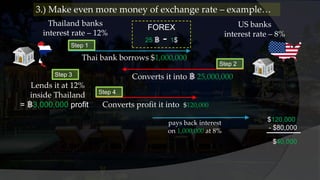
Thailand banks
interest rate – 12%
US banks
interest rate – 8%
Thai bank borrows $1,000,000
Converts it into ฿ 25,000,000
FOREX
25 ฿ - 1$
3.) Make even more money of exchange rate – example…
Step 1
Step 2
Thailand banks
interest rate – 12%
US banks
interest rate – 8%
Thai bank borrows $1,000,000
Converts it into ฿ 25,000,000
Lends it at 12%
inside Thailand
= ฿3,000,000 profit Converts profit it into $120,000
pays back interest
on 1,000,000 at 8%
$40,000
- $80,000
$120,000
FOREX
25 ฿ - 1$
3.) Make even more money of exchange rate – example…
Step 3
Step 1
Step 2
Step 4
Thailand banks
interest rate – 12%
US banks
interest rate – 8%
Thai bank borrows $1,000,000
Converts it into ฿ 25,000,000
Lends it at 12%
inside Thailand
Converts profit it into $120,000
pays back interest
on 1,000,000 at 8%
$40,000
- $80,000
$120,000
Makes an extra
฿1,000,000 on
the US loan
FOREX
25 ฿ - 1$
3.) Make even more money of exchange rate – example…
Step 1
Step 2
Converts back into ฿1,000,000
Step 5
Step 3
= ฿3,000,000 profit
Step 4
So Thailand banks make a lot of extra
money using the fixed exchange rate.
Economy is growing quickly, lots of
international investors enter the
market.
Financial account
However, this investment isn’t actually growing
fundamentals 基本面 in the economy…
Current account
So they are not building a lot
more factories and selling
exports.
A lot of this new money is used to buy fancy
cars, homes, luxury items, imports, etc.
(Portfolio investment)
So Thailand banks make a lot of extra
money using the fixed exchange rate.
Financial account
However, this investment isn’t actually growing
fundamentals 基本面 in the economy…
Current account
(Portfolio investment)
*** This might look balanced, however this is a
Developing country. For a Developed country with a
high capacity already in the economy, balance is
good. But this is a newly Developing country, that
needs to increase it’s productivity a double surplus is
actually a better thing to have.
Current account
But then the international situation
changes…
Remember nothing lasts forever…
China opens more SEZ 经济特区 and
Yuan depreciates
¥
Japan Yen and others depreciates ¥
***Competitors become cheaper
***At the time, one of Thailand’s largest exports is
semi-conductors and now China is entering this
market and is becoming cheaper and getting
economies of scale. Japan’s economy which always
is high-tech is also slowing down and depreciating.
The International situation changes…
China opens more SEZ 经济特区 and
Yuan depreciates
¥
Japan Yen and others depreciates ¥
US Dollar Appreciates
$
***Competitors become cheaper
***Thai Baht ฿ is fixed to dollar, so if dollar
appreciates then the baht appreciates, so
even less exports and unbalanced economy.
฿
The International situation changes…
Investors see this situation and
want to leave Thailand
Thailand already has a current
account deficit problem
Current account
And with this pressure of exchange
rates it will sell even less exports
*** Country hasn’t developed very much industry to
export with it’s new capital anyway
Financial account
*** Portfolio investment
*** This leads Thai Baht ฿ to depreciate, but they
cannot allow this to happen or the banks will fail
because of all the loans it has already taken out.
฿
*** Also speculators are already trying to manipulate
操纵 the FOREX
This means…
Thailand banks
interest rate – 12%
US banks
interest rate – 8%
Thai bank borrows $1,000,000
Converts it into ฿ 25,000,000
Lends it at 12%
inside Thailand
Converts profit it into $120,000
pays back interest
on 1,000,000 at 8%
$40,000
- $80,000
$120,000
Makes an extra
฿1,000,000 on
the US loan
FOREX
25 ฿ - 1$
Step 1
Step 2
Converts back into ฿1,000,000
Step 5
Step 3
= ฿3,000,000 profit
Step 4
Remember the international loans?
Thailand banks
interest rate – 12%
US banks
interest rate – 8%
***Original $1,000,000 loan is now only
worth $556,000 and the interest payments
are higher then the profit that can be made.
$ -13,000
- $80,000
$67,000
Depreciate from 25 to 45
฿3,000,000 profit
From the
$1,000,000
loan before
Converts it into $67,000
pays back interest
on 1,000,000 at 8%
FOREX
45 ฿ - 1$
Why the Banks will fail if Depreciation happens…
1.)Fall in exchange rate
means:
Exports don’t really increase,
because have little to export,
mostly only developed tourist
and service sectors before with
a housing bubble 房地产泡沫.
Import prices increase and
helps create inflation.
banks and companies
may become bankrupt.
2.) Defend and try to
stabilize currency means:
Increase interest rates
to stop capital flight but
higher interest rates also
lower domestic economy.
lower domestic economy
means recession and
maybe banks fail anyway.
Two choices about what to do about the FOREX
Big Dilemma
It has to use its official reserves of US dollars to stable the currency
1.) So since…
Investors scared,
want to leave Thai
FOREX
MARKET
฿ S
฿ D
Deprecation
of Baht ฿
So Thailand decides to control its FOREX…
It has to use its official reserves of US dollars to stable the currency
1.) So since…
Investors scared,
want to leave Thai
2.) To stop this depreciation…
FOREX
MARKET
฿ S
฿ D
Deprecation
of Baht ฿
Thai sells official
reserves ($)
$ S
Thai buys its own
money back
฿ D
Appreciation
of Baht ฿ to
offset the
change
So Thailand decides to control its FOREX…
Speculators in the market see and
understand this problem and see a way
to exploit this and profit from it.
Speculators bet against what Thailand is
doing to manage it’s FOREX values and
try to force the currency to decrease.
They do this by borrowing money from
Thailand banks and then resell the
money on the FOREX markets.
FOREX
MARKETBorrow money
from Thai banks
Convert ฿ in to $ $ D
฿ s Deprecation
of Baht ฿
***Thailand has to continue to sell its reserves of $
to stop this deprecation from happening, but they
run out of reserves and the system collapses.
Speculators plan of attack…
Speculators force the value of the baht
down by borrowing Baht from the bank
and selling it in the FOREX market.
Thailand government tries to increase the
value of the baht by selling it’s official reserves
to buy it’s own currency on the FOREX but
runs out of official reserves to do it.
Crazy huh?
But why do speculators borrow money from
Thailand banks?
For example…
Borrow
฿ 100
FOREX
1฿ - 1$
Convert ฿ 100 to $ 100
Why speculators borrow money from Thailand banks
Step 1
Step 2
For example…
FOREX
1฿ - 1$
FOREX
2฿ - 1$
If Baht depreciate from 1 to 2
Convert $ 100 to ฿ 200
฿
฿ 200
Pay back
฿ 100
฿ -100
฿ 100 Profit
Why speculators borrow money from Thailand banks
Step 4
Step 3
For example…
Borrow
฿ 100
FOREX
1฿ - 1$
Convert ฿ 100 to $ 100
FOREX
2฿ - 1$
If Baht depreciate from 1 to 2
Convert $ 100 to ฿ 200
฿
฿ 200
Pay back
฿ 100
฿ -100
฿ 100 Profit
Why speculators borrow money from Thailand banks
Step 1
Step 2
Step 4
Step 3
Thailand loses this race of buying and
selling currency on the FOREX. The
government runs out of money and is
forced to float its currency.
It then falls in a big way…
Baht loses more then half it’s value
Mostly things that change in demand for imports and exports
Mostly things that change the demand for investments
1.) Consumer Tastes
2.) Relative incomes (booms and recessions)
3.) Relative prices (PPP) (Inflation)
5.) Speculation
4.) Interest rates
4.) Change in Equilibrium – Reasons
Reasons that change on the Current Account side
Reasons that change on the Financial Account side
6.) Government debt
7.) FDI or Portfolio investment
All these thing go bad at
the same time!
Thailand wasn’t the only country that had a problem
with it’s banking system like this…
It starts in Thailand and moves to:
These countries saw
depreciations that hurt
there economies because
of similar issues
- Philippines
- Hong Kong
- Taiwan
- Singapore
- South Korea
- Malaysia
- Indonesia
It spread like a sickness, that
is why it’s often called the
“Asian Contagion”
亚洲金融风暴
Contagion = spread of disease
Other similar countries are
affected and infected with this
Thailand GDP drops -15% !!!!!!!!!!
An unbelievable amount!!!!!
FOREX rates and GNP (Gross national product – similar to GDP) all fall
an unbelievable amount in several countries
1. Productivity: economic expansion before crisis
later explained by the rapid growth of production
inputs (capital and labor) – but relatively little
increase in productivity
2. Banking Regulation: Ineffective government
supervision
3. Exchange rate regimes- Mostly pegged exchange
rate system
4. Legal Framework: lack of structured legal
framework to deal with bankruptcy
Weaknesses that became apparent after the crisis:
Asian Weaknesses…
Hope that makes sense, go read it again…
The End
Thank you 
An Explanation of how the 1997
Asian Financial crisis happened

Asian crisis example SFLS

  • 1.
    An Explanation ofhow the 1997 Asian Financial crisis happened
  • 2.
    This powerpoint will discuss Thailandas the example. The problems became apparent here first but was not the only country that had these type of problems…
  • 3.
    The country has… -High savings rate - High investment possibilities - High interest rates - Low cost for foreign investment - Capital Market liberalizations (deregulation) - Increase land values - Low inflation - increasing exporting sector - Managed exchange rate Looks like a great place to invest and grow, especially for some portfolio investments! Thailand - during the 1990s…
  • 4.
    Thailand was apoor country that began to open to the rest of the world and in the 1990s liberalized it’s markets and removed lots of regulations.
  • 5.
    And it becamea country on the move, modernizing, and doing it quite quickly.
  • 6.
    The speed wasremarkable but unequal, as is often the case with newly developing countries.
  • 7.
    Foreign investors broughtnew capital, purchased vacation homes, developed tourist lands, quick money was to be made in the new financial markets, and luxury imports increased.
  • 8.
  • 9.
    But of course,nothing lasts forever…
  • 10.
    Banks typically makemoney by people saving money in the banks, paying them low interest then loaning the money back out to other people at higher interest and make money on the difference. These new financial markets were like “The Wild West” 狂野西部 as an American would say… Thailand banks realize they can get even more money by borrowing money from other banks at a low interest and then loan that money back out to other people at higher interest and make even more on that difference. A focus on the banks…
  • 11.
    A focus onthe banks… Thailand banks realize they can get even more money by borrowing money from other banks at a low interest and then loan that money back out to other people at higher interest and make even more on that difference. Banks typically make money by people saving money in the banks, paying them low interest then loaning the money back out to other people at higher interest and make money on the difference. These new financial markets were like “The Wild West” 狂野西部 as an American would say…
  • 12.
    Plus a lowfixed exchange rate could makes this really work. So a 3 part example: 1.) An example of how do banks typically make money. 2.) How these “clever” newly “liberalized” banks increased this process. 3.) How they made even more through fixed exchange rates. A focus on the banks…
  • 13.
  • 14.
    SaversBorrowers Liabilities 5%Assets 9% ฿100฿100 depositsLends Paysback with interest ฿109 Pays interest owed ฿105 Bank makes profit of ฿ 4 Thailand’s idea is, don’t just get savers money, but get even more from other international banks at low interest and relend it at higher interest inside Thailand. 1.) Typical way a bank makes money
  • 15.
    SaversBorrowers Liabilities 5%Assets 9% ฿100 ฿100 Borrowmoney from other banks at low interest ฿100 ฿100 Make even more loans themselves at high interest Also with a fixed exchange rate it is possible to do this, and make even more through the fixed exchange rate system. 2.) Clever Thailand bank idea
  • 16.
    SaversBorrowers Liabilities 5%Assets 9% ฿105 ฿109 ฿105 ฿109 2.)Clever Thailand bank idea Pays back with interest Pays interest owed Bank makes profit of ฿ 8 More loans equals more profit! Also with a fixed exchange rate it is possible to do this, and make even more through the fixed exchange rate system.
  • 17.
    Thailand banks interest rate– 12% US banks interest rate – 8% Thai bank borrows $1,000,000 Converts it into ฿ 25,000,000 FOREX 25 ฿ - 1$ 3.) Make even more money of exchange rate – example… Step 1 Step 2
  • 18.
    Thailand banks interest rate– 12% US banks interest rate – 8% Thai bank borrows $1,000,000 Converts it into ฿ 25,000,000 Lends it at 12% inside Thailand = ฿3,000,000 profit Converts profit it into $120,000 pays back interest on 1,000,000 at 8% $40,000 - $80,000 $120,000 FOREX 25 ฿ - 1$ 3.) Make even more money of exchange rate – example… Step 3 Step 1 Step 2 Step 4
  • 19.
    Thailand banks interest rate– 12% US banks interest rate – 8% Thai bank borrows $1,000,000 Converts it into ฿ 25,000,000 Lends it at 12% inside Thailand Converts profit it into $120,000 pays back interest on 1,000,000 at 8% $40,000 - $80,000 $120,000 Makes an extra ฿1,000,000 on the US loan FOREX 25 ฿ - 1$ 3.) Make even more money of exchange rate – example… Step 1 Step 2 Converts back into ฿1,000,000 Step 5 Step 3 = ฿3,000,000 profit Step 4
  • 20.
    So Thailand banksmake a lot of extra money using the fixed exchange rate. Economy is growing quickly, lots of international investors enter the market. Financial account However, this investment isn’t actually growing fundamentals 基本面 in the economy… Current account So they are not building a lot more factories and selling exports. A lot of this new money is used to buy fancy cars, homes, luxury items, imports, etc. (Portfolio investment)
  • 21.
    So Thailand banksmake a lot of extra money using the fixed exchange rate. Financial account However, this investment isn’t actually growing fundamentals 基本面 in the economy… Current account (Portfolio investment) *** This might look balanced, however this is a Developing country. For a Developed country with a high capacity already in the economy, balance is good. But this is a newly Developing country, that needs to increase it’s productivity a double surplus is actually a better thing to have. Current account
  • 22.
    But then theinternational situation changes… Remember nothing lasts forever…
  • 23.
    China opens moreSEZ 经济特区 and Yuan depreciates ¥ Japan Yen and others depreciates ¥ ***Competitors become cheaper ***At the time, one of Thailand’s largest exports is semi-conductors and now China is entering this market and is becoming cheaper and getting economies of scale. Japan’s economy which always is high-tech is also slowing down and depreciating. The International situation changes…
  • 24.
    China opens moreSEZ 经济特区 and Yuan depreciates ¥ Japan Yen and others depreciates ¥ US Dollar Appreciates $ ***Competitors become cheaper ***Thai Baht ฿ is fixed to dollar, so if dollar appreciates then the baht appreciates, so even less exports and unbalanced economy. ฿ The International situation changes…
  • 25.
    Investors see thissituation and want to leave Thailand Thailand already has a current account deficit problem Current account And with this pressure of exchange rates it will sell even less exports *** Country hasn’t developed very much industry to export with it’s new capital anyway Financial account *** Portfolio investment *** This leads Thai Baht ฿ to depreciate, but they cannot allow this to happen or the banks will fail because of all the loans it has already taken out. ฿ *** Also speculators are already trying to manipulate 操纵 the FOREX This means…
  • 26.
    Thailand banks interest rate– 12% US banks interest rate – 8% Thai bank borrows $1,000,000 Converts it into ฿ 25,000,000 Lends it at 12% inside Thailand Converts profit it into $120,000 pays back interest on 1,000,000 at 8% $40,000 - $80,000 $120,000 Makes an extra ฿1,000,000 on the US loan FOREX 25 ฿ - 1$ Step 1 Step 2 Converts back into ฿1,000,000 Step 5 Step 3 = ฿3,000,000 profit Step 4 Remember the international loans?
  • 27.
    Thailand banks interest rate– 12% US banks interest rate – 8% ***Original $1,000,000 loan is now only worth $556,000 and the interest payments are higher then the profit that can be made. $ -13,000 - $80,000 $67,000 Depreciate from 25 to 45 ฿3,000,000 profit From the $1,000,000 loan before Converts it into $67,000 pays back interest on 1,000,000 at 8% FOREX 45 ฿ - 1$ Why the Banks will fail if Depreciation happens…
  • 28.
    1.)Fall in exchangerate means: Exports don’t really increase, because have little to export, mostly only developed tourist and service sectors before with a housing bubble 房地产泡沫. Import prices increase and helps create inflation. banks and companies may become bankrupt. 2.) Defend and try to stabilize currency means: Increase interest rates to stop capital flight but higher interest rates also lower domestic economy. lower domestic economy means recession and maybe banks fail anyway. Two choices about what to do about the FOREX Big Dilemma
  • 29.
    It has touse its official reserves of US dollars to stable the currency 1.) So since… Investors scared, want to leave Thai FOREX MARKET ฿ S ฿ D Deprecation of Baht ฿ So Thailand decides to control its FOREX…
  • 30.
    It has touse its official reserves of US dollars to stable the currency 1.) So since… Investors scared, want to leave Thai 2.) To stop this depreciation… FOREX MARKET ฿ S ฿ D Deprecation of Baht ฿ Thai sells official reserves ($) $ S Thai buys its own money back ฿ D Appreciation of Baht ฿ to offset the change So Thailand decides to control its FOREX…
  • 31.
    Speculators in themarket see and understand this problem and see a way to exploit this and profit from it. Speculators bet against what Thailand is doing to manage it’s FOREX values and try to force the currency to decrease. They do this by borrowing money from Thailand banks and then resell the money on the FOREX markets.
  • 32.
    FOREX MARKETBorrow money from Thaibanks Convert ฿ in to $ $ D ฿ s Deprecation of Baht ฿ ***Thailand has to continue to sell its reserves of $ to stop this deprecation from happening, but they run out of reserves and the system collapses. Speculators plan of attack…
  • 33.
    Speculators force thevalue of the baht down by borrowing Baht from the bank and selling it in the FOREX market. Thailand government tries to increase the value of the baht by selling it’s official reserves to buy it’s own currency on the FOREX but runs out of official reserves to do it. Crazy huh? But why do speculators borrow money from Thailand banks?
  • 34.
    For example… Borrow ฿ 100 FOREX 1฿- 1$ Convert ฿ 100 to $ 100 Why speculators borrow money from Thailand banks Step 1 Step 2
  • 35.
    For example… FOREX 1฿ -1$ FOREX 2฿ - 1$ If Baht depreciate from 1 to 2 Convert $ 100 to ฿ 200 ฿ ฿ 200 Pay back ฿ 100 ฿ -100 ฿ 100 Profit Why speculators borrow money from Thailand banks Step 4 Step 3
  • 36.
    For example… Borrow ฿ 100 FOREX 1฿- 1$ Convert ฿ 100 to $ 100 FOREX 2฿ - 1$ If Baht depreciate from 1 to 2 Convert $ 100 to ฿ 200 ฿ ฿ 200 Pay back ฿ 100 ฿ -100 ฿ 100 Profit Why speculators borrow money from Thailand banks Step 1 Step 2 Step 4 Step 3
  • 37.
    Thailand loses thisrace of buying and selling currency on the FOREX. The government runs out of money and is forced to float its currency. It then falls in a big way…
  • 38.
    Baht loses morethen half it’s value
  • 39.
    Mostly things thatchange in demand for imports and exports Mostly things that change the demand for investments 1.) Consumer Tastes 2.) Relative incomes (booms and recessions) 3.) Relative prices (PPP) (Inflation) 5.) Speculation 4.) Interest rates 4.) Change in Equilibrium – Reasons Reasons that change on the Current Account side Reasons that change on the Financial Account side 6.) Government debt 7.) FDI or Portfolio investment All these thing go bad at the same time!
  • 40.
    Thailand wasn’t theonly country that had a problem with it’s banking system like this… It starts in Thailand and moves to: These countries saw depreciations that hurt there economies because of similar issues - Philippines - Hong Kong - Taiwan - Singapore - South Korea - Malaysia - Indonesia It spread like a sickness, that is why it’s often called the “Asian Contagion” 亚洲金融风暴 Contagion = spread of disease
  • 41.
    Other similar countriesare affected and infected with this
  • 42.
    Thailand GDP drops-15% !!!!!!!!!! An unbelievable amount!!!!!
  • 43.
    FOREX rates andGNP (Gross national product – similar to GDP) all fall an unbelievable amount in several countries
  • 44.
    1. Productivity: economicexpansion before crisis later explained by the rapid growth of production inputs (capital and labor) – but relatively little increase in productivity 2. Banking Regulation: Ineffective government supervision 3. Exchange rate regimes- Mostly pegged exchange rate system 4. Legal Framework: lack of structured legal framework to deal with bankruptcy Weaknesses that became apparent after the crisis: Asian Weaknesses…
  • 45.
    Hope that makessense, go read it again… The End Thank you  An Explanation of how the 1997 Asian Financial crisis happened

Editor's Notes

  • #3 East Asia was a booming part of the world. With high rates of saving and investment; rapidly improving educational levels among the work force; and if not free trade, at least a high degree of openness to and integration with world markets. Capital Market liberalizations 1900s, increased financial transactions through the banks. Shift from an inward-looking, import-substitution development strategy to one that emphasized exports. During the 1990s: massive capital inflows were accumulated progressively along with a high interest rate differential and under fixed exchange rate regime, including capital account deregulation
  • #4 East Asia was a booming part of the world. With high rates of saving and investment; rapidly improving educational levels among the work force; and if not free trade, at least a high degree of openness to and integration with world markets. Capital Market liberalizations 1900s, increased financial transactions through the banks. Shift from an inward-looking, import-substitution development strategy to one that emphasized exports. During the 1990s: massive capital inflows were accumulated progressively along with a high interest rate differential and under fixed exchange rate regime, including capital account deregulation
  • #21 Drop in currencies make exports attractive but imports more expensive. The east Asian countries were highly dependent on trade. Also domestic banks and companies had large debts denominated in dollars. So a drop in the domestic currency means foreign currency becomes more expensive, relatively increasing the value of the dollar denominated debts even though the debts are the same. The huge influx of foreign capital happened with the market liberalization. The differential in interest rates played in favor of the domestic market and investor began to spend more and more in these economies.
  • #22 Drop in currencies make exports attractive but imports more expensive. The east Asian countries were highly dependent on trade. Also domestic banks and companies had large debts denominated in dollars. So a drop in the domestic currency means foreign currency becomes more expensive, relatively increasing the value of the dollar denominated debts even though the debts are the same. The huge influx of foreign capital happened with the market liberalization. The differential in interest rates played in favor of the domestic market and investor began to spend more and more in these economies.
  • #23 Drop in currencies make exports attractive but imports more expensive. The east Asian countries were highly dependent on trade. Also domestic banks and companies had large debts denominated in dollars. So a drop in the domestic currency means foreign currency becomes more expensive, relatively increasing the value of the dollar denominated debts even though the debts are the same. The huge influx of foreign capital happened with the market liberalization. The differential in interest rates played in favor of the domestic market and investor began to spend more and more in these economies.
  • #24 Drop in currencies make exports attractive but imports more expensive. The east Asian countries were highly dependent on trade. Also domestic banks and companies had large debts denominated in dollars. So a drop in the domestic currency means foreign currency becomes more expensive, relatively increasing the value of the dollar denominated debts even though the debts are the same. The huge influx of foreign capital happened with the market liberalization. The differential in interest rates played in favor of the domestic market and investor began to spend more and more in these economies.
  • #25 Drop in currencies make exports attractive but imports more expensive. The east Asian countries were highly dependent on trade. Also domestic banks and companies had large debts denominated in dollars. So a drop in the domestic currency means foreign currency becomes more expensive, relatively increasing the value of the dollar denominated debts even though the debts are the same. The huge influx of foreign capital happened with the market liberalization. The differential in interest rates played in favor of the domestic market and investor began to spend more and more in these economies.
  • #26 Drop in currencies make exports attractive but imports more expensive. The east Asian countries were highly dependent on trade. Also domestic banks and companies had large debts denominated in dollars. So a drop in the domestic currency means foreign currency becomes more expensive, relatively increasing the value of the dollar denominated debts even though the debts are the same. The huge influx of foreign capital happened with the market liberalization. The differential in interest rates played in favor of the domestic market and investor began to spend more and more in these economies.
  • #29 Drop in currencies make exports attractive but imports more expensive. The east Asian countries were highly dependent on trade. Also domestic banks and companies had large debts denominated in dollars. So a drop in the domestic currency means foreign currency becomes more expensive, relatively increasing the value of the dollar denominated debts even though the debts are the same. The huge influx of foreign capital happened with the market liberalization. The differential in interest rates played in favor of the domestic market and investor began to spend more and more in these economies.
  • #30 Drop in currencies make exports attractive but imports more expensive. The east Asian countries were highly dependent on trade. Also domestic banks and companies had large debts denominated in dollars. So a drop in the domestic currency means foreign currency becomes more expensive, relatively increasing the value of the dollar denominated debts even though the debts are the same. The huge influx of foreign capital happened with the market liberalization. The differential in interest rates played in favor of the domestic market and investor began to spend more and more in these economies.
  • #31 Drop in currencies make exports attractive but imports more expensive. The east Asian countries were highly dependent on trade. Also domestic banks and companies had large debts denominated in dollars. So a drop in the domestic currency means foreign currency becomes more expensive, relatively increasing the value of the dollar denominated debts even though the debts are the same. The huge influx of foreign capital happened with the market liberalization. The differential in interest rates played in favor of the domestic market and investor began to spend more and more in these economies.
  • #32 Drop in currencies make exports attractive but imports more expensive. The east Asian countries were highly dependent on trade. Also domestic banks and companies had large debts denominated in dollars. So a drop in the domestic currency means foreign currency becomes more expensive, relatively increasing the value of the dollar denominated debts even though the debts are the same. The huge influx of foreign capital happened with the market liberalization. The differential in interest rates played in favor of the domestic market and investor began to spend more and more in these economies.
  • #33 Drop in currencies make exports attractive but imports more expensive. The east Asian countries were highly dependent on trade. Also domestic banks and companies had large debts denominated in dollars. So a drop in the domestic currency means foreign currency becomes more expensive, relatively increasing the value of the dollar denominated debts even though the debts are the same. The huge influx of foreign capital happened with the market liberalization. The differential in interest rates played in favor of the domestic market and investor began to spend more and more in these economies.
  • #34 Drop in currencies make exports attractive but imports more expensive. The east Asian countries were highly dependent on trade. Also domestic banks and companies had large debts denominated in dollars. So a drop in the domestic currency means foreign currency becomes more expensive, relatively increasing the value of the dollar denominated debts even though the debts are the same. The huge influx of foreign capital happened with the market liberalization. The differential in interest rates played in favor of the domestic market and investor began to spend more and more in these economies.
  • #35 Drop in currencies make exports attractive but imports more expensive. The east Asian countries were highly dependent on trade. Also domestic banks and companies had large debts denominated in dollars. So a drop in the domestic currency means foreign currency becomes more expensive, relatively increasing the value of the dollar denominated debts even though the debts are the same. The huge influx of foreign capital happened with the market liberalization. The differential in interest rates played in favor of the domestic market and investor began to spend more and more in these economies.
  • #36 Drop in currencies make exports attractive but imports more expensive. The east Asian countries were highly dependent on trade. Also domestic banks and companies had large debts denominated in dollars. So a drop in the domestic currency means foreign currency becomes more expensive, relatively increasing the value of the dollar denominated debts even though the debts are the same. The huge influx of foreign capital happened with the market liberalization. The differential in interest rates played in favor of the domestic market and investor began to spend more and more in these economies.
  • #37 Drop in currencies make exports attractive but imports more expensive. The east Asian countries were highly dependent on trade. Also domestic banks and companies had large debts denominated in dollars. So a drop in the domestic currency means foreign currency becomes more expensive, relatively increasing the value of the dollar denominated debts even though the debts are the same. The huge influx of foreign capital happened with the market liberalization. The differential in interest rates played in favor of the domestic market and investor began to spend more and more in these economies.
  • #38 Drop in currencies make exports attractive but imports more expensive. The east Asian countries were highly dependent on trade. Also domestic banks and companies had large debts denominated in dollars. So a drop in the domestic currency means foreign currency becomes more expensive, relatively increasing the value of the dollar denominated debts even though the debts are the same. The huge influx of foreign capital happened with the market liberalization. The differential in interest rates played in favor of the domestic market and investor began to spend more and more in these economies.
  • #40 39
  • #41 Drop in currencies make exports attractive but imports more expensive. The east Asian countries were highly dependent on trade. Also domestic banks and companies had large debts denominated in dollars. So a drop in the domestic currency means foreign currency becomes more expensive, relatively increasing the value of the dollar denominated debts even though the debts are the same. The huge influx of foreign capital happened with the market liberalization. The differential in interest rates played in favor of the domestic market and investor began to spend more and more in these economies.
  • #43 Drop in currencies make exports attractive but imports more expensive. The east Asian countries were highly dependent on trade. Also domestic banks and companies had large debts denominated in dollars. So a drop in the domestic currency means foreign currency becomes more expensive, relatively increasing the value of the dollar denominated debts even though the debts are the same. The huge influx of foreign capital happened with the market liberalization. The differential in interest rates played in favor of the domestic market and investor began to spend more and more in these economies.
  • #44 Drop in currencies make exports attractive but imports more expensive. The east Asian countries were highly dependent on trade. Also domestic banks and companies had large debts denominated in dollars. So a drop in the domestic currency means foreign currency becomes more expensive, relatively increasing the value of the dollar denominated debts even though the debts are the same. The huge influx of foreign capital happened with the market liberalization. The differential in interest rates played in favor of the domestic market and investor began to spend more and more in these economies.
  • #45 lack of supervision by bank regulators and lack of expertise in screening and monitoring borrowers at banking institutions, losses on the loans began to mount ( An estimated 15% to 35% of all bank loans turned sour in Thailand, Indonesia, Malaysia, and south Korea), causing an erosion of bank’s net worth (capital). As a result of this erosion, banks had fewer resources to lend and this lack of lending eventually led to a contraction in economic activity. Corruption..close ties between business interests and government officials appear to have helped foster considerable moral hazard in lending. All wanted financial liberalization but lacked proper government supervision. Heavy reliance on banks due to underdeveloped capital markets Pegged exchange rate made the adjustment process more difficult