First Principles of Economics
The Theory of Economics does not furnish a body of
settled conclusions immediately applicable to policy. It
is a method rather than a doctrine, an apparatus of the
mind, a technique of thinking which helps its possessor
to draw correct conclusions.
经济学的理论并不包括一组已经被认证的结论可以即刻
用于解释政府的决策。
它是一个方法而不是一个教条。它是人思想发出的工具,
是一种思考的技术,
让拥有人能够用它后达到正确的结论。
(From: The General Theory of Employment, Interest, and Money)
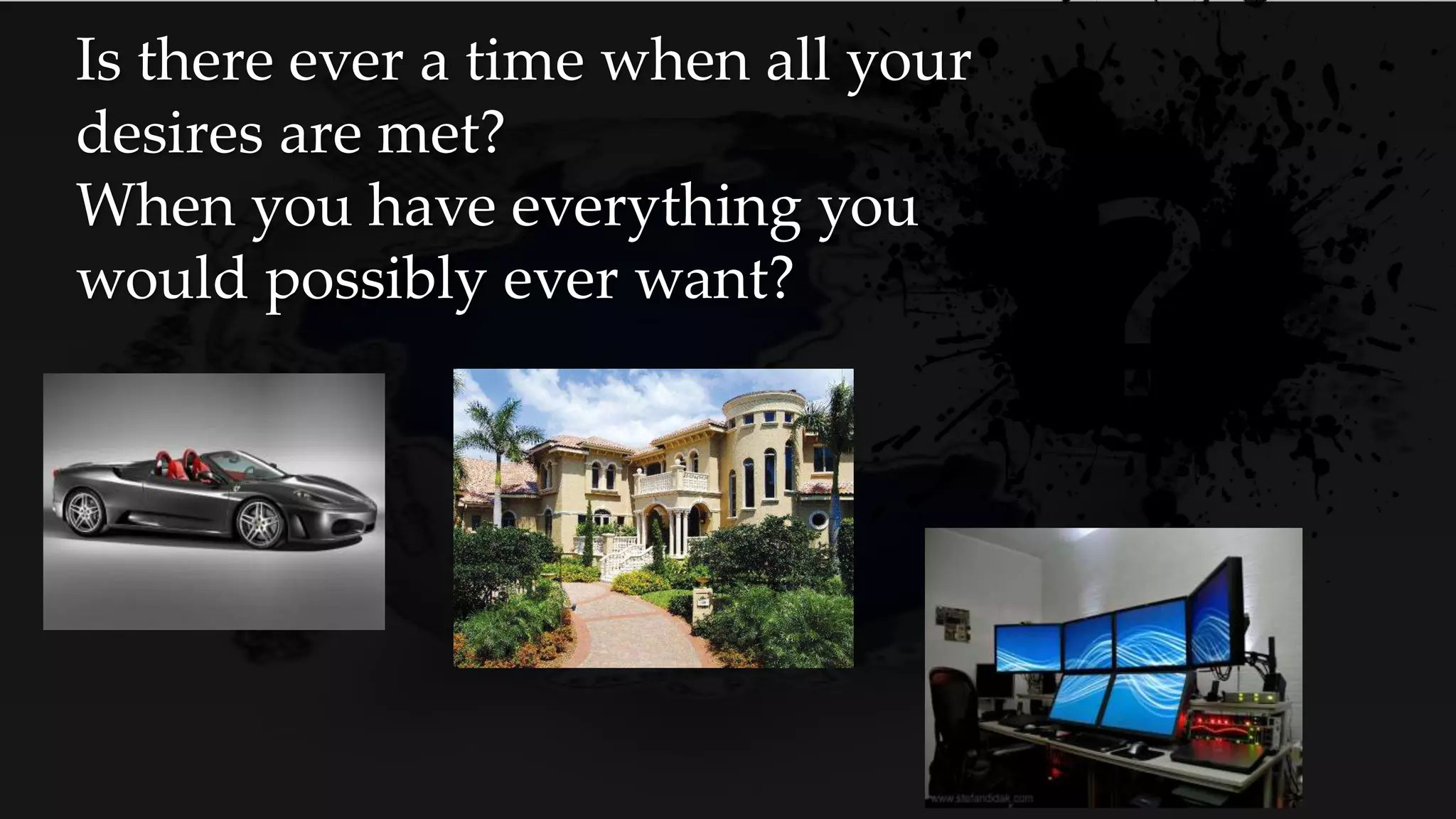
Is there ever a time when all your
desires are met?
When you have everything you
would possibly ever want?
Is there ever a time when all your
desires are met?
When you have everything you
would possibly ever want?
I’m willing to bet there is always
something more that you want…
What Economics is
Economics is a social science, attempting to study
people, their behavior, and the choices that they make.
What Economics is
Economics is a social science, attempting to study
people, their behavior, and the choices that they make.
Textbook Definition:
Economics is the study of
how human beings
coordinate their wants and
desires, given the decision-
making mechanism, social
customs, and political
realities of the society.
What Economics is
Economics is a social science, attempting to study
people, their behavior, and the choices that they make.
Textbook Definition:
Economics is the study of
how human beings
coordinate their wants and
desires, given the decision-
making mechanism, social
customs, and political
realities of the society.
Mr. H’s Definition:
1.) What to produce.
2.) How much to produce.
3.) How to produce it.
4.) Who to produce it for.
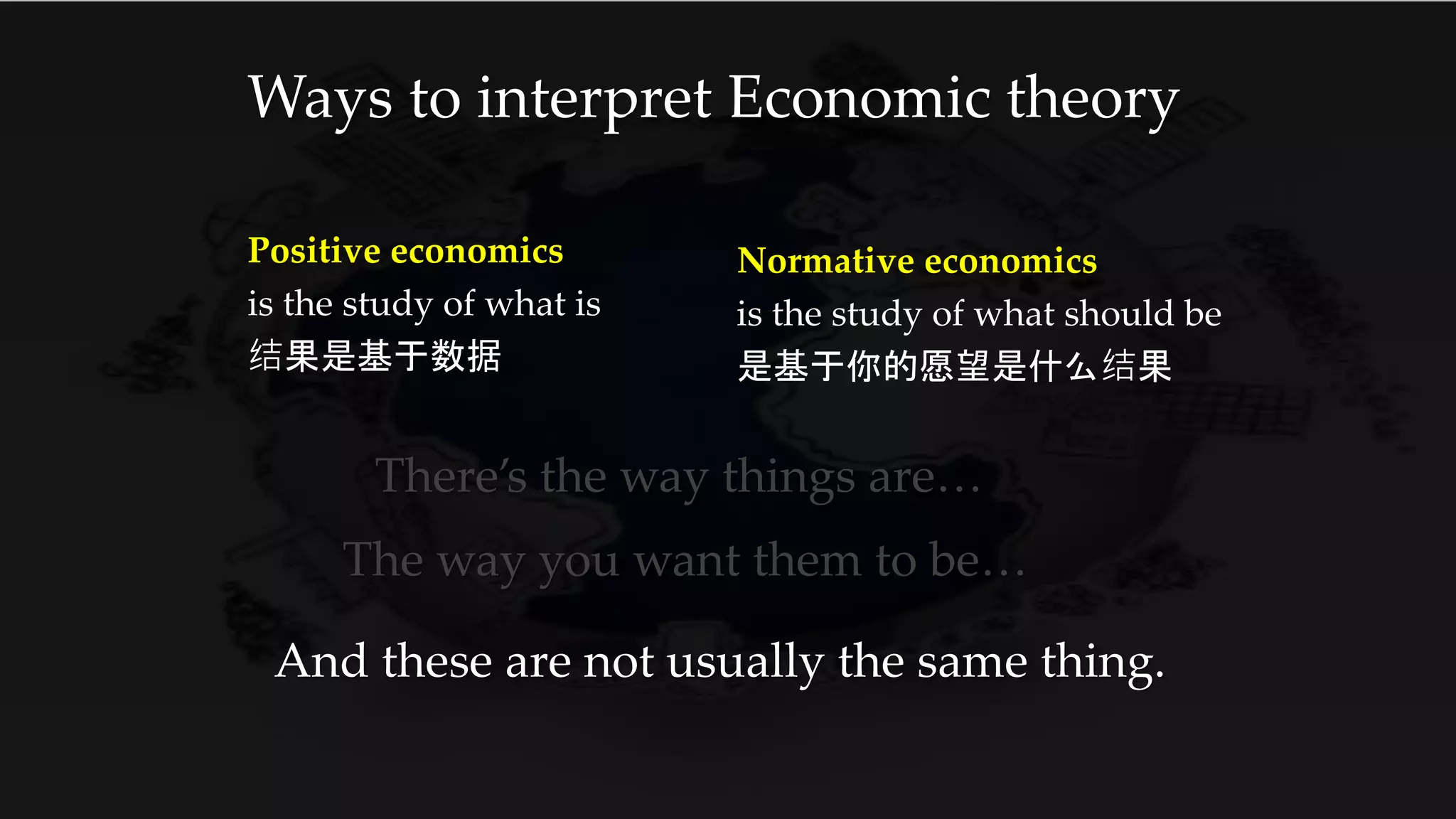
Ways to interpret Economic theory
Positive economics
is the study of what is
结果是基于数据
Normative economics
is the study of what should be
是基于你的愿望是什么结果
Ways to interpret Economic theory
Positive economics
is the study of what is
结果是基于数据
Normative economics
is the study of what should be
是基于你的愿望是什么结果
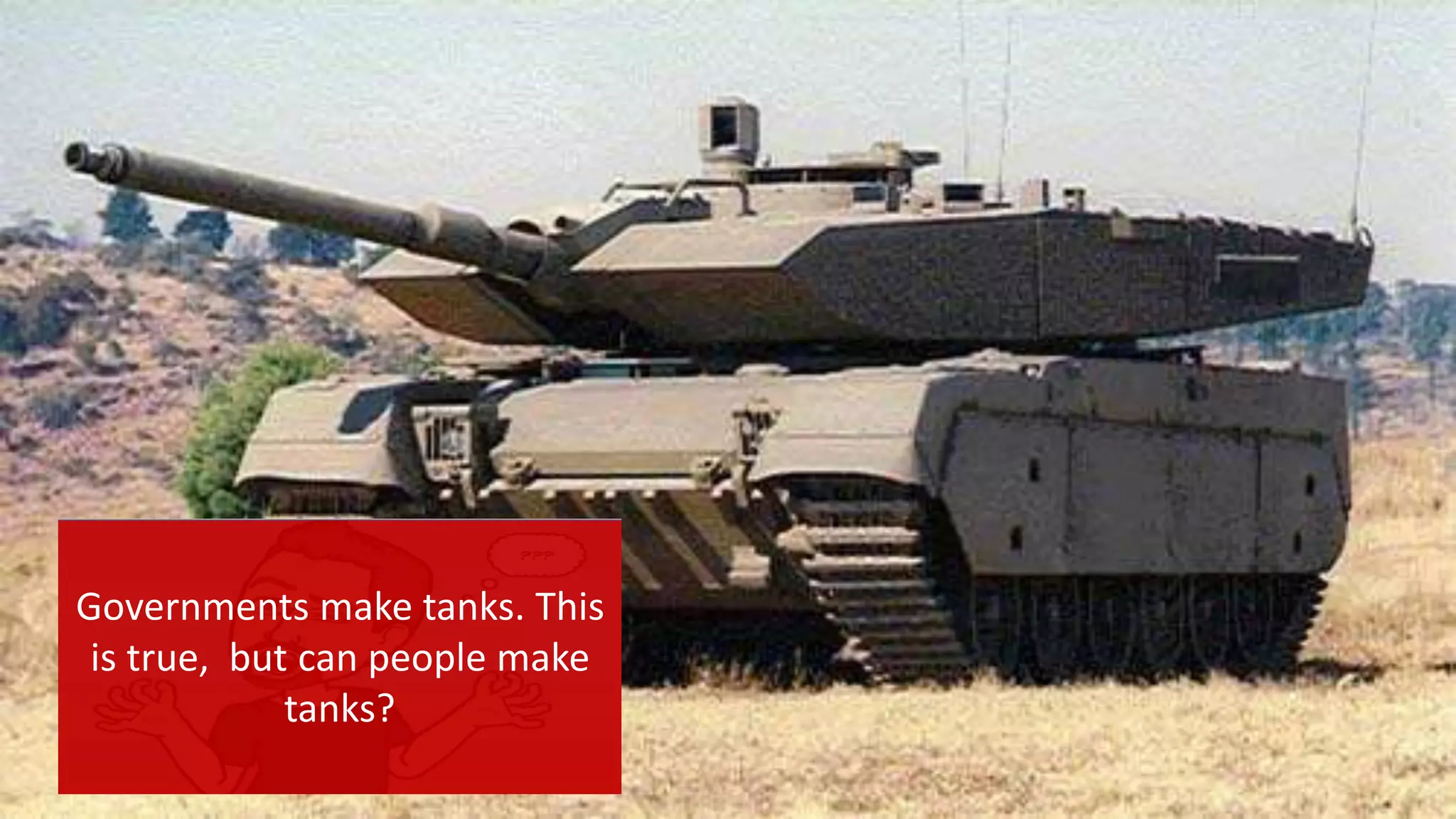
There’s the way things are…
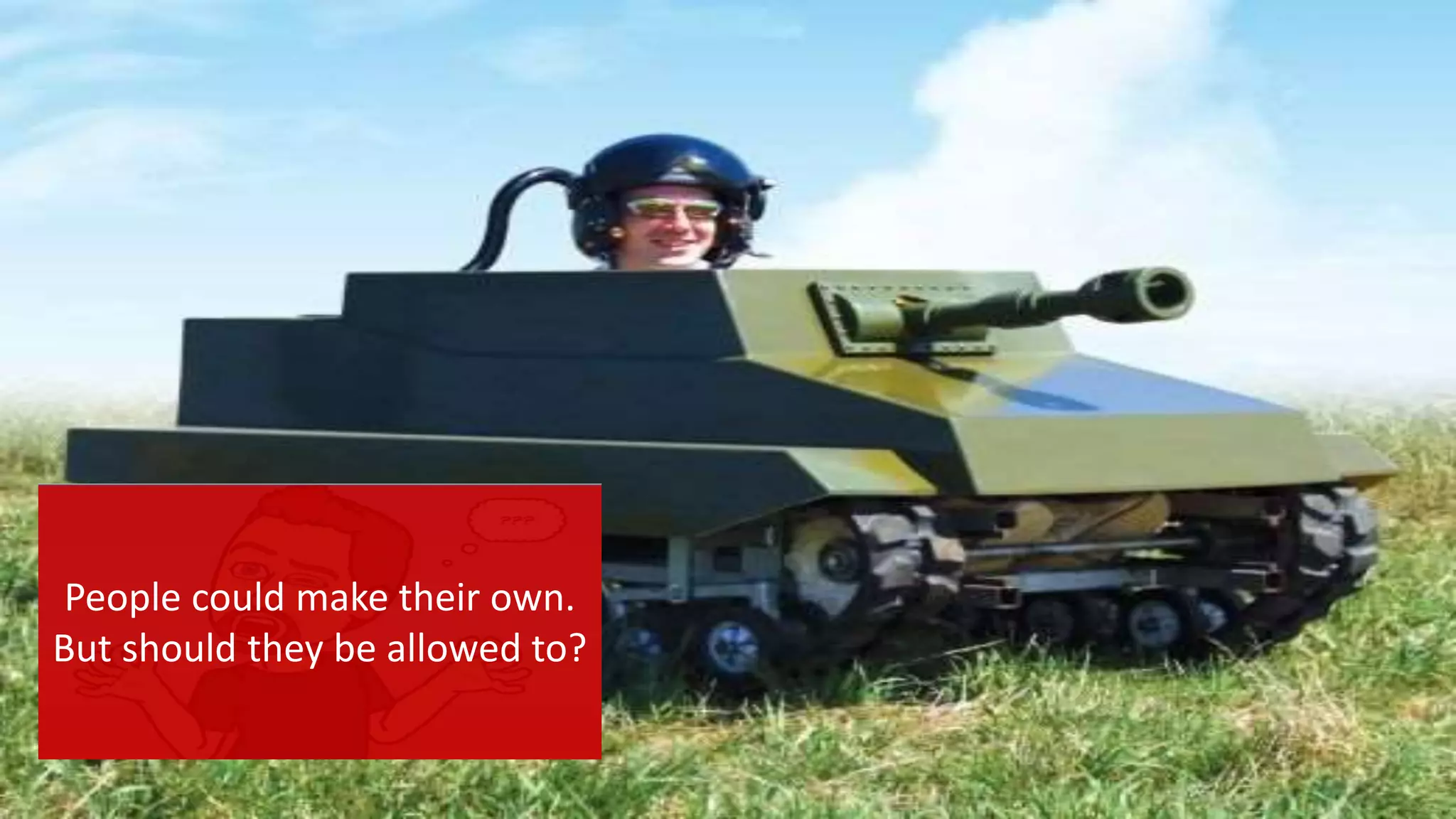
Governments make tanks. This
is true, but can people make
tanks?
People could make their own.
But should they be allowed to?
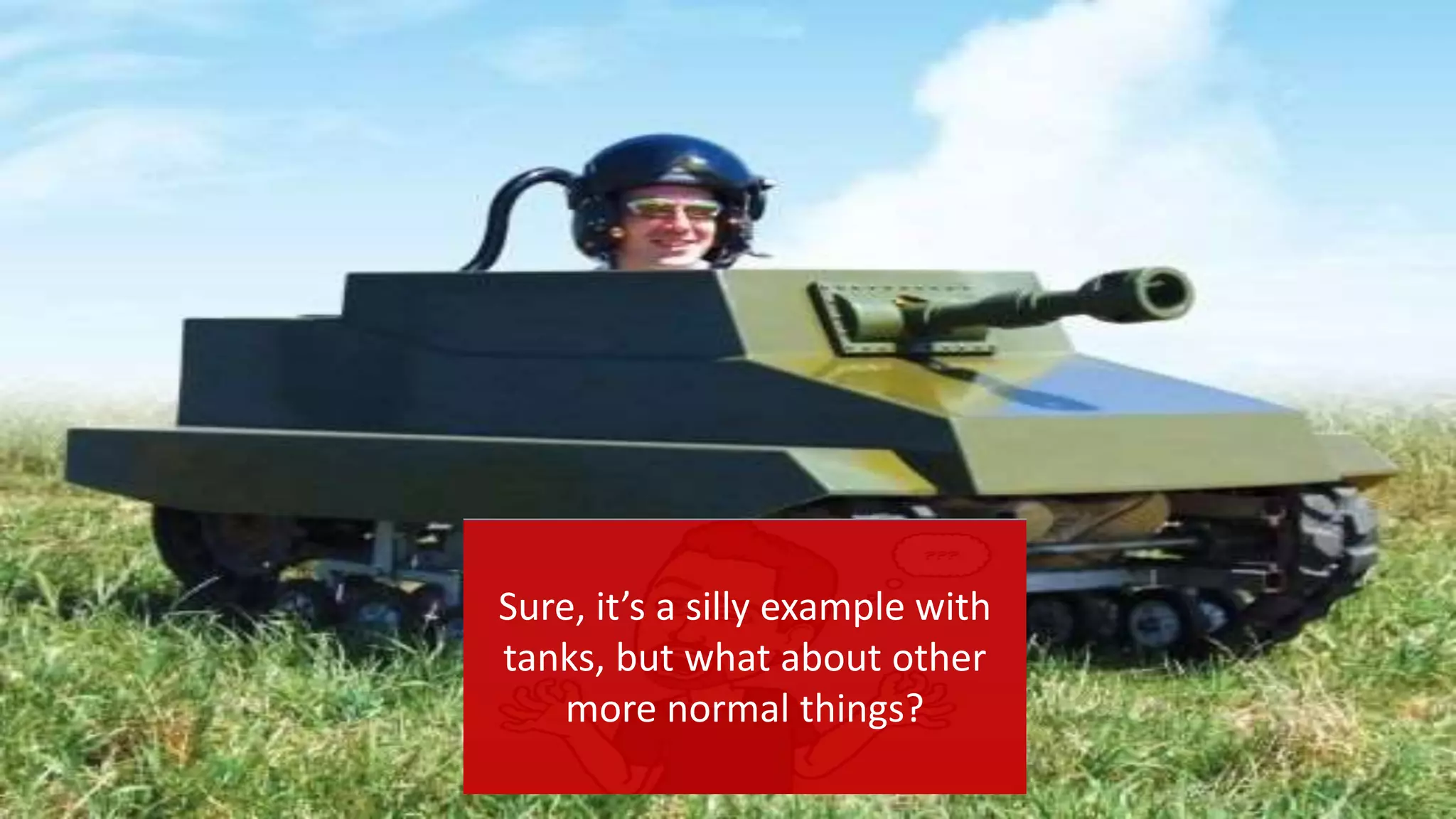
Sure, it’s a silly example with
tanks, but what about other
more normal things?
Ways to interpret Economic theory
Positive economics
is the study of what is
结果是基于数据
Normative economics
is the study of what should be
是基于你的愿望是什么结果
There’s the way things are…
The way you want them to be…
Ways to interpret Economic theory
Positive economics
is the study of what is
结果是基于数据
Normative economics
is the study of what should be
是基于你的愿望是什么结果
There’s the way things are…
The way you want them to be…
And these are not usually the same thing.
Ways to interpret Economic theory
Positive economics
is the study of what is
结果是基于数据
Normative economics
is the study of what should be
是基于你的愿望是什么结果
And these are not usually the same thing.
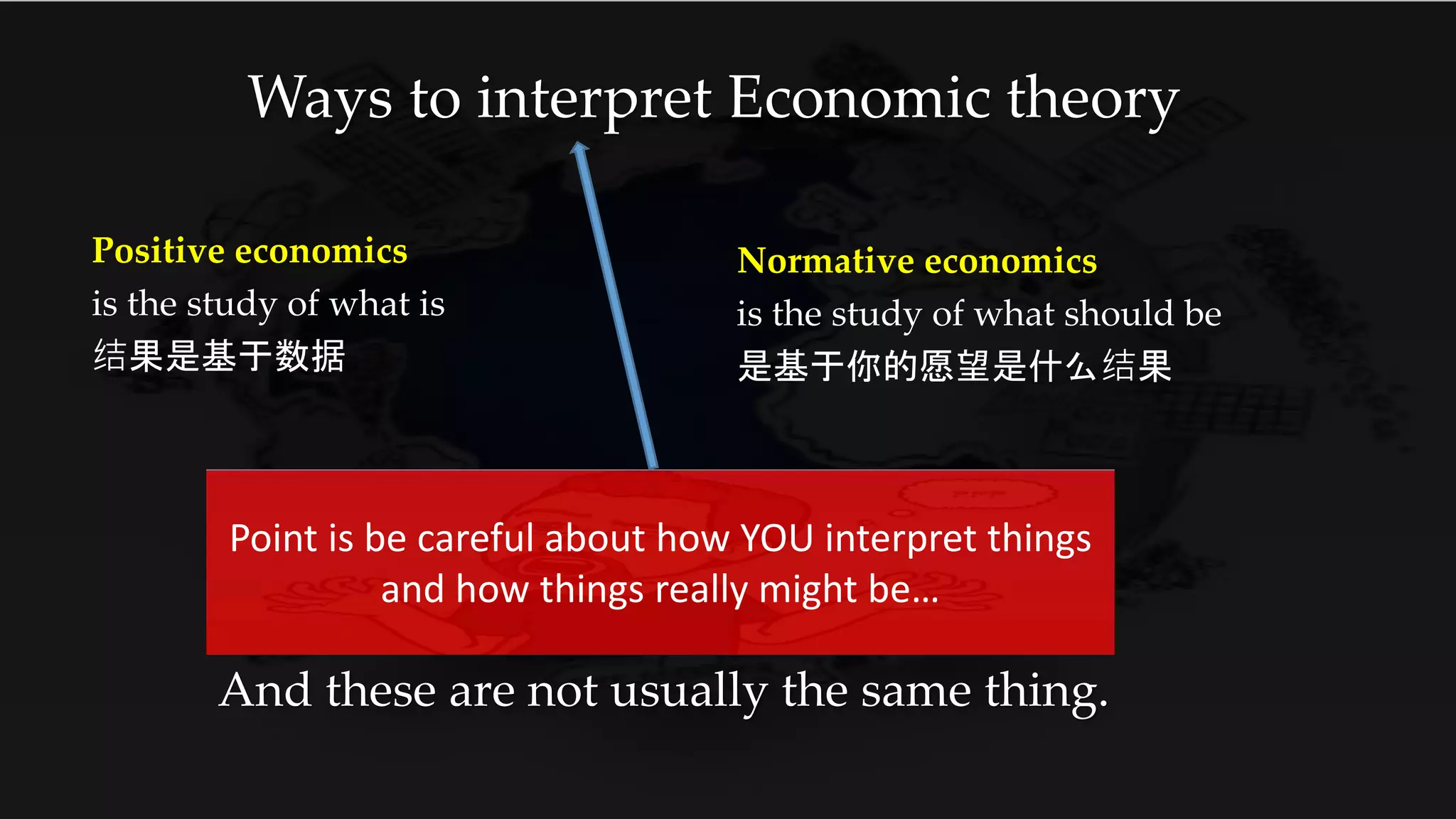
Point is be careful about how YOU interpret things
and how things really might be…
6 basic concepts that you will see
again, and again, and again, and
again, throughout your whole time in
class.
Basic ideas of Economics
1.) Resources are
Scarce.
Land
Labor
Capital
Entrepreneurship
- the quantity available is
not large enough to satisfy
all productive uses and all
of people’s desires.
- there is not enough stuff
for everyone.
- Unlimited wants, limited
resources.
Basic ideas of Economics
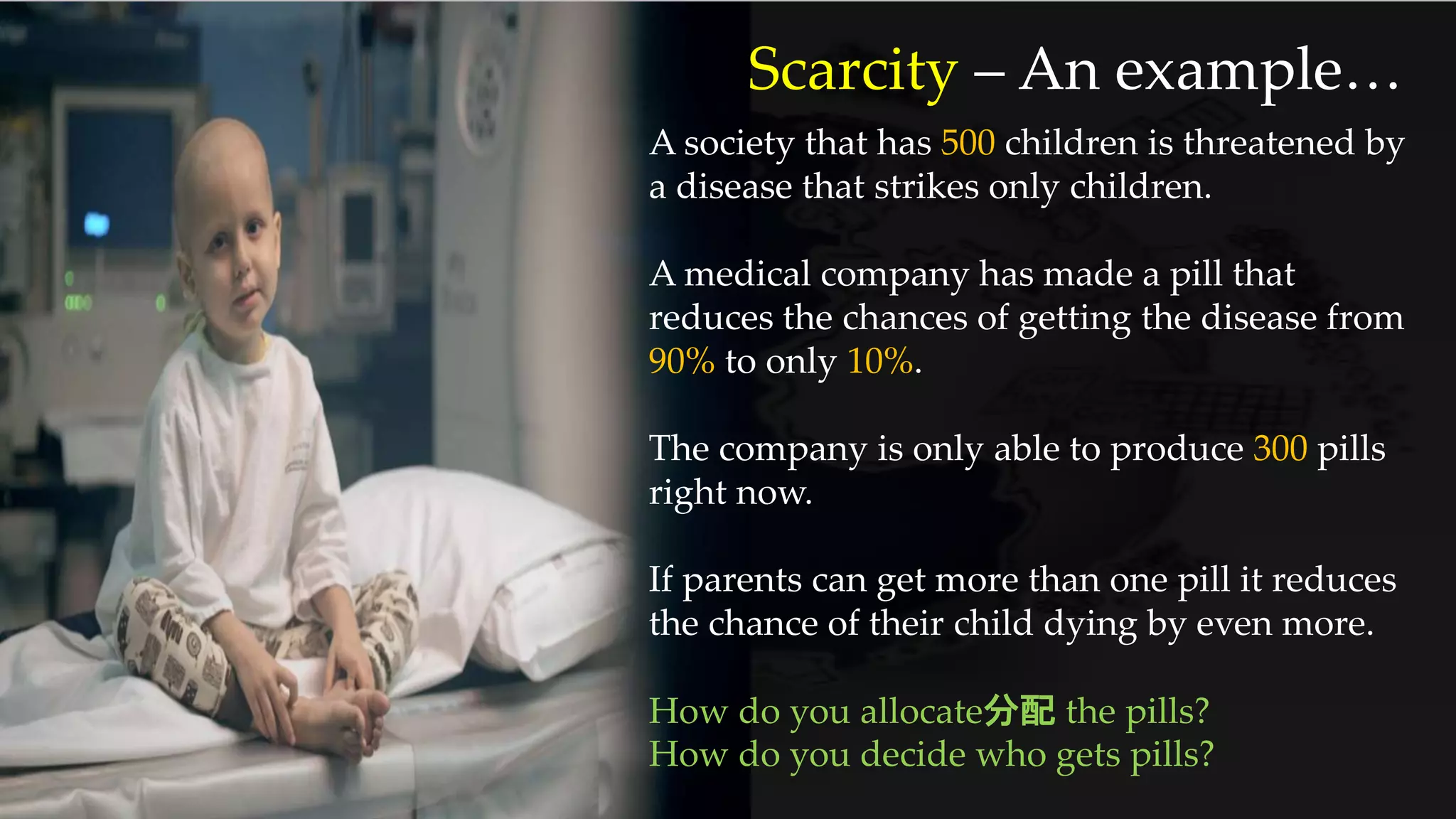
Scarcity – An example…
A society that has 500 children is threatened by
a disease that strikes only children.
A medical company has made a pill that
reduces the chances of getting the disease from
90% to only 10%.
The company is only able to produce 300 pills
right now.
If parents can get more than one pill it reduces
the chance of their child dying by even more.
How do you allocate分配 the pills?
How do you decide who gets pills?
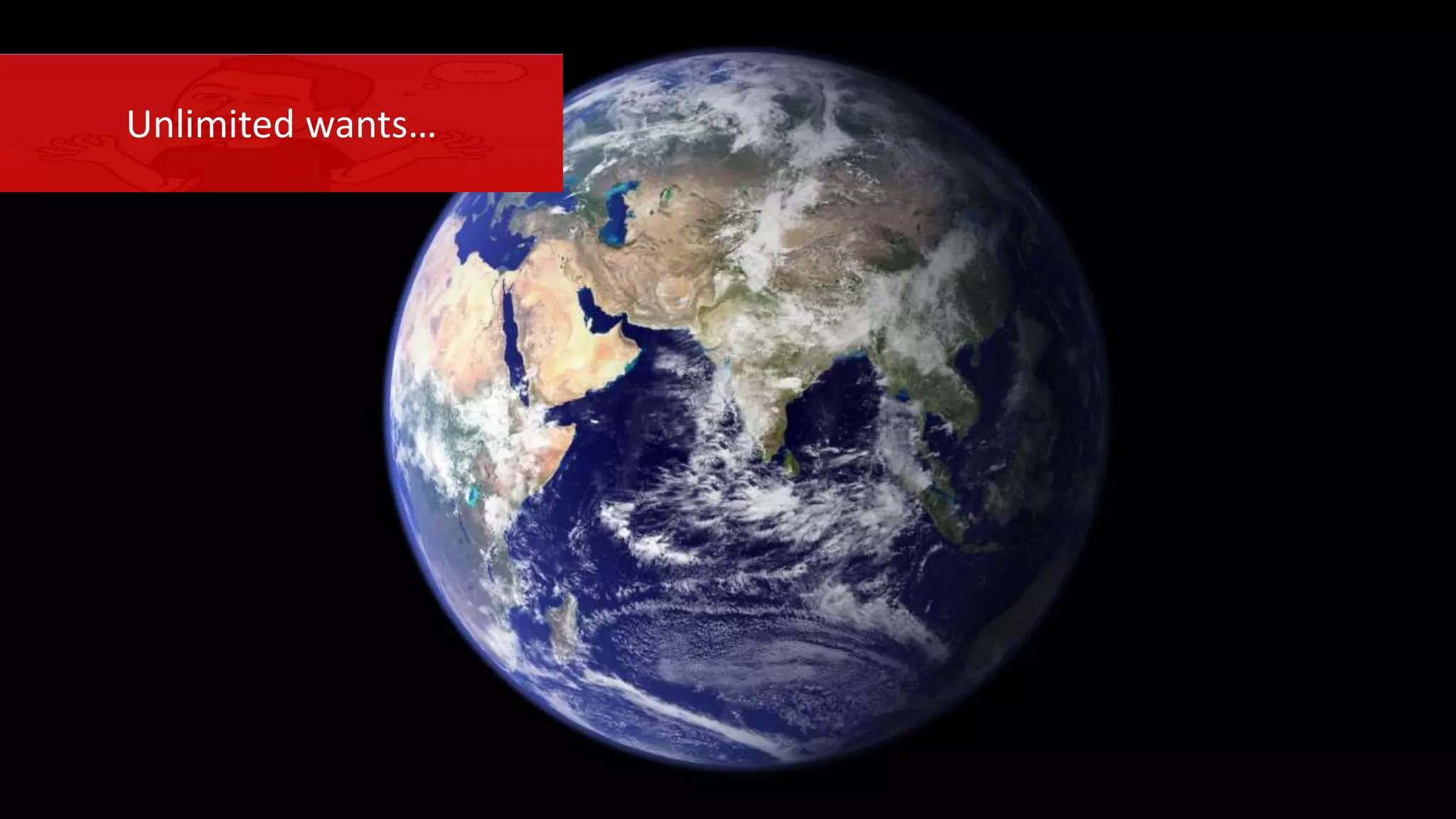
Unlimited wants…
Unlimited wants…
But limited resources…
2.) Trade - Offs
The big trade off in society is
between
efficiency and equality.
- Making decisions requires
trading one thing for another
效率 平等
1.) Resources are Scarce.
Basic ideas of Economics
“There is no such thing as a free lunch”
you don't get something for nothing
鱼与熊掌不可兼得
2.) Trade – Offs …..
{
Can’t do this in class…
{
And expect to achieve this at
the same time.
{
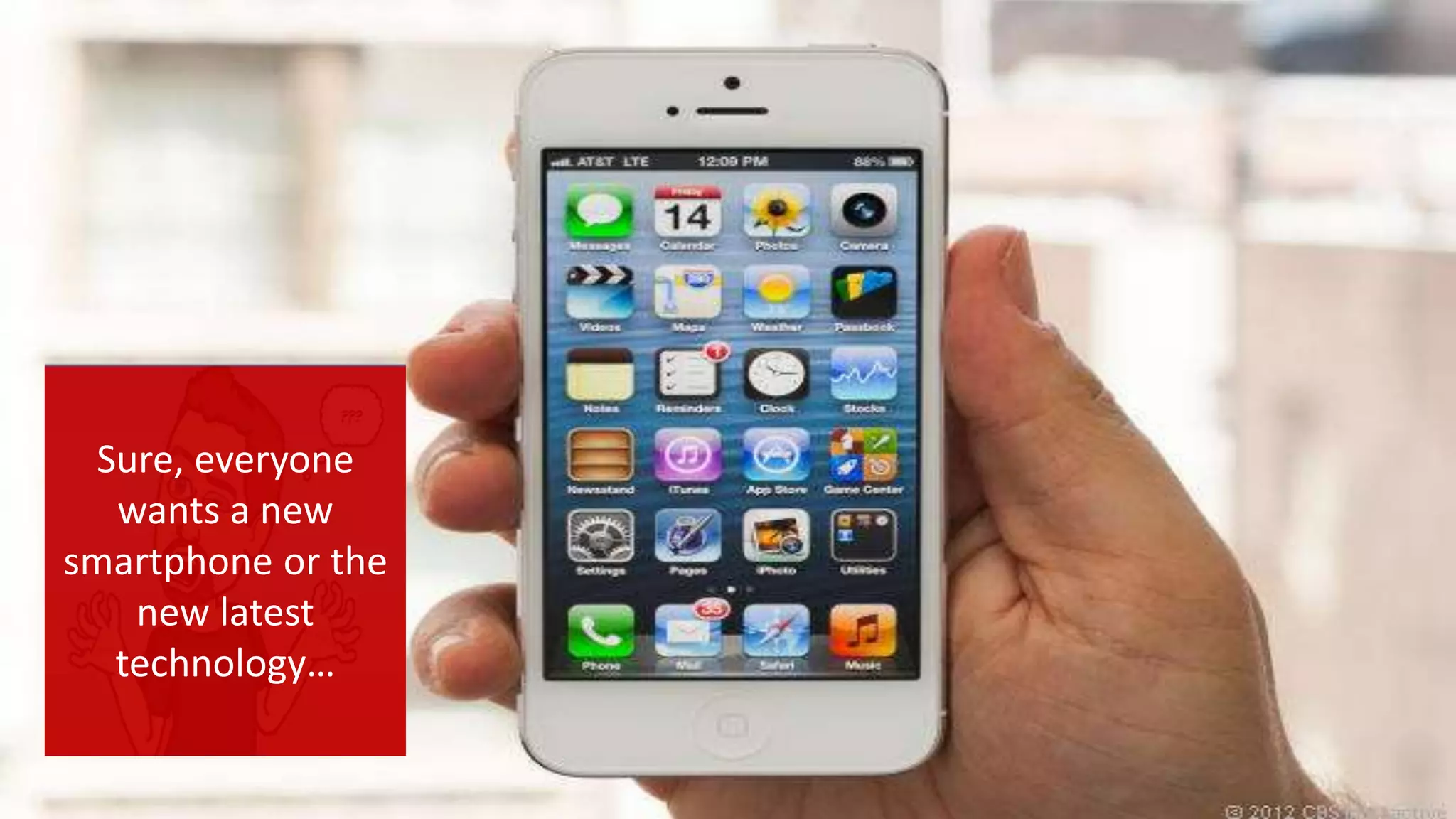
Sure, everyone
wants a new
smartphone or the
new latest
technology…
Are you will to accept the trade
off of the pollution created to
make it all?
1.) Resources are Scarce.
2.) Trade - Offs
3.) Opportunity Costs - The real cost of something
is what you must give up to
get it.
*** The next option – not every
single option
Basic ideas of Economics
Everything has a Cost
To an economist, everything has a value that
you can be measured by ho much you give up
of something else.
How much are the following worth to you?
--- A pen.
--- A coffee cup
--- Your pet
--- Your time
--- Your finger
--- A human life
Everything has a Cost
To an economist, everything has a value that
you can be measured by ho much you give up
of something else.
How much are the following worth to you?
--- A pen.
--- A coffee cup
--- Your pet
--- Your time
--- Your finger
--- A human life
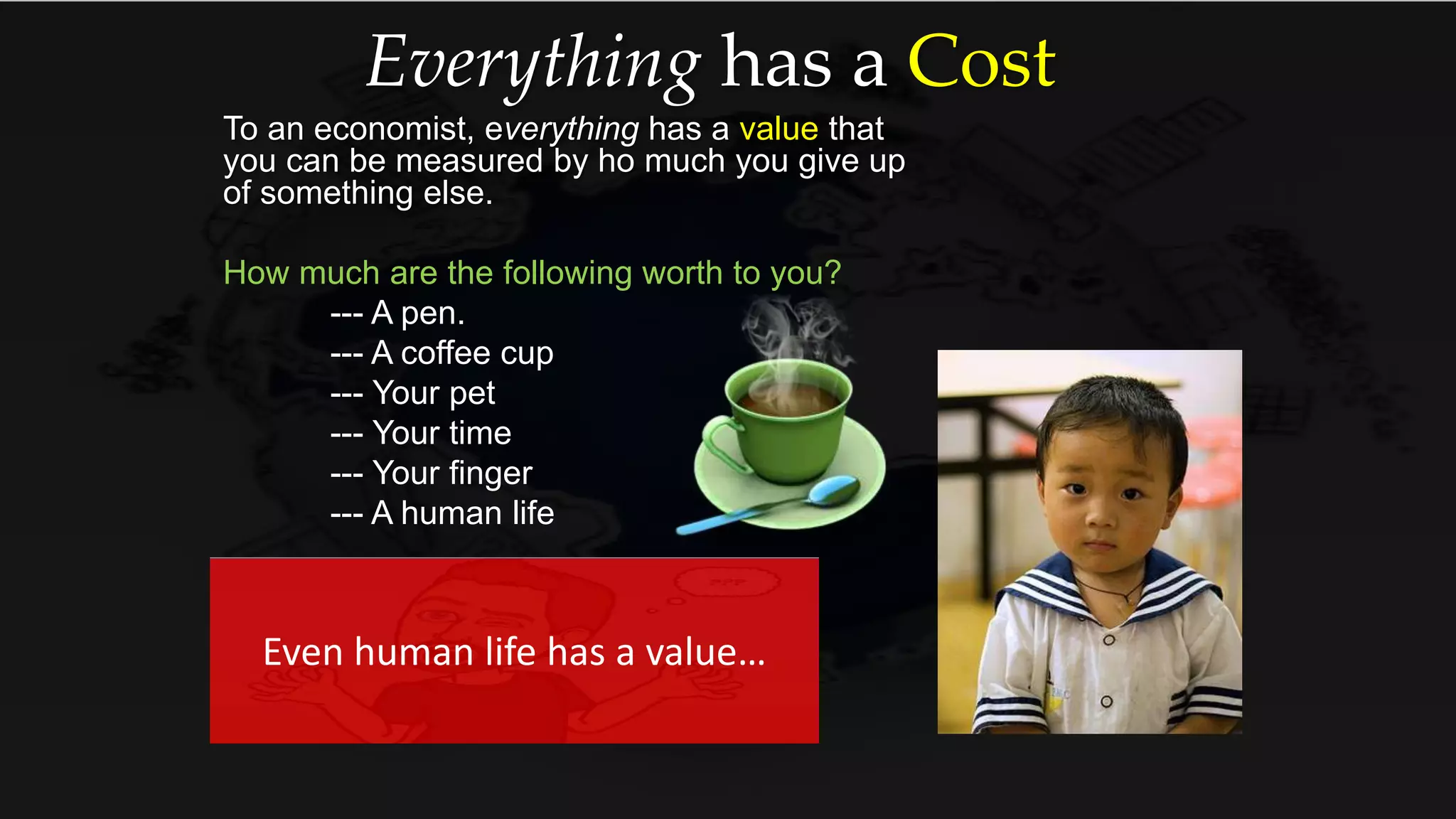
Even human life has a value…
Someone has to decide how
many number of police to have,
security, etc…
How many police is enough?
Is your life worth the extra
resources?
3.) Opportunity Costs …..
Making decisions requires individuals to consider the benefits
and costs of some action.
每一项决策是有成本的
What you must give up when you make a decision
Examples:
--- I decide to come here today.
--- I decide to work on my lesson plans last night.
--- I decide to spend time with my daughter.
--- I decided to move to China.
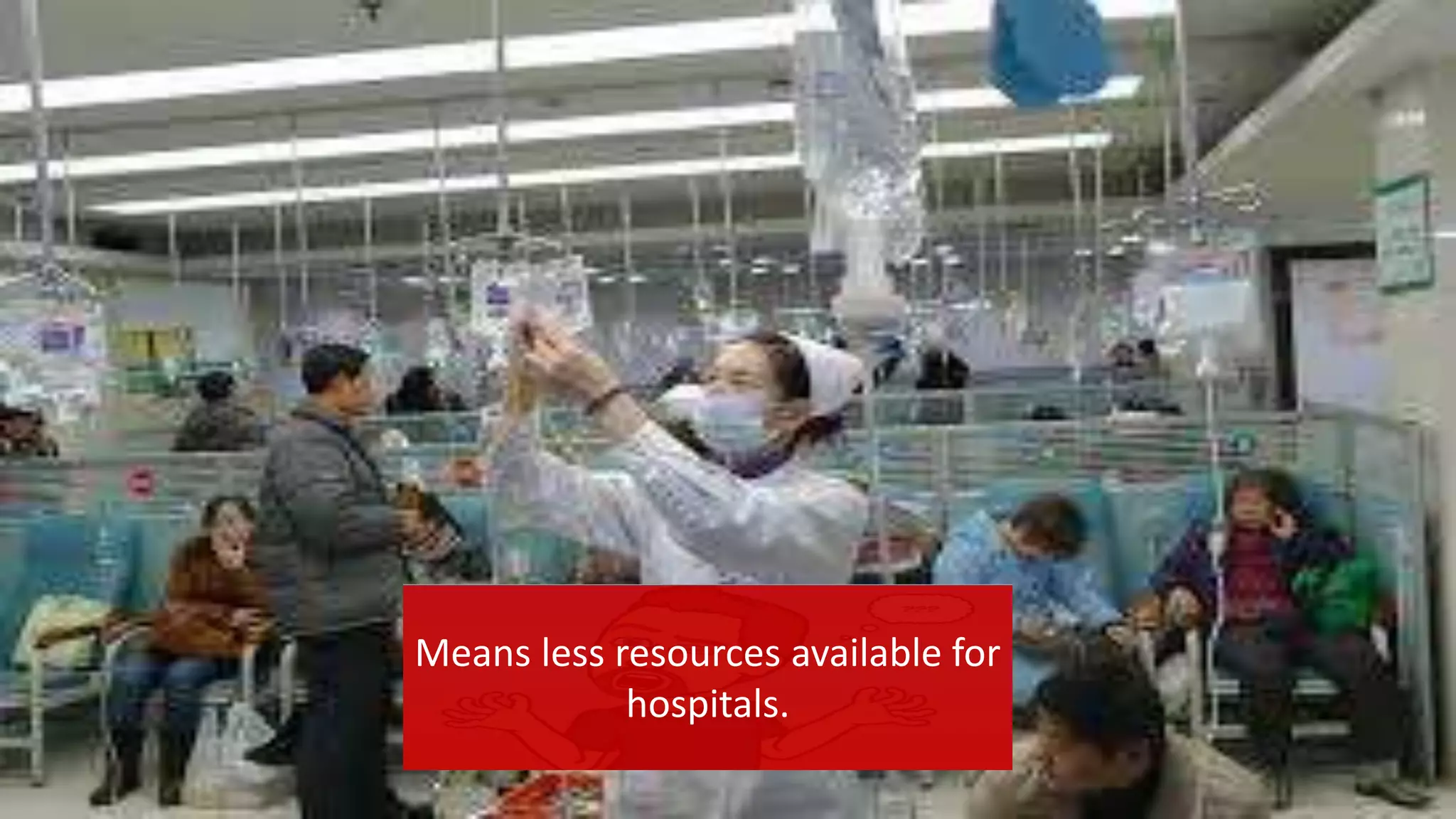
Resources used to build new
tanks…
{
Means less resources available for
hospitals.
1.) Resources are Scarce.
2.) Trade - Offs
3.) Opportunity Costs
4.) Marginal Thinking - Means an additional one, the
measurement from one unit to
the next. 最后的东西之一
“How much?” is a decision at
the margin. (the very last unit,
not of everything)
Basic ideas of Economics
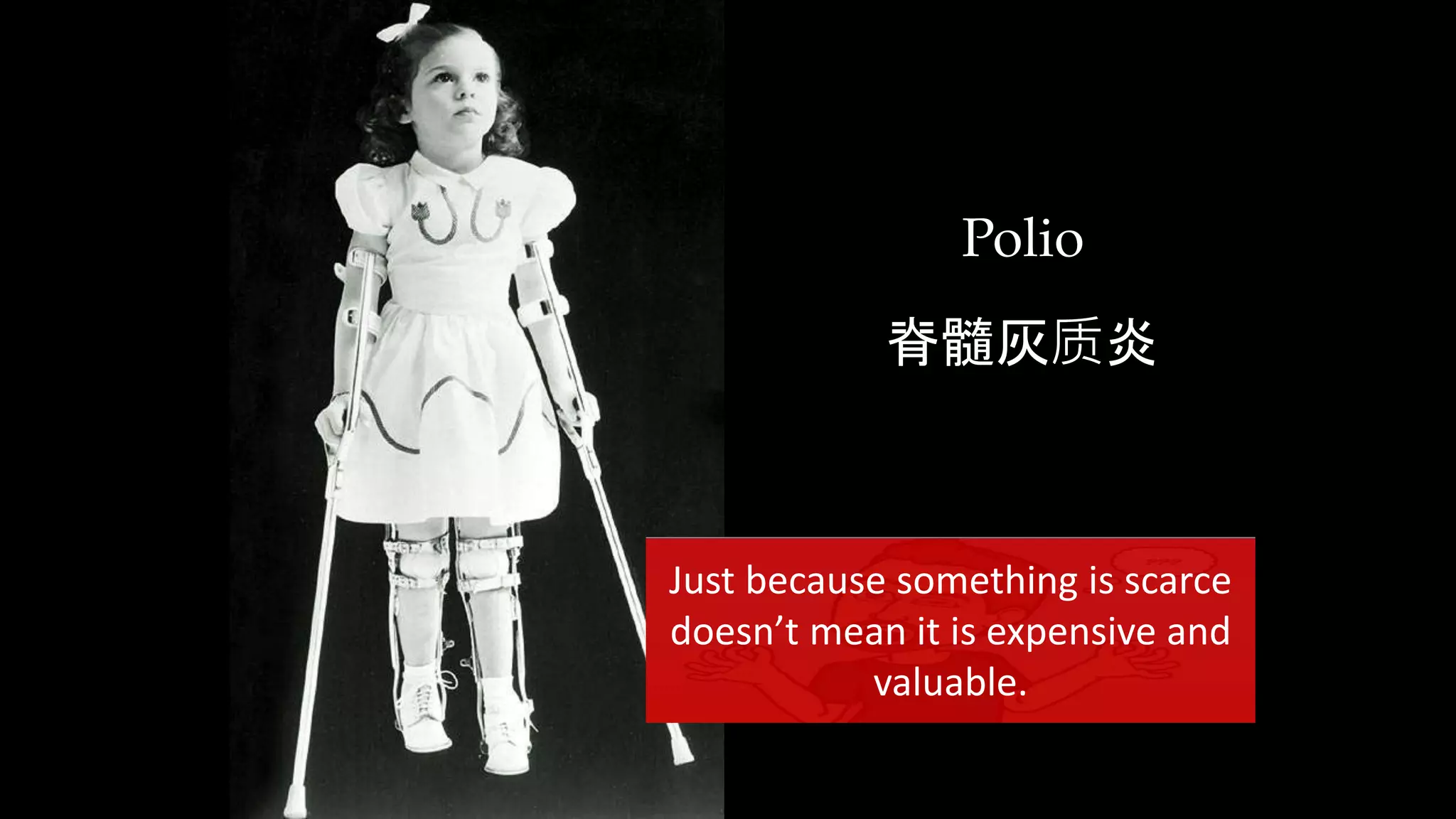
Which one is worth more? Why?
脊髓灰质炎
Polio
Just because something is scarce
doesn’t mean it is expensive and
valuable.
{A short lesson on Marginal
Understanding…
{
This delicious drink costs
1 rmb
{
{
This made me very
happy to drink!
{
Oh look another one!
Also cost 1 rmb
{
{
This made me happy to
drink!
{
Oh look another one!
Also cost 1 rmb
{
{
OK, a little full now
{
Oh look another one?
Also cost 1 rmb
{
{
This one also made me
very happy to drink.
{
Oh look another one?
Also cost 1 rmb
{
{
…
{
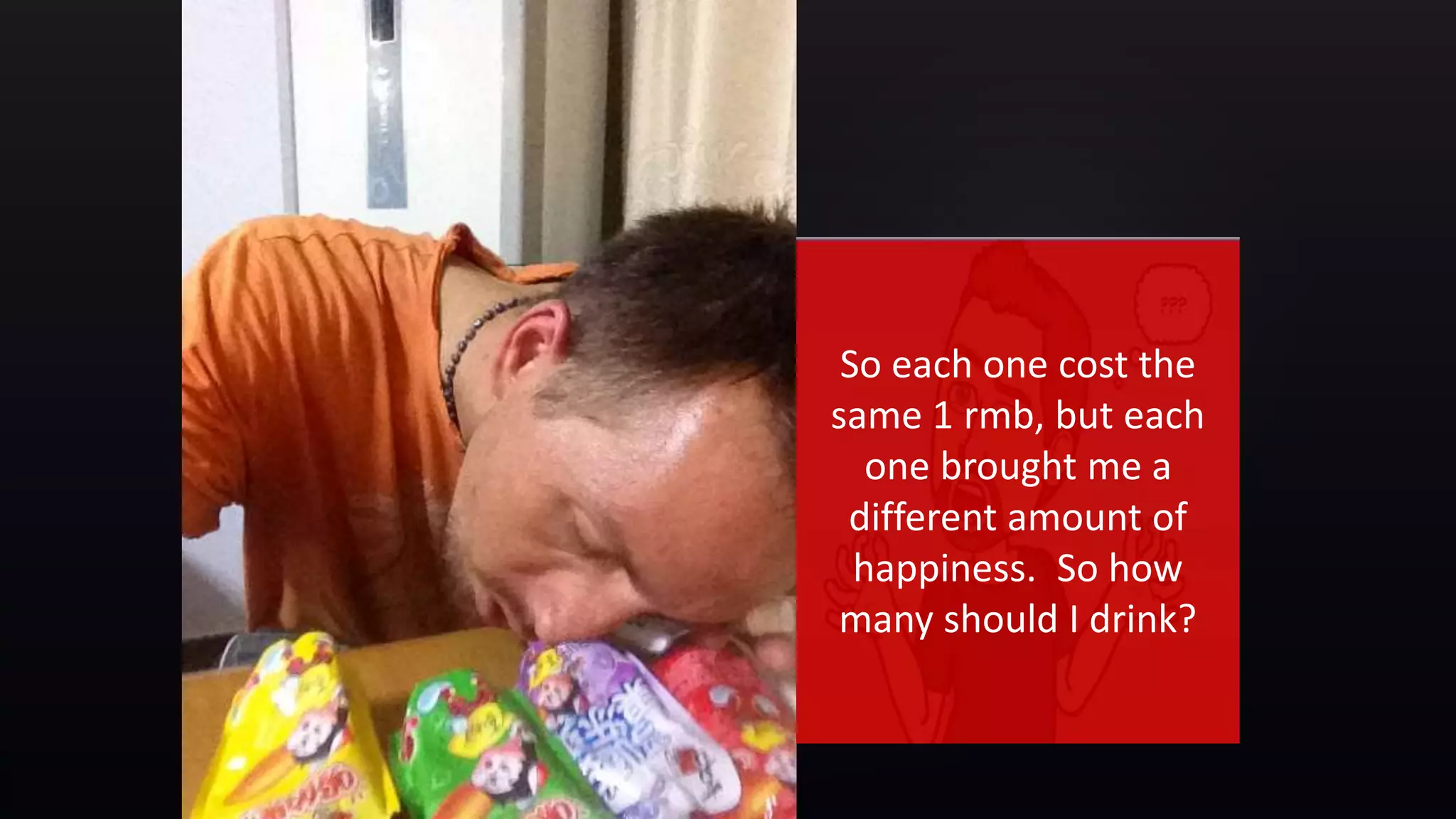
So each one cost the
same 1 rmb, but each
one brought me a
different amount of
happiness. So how
many should I drink?
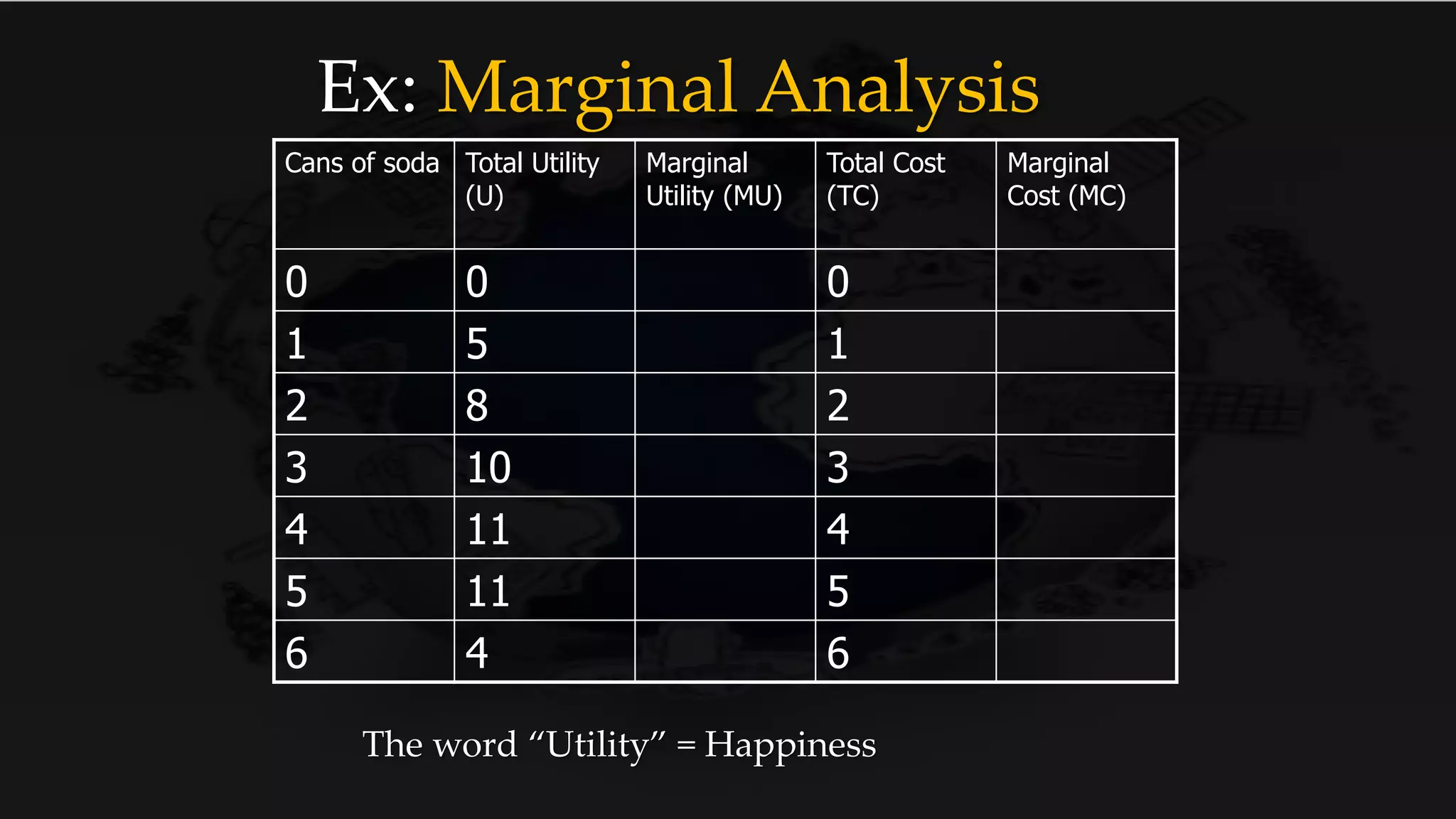
Ex: Marginal Analysis
Cans of soda Total Utility
(U)
Marginal
Utility (MU)
Total Cost
(TC)
Marginal
Cost (MC)
0 0 0
1 5 1
2 8 2
3 10 3
4 11 4
5 11 5
6 4 6
The word “Utility” = Happiness
Cans of Soda Total Utility
(U)
Marginal
Utility (MU)
Total Cost
(TC)
Marginal
Cost (MC)
0 0 -- 0 --
1 5 5 1 1
2 8 3 2 1
3 10 2 3 1
4 11 1 4 1
5 11 0 5 1
6 4 -7 6 1
Ex: Marginal Analysis
The word “Utility” = Happiness
drinks Total Utility
(U)
Marginal
Utility (MU)
Total Cost
(TC)
Marginal
Cost (MC)
0 0 -- 0 --
1 5 5 1 1
2 8 3 2 1
3 10 2 3 1
4 11 1 4 1
5 11 0 5 1
6 4 -7 6 1
Ex: Marginal Analysis
The word “Utility” = Happiness
What does Rational mean?
合理的
What does mean to be Rational?
1.) Resources are Scarce.
Basic ideas of Economics
2.) Trade - Offs
3.) Opportunity Costs
4.) Marginal Thinking.
5.) Rational Thinking - People usually exploit
opportunities to make
themselves better off.
合理的
人们通常利用机会来
改善自己的境况。
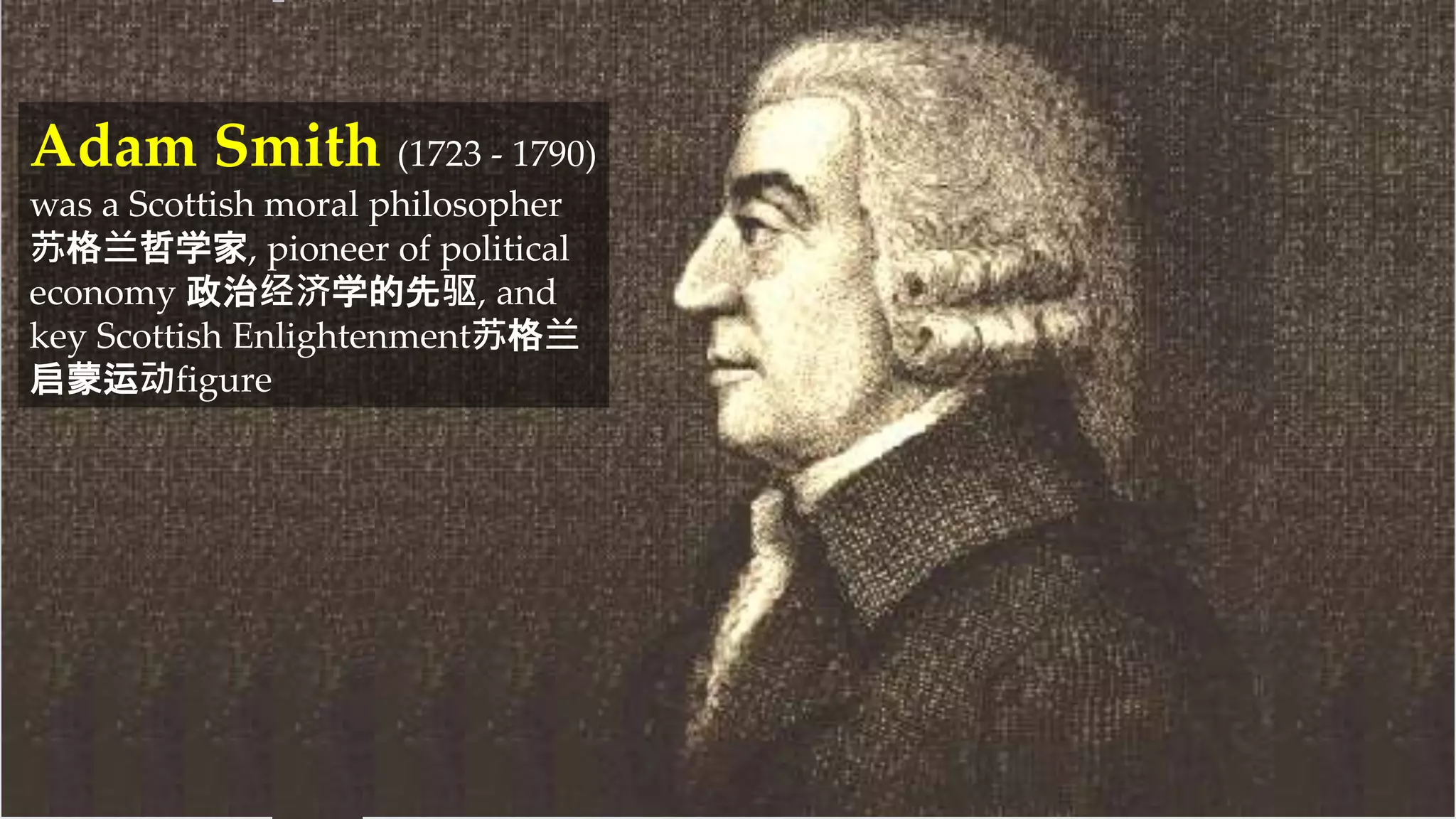
Adam Smith (1723 - 1790)
was a Scottish moral philosopher
苏格兰哲学家, pioneer of political
economy 政治经济学的先驱, and
key Scottish Enlightenment苏格兰
启蒙运动figure
Adam Smith (1723 - 1790)
was a Scottish moral philosopher
苏格兰哲学家, pioneer of political
economy 政治经济学的先驱, and
key Scottish Enlightenment苏格兰
启蒙运动figure
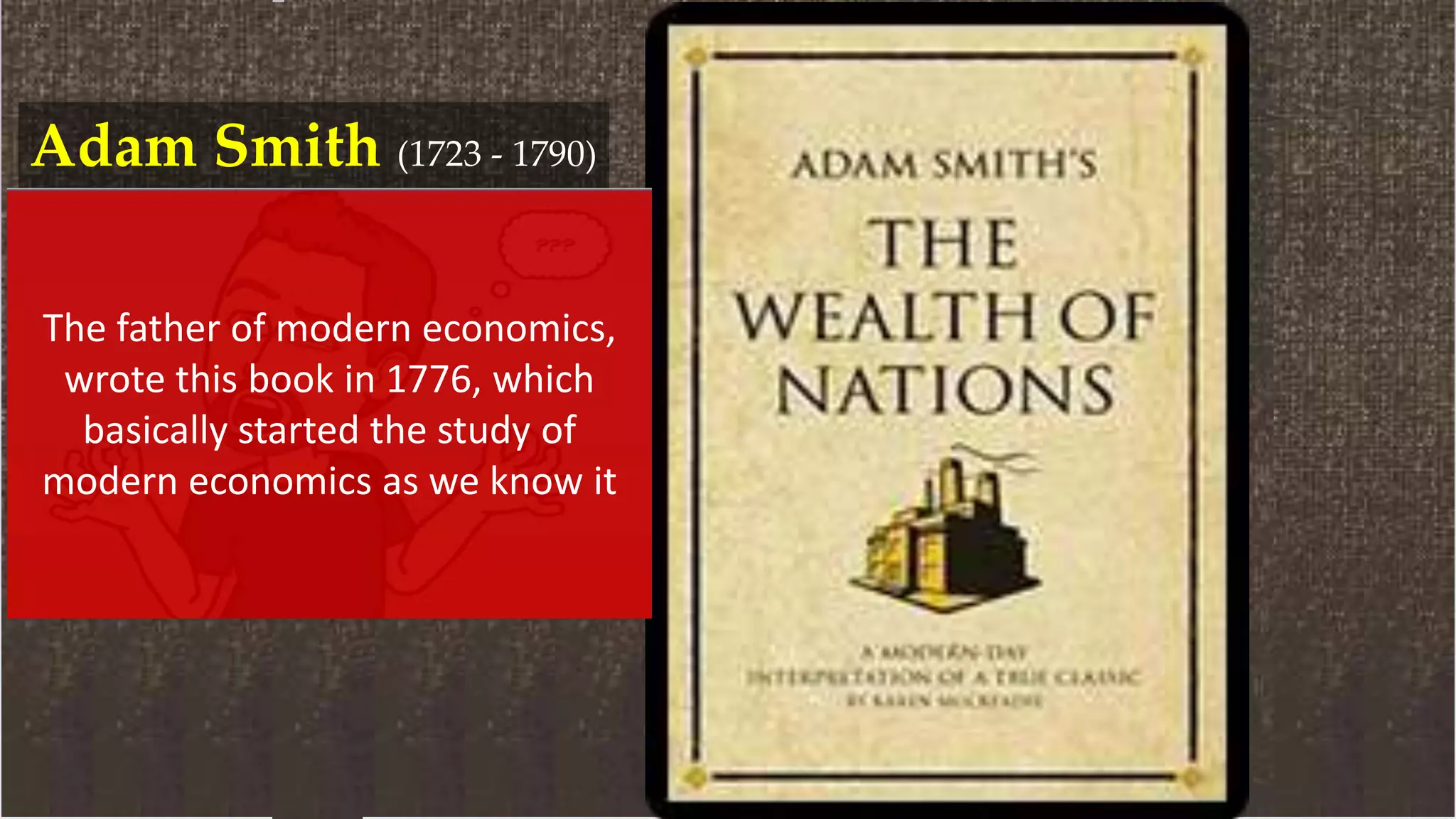
The father of modern economics,
wrote this book in 1776, which
basically started the study of
modern economics as we know it
{
“It is not from the benevolence
of the butcher, the brewer, or the
baker, that we can expect our
dinner, but from their regard to
their own interest”
“这不是从仁的屠夫,酿酒商,或
面包师,我们可以期望我们的晚
餐,但他们关于自己的兴趣”
Adam Smith’s famous book
The Wealth of Nations
To be rational is
also to be selfish
and this is good
for society.
You are at a store about to buy a fancy new notebook. It costs
100RMB. Before you buy it, your friend calls from a store 30
minutes away, that is selling the same notebook for 50MB. Would
you drive to the other store to get the cheaper price?
Ex: Rational Behavior and Self-Interest
You buy the cheaper
book right? Save 50%
of the price right?
Ex: Rational Behavior and Self-Interest
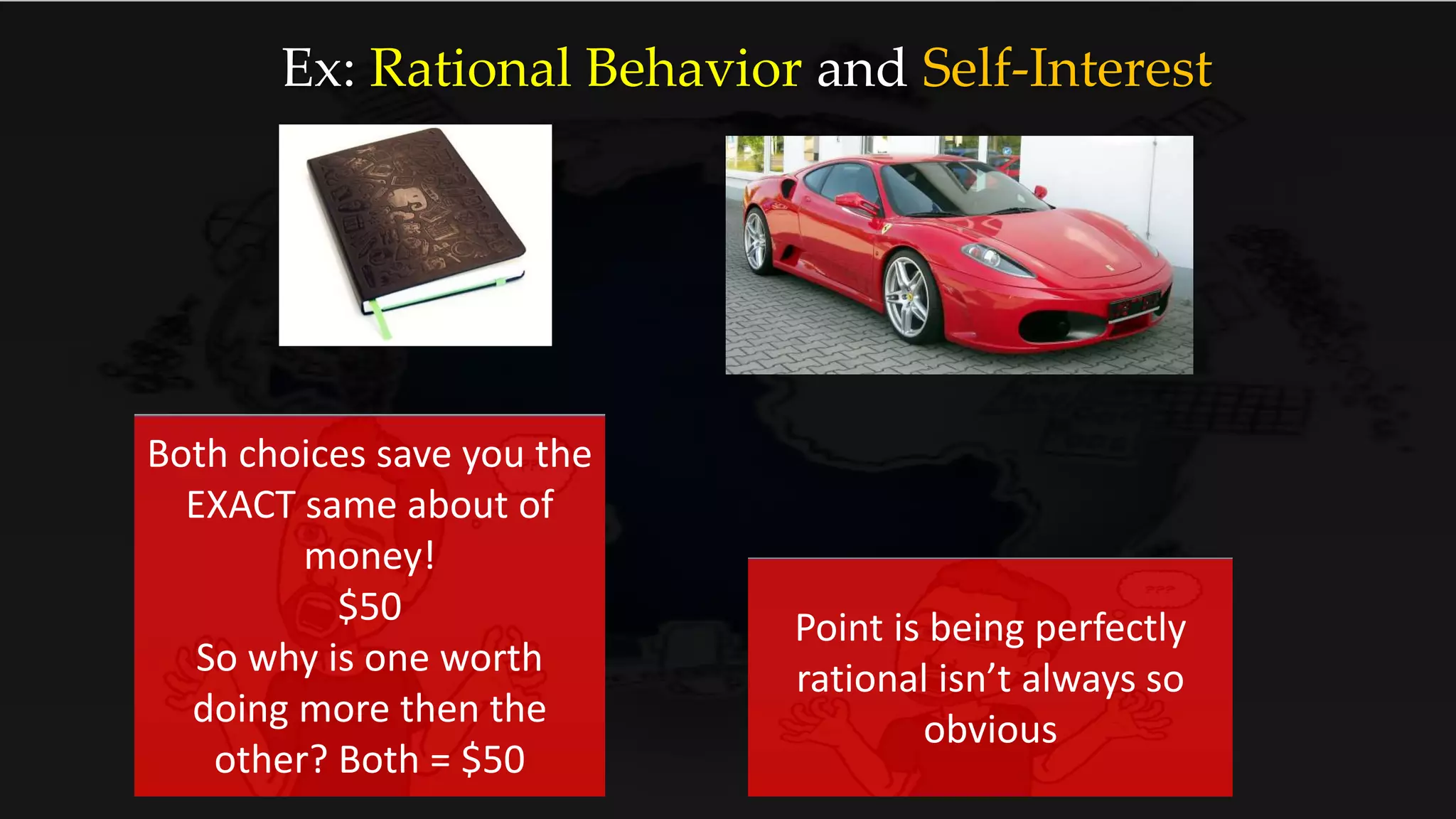
You are at a car dealership about to buy a new car. It costs 380,000RMB.
Before you buy it, your friend calls from a car dealership 30 minutes
away, that is selling the same car for 379,950RMB. Would you drive to
the other store to get the cheaper price?
You don’t buy the
cheaper car,
seems silly right?
Ex: Rational Behavior and Self-Interest
Both choices save you the
EXACT same about of
money!
$50
So why is one worth
doing more then the
other? Both = $50
Point is being perfectly
rational isn’t always so
obvious
Are you good at what you do?
1.) Resources are Scarce.
Basic ideas of Economics
2.) Trade - Offs
3.) Opportunity Costs
4.) Marginal Thinking.
5.) Rational Thinking
6.) Specialization
Also related to Productivity
- You do what you do best,
others do what they do best,
and everyone has more.
专业化
生产率
Adam Smith (1723 - 1790)
was a Scottish moral philosopher
苏格兰哲学家, pioneer of political
economy 政治经济学的先驱, and
key Scottish Enlightenment苏格兰
启蒙运动figure
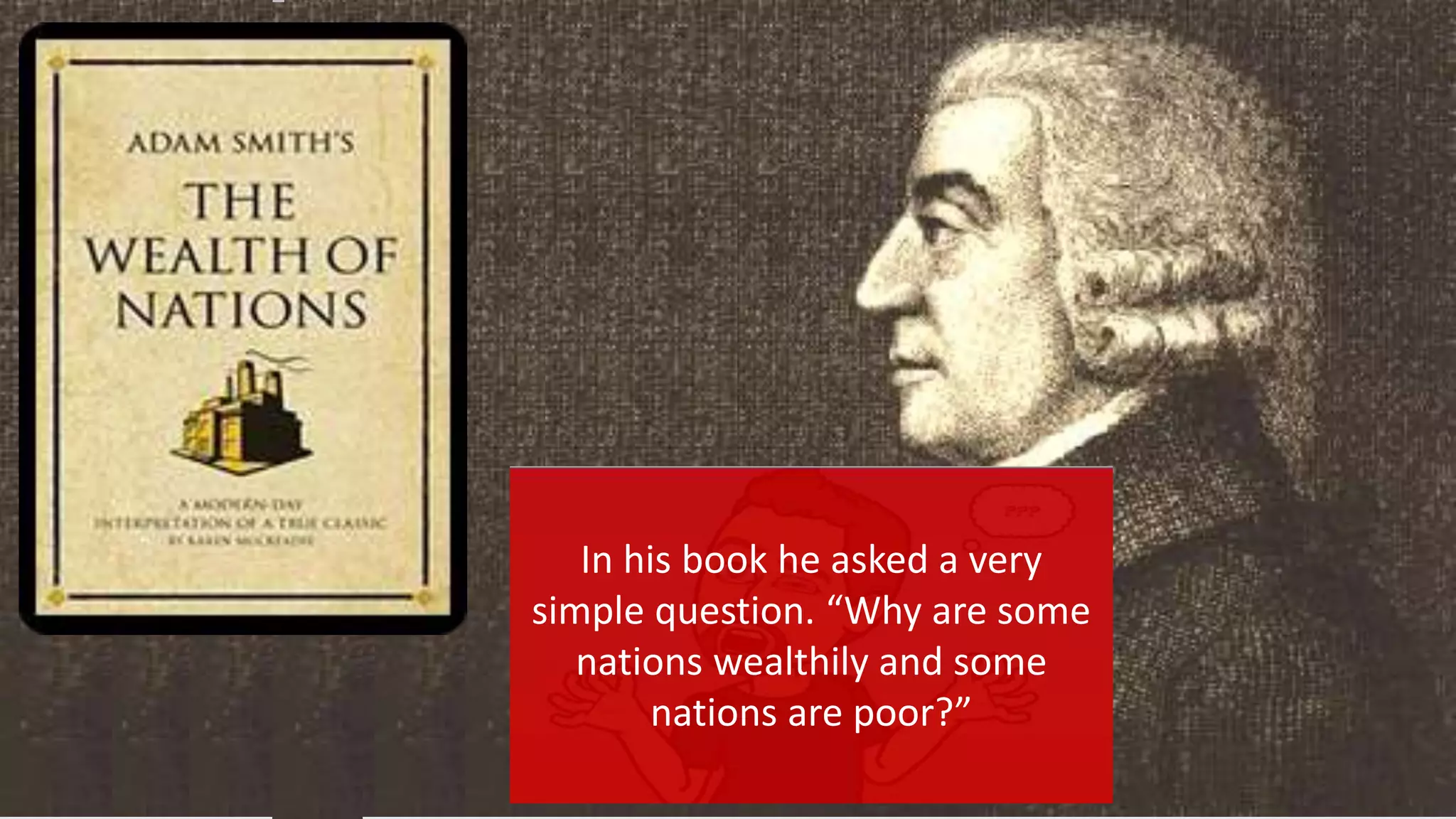
In his book he asked a very
simple question. “Why are some
nations wealthily and some
nations are poor?”
He visited a pin factory
and discovered an answer
This is a pin
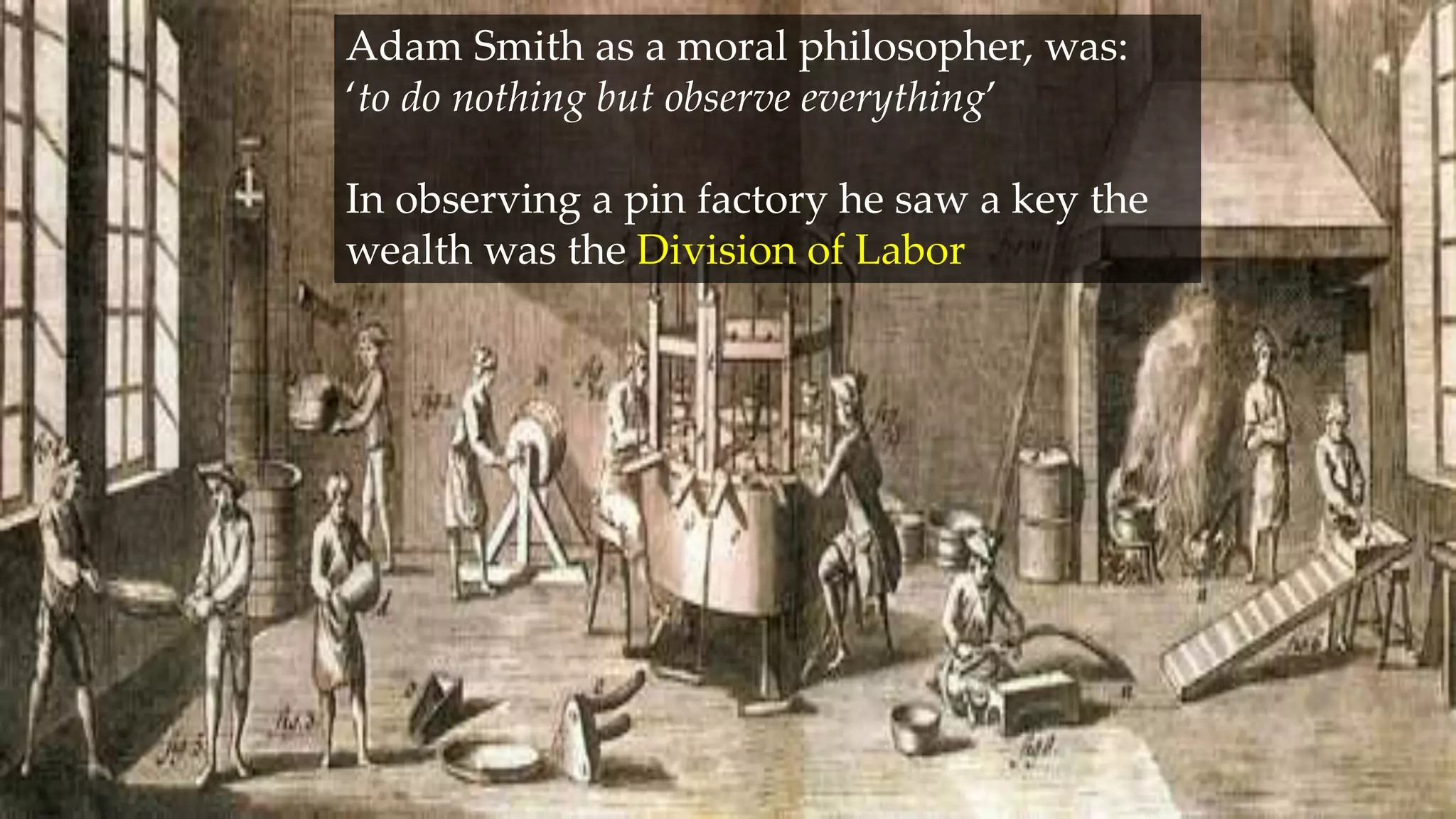
Adam Smith as a moral philosopher, was:
‘to do nothing but observe everything’
In observing a pin factory he saw a key the
wealth was the Division of Labor
Adam Smith as a moral philosopher, was:
‘to do nothing but observe everything’
In observing a pin factory he saw a key the
wealth was the Division of Labor
By dividing up the tasks into specializations, each
person was more productive = more output =
more wealth
Think of a pencil….
For an interesting
example of this in action
It takes an entire planet to make a simple
pencil
It takes an entire planet to get the
resources to create, design, and ship a
pencil all around the world, and for such a
cheap price.
Summary so far…
What Economics is
Economics is a social science, attempting to study
people, their behavior, and the choices that they make.
Definition:
1.) What to produce.
2.) How much to produce.
3.) How to produce it.
4.) Who to produce it for.
1.) Resources are Scarce.
Basic ideas of Economics
2.) Trade - Offs
3.) Opportunity Costs
4.) Marginal Thinking.
5.) Rational Thinking
6.) Specialization
- there is not enough stuff
for everyone.
- 鱼与熊掌不可兼得
- What you must give up when
you make a decision
- 最后的东西之一
- 合理的
- Productivity and the Division
of Labor
Ways to interpret Economic theory
Positive economics
is the study of what is
结果是基于数据
Normative economics
is the study of what should be
是基于你的愿望是什么结果
{
Thank you
The End


Basic Econ Ideas

  • 1.
  • 2.
    The Theory ofEconomics does not furnish a body of settled conclusions immediately applicable to policy. It is a method rather than a doctrine, an apparatus of the mind, a technique of thinking which helps its possessor to draw correct conclusions. 经济学的理论并不包括一组已经被认证的结论可以即刻 用于解释政府的决策。 它是一个方法而不是一个教条。它是人思想发出的工具, 是一种思考的技术, 让拥有人能够用它后达到正确的结论。 (From: The General Theory of Employment, Interest, and Money)


  • 3.
    Is there evera time when all your desires are met? When you have everything you would possibly ever want?
  • 4.
    Is there evera time when all your desires are met? When you have everything you would possibly ever want? I’m willing to bet there is always something more that you want…
  • 5.
    What Economics is Economicsis a social science, attempting to study people, their behavior, and the choices that they make.
  • 6.
    What Economics is Economicsis a social science, attempting to study people, their behavior, and the choices that they make. Textbook Definition: Economics is the study of how human beings coordinate their wants and desires, given the decision- making mechanism, social customs, and political realities of the society.
  • 7.
    What Economics is Economicsis a social science, attempting to study people, their behavior, and the choices that they make. Textbook Definition: Economics is the study of how human beings coordinate their wants and desires, given the decision- making mechanism, social customs, and political realities of the society. Mr. H’s Definition: 1.) What to produce. 2.) How much to produce. 3.) How to produce it. 4.) Who to produce it for.
  • 8.
    Ways to interpretEconomic theory Positive economics is the study of what is 结果是基于数据 Normative economics is the study of what should be 是基于你的愿望是什么结果
  • 9.
    Ways to interpretEconomic theory Positive economics is the study of what is 结果是基于数据 Normative economics is the study of what should be 是基于你的愿望是什么结果 There’s the way things are…
  • 10.
    Governments make tanks.This is true, but can people make tanks?
  • 11.
    People could maketheir own. But should they be allowed to?
  • 12.
    Sure, it’s asilly example with tanks, but what about other more normal things?
  • 13.
    Ways to interpretEconomic theory Positive economics is the study of what is 结果是基于数据 Normative economics is the study of what should be 是基于你的愿望是什么结果 There’s the way things are… The way you want them to be…
  • 14.
    Ways to interpretEconomic theory Positive economics is the study of what is 结果是基于数据 Normative economics is the study of what should be 是基于你的愿望是什么结果 There’s the way things are… The way you want them to be… And these are not usually the same thing.
  • 15.
    Ways to interpretEconomic theory Positive economics is the study of what is 结果是基于数据 Normative economics is the study of what should be 是基于你的愿望是什么结果 And these are not usually the same thing. Point is be careful about how YOU interpret things and how things really might be…
  • 16.
    6 basic conceptsthat you will see again, and again, and again, and again, throughout your whole time in class. Basic ideas of Economics
  • 17.
    1.) Resources are Scarce. Land Labor Capital Entrepreneurship -the quantity available is not large enough to satisfy all productive uses and all of people’s desires. - there is not enough stuff for everyone. - Unlimited wants, limited resources. Basic ideas of Economics
  • 18.
    Scarcity – Anexample… A society that has 500 children is threatened by a disease that strikes only children. A medical company has made a pill that reduces the chances of getting the disease from 90% to only 10%. The company is only able to produce 300 pills right now. If parents can get more than one pill it reduces the chance of their child dying by even more. How do you allocate分配 the pills? How do you decide who gets pills?
  • 19.
  • 20.
  • 21.
    2.) Trade -Offs The big trade off in society is between efficiency and equality. - Making decisions requires trading one thing for another 效率 平等 1.) Resources are Scarce. Basic ideas of Economics
  • 22.
    “There is nosuch thing as a free lunch” you don't get something for nothing 鱼与熊掌不可兼得 2.) Trade – Offs …..
  • 23.
    { Can’t do thisin class…
  • 24.
    { And expect toachieve this at the same time.
  • 25.
    { Sure, everyone wants anew smartphone or the new latest technology…
  • 26.
    Are you willto accept the trade off of the pollution created to make it all?
  • 27.
    1.) Resources areScarce. 2.) Trade - Offs 3.) Opportunity Costs - The real cost of something is what you must give up to get it. *** The next option – not every single option Basic ideas of Economics
  • 28.
    Everything has aCost To an economist, everything has a value that you can be measured by ho much you give up of something else. How much are the following worth to you? --- A pen. --- A coffee cup --- Your pet --- Your time --- Your finger --- A human life
  • 29.
    Everything has aCost To an economist, everything has a value that you can be measured by ho much you give up of something else. How much are the following worth to you? --- A pen. --- A coffee cup --- Your pet --- Your time --- Your finger --- A human life Even human life has a value…
  • 30.
    Someone has todecide how many number of police to have, security, etc… How many police is enough? Is your life worth the extra resources?
  • 31.
    3.) Opportunity Costs….. Making decisions requires individuals to consider the benefits and costs of some action. 每一项决策是有成本的 What you must give up when you make a decision Examples: --- I decide to come here today. --- I decide to work on my lesson plans last night. --- I decide to spend time with my daughter. --- I decided to move to China.
  • 32.
    Resources used tobuild new tanks…
  • 33.
    { Means less resourcesavailable for hospitals.
  • 34.
    1.) Resources areScarce. 2.) Trade - Offs 3.) Opportunity Costs 4.) Marginal Thinking - Means an additional one, the measurement from one unit to the next. 最后的东西之一 “How much?” is a decision at the margin. (the very last unit, not of everything) Basic ideas of Economics
  • 35.
    Which one isworth more? Why?
  • 36.
    脊髓灰质炎 Polio Just because somethingis scarce doesn’t mean it is expensive and valuable.
  • 37.
    {A short lessonon Marginal Understanding…
  • 38.
  • 39.
  • 40.
    { This made mevery happy to drink!
  • 41.
    { Oh look anotherone! Also cost 1 rmb
  • 42.
  • 43.
    { This made mehappy to drink!
  • 44.
    { Oh look anotherone! Also cost 1 rmb
  • 45.
  • 46.
  • 47.
    { Oh look anotherone? Also cost 1 rmb
  • 48.
  • 49.
    { This one alsomade me very happy to drink.
  • 50.
    { Oh look anotherone? Also cost 1 rmb
  • 51.
  • 52.
  • 53.
    { So each onecost the same 1 rmb, but each one brought me a different amount of happiness. So how many should I drink?
  • 54.
    Ex: Marginal Analysis Cansof soda Total Utility (U) Marginal Utility (MU) Total Cost (TC) Marginal Cost (MC) 0 0 0 1 5 1 2 8 2 3 10 3 4 11 4 5 11 5 6 4 6 The word “Utility” = Happiness
  • 55.
    Cans of SodaTotal Utility (U) Marginal Utility (MU) Total Cost (TC) Marginal Cost (MC) 0 0 -- 0 -- 1 5 5 1 1 2 8 3 2 1 3 10 2 3 1 4 11 1 4 1 5 11 0 5 1 6 4 -7 6 1 Ex: Marginal Analysis The word “Utility” = Happiness
  • 56.
    drinks Total Utility (U) Marginal Utility(MU) Total Cost (TC) Marginal Cost (MC) 0 0 -- 0 -- 1 5 5 1 1 2 8 3 2 1 3 10 2 3 1 4 11 1 4 1 5 11 0 5 1 6 4 -7 6 1 Ex: Marginal Analysis The word “Utility” = Happiness
  • 57.
    What does Rationalmean? 合理的 What does mean to be Rational?
  • 58.
    1.) Resources areScarce. Basic ideas of Economics 2.) Trade - Offs 3.) Opportunity Costs 4.) Marginal Thinking. 5.) Rational Thinking - People usually exploit opportunities to make themselves better off. 合理的 人们通常利用机会来 改善自己的境况。
  • 59.
    Adam Smith (1723- 1790) was a Scottish moral philosopher 苏格兰哲学家, pioneer of political economy 政治经济学的先驱, and key Scottish Enlightenment苏格兰 启蒙运动figure
  • 60.
    Adam Smith (1723- 1790) was a Scottish moral philosopher 苏格兰哲学家, pioneer of political economy 政治经济学的先驱, and key Scottish Enlightenment苏格兰 启蒙运动figure The father of modern economics, wrote this book in 1776, which basically started the study of modern economics as we know it
  • 61.
    { “It is notfrom the benevolence of the butcher, the brewer, or the baker, that we can expect our dinner, but from their regard to their own interest” “这不是从仁的屠夫,酿酒商,或 面包师,我们可以期望我们的晚 餐,但他们关于自己的兴趣” Adam Smith’s famous book The Wealth of Nations To be rational is also to be selfish and this is good for society.
  • 62.
    You are ata store about to buy a fancy new notebook. It costs 100RMB. Before you buy it, your friend calls from a store 30 minutes away, that is selling the same notebook for 50MB. Would you drive to the other store to get the cheaper price? Ex: Rational Behavior and Self-Interest You buy the cheaper book right? Save 50% of the price right?
  • 63.
    Ex: Rational Behaviorand Self-Interest You are at a car dealership about to buy a new car. It costs 380,000RMB. Before you buy it, your friend calls from a car dealership 30 minutes away, that is selling the same car for 379,950RMB. Would you drive to the other store to get the cheaper price? You don’t buy the cheaper car, seems silly right?
  • 64.
    Ex: Rational Behaviorand Self-Interest Both choices save you the EXACT same about of money! $50 So why is one worth doing more then the other? Both = $50 Point is being perfectly rational isn’t always so obvious
  • 65.
    Are you goodat what you do?
  • 66.
    1.) Resources areScarce. Basic ideas of Economics 2.) Trade - Offs 3.) Opportunity Costs 4.) Marginal Thinking. 5.) Rational Thinking 6.) Specialization Also related to Productivity - You do what you do best, others do what they do best, and everyone has more. 专业化 生产率
  • 67.
    Adam Smith (1723- 1790) was a Scottish moral philosopher 苏格兰哲学家, pioneer of political economy 政治经济学的先驱, and key Scottish Enlightenment苏格兰 启蒙运动figure
  • 68.
    In his bookhe asked a very simple question. “Why are some nations wealthily and some nations are poor?”
  • 69.
    He visited apin factory and discovered an answer This is a pin
  • 70.
    Adam Smith asa moral philosopher, was: ‘to do nothing but observe everything’ In observing a pin factory he saw a key the wealth was the Division of Labor
  • 71.
    Adam Smith asa moral philosopher, was: ‘to do nothing but observe everything’ In observing a pin factory he saw a key the wealth was the Division of Labor By dividing up the tasks into specializations, each person was more productive = more output = more wealth
  • 72.
    Think of apencil…. For an interesting example of this in action
  • 73.
    It takes anentire planet to make a simple pencil
  • 74.
    It takes anentire planet to get the resources to create, design, and ship a pencil all around the world, and for such a cheap price.
  • 75.
  • 76.
    What Economics is Economicsis a social science, attempting to study people, their behavior, and the choices that they make. Definition: 1.) What to produce. 2.) How much to produce. 3.) How to produce it. 4.) Who to produce it for.
  • 77.
    1.) Resources areScarce. Basic ideas of Economics 2.) Trade - Offs 3.) Opportunity Costs 4.) Marginal Thinking. 5.) Rational Thinking 6.) Specialization - there is not enough stuff for everyone. - 鱼与熊掌不可兼得 - What you must give up when you make a decision - 最后的东西之一 - 合理的 - Productivity and the Division of Labor
  • 78.
    Ways to interpretEconomic theory Positive economics is the study of what is 结果是基于数据 Normative economics is the study of what should be 是基于你的愿望是什么结果
  • 79.