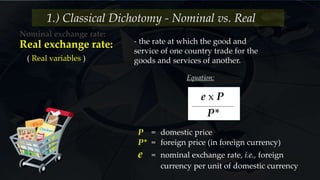
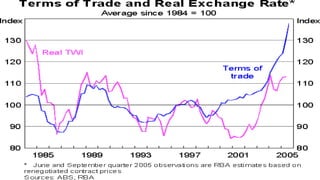
1. Nominal exchange rates refer to the price of a currency in terms of another currency, while real exchange rates refer to the quantity of goods and services that can be purchased with a currency.
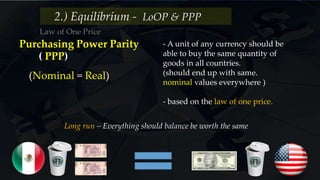
2. In equilibrium, the law of one price suggests that identical goods should sell for the same price across markets, while purchasing power parity suggests that exchange rates should equal the ratio of price levels between countries.
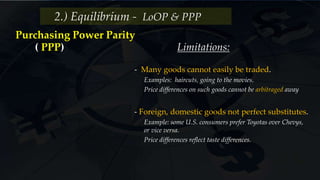
3. Both theories are limited in the short run but tend to hold in the long run as arbitrage acts to equalize prices and purchasing power across markets over time.