FISCAL POLICY
0
MANUEL M. MATHEW
Fiscal policy
•The overall activities of the government through budget
comes under the area known as fiscal policy. Technically,
fiscal policy is known as the policy of the government
regarding the use of taxation, public expenditure and
borrowings to realize certain economic objectives (like
economic growth). Budget is the channel through which
fiscal policy is delivered.
1
Objectives of fiscal policy
•promote economic growth
•stabilization of the economy (during recession
and boom)
•creating employment opportunities
•to promote redistribution of income and wealth
2
Countercyclical fiscal policy?
A counter-cyclical fiscal policy refers to strategy
by the government to counter boom or recession
through fiscal measures. It works against the
ongoing boom or recession trend; thus, trying to
stabilize the economy.
3
Countercyclical fiscal policy during recession
•Recession is a business cycle situation where
there is slowing demand and falling growth
in the economy. Here, the Government’s
responsibility is to generate demand by fine-
tuning taxation and expenditure policies.
Reducing taxes and increasing expenditure
will help to create demand and producing
upswing in the economy.
4
Countercyclical fiscal policy during boom
•In the case of boom, economic activities will be on
upswing. Amplifying the boom is disastrous as it may
create inflation and debt crisis and the government’s
responsibility here is to bring down the pace of
economic activities. Increasing taxes and reducing
public expenditure will make boom mild. Thus, slowing
down demand should be the nature of countercyclical
fiscal policy during boom.
5
Procyclical fiscal policy
•Procyclical is the opposite of countercyclical.
Here, fiscal policy goes in line with the current
mood of the business cycle; amplifying them. For
example, during the time of boom, government
makes high expenditure and doesn’t hike taxes.
Thus, boom grows further. Such a policy is
dangerous and brings instability in the economy.
6
Compensatory Fiscal Policy
•During recession, private expenditure in the form of
consumption and investment may decline due to the
operation of some adverse factors. This decline in
aggregate demand will reduce consumption, investment,
employment etc, leading to down turn and recession in
the economy. In this juncture, effort by the government
through additional expenditure (and reduced taxes) will
fill the gap in demand, consumption and investment. The
main thrust of compensatory fiscal policy thus is that the
government should inject extra expenditure to reinstate
demand.
7
Deficit financing
•Deficit financing is the budgetary situation where
government’s expenditure is higher than its
revenue. It is a practice where the government is
financing the excess expenditure with outside
resources. The expenditure revenue gap is
financed by either printing of currency or through
borrowing. Now a day most governments both in
the developed and developing world are having
deficit budgets and these deficits are often
financed through borrowing. 8
Various indicators of deficit financing are:
•Budget deficit = total expenditure – total receipts
•Revenue deficit = revenue expenditure – revenue
receipts
•Fiscal Deficit = total expenditure – total receipts except
borrowings
•Primary Deficit = Fiscal deficit- interest payments
•Effective revenue Deficit-= Revenue Deficit – grants
for the creation of capital assets
•Monetized Fiscal Deficit = that part of the fiscal deficit
covered by borrowing from the RBI.
9
Golden Rule in Fiscal Policy
•If the government uses the borrowed fund to finance
current expenditure (revenue expenditure) or the
expenditure to pay pension and salaries, the benefit
will go to the present generation. On the other hand,
the people who have to repay the debt is the future
generation. Hence, the repaying group or the future
generation should also get the benefit of
government borrowing and spending. Thus the
golden rule states that while practicing the budget,
the government should follow intergenerational
equity. 10
THE BUDGET
11
•Budget is technically known as the annual
financial statement. The Annual Financial
Statement contains an estimated expenditure
and receipt statement for the coming year, a
revised estimated for the current year and an
actual statement for the past year.
12
Why budget is important
•Budget brings tax changes
•Budget launches different welfare schemes
•Budget brings economic reform measures
•Budget is often designed as a response to the
prevailing macroeconomic environment in
the country.
13
14
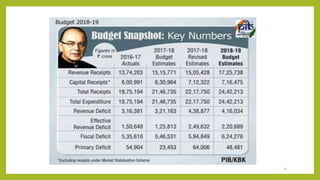
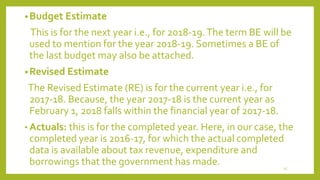
•Budget Estimate
This is for the next year i.e., for 2018-19.The term BE will be
used to mention for the year 2018-19. Sometimes a BE of
the last budget may also be attached.
•Revised Estimate
The Revised Estimate (RE) is for the current year i.e., for
2017-18. Because, the year 2017-18 is the current year as
February 1, 2018 falls within the financial year of 2017-18.
• Actuals: this is for the completed year. Here, in our case, the
completed year is 2016-17, for which the actual completed
data is available about tax revenue, expenditure and
borrowings that the government has made. 15
Constitutional provision for budget
•Article 112: President shall, in respect of every financial year,
cause to be laid before Parliament, Annual Financial
Statement.
•Article 265: provides that ‘no tax shall be levied or collected
except by authority of law’. [ie. Taxation needs approval of
Parliament.]
•Article 266: provides that ‘no expenditure can be incurred
except with the authorisation of the Legislature’ [ie.
Expenditure needs approval of Parliament.]
16
Government Accounts are kept viz.
•(i) Consolidated Fund,
•(ii) Contingency Fund and
•(iii) Public Account.
17
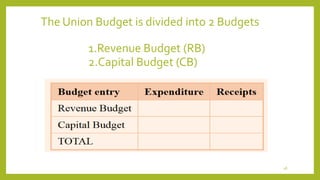
The Union Budget is divided into 2 Budgets
1.Revenue Budget (RB)
2.Capital Budget (CB)
18
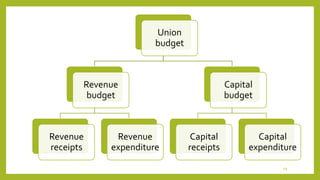
Union
budget
Revenue
budget
Revenue
receipts
Revenue
expenditure
Capital
budget
Capital
receipts
Capital
expenditure
19
Revenue budget
•Revenue budget involves revenue receipts and
revenue expenditure. These expenditures and
receipts are related to the day to day functioning
of the government.
20
Revenue receipts
Do not create liability
Do not reduce our asset.
21
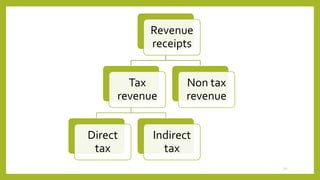
Revenue
receipts
Tax
revenue
Direct
tax
Indirect
tax
Non tax
revenue
22
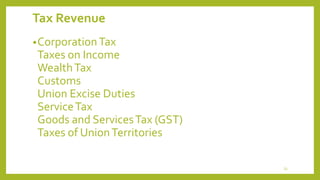
Tax Revenue
•CorporationTax
Taxes on Income
WealthTax
Customs
Union Excise Duties
ServiceTax
Goods and ServicesTax (GST)
Taxes of UnionTerritories
23
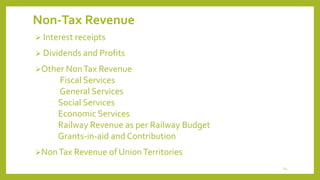
Non-Tax Revenue
 Interest receipts
 Dividends and Profits
Other NonTax Revenue
Fiscal Services
General Services
Social Services
Economic Services
Railway Revenue as per Railway Budget
Grants-in-aid and Contribution
NonTax Revenue of UnionTerritories
24
Revenue Expenditure
Revenue expenditure is expenditure for normal
running of the government department and
various services, interest charges on debt incurred
by government, subsidies and so on.
Do not create any asset for the govt.
25
Important Revenue Expenditures
• Interest payments
• Defence and Police
• Subsidies
• Grants to States and UnionTerritories
• Pensions and Salaries
• Economic services
• Other general services
• Social Services
• Postal deficit
• Exp.on UTs without legislature
• Grants to Foreign govts.
26
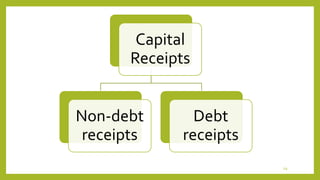
Capital budget
Capital Budget consists Capital Receipts and Capital Expenditure.
Capital Receipts
 Creates liability
Reduces financial asset .
27
28
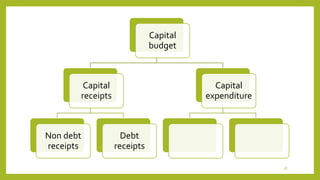
Capital
budget
Capital
receipts
Non debt
receipts
Debt
receipts
Capital
expenditure
Capital
Receipts
Non-debt
receipts
Debt
receipts
29
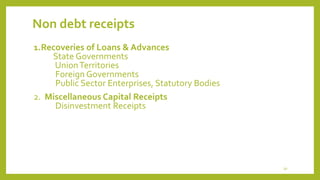
Non debt receipts
1.Recoveries of Loans & Advances
State Governments
UnionTerritories
Foreign Governments
Public Sector Enterprises, Statutory Bodies
2. Miscellaneous Capital Receipts
Disinvestment Receipts
30
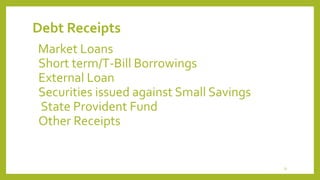
Debt Receipts
Market Loans
Short term/T-Bill Borrowings
External Loan
Securities issued against Small Savings
State Provident Fund
Other Receipts
31
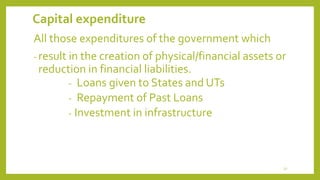
Capital expenditure
All those expenditures of the government which
- result in the creation of physical/financial assets or
reduction in financial liabilities.
- Loans given to States and UTs
- Repayment of Past Loans
- Investment in infrastructure
32
DEFICITS
33
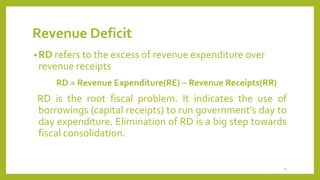
Revenue Deficit
•RD refers to the excess of revenue expenditure over
revenue receipts
RD = Revenue Expenditure(RE) – Revenue Receipts(RR)
RD is the root fiscal problem. It indicates the use of
borrowings (capital receipts) to run government’s day to
day expenditure. Elimination of RD is a big step towards
fiscal consolidation.
34
Fiscal Deficit
• FD is the difference between the total expenditure and
[revenue receipts plus non-debt capital receipts]. It indicates
the amount the Govt has to borrow to meet its annual
targets.
• FD= Total Expenditure - (Revenue Receipts+ Non-Debt
Creating Capital Receipts)
The most popular indicator to show the health of
government finances. It is actually borrowings of the
government to run the budget. FD results in future interest
payments. It also adds to inflation.
35
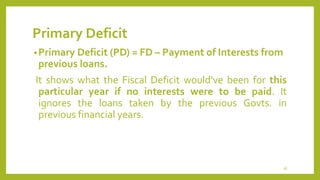
Primary Deficit
•Primary Deficit (PD) = FD – Payment of Interests from
previous loans.
It shows what the Fiscal Deficit would’ve been for this
particular year if no interests were to be paid. It
ignores the loans taken by the previous Govts. in
previous financial years.
36
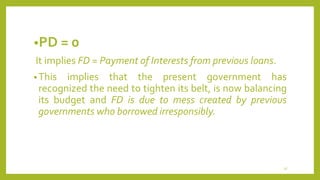
•PD = 0
It implies FD = Payment of Interests from previous loans.
•This implies that the present government has
recognized the need to tighten its belt, is now balancing
its budget and FD is due to mess created by previous
governments who borrowed irresponsibly.
37
•PD = FD
It implies that Payment of Interests from previous loans
are 0. Meaning we are taking loans to meet other
targets and not payment of past loans. This implies
previous governments acted very responsibly and
balanced their budgets.
38
Effective Revenue Deficit(ERD)
•ERD = RD – (grants for creation of capital assets)
•We included all loans given to the states as one single
category, revenue expenditure, without classifying
which ones are being used for asset creation i.e. Capital
Expenditure and which ones to meet other expenses i.e.
Revenue Expenditure.
•Those which are used for asset creation at the state level
are subtracted from the revenue deficit to arrive at
Effective Revenue Deficit.
39
Budget Deficit
Printing of currency to finance budget. This is highly
inflationary. This practice is not existing in India right
now.
Monetized Fiscal Deficit (MFD)
Indicate borrowings from the RBI. Such borrowings
create inflation. When the money is paid back to the RBI,
the inflation effect may be reduced. Still, MFD is as
inflationary as BD.
40

Fiscal policy

  • 1.
  • 2.
    Fiscal policy •The overallactivities of the government through budget comes under the area known as fiscal policy. Technically, fiscal policy is known as the policy of the government regarding the use of taxation, public expenditure and borrowings to realize certain economic objectives (like economic growth). Budget is the channel through which fiscal policy is delivered. 1
  • 3.
    Objectives of fiscalpolicy •promote economic growth •stabilization of the economy (during recession and boom) •creating employment opportunities •to promote redistribution of income and wealth 2
  • 4.
    Countercyclical fiscal policy? Acounter-cyclical fiscal policy refers to strategy by the government to counter boom or recession through fiscal measures. It works against the ongoing boom or recession trend; thus, trying to stabilize the economy. 3
  • 5.
    Countercyclical fiscal policyduring recession •Recession is a business cycle situation where there is slowing demand and falling growth in the economy. Here, the Government’s responsibility is to generate demand by fine- tuning taxation and expenditure policies. Reducing taxes and increasing expenditure will help to create demand and producing upswing in the economy. 4
  • 6.
    Countercyclical fiscal policyduring boom •In the case of boom, economic activities will be on upswing. Amplifying the boom is disastrous as it may create inflation and debt crisis and the government’s responsibility here is to bring down the pace of economic activities. Increasing taxes and reducing public expenditure will make boom mild. Thus, slowing down demand should be the nature of countercyclical fiscal policy during boom. 5
  • 7.
    Procyclical fiscal policy •Procyclicalis the opposite of countercyclical. Here, fiscal policy goes in line with the current mood of the business cycle; amplifying them. For example, during the time of boom, government makes high expenditure and doesn’t hike taxes. Thus, boom grows further. Such a policy is dangerous and brings instability in the economy. 6
  • 8.
    Compensatory Fiscal Policy •Duringrecession, private expenditure in the form of consumption and investment may decline due to the operation of some adverse factors. This decline in aggregate demand will reduce consumption, investment, employment etc, leading to down turn and recession in the economy. In this juncture, effort by the government through additional expenditure (and reduced taxes) will fill the gap in demand, consumption and investment. The main thrust of compensatory fiscal policy thus is that the government should inject extra expenditure to reinstate demand. 7
  • 9.
    Deficit financing •Deficit financingis the budgetary situation where government’s expenditure is higher than its revenue. It is a practice where the government is financing the excess expenditure with outside resources. The expenditure revenue gap is financed by either printing of currency or through borrowing. Now a day most governments both in the developed and developing world are having deficit budgets and these deficits are often financed through borrowing. 8
  • 10.
    Various indicators ofdeficit financing are: •Budget deficit = total expenditure – total receipts •Revenue deficit = revenue expenditure – revenue receipts •Fiscal Deficit = total expenditure – total receipts except borrowings •Primary Deficit = Fiscal deficit- interest payments •Effective revenue Deficit-= Revenue Deficit – grants for the creation of capital assets •Monetized Fiscal Deficit = that part of the fiscal deficit covered by borrowing from the RBI. 9
  • 11.
    Golden Rule inFiscal Policy •If the government uses the borrowed fund to finance current expenditure (revenue expenditure) or the expenditure to pay pension and salaries, the benefit will go to the present generation. On the other hand, the people who have to repay the debt is the future generation. Hence, the repaying group or the future generation should also get the benefit of government borrowing and spending. Thus the golden rule states that while practicing the budget, the government should follow intergenerational equity. 10
  • 12.
  • 13.
    •Budget is technicallyknown as the annual financial statement. The Annual Financial Statement contains an estimated expenditure and receipt statement for the coming year, a revised estimated for the current year and an actual statement for the past year. 12
  • 14.
    Why budget isimportant •Budget brings tax changes •Budget launches different welfare schemes •Budget brings economic reform measures •Budget is often designed as a response to the prevailing macroeconomic environment in the country. 13
  • 15.
  • 16.
    •Budget Estimate This isfor the next year i.e., for 2018-19.The term BE will be used to mention for the year 2018-19. Sometimes a BE of the last budget may also be attached. •Revised Estimate The Revised Estimate (RE) is for the current year i.e., for 2017-18. Because, the year 2017-18 is the current year as February 1, 2018 falls within the financial year of 2017-18. • Actuals: this is for the completed year. Here, in our case, the completed year is 2016-17, for which the actual completed data is available about tax revenue, expenditure and borrowings that the government has made. 15
  • 17.
    Constitutional provision forbudget •Article 112: President shall, in respect of every financial year, cause to be laid before Parliament, Annual Financial Statement. •Article 265: provides that ‘no tax shall be levied or collected except by authority of law’. [ie. Taxation needs approval of Parliament.] •Article 266: provides that ‘no expenditure can be incurred except with the authorisation of the Legislature’ [ie. Expenditure needs approval of Parliament.] 16
  • 18.
    Government Accounts arekept viz. •(i) Consolidated Fund, •(ii) Contingency Fund and •(iii) Public Account. 17
  • 19.
    The Union Budgetis divided into 2 Budgets 1.Revenue Budget (RB) 2.Capital Budget (CB) 18
  • 20.
  • 21.
    Revenue budget •Revenue budgetinvolves revenue receipts and revenue expenditure. These expenditures and receipts are related to the day to day functioning of the government. 20
  • 22.
    Revenue receipts Do notcreate liability Do not reduce our asset. 21
  • 23.
  • 24.
    Tax Revenue •CorporationTax Taxes onIncome WealthTax Customs Union Excise Duties ServiceTax Goods and ServicesTax (GST) Taxes of UnionTerritories 23
  • 25.
    Non-Tax Revenue  Interestreceipts  Dividends and Profits Other NonTax Revenue Fiscal Services General Services Social Services Economic Services Railway Revenue as per Railway Budget Grants-in-aid and Contribution NonTax Revenue of UnionTerritories 24
  • 26.
    Revenue Expenditure Revenue expenditureis expenditure for normal running of the government department and various services, interest charges on debt incurred by government, subsidies and so on. Do not create any asset for the govt. 25
  • 27.
    Important Revenue Expenditures •Interest payments • Defence and Police • Subsidies • Grants to States and UnionTerritories • Pensions and Salaries • Economic services • Other general services • Social Services • Postal deficit • Exp.on UTs without legislature • Grants to Foreign govts. 26
  • 28.
    Capital budget Capital Budgetconsists Capital Receipts and Capital Expenditure. Capital Receipts  Creates liability Reduces financial asset . 27
  • 29.
  • 30.
  • 31.
    Non debt receipts 1.Recoveriesof Loans & Advances State Governments UnionTerritories Foreign Governments Public Sector Enterprises, Statutory Bodies 2. Miscellaneous Capital Receipts Disinvestment Receipts 30
  • 32.
    Debt Receipts Market Loans Shortterm/T-Bill Borrowings External Loan Securities issued against Small Savings State Provident Fund Other Receipts 31
  • 33.
    Capital expenditure All thoseexpenditures of the government which - result in the creation of physical/financial assets or reduction in financial liabilities. - Loans given to States and UTs - Repayment of Past Loans - Investment in infrastructure 32
  • 34.
  • 35.
    Revenue Deficit •RD refersto the excess of revenue expenditure over revenue receipts RD = Revenue Expenditure(RE) – Revenue Receipts(RR) RD is the root fiscal problem. It indicates the use of borrowings (capital receipts) to run government’s day to day expenditure. Elimination of RD is a big step towards fiscal consolidation. 34
  • 36.
    Fiscal Deficit • FDis the difference between the total expenditure and [revenue receipts plus non-debt capital receipts]. It indicates the amount the Govt has to borrow to meet its annual targets. • FD= Total Expenditure - (Revenue Receipts+ Non-Debt Creating Capital Receipts) The most popular indicator to show the health of government finances. It is actually borrowings of the government to run the budget. FD results in future interest payments. It also adds to inflation. 35
  • 37.
    Primary Deficit •Primary Deficit(PD) = FD – Payment of Interests from previous loans. It shows what the Fiscal Deficit would’ve been for this particular year if no interests were to be paid. It ignores the loans taken by the previous Govts. in previous financial years. 36
  • 38.
    •PD = 0 Itimplies FD = Payment of Interests from previous loans. •This implies that the present government has recognized the need to tighten its belt, is now balancing its budget and FD is due to mess created by previous governments who borrowed irresponsibly. 37
  • 39.
    •PD = FD Itimplies that Payment of Interests from previous loans are 0. Meaning we are taking loans to meet other targets and not payment of past loans. This implies previous governments acted very responsibly and balanced their budgets. 38
  • 40.
    Effective Revenue Deficit(ERD) •ERD= RD – (grants for creation of capital assets) •We included all loans given to the states as one single category, revenue expenditure, without classifying which ones are being used for asset creation i.e. Capital Expenditure and which ones to meet other expenses i.e. Revenue Expenditure. •Those which are used for asset creation at the state level are subtracted from the revenue deficit to arrive at Effective Revenue Deficit. 39
  • 41.
    Budget Deficit Printing ofcurrency to finance budget. This is highly inflationary. This practice is not existing in India right now. Monetized Fiscal Deficit (MFD) Indicate borrowings from the RBI. Such borrowings create inflation. When the money is paid back to the RBI, the inflation effect may be reduced. Still, MFD is as inflationary as BD. 40