FISCAL POLICY
FISCAL POLICY 
* Fiscal policy deals with the taxation and expenditure decisions of the 
government . 
* the government deals with fiscal policy while the central bank is 
responsible for monetary policy. Fiscal policy is composed of several parts. 
These include, tax policy, expenditure policy, investment or disinvestment 
strategies and debt or surplus management.
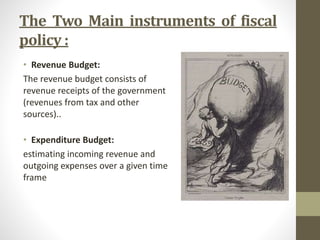
The Two Main instruments of fiscal 
policy : 
• Revenue Budget: 
The revenue budget consists of 
revenue receipts of the government 
(revenues from tax and other 
sources).. 
• Expenditure Budget: 
estimating incoming revenue and 
outgoing expenses over a given time 
frame
Methods of Funding : 
• Taxation 
• Seigniorage, the benefit from printing money 
• Borrowing money from the population or from abroad 
• Consumption of fiscal reserves 
• Sale of fixed assets (e.g., land)
Consuming prior surpluses : 
• A fiscal surplus is often saved for future use, and may be 
invested in either local currency or any financial instrument 
that may be traded later once resources are Consuming prior 
surpluses
How Fiscal Policy Works : 
• Fiscal policy is based on the theories of British economist 
John Maynard Keynes. Also known as Keynesian economics, 
this theory basically states that governments can influence 
macroeconomic productivity levels by increasing or 
decreasing tax levels and public spending. This influence, in 
turn, curbs inflation (generally considered to be healthy 
when between 2-3%), increases employment and maintains 
a healthy value of money. Fiscal policy is very important to 
the economy. For example
Who Does Fiscal Policy Affect? 
• Unfortunately, the effects of any fiscal policy are not the same for 
everyone. Depending on the political orientations and goals of the 
policymakers, a tax cut could affect only the middle class, which is 
typically the largest economic group. In times of economic decline 
and rising taxation, it is this same group that may have to pay more 
taxes than the wealthier upper class. 
• Similarly, when a government decides to adjust its spending, its 
policy may affect only a specific group of people. A decision to 
build a new bridge, for example, will give work and more income 
to hundreds of construction workers. A decision to spend money 
on building a new space shuttle, on the other hand, benefits only a 
small, specialized pool of experts, which would not do much to 
increase aggregate employment levels.
In Fiscal Policy there are three 
possible positions : 
• A Neutral position applies when the budget outcome has 
neutral effect on the level of economic activity where the 
govt. spending is fully funded by the revenue collected from 
the tax. 
• An Expansionary position is when there is a higher budget 
deficit where the govt. spending is higher than the revenue 
collected from the tax. 
• An Contractionary position is when there is a lower budget 
deficit where the govt. spending is lower than the revenue 
collected from the tax.
OBJECTIVES OF FISCAL POLICY : 
• Increase in capital formation. 
• Degree of Growth. 
• To achieve desirable price level. 
• To achieve desirable consumption level. 
• To achieve desirable employment level. 
• To achieve desirable income distribution
THANK YOU

Fiscal policy

  • 1.
  • 2.
    FISCAL POLICY *Fiscal policy deals with the taxation and expenditure decisions of the government . * the government deals with fiscal policy while the central bank is responsible for monetary policy. Fiscal policy is composed of several parts. These include, tax policy, expenditure policy, investment or disinvestment strategies and debt or surplus management.
  • 3.
    The Two Maininstruments of fiscal policy : • Revenue Budget: The revenue budget consists of revenue receipts of the government (revenues from tax and other sources).. • Expenditure Budget: estimating incoming revenue and outgoing expenses over a given time frame
  • 4.
    Methods of Funding: • Taxation • Seigniorage, the benefit from printing money • Borrowing money from the population or from abroad • Consumption of fiscal reserves • Sale of fixed assets (e.g., land)
  • 5.
    Consuming prior surpluses: • A fiscal surplus is often saved for future use, and may be invested in either local currency or any financial instrument that may be traded later once resources are Consuming prior surpluses
  • 6.
    How Fiscal PolicyWorks : • Fiscal policy is based on the theories of British economist John Maynard Keynes. Also known as Keynesian economics, this theory basically states that governments can influence macroeconomic productivity levels by increasing or decreasing tax levels and public spending. This influence, in turn, curbs inflation (generally considered to be healthy when between 2-3%), increases employment and maintains a healthy value of money. Fiscal policy is very important to the economy. For example
  • 7.
    Who Does FiscalPolicy Affect? • Unfortunately, the effects of any fiscal policy are not the same for everyone. Depending on the political orientations and goals of the policymakers, a tax cut could affect only the middle class, which is typically the largest economic group. In times of economic decline and rising taxation, it is this same group that may have to pay more taxes than the wealthier upper class. • Similarly, when a government decides to adjust its spending, its policy may affect only a specific group of people. A decision to build a new bridge, for example, will give work and more income to hundreds of construction workers. A decision to spend money on building a new space shuttle, on the other hand, benefits only a small, specialized pool of experts, which would not do much to increase aggregate employment levels.
  • 8.
    In Fiscal Policythere are three possible positions : • A Neutral position applies when the budget outcome has neutral effect on the level of economic activity where the govt. spending is fully funded by the revenue collected from the tax. • An Expansionary position is when there is a higher budget deficit where the govt. spending is higher than the revenue collected from the tax. • An Contractionary position is when there is a lower budget deficit where the govt. spending is lower than the revenue collected from the tax.
  • 9.
    OBJECTIVES OF FISCALPOLICY : • Increase in capital formation. • Degree of Growth. • To achieve desirable price level. • To achieve desirable consumption level. • To achieve desirable employment level. • To achieve desirable income distribution
  • 10.