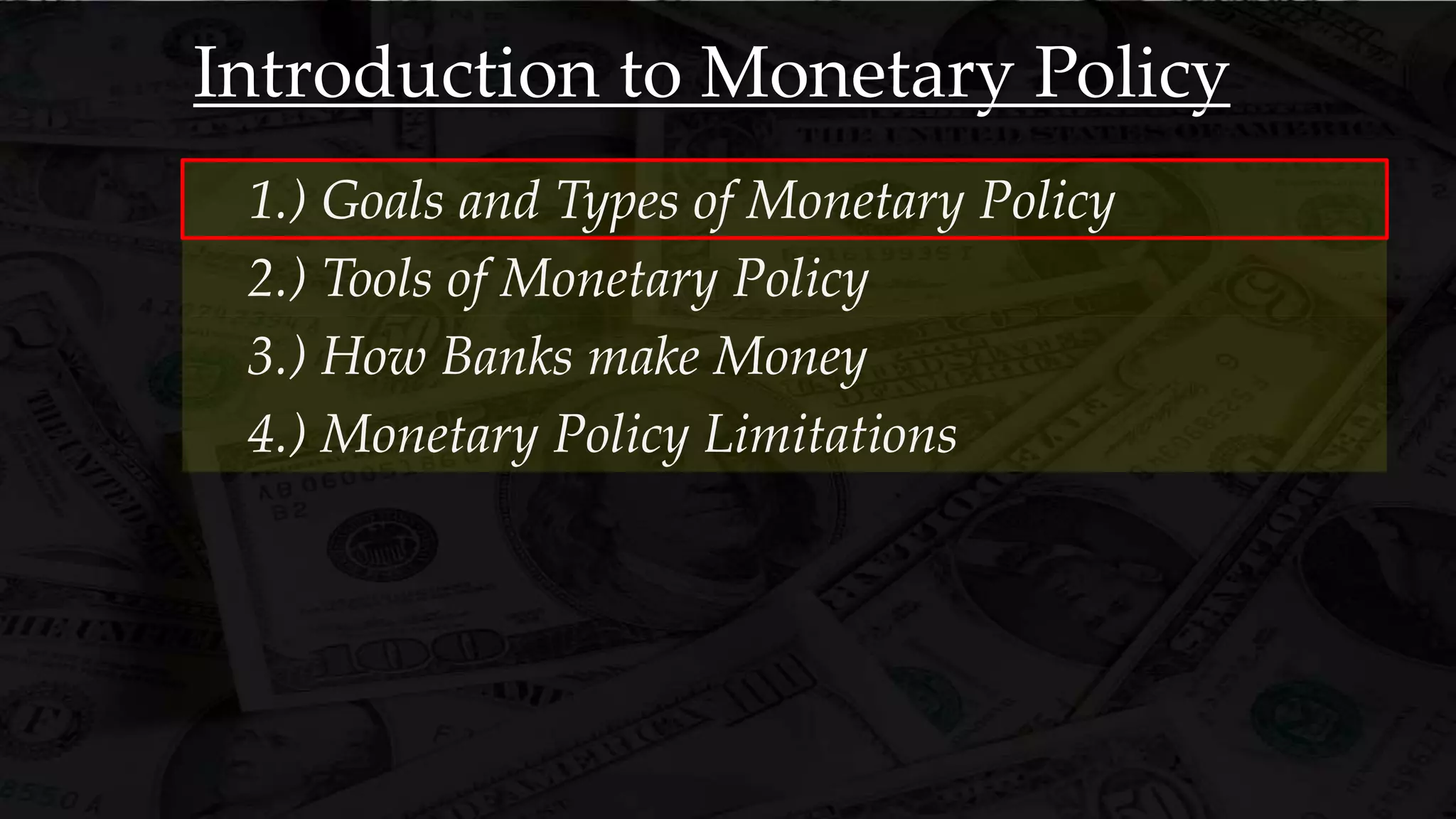
Introduction to Monetary Policy
3.) How Banks make Money
1.) Goals and Types of Monetary Policy
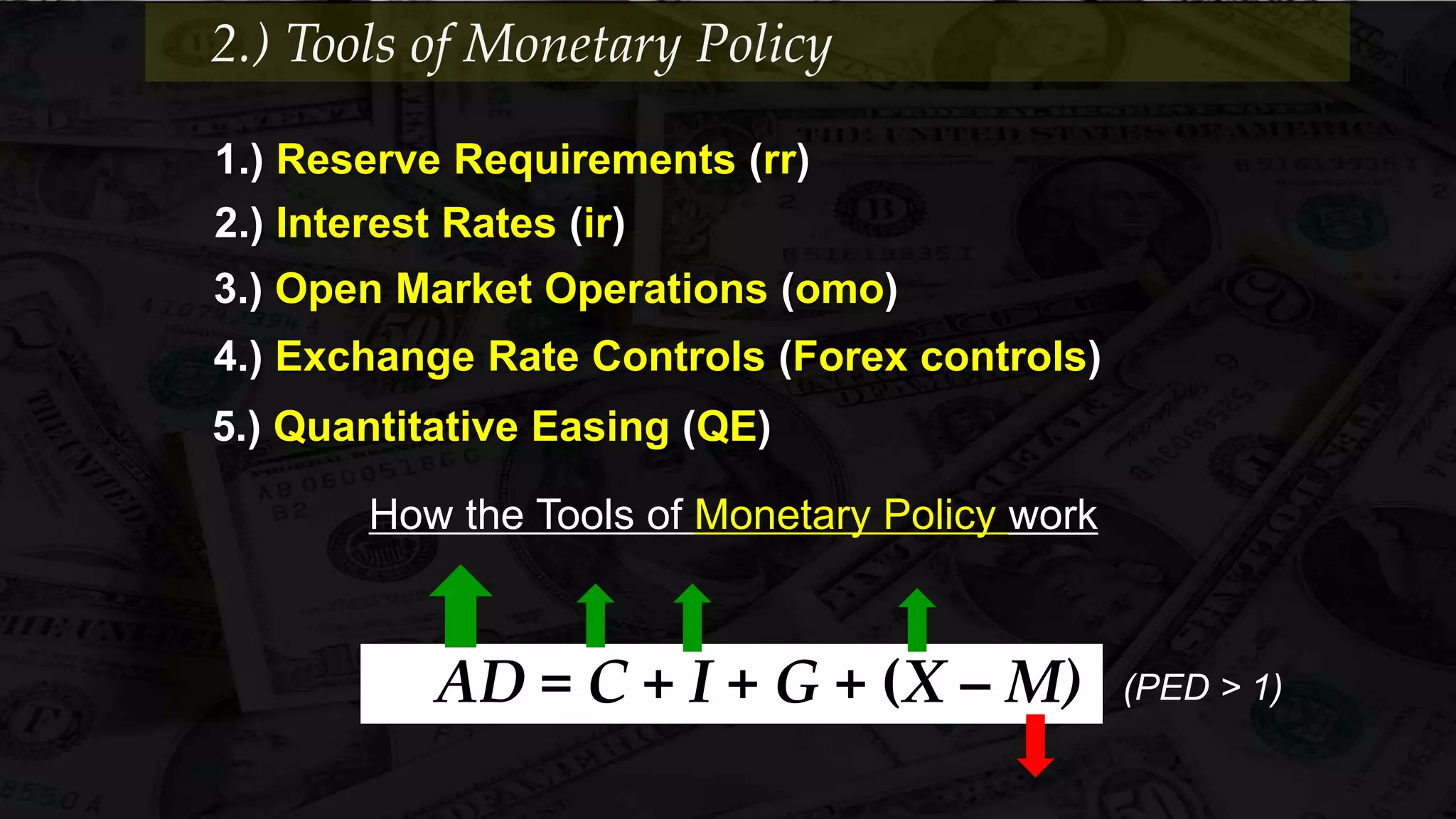
2.) Tools of Monetary Policy
4.) Monetary Policy Limitations
Monetary Policy
AD = C + I + G + (X – M)
- is the use of targeting inflation,
interest rates, and the exchange
rates to shift the AD curve.
Reworded definition: 换句话说
- is the use of changing the supply of
money to sustain economic growth
and smooth 连出 the business cycle.
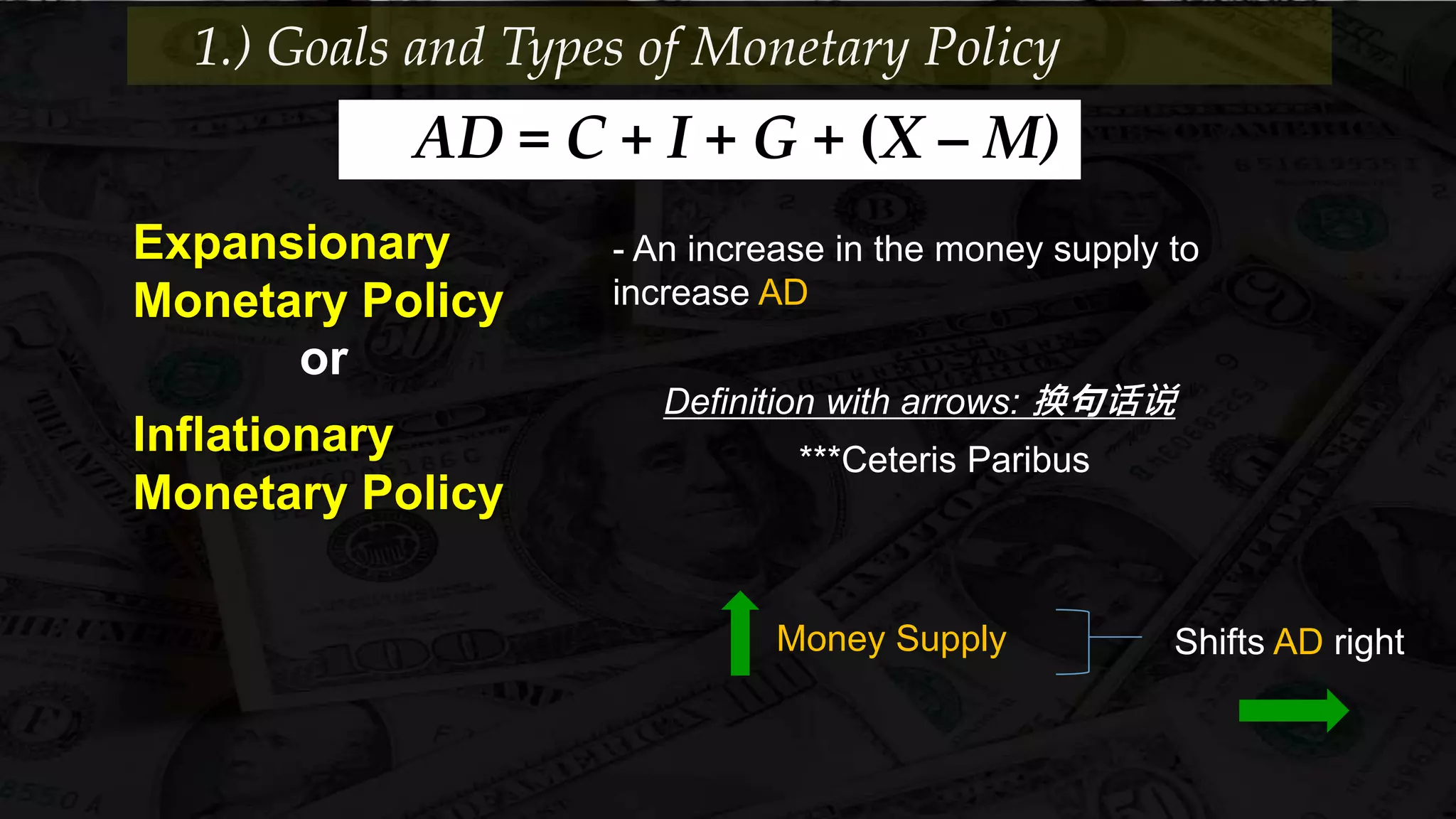
1.) Goals and Types of Monetary Policy
- An increase in the money supply to
increase AD
Expansionary
Monetary Policy
AD = C + I + G + (X – M)
Inflationary
Monetary Policy
or
Definition with arrows: 换句话说
***Ceteris Paribus
Money Supply Shifts AD right
1.) Goals and Types of Monetary Policy
AD = C + I + G + (X – M)
Contractionary
Monetary Policy
Deflationary
Monetary Policy
or
Money Supply
***Ceteris Paribus
Definition with arrows: 换句话说
Shifts AD left
- An decrease in the money supply to
increase AD
Expansionary Monetary Policy
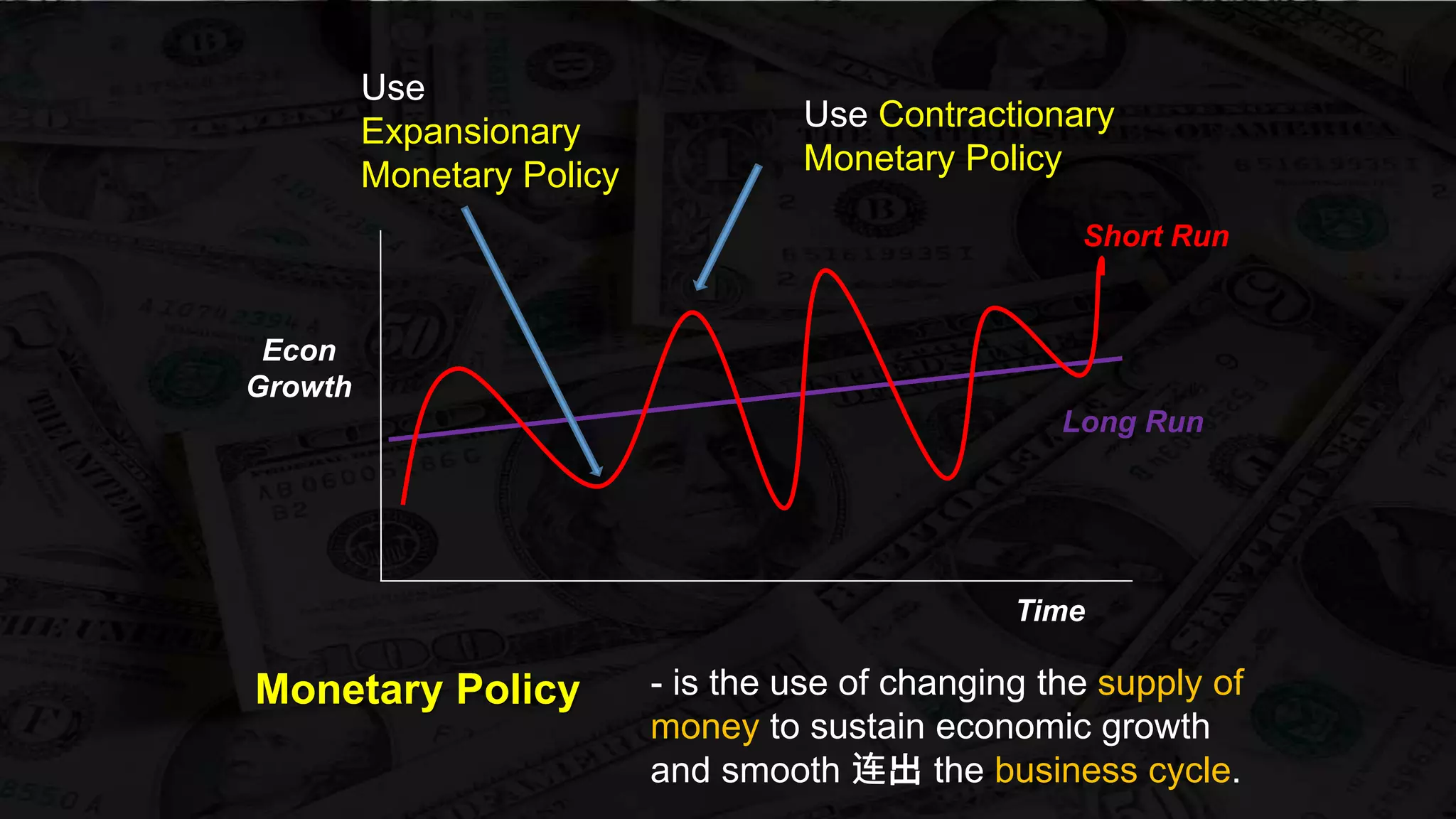
1.) Goals and Types of Monetary Policy
Time
Long Run
Short Run
Econ
Growth
Use Contractionary
Monetary Policy
Use
Expansionary
Monetary Policy
Monetary Policy - is the use of changing the supply of
money to sustain economic growth
and smooth 连出 the business cycle.
Time
Long Run
Short Run
Business Cycle
Econ
Growth
Monetary Policy - is the use of changing the supply of
money to sustain economic growth
and smooth 连出 the business cycle.
- Basically,
monetary
policy aims to
stabilize
economic
growth,
avoiding a
boom and
bust economic
cycle.
Introduction to Monetary Policy
1.) Goals and Types of Monetary Policy
2.) Tools of Monetary Policy
3.) How Banks make Money
4.) Monetary Policy Limitations
1.) Reserve Requirements (rr)
2.) Interest Rates (ir)
3.) Open Market Operations (omo)
4.) Exchange Rate Controls (Forex controls)
5.) Quantitative Easing (QE)
2.) Tools of Monetary Policy
AD = C + I + G + (X – M)
How the Tools of Monetary Policy work
(PED > 1)
AD = C + I + G + (X – M)
Money Supply
Price
level
GDP
AD
SRAS
PE
LRAS
YN Y1
P1
AD1
***(PED > 1)
1.) Goals and Types of Monetary Policy
- More money mean
more possible
transactions and
investment in the
economy, however can
lead to inflation.
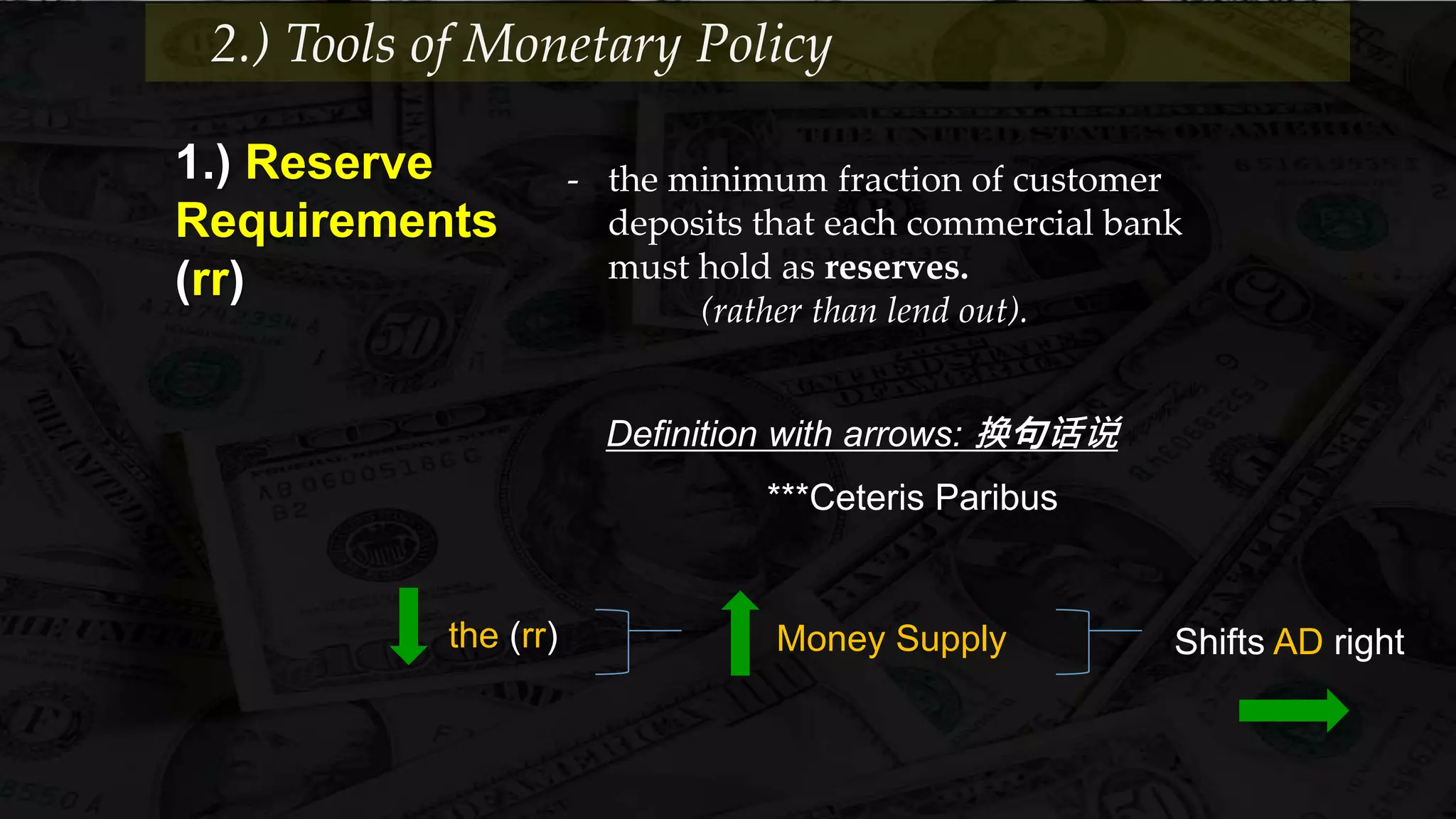
1.) Reserve
Requirements
(rr)
- the minimum fraction of customer
deposits that each commercial bank
must hold as reserves.
(rather than lend out).
Definition with arrows: 换句话说
***Ceteris Paribus
the (rr)
2.) Tools of Monetary Policy
Money Supply Shifts AD right
Liabilities Assets
$100
Let’s say the (rr) is
10% percent
(rr)
Let’s say
people
deposit
$100 in
the bank
The bank can make lots
of loans and increase the
money supply a lot
10% Cannot be lent out
loans
+ $90
2.) Tools of Monetary Policy – Reserve Requirements
90% Can be
lent out
Reserve Requirements - the minimum amount banks have to
keep in the bank and can’t lend out.
(rr)
MS AD=
$100
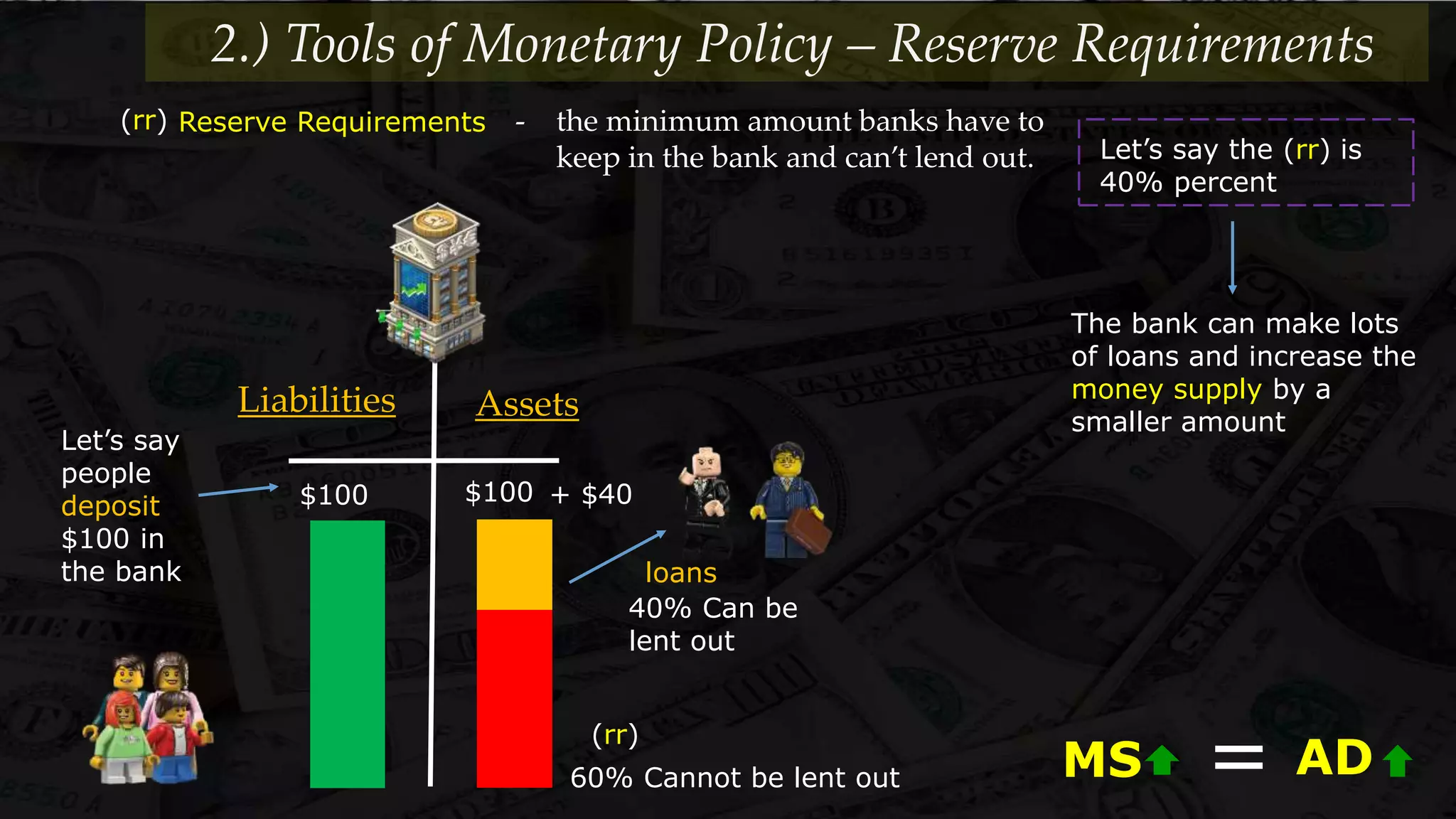
Let’s say the (rr) is
40% percent
(rr)
60% Cannot be lent out
loans
2.) Tools of Monetary Policy – Reserve Requirements
40% Can be
lent out
Reserve Requirements - the minimum amount banks have to
keep in the bank and can’t lend out.
(rr)
MS AD=
The bank can make lots
of loans and increase the
money supply by a
smaller amount
Liabilities Assets
$100
Let’s say
people
deposit
$100 in
the bank
$100 + $40
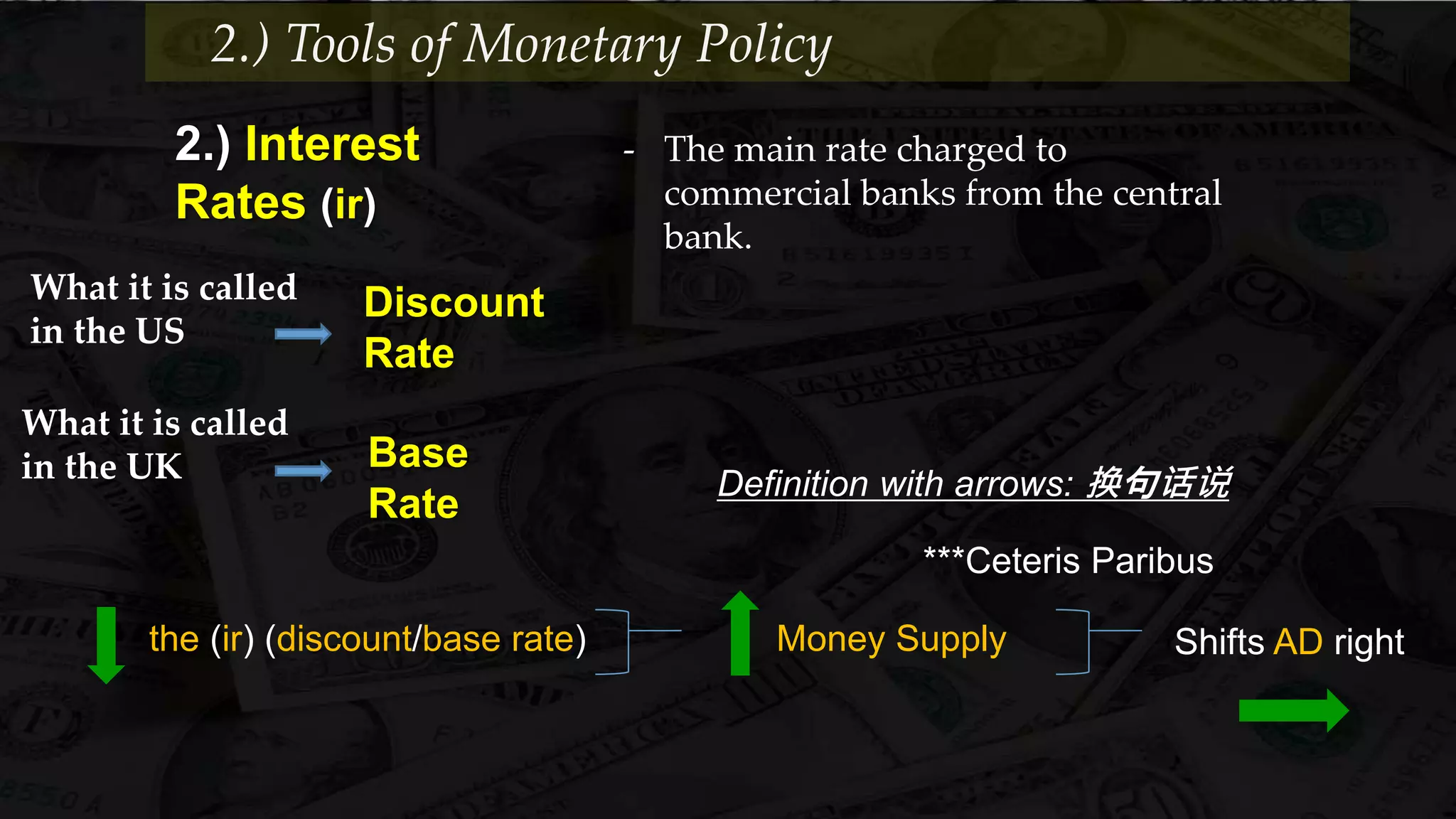
2.) Interest
Rates (ir)
- The main rate charged to
commercial banks from the central
bank.
Definition with arrows: 换句话说
***Ceteris Paribus
the (ir) (discount/base rate)
Discount
Rate
What it is called
in the US
Base
Rate
What it is called
in the UK
2.) Tools of Monetary Policy
Money Supply Shifts AD right
- benchmark rate that some of the
world's leading banks charge each
other for short-term loans. (inter-bank)
the inter-bank rate
Federal
funds rate
What it is called
in the US
Libor
What it is called
in the UK
2.) Tools of Monetary Policy
2.) Interest
Rates (ir)
Definition with arrows: 换句话说
***Ceteris Paribus
Money Supply Shifts AD right
2.) Tools of Monetary Policy – Interest rates
- The central bank rate can
control all the other banks
rates
Discount Rate or Base rate
- Rate the central bank charges
to the commercial banks
- Rate banks charge to
each other
Federal Funds Rate or Libor
(only to be used in uncommon times)
(more commonly used rate)
5%
6% 6%
8% 8% 8%
central bank
commercial banks
Bank customers
2.) Tools of Monetary Policy – Interest rates
- The central bank rate can
control all the other banks
rates
Discount Rate or Base rate
- Rate the central bank charges
to the commercial banks
- Rate banks charge to
each other
Federal Funds Rate or Libor
(only to be used in uncommon times)
(more commonly used rate)
central bank
commercial banks
Bank customers
Let’s say the central
bank lowers it’s rate
2%
3% 3%
5% 5% 5%
Means lowers rates for I
in AD so more
investment spending MS = AD
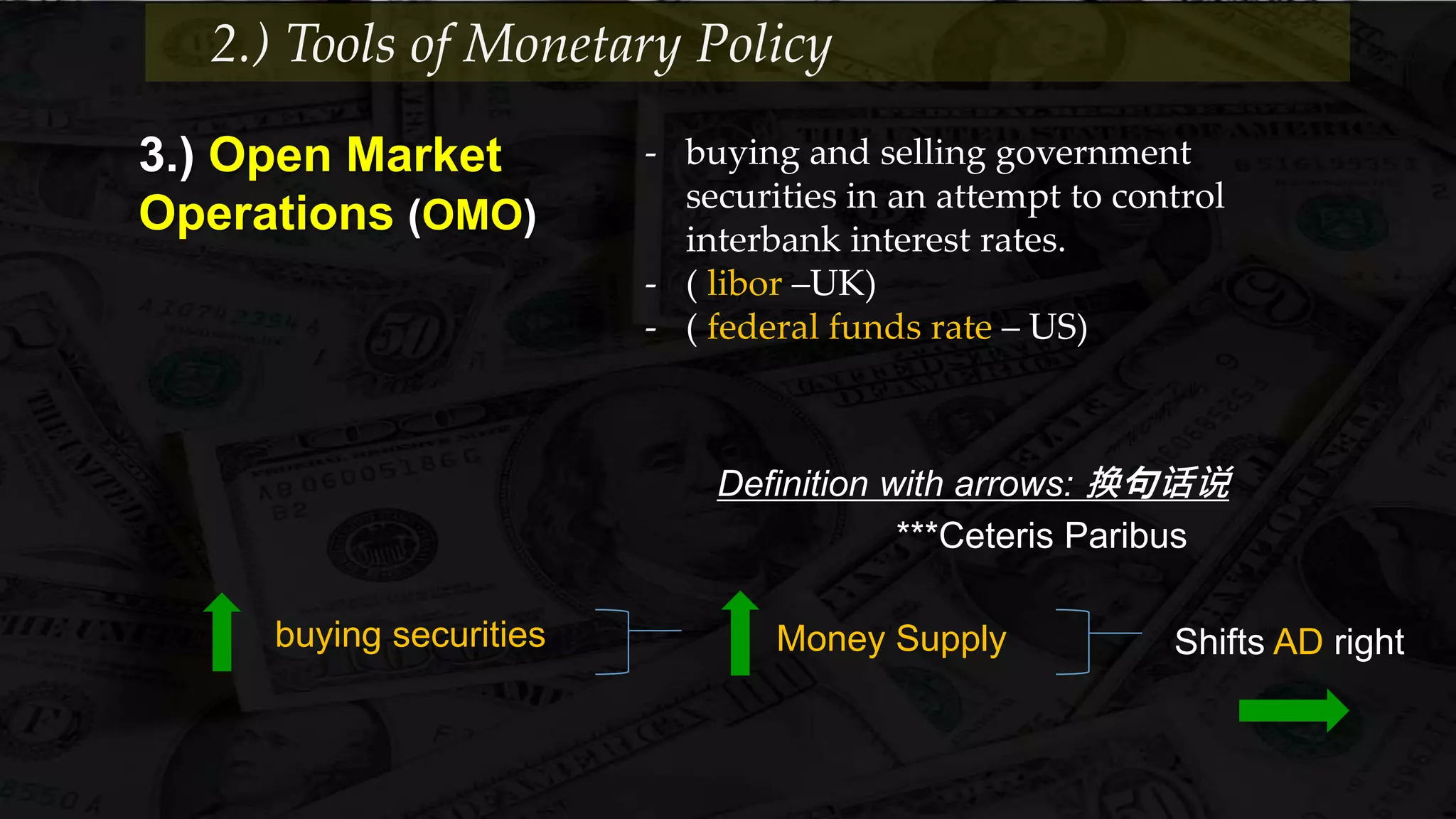
3.) Open Market
Operations (OMO)
buying securities
- buying and selling government
securities in an attempt to control
interbank interest rates.
- ( libor –UK)
- ( federal funds rate – US)
2.) Tools of Monetary Policy
Definition with arrows: 换句话说
***Ceteris Paribus
Money Supply Shifts AD right
2.) Tools of Monetary Policy - OMO
- buying and selling government securities
in an attempt to control interbank interest
rates.
MS AD=
Central bank goes out
into the market and buys
bonds and securities…
in exchange for liquid
money.
central bank
Investors are
commercial banks New money can now
be lend out or used for
consumption.
4.) Exchange
Rate controls
(FOREX controls)
increase Depreciation
- Managing the use of the countries
money between countries.
2.) Tools of Monetary Policy
Definition with arrows: 换句话说
***Ceteris Paribus
Money Supply Shifts AD right
Marvel
Land
DC
Land
Marvel Land Money
DC land Money
(Country B)(Country A)
FOREX graph example
D from B D from A
S from B
S from A
A money = more valuable
B/A
A/B
B money = less valuable
Appreciation
in other country
Depreciation
in this country
NX AD==Depreciation
5.) Quantitative
Easing (QE)
buying securities
- Buying and selling more types of securities.
- used by central banks to stimulate the
economy when standard monetary policy
has become ineffective.
2.) Tools of Monetary Policy
Definition with arrows: 换句话说
***Ceteris Paribus
Money Supply Shifts AD right
2.) Tools of Monetary Policy - QE
- The same idea and OMO, but now the
bank just buys even more different types of
securities.
MS AD=
Central bank goes out
into the market and buys
bonds and securities…
in exchange for liquid
money.
central bank
Investors are
commercial banks New money can now
be lend out or used for
consumption.
Introduction to Monetary Policy
3.) How Banks Create Money
1.) Goals and Types of Monetary Policy
2.) Tools of Monetary Policy
4.) Monetary Policy Limitations
- banks keep a fraction of deposits as reserves
and use the rest to make loans.
The central bank of a country establishes reserve
requirements, regulations on the minimum amount of
reserves that banks must hold against deposits.
The reserve ratio, (rr)
= fraction of deposits that banks hold as reserves
= total reserves as a percentage of total deposits
fractional
reserve
banking
system,
部分准备
金银行制度
Excess reserves are bank reserves over and
above its required reserves.
3.) How Banks Create Money
Liabilities Assets
$100
Reserves (rr)
deposit
10% Cannot be lent out
loans
+ $90
90% Can be lent out
3.) How Banks Create Money
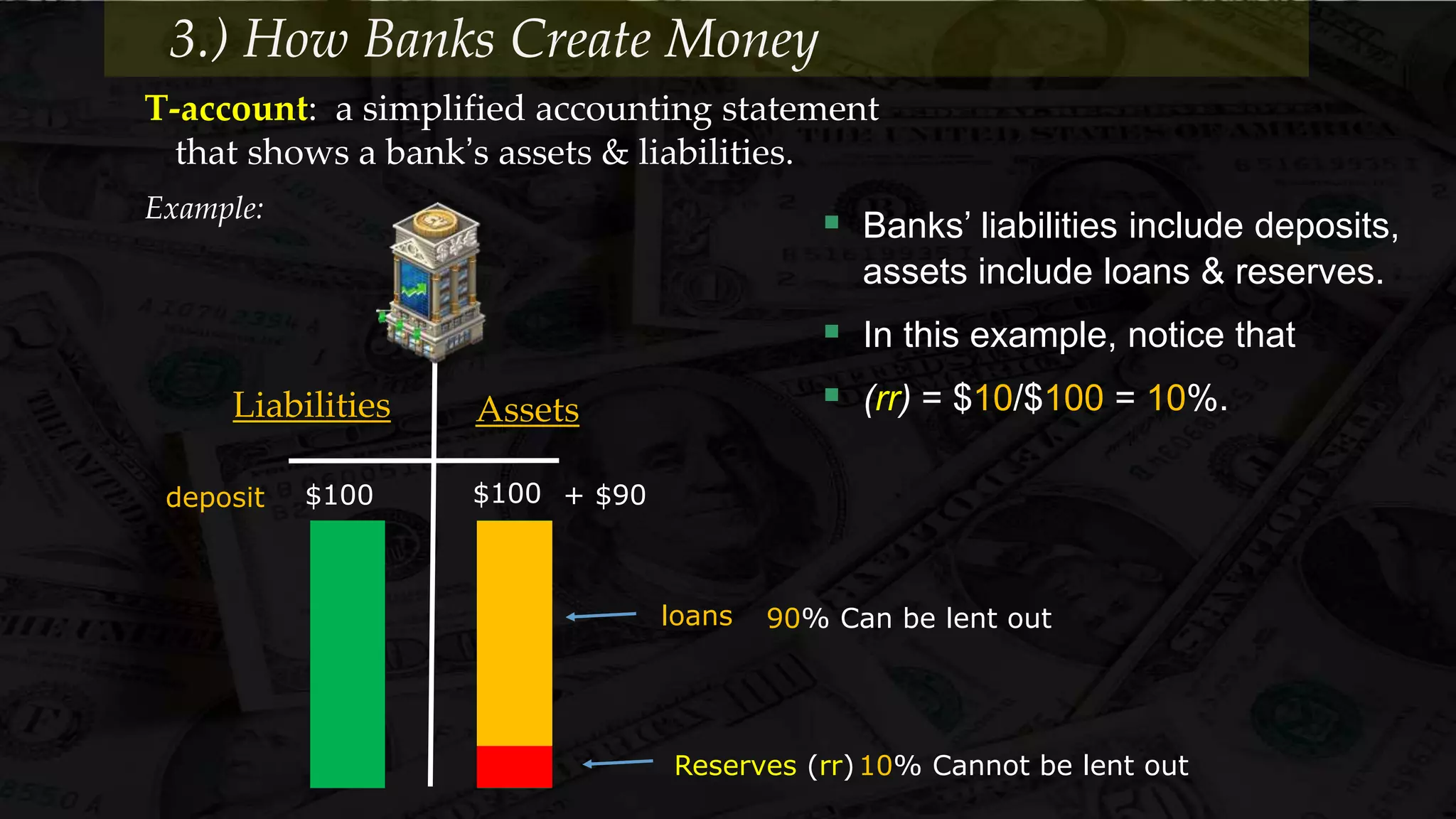
T-account: a simplified accounting statement
that shows a bank’s assets & liabilities.
Example:
 Banks’ liabilities include deposits,
assets include loans & reserves.
 In this example, notice that
 (rr) = $10/$100 = 10%.
$100
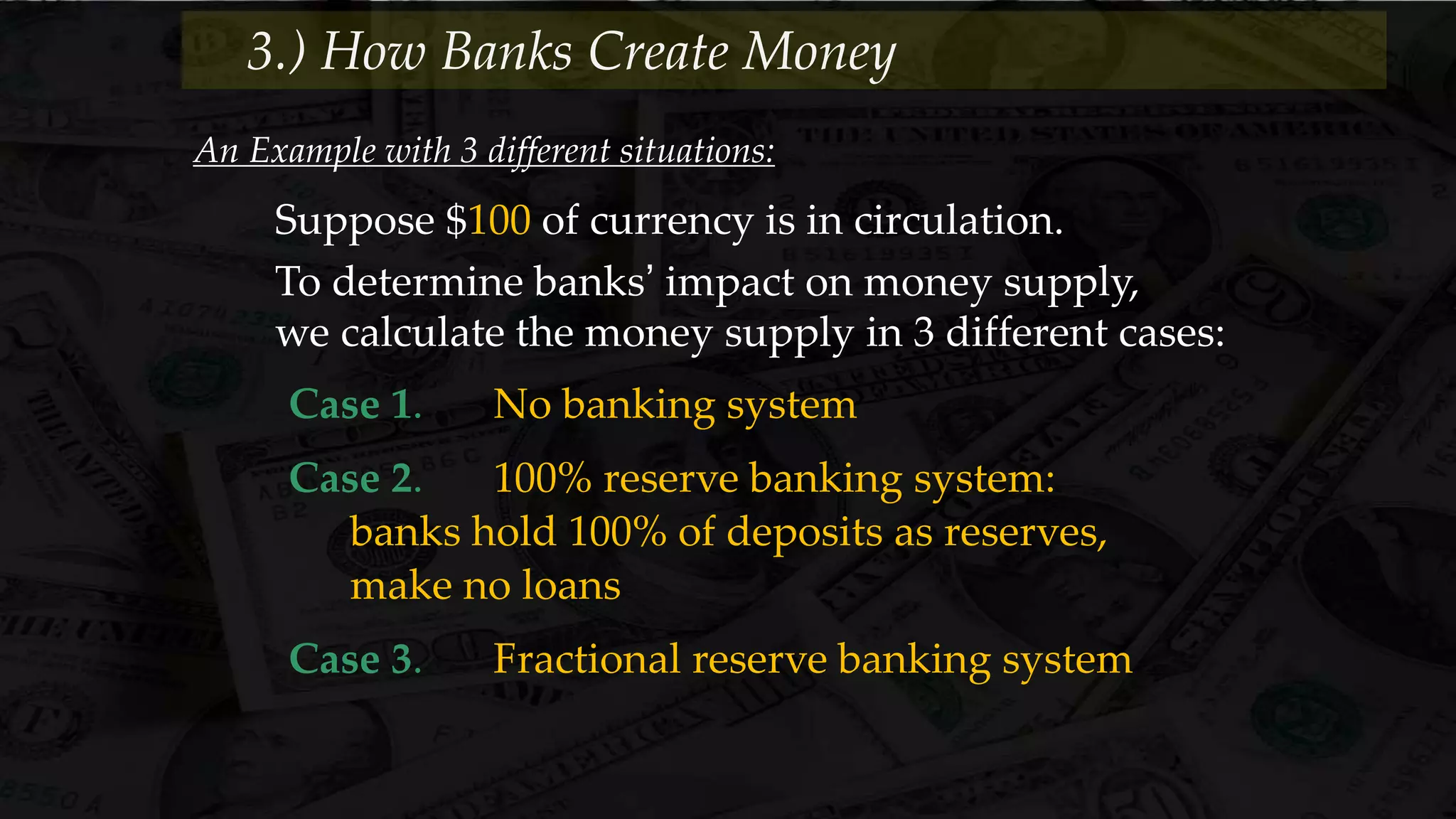
An Example with 3 different situations:
Suppose $100 of currency is in circulation.
To determine banks’ impact on money supply,
we calculate the money supply in 3 different cases:
Case 1. No banking system
Case 2. 100% reserve banking system:
banks hold 100% of deposits as reserves,
make no loans
Case 3. Fractional reserve banking system
3.) How Banks Create Money
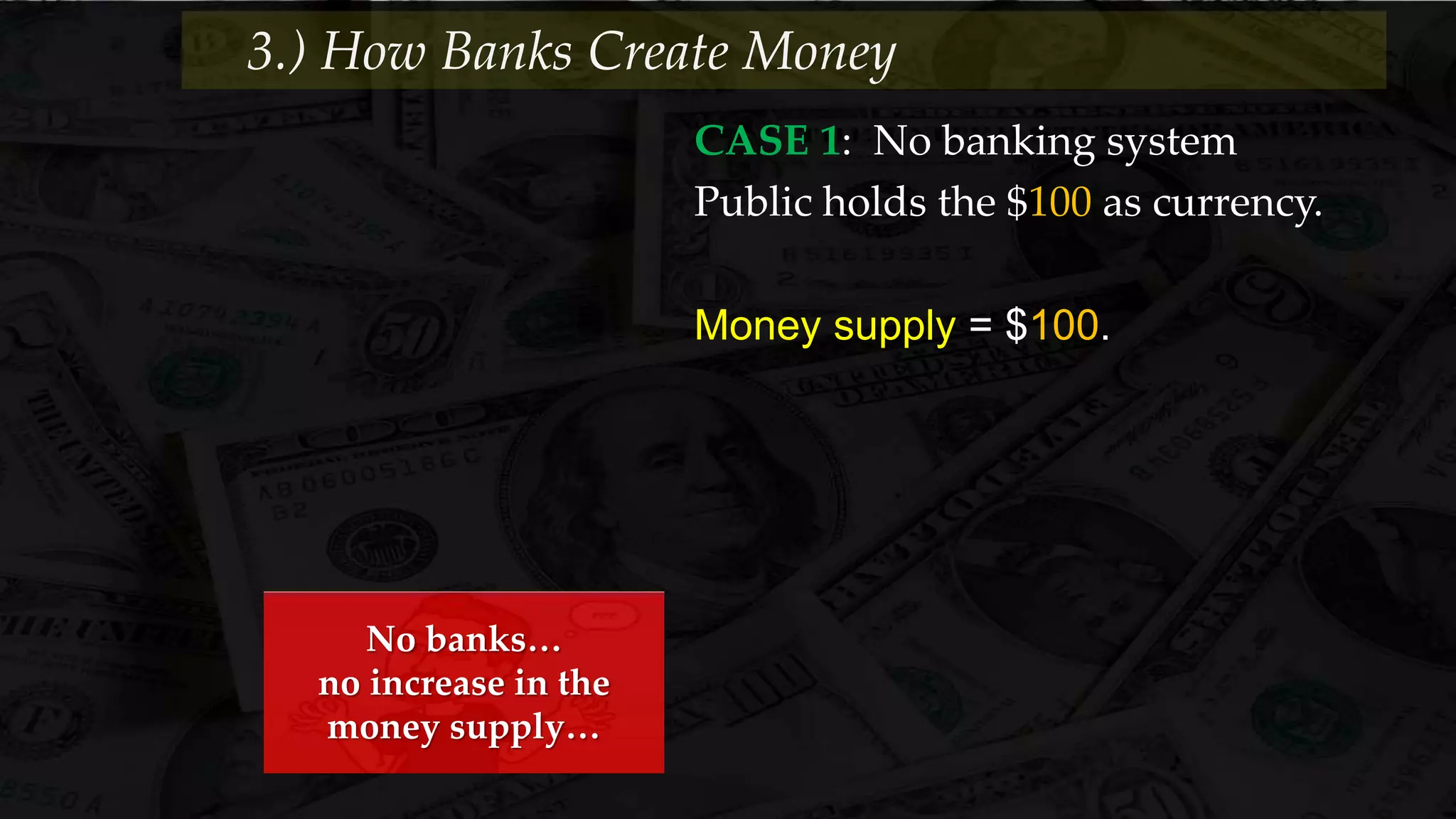
CASE 1: No banking system
Public holds the $100 as currency.
Money supply = $100.
3.) How Banks Create Money
No banks…
no increase in the
money supply…
Liabilities Assets
$100
Reserves (rr)
deposit
100% Cannot be lent out
$100
3.) How Banks Create Money
CASE 2: 100% reserve banking system
Public deposits the $100 at First National Bank (FNB).
Money supply =
currency + deposits =
$0 + $100 = $100
In a 100% reserve banking system,
banks do not affect size of money supply.
Banks can’t make
loans…
no increase in the
money supply…
Liabilities Assets
$100
Reserves (rr)
deposit
$10 Cannot be lent out
$100 +90
3.) How Banks Create Money
CASE 3: Fractional reserve banking system
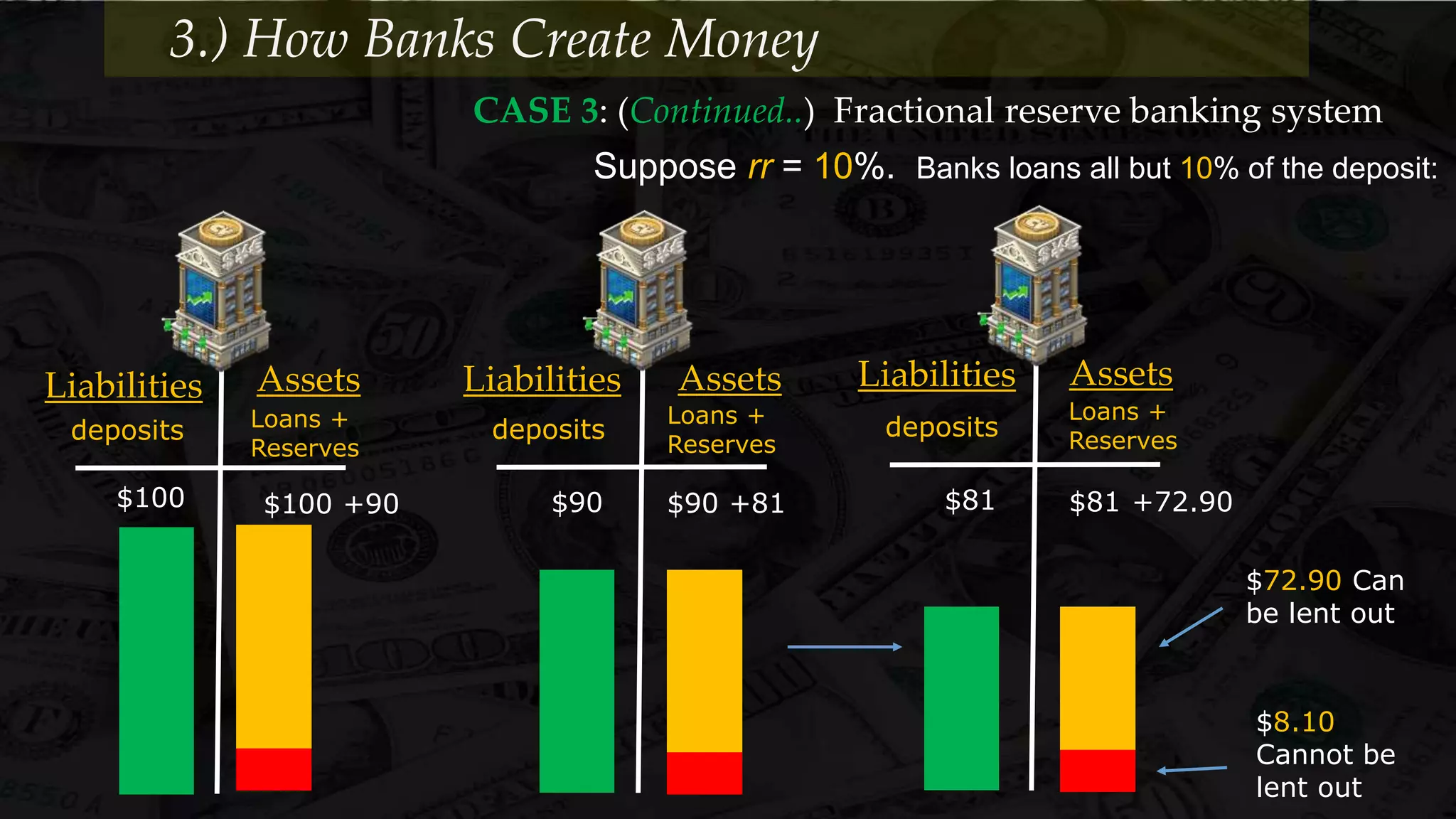
Suppose rr = 10%. Banks loans all but 10% of the deposit:
loans $90 Can be lent out
Liabilities Assets
$100
Reserves (rr)
deposits
$9 Cannot be lent out
$100 +90
3.) How Banks Create Money
Suppose rr = 10%. Banks loans all but 10% of the deposit:
Loans +
Reserves
$81 Can be lent out
CASE 3: (Continued..) Fractional reserve banking system
Assets
$90
deposits
+81
Liabilities
Loans +
Reserves
$90
Liabilities Assets
$100
deposits
$8.10
Cannot be
lent out
$100 +90
3.) How Banks Create Money
Suppose rr = 10%. Banks loans all but 10% of the deposit:
Loans +
Reserves
$72.90 Can
be lent out
CASE 3: (Continued..) Fractional reserve banking system
Assets
$90
deposits
$90 +81
Liabilities
Loans +
Reserves
Assets
$81
deposits
+72.90
Liabilities
Loans +
Reserves
$81
The process continues, and money is created with each new loan...
Original deposit =
1-bank lending =
2-bank lending =
3-bank lending =
...
$ 100.00
$ 90.00
$ 81.00
$ 72.90
...
Total money supply = $ 1000.00
3.) How Banks Create Money
In this example
$100 or reserves
generates $1000
of money
Known as the
Money Multiplier
CASE 3: Fractional reserve banking system
部分准备金银行制度
***A fractional reserve banking system
creates money, but not wealth.
The Credit multiplier = 1/rr.
In our example,
rr = 10%
money multiplier = 1/rr = 10
$100 of reserves creates
$1000 of money
Credit
multiplier
or
Money
multiplier
- the amount of money the
banking system generates
with each dollar of reserves.
3.) How Banks Create Money
Introduction to Monetary Policy
3.) How Banks Create Money
1.) Goals and Types of Monetary Policy
2.) Tools of Monetary Policy
4.) Monetary Policy Limitations
At some point it stops
being effective.
4.) Monetary Policy Limitations
A common expression
about it is called,
“pushing on a string”
Liquidity Trap
4.) Monetary Policy Limitations
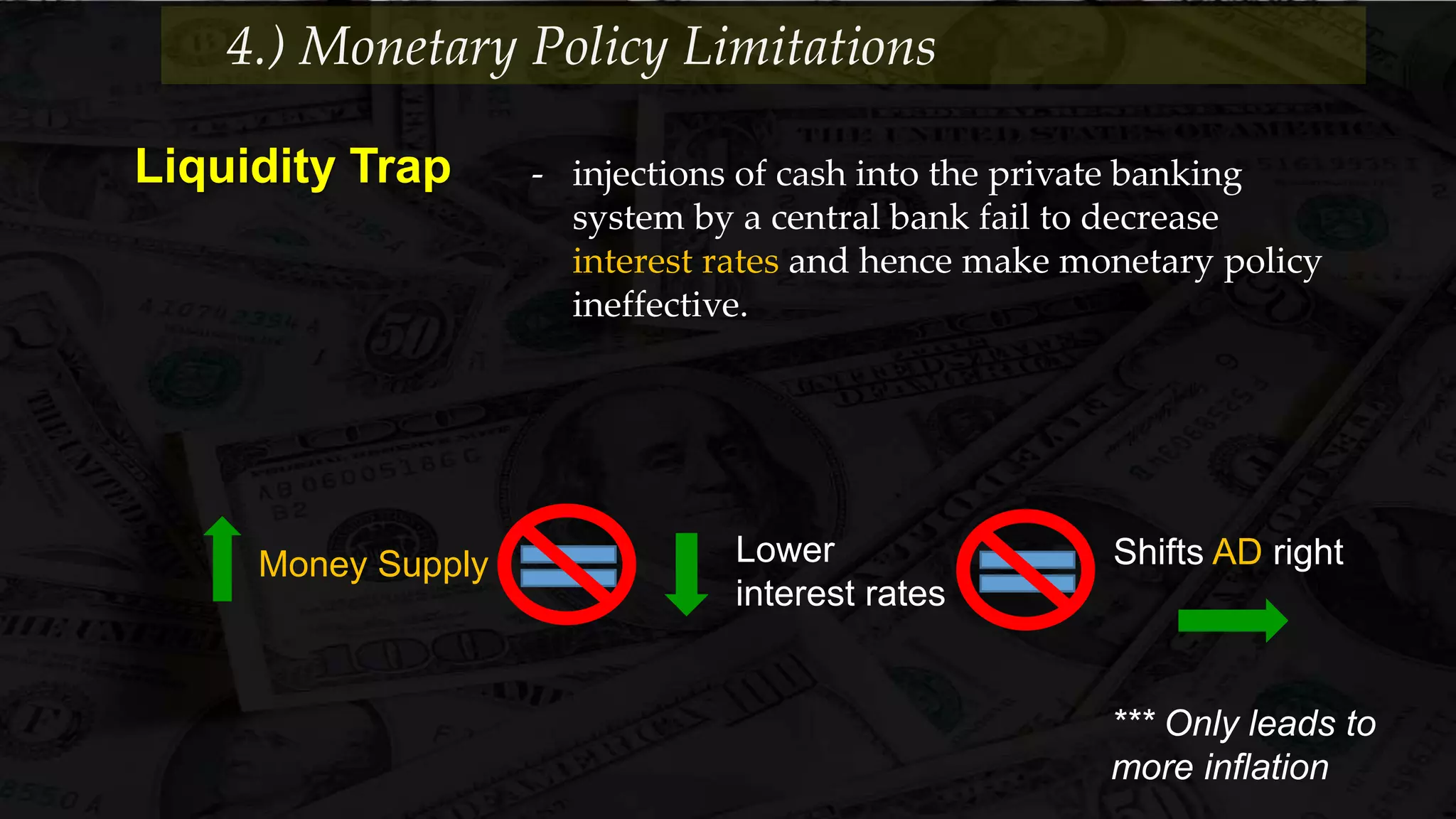
- injections of cash into the private banking
system by a central bank fail to decrease
interest rates and hence make monetary policy
ineffective.
Money Supply Shifts AD rightLower
interest rates
*** Only leads to
more inflation
Liquidity Trap Discount Rate or Base rate
Federal Funds Rate or Libor
central bank
commercial banks
Bank customers
Once the rate gets to
0% it’s not working to
stimulate any more
growth. 0%
0% 0%
0% 0% 0%
Reached the end of this
tool and I in AD is not
increasing with the
lower rates.
Now what?
4.) Monetary Policy Limitations – Liquidity Trap
4.) Monetary Policy Limitations
Monetary policy can’t really
help this problem.
Price
level
GDP
AD
SRAS
PE
LRAS
YN
SRAS1
Y1
P1
2.) Cost-Push
Negative supply
shock
4.) Monetary Policy Limitations
The bad kind of
inflation because
it involves lower
output.
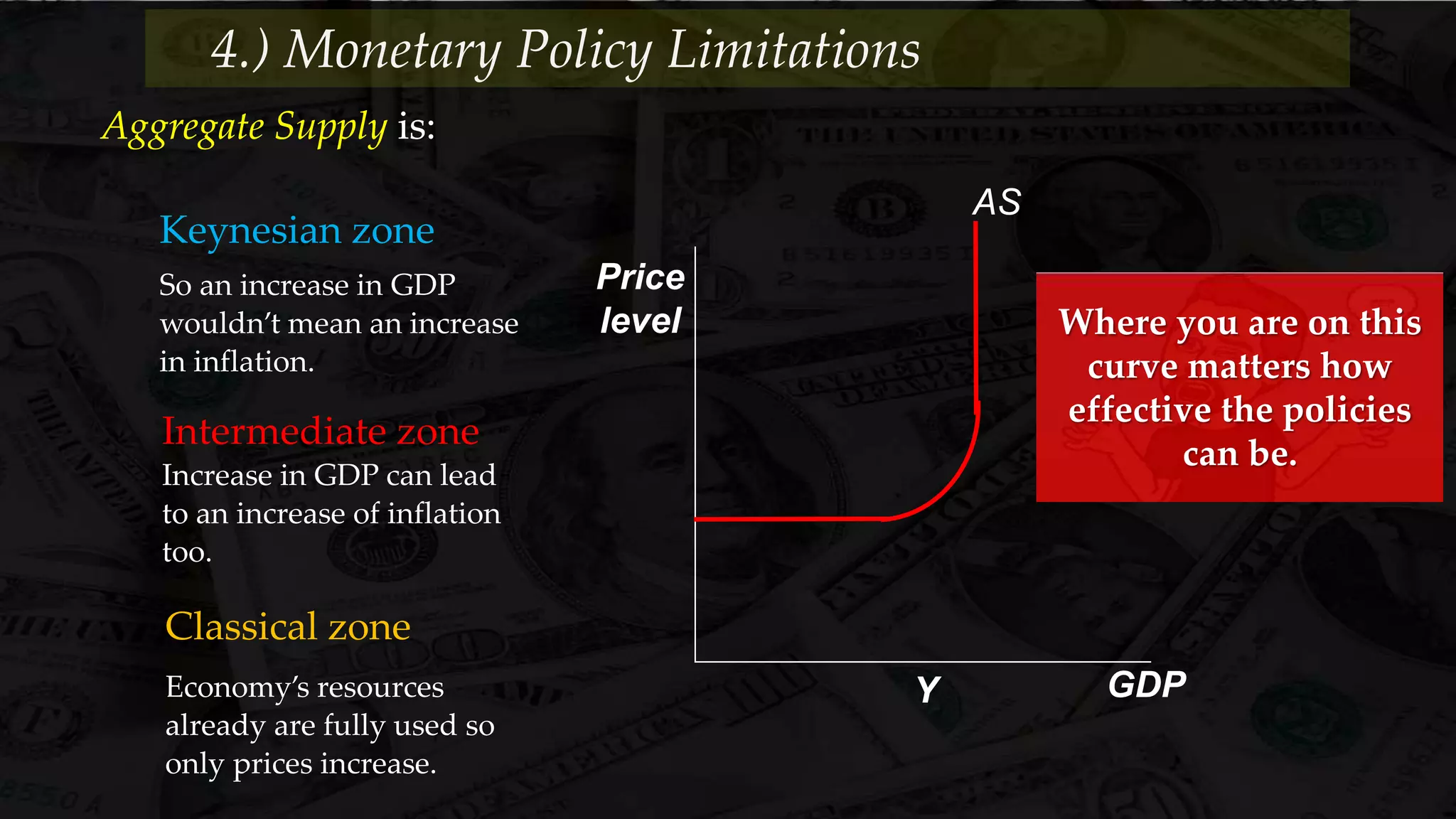
Monetary policy can’t really help this problem, it
only adds to inflation.
{
Price
level
GDPY
AS
Aggregate Supply is:Aggregate Supply is:
Classical zone
Economy’s resources
already are fully used so
only prices increase.
Intermediate zone
Increase in GDP can lead
to an increase of inflation
too.
Keynesian zone
So an increase in GDP
wouldn’t mean an increase
in inflation.
4.) Monetary Policy Limitations
Where you are on this
curve matters how
effective the policies
can be.
Price
level
GDPY
Aggregate Supply is:
Classical zone
Economy’s resources
already are fully used so
only prices increase
Intermediate zone
Increase in GDP can lead
to an increase of inflation
too.
Keynesian zone
So an increase in GDP
wouldn’t mean an increase
in inflation.
4.) Monetary Policy Limitations
AD AD1
Can be very effective
here...
AS
Price
level
GDPY
Aggregate Supply is:
Classical zone
Economy’s resources
already are fully used so
only prices increase.
Intermediate zone
Increase in GDP can lead
to an increase of inflation
too.
Keynesian zone
So an increase in GDP
wouldn’t mean an increase
in inflation.
4.) Monetary Policy Limitations
AD
AD1
Can be effective here,
but watch out for
inflation.
AS
Price
level
GDPY
Aggregate Supply is:
Classical zone
Economy’s resources
already are fully used so
only prices increase.
Intermediate zone
Increase in GDP can lead
to an increase of inflation
too.
Keynesian zone
So an increase in GDP
wouldn’t mean an increase
in inflation.
4.) Monetary Policy Limitations
AD
AD1
AS
No longer effective
now, you just have
inflation.
So to summarize…
AD = C + I + G + (X – M)
Money Supply
Price
level
GDP
AD
SRAS
PE
LRAS
YN Y1
P1
AD1
***(PED > 1)
1.) Goals and Types of Monetary Policy
- More money mean
more possible
transactions and
investment in the
economy, however can
lead to inflation.
1.) Reserve Requirements (rr)
2.) Interest Rates (ir)
3.) Open Market Operations (omo)
4.) Exchange Rate Controls (Forex controls)
5.) Quantitative Easing (QE)
2.) Tools of Monetary Policy
AD = C + I + G + (X – M)
How the Tools of Monetary Policy work
(PED > 1)
- banks keep a fraction of deposits as reserves
and use the rest to make loans.
The central bank of a country establishes reserve
requirements, regulations on the minimum amount of
reserves that banks must hold against deposits.
The reserve ratio, (rr)
= fraction of deposits that banks hold as reserves
= total reserves as a percentage of total deposits
fractional
reserve
banking
system,
部分准备
金银行制度
Excess reserves are bank reserves over and
above its required reserves.
3.) How Banks Create Money
The Credit multiplier = 1/rr.
In our example,
rr = 10%
money multiplier = 1/rr = 10
$100 of reserves creates
$1000 of money
Credit
multiplier
or
Money
multiplier
- the amount of money the
banking system generates
with each dollar of reserves.
3.) How Banks Create Money
4.) Monetary Policy Limitations
Price
level
GDPY
AS
Aggregate Supply is:
Classical zone
Economy’s resources
already are fully used so
only prices increase.
Intermediate zone
Increase in GDP can lead
to an increase of inflation
too.
Keynesian zone
So an increase in GDP
wouldn’t mean an increase
in inflation.
4.) Monetary Policy Limitations
AD
AD1
Price
level
GDPY
AS
Aggregate Supply is:
Classical zone
Economy’s resources
already are fully used so
only prices increase.
Intermediate zone
Increase in GDP can lead
to an increase of inflation
too.
Keynesian zone
So an increase in GDP
wouldn’t mean an increase
in inflation.
4.) Monetary Policy Limitations
AD
AD1
The end
Thank you


Monetary Policy SFLS

  • 1.
  • 2.
    Introduction to MonetaryPolicy 3.) How Banks make Money 1.) Goals and Types of Monetary Policy 2.) Tools of Monetary Policy 4.) Monetary Policy Limitations
  • 3.
    Monetary Policy AD =C + I + G + (X – M) - is the use of targeting inflation, interest rates, and the exchange rates to shift the AD curve. Reworded definition: 换句话说 - is the use of changing the supply of money to sustain economic growth and smooth 连出 the business cycle. 1.) Goals and Types of Monetary Policy
  • 4.
    - An increasein the money supply to increase AD Expansionary Monetary Policy AD = C + I + G + (X – M) Inflationary Monetary Policy or Definition with arrows: 换句话说 ***Ceteris Paribus Money Supply Shifts AD right 1.) Goals and Types of Monetary Policy
  • 5.
    AD = C+ I + G + (X – M) Contractionary Monetary Policy Deflationary Monetary Policy or Money Supply ***Ceteris Paribus Definition with arrows: 换句话说 Shifts AD left - An decrease in the money supply to increase AD Expansionary Monetary Policy 1.) Goals and Types of Monetary Policy
  • 6.
    Time Long Run Short Run Econ Growth UseContractionary Monetary Policy Use Expansionary Monetary Policy Monetary Policy - is the use of changing the supply of money to sustain economic growth and smooth 连出 the business cycle.
  • 7.
    Time Long Run Short Run BusinessCycle Econ Growth Monetary Policy - is the use of changing the supply of money to sustain economic growth and smooth 连出 the business cycle. - Basically, monetary policy aims to stabilize economic growth, avoiding a boom and bust economic cycle.
  • 8.
    Introduction to MonetaryPolicy 1.) Goals and Types of Monetary Policy 2.) Tools of Monetary Policy 3.) How Banks make Money 4.) Monetary Policy Limitations
  • 9.
    1.) Reserve Requirements(rr) 2.) Interest Rates (ir) 3.) Open Market Operations (omo) 4.) Exchange Rate Controls (Forex controls) 5.) Quantitative Easing (QE) 2.) Tools of Monetary Policy AD = C + I + G + (X – M) How the Tools of Monetary Policy work (PED > 1)
  • 10.
    AD = C+ I + G + (X – M) Money Supply Price level GDP AD SRAS PE LRAS YN Y1 P1 AD1 ***(PED > 1) 1.) Goals and Types of Monetary Policy - More money mean more possible transactions and investment in the economy, however can lead to inflation.
  • 11.
    1.) Reserve Requirements (rr) - theminimum fraction of customer deposits that each commercial bank must hold as reserves. (rather than lend out). Definition with arrows: 换句话说 ***Ceteris Paribus the (rr) 2.) Tools of Monetary Policy Money Supply Shifts AD right
  • 12.
    Liabilities Assets $100 Let’s saythe (rr) is 10% percent (rr) Let’s say people deposit $100 in the bank The bank can make lots of loans and increase the money supply a lot 10% Cannot be lent out loans + $90 2.) Tools of Monetary Policy – Reserve Requirements 90% Can be lent out Reserve Requirements - the minimum amount banks have to keep in the bank and can’t lend out. (rr) MS AD= $100
  • 13.
    Let’s say the(rr) is 40% percent (rr) 60% Cannot be lent out loans 2.) Tools of Monetary Policy – Reserve Requirements 40% Can be lent out Reserve Requirements - the minimum amount banks have to keep in the bank and can’t lend out. (rr) MS AD= The bank can make lots of loans and increase the money supply by a smaller amount Liabilities Assets $100 Let’s say people deposit $100 in the bank $100 + $40
  • 14.
    2.) Interest Rates (ir) -The main rate charged to commercial banks from the central bank. Definition with arrows: 换句话说 ***Ceteris Paribus the (ir) (discount/base rate) Discount Rate What it is called in the US Base Rate What it is called in the UK 2.) Tools of Monetary Policy Money Supply Shifts AD right
  • 15.
    - benchmark ratethat some of the world's leading banks charge each other for short-term loans. (inter-bank) the inter-bank rate Federal funds rate What it is called in the US Libor What it is called in the UK 2.) Tools of Monetary Policy 2.) Interest Rates (ir) Definition with arrows: 换句话说 ***Ceteris Paribus Money Supply Shifts AD right
  • 16.
    2.) Tools ofMonetary Policy – Interest rates - The central bank rate can control all the other banks rates Discount Rate or Base rate - Rate the central bank charges to the commercial banks - Rate banks charge to each other Federal Funds Rate or Libor (only to be used in uncommon times) (more commonly used rate) 5% 6% 6% 8% 8% 8% central bank commercial banks Bank customers
  • 17.
    2.) Tools ofMonetary Policy – Interest rates - The central bank rate can control all the other banks rates Discount Rate or Base rate - Rate the central bank charges to the commercial banks - Rate banks charge to each other Federal Funds Rate or Libor (only to be used in uncommon times) (more commonly used rate) central bank commercial banks Bank customers Let’s say the central bank lowers it’s rate 2% 3% 3% 5% 5% 5% Means lowers rates for I in AD so more investment spending MS = AD
  • 18.
    3.) Open Market Operations(OMO) buying securities - buying and selling government securities in an attempt to control interbank interest rates. - ( libor –UK) - ( federal funds rate – US) 2.) Tools of Monetary Policy Definition with arrows: 换句话说 ***Ceteris Paribus Money Supply Shifts AD right
  • 19.
    2.) Tools ofMonetary Policy - OMO - buying and selling government securities in an attempt to control interbank interest rates. MS AD= Central bank goes out into the market and buys bonds and securities… in exchange for liquid money. central bank Investors are commercial banks New money can now be lend out or used for consumption.
  • 20.
    4.) Exchange Rate controls (FOREXcontrols) increase Depreciation - Managing the use of the countries money between countries. 2.) Tools of Monetary Policy Definition with arrows: 换句话说 ***Ceteris Paribus Money Supply Shifts AD right
  • 21.
    Marvel Land DC Land Marvel Land Money DCland Money (Country B)(Country A) FOREX graph example D from B D from A S from B S from A A money = more valuable B/A A/B B money = less valuable Appreciation in other country Depreciation in this country NX AD==Depreciation
  • 22.
    5.) Quantitative Easing (QE) buyingsecurities - Buying and selling more types of securities. - used by central banks to stimulate the economy when standard monetary policy has become ineffective. 2.) Tools of Monetary Policy Definition with arrows: 换句话说 ***Ceteris Paribus Money Supply Shifts AD right
  • 23.
    2.) Tools ofMonetary Policy - QE - The same idea and OMO, but now the bank just buys even more different types of securities. MS AD= Central bank goes out into the market and buys bonds and securities… in exchange for liquid money. central bank Investors are commercial banks New money can now be lend out or used for consumption.
  • 24.
    Introduction to MonetaryPolicy 3.) How Banks Create Money 1.) Goals and Types of Monetary Policy 2.) Tools of Monetary Policy 4.) Monetary Policy Limitations
  • 25.
    - banks keepa fraction of deposits as reserves and use the rest to make loans. The central bank of a country establishes reserve requirements, regulations on the minimum amount of reserves that banks must hold against deposits. The reserve ratio, (rr) = fraction of deposits that banks hold as reserves = total reserves as a percentage of total deposits fractional reserve banking system, 部分准备 金银行制度 Excess reserves are bank reserves over and above its required reserves. 3.) How Banks Create Money
  • 26.
    Liabilities Assets $100 Reserves (rr) deposit 10%Cannot be lent out loans + $90 90% Can be lent out 3.) How Banks Create Money T-account: a simplified accounting statement that shows a bank’s assets & liabilities. Example:  Banks’ liabilities include deposits, assets include loans & reserves.  In this example, notice that  (rr) = $10/$100 = 10%. $100
  • 27.
    An Example with3 different situations: Suppose $100 of currency is in circulation. To determine banks’ impact on money supply, we calculate the money supply in 3 different cases: Case 1. No banking system Case 2. 100% reserve banking system: banks hold 100% of deposits as reserves, make no loans Case 3. Fractional reserve banking system 3.) How Banks Create Money
  • 28.
    CASE 1: Nobanking system Public holds the $100 as currency. Money supply = $100. 3.) How Banks Create Money No banks… no increase in the money supply…
  • 29.
    Liabilities Assets $100 Reserves (rr) deposit 100%Cannot be lent out $100 3.) How Banks Create Money CASE 2: 100% reserve banking system Public deposits the $100 at First National Bank (FNB). Money supply = currency + deposits = $0 + $100 = $100 In a 100% reserve banking system, banks do not affect size of money supply. Banks can’t make loans… no increase in the money supply…
  • 30.
    Liabilities Assets $100 Reserves (rr) deposit $10Cannot be lent out $100 +90 3.) How Banks Create Money CASE 3: Fractional reserve banking system Suppose rr = 10%. Banks loans all but 10% of the deposit: loans $90 Can be lent out
  • 31.
    Liabilities Assets $100 Reserves (rr) deposits $9Cannot be lent out $100 +90 3.) How Banks Create Money Suppose rr = 10%. Banks loans all but 10% of the deposit: Loans + Reserves $81 Can be lent out CASE 3: (Continued..) Fractional reserve banking system Assets $90 deposits +81 Liabilities Loans + Reserves $90
  • 32.
    Liabilities Assets $100 deposits $8.10 Cannot be lentout $100 +90 3.) How Banks Create Money Suppose rr = 10%. Banks loans all but 10% of the deposit: Loans + Reserves $72.90 Can be lent out CASE 3: (Continued..) Fractional reserve banking system Assets $90 deposits $90 +81 Liabilities Loans + Reserves Assets $81 deposits +72.90 Liabilities Loans + Reserves $81
  • 33.
    The process continues,and money is created with each new loan... Original deposit = 1-bank lending = 2-bank lending = 3-bank lending = ... $ 100.00 $ 90.00 $ 81.00 $ 72.90 ... Total money supply = $ 1000.00 3.) How Banks Create Money In this example $100 or reserves generates $1000 of money Known as the Money Multiplier CASE 3: Fractional reserve banking system 部分准备金银行制度 ***A fractional reserve banking system creates money, but not wealth.
  • 34.
    The Credit multiplier= 1/rr. In our example, rr = 10% money multiplier = 1/rr = 10 $100 of reserves creates $1000 of money Credit multiplier or Money multiplier - the amount of money the banking system generates with each dollar of reserves. 3.) How Banks Create Money
  • 35.
    Introduction to MonetaryPolicy 3.) How Banks Create Money 1.) Goals and Types of Monetary Policy 2.) Tools of Monetary Policy 4.) Monetary Policy Limitations
  • 36.
    At some pointit stops being effective.
  • 37.
    4.) Monetary PolicyLimitations A common expression about it is called, “pushing on a string”
  • 38.
    Liquidity Trap 4.) MonetaryPolicy Limitations - injections of cash into the private banking system by a central bank fail to decrease interest rates and hence make monetary policy ineffective. Money Supply Shifts AD rightLower interest rates *** Only leads to more inflation
  • 39.
    Liquidity Trap DiscountRate or Base rate Federal Funds Rate or Libor central bank commercial banks Bank customers Once the rate gets to 0% it’s not working to stimulate any more growth. 0% 0% 0% 0% 0% 0% Reached the end of this tool and I in AD is not increasing with the lower rates. Now what? 4.) Monetary Policy Limitations – Liquidity Trap
  • 40.
    4.) Monetary PolicyLimitations Monetary policy can’t really help this problem.
  • 41.
    Price level GDP AD SRAS PE LRAS YN SRAS1 Y1 P1 2.) Cost-Push Negative supply shock 4.)Monetary Policy Limitations The bad kind of inflation because it involves lower output. Monetary policy can’t really help this problem, it only adds to inflation.
  • 42.
  • 43.
    Price level GDPY AS Aggregate Supply is:AggregateSupply is: Classical zone Economy’s resources already are fully used so only prices increase. Intermediate zone Increase in GDP can lead to an increase of inflation too. Keynesian zone So an increase in GDP wouldn’t mean an increase in inflation. 4.) Monetary Policy Limitations Where you are on this curve matters how effective the policies can be.
  • 44.
    Price level GDPY Aggregate Supply is: Classicalzone Economy’s resources already are fully used so only prices increase Intermediate zone Increase in GDP can lead to an increase of inflation too. Keynesian zone So an increase in GDP wouldn’t mean an increase in inflation. 4.) Monetary Policy Limitations AD AD1 Can be very effective here... AS
  • 45.
    Price level GDPY Aggregate Supply is: Classicalzone Economy’s resources already are fully used so only prices increase. Intermediate zone Increase in GDP can lead to an increase of inflation too. Keynesian zone So an increase in GDP wouldn’t mean an increase in inflation. 4.) Monetary Policy Limitations AD AD1 Can be effective here, but watch out for inflation. AS
  • 46.
    Price level GDPY Aggregate Supply is: Classicalzone Economy’s resources already are fully used so only prices increase. Intermediate zone Increase in GDP can lead to an increase of inflation too. Keynesian zone So an increase in GDP wouldn’t mean an increase in inflation. 4.) Monetary Policy Limitations AD AD1 AS No longer effective now, you just have inflation.
  • 47.
  • 48.
    AD = C+ I + G + (X – M) Money Supply Price level GDP AD SRAS PE LRAS YN Y1 P1 AD1 ***(PED > 1) 1.) Goals and Types of Monetary Policy - More money mean more possible transactions and investment in the economy, however can lead to inflation.
  • 49.
    1.) Reserve Requirements(rr) 2.) Interest Rates (ir) 3.) Open Market Operations (omo) 4.) Exchange Rate Controls (Forex controls) 5.) Quantitative Easing (QE) 2.) Tools of Monetary Policy AD = C + I + G + (X – M) How the Tools of Monetary Policy work (PED > 1)
  • 50.
    - banks keepa fraction of deposits as reserves and use the rest to make loans. The central bank of a country establishes reserve requirements, regulations on the minimum amount of reserves that banks must hold against deposits. The reserve ratio, (rr) = fraction of deposits that banks hold as reserves = total reserves as a percentage of total deposits fractional reserve banking system, 部分准备 金银行制度 Excess reserves are bank reserves over and above its required reserves. 3.) How Banks Create Money
  • 51.
    The Credit multiplier= 1/rr. In our example, rr = 10% money multiplier = 1/rr = 10 $100 of reserves creates $1000 of money Credit multiplier or Money multiplier - the amount of money the banking system generates with each dollar of reserves. 3.) How Banks Create Money
  • 52.
  • 53.
    Price level GDPY AS Aggregate Supply is: Classicalzone Economy’s resources already are fully used so only prices increase. Intermediate zone Increase in GDP can lead to an increase of inflation too. Keynesian zone So an increase in GDP wouldn’t mean an increase in inflation. 4.) Monetary Policy Limitations AD AD1
  • 54.
    Price level GDPY AS Aggregate Supply is: Classicalzone Economy’s resources already are fully used so only prices increase. Intermediate zone Increase in GDP can lead to an increase of inflation too. Keynesian zone So an increase in GDP wouldn’t mean an increase in inflation. 4.) Monetary Policy Limitations AD AD1
  • 55.