First Basic Models of the Economy
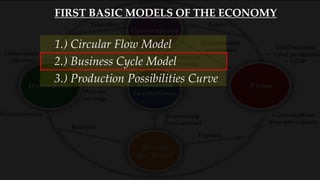
FIRST BASIC MODELS OF THE ECONOMY
3.) Production Possibilities Curve
1.) Circular Flow Model
2.) Business Cycle Model
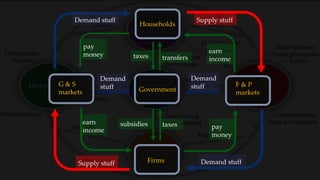
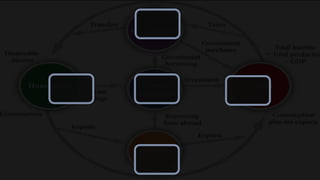
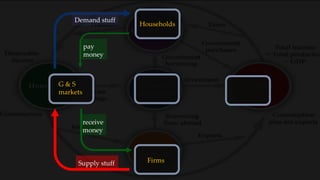
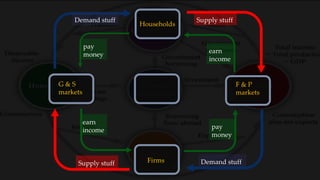
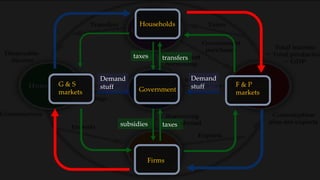
Households
Firms
G & S
markets
Demand stuff
Supply stuff
pay
money
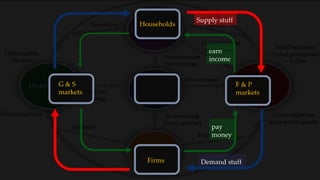
earn
income
F & P
markets
Demand stuff
Supply stuff
earn
income
pay
money
Government
transferstaxes
taxessubsidies
Demand
stuff
Demand
stuff
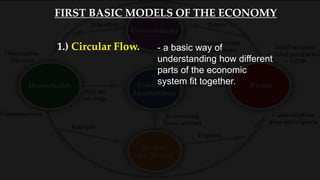
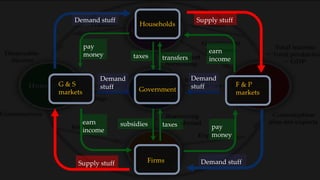
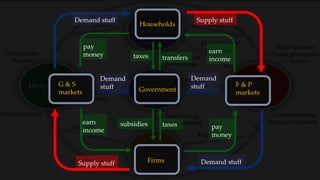
1.) Circular Flow. - a basic way of
understanding how different
parts of the economic
system fit together.
FIRST BASIC MODELS OF THE ECONOMY
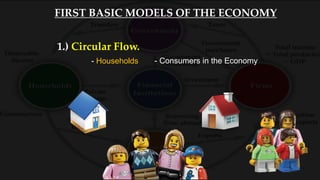
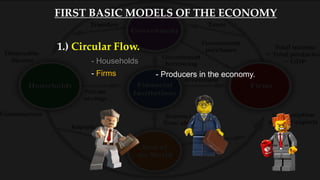
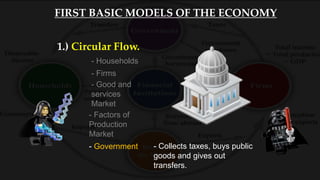
1.) Circular Flow.
- Consumers in the Economy- Households
FIRST BASIC MODELS OF THE ECONOMY
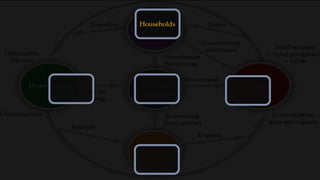
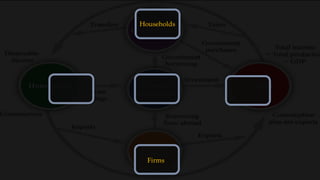
Households
1.) Circular Flow.
- Households
- Producers in the economy.- Firms
FIRST BASIC MODELS OF THE ECONOMY
Households
Firms
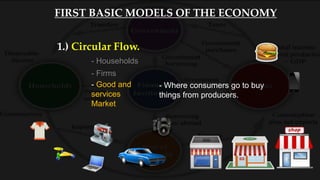
1.) Circular Flow.
- Households
- Firms
- Where consumers go to buy
things from producers.
- Good and
services
Market
FIRST BASIC MODELS OF THE ECONOMY
Households
Firms
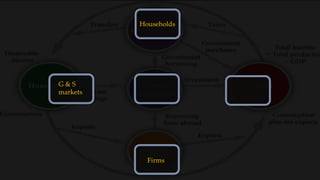
G & S
markets
Households
Firms
G & S
markets
Demand stuff
Supply stuff
pay
money
receive
money
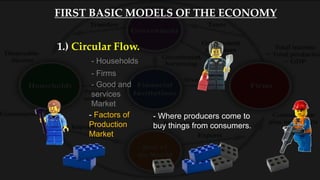
1.) Circular Flow.
- Households
- Firms
- Good and
services
Market
- Where producers come to
buy things from consumers.
- Factors of
Production
Market
FIRST BASIC MODELS OF THE ECONOMY
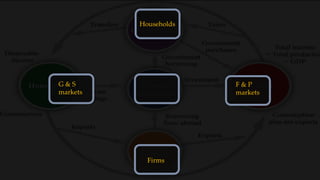
Households
Firms
G & S
markets
F & P
markets
Households
Firms
G & S
markets
F & P
markets
Demand stuff
Supply stuff
earn
income
pay
money
Households
Firms
G & S
markets
Demand stuff
Supply stuff
pay
money
earn
income
F & P
markets
Demand stuff
Supply stuff
earn
income
pay
money
1.) Circular Flow.
- Households
- Firms
- Good and
services
Market
- Factors of
Production
Market
- Collects taxes, buys public
goods and gives out
transfers.
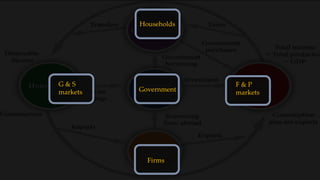
- Government
FIRST BASIC MODELS OF THE ECONOMY
Households
Firms
G & S
markets
F & P
marketsGovernment
Households
Firms
G & S
markets
F & P
marketsGovernment
transferstaxes
taxessubsidies
Demand
stuff
Demand
stuff
Households
Firms
G & S
markets
Demand stuff
Supply stuff
pay
money
earn
income
F & P
markets
Demand stuff
Supply stuff
earn
income
pay
money
Government
transferstaxes
taxessubsidies
Demand
stuff
Demand
stuff
FIRST BASIC MODELS OF THE ECONOMY
3.) Production Possibilities Curve
1.) Circular Flow Model
2.) Business Cycle Model
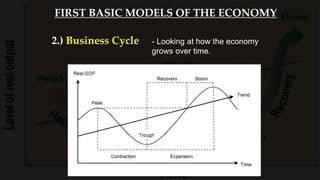
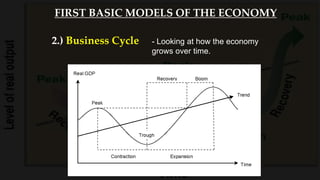
2.) Business Cycle - Looking at how the economy
grows over time.
FIRST BASIC MODELS OF THE ECONOMY
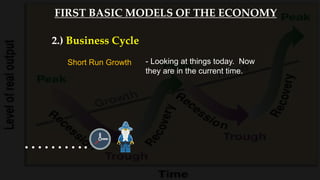
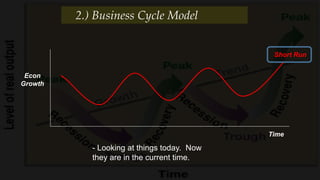
- Looking at things today. Now
they are in the current time.
Short Run Growth
2.) Business Cycle
FIRST BASIC MODELS OF THE ECONOMY
……….
Time
Short Run
Econ
Growth
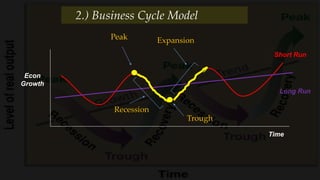
- Looking at things today. Now
they are in the current time.
2.) Business Cycle Model
2.) Business Cycle
- Looking at trend 趋向
over long periods of time.
- Long Run Growth trend
- Short Run Growth
- Averaging out the short
run.
FIRST BASIC MODELS OF THE ECONOMY
…………………………
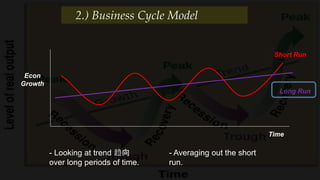
Time
Short Run
Econ
Growth
Long Run
- Looking at trend 趋向
over long periods of time.
- Averaging out the short
run.
2.) Business Cycle Model
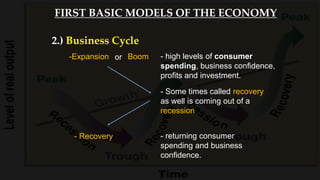
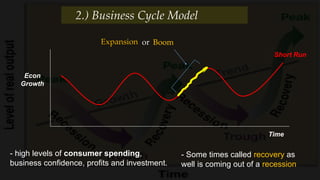
or - high levels of consumer
spending, business confidence,
profits and investment.
Boom
2.) Business Cycle
-Expansion
- Some times called recovery
as well is coming out of a
recession
- returning consumer
spending and business
confidence.
- Recovery
FIRST BASIC MODELS OF THE ECONOMY
Time
Short Run
Econ
Growth
Boomor
- high levels of consumer spending,
business confidence, profits and investment.
Expansion
- Some times called recovery as
well is coming out of a recession
2.) Business Cycle Model
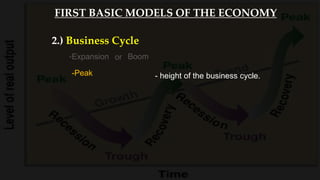
-Peak
or
- height of the business cycle.
Boom
2.) Business Cycle
-Expansion
FIRST BASIC MODELS OF THE ECONOMY
Time
Short Run
Econ
Growth
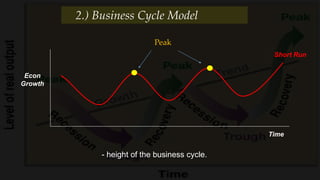
- height of the business cycle.
Peak
2.) Business Cycle Model
-Peak
or Boom
2.) Business Cycle
-Expansion
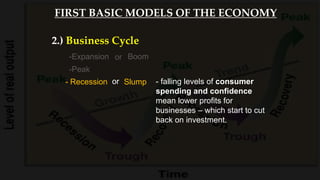
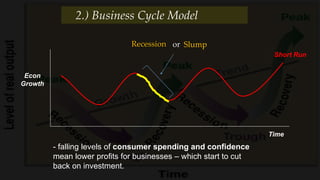
- Recession Slumpor - falling levels of consumer
spending and confidence
mean lower profits for
businesses – which start to cut
back on investment.
FIRST BASIC MODELS OF THE ECONOMY
Time
Short Run
Econ
Growth
SlumporRecession
- falling levels of consumer spending and confidence
mean lower profits for businesses – which start to cut
back on investment.
2.) Business Cycle Model
-Peak
or Boom
2.) Business Cycle
-Expansion
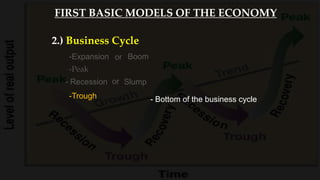
- Recession Slumpor
- Bottom of the business cycle-Trough
FIRST BASIC MODELS OF THE ECONOMY
Time
Short Run
Econ
Growth
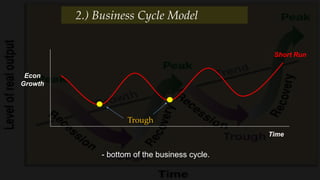
Trough
- bottom of the business cycle.
2.) Business Cycle Model
Time
Short Run
Econ
Growth
Long Run
2.) Business Cycle Model
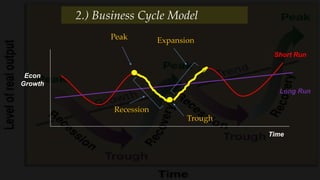
Peak
Recession
Trough
Expansion
FIRST BASIC MODELS OF THE ECONOMY
3.) Production Possibilities Curve
1.) Circular Flow Model
2.) Business Cycle Model
3.) Production
Possibilities Curve
(PPC)
Production
Possibilities Frontier
(PPF)
Also called:
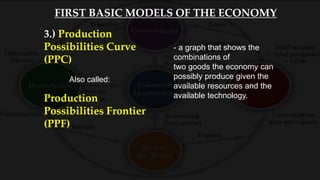
- a graph that shows the
combinations of
two goods the economy can
possibly produce given the
available resources and the
available technology.
FIRST BASIC MODELS OF THE ECONOMY
1.) Full employment: all resources are used
2.) Productive efficiency: goods are being
produced in the least costly way
4.) Fixed 不变 amount of resources
5.) Fixed 不变 amount of technology
3.) Production Possibilities Curve
Assumptions 假定:
0
1,000
2,000
3,000
4,000
5,000
6,000
0 100 200 300 400 500 600
AxisTitle
Axis Title
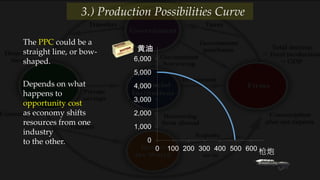
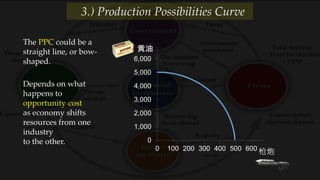
The PPC could be a
straight line, or bow-
shaped.
Depends on what
happens to
opportunity cost
as economy shifts
resources from one
industry
to the other.
3.) Production Possibilities Curve
枪炮
黄油
0
1,000
2,000
3,000
4,000
5,000
6,000
0 100 200 300 400 500 600
AxisTitle
Axis Title
Consumption
goods
Capital
goods
A
B
C
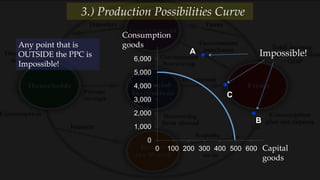
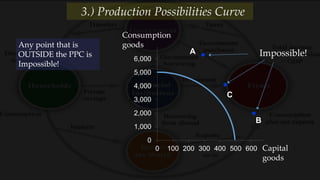
Any point that is
OUTSIDE the PPC is
Impossible!
Impossible!
3.) Production Possibilities Curve
0
1,000
2,000
3,000
4,000
5,000
6,000
0 100 200 300 400 500 600
AxisTitle
Axis Title
Consumption
goods
Capital
goods
A
B
C
D
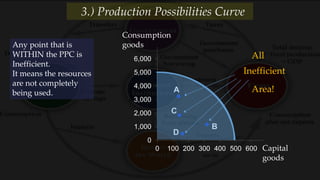
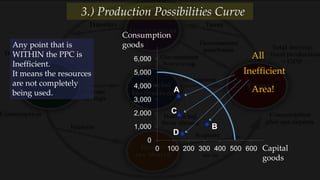
Any point that is
WITHIN the PPC is
Inefficient.
It means the resources
are not completely
being used.
Inefficient
All
Area!
3.) Production Possibilities Curve
0
1,000
2,000
3,000
4,000
5,000
6,000
0 100 200 300 400 500 600
AxisTitle
Axis Title
Consumption
goods
Capital
goods
A
B
C
D
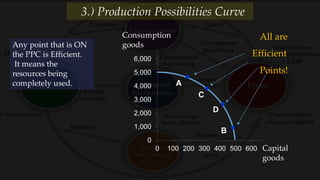
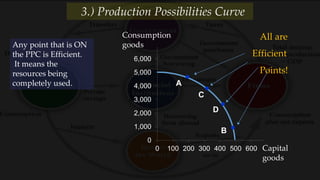
Any point that is ON
the PPC is Efficient.
It means the
resources being
completely used.
Efficient
All are
Points!
3.) Production Possibilities Curve
0
1,000
2,000
3,000
4,000
5,000
6,000
0 100 200 300 400 500 600
AxisTitle
Axis Title
Consumption
goods
Capital
goods
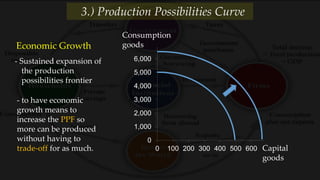
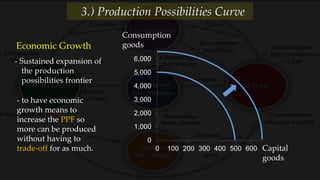
Economic Growth
- Sustained expansion of
the production
possibilities frontier
- to have economic
growth means to
increase the PPF so
more can be produced
without having to
trade-off for as much.
3.) Production Possibilities Curve
0
1,000
2,000
3,000
4,000
5,000
6,000
0 100 200 300 400 500 600
AxisTitle
Axis Title
Consumption
goods
Capital
goods
A
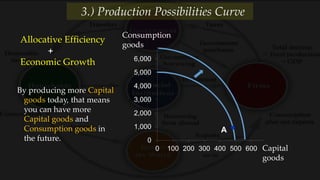
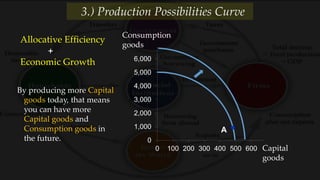
Allocative Efficiency
+
Economic Growth
By producing more Capital
goods today, that means
you can have more
Capital goods and
Consumption goods in
the future.
3.) Production Possibilities Curve
So to Summarize…
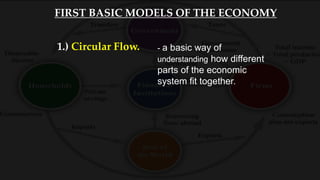
1.) Circular Flow. - a basic way of
understanding how different
parts of the economic
system fit together.
FIRST BASIC MODELS OF THE ECONOMY
Households
Firms
G & S
markets
Demand stuff
Supply stuff
pay
money
earn
income
F & P
markets
Demand stuff
Supply stuff
earn
income
pay
money
Government
transferstaxes
taxessubsidies
Demand
stuff
Demand
stuff
2.) Business Cycle - Looking at how the economy
grows over time.
FIRST BASIC MODELS OF THE ECONOMY
Time
Short Run
Econ
Growth
Long Run
2.) Business Cycle Model
Peak
Recession
Trough
Expansion
3.) Production
Possibilities Curve
(PPC)
Production
Possibilities Frontier
(PPF)
Also called:
- a graph that shows the
combinations of
two goods the economy can
possibly produce given the
available resources and the
available technology.
FIRST BASIC MODELS OF THE ECONOMY
0
1,000
2,000
3,000
4,000
5,000
6,000
0 100 200 300 400 500 600
AxisTitle
Axis Title
The PPC could be a
straight line, or bow-
shaped.
Depends on what
happens to
opportunity cost
as economy shifts
resources from one
industry
to the other.
3.) Production Possibilities Curve
枪炮
黄油
0
1,000
2,000
3,000
4,000
5,000
6,000
0 100 200 300 400 500 600
AxisTitle
Axis Title
Consumption
goods
Capital
goods
A
B
C
D
Any point that is ON
the PPC is Efficient.
It means the
resources being
completely used.
Efficient
All are
Points!
3.) Production Possibilities Curve
0
1,000
2,000
3,000
4,000
5,000
6,000
0 100 200 300 400 500 600
AxisTitle
Axis Title
Consumption
goods
Capital
goods
A
B
C
D
Any point that is
WITHIN the PPC is
Inefficient.
It means the resources
are not completely
being used.
Inefficient
All
Area!
3.) Production Possibilities Curve
0
1,000
2,000
3,000
4,000
5,000
6,000
0 100 200 300 400 500 600
AxisTitle
Axis Title
Consumption
goods
Capital
goods
A
B
C
Any point that is
OUTSIDE the PPC is
Impossible!
Impossible!
3.) Production Possibilities Curve
0
1,000
2,000
3,000
4,000
5,000
6,000
0 100 200 300 400 500 600
AxisTitle
Axis Title
Consumption
goods
Capital
goods
Economic Growth
- Sustained expansion of
the production
possibilities frontier
- to have economic
growth means to
increase the PPF so
more can be produced
without having to
trade-off for as much.
3.) Production Possibilities Curve
0
1,000
2,000
3,000
4,000
5,000
6,000
0 100 200 300 400 500 600
AxisTitle
Axis Title
Consumption
goods
Capital
goods
A
Allocative Efficiency
+
Economic Growth
By producing more Capital
goods today, that means
you can have more
Capital goods and
Consumption goods in
the future.
3.) Production Possibilities Curve
The End.
Thank you 
Please view the next
PPT about the PPC
in more detail.

Basic Models SFLS

  • 1.
    First Basic Modelsof the Economy
  • 2.
    FIRST BASIC MODELSOF THE ECONOMY 3.) Production Possibilities Curve 1.) Circular Flow Model 2.) Business Cycle Model
  • 3.
    Households Firms G & S markets Demandstuff Supply stuff pay money earn income F & P markets Demand stuff Supply stuff earn income pay money Government transferstaxes taxessubsidies Demand stuff Demand stuff
  • 6.
    1.) Circular Flow.- a basic way of understanding how different parts of the economic system fit together. FIRST BASIC MODELS OF THE ECONOMY
  • 7.
    1.) Circular Flow. -Consumers in the Economy- Households FIRST BASIC MODELS OF THE ECONOMY
  • 8.
  • 9.
    1.) Circular Flow. -Households - Producers in the economy.- Firms FIRST BASIC MODELS OF THE ECONOMY
  • 10.
  • 11.
    1.) Circular Flow. -Households - Firms - Where consumers go to buy things from producers. - Good and services Market FIRST BASIC MODELS OF THE ECONOMY
  • 12.
  • 13.
    Households Firms G & S markets Demandstuff Supply stuff pay money receive money
  • 14.
    1.) Circular Flow. -Households - Firms - Good and services Market - Where producers come to buy things from consumers. - Factors of Production Market FIRST BASIC MODELS OF THE ECONOMY
  • 15.
  • 16.
    Households Firms G & S markets F& P markets Demand stuff Supply stuff earn income pay money
  • 17.
    Households Firms G & S markets Demandstuff Supply stuff pay money earn income F & P markets Demand stuff Supply stuff earn income pay money
  • 18.
    1.) Circular Flow. -Households - Firms - Good and services Market - Factors of Production Market - Collects taxes, buys public goods and gives out transfers. - Government FIRST BASIC MODELS OF THE ECONOMY
  • 19.
    Households Firms G & S markets F& P marketsGovernment
  • 20.
    Households Firms G & S markets F& P marketsGovernment transferstaxes taxessubsidies Demand stuff Demand stuff
  • 21.
    Households Firms G & S markets Demandstuff Supply stuff pay money earn income F & P markets Demand stuff Supply stuff earn income pay money Government transferstaxes taxessubsidies Demand stuff Demand stuff
  • 22.
    FIRST BASIC MODELSOF THE ECONOMY 3.) Production Possibilities Curve 1.) Circular Flow Model 2.) Business Cycle Model
  • 23.
    2.) Business Cycle- Looking at how the economy grows over time. FIRST BASIC MODELS OF THE ECONOMY
  • 24.
    - Looking atthings today. Now they are in the current time. Short Run Growth 2.) Business Cycle FIRST BASIC MODELS OF THE ECONOMY ……….
  • 25.
    Time Short Run Econ Growth - Lookingat things today. Now they are in the current time. 2.) Business Cycle Model
  • 26.
    2.) Business Cycle -Looking at trend 趋向 over long periods of time. - Long Run Growth trend - Short Run Growth - Averaging out the short run. FIRST BASIC MODELS OF THE ECONOMY …………………………
  • 27.
    Time Short Run Econ Growth Long Run -Looking at trend 趋向 over long periods of time. - Averaging out the short run. 2.) Business Cycle Model
  • 28.
    or - highlevels of consumer spending, business confidence, profits and investment. Boom 2.) Business Cycle -Expansion - Some times called recovery as well is coming out of a recession - returning consumer spending and business confidence. - Recovery FIRST BASIC MODELS OF THE ECONOMY
  • 29.
    Time Short Run Econ Growth Boomor - highlevels of consumer spending, business confidence, profits and investment. Expansion - Some times called recovery as well is coming out of a recession 2.) Business Cycle Model
  • 30.
    -Peak or - height ofthe business cycle. Boom 2.) Business Cycle -Expansion FIRST BASIC MODELS OF THE ECONOMY
  • 31.
    Time Short Run Econ Growth - heightof the business cycle. Peak 2.) Business Cycle Model
  • 32.
    -Peak or Boom 2.) BusinessCycle -Expansion - Recession Slumpor - falling levels of consumer spending and confidence mean lower profits for businesses – which start to cut back on investment. FIRST BASIC MODELS OF THE ECONOMY
  • 33.
    Time Short Run Econ Growth SlumporRecession - fallinglevels of consumer spending and confidence mean lower profits for businesses – which start to cut back on investment. 2.) Business Cycle Model
  • 34.
    -Peak or Boom 2.) BusinessCycle -Expansion - Recession Slumpor - Bottom of the business cycle-Trough FIRST BASIC MODELS OF THE ECONOMY
  • 35.
    Time Short Run Econ Growth Trough - bottomof the business cycle. 2.) Business Cycle Model
  • 36.
    Time Short Run Econ Growth Long Run 2.)Business Cycle Model Peak Recession Trough Expansion
  • 37.
    FIRST BASIC MODELSOF THE ECONOMY 3.) Production Possibilities Curve 1.) Circular Flow Model 2.) Business Cycle Model
  • 38.
    3.) Production Possibilities Curve (PPC) Production PossibilitiesFrontier (PPF) Also called: - a graph that shows the combinations of two goods the economy can possibly produce given the available resources and the available technology. FIRST BASIC MODELS OF THE ECONOMY
  • 39.
    1.) Full employment:all resources are used 2.) Productive efficiency: goods are being produced in the least costly way 4.) Fixed 不变 amount of resources 5.) Fixed 不变 amount of technology 3.) Production Possibilities Curve Assumptions 假定:
  • 40.
    0 1,000 2,000 3,000 4,000 5,000 6,000 0 100 200300 400 500 600 AxisTitle Axis Title The PPC could be a straight line, or bow- shaped. Depends on what happens to opportunity cost as economy shifts resources from one industry to the other. 3.) Production Possibilities Curve 枪炮 黄油
  • 41.
    0 1,000 2,000 3,000 4,000 5,000 6,000 0 100 200300 400 500 600 AxisTitle Axis Title Consumption goods Capital goods A B C Any point that is OUTSIDE the PPC is Impossible! Impossible! 3.) Production Possibilities Curve
  • 42.
    0 1,000 2,000 3,000 4,000 5,000 6,000 0 100 200300 400 500 600 AxisTitle Axis Title Consumption goods Capital goods A B C D Any point that is WITHIN the PPC is Inefficient. It means the resources are not completely being used. Inefficient All Area! 3.) Production Possibilities Curve
  • 43.
    0 1,000 2,000 3,000 4,000 5,000 6,000 0 100 200300 400 500 600 AxisTitle Axis Title Consumption goods Capital goods A B C D Any point that is ON the PPC is Efficient. It means the resources being completely used. Efficient All are Points! 3.) Production Possibilities Curve
  • 44.
    0 1,000 2,000 3,000 4,000 5,000 6,000 0 100 200300 400 500 600 AxisTitle Axis Title Consumption goods Capital goods Economic Growth - Sustained expansion of the production possibilities frontier - to have economic growth means to increase the PPF so more can be produced without having to trade-off for as much. 3.) Production Possibilities Curve
  • 45.
    0 1,000 2,000 3,000 4,000 5,000 6,000 0 100 200300 400 500 600 AxisTitle Axis Title Consumption goods Capital goods A Allocative Efficiency + Economic Growth By producing more Capital goods today, that means you can have more Capital goods and Consumption goods in the future. 3.) Production Possibilities Curve
  • 46.
  • 47.
    1.) Circular Flow.- a basic way of understanding how different parts of the economic system fit together. FIRST BASIC MODELS OF THE ECONOMY
  • 48.
    Households Firms G & S markets Demandstuff Supply stuff pay money earn income F & P markets Demand stuff Supply stuff earn income pay money Government transferstaxes taxessubsidies Demand stuff Demand stuff
  • 49.
    2.) Business Cycle- Looking at how the economy grows over time. FIRST BASIC MODELS OF THE ECONOMY
  • 50.
    Time Short Run Econ Growth Long Run 2.)Business Cycle Model Peak Recession Trough Expansion
  • 51.
    3.) Production Possibilities Curve (PPC) Production PossibilitiesFrontier (PPF) Also called: - a graph that shows the combinations of two goods the economy can possibly produce given the available resources and the available technology. FIRST BASIC MODELS OF THE ECONOMY
  • 52.
    0 1,000 2,000 3,000 4,000 5,000 6,000 0 100 200300 400 500 600 AxisTitle Axis Title The PPC could be a straight line, or bow- shaped. Depends on what happens to opportunity cost as economy shifts resources from one industry to the other. 3.) Production Possibilities Curve 枪炮 黄油
  • 53.
    0 1,000 2,000 3,000 4,000 5,000 6,000 0 100 200300 400 500 600 AxisTitle Axis Title Consumption goods Capital goods A B C D Any point that is ON the PPC is Efficient. It means the resources being completely used. Efficient All are Points! 3.) Production Possibilities Curve
  • 54.
    0 1,000 2,000 3,000 4,000 5,000 6,000 0 100 200300 400 500 600 AxisTitle Axis Title Consumption goods Capital goods A B C D Any point that is WITHIN the PPC is Inefficient. It means the resources are not completely being used. Inefficient All Area! 3.) Production Possibilities Curve
  • 55.
    0 1,000 2,000 3,000 4,000 5,000 6,000 0 100 200300 400 500 600 AxisTitle Axis Title Consumption goods Capital goods A B C Any point that is OUTSIDE the PPC is Impossible! Impossible! 3.) Production Possibilities Curve
  • 56.
    0 1,000 2,000 3,000 4,000 5,000 6,000 0 100 200300 400 500 600 AxisTitle Axis Title Consumption goods Capital goods Economic Growth - Sustained expansion of the production possibilities frontier - to have economic growth means to increase the PPF so more can be produced without having to trade-off for as much. 3.) Production Possibilities Curve
  • 57.
    0 1,000 2,000 3,000 4,000 5,000 6,000 0 100 200300 400 500 600 AxisTitle Axis Title Consumption goods Capital goods A Allocative Efficiency + Economic Growth By producing more Capital goods today, that means you can have more Capital goods and Consumption goods in the future. 3.) Production Possibilities Curve
  • 58.
    The End. Thank you Please view the next PPT about the PPC in more detail.