FISCAL
POLICY
S U B M I T T E D B Y,
M O H A M E D R A F E E K
mdrafeekph.com
WHAT IS FISCAL POLICY?
• Fiscal policy refers to the use of government spending and taxation policies to
influence the economy. The main objective of fiscal policy is to achieve
macroeconomic stability and sustainable economic growth by controlling the
levels of aggregate demand, which is the total amount of goods and services
that consumers, businesses, and the government are willing to buy.
• Governments can use fiscal policy to stimulate economic activity during a
recession by increasing government spending and reducing taxes, which will
increase aggregate demand. Conversely, during an economic boom, the
government may reduce spending and increase taxes to slow down economic
growth and control inflation.
mdrafeekph.com
• Fiscal policy can also be used to address structural issues in
the economy by increasing spending on infrastructure,
education, and health care, which can lead to long-term
growth and productivity.
• Fiscal policy is often implemented through the annual
budget process, where the government sets its revenue and
expenditure targets for the upcoming year. The government
can also use other tools like subsidies, transfer payments,
and tax incentives to influence economic activity.
• Overall, fiscal policy is important for governments to achieve
their economic objectives and maintain macroeconomic
stability.
mdrafeekph.com
Types of Fiscal Policy
mdrafeekph.com
Neutral fiscal Policy
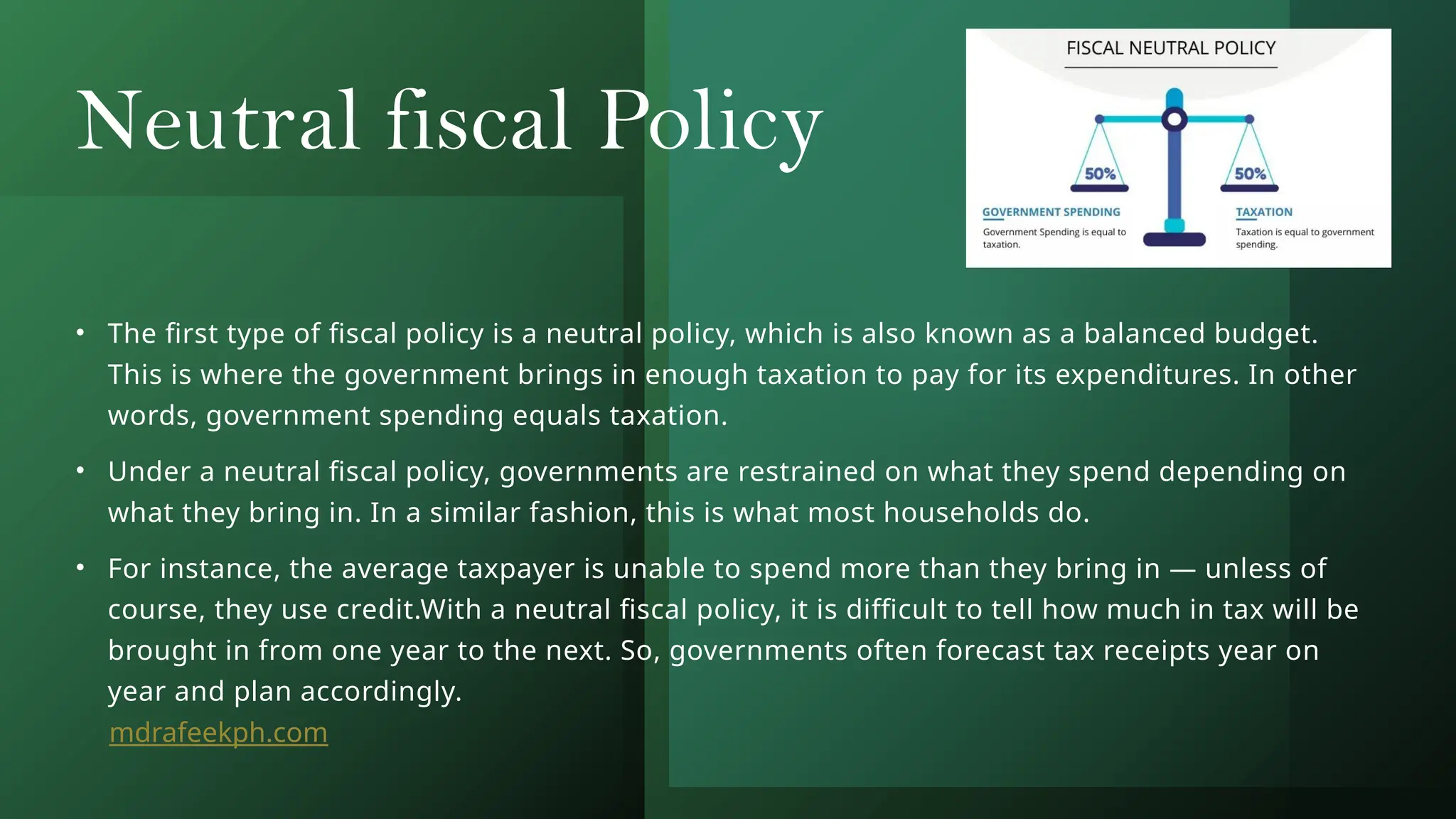
• The first type of fiscal policy is a neutral policy, which is also known as a balanced budget.
This is where the government brings in enough taxation to pay for its expenditures. In other
words, government spending equals taxation.
• Under a neutral fiscal policy, governments are restrained on what they spend depending on
what they bring in. In a similar fashion, this is what most households do.
• For instance, the average taxpayer is unable to spend more than they bring in — unless of
course, they use credit.With a neutral fiscal policy, it is difficult to tell how much in tax will be
brought in from one year to the next. So, governments often forecast tax receipts year on
year and plan accordingly.
mdrafeekph.com
Expansionary Fiscal Policy
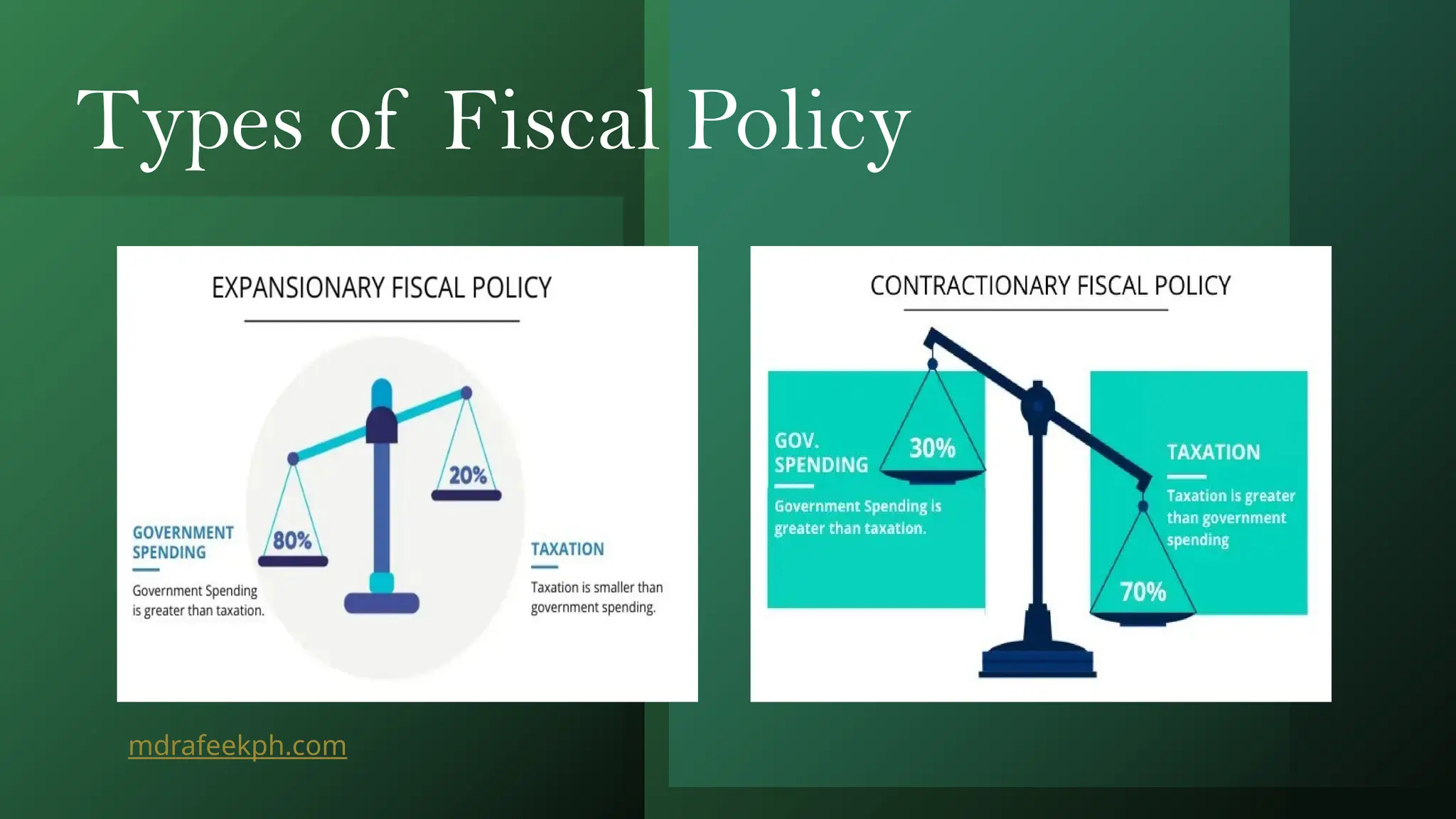
• Expansionary fiscal policy is where the government spends more than it takes in through taxes. This may
involve a reduction in taxes, an increase in spending, or a mixture of both. In turn, it creates what is
known as a budget or fiscal deficit.
• During recessionary periods, a budget deficit naturally forms. This is because unemployment tends to
increase, meaning lower income from tax receipts which generally account for half of governments
revenue.At the same time, governments want to ensure full employment. It is therefore faced with a
tough decision between increasing the budget deficit further or trying to fight the recession.
• At the same time, governments are equally forced to pay higher amounts in unemployment and other
social security benefits, thereby increasing government spending, whilst tax revenues fall.Expansionary
fiscal policy uses lower taxes and/or higher spending to ultimately boost prosperity and economic
growth. By reducing taxes, consumers have more money in their pockets to go out, spend, and stimulate
the economy.
• At the same time, higher government spending can boost aggregate demand. If it undertakes an
investment project, it can create many new jobs. Jobs for people that would otherwise be unemployed.
In turn, these employees will have more money to spend, thereby stimulating the economy.
mdrafeekph.com
Contractionary Fiscal Policy
• Contractionary fiscal policy is where the government collects more in taxes than it spends. A government
may wish to do this for several reasons. primarily, it is used to help stem inflation. For instance, the more
governments tax, the less disposable income consumers have.
• In turn, this reduces aggregate demand which may seem like a bad thing, but it helps reduces inflation. So
a contractionary fiscal policy will take money away from consumers. Consequently, they demand less from
individual businesses.
• This then sends a signal to those businesses that demand is starting to decline. So they stop raising prices
so quickly, thereby reducing the rate of inflation. With that said, governments may wish to impose a
contractionary policy in order to reduce or control their debt. Although we have discussed lower taxation,
governments can also resort to lower spending otherwise known as austerity to do so.
• We have seen in countries such as Greece, Spain, and Italy a level of spending that was unsustainable. As a
result, it had to undertake a contractionary fiscal policy in order to meet its debt payments. What made this
so painful was that their economies were going through one of the worse recessions in history.
• In summary, a contractionary fiscal policy would aim to either reduce inflation or reduce government debt.
mdrafeekph.com
Objectives of Fiscal Policy
• To promote economic growth: Government promotes economic growth by setting up basic
and heavy industries like steel, chemical, fertilizers, machine tools, etc. It also builds
infrastructure like roads, canals, railways, airports, education and health services, water and
electricity supply, telecommunications, etc. that foster economic growth. Both basic and
heavy industries and infrastructure require huge amount of investment which normally the
private sector does not take up. Since these industries and infrastructure facilities are
essential for economic growth in the country, the burden to set up and develop them falls
on the government.
• To reduce income and wealth inequalities: Government reduces inequalities in income and
wealth by taxing the rich more and spending more on the poor. Further, it provides for the
employment opportunities to poor that help them to earn.
mdrafeekph.com
• To provide employment opportunities: Employment opportunities are increased by the
government in various ways, One, jobs are created when it sets up public sector enterprises. Two, it
provides subsidies and other incentives like tax holidays, low rates of taxes etc. to private sector that
encourage production and employment. It also encourages setting up of small scale, cottage and
village industries by people which are employment oriented. This it does by providing them tax
concessions, subsidies, grants, loans at low rates of interest, etc. Finally, it creates jobs for poor
when it undertakes public works programmes like construction of roads, bridges,
canals, buildings, etc.
• To ensure stability in prices: Government ensures stability of prices of essential goods and services
by regulating their supplies. Hence, it incurs expenditure on ration and fair price shops that keep
sufficient stock of food grains. If also subsidizes cooking gas, electricity, water and essential services
like transport and maintains their prices at low level affordable to the common man.
• To correct balance of payments deficit: The balance of payments account of a country records its
receipts and payment with foreign countries. When payments to foreigners are more than receipts
from foreigners, the balance of payments account is said to be in deficit. Quite often this deficit is
caused when a country imports more than it exports.
mdrafeekph.com
Historical Example of Fiscal
Policy
• One historical example of fiscal policy is the New Deal programs implemented by President
Franklin D. Roosevelt in the 1930s to combat the Great Depression. These policies involved a
significant increase in government spending on public works projects, such as infrastructure
and the creation of jobs, which helped to stimulate economic growth and reduce
unemployment rates.
• Additionally, the New Deal included tax reforms, such as the introduction of the Social
Security program and the implementation of higher income tax rates for the wealthy, which
were aimed at promoting greater income equality and reducing economic inequality. Overall,
the New Deal represented a significant expansion of the role of the federal government in
the economy and served as a model for subsequent government intervention during times of
economic crisis.
mdrafeekph.com
Role of Politics in Fiscal Policy
• Politics plays a crucial role in fiscal policy, which refers to the government's use of taxation and spending to
influence the economy. Fiscal policy can be expansionary or contractionary, depending on whether the
government increases spending or reduces taxes to stimulate economic growth or reduces spending or increases
taxes to combat inflation.
• In many countries, fiscal policy is heavily influenced by political considerations, such as ideology, party platforms,
and election cycles. For example, a government may implement expansionary fiscal policies in the lead-up to an
election to boost economic growth and improve its chances of re-election. Conversely, a government may adopt
contractionary fiscal policies after an election to address budget deficits and reduce public debt.
• Political polarization can also influence fiscal policy, with different political parties having different views on the
appropriate level of government spending, taxation, and debt. This can lead to gridlock and delayed decision-
making, as different factions within government seek to advance their own interests and priorities.
• Moreover, interest groups, such as businesses, labor unions, and advocacy organizations, can influence fiscal
policy by lobbying for policies that benefit their members or constituents. Politicians may also be influenced by
campaign contributions and other forms of financial support from interest groups.
• Overall, the role of politics in fiscal policy is complex and multifaceted. While politics can help shape the priorities
and goals of fiscal policy, it can also lead to conflicts and delays that hinder effective economic management.
mdrafeekph.com
FISCAL POLICY OF INDIA
India's fiscal policy refers to the government's decisions regarding taxation, spending, and borrowing that are
designed to achieve certain economic goals. The following are some key aspects of India's fiscal policy:
• Taxation: The Indian government collects taxes through various means, including income tax, corporate tax,
goods and services tax (GST), and customs duty. The government periodically reviews and adjusts tax rates to
ensure adequate revenue collection.
• Spending: The Indian government spends money on various programs and initiatives, including
infrastructure development, social welfare schemes, defense, education, and healthcare. The government
also provides subsidies and grants to certain sectors and groups.
• Borrowing: The Indian government borrows money from domestic and international sources to finance its
expenditures. The government issues bonds and treasury bills to raise funds and manages its debt through
the Reserve Bank of India.
mdrafeekph.com
• Fiscal deficit: The fiscal deficit refers to the difference between the government's total
expenditure and total revenue. The Indian government aims to keep its fiscal deficit under
control to avoid inflation and maintain fiscal stability.
• Fiscal targets: The Indian government sets fiscal targets in its annual budget, including
targets for revenue, expenditure, and deficit. These targets are designed to achieve specific
economic objectives, such as promoting growth, reducing poverty, and improving
infrastructure.
• In recent years, India's fiscal policy has focused on increasing revenue collection, reducing
subsidies, and promoting economic growth. The government has also implemented several
reforms to simplify tax laws and improve tax compliance. However, India continues to face
challenges in maintaining fiscal discipline, particularly in managing its fiscal deficit and
reducing its debt burden.
mdrafeekph.com
EXAMPLES OF FISCAL
POLICES OF INDIA
Here are some examples of fiscal policies implemented by the Indian government:
• Goods and Services Tax (GST): In 2017, India implemented the GST, which replaced multiple indirect taxes with a unified tax
system. The GST has simplified the tax system, increased revenue collection, and promoted the ease of doing business in India.
• National Rural Employment Guarantee Act (NREGA): The NREGA, introduced in 2005, provides a legal guarantee for 100
days of employment to every rural household in India. The government spends a significant amount of money on NREGA,
which has helped reduce poverty and unemployment in rural areas.
• Pradhan Mantri Jan Dhan Yojana (PMJDY): The PMJDY is a financial inclusion program launched in 2014 that aims to provide
basic banking services to all households in India. The government offers zero balance accounts, insurance, and overdraft
facilities to PMJDY account holders. The program has helped increase financial literacy and inclusion in India.
mdrafeekph.com
• Fiscal stimulus package: In response to the COVID-19 pandemic, the Indian government
announced a fiscal stimulus package of Rs 20 lakh crore ($260 billion) in May 2020. The
package included measures such as cash transfers to farmers and poor households, credit
guarantees to small businesses, and increased allocation for healthcare and infrastructure.
• Disinvestment: The Indian government has implemented a policy of disinvestment, whereby
it sells its stake in public sector companies to raise funds. The government has set a
disinvestment target of Rs 1.75 lakh crore ($23 billion) for the fiscal year 2022. Disinvestment
helps the government raise funds and improve the efficiency of public sector companies.
These are some of the examples of fiscal policies of India. The government regularly reviews
and adjusts its fiscal policies to achieve its economic goals.
mdrafeekph.com
Thank You
mdrafeekph.com

FISCAL POLICY.pptx created by Mohamed Rafeek

  • 1.
    FISCAL POLICY S U BM I T T E D B Y, M O H A M E D R A F E E K mdrafeekph.com
  • 2.
    WHAT IS FISCALPOLICY? • Fiscal policy refers to the use of government spending and taxation policies to influence the economy. The main objective of fiscal policy is to achieve macroeconomic stability and sustainable economic growth by controlling the levels of aggregate demand, which is the total amount of goods and services that consumers, businesses, and the government are willing to buy. • Governments can use fiscal policy to stimulate economic activity during a recession by increasing government spending and reducing taxes, which will increase aggregate demand. Conversely, during an economic boom, the government may reduce spending and increase taxes to slow down economic growth and control inflation. mdrafeekph.com
  • 3.
    • Fiscal policycan also be used to address structural issues in the economy by increasing spending on infrastructure, education, and health care, which can lead to long-term growth and productivity. • Fiscal policy is often implemented through the annual budget process, where the government sets its revenue and expenditure targets for the upcoming year. The government can also use other tools like subsidies, transfer payments, and tax incentives to influence economic activity. • Overall, fiscal policy is important for governments to achieve their economic objectives and maintain macroeconomic stability. mdrafeekph.com
  • 4.
    Types of FiscalPolicy mdrafeekph.com
  • 5.
    Neutral fiscal Policy •The first type of fiscal policy is a neutral policy, which is also known as a balanced budget. This is where the government brings in enough taxation to pay for its expenditures. In other words, government spending equals taxation. • Under a neutral fiscal policy, governments are restrained on what they spend depending on what they bring in. In a similar fashion, this is what most households do. • For instance, the average taxpayer is unable to spend more than they bring in — unless of course, they use credit.With a neutral fiscal policy, it is difficult to tell how much in tax will be brought in from one year to the next. So, governments often forecast tax receipts year on year and plan accordingly. mdrafeekph.com
  • 6.
    Expansionary Fiscal Policy •Expansionary fiscal policy is where the government spends more than it takes in through taxes. This may involve a reduction in taxes, an increase in spending, or a mixture of both. In turn, it creates what is known as a budget or fiscal deficit. • During recessionary periods, a budget deficit naturally forms. This is because unemployment tends to increase, meaning lower income from tax receipts which generally account for half of governments revenue.At the same time, governments want to ensure full employment. It is therefore faced with a tough decision between increasing the budget deficit further or trying to fight the recession. • At the same time, governments are equally forced to pay higher amounts in unemployment and other social security benefits, thereby increasing government spending, whilst tax revenues fall.Expansionary fiscal policy uses lower taxes and/or higher spending to ultimately boost prosperity and economic growth. By reducing taxes, consumers have more money in their pockets to go out, spend, and stimulate the economy. • At the same time, higher government spending can boost aggregate demand. If it undertakes an investment project, it can create many new jobs. Jobs for people that would otherwise be unemployed. In turn, these employees will have more money to spend, thereby stimulating the economy. mdrafeekph.com
  • 7.
    Contractionary Fiscal Policy •Contractionary fiscal policy is where the government collects more in taxes than it spends. A government may wish to do this for several reasons. primarily, it is used to help stem inflation. For instance, the more governments tax, the less disposable income consumers have. • In turn, this reduces aggregate demand which may seem like a bad thing, but it helps reduces inflation. So a contractionary fiscal policy will take money away from consumers. Consequently, they demand less from individual businesses. • This then sends a signal to those businesses that demand is starting to decline. So they stop raising prices so quickly, thereby reducing the rate of inflation. With that said, governments may wish to impose a contractionary policy in order to reduce or control their debt. Although we have discussed lower taxation, governments can also resort to lower spending otherwise known as austerity to do so. • We have seen in countries such as Greece, Spain, and Italy a level of spending that was unsustainable. As a result, it had to undertake a contractionary fiscal policy in order to meet its debt payments. What made this so painful was that their economies were going through one of the worse recessions in history. • In summary, a contractionary fiscal policy would aim to either reduce inflation or reduce government debt. mdrafeekph.com
  • 8.
    Objectives of FiscalPolicy • To promote economic growth: Government promotes economic growth by setting up basic and heavy industries like steel, chemical, fertilizers, machine tools, etc. It also builds infrastructure like roads, canals, railways, airports, education and health services, water and electricity supply, telecommunications, etc. that foster economic growth. Both basic and heavy industries and infrastructure require huge amount of investment which normally the private sector does not take up. Since these industries and infrastructure facilities are essential for economic growth in the country, the burden to set up and develop them falls on the government. • To reduce income and wealth inequalities: Government reduces inequalities in income and wealth by taxing the rich more and spending more on the poor. Further, it provides for the employment opportunities to poor that help them to earn. mdrafeekph.com
  • 9.
    • To provideemployment opportunities: Employment opportunities are increased by the government in various ways, One, jobs are created when it sets up public sector enterprises. Two, it provides subsidies and other incentives like tax holidays, low rates of taxes etc. to private sector that encourage production and employment. It also encourages setting up of small scale, cottage and village industries by people which are employment oriented. This it does by providing them tax concessions, subsidies, grants, loans at low rates of interest, etc. Finally, it creates jobs for poor when it undertakes public works programmes like construction of roads, bridges, canals, buildings, etc. • To ensure stability in prices: Government ensures stability of prices of essential goods and services by regulating their supplies. Hence, it incurs expenditure on ration and fair price shops that keep sufficient stock of food grains. If also subsidizes cooking gas, electricity, water and essential services like transport and maintains their prices at low level affordable to the common man. • To correct balance of payments deficit: The balance of payments account of a country records its receipts and payment with foreign countries. When payments to foreigners are more than receipts from foreigners, the balance of payments account is said to be in deficit. Quite often this deficit is caused when a country imports more than it exports. mdrafeekph.com
  • 10.
    Historical Example ofFiscal Policy • One historical example of fiscal policy is the New Deal programs implemented by President Franklin D. Roosevelt in the 1930s to combat the Great Depression. These policies involved a significant increase in government spending on public works projects, such as infrastructure and the creation of jobs, which helped to stimulate economic growth and reduce unemployment rates. • Additionally, the New Deal included tax reforms, such as the introduction of the Social Security program and the implementation of higher income tax rates for the wealthy, which were aimed at promoting greater income equality and reducing economic inequality. Overall, the New Deal represented a significant expansion of the role of the federal government in the economy and served as a model for subsequent government intervention during times of economic crisis. mdrafeekph.com
  • 11.
    Role of Politicsin Fiscal Policy • Politics plays a crucial role in fiscal policy, which refers to the government's use of taxation and spending to influence the economy. Fiscal policy can be expansionary or contractionary, depending on whether the government increases spending or reduces taxes to stimulate economic growth or reduces spending or increases taxes to combat inflation. • In many countries, fiscal policy is heavily influenced by political considerations, such as ideology, party platforms, and election cycles. For example, a government may implement expansionary fiscal policies in the lead-up to an election to boost economic growth and improve its chances of re-election. Conversely, a government may adopt contractionary fiscal policies after an election to address budget deficits and reduce public debt. • Political polarization can also influence fiscal policy, with different political parties having different views on the appropriate level of government spending, taxation, and debt. This can lead to gridlock and delayed decision- making, as different factions within government seek to advance their own interests and priorities. • Moreover, interest groups, such as businesses, labor unions, and advocacy organizations, can influence fiscal policy by lobbying for policies that benefit their members or constituents. Politicians may also be influenced by campaign contributions and other forms of financial support from interest groups. • Overall, the role of politics in fiscal policy is complex and multifaceted. While politics can help shape the priorities and goals of fiscal policy, it can also lead to conflicts and delays that hinder effective economic management. mdrafeekph.com
  • 12.
    FISCAL POLICY OFINDIA India's fiscal policy refers to the government's decisions regarding taxation, spending, and borrowing that are designed to achieve certain economic goals. The following are some key aspects of India's fiscal policy: • Taxation: The Indian government collects taxes through various means, including income tax, corporate tax, goods and services tax (GST), and customs duty. The government periodically reviews and adjusts tax rates to ensure adequate revenue collection. • Spending: The Indian government spends money on various programs and initiatives, including infrastructure development, social welfare schemes, defense, education, and healthcare. The government also provides subsidies and grants to certain sectors and groups. • Borrowing: The Indian government borrows money from domestic and international sources to finance its expenditures. The government issues bonds and treasury bills to raise funds and manages its debt through the Reserve Bank of India. mdrafeekph.com
  • 13.
    • Fiscal deficit:The fiscal deficit refers to the difference between the government's total expenditure and total revenue. The Indian government aims to keep its fiscal deficit under control to avoid inflation and maintain fiscal stability. • Fiscal targets: The Indian government sets fiscal targets in its annual budget, including targets for revenue, expenditure, and deficit. These targets are designed to achieve specific economic objectives, such as promoting growth, reducing poverty, and improving infrastructure. • In recent years, India's fiscal policy has focused on increasing revenue collection, reducing subsidies, and promoting economic growth. The government has also implemented several reforms to simplify tax laws and improve tax compliance. However, India continues to face challenges in maintaining fiscal discipline, particularly in managing its fiscal deficit and reducing its debt burden. mdrafeekph.com
  • 14.
    EXAMPLES OF FISCAL POLICESOF INDIA Here are some examples of fiscal policies implemented by the Indian government: • Goods and Services Tax (GST): In 2017, India implemented the GST, which replaced multiple indirect taxes with a unified tax system. The GST has simplified the tax system, increased revenue collection, and promoted the ease of doing business in India. • National Rural Employment Guarantee Act (NREGA): The NREGA, introduced in 2005, provides a legal guarantee for 100 days of employment to every rural household in India. The government spends a significant amount of money on NREGA, which has helped reduce poverty and unemployment in rural areas. • Pradhan Mantri Jan Dhan Yojana (PMJDY): The PMJDY is a financial inclusion program launched in 2014 that aims to provide basic banking services to all households in India. The government offers zero balance accounts, insurance, and overdraft facilities to PMJDY account holders. The program has helped increase financial literacy and inclusion in India. mdrafeekph.com
  • 15.
    • Fiscal stimuluspackage: In response to the COVID-19 pandemic, the Indian government announced a fiscal stimulus package of Rs 20 lakh crore ($260 billion) in May 2020. The package included measures such as cash transfers to farmers and poor households, credit guarantees to small businesses, and increased allocation for healthcare and infrastructure. • Disinvestment: The Indian government has implemented a policy of disinvestment, whereby it sells its stake in public sector companies to raise funds. The government has set a disinvestment target of Rs 1.75 lakh crore ($23 billion) for the fiscal year 2022. Disinvestment helps the government raise funds and improve the efficiency of public sector companies. These are some of the examples of fiscal policies of India. The government regularly reviews and adjusts its fiscal policies to achieve its economic goals. mdrafeekph.com
  • 16.