 Word fisc means 'state treasury' & refers to policy concerning use
of 'state treasury' to achieve goals.
 Refers to the actions governments take in relation to taxation
and government spending.
Stimulate economic growth in a period of a recession.
Keep inflation low.
Fiscal policy aims to stabilize economic growth, avoiding a boom
and bust economic cycle.
Neutral Fiscal Policy
Expansionary Fiscal Policy
Contractionary Fiscal Policy
 Governments restrained on what they spend depending on what
they bring in
Government brings enough taxation to pay expenditures.
Difficult to tell how much tax will be brought in from one year to the
next.
The government spends more than it takes in through taxes.
Uses lower taxes & higher spending to ultimately boost
economic growth.
Government collects more in taxes than it spends.
Reduces aggregate demand which seem like a bad thing
 It helps to reduces inflation.
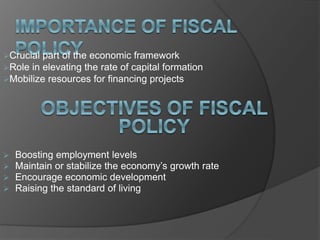
Crucial part of the economic framework
Role in elevating the rate of capital formation
Mobilize resources for financing projects
 Boosting employment levels
 Maintain or stabilize the economy’s growth rate
 Encourage economic development
 Raising the standard of living
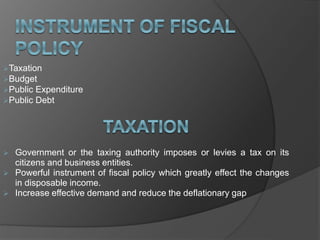
Taxation
Budget
Public Expenditure
Public Debt
 Government or the taxing authority imposes or levies a tax on its
citizens and business entities.
 Powerful instrument of fiscal policy which greatly effect the changes
in disposable income.
 Increase effective demand and reduce the deflationary gap
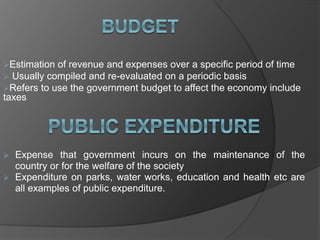
Estimation of revenue and expenses over a specific period of time
 Usually compiled and re-evaluated on a periodic basis
Refers to use the government budget to affect the economy include
taxes
 Expense that government incurs on the maintenance of the
country or for the welfare of the society
 Expenditure on parks, water works, education and health etc are
all examples of public expenditure.
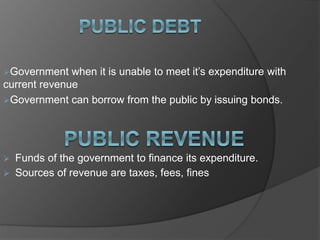
Government when it is unable to meet it’s expenditure with
current revenue
Government can borrow from the public by issuing bonds.
 Funds of the government to finance its expenditure.
 Sources of revenue are taxes, fees, fines
Fiscal policy

Fiscal policy

  • 2.
     Word fiscmeans 'state treasury' & refers to policy concerning use of 'state treasury' to achieve goals.  Refers to the actions governments take in relation to taxation and government spending. Stimulate economic growth in a period of a recession. Keep inflation low. Fiscal policy aims to stabilize economic growth, avoiding a boom and bust economic cycle.
  • 3.
    Neutral Fiscal Policy ExpansionaryFiscal Policy Contractionary Fiscal Policy  Governments restrained on what they spend depending on what they bring in Government brings enough taxation to pay expenditures. Difficult to tell how much tax will be brought in from one year to the next.
  • 4.
    The government spendsmore than it takes in through taxes. Uses lower taxes & higher spending to ultimately boost economic growth. Government collects more in taxes than it spends. Reduces aggregate demand which seem like a bad thing  It helps to reduces inflation.
  • 5.
    Crucial part ofthe economic framework Role in elevating the rate of capital formation Mobilize resources for financing projects  Boosting employment levels  Maintain or stabilize the economy’s growth rate  Encourage economic development  Raising the standard of living
  • 7.
    Taxation Budget Public Expenditure Public Debt Government or the taxing authority imposes or levies a tax on its citizens and business entities.  Powerful instrument of fiscal policy which greatly effect the changes in disposable income.  Increase effective demand and reduce the deflationary gap
  • 8.
    Estimation of revenueand expenses over a specific period of time  Usually compiled and re-evaluated on a periodic basis Refers to use the government budget to affect the economy include taxes  Expense that government incurs on the maintenance of the country or for the welfare of the society  Expenditure on parks, water works, education and health etc are all examples of public expenditure.
  • 9.
    Government when itis unable to meet it’s expenditure with current revenue Government can borrow from the public by issuing bonds.  Funds of the government to finance its expenditure.  Sources of revenue are taxes, fees, fines