International Trade
Part 2
International Trade:
3.) Graphing International Trade
1.) Specialization & Comparative Advantage
2.) PPC and Trading Possibilities
4.) Terms of Trade
5.) Arguments about International Trade
6.) Some ways to restrict International Trade
Are clothes
cheap in China?
The Answer:
Who’s Asking?
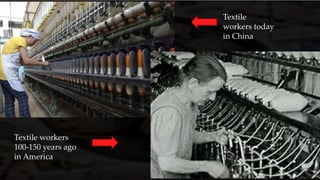
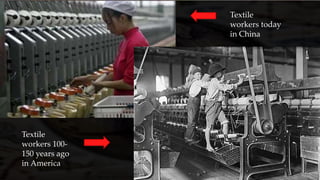
Textile
workers today
in China
Textile workers
100-150 years ago
in America
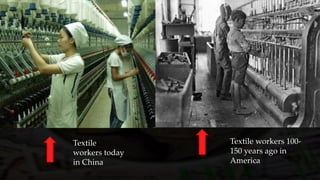
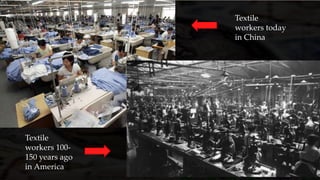
Textile
workers today
in China
Textile workers 100-
150 years ago in
America
Textile
workers today
in China
Textile
workers 100-
150 years ago
in America
Textile
workers today
in China
Textile
workers 100-
150 years ago
in America
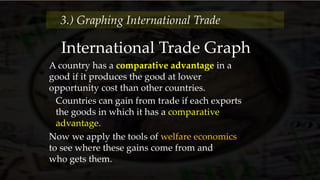
International Trade Graph
A country has a comparative advantage in a
good if it produces the good at lower
opportunity cost than other countries.
Countries can gain from trade if each exports
the goods in which it has a comparative
advantage.
Now we apply the tools of welfare economics
to see where these gains come from and
who gets them.
3.) Graphing International Trade
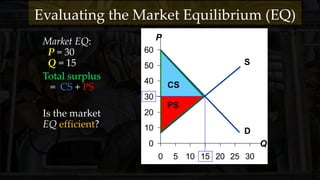
Market EQ:
P = 30
Q = 15
Total surplus
= CS + PS
Is the market
EQ efficient?
0
10
20
30
40
50
60
0 5 10 15 20 25 30
P
Q
S
D
CS
PS
D
S
Evaluating the Market Equilibrium (EQ)
P
Q
D
S
PS
PB
QEQT
A
B C
D E
F
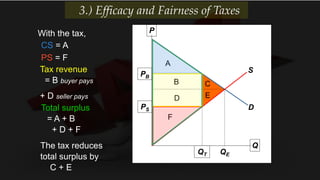
CS = A
PS = F
Tax revenue
= B buyer pays
+ D seller pays
Total surplus
= A + B
+ D + F
With the tax,
The tax reduces
total surplus by
C + E
3.) Efficacy and Fairness of Taxes
P
Q
D
S
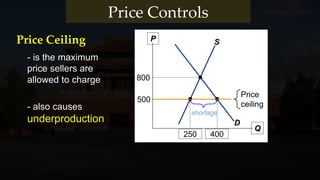
250 400
shortage
Price
ceiling
500
800
Price Ceiling
- is the maximum
price sellers are
allowed to charge
- also causes
underproduction
Price Controls
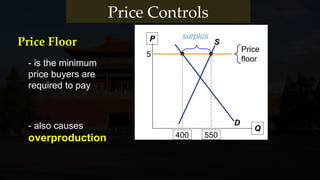
Price Floor
- is the minimum
price buyers are
required to pay
- also causes
overproduction
P
Q
D
S
400 550
Price
floor
5
surplus
Price Controls
International Trade:
3.) Graphing International Trade
1.) Specialization & Comparative Advantage
2.) PPC and Trading Possibilities
4.) Terms of Trade
5.) Arguments about International Trade
6.) Some ways to restrict International Trade
The World Price and Comparative Advantage
PW = the world price of a good, in world markets
PD = domestic国内 price without trade (autarky 自给自足 )
If PD < PW,
- country has (CA) in the good
- under free trade, country exports the good
If PD > PW,
- country does not have (CA)
- under free trade, country imports the good
Things to define on the graph first:
1. The Small Economy Assumption
Things to define on the graph first:
Assumptions 假定:
1. The Small Economy Assumption
Things to define on the graph first:
Assumptions 假定:
- A small economy is a price taker in world
markets: Its actions have no effect on PW.
Not always true – especially for the U.S. And China – but makes
understanding easier without changing its lessons.
- When a small economy engages in free
trade, PW is the only relevant相应 price:
No seller would accept less than PW, since they could sell the good
for PW in world markets.
No buyer would pay more than PW, since they could buy the good
for PW in world markets.
Exporting country example…
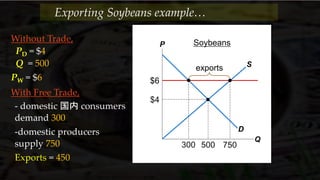
Without Trade,
PD = $4
Q = 500
PW = $6
With Free Trade,
- domestic 国内 consumers
demand 300
-domestic producers
supply 750
Exports = 450
P
Q
D
S
$6
$4
500300
Soybeans
exports
750
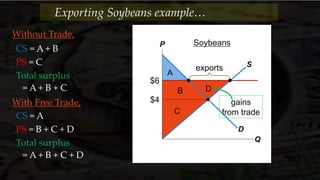
Exporting Soybeans example…
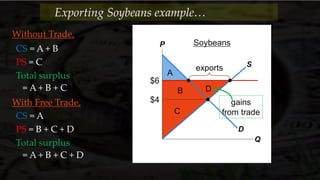
Without Trade,
CS = A + B
PS = C
Total surplus
= A + B + C
With Free Trade,
CS = A
PS = B + C + D
Total surplus
= A + B + C + D
P
Q
D
S
$6
$4
Soybeans
exports
A
B D
C
gains
from trade
Exporting Soybeans example…
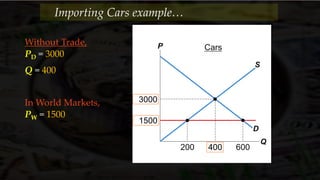
Importing country example…
Without Trade,
PD = 3000
Q = 400
In World Markets,
PW = 1500
P
Q
D
S
$1500
200
$3000
400 600
Cars
Importing Cars example…
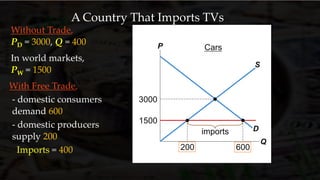
With Free Trade,
- domestic consumers
demand 600
- domestic producers
supply 200
Imports = 400
P
Q
D
S
1500
200
3000
600
Cars
imports
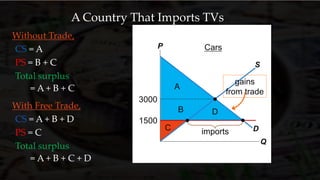
A Country That Imports TVs
Without Trade,
PD = 3000, Q = 400
In world markets,
PW = 1500
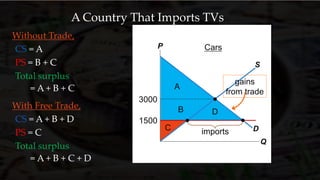
Without Trade,
CS = A
PS = B + C
Total surplus
= A + B + C
With Free Trade,
CS = A + B + D
PS = C
Total surplus
= A + B + C + D
P
Q
D
S
1500
3000
Cars
A
B D
C
gains
from trade
imports
A Country That Imports TVs
total surplus
producer surplus
consumer surplus
direction of trade
rises
falls
rises
imports
PD > PW
rises
rises
falls
exports
PD < PW
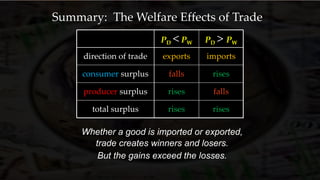
Summary: The Welfare Effects of Trade
Whether a good is imported or exported,
trade creates winners and losers.
But the gains exceed the losses.
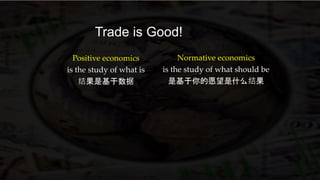
Trade is Good!
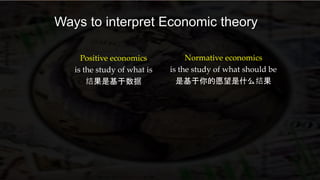
Positive economics
is the study of what is
结果是基于数据
Normative economics
is the study of what should be
是基于你的愿望是什么结果
International Trade:
3.) Graphing International Trade
1.) Specialization & Comparative Advantage
2.) PPC and Trading Possibilities
4.) Terms of Trade
5.) Arguments about International Trade
3.5) Trade Graph Results
6.) Some ways to restrict International Trade
Importing Country Results:
Consumers
are Winners!
3.5) Trade Graph Results…
Lower prices and
more variety!
Importing Country Results:
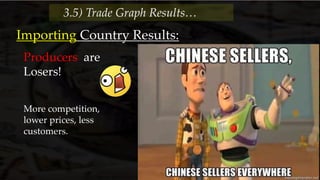
Producers are
Losers!
3.5) Trade Graph Results…
More competition,
lower prices, less
customers.
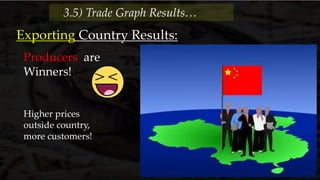
Exporting Country Results:
Producers are
Winners!
3.5) Trade Graph Results…
Higher prices
outside country,
more customers!
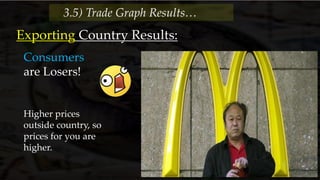
Exporting Country Results:
Consumers
are Losers!
3.5) Trade Graph Results…
Higher prices
outside country, so
prices for you are
higher.
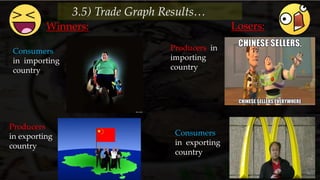
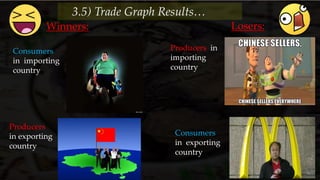
Winners: Losers:
Consumers
in importing
country
Producers in
importing
country
Consumers
in exporting
country
Producers
in exporting
country
3.5) Trade Graph Results…
International Trade:
3.) Graphing International Trade
1.) Specialization & Comparative Advantage
2.) PPC and Trading Possibilities
4.) Terms of Trade
5.) Arguments about International Trade
6.) Some ways to restrict International Trade
- An easy way to measure trade
between countries.
(if your getting a good deal or not)
好对付?
4.) Terms of Trade
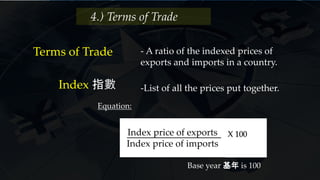
Terms of Trade - A ratio of the indexed prices of
exports and imports in a country.
4.) Terms of Trade
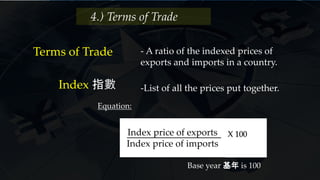
Terms of Trade - A ratio of the indexed prices of
exports and imports in a country.
-List of all the prices put together.Index 指數
Index price of exports
Index price of imports
X 100
Base year 基年 is 100
Equation:
4.) Terms of Trade
Terms of Trade - A ratio of the indexed prices of
exports and imports in a country.
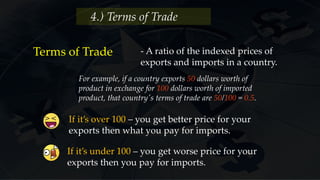
For example, if a country exports 50 dollars worth of
product in exchange for 100 dollars worth of imported
product, that country's terms of trade are 50/100 = 0.5.
If it’s over 100 – you get better price for your
exports then what you pay for imports.
If it’s under 100 – you get worse price for your
exports then you pay for imports.
4.) Terms of Trade
Terms of Trade - A ratio of the indexed prices of
exports and imports in a country.
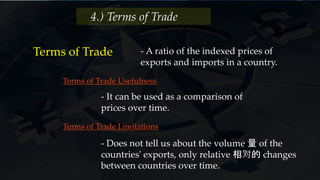
- It can be used as a comparison of
prices over time.
Terms of Trade Usefulness
Terms of Trade Limitations
- Does not tell us about the volume 量 of the
countries' exports, only relative 相对的 changes
between countries over time.
International Trade:
3.) Graphing International Trade
1.) Specialization & Comparative Advantage
2.) PPC and Trading Possibilities
4.) Terms of Trade
5.) Arguments about International Trade
6.) Some ways to restrict International Trade
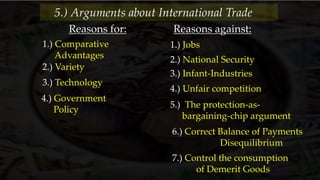
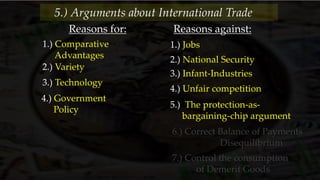
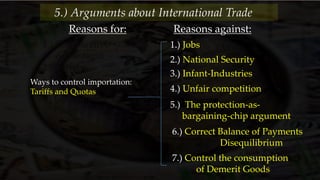
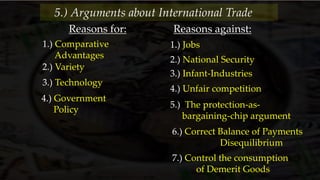
Reasons for: Reasons against:
1.) Comparative
Advantages
2.) Variety
3.) Technology
4.) Government
Policy
1.) Jobs
2.) National Security
3.) Infant-Industries
4.) Unfair competition
6.) Correct Balance of Payments
Disequilibrium
7.) Control the consumption
of Demerit Goods
5.) The protection-as-
bargaining-chip argument
5.) Arguments about International Trade
Reasons for: Reasons against:
1.) Comparative
Advantages
2.) Variety
3.) Technology
4.) Government
Policy
1.) Jobs
2.) National Security
3.) Infant-Industries
4.) Unfair competition
6.) Correct Balance of Payments
Disequilibrium
7.) Control the consumption
of Demerit Goods
5.) The protection-as-
bargaining-chip argument
5.) Arguments about International Trade
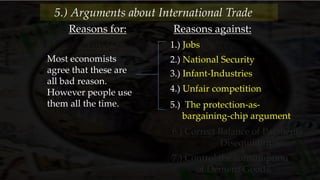
Most economists
agree that these are
all bad reason.
However people use
them all the time.
Reasons for: Reasons against:
1.) Comparative
Advantages
2.) Variety
3.) Technology
4.) Government
Policy
1.) Jobs
2.) National Security
3.) Infant-Industries
4.) Unfair competition
6.) Correct Balance of Payments
Disequilibrium
7.) Control the consumption
of Demerit Goods
5.) The protection-as-
bargaining-chip argument
5.) Arguments about International Trade
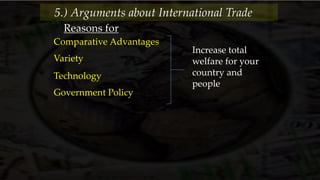
Reasons for
1. ) Comparative Advantages - Produce more with
lower costs and produce
on a larger scale.
5.) Arguments about International Trade
Reasons for
Comparative advantages
2.) Variety - More cool stuff to buy!
5.) Arguments about International Trade
Reasons for
Comparative advantages
Variety
3.) Technology -Learn new things and can
make even more cool stuff!
5.) Arguments about International Trade
Reasons for
Comparative advantages
Variety
Technology
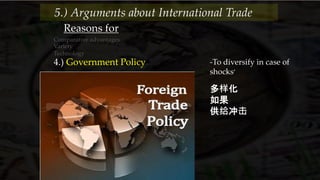
4.) Government Policy -To diversify in case of
shocks’
多样化
如果
供给冲击
5.) Arguments about International Trade
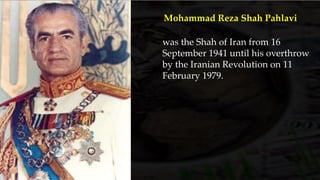
was the Shah of Iran from 16
September 1941 until his overthrow
by the Iranian Revolution on 11
February 1979.
Mohammad Reza Shah Pahlavi
Mohammad
Reza Shah
Pahlavi
Leader of Iran
Jimmy Carter
President of USA
Iranian
Revolution
(1979)
伊朗革命
was an Iranian Shia Muslim religious
leader, revolutionary, politician, the
founder of the Islamic Republic of
Iran and the leader of the 1979
Iranian Revolution which saw the
overthrow of the Pahlavi monarchy
and the Shah of Iran.
Grand Ayatollah Sayyid Ruhollah
Mūsavi Khomeini
Reasons for
Comparative Advantages
Variety
Technology
Increase total
welfare for your
country and
people
Government Policy
5.) Arguments about International Trade
Why All the Opposition 反对 to Trade?
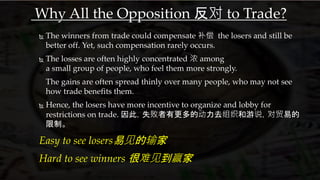
 The winners from trade could compensate 补偿 the losers and still be
better off. Yet, such compensation rarely occurs.
 The losses are often highly concentrated 浓 among
a small group of people, who feel them more strongly.
The gains are often spread thinly over many people, who may not see
how trade benefits them.
 Hence, the losers have more incentive to organize and lobby for
restrictions on trade. 因此,失败者有更多的动力去组织和游说,对贸易的
限制。
Easy to see losers易见的输家
Hard to see winners 很难见到赢家
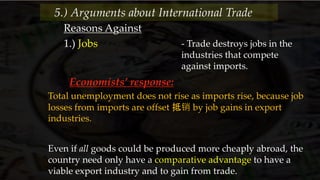
Reasons Against
- Trade destroys jobs in the
industries that compete
against imports.
1.) Jobs
5.) Arguments about International Trade
Reasons Against
- Trade destroys jobs in the
industries that compete
against imports.
1.) Jobs
5.) Arguments about International Trade
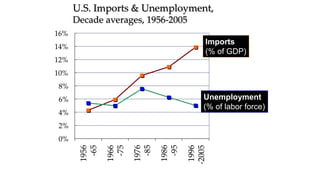
Economists’ response:
Total unemployment does not rise as imports rise, because job
losses from imports are offset 抵销 by job gains in export
industries.
Even if all goods could be produced more cheaply abroad, the
country need only have a comparative advantage to have a
viable export industry and to gain from trade.
U.S. Imports & Unemployment,
Decade averages, 1956-2005
0%
2%
4%
6%
8%
10%
12%
14%
16%
1956
-65
1966
-75
1976
-85
1986
-95
1996
-2005
Imports
(% of GDP)
Unemployment
(% of labor force)
Reasons Against
Jobs
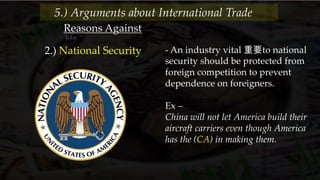
2.) National Security - An industry vital 重要to national
security should be protected from
foreign competition to prevent
dependence on foreigners.
Ex –
China will not let America build their
aircraft carriers even though America
has the (CA) in making them.
5.) Arguments about International Trade
Reasons Against
Jobs
2.) National Security - An industry vital 重要to national
security should be protected from
foreign competition to prevent
dependence on foreigners.
5.) Arguments about International Trade
Economists’ response:
Fine, as long as we base policy on true security
needs.
But producers may exaggerate their own
importance to national security to obtain
protection from foreign competition.
Reasons Against
Jobs
National Security
3.) Infant-Industries
Sunrise- industries
- A new industry argues for
temporary protection until it
is mature 成熟 and can
compete with foreign firms.
5.) Arguments about International Trade
Reasons Against
Jobs
National Security
3.) Infant-Industries
Sunrise- industries
- A new industry argues for
temporary protection until it is
mature 成熟 and can compete
with foreign firms.
5.) Arguments about International Trade
Economists’ response:
Difficult for govt to determine which industries will eventually be
able to win.
to compete and whether benefits of establishing these industries
exceed cost to consumers of restricting imports.
Besides, if a firm will be profitable in the long run,
it should be willing to incur temporary losses.
Reasons Against
Jobs
National Security
Infant-Industries
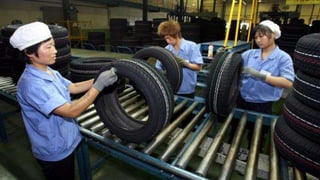
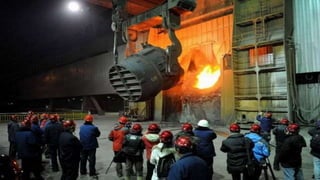
4.) Unfair Competition
Dumping
- Producers argue their
competitors in another
country have an unfair
advantage,
example - due to govt
subsidies. Dumping
5.) Arguments about International Trade
Reasons Against
Jobs
National Security
Infant-Industries
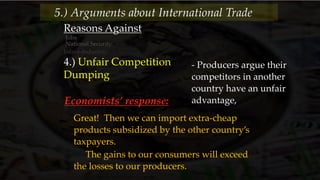
4.) Unfair Competition
Dumping
- Producers argue their
competitors in another
country have an unfair
advantage,
5.) Arguments about International Trade
Economists’ response:
Great! Then we can import extra-cheap
products subsidized by the other country’s
taxpayers.
The gains to our consumers will exceed
the losses to our producers.

Reasons Against
5.) Arguments about International Trade
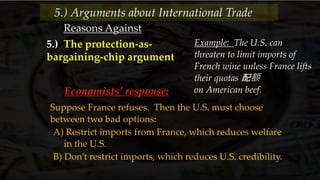
5.) The protection-as-
bargaining-chip argument
Example: The U.S. can
threaten to limit imports of
French wine unless France lifts
their quotas 配额
on American beef.Economists’ response:
Suppose France refuses. Then the U.S. must choose
between two bad options:
A) Restrict imports from France, which reduces welfare
in the U.S.
B) Don’t restrict imports, which reduces U.S. credibility.
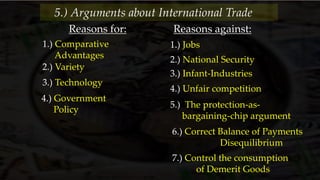
Reasons for: Reasons against:
1.) Comparative
Advantages
2.) Variety
3.) Technology
4.) Government
Policy
1.) Jobs
2.) National Security
3.) Infant-Industries
4.) Unfair competition
6.) Correct Balance of Payments
Disequilibrium
7.) Control the consumption
of Demerit Goods
5.) The protection-as-
bargaining-chip argument
5.) Arguments about International Trade
International Trade:
3.) Graphing International Trade
1.) Specialization & Comparative Advantage
2.) PPC and Trading Possibilities
4.) Terms of Trade
5.) Arguments about International Trade
6.) Some ways to restrict International Trade
Reasons for: Reasons against:
1.) Comparative
Advantages
2.) Variety
3.) Technology
4.) Government
Policy
1.) Jobs
2.) National Security
3.) Infant-Industries
4.) Unfair competition
6.) Correct Balance of Payments
Disequilibrium
7.) Control the consumption
of Demerit Goods
5.) The protection-as-
bargaining-chip argument
5.) Arguments about International Trade
Ways to control importation:
Tariffs and Quotas
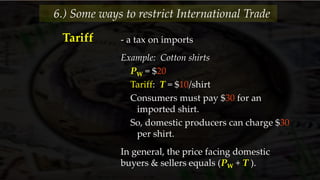
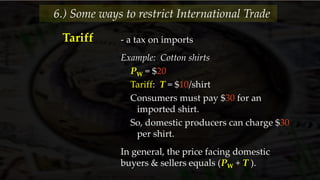
- a tax on imports
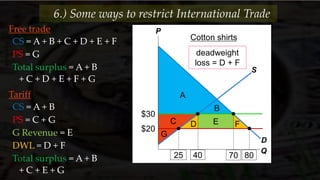
Example: Cotton shirts
PW = $20
Tariff: T = $10/shirt
Consumers must pay $30 for an
imported shirt.
So, domestic producers can charge $30
per shirt.
In general, the price facing domestic
buyers & sellers equals (PW + T ).
6.) Some ways to restrict International Trade
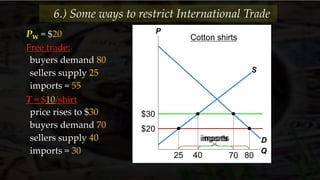
Tariff
$30
PW = $20
Free trade:
buyers demand 80
sellers supply 25
imports = 55
T = $10/shirt
price rises to $30
buyers demand 70
sellers supply 40
imports = 30
P
Q
D
S
$20
25
Cotton shirts
40 70 80
importsimports
6.) Some ways to restrict International Trade
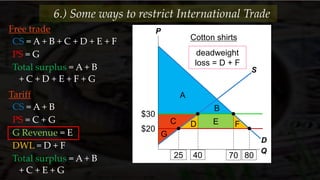
$30
Free trade
CS = A + B + C + D + E + F
PS = G
Total surplus = A + B
+ C + D + E + F + G
Tariff
CS = A + B
PS = C + G
G Revenue = E
DWL = D + F
Total surplus = A + B
+ C + E + G
P
Q
D
S
$20
25
Cotton shirts
40
A
B
D E
G
FC
70 80
deadweight
loss = D + F
6.) Some ways to restrict International Trade
$30
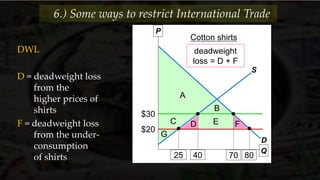
DWL
D = deadweight loss
from the
higher prices of
shirts
F = deadweight loss
from the under-
consumption
of shirts
P
Q
D
S
$20
25
Cotton shirts
40
A
B
D E
G
FC
70 80
deadweight
loss = D + F
6.) Some ways to restrict International Trade
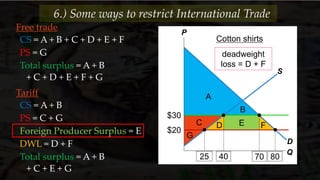
- a tax on imports
6.) Some ways to restrict International Trade
Tariff
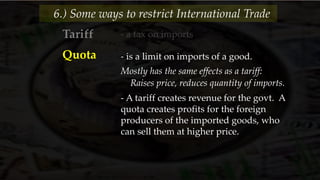
Quota - is a limit on imports of a good.
Mostly has the same effects as a tariff:
Raises price, reduces quantity of imports.
- A tariff creates revenue for the govt. A
quota creates profits for the foreign
producers of the imported goods, who
can sell them at higher price.
$30
Free trade
CS = A + B + C + D + E + F
PS = G
Total surplus = A + B
+ C + D + E + F + G
Tariff
CS = A + B
PS = C + G
Foreign Producer Surplus = E
DWL = D + F
Total surplus = A + B
+ C + E + G
P
Q
D
S
$20
25
Cotton shirts
40
A
B
D E
G
FC
70 80
deadweight
loss = D + F
6.) Some ways to restrict International Trade
Ways to interpret Economic theory
Positive economics
is the study of what is
结果是基于数据
Normative economics
is the study of what should be
是基于你的愿望是什么结果
So to Summarize…
International Trade:
3.) Graphing International Trade
1.) Specialization & Comparative Advantage
2.) PPC and Trading Possibilities
4.) Terms of Trade
5.) Arguments about International Trade
6.) Some ways to restrict International Trade
Absolute
Advantage
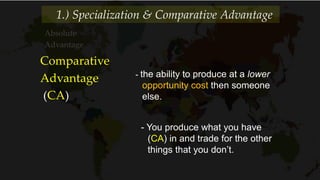
1.) Specialization & Comparative Advantage
Comparative
Advantage
(CA)
- the ability to produce at a lower
opportunity cost then someone
else.
- You produce what you have
(CA) in and trade for the other
things that you don’t.
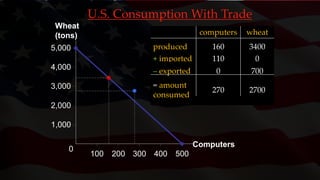
4,000
100
5,000
2,000
1,000
3,000
500200 300 400
0
Computers
Wheat
(tons)
U.S. Consumption With Trade
2700270
= amount
consumed
0110+ imported
7000– exported
3400160produced
wheatcomputers
Without Trade,
CS = A + B
PS = C
Total surplus
= A + B + C
With Free Trade,
CS = A
PS = B + C + D
Total surplus
= A + B + C + D
P
Q
D
S
$6
$4
Soybeans
exports
A
B D
C
gains
from trade
Exporting Soybeans example…
Without Trade,
CS = A
PS = B + C
Total surplus
= A + B + C
With Free Trade,
CS = A + B + D
PS = C
Total surplus
= A + B + C + D
P
Q
D
S
1500
3000
Cars
A
B D
C
gains
from trade
imports
A Country That Imports TVs
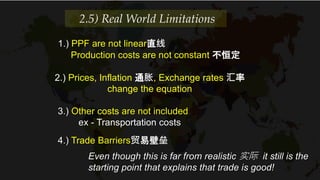
2.5) Real World Limitations
1.) PPF are not linear直线
Production costs are not constant 不恒定
2.) Prices, Inflation 通胀, Exchange rates 汇率
change the equation
3.) Other costs are not included
ex - Transportation costs
Even though this is far from realistic 实际 it still is the
starting point that explains that trade is good!
4.) Trade Barriers贸易壁垒
Winners: Losers:
Consumers
in importing
country
Producers in
importing
country
Consumers
in exporting
country
Producers
in exporting
country
3.5) Trade Graph Results…
4.) Terms of Trade
Terms of Trade - A ratio of the indexed prices of
exports and imports in a country.
-List of all the prices put together.Index 指數
Index price of exports
Index price of imports
X 100
Base year 基年 is 100
Equation:
Reasons for: Reasons against:
1.) Comparative
Advantages
2.) Variety
3.) Technology
4.) Government
Policy
1.) Jobs
2.) National Security
3.) Infant-Industries
4.) Unfair competition
6.) Correct Balance of Payments
Disequilibrium
7.) Control the consumption
of Demerit Goods
5.) The protection-as-
bargaining-chip argument
5.) Arguments about International Trade
- a tax on imports
Example: Cotton shirts
PW = $20
Tariff: T = $10/shirt
Consumers must pay $30 for an
imported shirt.
So, domestic producers can charge $30
per shirt.
In general, the price facing domestic
buyers & sellers equals (PW + T ).
6.) Some ways to restrict International Trade
Tariff
- a tax on imports
6.) Some ways to restrict International Trade
Tariff
Quota - is a limit on imports of a good.
Mostly has the same effects as a tariff:
Raises price, reduces quantity of imports.
- A tariff creates revenue for the govt. A
quota creates profits for the foreign
producers of the imported goods, who
can sell them at higher price.
$30
Free trade
CS = A + B + C + D + E + F
PS = G
Total surplus = A + B
+ C + D + E + F + G
Tariff
CS = A + B
PS = C + G
G Revenue = E
DWL = D + F
Total surplus = A + B
+ C + E + G
P
Q
D
S
$20
25
Cotton shirts
40
A
B
D E
G
FC
70 80
deadweight
loss = D + F
6.) Some ways to restrict International Trade
$30
Free trade
CS = A + B + C + D + E + F
PS = G
Total surplus = A + B
+ C + D + E + F + G
Tariff
CS = A + B
PS = C + G
Foreign Producer Surplus = E
DWL = D + F
Total surplus = A + B
+ C + E + G
P
Q
D
S
$20
25
Cotton shirts
40
A
B
D E
G
FC
70 80
deadweight
loss = D + F
6.) Some ways to restrict International Trade
The End
Thank you
授人以鱼不如授人以渔

International Trade SFLS part2

  • 1.
  • 2.
    International Trade: 3.) GraphingInternational Trade 1.) Specialization & Comparative Advantage 2.) PPC and Trading Possibilities 4.) Terms of Trade 5.) Arguments about International Trade 6.) Some ways to restrict International Trade
  • 3.
    Are clothes cheap inChina? The Answer: Who’s Asking?
  • 4.
    Textile workers today in China Textileworkers 100-150 years ago in America
  • 5.
    Textile workers today in China Textileworkers 100- 150 years ago in America
  • 6.
  • 7.
  • 12.
    International Trade Graph Acountry has a comparative advantage in a good if it produces the good at lower opportunity cost than other countries. Countries can gain from trade if each exports the goods in which it has a comparative advantage. Now we apply the tools of welfare economics to see where these gains come from and who gets them. 3.) Graphing International Trade
  • 13.
    Market EQ: P =30 Q = 15 Total surplus = CS + PS Is the market EQ efficient? 0 10 20 30 40 50 60 0 5 10 15 20 25 30 P Q S D CS PS D S Evaluating the Market Equilibrium (EQ)
  • 14.
    P Q D S PS PB QEQT A B C D E F CS= A PS = F Tax revenue = B buyer pays + D seller pays Total surplus = A + B + D + F With the tax, The tax reduces total surplus by C + E 3.) Efficacy and Fairness of Taxes
  • 15.
    P Q D S 250 400 shortage Price ceiling 500 800 Price Ceiling -is the maximum price sellers are allowed to charge - also causes underproduction Price Controls
  • 16.
    Price Floor - isthe minimum price buyers are required to pay - also causes overproduction P Q D S 400 550 Price floor 5 surplus Price Controls
  • 17.
    International Trade: 3.) GraphingInternational Trade 1.) Specialization & Comparative Advantage 2.) PPC and Trading Possibilities 4.) Terms of Trade 5.) Arguments about International Trade 6.) Some ways to restrict International Trade
  • 18.
    The World Priceand Comparative Advantage PW = the world price of a good, in world markets PD = domestic国内 price without trade (autarky 自给自足 ) If PD < PW, - country has (CA) in the good - under free trade, country exports the good If PD > PW, - country does not have (CA) - under free trade, country imports the good Things to define on the graph first:
  • 19.
    1. The SmallEconomy Assumption Things to define on the graph first: Assumptions 假定:
  • 27.
    1. The SmallEconomy Assumption Things to define on the graph first: Assumptions 假定: - A small economy is a price taker in world markets: Its actions have no effect on PW. Not always true – especially for the U.S. And China – but makes understanding easier without changing its lessons. - When a small economy engages in free trade, PW is the only relevant相应 price: No seller would accept less than PW, since they could sell the good for PW in world markets. No buyer would pay more than PW, since they could buy the good for PW in world markets.
  • 28.
  • 29.
    Without Trade, PD =$4 Q = 500 PW = $6 With Free Trade, - domestic 国内 consumers demand 300 -domestic producers supply 750 Exports = 450 P Q D S $6 $4 500300 Soybeans exports 750 Exporting Soybeans example…
  • 30.
    Without Trade, CS =A + B PS = C Total surplus = A + B + C With Free Trade, CS = A PS = B + C + D Total surplus = A + B + C + D P Q D S $6 $4 Soybeans exports A B D C gains from trade Exporting Soybeans example…
  • 31.
  • 32.
    Without Trade, PD =3000 Q = 400 In World Markets, PW = 1500 P Q D S $1500 200 $3000 400 600 Cars Importing Cars example…
  • 33.
    With Free Trade, -domestic consumers demand 600 - domestic producers supply 200 Imports = 400 P Q D S 1500 200 3000 600 Cars imports A Country That Imports TVs Without Trade, PD = 3000, Q = 400 In world markets, PW = 1500
  • 34.
    Without Trade, CS =A PS = B + C Total surplus = A + B + C With Free Trade, CS = A + B + D PS = C Total surplus = A + B + C + D P Q D S 1500 3000 Cars A B D C gains from trade imports A Country That Imports TVs
  • 35.
    total surplus producer surplus consumersurplus direction of trade rises falls rises imports PD > PW rises rises falls exports PD < PW Summary: The Welfare Effects of Trade Whether a good is imported or exported, trade creates winners and losers. But the gains exceed the losses.
  • 36.
    Trade is Good! Positiveeconomics is the study of what is 结果是基于数据 Normative economics is the study of what should be 是基于你的愿望是什么结果
  • 37.
    International Trade: 3.) GraphingInternational Trade 1.) Specialization & Comparative Advantage 2.) PPC and Trading Possibilities 4.) Terms of Trade 5.) Arguments about International Trade 3.5) Trade Graph Results 6.) Some ways to restrict International Trade
  • 38.
    Importing Country Results: Consumers areWinners! 3.5) Trade Graph Results… Lower prices and more variety!
  • 39.
    Importing Country Results: Producersare Losers! 3.5) Trade Graph Results… More competition, lower prices, less customers.
  • 40.
    Exporting Country Results: Producersare Winners! 3.5) Trade Graph Results… Higher prices outside country, more customers!
  • 41.
    Exporting Country Results: Consumers areLosers! 3.5) Trade Graph Results… Higher prices outside country, so prices for you are higher.
  • 42.
    Winners: Losers: Consumers in importing country Producersin importing country Consumers in exporting country Producers in exporting country 3.5) Trade Graph Results…
  • 43.
    International Trade: 3.) GraphingInternational Trade 1.) Specialization & Comparative Advantage 2.) PPC and Trading Possibilities 4.) Terms of Trade 5.) Arguments about International Trade 6.) Some ways to restrict International Trade
  • 44.
    - An easyway to measure trade between countries. (if your getting a good deal or not) 好对付? 4.) Terms of Trade Terms of Trade - A ratio of the indexed prices of exports and imports in a country.
  • 45.
    4.) Terms ofTrade Terms of Trade - A ratio of the indexed prices of exports and imports in a country. -List of all the prices put together.Index 指數 Index price of exports Index price of imports X 100 Base year 基年 is 100 Equation:
  • 46.
    4.) Terms ofTrade Terms of Trade - A ratio of the indexed prices of exports and imports in a country. For example, if a country exports 50 dollars worth of product in exchange for 100 dollars worth of imported product, that country's terms of trade are 50/100 = 0.5. If it’s over 100 – you get better price for your exports then what you pay for imports. If it’s under 100 – you get worse price for your exports then you pay for imports.
  • 47.
    4.) Terms ofTrade Terms of Trade - A ratio of the indexed prices of exports and imports in a country. - It can be used as a comparison of prices over time. Terms of Trade Usefulness Terms of Trade Limitations - Does not tell us about the volume 量 of the countries' exports, only relative 相对的 changes between countries over time.
  • 48.
    International Trade: 3.) GraphingInternational Trade 1.) Specialization & Comparative Advantage 2.) PPC and Trading Possibilities 4.) Terms of Trade 5.) Arguments about International Trade 6.) Some ways to restrict International Trade
  • 49.
    Reasons for: Reasonsagainst: 1.) Comparative Advantages 2.) Variety 3.) Technology 4.) Government Policy 1.) Jobs 2.) National Security 3.) Infant-Industries 4.) Unfair competition 6.) Correct Balance of Payments Disequilibrium 7.) Control the consumption of Demerit Goods 5.) The protection-as- bargaining-chip argument 5.) Arguments about International Trade
  • 50.
    Reasons for: Reasonsagainst: 1.) Comparative Advantages 2.) Variety 3.) Technology 4.) Government Policy 1.) Jobs 2.) National Security 3.) Infant-Industries 4.) Unfair competition 6.) Correct Balance of Payments Disequilibrium 7.) Control the consumption of Demerit Goods 5.) The protection-as- bargaining-chip argument 5.) Arguments about International Trade Most economists agree that these are all bad reason. However people use them all the time.
  • 51.
    Reasons for: Reasonsagainst: 1.) Comparative Advantages 2.) Variety 3.) Technology 4.) Government Policy 1.) Jobs 2.) National Security 3.) Infant-Industries 4.) Unfair competition 6.) Correct Balance of Payments Disequilibrium 7.) Control the consumption of Demerit Goods 5.) The protection-as- bargaining-chip argument 5.) Arguments about International Trade
  • 52.
    Reasons for 1. )Comparative Advantages - Produce more with lower costs and produce on a larger scale. 5.) Arguments about International Trade
  • 53.
    Reasons for Comparative advantages 2.)Variety - More cool stuff to buy! 5.) Arguments about International Trade
  • 54.
    Reasons for Comparative advantages Variety 3.)Technology -Learn new things and can make even more cool stuff! 5.) Arguments about International Trade
  • 60.
    Reasons for Comparative advantages Variety Technology 4.)Government Policy -To diversify in case of shocks’ 多样化 如果 供给冲击 5.) Arguments about International Trade
  • 61.
    was the Shahof Iran from 16 September 1941 until his overthrow by the Iranian Revolution on 11 February 1979. Mohammad Reza Shah Pahlavi
  • 63.
    Mohammad Reza Shah Pahlavi Leader ofIran Jimmy Carter President of USA
  • 64.
  • 65.
    was an IranianShia Muslim religious leader, revolutionary, politician, the founder of the Islamic Republic of Iran and the leader of the 1979 Iranian Revolution which saw the overthrow of the Pahlavi monarchy and the Shah of Iran. Grand Ayatollah Sayyid Ruhollah Mūsavi Khomeini
  • 69.
    Reasons for Comparative Advantages Variety Technology Increasetotal welfare for your country and people Government Policy 5.) Arguments about International Trade
  • 70.
    Why All theOpposition 反对 to Trade?  The winners from trade could compensate 补偿 the losers and still be better off. Yet, such compensation rarely occurs.  The losses are often highly concentrated 浓 among a small group of people, who feel them more strongly. The gains are often spread thinly over many people, who may not see how trade benefits them.  Hence, the losers have more incentive to organize and lobby for restrictions on trade. 因此,失败者有更多的动力去组织和游说,对贸易的 限制。 Easy to see losers易见的输家 Hard to see winners 很难见到赢家
  • 71.
    Reasons Against - Tradedestroys jobs in the industries that compete against imports. 1.) Jobs 5.) Arguments about International Trade
  • 72.
    Reasons Against - Tradedestroys jobs in the industries that compete against imports. 1.) Jobs 5.) Arguments about International Trade Economists’ response: Total unemployment does not rise as imports rise, because job losses from imports are offset 抵销 by job gains in export industries. Even if all goods could be produced more cheaply abroad, the country need only have a comparative advantage to have a viable export industry and to gain from trade.
  • 73.
    U.S. Imports &Unemployment, Decade averages, 1956-2005 0% 2% 4% 6% 8% 10% 12% 14% 16% 1956 -65 1966 -75 1976 -85 1986 -95 1996 -2005 Imports (% of GDP) Unemployment (% of labor force)
  • 74.
    Reasons Against Jobs 2.) NationalSecurity - An industry vital 重要to national security should be protected from foreign competition to prevent dependence on foreigners. Ex – China will not let America build their aircraft carriers even though America has the (CA) in making them. 5.) Arguments about International Trade
  • 75.
    Reasons Against Jobs 2.) NationalSecurity - An industry vital 重要to national security should be protected from foreign competition to prevent dependence on foreigners. 5.) Arguments about International Trade Economists’ response: Fine, as long as we base policy on true security needs. But producers may exaggerate their own importance to national security to obtain protection from foreign competition.
  • 76.
    Reasons Against Jobs National Security 3.)Infant-Industries Sunrise- industries - A new industry argues for temporary protection until it is mature 成熟 and can compete with foreign firms. 5.) Arguments about International Trade
  • 80.
    Reasons Against Jobs National Security 3.)Infant-Industries Sunrise- industries - A new industry argues for temporary protection until it is mature 成熟 and can compete with foreign firms. 5.) Arguments about International Trade Economists’ response: Difficult for govt to determine which industries will eventually be able to win. to compete and whether benefits of establishing these industries exceed cost to consumers of restricting imports. Besides, if a firm will be profitable in the long run, it should be willing to incur temporary losses.
  • 81.
    Reasons Against Jobs National Security Infant-Industries 4.)Unfair Competition Dumping - Producers argue their competitors in another country have an unfair advantage, example - due to govt subsidies. Dumping 5.) Arguments about International Trade
  • 87.
    Reasons Against Jobs National Security Infant-Industries 4.)Unfair Competition Dumping - Producers argue their competitors in another country have an unfair advantage, 5.) Arguments about International Trade Economists’ response: Great! Then we can import extra-cheap products subsidized by the other country’s taxpayers. The gains to our consumers will exceed the losses to our producers.
  • 88.
    Reasons Against 5.) Argumentsabout International Trade 5.) The protection-as- bargaining-chip argument Example: The U.S. can threaten to limit imports of French wine unless France lifts their quotas 配额 on American beef.Economists’ response: Suppose France refuses. Then the U.S. must choose between two bad options: A) Restrict imports from France, which reduces welfare in the U.S. B) Don’t restrict imports, which reduces U.S. credibility.
  • 89.
    Reasons for: Reasonsagainst: 1.) Comparative Advantages 2.) Variety 3.) Technology 4.) Government Policy 1.) Jobs 2.) National Security 3.) Infant-Industries 4.) Unfair competition 6.) Correct Balance of Payments Disequilibrium 7.) Control the consumption of Demerit Goods 5.) The protection-as- bargaining-chip argument 5.) Arguments about International Trade
  • 90.
    International Trade: 3.) GraphingInternational Trade 1.) Specialization & Comparative Advantage 2.) PPC and Trading Possibilities 4.) Terms of Trade 5.) Arguments about International Trade 6.) Some ways to restrict International Trade
  • 91.
    Reasons for: Reasonsagainst: 1.) Comparative Advantages 2.) Variety 3.) Technology 4.) Government Policy 1.) Jobs 2.) National Security 3.) Infant-Industries 4.) Unfair competition 6.) Correct Balance of Payments Disequilibrium 7.) Control the consumption of Demerit Goods 5.) The protection-as- bargaining-chip argument 5.) Arguments about International Trade Ways to control importation: Tariffs and Quotas
  • 92.
    - a taxon imports Example: Cotton shirts PW = $20 Tariff: T = $10/shirt Consumers must pay $30 for an imported shirt. So, domestic producers can charge $30 per shirt. In general, the price facing domestic buyers & sellers equals (PW + T ). 6.) Some ways to restrict International Trade Tariff
  • 93.
    $30 PW = $20 Freetrade: buyers demand 80 sellers supply 25 imports = 55 T = $10/shirt price rises to $30 buyers demand 70 sellers supply 40 imports = 30 P Q D S $20 25 Cotton shirts 40 70 80 importsimports 6.) Some ways to restrict International Trade
  • 94.
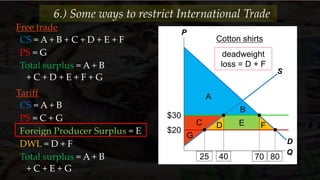
    $30 Free trade CS =A + B + C + D + E + F PS = G Total surplus = A + B + C + D + E + F + G Tariff CS = A + B PS = C + G G Revenue = E DWL = D + F Total surplus = A + B + C + E + G P Q D S $20 25 Cotton shirts 40 A B D E G FC 70 80 deadweight loss = D + F 6.) Some ways to restrict International Trade
  • 95.
    $30 DWL D = deadweightloss from the higher prices of shirts F = deadweight loss from the under- consumption of shirts P Q D S $20 25 Cotton shirts 40 A B D E G FC 70 80 deadweight loss = D + F 6.) Some ways to restrict International Trade
  • 96.
    - a taxon imports 6.) Some ways to restrict International Trade Tariff Quota - is a limit on imports of a good. Mostly has the same effects as a tariff: Raises price, reduces quantity of imports. - A tariff creates revenue for the govt. A quota creates profits for the foreign producers of the imported goods, who can sell them at higher price.
  • 97.
    $30 Free trade CS =A + B + C + D + E + F PS = G Total surplus = A + B + C + D + E + F + G Tariff CS = A + B PS = C + G Foreign Producer Surplus = E DWL = D + F Total surplus = A + B + C + E + G P Q D S $20 25 Cotton shirts 40 A B D E G FC 70 80 deadweight loss = D + F 6.) Some ways to restrict International Trade
  • 100.
    Ways to interpretEconomic theory Positive economics is the study of what is 结果是基于数据 Normative economics is the study of what should be 是基于你的愿望是什么结果
  • 101.
  • 102.
    International Trade: 3.) GraphingInternational Trade 1.) Specialization & Comparative Advantage 2.) PPC and Trading Possibilities 4.) Terms of Trade 5.) Arguments about International Trade 6.) Some ways to restrict International Trade
  • 103.
    Absolute Advantage 1.) Specialization &Comparative Advantage Comparative Advantage (CA) - the ability to produce at a lower opportunity cost then someone else. - You produce what you have (CA) in and trade for the other things that you don’t.
  • 105.
    4,000 100 5,000 2,000 1,000 3,000 500200 300 400 0 Computers Wheat (tons) U.S.Consumption With Trade 2700270 = amount consumed 0110+ imported 7000– exported 3400160produced wheatcomputers
  • 106.
    Without Trade, CS =A + B PS = C Total surplus = A + B + C With Free Trade, CS = A PS = B + C + D Total surplus = A + B + C + D P Q D S $6 $4 Soybeans exports A B D C gains from trade Exporting Soybeans example…
  • 107.
    Without Trade, CS =A PS = B + C Total surplus = A + B + C With Free Trade, CS = A + B + D PS = C Total surplus = A + B + C + D P Q D S 1500 3000 Cars A B D C gains from trade imports A Country That Imports TVs
  • 108.
    2.5) Real WorldLimitations 1.) PPF are not linear直线 Production costs are not constant 不恒定 2.) Prices, Inflation 通胀, Exchange rates 汇率 change the equation 3.) Other costs are not included ex - Transportation costs Even though this is far from realistic 实际 it still is the starting point that explains that trade is good! 4.) Trade Barriers贸易壁垒
  • 109.
    Winners: Losers: Consumers in importing country Producersin importing country Consumers in exporting country Producers in exporting country 3.5) Trade Graph Results…
  • 110.
    4.) Terms ofTrade Terms of Trade - A ratio of the indexed prices of exports and imports in a country. -List of all the prices put together.Index 指數 Index price of exports Index price of imports X 100 Base year 基年 is 100 Equation:
  • 111.
    Reasons for: Reasonsagainst: 1.) Comparative Advantages 2.) Variety 3.) Technology 4.) Government Policy 1.) Jobs 2.) National Security 3.) Infant-Industries 4.) Unfair competition 6.) Correct Balance of Payments Disequilibrium 7.) Control the consumption of Demerit Goods 5.) The protection-as- bargaining-chip argument 5.) Arguments about International Trade
  • 112.
    - a taxon imports Example: Cotton shirts PW = $20 Tariff: T = $10/shirt Consumers must pay $30 for an imported shirt. So, domestic producers can charge $30 per shirt. In general, the price facing domestic buyers & sellers equals (PW + T ). 6.) Some ways to restrict International Trade Tariff
  • 113.
    - a taxon imports 6.) Some ways to restrict International Trade Tariff Quota - is a limit on imports of a good. Mostly has the same effects as a tariff: Raises price, reduces quantity of imports. - A tariff creates revenue for the govt. A quota creates profits for the foreign producers of the imported goods, who can sell them at higher price.
  • 114.
    $30 Free trade CS =A + B + C + D + E + F PS = G Total surplus = A + B + C + D + E + F + G Tariff CS = A + B PS = C + G G Revenue = E DWL = D + F Total surplus = A + B + C + E + G P Q D S $20 25 Cotton shirts 40 A B D E G FC 70 80 deadweight loss = D + F 6.) Some ways to restrict International Trade
  • 115.
    $30 Free trade CS =A + B + C + D + E + F PS = G Total surplus = A + B + C + D + E + F + G Tariff CS = A + B PS = C + G Foreign Producer Surplus = E DWL = D + F Total surplus = A + B + C + E + G P Q D S $20 25 Cotton shirts 40 A B D E G FC 70 80 deadweight loss = D + F 6.) Some ways to restrict International Trade
  • 116.
  • 117.