The Multiplier Effect
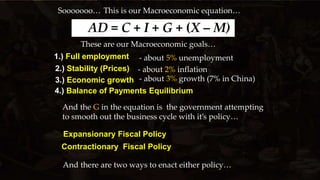
Sooooooo…
1.) Full employment - about 5% unemployment
2.) Stability (Prices)
3.) Economic growth
4.) Balance of Payments Equilibrium
- about 2% inflation
- about 3% growth (7% in China)
AD = C + I + G + (X – M)
These are our Macroeconomic goals…
This is our Macroeconomic equation…
And the G in the equation is the government attempting
to smooth out the business cycle with it’s policy…
Expansionary Fiscal Policy
Contractionary Fiscal Policy
And there are two ways to enact either policy…
AD = C + I + G + (X – M)
And there are two ways to enact either policy…
 Government spending
 Taxes
And the two ways this is accomplished…
Discretionary Fiscal Policy
Automatic Stabilizers
And there are the resources used to do this…
AD = C + I + G + (X – M)
Federal Budget
And there are the resources used to do this…
Which comes from either…
Taxes
Borrowing
Soooooooooooo…….
The next question is how effective are these policies…
I work for the
Government!
Big G Man
This Man represents the
Government in our economy
so we will call him…
Let’s look at our
country’s AD!
Fiscal Policy Effectiveness Example
Price
level
GDP
AD
SRAS
PE
YN
Y1
P1
LRAS
Big G Man
Oh No! the AD is
below the long
run equilibrium!
Fiscal Policy Effectiveness Example
Price
level
GDP
AD
SRAS
PE
YN
Y1
P1
LRAS
I am sad
for my
country
Big G Man
Fiscal Policy Effectiveness Example
Price
level
GDP
AD
SRAS
PE
YN
Y1
P1
LRASLet’s check the
GDP spending
numbers
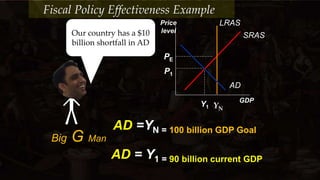
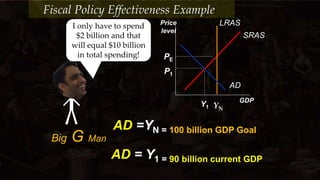
AD = Y1 = 90 billion current GDP
AD =YN = 100 billion GDP Goal
Big G Man
Fiscal Policy Effectiveness Example
Price
level
GDP
AD
SRAS
PE
YN
Y1
P1
LRAS
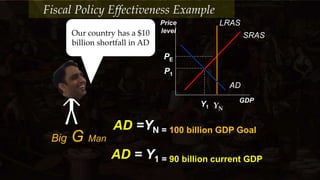
AD = Y1 = 90 billion current GDP
AD =YN = 100 billion GDP Goal
Big G Man
Our country has a $10
billion shortfall in AD
Fiscal Policy Effectiveness Example
Price
level
GDP
AD
SRAS
PE
YN
Y1
P1
LRAS
AD = Y1 = 90 billion current GDP
AD =YN = 100 billion GDP Goal
Big G Man
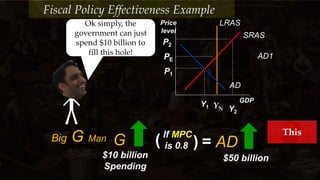
Ok simply, the
government can just
spend $10 billion to
fill this hole!
Fiscal Policy Effectiveness Example
G
Price
level
GDP
AD
SRAS
PE
YN
Y1
P1
LRASOk simply, the
government can just
spend $10 billion to
fill this hole!
$10 billion
Spending
= AD
$10 billion
Big G Man
Fiscal Policy Effectiveness Example
G
Price
level
GDP
AD
SRAS
PE
YN
Y1
P1
LRASOk simply, the
government can just
spend $10 billion to
fill this hole!
$10 billion
Spending
= AD
$10 billion
Big G Man
Fiscal Policy Effectiveness Example
G
Price
level
GDP
AD
SRAS
PE
YN
Y1
P1
LRASOk simply, the
government can just
spend $10 billion to
fill this hole!
$10 billion
Spending
= AD
$10 billion
Big G Man
This doesn’t work
Fiscal Policy Effectiveness Example
G
Price
level
GDP
AD
SRAS
PE
YN
Y1
P1
LRASOk simply, the
government can just
spend $10 billion to
fill this hole!
$10 billion
Spending
= AD
$10 billion
Big G Man
It doesn’t
equal this,
instead it
equal…
G
Price
level
GDP
AD
SRAS
PE
YN
Y1
P1
LRASOk simply, the
government can just
spend $10 billion to
fill this hole!
$10 billion
Spending
= AD
$50 billion
AD1
Y2
P2
Big G Man If MPC
is 0.8( )
Fiscal Policy Effectiveness Example
This
G
Price
level
GDP
SRAS
PE
YN
LRASOh no! the economy is
overheating and now
we have too much
inflation!
$10 billion
Spending
= AD
$50 billion
AD1
Y2
P2
= Inflation
Fiscal Policy Effectiveness Example
G
Price
level
GDP
SRAS
PE
YN
LRAS
What did I do wrong?
$10 billion
Spending
= AD
$50 billion
AD1
Y2
P2
= Inflation
Fiscal Policy Effectiveness Example
AD = C + I + G + (X – M)
Government spending
Price
level
GDP
AD
SRAS
PE
LRAS
YN Y1
P1
AD1
- Government spends
more in the economy
and makes jobs, people
have more money and
increase consumption.
Fiscal Policy Effectiveness Example
Must add a
multiplier
effect
AD = C + I + G + (X – M)
Taxes
Price
level
GDP
AD
SRAS
PE
LRAS
YN Y1
P1
AD1
- Lower taxes means
people have more
money to use for
consumption and also
businesses have more
money to increase
investment spending.
Fiscal Policy Effectiveness Example
Must add a
multiplier
effect
- the number of times a rise in national
income exceeds the rise in injections 注入
of demand that caused it
The Multiplier
effect
the additional shifts in AD
that result when fiscal policy
increases income and thereby
increases consumer spending (C)
Reworded definition: 换句话说
Each $1 increase in G can generate
more than a $1 increase in AD.
Fiscal Policy Effectiveness
The Multiplier
effect
1
1 – MPC
=
- the number of times a rise in national
income exceeds the rise in injections 注入
of demand that caused it
G spending
Equation:
or
1
MPS
=
Tax Equation:
or
Tax Equation:
or
The Multiplier Effect
1.) The government buys airplanes from a domestic
manufacturer.
2.) This is distributed to workers (wages)
and owners ( profits or stock dividends).
3.) These people are also consumers and
will spend a portion of the extra income.
4.) This extra consumption
causes further increases in AD.
Price
level
GDP
AD
Multiplier Effect Example
- the fraction of extra income that
households consumes rather than
save
The Multiplier
effect
Marginal
Propensity to
Consume
(MPC)
Example:
1.) if MPC = 0.8
2.) if income rises by $100
3.) then C consumption rises $80
The size of the multiplier depends on MPC.
Fiscal Policy Effectiveness
Marginal
Propensity to
Consume
(MPC)
The size of the multiplier depends
on MPC.
if MPC = 0.5 Multiplier = 2
if MPC = 0.75 Multiplier = 4
if MPC = 0.9 Multiplier = 10
Example sizes:
Fiscal Policy Effectiveness
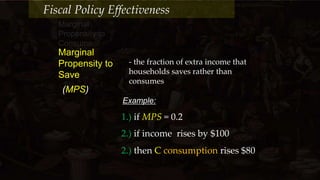
- the fraction of extra income that
households saves rather than
consumes
Marginal
Propensity to
Consume
(MPS)
Marginal
Propensity to
Save
Example:
1.) if MPS = 0.2
2.) if income rises by $100
2.) then C consumption rises $80
Fiscal Policy Effectiveness
I will spend more G
money and make a
new bridge!
Big G Man
Fiscal Policy Effectiveness Example
So I need to hire
some workers to
do it.
Big G Man
Fiscal Policy Effectiveness Example
Big G Man
给钱 做桥
G
$10 billion
Spending
=
AD
$10 billion + …
Workers
Fiscal Policy Effectiveness Example
Workers
Some of this money
with will spend
(MPC) = 0.8
We have earned
some wages!
Some of this money
we will save (MPS)
= 0.2
Fiscal Policy Effectiveness Example
Workers
Let’s buy some new
dresses!
Fiscal Policy Effectiveness Example
Workers
给钱
Dress maker
做衣服
($10 billion)
$8 billion用钱
$2 billion存钱。
Fiscal Policy Effectiveness Example
Workers
给钱
Dress maker
做衣服
G
$10 billion
Spending
+
workers
$8 billion
Spending
+ …
Fiscal Policy Effectiveness Example
Big G Man
$10 billion
Spending
+ …
Workers
+ +
Dress maker
+
$8 billion
Spending
$6.4 billion
Spending
+ +…
Fiscal Policy Effectiveness Example
Big G Man
+ …
Workers
+ +
Dress maker
G
$10 billion
Spending
+
MPC = 0.8
of each round of
income’s spending
1
1 – MPC
=
Fiscal Policy Effectiveness Example
Big G Man
+ …
Workers
+ +
Dress maker
MPC = 0.8
of each round of
income’s spending
1
1 – MPC
= Multiplier
= 5
Fiscal Policy Effectiveness Example
Big G Man
+ …
Workers
+ +
Dress maker
G
$10 billion
Spending
= AD
$50 billion
x Multiplier
of 5
Fiscal Policy Effectiveness Example
A $10billion increase
in G initially shifts
AD to the right by
$10billion.
The increase in Y
causes C to rise,
which shifts AD
further to the right.
Y
P
AD1
P1
AD2
AD3
Y1 Y3Y2
$10 billion
The Multiplier Effect
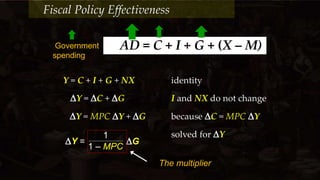
AD = C + I + G + (X – M)Government
spending
Y = C + I + G + NX identity
Y = C + G I and NX do not change
Y = MPC Y + G because C = MPC Y
solved for Y1
1 – MPC
Y = G
The multiplier
Fiscal Policy Effectiveness
Marginal Propensity to Consume (MPC)
Price
level
GDP
AD
SRAS
PE
YN
Y1
P1
LRAS
Ok let’s try
again!
Big G Man
Price
level
GDP
AD
SRAS
PE
YN
Y1
P1
LRASLet’s check the
GDP spending
numbers
AD = Y1 = 90 billion current GDP
AD =YN = 100 billion GDP Goal
Big G Man
Fiscal Policy Effectiveness Example
Price
level
GDP
AD
SRAS
PE
YN
Y1
P1
LRAS
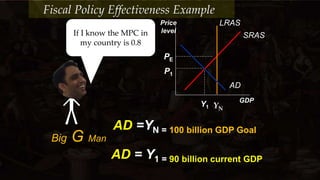
AD = Y1 = 90 billion current GDP
AD =YN = 100 billion GDP Goal
Big G Man
Our country has a $10
billion shortfall in AD
Fiscal Policy Effectiveness Example
Price
level
GDP
AD
SRAS
PE
YN
Y1
P1
LRAS
AD = Y1 = 90 billion current GDP
AD =YN = 100 billion GDP Goal
Big G Man
If I know the MPC in
my country is 0.8
Fiscal Policy Effectiveness Example
Price
level
GDP
AD
SRAS
PE
YN
Y1
P1
LRAS
Then I use that in this
equation
1
1 – MPC
=
= 1/1-0.8
= 1/0.2Big G Man
Fiscal Policy Effectiveness Example
Price
level
GDP
AD
SRAS
PE
YN
Y1
P1
LRAS
1
1 – MPC
=
= 1/1-0.8
= 1/0.2
= 5
Big G Man
Now I know the
multiplier!
Fiscal Policy Effectiveness Example
Price
level
GDP
AD
SRAS
PE
YN
Y1
P1
LRASI only have to spend
$2 billion and that
will equal $10 billion
in total spending!
AD = Y1 = 90 billion current GDP
AD =YN = 100 billion GDP Goal
Big G Man
Fiscal Policy Effectiveness Example
Big G man
Price
level
GDP
AD
SRAS
PE
YN
LRAS
Hurry! Our
Economy is saved!
Fiscal Policy Effectiveness Example
AD = C + I + G + (X – M)
Government spending
Price
level
GDP
AD
SRAS
PE
LRAS
YN Y1
P1
AD1
- Government spends
more in the economy
and makes jobs, people
have more money and
increase consumption.
Fiscal Policy Effectiveness Example
This has a
multiplier…
AD = C + I + G + (X – M)
Taxes
Price
level
GDP
AD
SRAS
PE
LRAS
YN Y1
P1
AD1
- Lower taxes means
people have more
money to use for
consumption and also
businesses have more
money to increase
investment spending.
Fiscal Policy Effectiveness Example
This has a
different
multiplier…
The Multiplier
effect
- the number of times a rise in national
income exceeds the rise in injections 注入
of demand that caused it
G spending
Equation:
or
Tax Equation:
or
Tax Equation:
or
MPC
1 – MPC
=
MPC
MPS
=
- MPC
1 – MPC
=
- MPC
MPS
=
Fiscal Policy Effectiveness
AD = C + I + G + (X – M)Taxes
Reduced taxes are not an injection of
new money
It “frees’” up current income into more
disposable income
Some is saved, some is spend, just like
the Government Spending Multiplier
but without the first injection of new
money that is 100% spend.
Tax Multiplier Effect
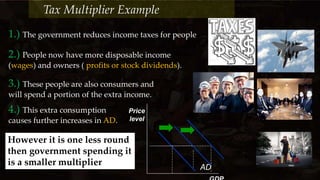
1.) The government reduces income taxes for people
2.) People now have more disposable income
(wages) and owners ( profits or stock dividends).
3.) These people are also consumers and
will spend a portion of the extra income.
4.) This extra consumption
causes further increases in AD.
Price
level
AD
However it is one less round
then government spending it
is a smaller multiplier
Tax Multiplier Example
Price
level
GDP
AD
SRAS
PE
YN
Y1
P1
LRAS
AD = Y1 = 90 billion current GDP
AD =YN = 100 billion GDP Goal
Big G Man
Our country has a $10
billion shortfall in AD
Tax Multiplier E ffect Example
What if instead of
building a bridge and
spending extra money
like before, I just gave
people tax cuts?
Big G Man
Tax Multiplier Effect Example
Big G Man WorkersBoss of Workers
I will reduce all your
taxes so you have
more disposable
income
Tax Multiplier Effect Example
Big G Man WorkersBoss of Workers
Hurry! I might even
hire new workers!
Tax Multiplier Effect Example
Big G Man WorkersBoss of Workers
Hurry! Now we can
buy more dresses!
Tax Multiplier Effect Example
Price
level
GDP
AD
SRAS
PE
YN
Y1
P1
LRAS
AD = Y1 = 90 billion current GDP
AD =YN = 100 billion GDP Goal
Big G Man
If I know the MPC in
my country is 0.8
Tax Multiplier Effect Example
Price
level
GDP
AD
SRAS
PE
YN
Y1
P1
LRAS
AD = Y1 = 90 billion current GDP
AD =YN = 100 billion GDP Goal
Big G Man
Our country has a $10
billion shortfall in AD
Tax Multiplier Effect Example
Price
level
GDP
AD
SRAS
PE
YN
Y1
P1
LRAS
Then I use that in this
equation
MPC
1 – MPC
=
= 0.8/1-0.8
= 0.8/0.2Big G Man
Tax Multiplier Effect Example
Price
level
GDP
AD
SRAS
PE
YN
Y1
P1
LRAS
MPC
1 – MPC
=
= 0.8/1-0.8
= 0.8/0.2
= 4
Big G Man
Now I know the tax
multiplier!
Tax Multiplier Effect Example
Price
level
GDP
AD
SRAS
PE
YN
Y1
P1
LRASI have to cut taxes by
2.5 billion to get $10
billion in total
spending!
AD = Y1 = 90 billion current GDP
AD =YN = 100 billion GDP Goal
Big G Man
Tax Multiplier Effect Example
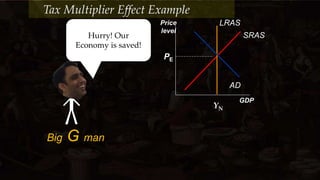
Big G man
Price
level
GDP
AD
SRAS
PE
YN
LRAS
Hurry! Our
Economy is saved!
Tax Multiplier Effect Example
The Multiplier
effect
1
1 – MPC
=
- the number of times a rise in national
income exceeds the rise in injections 注入
of demand that caused it
G spending
Equation:
or
1
MPS
=
Tax Equation:
or
Tax Equation:
or
MPC
1 – MPC
=
MPC
MPS
=
- MPC
1 – MPC
=
- MPC
MPS
=
Fiscal Policy Effectiveness
So the Government can spend money and
increase AD by a multiplier…
Or the Government can decrease taxes an
increase AD by a multiplier…
So the Government spending has a bigger multiplier…
However…
Don’t forget the money isn’t free, it comes
from the federal budget that has to be
balanced, and if it’s in deficit this adds
another problem.
The Multiplier Effect
3.1) Budget Deficit Problems
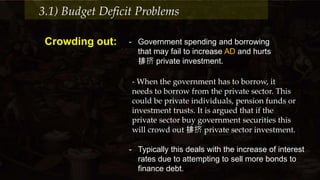
Crowding out: - Government spending and borrowing
that may fail to increase AD and hurts
排挤 private investment.
- When the government has to borrow, it
needs to borrow from the private sector. This
could be private individuals, pension funds or
investment trusts. It is argued that if the
private sector buy government securities this
will crowd out 排挤 private sector investment.
- Typically this deals with the increase of interest
rates due to attempting to sell more bonds to
finance debt.
So a quick example of
this…
The Multiplier Effect
The economy is in recession.
Shifting the AD curve rightward by $200billion
would end the recession.
A. If MPC = .8 and there is no crowding out,
how much should the government increase G
to end the recession?
B. If there is crowding out, will the government
need to increase G more or less than this
amount?
The Multiplier Effect Example
The economy is in recession.
Shifting the AD curve rightward by $200billion
would end the recession.
A. If MPC = .8 and there is no crowding out,
how much should the government increase G
to end the recession?
Multiplier = 1/(1 – .8) = 5
Answer: Increase G by $40billion
to shift AD by 5 x $40billion = $200billion
The economy is in recession.
Shifting the AD curve rightward by $200billion
would end the recession.
B. If there is crowding out, will the government
need to increase G more or less than this
amount?
- Crowding out reduces the impact of G on AD.
Answer: To offset this, the government should
increase G by a larger amount, how much
depends on the math involved.
Hope you understand!
Thank you!

The Multiplier Effect SFLS

  • 1.
  • 2.
    Sooooooo… 1.) Full employment- about 5% unemployment 2.) Stability (Prices) 3.) Economic growth 4.) Balance of Payments Equilibrium - about 2% inflation - about 3% growth (7% in China) AD = C + I + G + (X – M) These are our Macroeconomic goals… This is our Macroeconomic equation… And the G in the equation is the government attempting to smooth out the business cycle with it’s policy… Expansionary Fiscal Policy Contractionary Fiscal Policy And there are two ways to enact either policy…
  • 3.
    AD = C+ I + G + (X – M) And there are two ways to enact either policy…  Government spending  Taxes And the two ways this is accomplished… Discretionary Fiscal Policy Automatic Stabilizers And there are the resources used to do this…
  • 4.
    AD = C+ I + G + (X – M) Federal Budget And there are the resources used to do this… Which comes from either… Taxes Borrowing Soooooooooooo……. The next question is how effective are these policies…
  • 5.
    I work forthe Government! Big G Man This Man represents the Government in our economy so we will call him… Let’s look at our country’s AD! Fiscal Policy Effectiveness Example
  • 6.
    Price level GDP AD SRAS PE YN Y1 P1 LRAS Big G Man OhNo! the AD is below the long run equilibrium! Fiscal Policy Effectiveness Example
  • 7.
    Price level GDP AD SRAS PE YN Y1 P1 LRAS I am sad formy country Big G Man Fiscal Policy Effectiveness Example
  • 8.
    Price level GDP AD SRAS PE YN Y1 P1 LRASLet’s check the GDPspending numbers AD = Y1 = 90 billion current GDP AD =YN = 100 billion GDP Goal Big G Man Fiscal Policy Effectiveness Example
  • 9.
    Price level GDP AD SRAS PE YN Y1 P1 LRAS AD = Y1= 90 billion current GDP AD =YN = 100 billion GDP Goal Big G Man Our country has a $10 billion shortfall in AD Fiscal Policy Effectiveness Example
  • 10.
    Price level GDP AD SRAS PE YN Y1 P1 LRAS AD = Y1= 90 billion current GDP AD =YN = 100 billion GDP Goal Big G Man Ok simply, the government can just spend $10 billion to fill this hole! Fiscal Policy Effectiveness Example
  • 11.
    Fiscal Policy EffectivenessExample G Price level GDP AD SRAS PE YN Y1 P1 LRASOk simply, the government can just spend $10 billion to fill this hole! $10 billion Spending = AD $10 billion Big G Man
  • 12.
    Fiscal Policy EffectivenessExample G Price level GDP AD SRAS PE YN Y1 P1 LRASOk simply, the government can just spend $10 billion to fill this hole! $10 billion Spending = AD $10 billion Big G Man
  • 13.
    Fiscal Policy EffectivenessExample G Price level GDP AD SRAS PE YN Y1 P1 LRASOk simply, the government can just spend $10 billion to fill this hole! $10 billion Spending = AD $10 billion Big G Man This doesn’t work
  • 14.
    Fiscal Policy EffectivenessExample G Price level GDP AD SRAS PE YN Y1 P1 LRASOk simply, the government can just spend $10 billion to fill this hole! $10 billion Spending = AD $10 billion Big G Man It doesn’t equal this, instead it equal…
  • 15.
    G Price level GDP AD SRAS PE YN Y1 P1 LRASOk simply, the governmentcan just spend $10 billion to fill this hole! $10 billion Spending = AD $50 billion AD1 Y2 P2 Big G Man If MPC is 0.8( ) Fiscal Policy Effectiveness Example This
  • 16.
    G Price level GDP SRAS PE YN LRASOh no! theeconomy is overheating and now we have too much inflation! $10 billion Spending = AD $50 billion AD1 Y2 P2 = Inflation Fiscal Policy Effectiveness Example
  • 17.
    G Price level GDP SRAS PE YN LRAS What did Ido wrong? $10 billion Spending = AD $50 billion AD1 Y2 P2 = Inflation Fiscal Policy Effectiveness Example
  • 18.
    AD = C+ I + G + (X – M) Government spending Price level GDP AD SRAS PE LRAS YN Y1 P1 AD1 - Government spends more in the economy and makes jobs, people have more money and increase consumption. Fiscal Policy Effectiveness Example Must add a multiplier effect
  • 19.
    AD = C+ I + G + (X – M) Taxes Price level GDP AD SRAS PE LRAS YN Y1 P1 AD1 - Lower taxes means people have more money to use for consumption and also businesses have more money to increase investment spending. Fiscal Policy Effectiveness Example Must add a multiplier effect
  • 20.
    - the numberof times a rise in national income exceeds the rise in injections 注入 of demand that caused it The Multiplier effect the additional shifts in AD that result when fiscal policy increases income and thereby increases consumer spending (C) Reworded definition: 换句话说 Each $1 increase in G can generate more than a $1 increase in AD. Fiscal Policy Effectiveness
  • 21.
    The Multiplier effect 1 1 –MPC = - the number of times a rise in national income exceeds the rise in injections 注入 of demand that caused it G spending Equation: or 1 MPS = Tax Equation: or Tax Equation: or The Multiplier Effect
  • 22.
    1.) The governmentbuys airplanes from a domestic manufacturer. 2.) This is distributed to workers (wages) and owners ( profits or stock dividends). 3.) These people are also consumers and will spend a portion of the extra income. 4.) This extra consumption causes further increases in AD. Price level GDP AD Multiplier Effect Example
  • 23.
    - the fractionof extra income that households consumes rather than save The Multiplier effect Marginal Propensity to Consume (MPC) Example: 1.) if MPC = 0.8 2.) if income rises by $100 3.) then C consumption rises $80 The size of the multiplier depends on MPC. Fiscal Policy Effectiveness
  • 24.
    Marginal Propensity to Consume (MPC) The sizeof the multiplier depends on MPC. if MPC = 0.5 Multiplier = 2 if MPC = 0.75 Multiplier = 4 if MPC = 0.9 Multiplier = 10 Example sizes: Fiscal Policy Effectiveness
  • 25.
    - the fractionof extra income that households saves rather than consumes Marginal Propensity to Consume (MPS) Marginal Propensity to Save Example: 1.) if MPS = 0.2 2.) if income rises by $100 2.) then C consumption rises $80 Fiscal Policy Effectiveness
  • 26.
    I will spendmore G money and make a new bridge! Big G Man Fiscal Policy Effectiveness Example
  • 27.
    So I needto hire some workers to do it. Big G Man Fiscal Policy Effectiveness Example
  • 28.
    Big G Man 给钱做桥 G $10 billion Spending = AD $10 billion + … Workers Fiscal Policy Effectiveness Example
  • 29.
    Workers Some of thismoney with will spend (MPC) = 0.8 We have earned some wages! Some of this money we will save (MPS) = 0.2 Fiscal Policy Effectiveness Example
  • 30.
    Workers Let’s buy somenew dresses! Fiscal Policy Effectiveness Example
  • 31.
    Workers 给钱 Dress maker 做衣服 ($10 billion) $8billion用钱 $2 billion存钱。 Fiscal Policy Effectiveness Example
  • 32.
    Workers 给钱 Dress maker 做衣服 G $10 billion Spending + workers $8billion Spending + … Fiscal Policy Effectiveness Example
  • 33.
    Big G Man $10billion Spending + … Workers + + Dress maker + $8 billion Spending $6.4 billion Spending + +… Fiscal Policy Effectiveness Example
  • 34.
    Big G Man +… Workers + + Dress maker G $10 billion Spending + MPC = 0.8 of each round of income’s spending 1 1 – MPC = Fiscal Policy Effectiveness Example
  • 35.
    Big G Man +… Workers + + Dress maker MPC = 0.8 of each round of income’s spending 1 1 – MPC = Multiplier = 5 Fiscal Policy Effectiveness Example
  • 36.
    Big G Man +… Workers + + Dress maker G $10 billion Spending = AD $50 billion x Multiplier of 5 Fiscal Policy Effectiveness Example
  • 37.
    A $10billion increase inG initially shifts AD to the right by $10billion. The increase in Y causes C to rise, which shifts AD further to the right. Y P AD1 P1 AD2 AD3 Y1 Y3Y2 $10 billion The Multiplier Effect
  • 38.
    AD = C+ I + G + (X – M)Government spending Y = C + I + G + NX identity Y = C + G I and NX do not change Y = MPC Y + G because C = MPC Y solved for Y1 1 – MPC Y = G The multiplier Fiscal Policy Effectiveness
  • 39.
    Marginal Propensity toConsume (MPC) Price level GDP AD SRAS PE YN Y1 P1 LRAS Ok let’s try again! Big G Man
  • 40.
    Price level GDP AD SRAS PE YN Y1 P1 LRASLet’s check the GDPspending numbers AD = Y1 = 90 billion current GDP AD =YN = 100 billion GDP Goal Big G Man Fiscal Policy Effectiveness Example
  • 41.
    Price level GDP AD SRAS PE YN Y1 P1 LRAS AD = Y1= 90 billion current GDP AD =YN = 100 billion GDP Goal Big G Man Our country has a $10 billion shortfall in AD Fiscal Policy Effectiveness Example
  • 42.
    Price level GDP AD SRAS PE YN Y1 P1 LRAS AD = Y1= 90 billion current GDP AD =YN = 100 billion GDP Goal Big G Man If I know the MPC in my country is 0.8 Fiscal Policy Effectiveness Example
  • 43.
    Price level GDP AD SRAS PE YN Y1 P1 LRAS Then I usethat in this equation 1 1 – MPC = = 1/1-0.8 = 1/0.2Big G Man Fiscal Policy Effectiveness Example
  • 44.
    Price level GDP AD SRAS PE YN Y1 P1 LRAS 1 1 – MPC = =1/1-0.8 = 1/0.2 = 5 Big G Man Now I know the multiplier! Fiscal Policy Effectiveness Example
  • 45.
    Price level GDP AD SRAS PE YN Y1 P1 LRASI only haveto spend $2 billion and that will equal $10 billion in total spending! AD = Y1 = 90 billion current GDP AD =YN = 100 billion GDP Goal Big G Man Fiscal Policy Effectiveness Example
  • 46.
    Big G man Price level GDP AD SRAS PE YN LRAS Hurry!Our Economy is saved! Fiscal Policy Effectiveness Example
  • 47.
    AD = C+ I + G + (X – M) Government spending Price level GDP AD SRAS PE LRAS YN Y1 P1 AD1 - Government spends more in the economy and makes jobs, people have more money and increase consumption. Fiscal Policy Effectiveness Example This has a multiplier…
  • 48.
    AD = C+ I + G + (X – M) Taxes Price level GDP AD SRAS PE LRAS YN Y1 P1 AD1 - Lower taxes means people have more money to use for consumption and also businesses have more money to increase investment spending. Fiscal Policy Effectiveness Example This has a different multiplier…
  • 49.
    The Multiplier effect - thenumber of times a rise in national income exceeds the rise in injections 注入 of demand that caused it G spending Equation: or Tax Equation: or Tax Equation: or MPC 1 – MPC = MPC MPS = - MPC 1 – MPC = - MPC MPS = Fiscal Policy Effectiveness
  • 50.
    AD = C+ I + G + (X – M)Taxes Reduced taxes are not an injection of new money It “frees’” up current income into more disposable income Some is saved, some is spend, just like the Government Spending Multiplier but without the first injection of new money that is 100% spend. Tax Multiplier Effect
  • 51.
    1.) The governmentreduces income taxes for people 2.) People now have more disposable income (wages) and owners ( profits or stock dividends). 3.) These people are also consumers and will spend a portion of the extra income. 4.) This extra consumption causes further increases in AD. Price level AD However it is one less round then government spending it is a smaller multiplier Tax Multiplier Example
  • 52.
    Price level GDP AD SRAS PE YN Y1 P1 LRAS AD = Y1= 90 billion current GDP AD =YN = 100 billion GDP Goal Big G Man Our country has a $10 billion shortfall in AD Tax Multiplier E ffect Example
  • 53.
    What if insteadof building a bridge and spending extra money like before, I just gave people tax cuts? Big G Man Tax Multiplier Effect Example
  • 54.
    Big G ManWorkersBoss of Workers I will reduce all your taxes so you have more disposable income Tax Multiplier Effect Example
  • 55.
    Big G ManWorkersBoss of Workers Hurry! I might even hire new workers! Tax Multiplier Effect Example
  • 56.
    Big G ManWorkersBoss of Workers Hurry! Now we can buy more dresses! Tax Multiplier Effect Example
  • 57.
    Price level GDP AD SRAS PE YN Y1 P1 LRAS AD = Y1= 90 billion current GDP AD =YN = 100 billion GDP Goal Big G Man If I know the MPC in my country is 0.8 Tax Multiplier Effect Example
  • 58.
    Price level GDP AD SRAS PE YN Y1 P1 LRAS AD = Y1= 90 billion current GDP AD =YN = 100 billion GDP Goal Big G Man Our country has a $10 billion shortfall in AD Tax Multiplier Effect Example
  • 59.
    Price level GDP AD SRAS PE YN Y1 P1 LRAS Then I usethat in this equation MPC 1 – MPC = = 0.8/1-0.8 = 0.8/0.2Big G Man Tax Multiplier Effect Example
  • 60.
    Price level GDP AD SRAS PE YN Y1 P1 LRAS MPC 1 – MPC = =0.8/1-0.8 = 0.8/0.2 = 4 Big G Man Now I know the tax multiplier! Tax Multiplier Effect Example
  • 61.
    Price level GDP AD SRAS PE YN Y1 P1 LRASI have tocut taxes by 2.5 billion to get $10 billion in total spending! AD = Y1 = 90 billion current GDP AD =YN = 100 billion GDP Goal Big G Man Tax Multiplier Effect Example
  • 62.
    Big G man Price level GDP AD SRAS PE YN LRAS Hurry!Our Economy is saved! Tax Multiplier Effect Example
  • 63.
    The Multiplier effect 1 1 –MPC = - the number of times a rise in national income exceeds the rise in injections 注入 of demand that caused it G spending Equation: or 1 MPS = Tax Equation: or Tax Equation: or MPC 1 – MPC = MPC MPS = - MPC 1 – MPC = - MPC MPS = Fiscal Policy Effectiveness
  • 64.
    So the Governmentcan spend money and increase AD by a multiplier… Or the Government can decrease taxes an increase AD by a multiplier… So the Government spending has a bigger multiplier… However… Don’t forget the money isn’t free, it comes from the federal budget that has to be balanced, and if it’s in deficit this adds another problem. The Multiplier Effect
  • 65.
    3.1) Budget DeficitProblems Crowding out: - Government spending and borrowing that may fail to increase AD and hurts 排挤 private investment. - When the government has to borrow, it needs to borrow from the private sector. This could be private individuals, pension funds or investment trusts. It is argued that if the private sector buy government securities this will crowd out 排挤 private sector investment. - Typically this deals with the increase of interest rates due to attempting to sell more bonds to finance debt.
  • 66.
    So a quickexample of this… The Multiplier Effect
  • 67.
    The economy isin recession. Shifting the AD curve rightward by $200billion would end the recession. A. If MPC = .8 and there is no crowding out, how much should the government increase G to end the recession? B. If there is crowding out, will the government need to increase G more or less than this amount? The Multiplier Effect Example
  • 68.
    The economy isin recession. Shifting the AD curve rightward by $200billion would end the recession. A. If MPC = .8 and there is no crowding out, how much should the government increase G to end the recession? Multiplier = 1/(1 – .8) = 5 Answer: Increase G by $40billion to shift AD by 5 x $40billion = $200billion
  • 69.
    The economy isin recession. Shifting the AD curve rightward by $200billion would end the recession. B. If there is crowding out, will the government need to increase G more or less than this amount? - Crowding out reduces the impact of G on AD. Answer: To offset this, the government should increase G by a larger amount, how much depends on the math involved.
  • 70.