Advances in the Research to Achieve
    Resistance to Wheat Rusts

   Sukhwinder-Singh, Ravi Singh, Julio Huerta, Sridhar
              Bhavani and Sybil Herrera

            Global Wheat Program, CIMMYT
Outline of the Presentation
 Introduction

 Background on resistance to wheat rusts

 Characterization of resistance

 Utilization of APR

 Mapping/ QTL analysis
Present (2011) vs. Future (2025)
 P o p u la t io n              6 . 8 b illio n
 8 . 5 b illio n

 C onc e rn                   lim it e d r e s o u r c e s
                               e ne rg y a nd
 e n v ir o n m e n t a l
 c o n s u m e r p re fe re nc e
 C rop a re a                         L im it e d s c o p e o f
 i nl a n te b rse e d i n g i n t h i s n e w e r a s h o u l d
 P c r a            e
 b e m o r e d i v e r s i fPerd s s u r e o n l a n d w i l l
                                i e
 iP l a nrt e a ese e i n g
   nc Br d                       N e w t o o ls o f b io lo g y
Wheat Research Efforts – CIMMYT

 Increase wheat productivity - genetic gain

 Protection – biotic and abiotic stresses
(estimated global losses due to pathogen
in wheat is 13 billion dollar (~12%)

Simultaneously evaluating for Yield (Y) and
  Stress Tolerant (ST)
Wheat Rusts – Historic Relevance
  to Agriculture Productivity
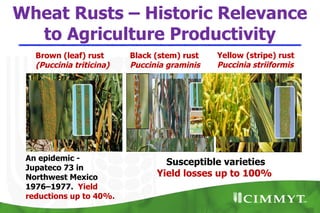
   Brown (leaf) rust      Black (stem) rust   Yellow (stripe) rust
   (Puccinia triticina)   Puccinia graminis   Puccinia striiformis


 An epidemic -
                                  Susceptible varieties
 Jupateco 73 in
 Northwest Mexico               Yield losses up to 100%
 1976–1977. Yield
 reductions up to 40%.
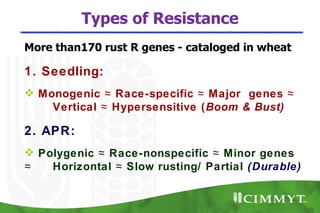
Types of Resistance
More than170 rust R genes - cataloged in wheat

1. Seedling:
 Monogenic ≈ Race-specific ≈ Major genes ≈
    Vertical ≈ Hypersensitive ( Boom & Bust)

2. APR:
 Polygenic ≈ Race-nonspecific ≈ Minor genes
≈   Horizontal ≈ Slow rusting/ Partial (Durable)
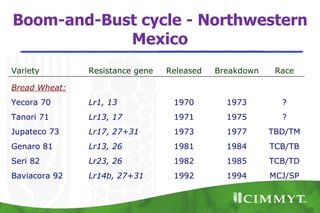
Boom-and-Bust cycle - Northwestern
            Mexico
Variety        Resistance gene   Released   Breakdown    Race

Bread Wheat:
Yecora 70      Lr1, 13            1970        1973        ?
Tanori 71      Lr13, 17           1971        1975        ?
Jupateco 73    Lr17, 27+31        1973        1977      TBD/TM
Genaro 81      Lr13, 26           1981        1984      TCB/TB
Seri 82        Lr23, 26           1982        1985      TCB/TD
Baviacora 92   Lr14b, 27+31       1992        1994      MCJ/SP
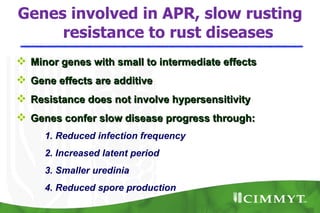
Genes involved in APR, slow rusting
     resistance to rust diseases
 Minor genes with small to intermediate effects
 Gene effects are additive
 Resistance does not involve hypersensitivity
 Genes confer slow disease progress through:
     1. Reduced infection frequency
     2. Increased latent period
     3. Smaller uredinia
     4. Reduced spore production
Durable Resistance

 Resistance which has remained effective in a
     cultivar during its widespread cultivation for
     a long sequence of generations or period of
     time in an environment favorable to a
disease or pest (Johnson 1988).

 Example: Frontana, Pavon 76, Parula, and
Chapio,
Identification and characterization of
          slow rusting resistance
● High or susceptible infection type in the seedling
  growth stage
● Lower disease severity or rate of disease progress
  in the field compared to susceptible check

 Brown rust: High (compatible) infection type in the field
 Yellow rust: Infection type not a reliable criteria due to
  systemic growth habit
 Stem rust: Variable size of pustules- bigger near nodes
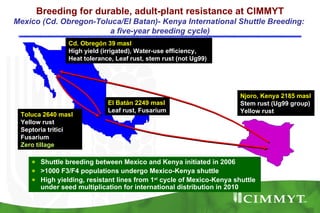
Breeding for durable, adult-plant resistance at CIMMYT
Mexico (Cd. Obregon-Toluca/El Batan)- Kenya International Shuttle Breeding:
                        a five-year breeding cycle)
               Cd. Obregón 39 masl
               High yield (irrigated), Water-use efficiency,
               Heat tolerance, Leaf rust, stem rust (not Ug99)


                                                                      Njoro, Kenya 2185 masl
                            El Batán 2249 masl                        Stem rust (Ug99 group)
                            Leaf rust, Fusarium                       Yellow rust
 Toluca 2640 masl
 Yellow rust
 Septoria tritici
 Fusarium
 Zero tillage

    ● Shuttle breeding between Mexico and Kenya initiated in 2006
    ● >1000 F3/F4 populations undergo Mexico-Kenya shuttle
    ● High yielding, resistant lines from 1st cycle of Mexico-Kenya shuttle
      under seed multiplication for international distribution in 2010
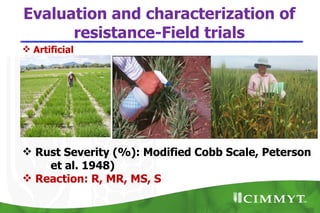
Evaluation and characterization of
      resistance-Field trials
 Artificial
epidemics


 Rust Severity (%): Modified Cobb Scale, Peterson
    et al. 1948)
 Reaction: R, MR, MS, S
Borlaug Global Rust Initiative
    A multi-institutional partnership for systematically
reducing vulnerability of global wheat crop to wheat rusts

Durable Rust Resistance in Wheat Project- Objectives
     Planning for the Threat of Emerging Wheat Rust Variants
     Advocating and Coordinating Global Cooperation
     Tracking Wheat Rust Pathogens
     Supporting Critical Rust Screening Facilities in East Africa
     Breeding to Produce Rust Resistant Varieties
     Developing and Optimizing Markers for Rust Resistance
     Reducing Linkage Drag
     Discovering New Sources of Rust Resistance
     Exploring Rice Immunity to Rust
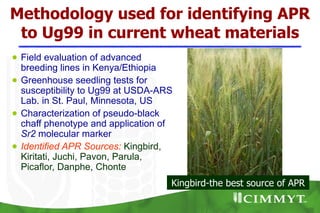
Methodology used for identifying APR
 to Ug99 in current wheat materials
● Field evaluation of advanced
  breeding lines in Kenya/Ethiopia
● Greenhouse seedling tests for
  susceptibility to Ug99 at USDA-ARS
  Lab. in St. Paul, Minnesota, US
● Characterization of pseudo-black
  chaff phenotype and application of
  Sr2 molecular marker
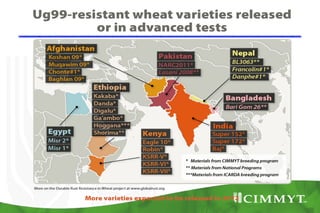
● Identified APR Sources: Kingbird,
  Kiritati, Juchi, Pavon, Parula,
  Picaflor, Danphe, Chonte
                                   Kingbird-the best source of APR
Genetic basis of resistance
 Evaluation of populations created from crosses:
   Susceptible parent X resistant parent
   Number resistance Number of genes conferring resistance

Resistant parent1 X Resistant parent2
        Allelism test
        Estimation of genetic diversitya

 Traditional Mendelian Segregation analysis

 Quantitative methods (formula for estimation of number of
genes determining a quantitative trait)
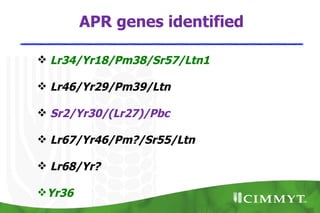
APR genes identified

 Lr34/Yr18/Pm38/Sr57/Ltn1

 Lr46/Yr29/Pm39/Ltn

 Sr2/Yr30/(Lr27)/Pbc

 Lr67/Yr46/Pm?/Sr55/Ltn

 Lr68/Yr?

Yr36
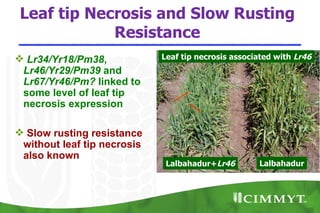
Leaf tip Necrosis and Slow Rusting
             Resistance
 Lr34/Yr18/Pm38,            Leaf tip necrosis associated with Lr46
 Lr46/Yr29/Pm39 and
 Lr67/Yr46/Pm? linked to
 some level of leaf tip
 necrosis expression

 Slow rusting resistance
 without leaf tip necrosis
 also known
                              Lalbahadur+Lr46        Lalbahadur
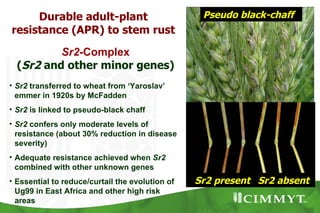
Durable adult-plant                          Pseudo black-chaff
resistance (APR) to stem rust
          Sr2-Complex
  (Sr2 and other minor genes)
• Sr2 transferred to wheat from ‘Yaroslav’
  emmer in 1920s by McFadden
• Sr2 is linked to pseudo-black chaff
• Sr2 confers only moderate levels of
  resistance (about 30% reduction in disease
  severity)
• Adequate resistance achieved when Sr2
  combined with other unknown genes
• Essential to reduce/curtail the evolution of   Sr2 present Sr2 absent
  Ug99 in East Africa and other high risk
  areas
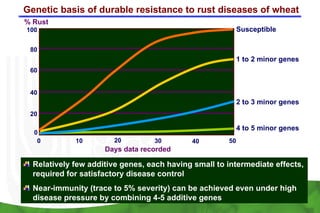
Genetic basis of durable resistance to rust diseases of wheat
% Rust
100                                                        Susceptible

 80
                                                           1 to 2 minor genes
 60


 40
                                                           2 to 3 minor genes
 20

                                                           4 to 5 minor genes
  0
   0         10        20         30        40        50
                     Days data recorded

  Relatively few additive genes, each having small to intermediate effects,
  required for satisfactory disease control
  Near-immunity (trace to 5% severity) can be achieved even under high
  disease pressure by combining 4-5 additive genes
Methodology
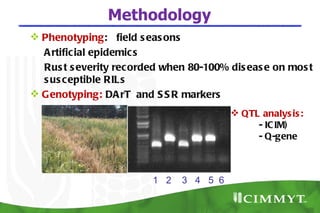
 Phenotyping: field s eas ons
  A rtificial epidemic s
  Rus t s everity rec orded when 80-100% dis eas e on mos t
  s us ceptible RILs
 G enotyping: DA rT and S S R markers
                                          QTL analys is :
                                              - IC IM)
                                              - Q-gene


                         1 2   3 4 5 6
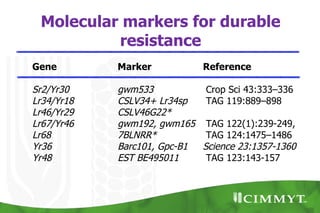
Molecular markers for durable
          resistance
Gene        Marker           Reference

Sr2/Yr30    gwm533           Crop Sci 43:333–336
Lr34/Yr18   CSLV34+ Lr34sp   TAG 119:889–898
Lr46/Yr29   CSLV46G22*
Lr67/Yr46   gwm192, gwm165 TAG 122(1):239-249,
Lr68        7BLNRR*          TAG 124:1475–1486
Yr36        Barc101, Gpc-B1 Science 23:1357-1360
Yr48        EST BE495011     TAG 123:143-157
Advances in Molecular Mapping of Slow
        Rusting Resistance Genes
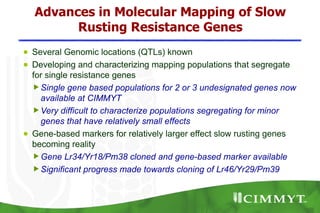
● Several Genomic locations (QTLs) known
● Developing and characterizing mapping populations that segregate
  for single resistance genes
   Single gene based populations for 2 or 3 undesignated genes now
    available at CIMMYT
   Very difficult to characterize populations segregating for minor
    genes that have relatively small effects
● Gene-based markers for relatively larger effect slow rusting genes
  becoming reality
   Gene Lr34/Yr18/Pm38 cloned and gene-based marker available
   Significant progress made towards cloning of Lr46/Yr29/Pm39
Cloning rust resistance genes in
                wheat
Understanding the structure of the genes and function of proteins

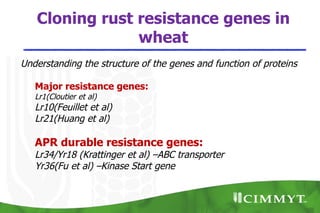
   Major resistance genes:
   Lr1(Cloutier et al)
   Lr10(Feuillet et al)
   Lr21(Huang et al)

   APR durable resistance genes:
   Lr34/Yr18 (Krattinger et al) –ABC transporter
   Yr36(Fu et al) –Kinase Start gene
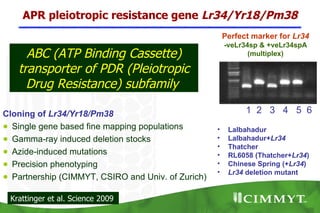
APR pleiotropic resistance gene Lr34/Yr18/Pm38
                                                        Perfect marker for Lr34
                                                        -veLr34sp & +veLr34spA
     ABC (ATP Binding Cassette)                                (multiplex)

   transporter of PDR (Pleiotropic
     Drug Resistance) subfamily

Cloning of Lr34/Yr18/Pm38                                     1 2 3 4 5 6
● Single gene based fine mapping populations        •    Lalbahadur
● Gamma-ray induced deletion stocks                 •    Lalbahadur+Lr34
                                                    •    Thatcher
● Azide-induced mutations                           •    RL6058 (Thatcher+Lr34)
● Precision phenotyping                             •    Chinese Spring (+Lr34)
                                                    •    Lr34 deletion mutant
● Partnership (CIMMYT, CSIRO and Univ. of Zurich)

 Krattinger et al. Science 2009
Acknowledgement

DRRW : BGRI         GWP at CIMMYT
(Bill and Melinda   Eric Eugenio Lopez’s
Gates Foundation)   Sybil Herrera-
                    Foessel
Syngenta            Pawan K. Singh
Foundation          Velu Govindan
        Thank you

Advances in the research to achieve resistance to wheat rusts

  • 1.
    Advances in theResearch to Achieve Resistance to Wheat Rusts Sukhwinder-Singh, Ravi Singh, Julio Huerta, Sridhar Bhavani and Sybil Herrera Global Wheat Program, CIMMYT
  • 2.
    Outline of thePresentation  Introduction  Background on resistance to wheat rusts  Characterization of resistance  Utilization of APR  Mapping/ QTL analysis
  • 3.
    Present (2011) vs.Future (2025)  P o p u la t io n 6 . 8 b illio n 8 . 5 b illio n  C onc e rn lim it e d r e s o u r c e s e ne rg y a nd e n v ir o n m e n t a l c o n s u m e r p re fe re nc e  C rop a re a L im it e d s c o p e o f i nl a n te b rse e d i n g i n t h i s n e w e r a s h o u l d P c r a e b e m o r e d i v e r s i fPerd s s u r e o n l a n d w i l l i e iP l a nrt e a ese e i n g nc Br d N e w t o o ls o f b io lo g y
  • 4.
    Wheat Research Efforts– CIMMYT  Increase wheat productivity - genetic gain  Protection – biotic and abiotic stresses (estimated global losses due to pathogen in wheat is 13 billion dollar (~12%) Simultaneously evaluating for Yield (Y) and Stress Tolerant (ST)
  • 5.
    Wheat Rusts –Historic Relevance to Agriculture Productivity Brown (leaf) rust Black (stem) rust Yellow (stripe) rust (Puccinia triticina) Puccinia graminis Puccinia striiformis An epidemic - Susceptible varieties Jupateco 73 in Northwest Mexico Yield losses up to 100% 1976–1977. Yield reductions up to 40%.
  • 6.
    Types of Resistance Morethan170 rust R genes - cataloged in wheat 1. Seedling:  Monogenic ≈ Race-specific ≈ Major genes ≈ Vertical ≈ Hypersensitive ( Boom & Bust) 2. APR:  Polygenic ≈ Race-nonspecific ≈ Minor genes ≈ Horizontal ≈ Slow rusting/ Partial (Durable)
  • 7.
    Boom-and-Bust cycle -Northwestern Mexico Variety Resistance gene Released Breakdown Race Bread Wheat: Yecora 70 Lr1, 13 1970 1973 ? Tanori 71 Lr13, 17 1971 1975 ? Jupateco 73 Lr17, 27+31 1973 1977 TBD/TM Genaro 81 Lr13, 26 1981 1984 TCB/TB Seri 82 Lr23, 26 1982 1985 TCB/TD Baviacora 92 Lr14b, 27+31 1992 1994 MCJ/SP
  • 8.
    Genes involved inAPR, slow rusting resistance to rust diseases  Minor genes with small to intermediate effects  Gene effects are additive  Resistance does not involve hypersensitivity  Genes confer slow disease progress through: 1. Reduced infection frequency 2. Increased latent period 3. Smaller uredinia 4. Reduced spore production
  • 9.
    Durable Resistance  Resistancewhich has remained effective in a cultivar during its widespread cultivation for a long sequence of generations or period of time in an environment favorable to a disease or pest (Johnson 1988).  Example: Frontana, Pavon 76, Parula, and Chapio,
  • 10.
    Identification and characterizationof slow rusting resistance ● High or susceptible infection type in the seedling growth stage ● Lower disease severity or rate of disease progress in the field compared to susceptible check Brown rust: High (compatible) infection type in the field Yellow rust: Infection type not a reliable criteria due to systemic growth habit Stem rust: Variable size of pustules- bigger near nodes
  • 11.
    Breeding for durable,adult-plant resistance at CIMMYT Mexico (Cd. Obregon-Toluca/El Batan)- Kenya International Shuttle Breeding: a five-year breeding cycle) Cd. Obregón 39 masl High yield (irrigated), Water-use efficiency, Heat tolerance, Leaf rust, stem rust (not Ug99) Njoro, Kenya 2185 masl El Batán 2249 masl Stem rust (Ug99 group) Leaf rust, Fusarium Yellow rust Toluca 2640 masl Yellow rust Septoria tritici Fusarium Zero tillage ● Shuttle breeding between Mexico and Kenya initiated in 2006 ● >1000 F3/F4 populations undergo Mexico-Kenya shuttle ● High yielding, resistant lines from 1st cycle of Mexico-Kenya shuttle under seed multiplication for international distribution in 2010
  • 12.
    Evaluation and characterizationof resistance-Field trials  Artificial epidemics  Rust Severity (%): Modified Cobb Scale, Peterson et al. 1948)  Reaction: R, MR, MS, S
  • 14.
    Borlaug Global RustInitiative A multi-institutional partnership for systematically reducing vulnerability of global wheat crop to wheat rusts Durable Rust Resistance in Wheat Project- Objectives  Planning for the Threat of Emerging Wheat Rust Variants  Advocating and Coordinating Global Cooperation  Tracking Wheat Rust Pathogens  Supporting Critical Rust Screening Facilities in East Africa  Breeding to Produce Rust Resistant Varieties  Developing and Optimizing Markers for Rust Resistance  Reducing Linkage Drag  Discovering New Sources of Rust Resistance  Exploring Rice Immunity to Rust
  • 15.
    Methodology used foridentifying APR to Ug99 in current wheat materials ● Field evaluation of advanced breeding lines in Kenya/Ethiopia ● Greenhouse seedling tests for susceptibility to Ug99 at USDA-ARS Lab. in St. Paul, Minnesota, US ● Characterization of pseudo-black chaff phenotype and application of Sr2 molecular marker ● Identified APR Sources: Kingbird, Kiritati, Juchi, Pavon, Parula, Picaflor, Danphe, Chonte Kingbird-the best source of APR
  • 16.
    Genetic basis ofresistance  Evaluation of populations created from crosses: Susceptible parent X resistant parent Number resistance Number of genes conferring resistance Resistant parent1 X Resistant parent2 Allelism test Estimation of genetic diversitya  Traditional Mendelian Segregation analysis  Quantitative methods (formula for estimation of number of genes determining a quantitative trait)
  • 17.
    APR genes identified Lr34/Yr18/Pm38/Sr57/Ltn1  Lr46/Yr29/Pm39/Ltn  Sr2/Yr30/(Lr27)/Pbc  Lr67/Yr46/Pm?/Sr55/Ltn  Lr68/Yr? Yr36
  • 18.
    Leaf tip Necrosisand Slow Rusting Resistance  Lr34/Yr18/Pm38, Leaf tip necrosis associated with Lr46 Lr46/Yr29/Pm39 and Lr67/Yr46/Pm? linked to some level of leaf tip necrosis expression  Slow rusting resistance without leaf tip necrosis also known Lalbahadur+Lr46 Lalbahadur
  • 19.
    Durable adult-plant Pseudo black-chaff resistance (APR) to stem rust Sr2-Complex (Sr2 and other minor genes) • Sr2 transferred to wheat from ‘Yaroslav’ emmer in 1920s by McFadden • Sr2 is linked to pseudo-black chaff • Sr2 confers only moderate levels of resistance (about 30% reduction in disease severity) • Adequate resistance achieved when Sr2 combined with other unknown genes • Essential to reduce/curtail the evolution of Sr2 present Sr2 absent Ug99 in East Africa and other high risk areas
  • 20.
    Genetic basis ofdurable resistance to rust diseases of wheat % Rust 100 Susceptible 80 1 to 2 minor genes 60 40 2 to 3 minor genes 20 4 to 5 minor genes 0 0 10 20 30 40 50 Days data recorded Relatively few additive genes, each having small to intermediate effects, required for satisfactory disease control Near-immunity (trace to 5% severity) can be achieved even under high disease pressure by combining 4-5 additive genes
  • 21.
    Methodology  Phenotyping: fields eas ons A rtificial epidemic s Rus t s everity rec orded when 80-100% dis eas e on mos t s us ceptible RILs  G enotyping: DA rT and S S R markers  QTL analys is : - IC IM) - Q-gene 1 2 3 4 5 6
  • 22.
    Molecular markers fordurable resistance Gene Marker Reference Sr2/Yr30 gwm533 Crop Sci 43:333–336 Lr34/Yr18 CSLV34+ Lr34sp TAG 119:889–898 Lr46/Yr29 CSLV46G22* Lr67/Yr46 gwm192, gwm165 TAG 122(1):239-249, Lr68 7BLNRR* TAG 124:1475–1486 Yr36 Barc101, Gpc-B1 Science 23:1357-1360 Yr48 EST BE495011 TAG 123:143-157
  • 23.
    Advances in MolecularMapping of Slow Rusting Resistance Genes ● Several Genomic locations (QTLs) known ● Developing and characterizing mapping populations that segregate for single resistance genes  Single gene based populations for 2 or 3 undesignated genes now available at CIMMYT  Very difficult to characterize populations segregating for minor genes that have relatively small effects ● Gene-based markers for relatively larger effect slow rusting genes becoming reality  Gene Lr34/Yr18/Pm38 cloned and gene-based marker available  Significant progress made towards cloning of Lr46/Yr29/Pm39
  • 24.
    Cloning rust resistancegenes in wheat Understanding the structure of the genes and function of proteins Major resistance genes: Lr1(Cloutier et al) Lr10(Feuillet et al) Lr21(Huang et al) APR durable resistance genes: Lr34/Yr18 (Krattinger et al) –ABC transporter Yr36(Fu et al) –Kinase Start gene
  • 25.
    APR pleiotropic resistancegene Lr34/Yr18/Pm38 Perfect marker for Lr34 -veLr34sp & +veLr34spA ABC (ATP Binding Cassette) (multiplex) transporter of PDR (Pleiotropic Drug Resistance) subfamily Cloning of Lr34/Yr18/Pm38 1 2 3 4 5 6 ● Single gene based fine mapping populations • Lalbahadur ● Gamma-ray induced deletion stocks • Lalbahadur+Lr34 • Thatcher ● Azide-induced mutations • RL6058 (Thatcher+Lr34) ● Precision phenotyping • Chinese Spring (+Lr34) • Lr34 deletion mutant ● Partnership (CIMMYT, CSIRO and Univ. of Zurich) Krattinger et al. Science 2009
  • 27.
    Acknowledgement DRRW : BGRI GWP at CIMMYT (Bill and Melinda Eric Eugenio Lopez’s Gates Foundation) Sybil Herrera- Foessel Syngenta Pawan K. Singh Foundation Velu Govindan Thank you

Editor's Notes

  • #4 Bread wheat provides ~20% of the calories consumed by humankind. The increasing world demand, limite resources, climate changing ------- improve strategies to increase genetic gain (yield) and also to reduce yield lossess due to pathogens 06/28/12
  • #5 improve strategies to increase genetic gain (yield) and also to reduce yield lossess due to pathogens More than160 resistance genes that confer resistance to rusts of wheat have been cataloged in wheat or introgressed into wheat from related species. These genes in wheat fall under two broad categories and are referred to as seedling and adult plant resistance (APR) genes. Seedling resistance genes are detected during both the seedling and adult plant stages and as such constitute an all stage resistance phenotype. APR is commonly detected at the post-seedling stage and often as field resistance. A large proportion of seedling resistance genes exhibit phenotypes of major effect and with varying infection types whereas most of the APR genes are partial in effect with varying levels of disease severity. 06/28/12
  • #6 Wheat rusts affects million of hectares of wheat and virulent races that have appeared within past decade are casuing large yile losses. Wheat rusts are prominent in their historic relevance to agriculture productivity More than160 resistance genes that confer resistance to rusts of wheat have been cataloged in wheat or introgressed into wheat from related species. These genes in wheat fall under two broad categories and are referred to as seedling and adult plant resistance (APR) genes. Seedling resistance genes are detected during both the seedling and adult plant stages and as such constitute an all stage resistance phenotype. APR is commonly detected at the post-seedling stage and often as field resistance. A large proportion of seedling resistance genes exhibit phenotypes of major effect and with varying infection types whereas most of the APR genes are partial in effect with varying levels of disease severity. 06/28/12
  • #8 Boom-and-Bust”: Race-Specific Genes for leaf rust resistance in Northwestern Mexico 06/28/12
  • #10 06/28/12
  • #12 06/28/12
  • #20 06/28/12 The top priority at CIMMYT is to restore the “Sr2 gene complex”, i.e., select slow rusting gene Sr2 in combination with other yet unidentified minor genes.
  • #21 06/28/12 This figure shows the relationship between number of minor genes and rust progress in field trials. It is likely that 4 to 5 minor genes will be necessary to retard the rust progress to non-significant levels.