

Diseases resistance
The inherent ability of crop plants to resist
or withstand the pathogen is called
resistance.
Gene-for-Gene Hypothesis
Proposed by Flor (1956)-study on flax rust
“For each resistance gene in the plant there is
a gene in the pathogen that determines if the
pathogen will be able to injure the plant.”
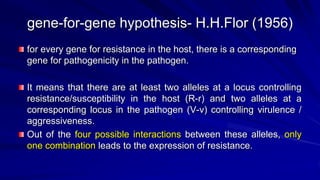
gene-for-gene hypothesis- H.H.Flor (1956)
for every gene for resistance in the host, there is a corresponding
gene for pathogenicity in the pathogen.
It means that there are at least two alleles at a locus controlling
resistance/susceptibility in the host (R-r) and two alleles at a
corresponding locus in the pathogen (V-v) controlling virulence /
aggressiveness.
Out of the four possible interactions between these alleles, only
one combination leads to the expression of resistance.
Virulence or
avirulence
genes in
pathogen
R (resistant,
dominant)
R
(susceptible,
recessive)
A dominant AR (-) Ar (+)
a recessive aR (+) Ar (+)
Gene combinations and Disease Reaction
Types in the Gene for Gene concept
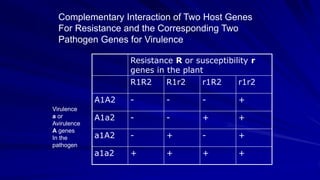
Resistance R or susceptibility r
genes in the plant
R1R2 R1r2 r1R2 r1r2
A1A2 - - - +
A1a2 - - + +
a1A2 - + - +
a1a2 + + + +
Virulence
a or
Avirulence
A genes
In the
pathogen
Complementary Interaction of Two Host Genes
For Resistance and the Corresponding Two
Pathogen Genes for Virulence
Resistance- Van der Plank (1960)
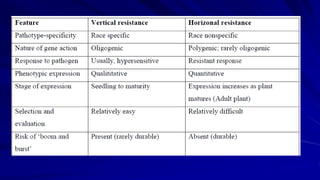
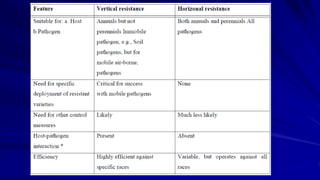
Vertical Resistance :
If plants are resistance to some races of a pathogen is more than to other
races.
Horizontal Resistance:
Resistance to more than one race of the pathogen or to many or all races
of the pathogen.
Vertical resistance
It is also called Perpendicular resistance, Physiological resistance,
seedling resistance, hypersensitivity, race specific resistance or
qualitative resistance.
As it is conditioned by one or a few genes, it is called major gene
or monogenic of oligogenic resistance.
 Controlled by major genes (one or two)
 Genes are readily transferred from one genotype to another
 Presence of genes can be determined by exposing plants to
particular races
 Leaf Rust Resistance in Wheat
Qualitative Resistance
Advantages
Easier screenings
Easier transfer of genes “all or nothing”
Disadvantages
Vulnerability to new races
Continuous use of particular cultivar may lead to development of
new race or shift in pest population (shift from race 1 to race 2)
Horizontal resistance
It is non-specific resistance governed by polygenes. It is
severally termed as non-specific, general, polygenic, minor
gene, mature plant, adult, quantitative resistance, partial or
field resistance or tolerance.
Fusarium head blight in wheat.
Quantitative Resistance
Controlled by many genes each with minor effects
Advantages
 Can control a broad range of races due to the fact that many loci are
involved
Disadvantages
 Difficult to transfer resistance from one genotype to another
 Individual genes harder to identify
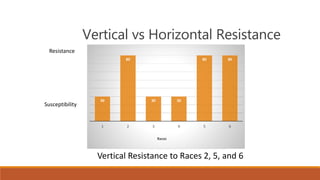
Vertical vs Horizontal Resistance
30
80
30 30
80 80
1 2 3 4 5 6
Races
Resistance
Susceptibility
Vertical Resistance to Races 2, 5, and 6
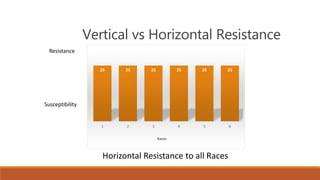
Vertical vs Horizontal Resistance
25 25 25 25 25 25
1 2 3 4 5 6
Races
Resistance
Susceptibility
Horizontal Resistance to all Races
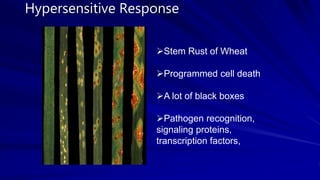
Hypersensitive Response
Stem Rust of Wheat
Programmed cell death
A lot of black boxes
Pathogen recognition,
signaling proteins,
transcription factors,
Sources of Resistance
Primary Gene Pool
Other breeding programs
Landraces
Germplasm collections (GRIN)
Wild Relatives
Tomato: Lycopersicon genus
Wheat: Agropyron genus
Aegilops tauschii, Triticum monococum
Mutant Transformations: powdery mildew in Barley
Breeding methods for diseases resistance variety
1. Introduction
2. Selection
3. Hybridization followed by selection,
4. Back cross method,
5. Induced mutagenesis,
6. Development of multilines ,
7. Tissue culture techniques

Plant diseasesresistance

  • 1.
    Diseases resistance The inherentability of crop plants to resist or withstand the pathogen is called resistance.
  • 2.
    Gene-for-Gene Hypothesis Proposed byFlor (1956)-study on flax rust “For each resistance gene in the plant there is a gene in the pathogen that determines if the pathogen will be able to injure the plant.”
  • 3.
    gene-for-gene hypothesis- H.H.Flor(1956) for every gene for resistance in the host, there is a corresponding gene for pathogenicity in the pathogen. It means that there are at least two alleles at a locus controlling resistance/susceptibility in the host (R-r) and two alleles at a corresponding locus in the pathogen (V-v) controlling virulence / aggressiveness. Out of the four possible interactions between these alleles, only one combination leads to the expression of resistance.
  • 5.
    Virulence or avirulence genes in pathogen R(resistant, dominant) R (susceptible, recessive) A dominant AR (-) Ar (+) a recessive aR (+) Ar (+) Gene combinations and Disease Reaction Types in the Gene for Gene concept
  • 6.
    Resistance R orsusceptibility r genes in the plant R1R2 R1r2 r1R2 r1r2 A1A2 - - - + A1a2 - - + + a1A2 - + - + a1a2 + + + + Virulence a or Avirulence A genes In the pathogen Complementary Interaction of Two Host Genes For Resistance and the Corresponding Two Pathogen Genes for Virulence
  • 7.
    Resistance- Van derPlank (1960) Vertical Resistance : If plants are resistance to some races of a pathogen is more than to other races. Horizontal Resistance: Resistance to more than one race of the pathogen or to many or all races of the pathogen.
  • 8.
    Vertical resistance It isalso called Perpendicular resistance, Physiological resistance, seedling resistance, hypersensitivity, race specific resistance or qualitative resistance. As it is conditioned by one or a few genes, it is called major gene or monogenic of oligogenic resistance.  Controlled by major genes (one or two)  Genes are readily transferred from one genotype to another  Presence of genes can be determined by exposing plants to particular races  Leaf Rust Resistance in Wheat
  • 9.
    Qualitative Resistance Advantages Easier screenings Easiertransfer of genes “all or nothing” Disadvantages Vulnerability to new races Continuous use of particular cultivar may lead to development of new race or shift in pest population (shift from race 1 to race 2)
  • 10.
    Horizontal resistance It isnon-specific resistance governed by polygenes. It is severally termed as non-specific, general, polygenic, minor gene, mature plant, adult, quantitative resistance, partial or field resistance or tolerance. Fusarium head blight in wheat.
  • 11.
    Quantitative Resistance Controlled bymany genes each with minor effects Advantages  Can control a broad range of races due to the fact that many loci are involved Disadvantages  Difficult to transfer resistance from one genotype to another  Individual genes harder to identify
  • 12.
    Vertical vs HorizontalResistance 30 80 30 30 80 80 1 2 3 4 5 6 Races Resistance Susceptibility Vertical Resistance to Races 2, 5, and 6
  • 13.
    Vertical vs HorizontalResistance 25 25 25 25 25 25 1 2 3 4 5 6 Races Resistance Susceptibility Horizontal Resistance to all Races
  • 14.
    Hypersensitive Response Stem Rustof Wheat Programmed cell death A lot of black boxes Pathogen recognition, signaling proteins, transcription factors,
  • 17.
    Sources of Resistance PrimaryGene Pool Other breeding programs Landraces Germplasm collections (GRIN) Wild Relatives Tomato: Lycopersicon genus Wheat: Agropyron genus Aegilops tauschii, Triticum monococum Mutant Transformations: powdery mildew in Barley
  • 18.
    Breeding methods fordiseases resistance variety 1. Introduction 2. Selection 3. Hybridization followed by selection, 4. Back cross method, 5. Induced mutagenesis, 6. Development of multilines , 7. Tissue culture techniques