Genomic and enabling technologies
in maize breeding for enhanced
genetic gains in the tropics
Sudha Nair, Raman Babu, Prasanna BM
08-10-2018
13th AMC, Ludhiana
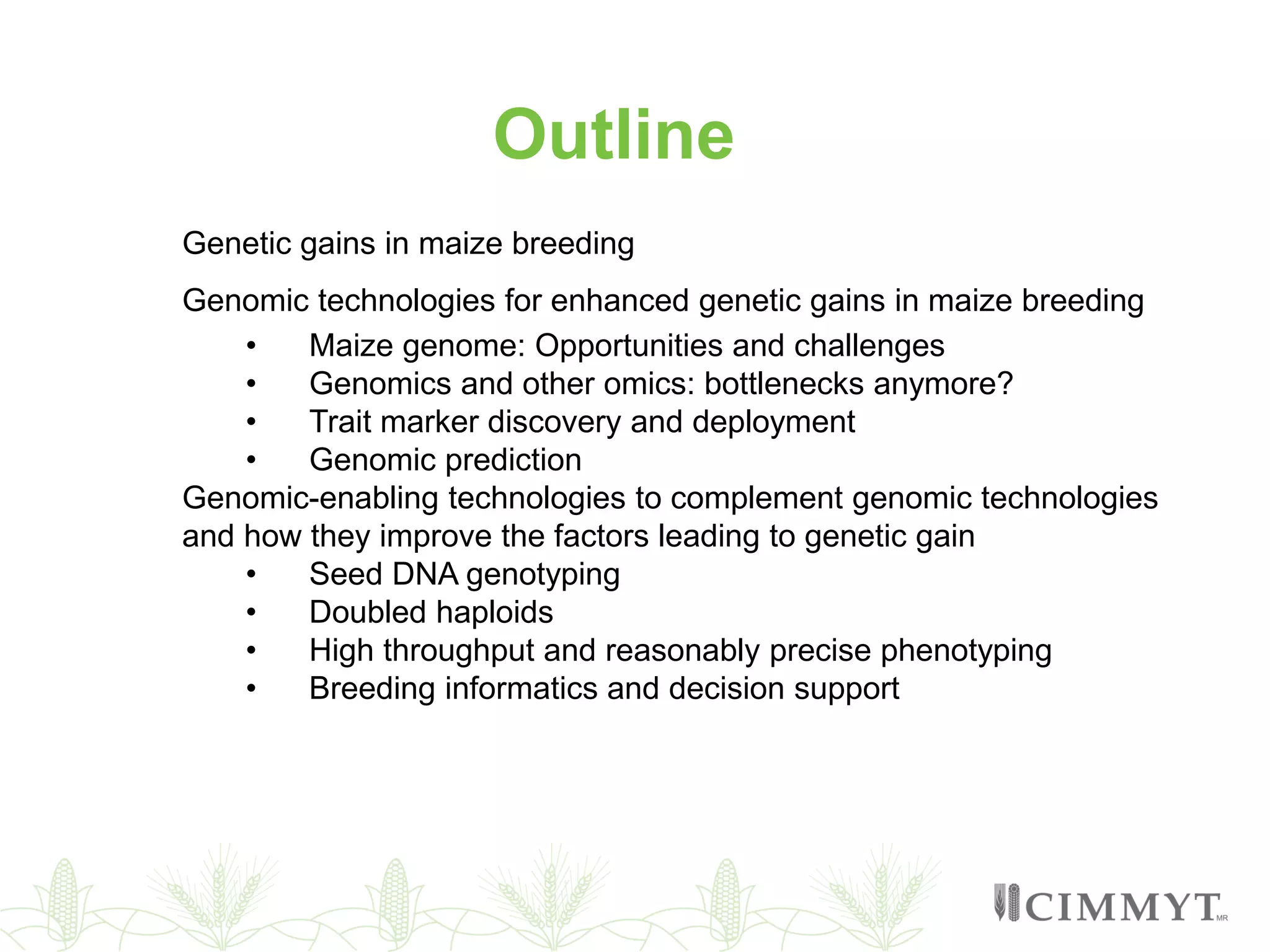
Outline
Genetic gains in maize breeding
Genomic technologies for enhanced genetic gains in maize breeding
• Maize genome: Opportunities and challenges
• Genomics and other omics: bottlenecks anymore?
• Trait marker discovery and deployment
• Genomic prediction
Genomic-enabling technologies to complement genomic technologies
and how they improve the factors leading to genetic gain
• Seed DNA genotyping
• Doubled haploids
• High throughput and reasonably precise phenotyping
• Breeding informatics and decision support
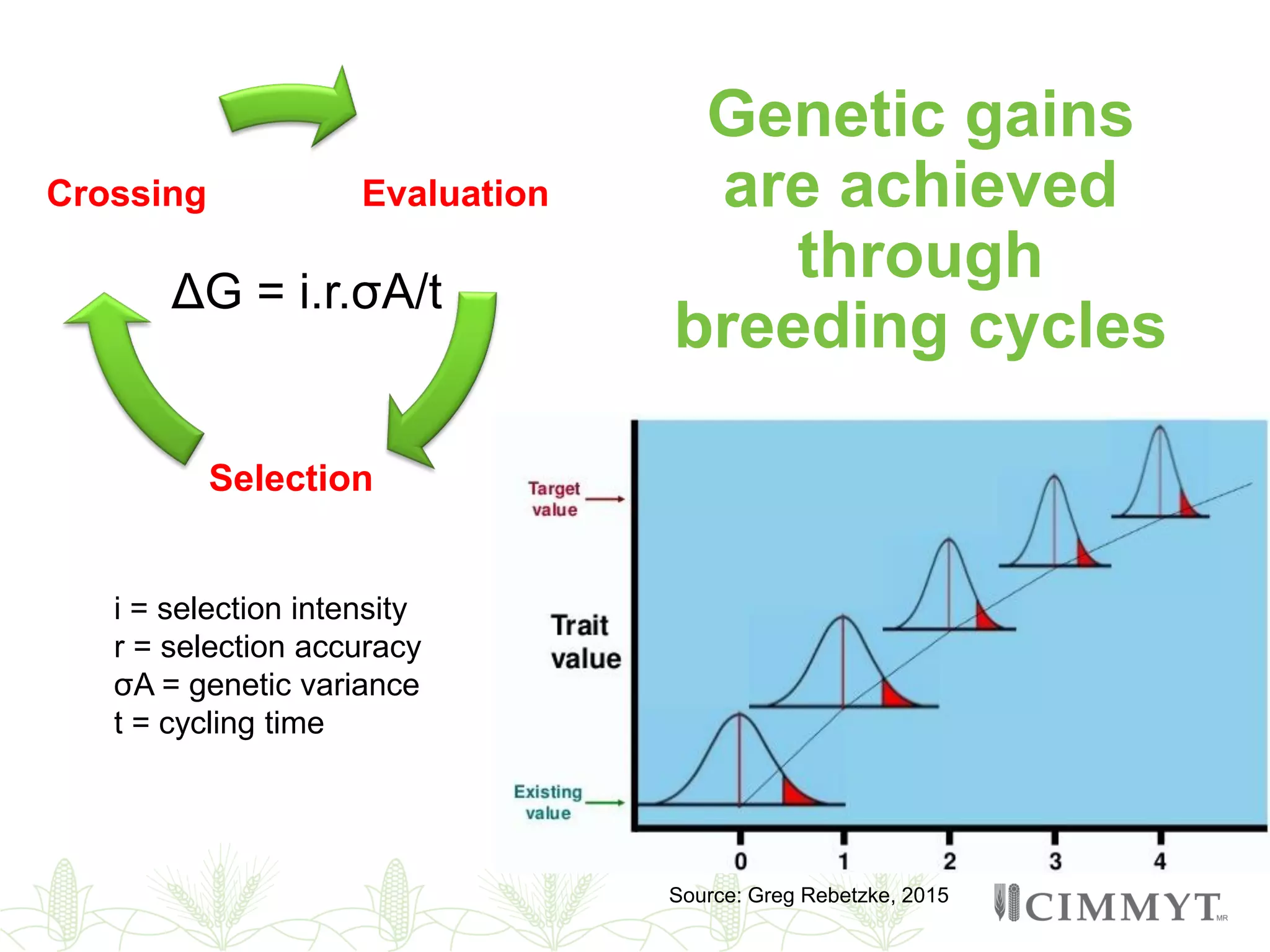
Evaluation
Selection
Crossing
Source: Greg Rebetzke, 2015
ΔG = i.r.σA/t
i = selection intensity
r = selection accuracy
σA = genetic variance
t = cycling time
Genetic gains
are achieved
through
breeding cycles
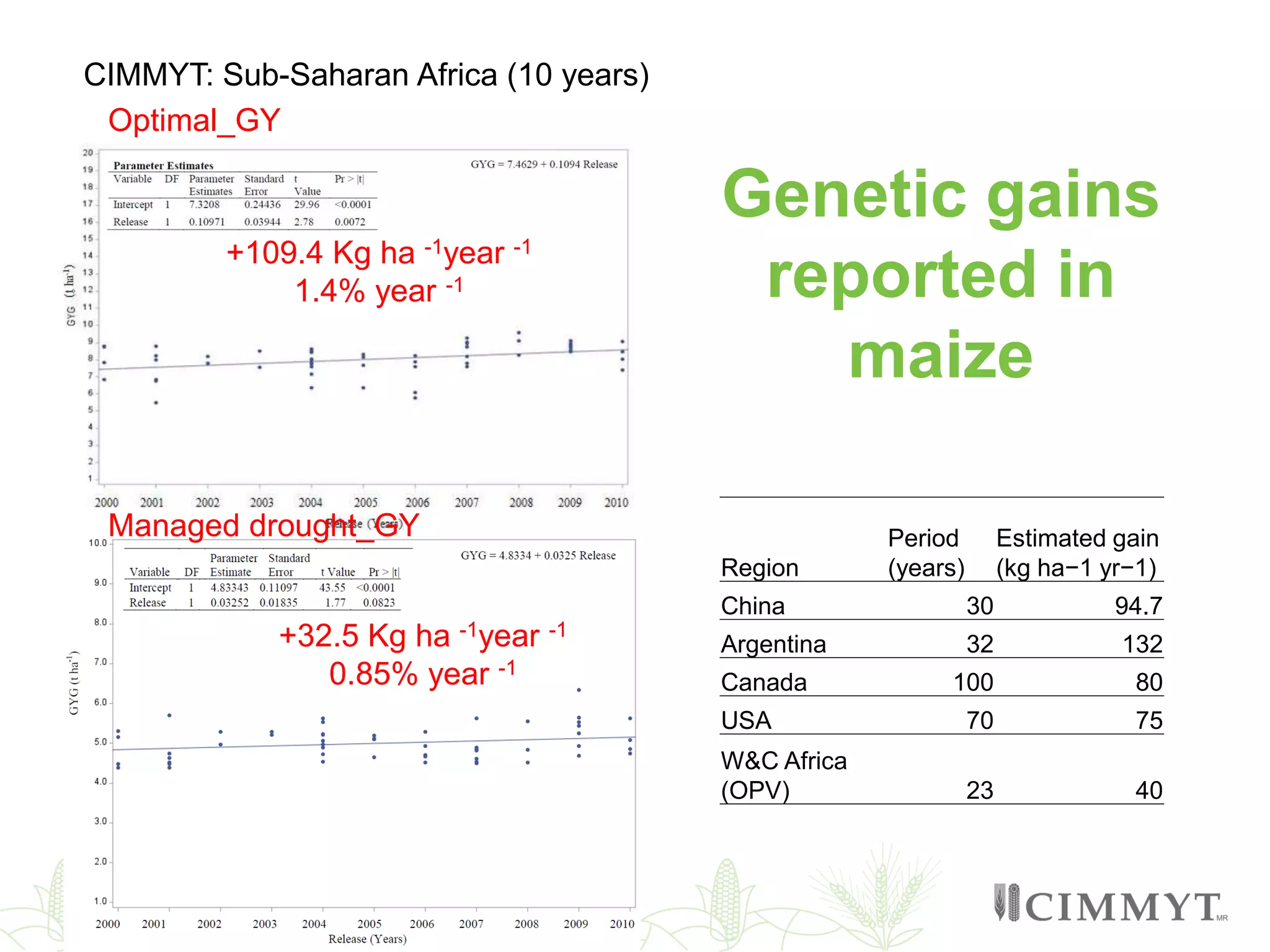
Genetic gains
reported in
maize
+109.4 Kg ha -1year -1
1.4% year -1
+32.5 Kg ha -1year -1
0.85% year -1
Optimal_GY
Managed drought_GY
Region
Period
(years)
Estimated gain
(kg ha−1 yr−1)
China 30 94.7
Argentina 32 132
Canada 100 80
USA 70 75
W&C Africa
(OPV) 23 40
CIMMYT: Sub-Saharan Africa (10 years)
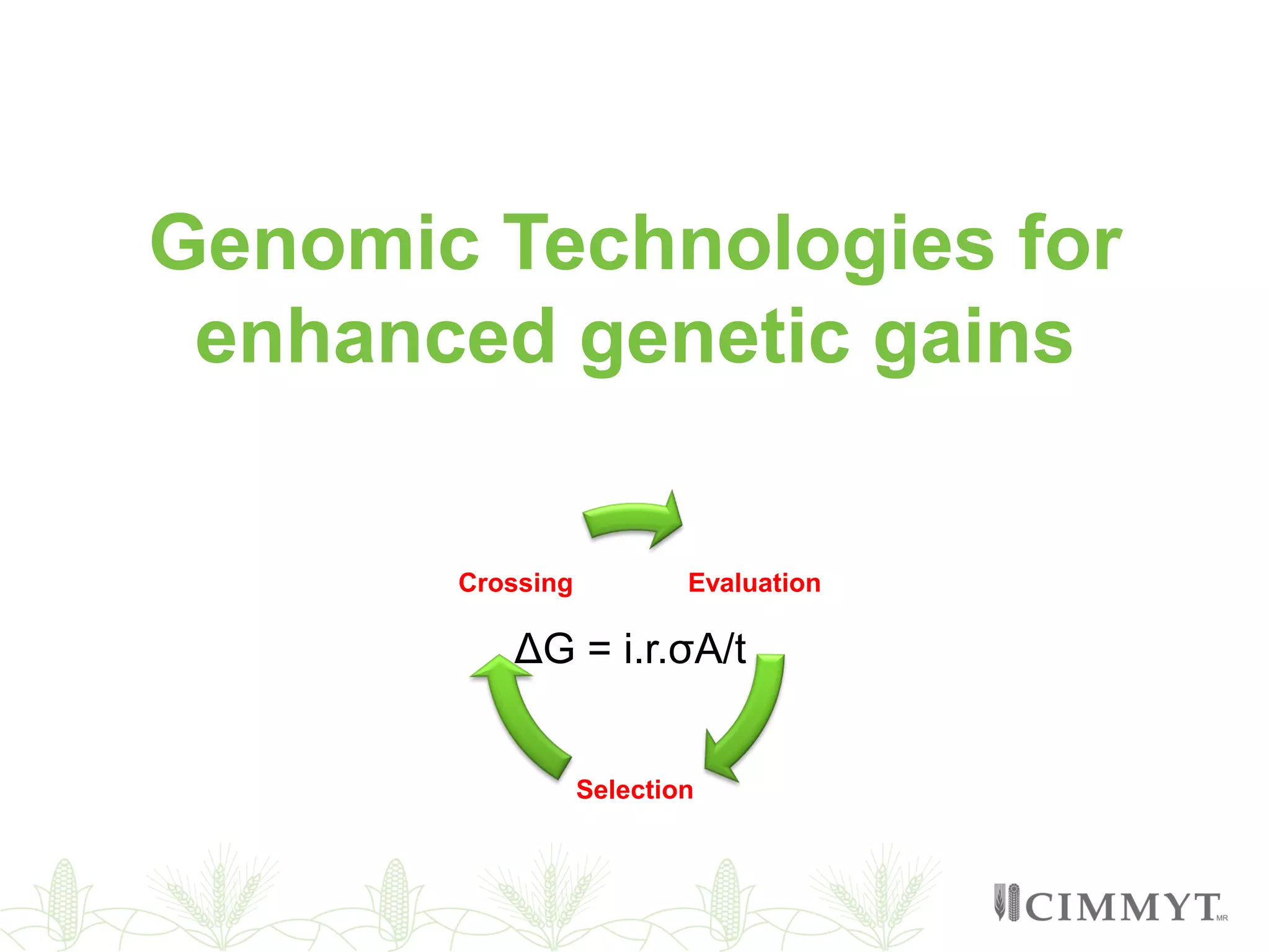
Genomic Technologies for
enhanced genetic gains
Evaluation
Selection
Crossing
ΔG = i.r.σA/t
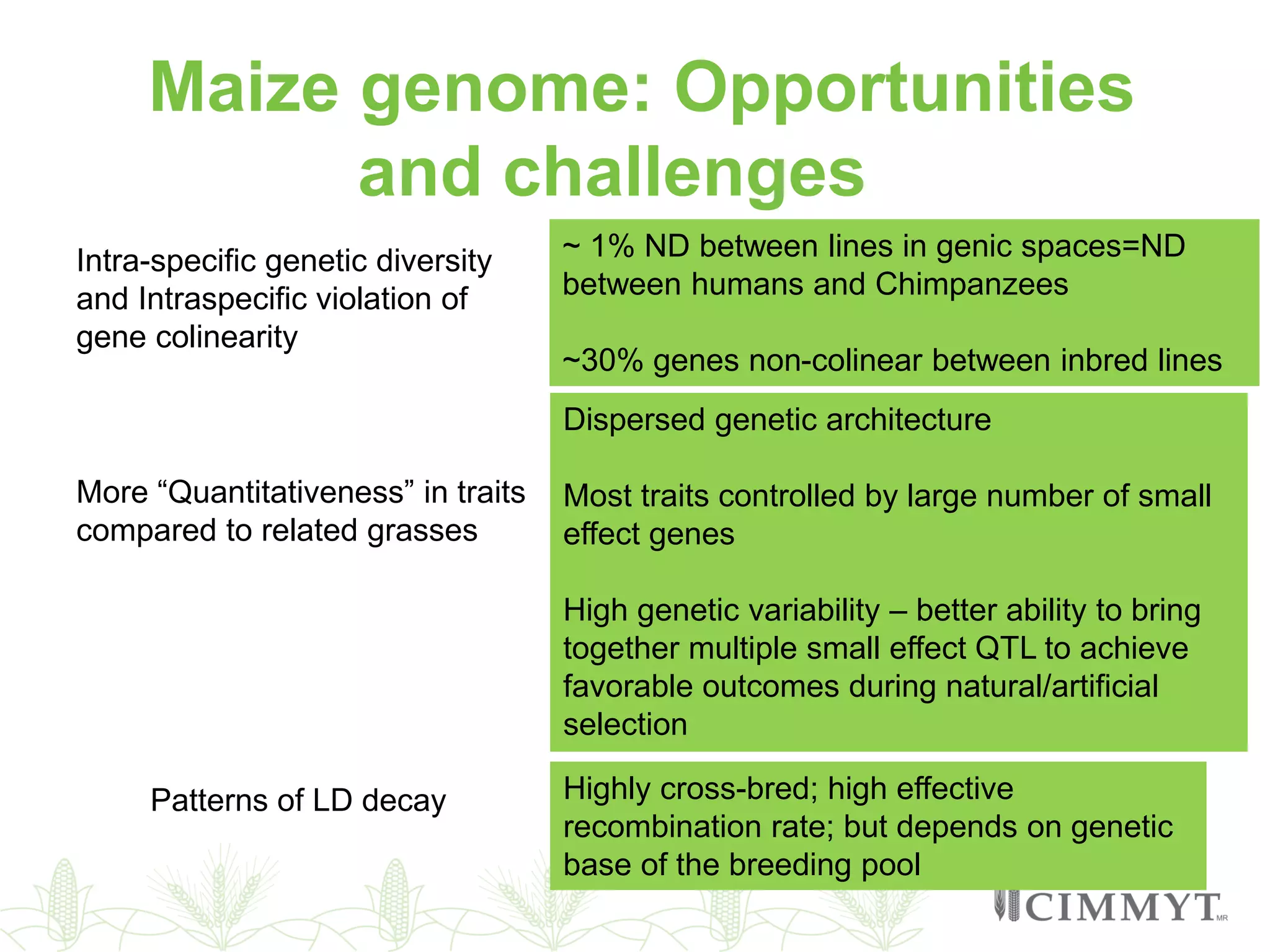
Maize genome: Opportunities
and challenges a
More “Quantitativeness” in traits
compared to related grasses
Dispersed genetic architecture
Most traits controlled by large number of small
effect genes
High genetic variability – better ability to bring
together multiple small effect QTL to achieve
favorable outcomes during natural/artificial
selection
Intra-specific genetic diversity
and Intraspecific violation of
gene colinearity
~ 1% ND between lines in genic spaces=ND
between humans and Chimpanzees
~30% genes non-colinear between inbred lines
Patterns of LD decay Highly cross-bred; high effective
recombination rate; but depends on genetic
base of the breeding pool
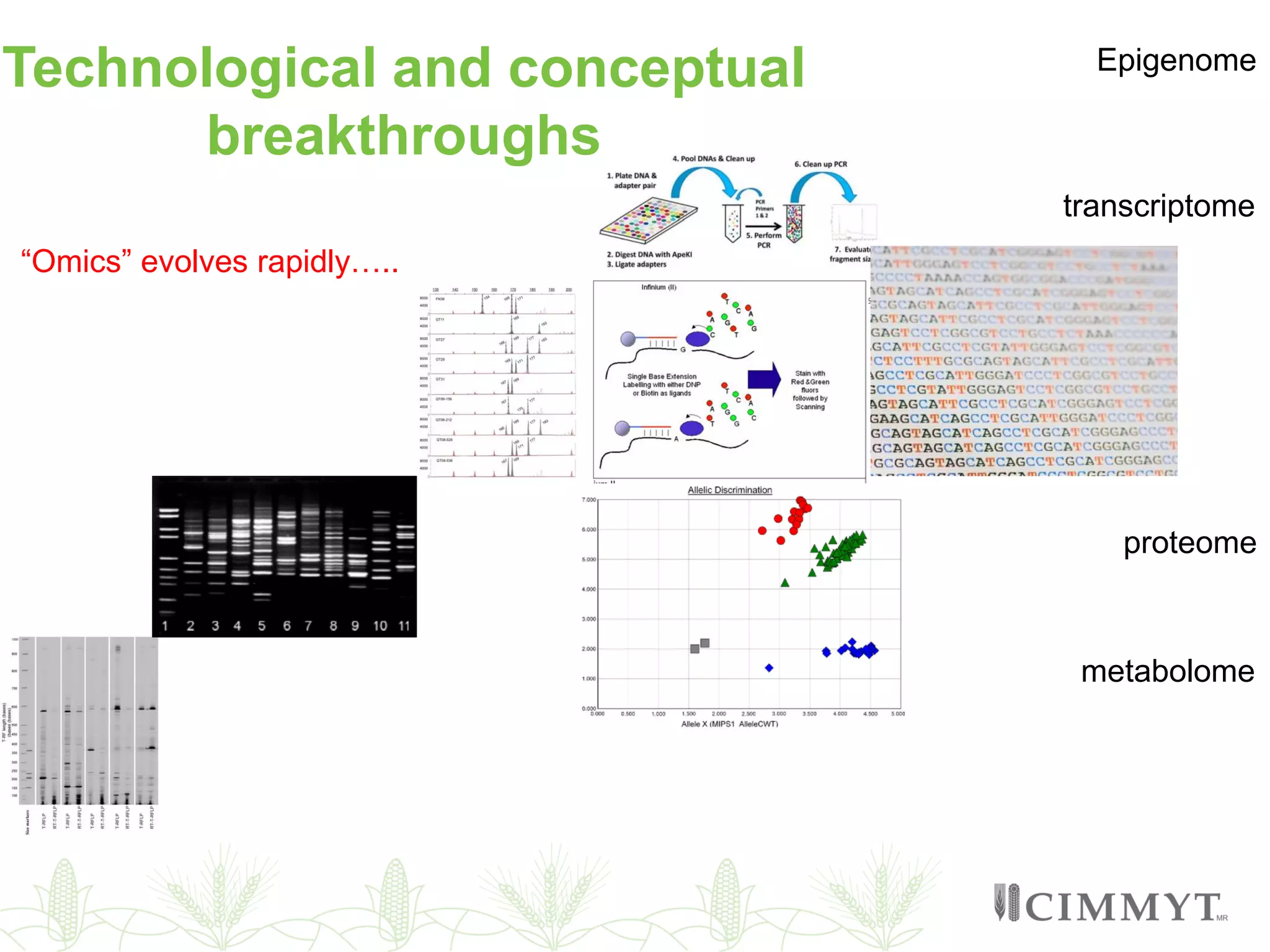
Epigenome
transcriptome
proteome
metabolome
“Omics” evolves rapidly…..
Technological and conceptual
breakthroughs
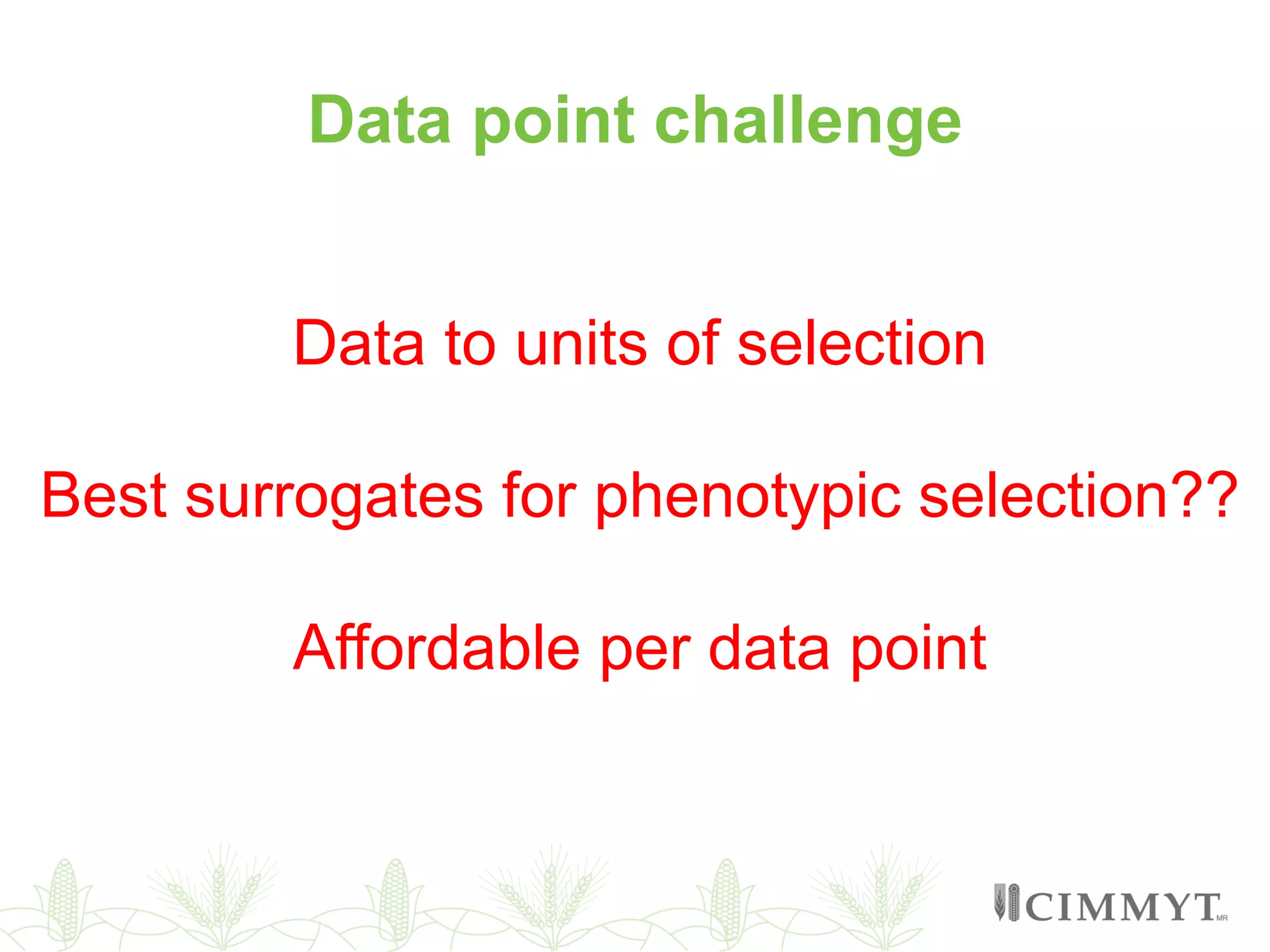
Data point challenge
Data to units of selection
Best surrogates for phenotypic selection??
Affordable per data point
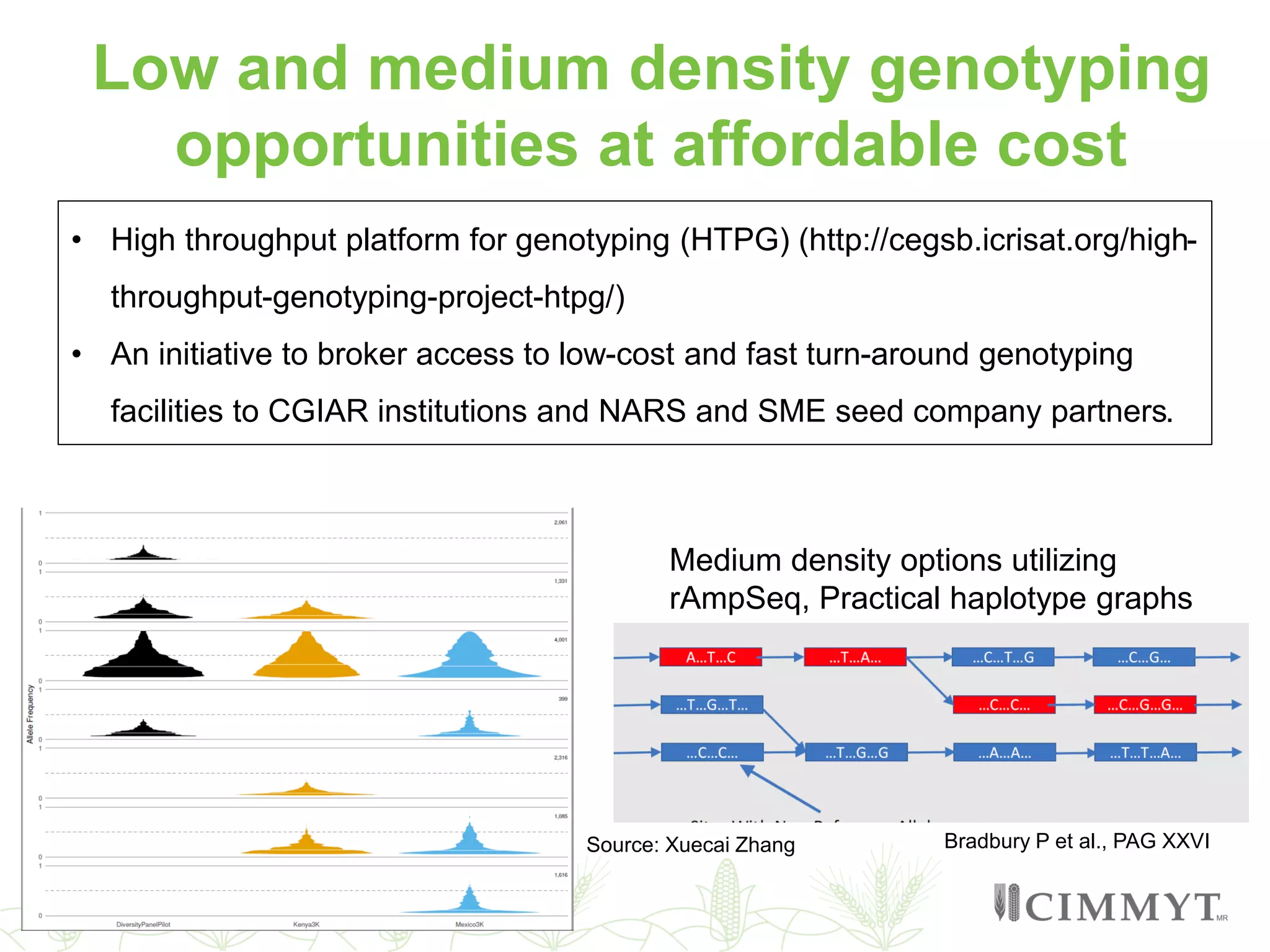
• High throughput platform for genotyping (HTPG) (http://cegsb.icrisat.org/high-
throughput-genotyping-project-htpg/)
• An initiative to broker access to low-cost and fast turn-around genotyping
facilities to CGIAR institutions and NARS and SME seed company partners.
Low and medium density genotyping
opportunities at affordable cost
Medium density options utilizing
rAmpSeq, Practical haplotype graphs
Source: Xuecai Zhang Bradbury P et al., PAG XXVI
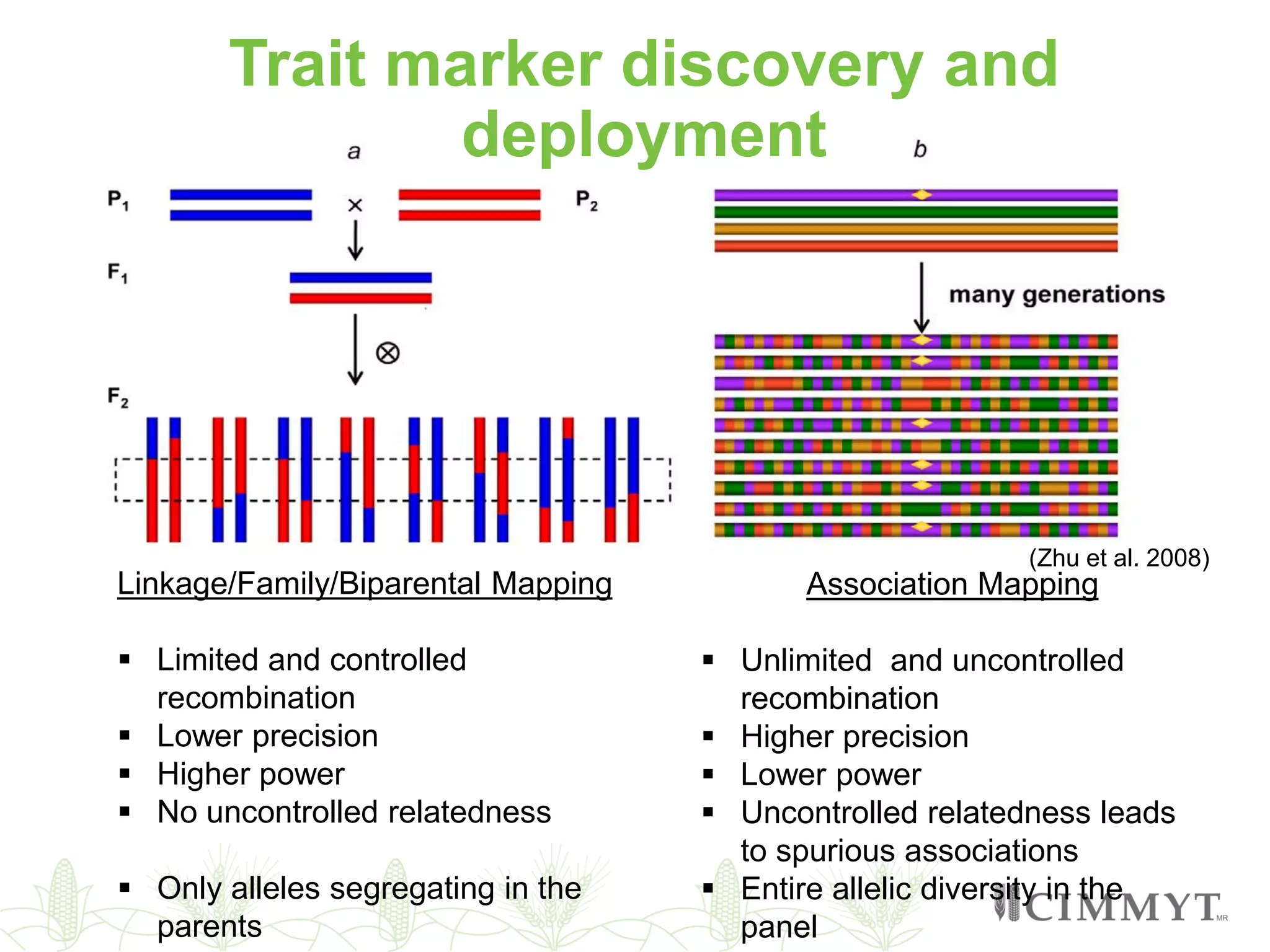
Linkage/Family/Biparental Mapping
 Limited and controlled
recombination
 Lower precision
 Higher power
 No uncontrolled relatedness
 Only alleles segregating in the
parents
Association Mapping
 Unlimited and uncontrolled
recombination
 Higher precision
 Lower power
 Uncontrolled relatedness leads
to spurious associations
 Entire allelic diversity in the
panel
(Zhu et al. 2008)
Trait marker discovery and
deployment
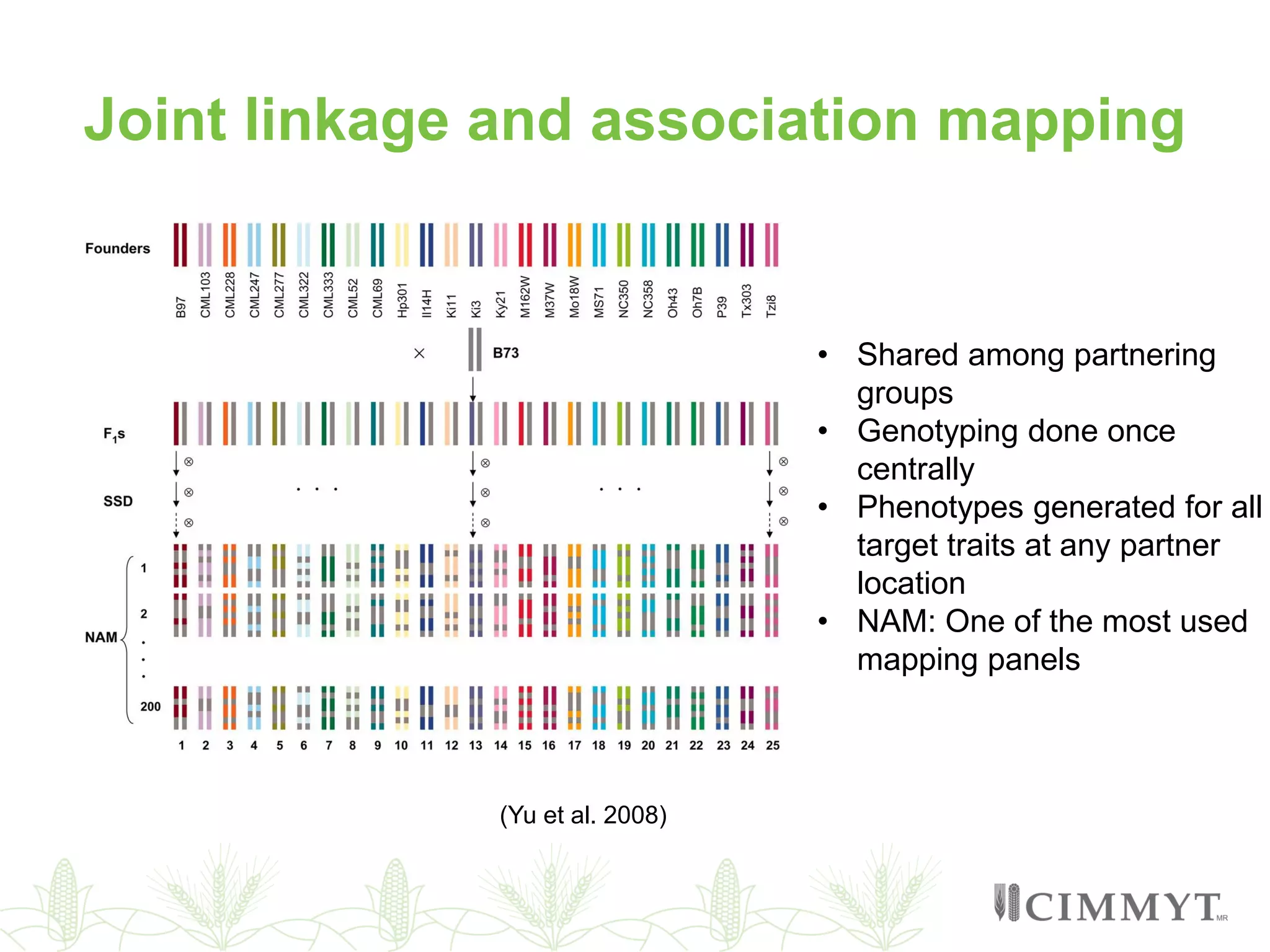
Joint linkage and association mapping
(Yu et al. 2008)
• Shared among partnering
groups
• Genotyping done once
centrally
• Phenotypes generated for all
target traits at any partner
location
• NAM: One of the most used
mapping panels
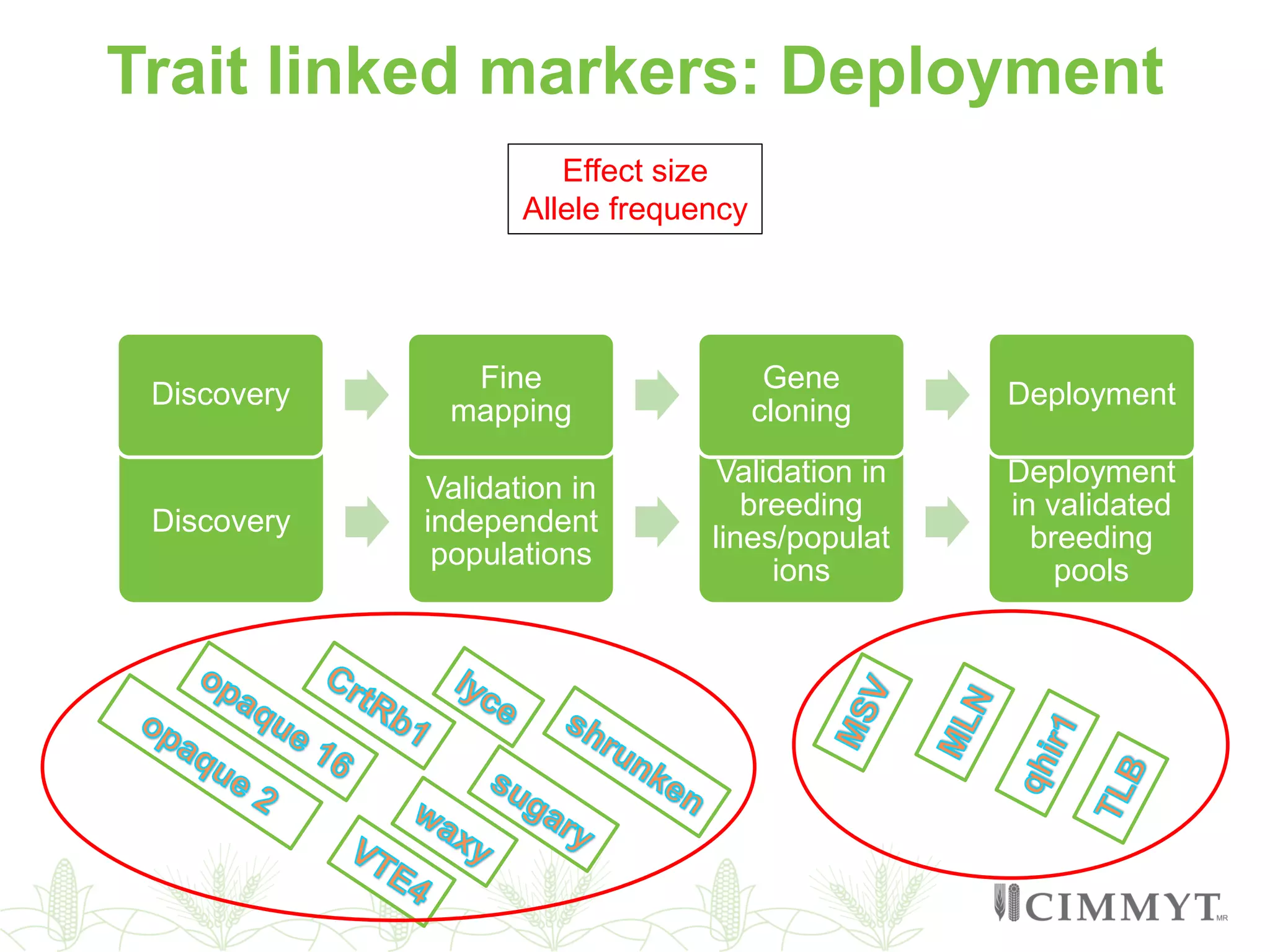
Trait linked markers: Deployment
Discovery
Validation in
independent
populations
Validation in
breeding
lines/populat
ions
Deployment
in validated
breeding
pools
Discovery
Fine
mapping
Gene
cloning
Deployment
Effect size
Allele frequency
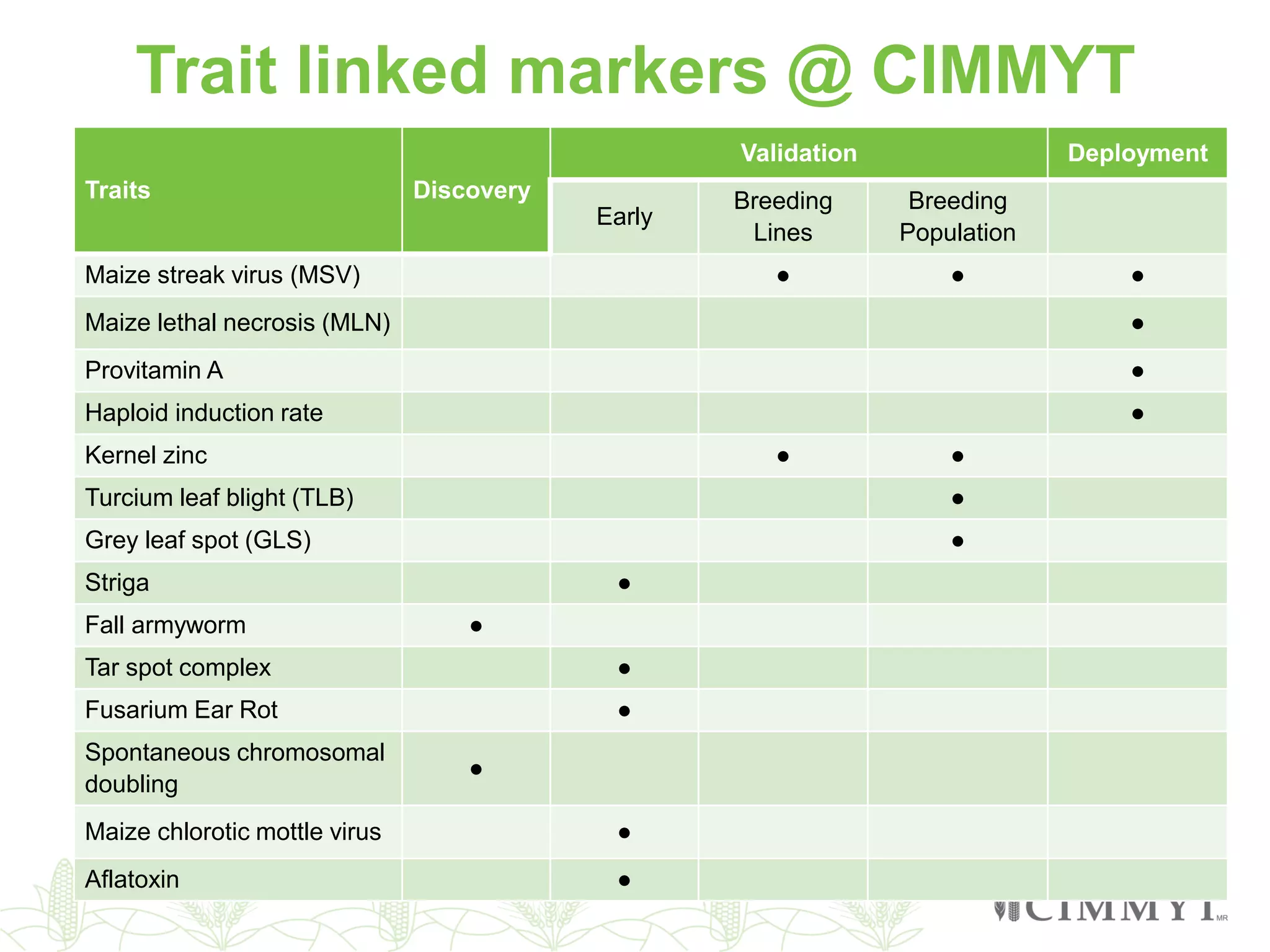
Traits Discovery
Validation Deployment
Early
Breeding
Lines
Breeding
Population
Maize streak virus (MSV) ● ● ●
Maize lethal necrosis (MLN) ●
Provitamin A ●
Haploid induction rate ●
Kernel zinc ● ●
Turcium leaf blight (TLB) ●
Grey leaf spot (GLS) ●
Striga ●
Fall armyworm ●
Tar spot complex ●
Fusarium Ear Rot ●
Spontaneous chromosomal
doubling
●
Maize chlorotic mottle virus ●
Aflatoxin ●
Trait linked markers @ CIMMYT
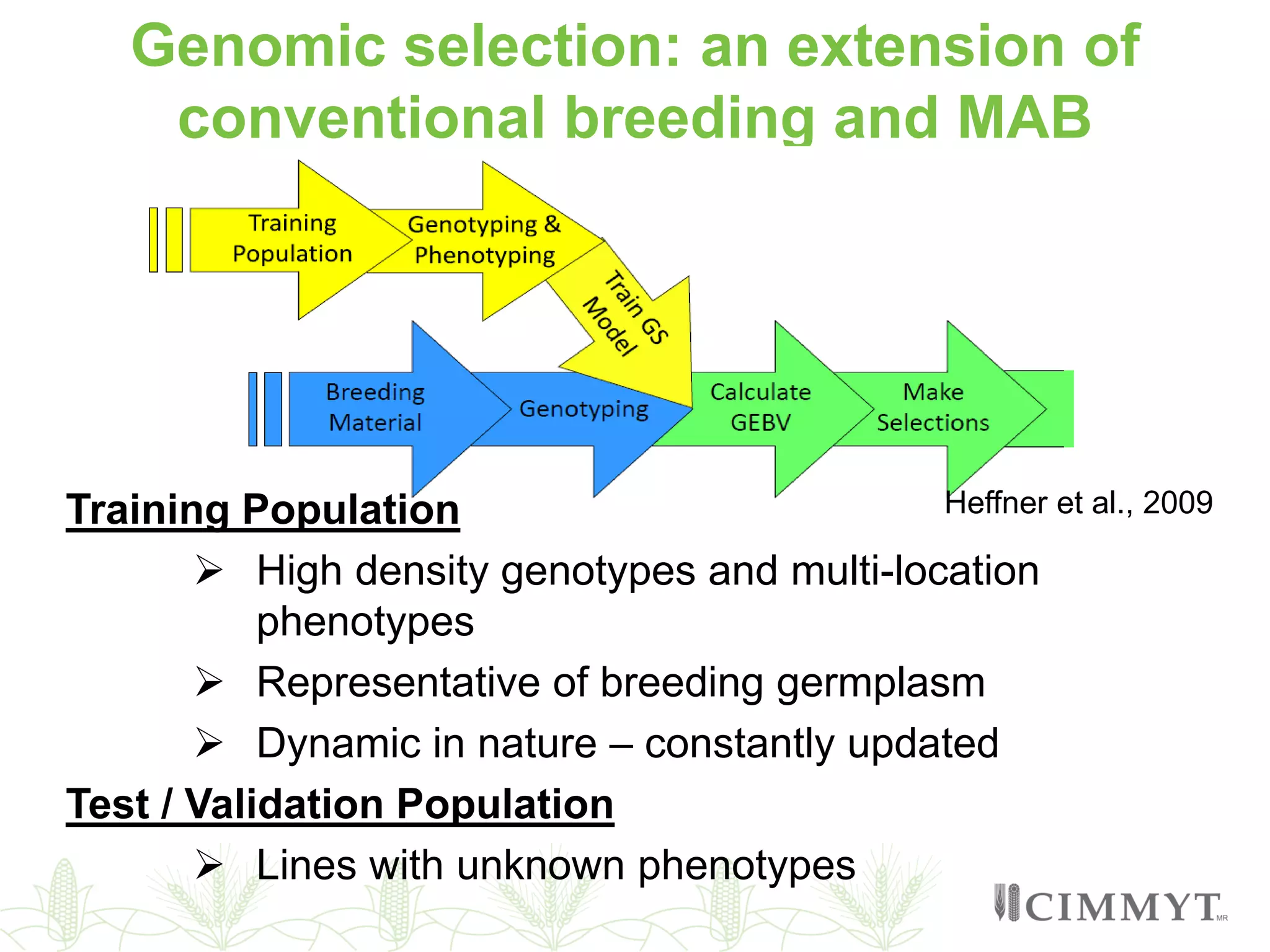
Genomic selection: an extension of
conventional breeding and MAB
Training Population
 High density genotypes and multi-location
phenotypes
 Representative of breeding germplasm
 Dynamic in nature – constantly updated
Test / Validation Population
 Lines with unknown phenotypes
Heffner et al., 2009
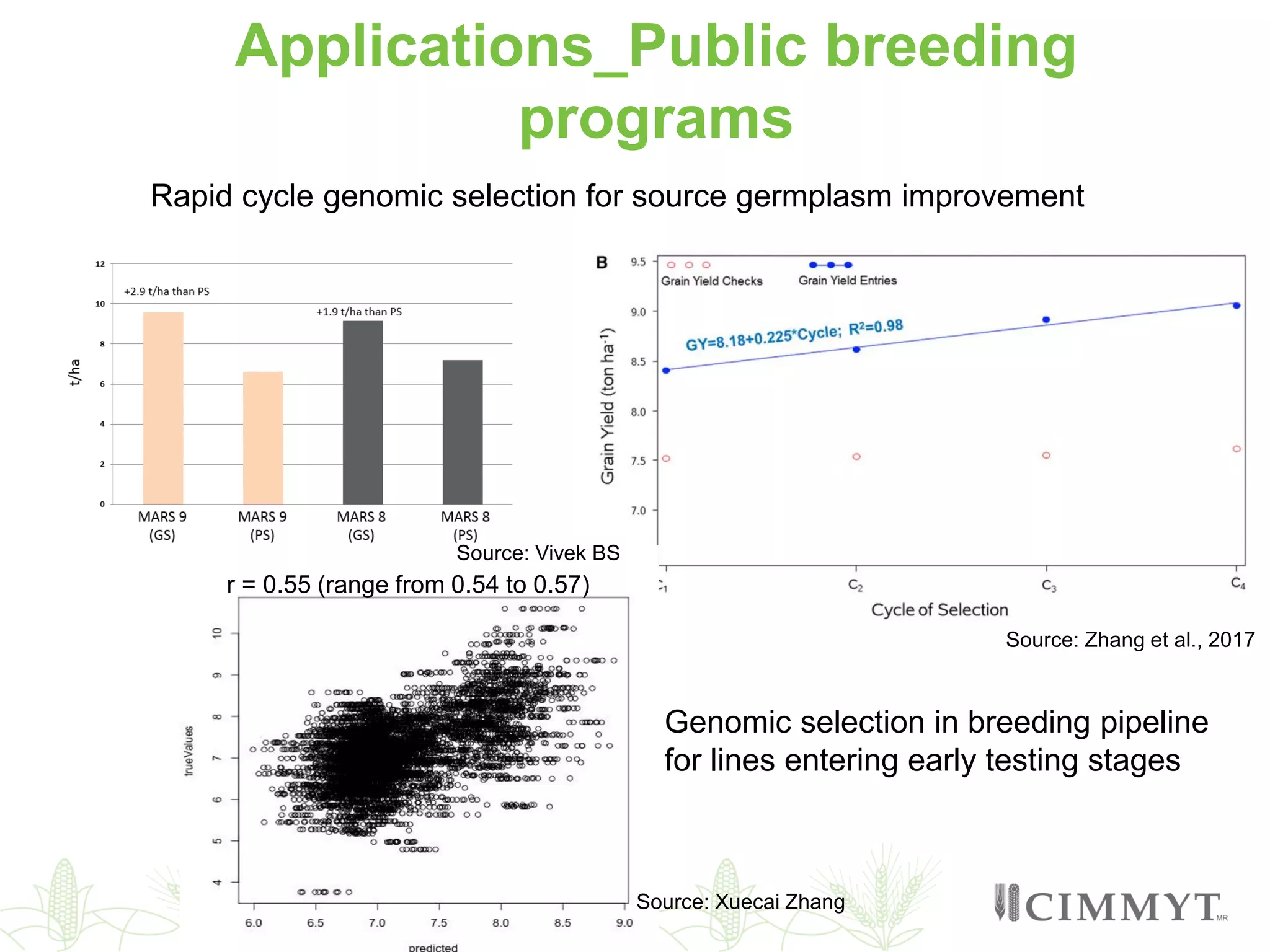
Applications_Public breeding
programs
Rapid cycle genomic selection for source germplasm improvement
Genomic selection in breeding pipeline
for lines entering early testing stages
r = 0.55 (range from 0.54 to 0.57)
Source: Vivek BS
Source: Xuecai Zhang
Source: Zhang et al., 2017
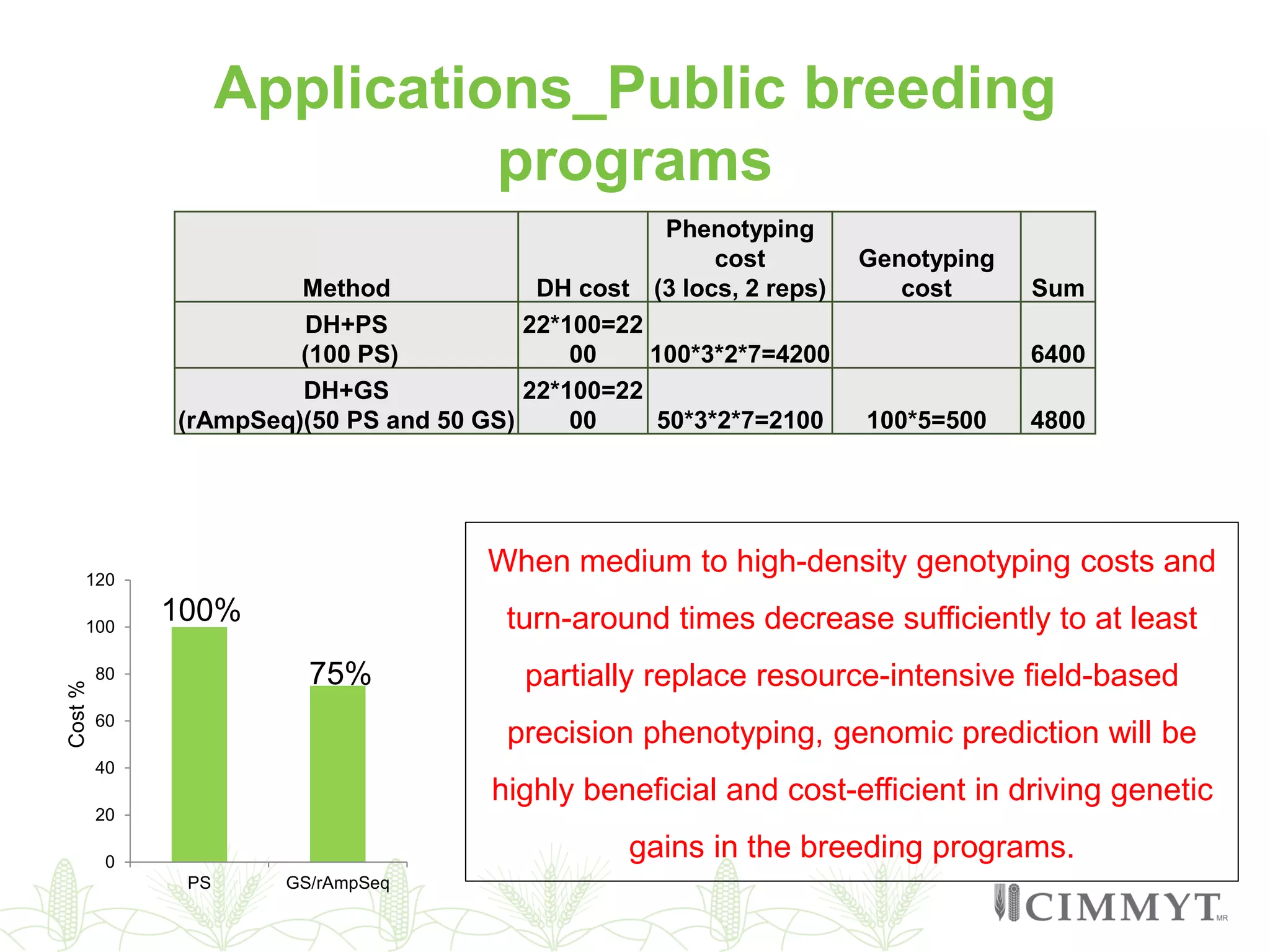
Applications_Public breeding
programs
Method DH cost
Phenotyping
cost
(3 locs, 2 reps)
Genotyping
cost Sum
DH+PS
(100 PS)
22*100=22
00 100*3*2*7=4200 6400
DH+GS
(rAmpSeq)(50 PS and 50 GS)
22*100=22
00 50*3*2*7=2100 100*5=500 4800
0
20
40
60
80
100
120
PS GS/rAmpSeq
75%
100%
When medium to high-density genotyping costs and
turn-around times decrease sufficiently to at least
partially replace resource-intensive field-based
precision phenotyping, genomic prediction will be
highly beneficial and cost-efficient in driving genetic
gains in the breeding programs.
Cost%
Genomic-enabling
technologies and their
impact on components of
genetic gain
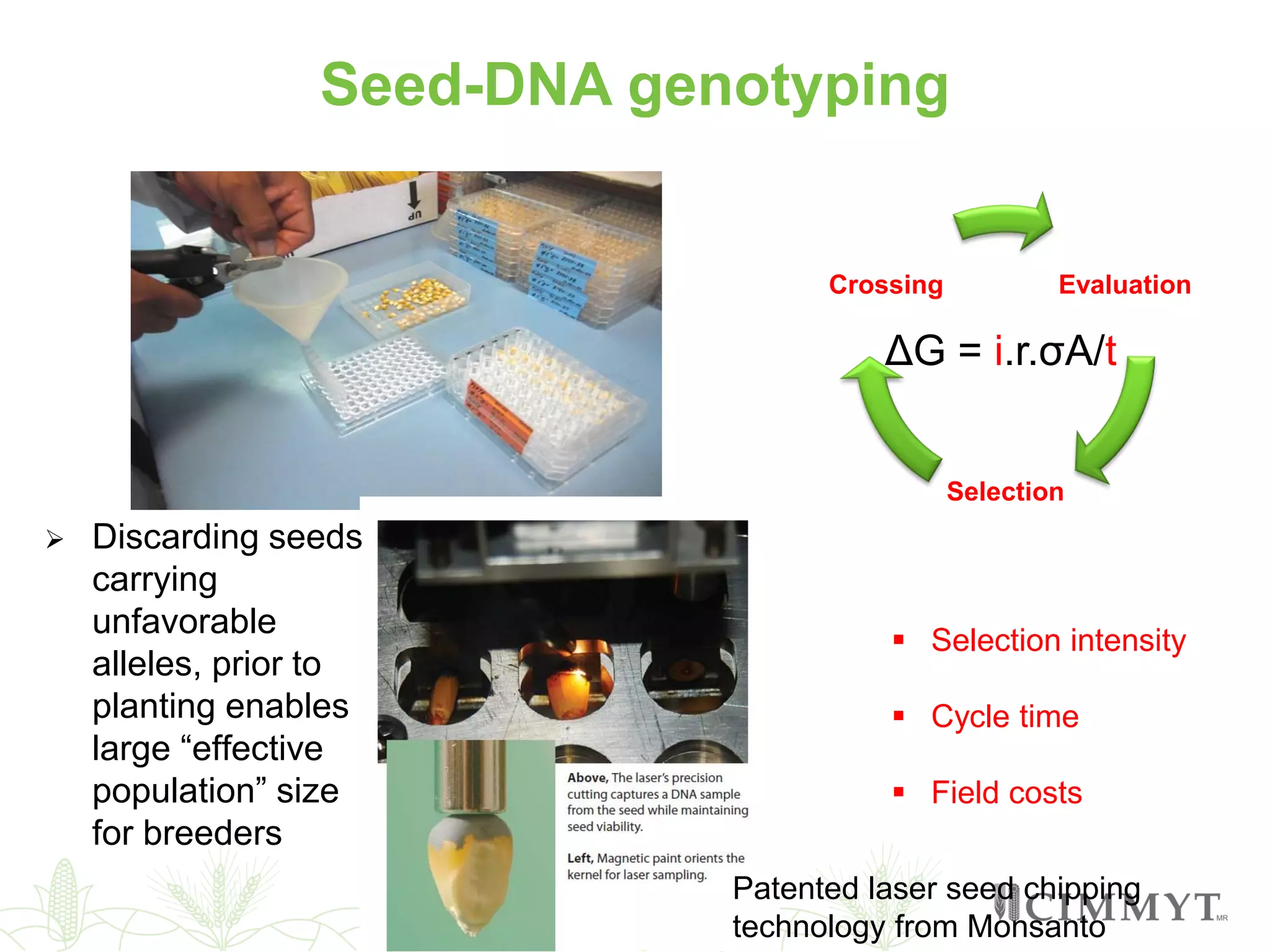
Seed-DNA genotyping
Patented laser seed chipping
technology from Monsanto
 Discarding seeds
carrying
unfavorable
alleles, prior to
planting enables
large “effective
population” size
for breeders
 Selection intensity
 Cycle time
 Field costs
Evaluation
Selection
Crossing
ΔG = i.r.σA/t
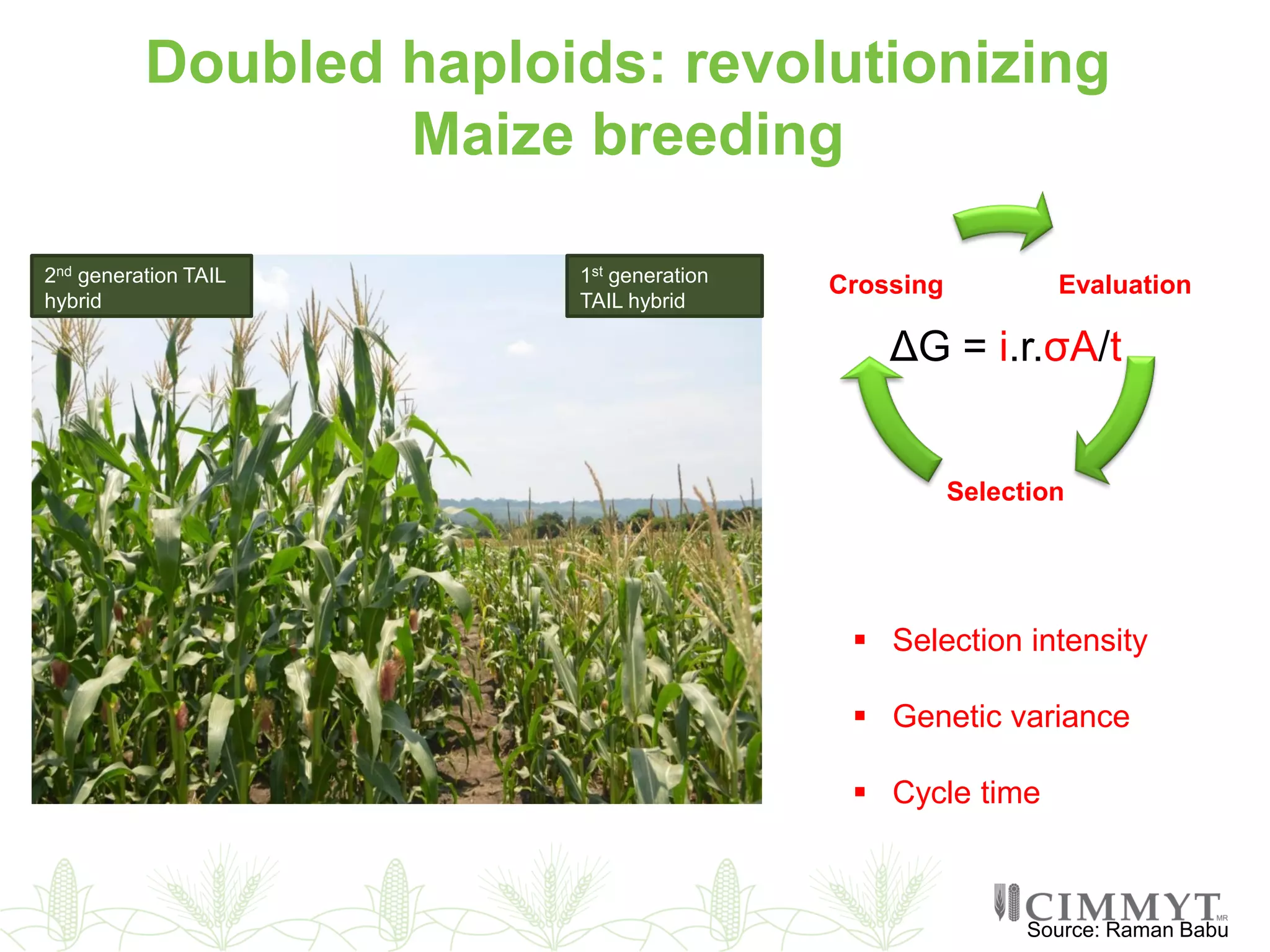
Doubled haploids: revolutionizing
Maize breeding
Source: Raman Babu
 Selection intensity
 Genetic variance
 Cycle time
1st generation
TAIL hybrid
2nd generation TAIL
hybrid
Evaluation
Selection
Crossing
ΔG = i.r.σA/t
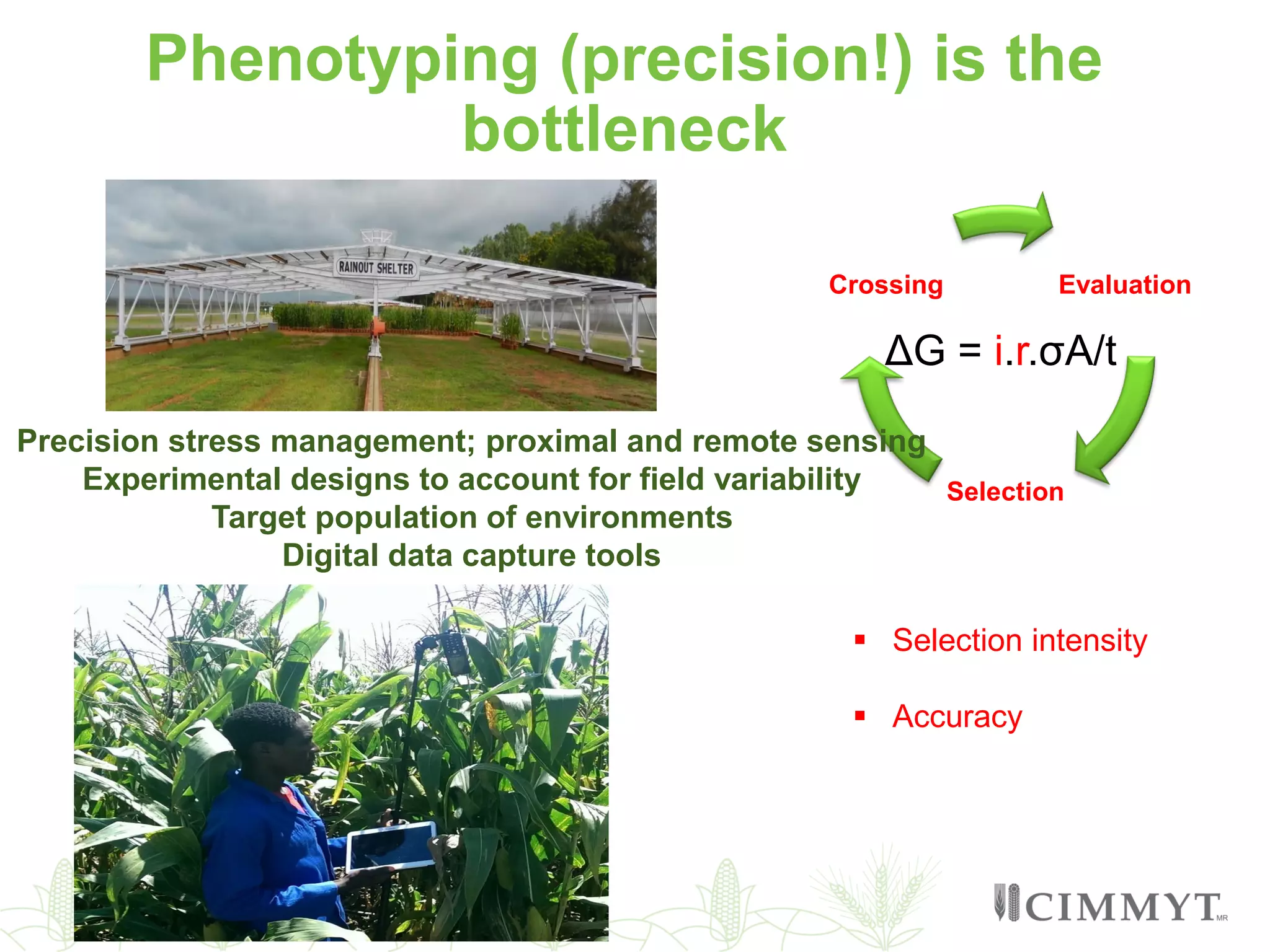
Phenotyping (precision!) is the
bottleneck
Evaluation
Selection
Crossing
ΔG = i.r.σA/t
 Selection intensity
 Accuracy
Precision stress management; proximal and remote sensing
Experimental designs to account for field variability
Target population of environments
Digital data capture tools
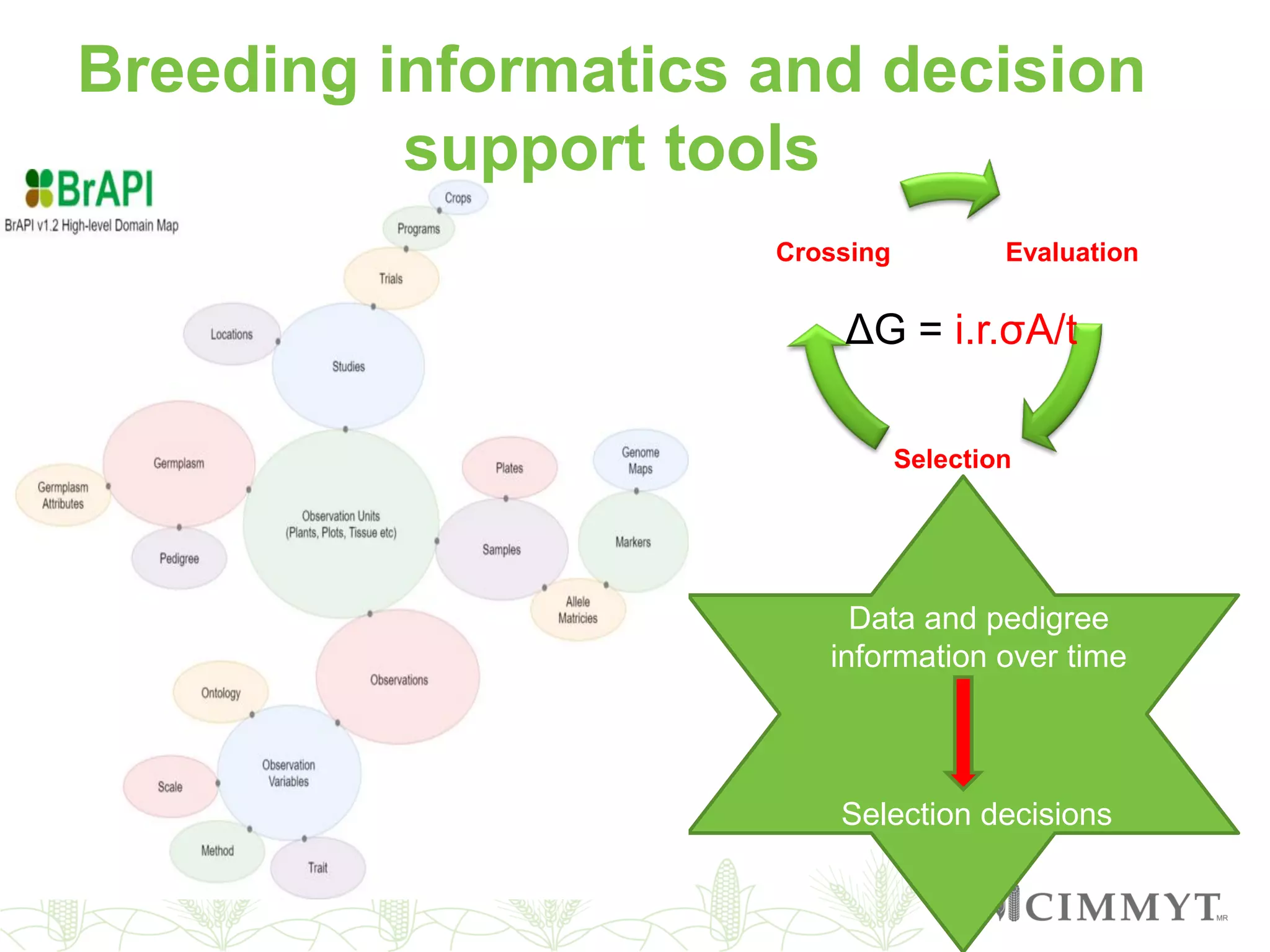
Breeding informatics and decision
support tools
Data and pedigree
information over time
Selection decisions
Evaluation
Selection
Crossing
ΔG = i.r.σA/t
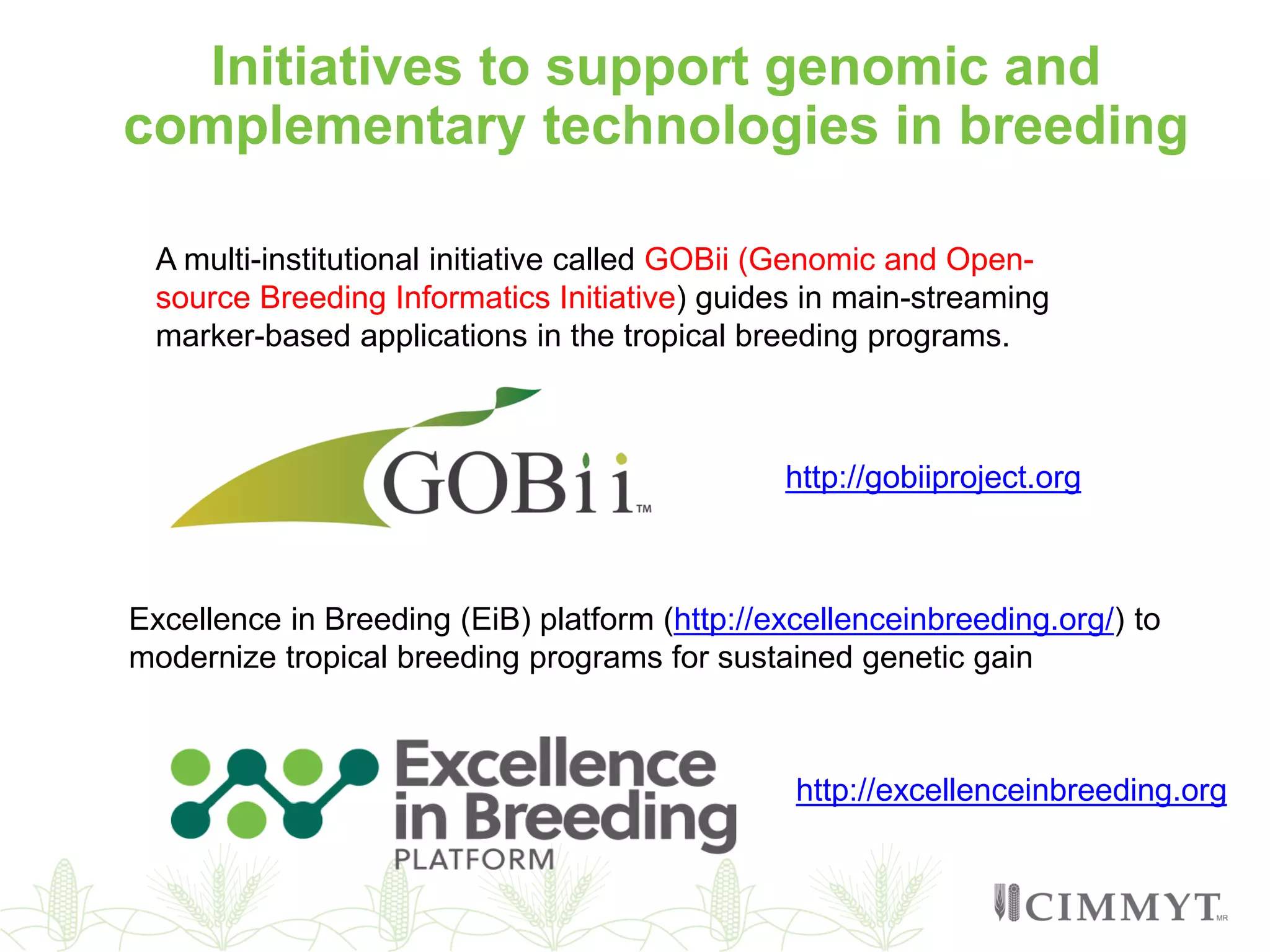
A multi-institutional initiative called GOBii (Genomic and Open-
source Breeding Informatics Initiative) guides in main-streaming
marker-based applications in the tropical breeding programs.
Excellence in Breeding (EiB) platform (http://excellenceinbreeding.org/) to
modernize tropical breeding programs for sustained genetic gain
http://gobiiproject.org
http://excellenceinbreeding.org
Initiatives to support genomic and
complementary technologies in breeding
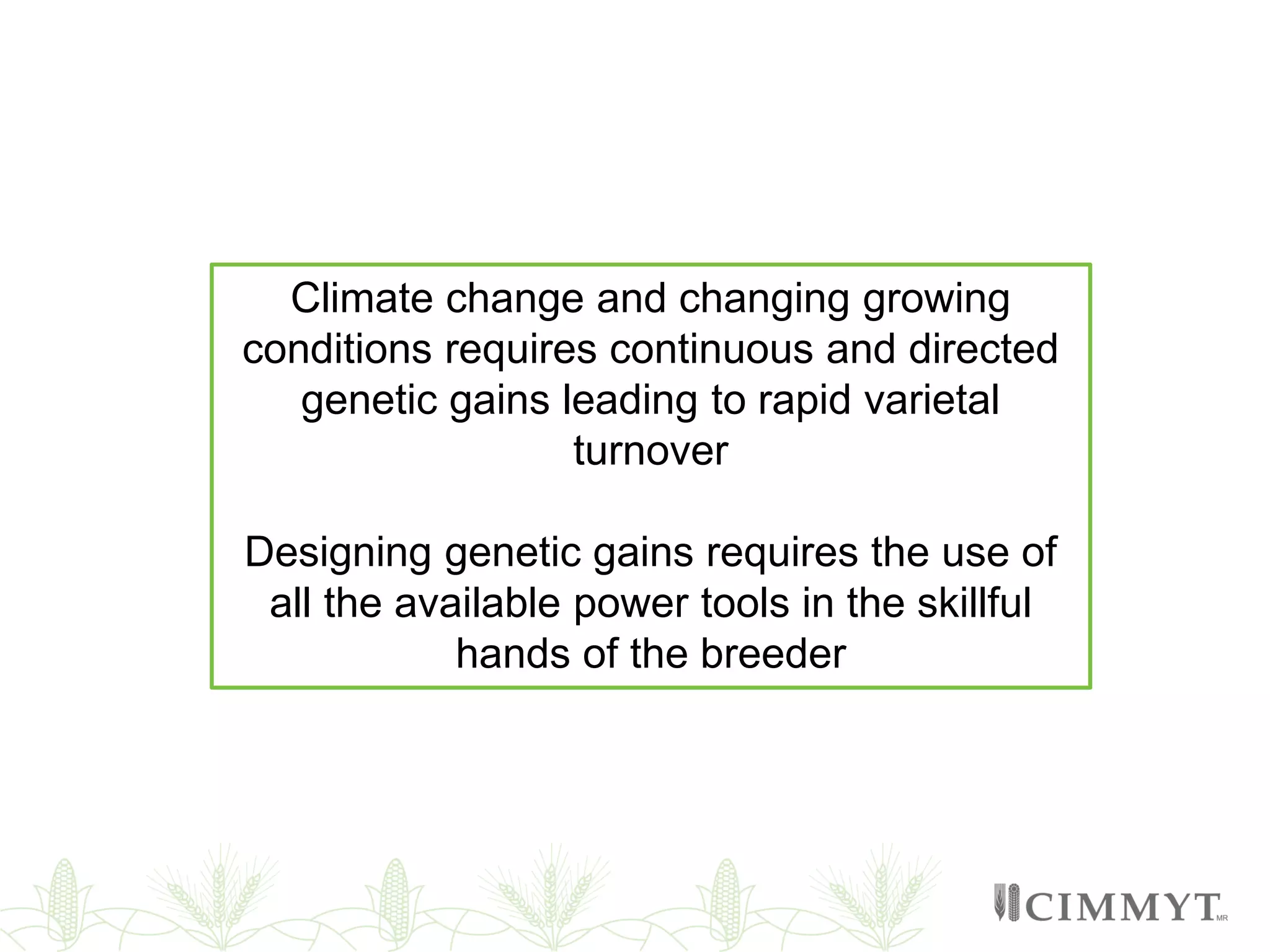
Climate change and changing growing
conditions requires continuous and directed
genetic gains leading to rapid varietal
turnover
Designing genetic gains requires the use of
all the available power tools in the skillful
hands of the breeder
Acknowledgements
• Global maize program, CIMMYT
• National program and CG partners (KALRO, NARO, AICRP(Maize), IITA
• Private seed company partners
Thank you
for your
interest!

Genomic and enabling technologies in maize breeding for enhanced genetic gains in the tropics

  • 1.
    Genomic and enablingtechnologies in maize breeding for enhanced genetic gains in the tropics Sudha Nair, Raman Babu, Prasanna BM 08-10-2018 13th AMC, Ludhiana
  • 2.
    Outline Genetic gains inmaize breeding Genomic technologies for enhanced genetic gains in maize breeding • Maize genome: Opportunities and challenges • Genomics and other omics: bottlenecks anymore? • Trait marker discovery and deployment • Genomic prediction Genomic-enabling technologies to complement genomic technologies and how they improve the factors leading to genetic gain • Seed DNA genotyping • Doubled haploids • High throughput and reasonably precise phenotyping • Breeding informatics and decision support
  • 3.
    Evaluation Selection Crossing Source: Greg Rebetzke,2015 ΔG = i.r.σA/t i = selection intensity r = selection accuracy σA = genetic variance t = cycling time Genetic gains are achieved through breeding cycles
  • 4.
    Genetic gains reported in maize +109.4Kg ha -1year -1 1.4% year -1 +32.5 Kg ha -1year -1 0.85% year -1 Optimal_GY Managed drought_GY Region Period (years) Estimated gain (kg ha−1 yr−1) China 30 94.7 Argentina 32 132 Canada 100 80 USA 70 75 W&C Africa (OPV) 23 40 CIMMYT: Sub-Saharan Africa (10 years)
  • 5.
    Genomic Technologies for enhancedgenetic gains Evaluation Selection Crossing ΔG = i.r.σA/t
  • 6.
    Maize genome: Opportunities andchallenges a More “Quantitativeness” in traits compared to related grasses Dispersed genetic architecture Most traits controlled by large number of small effect genes High genetic variability – better ability to bring together multiple small effect QTL to achieve favorable outcomes during natural/artificial selection Intra-specific genetic diversity and Intraspecific violation of gene colinearity ~ 1% ND between lines in genic spaces=ND between humans and Chimpanzees ~30% genes non-colinear between inbred lines Patterns of LD decay Highly cross-bred; high effective recombination rate; but depends on genetic base of the breeding pool
  • 7.
  • 8.
    Data point challenge Datato units of selection Best surrogates for phenotypic selection?? Affordable per data point
  • 9.
    • High throughputplatform for genotyping (HTPG) (http://cegsb.icrisat.org/high- throughput-genotyping-project-htpg/) • An initiative to broker access to low-cost and fast turn-around genotyping facilities to CGIAR institutions and NARS and SME seed company partners. Low and medium density genotyping opportunities at affordable cost Medium density options utilizing rAmpSeq, Practical haplotype graphs Source: Xuecai Zhang Bradbury P et al., PAG XXVI
  • 10.
    Linkage/Family/Biparental Mapping  Limitedand controlled recombination  Lower precision  Higher power  No uncontrolled relatedness  Only alleles segregating in the parents Association Mapping  Unlimited and uncontrolled recombination  Higher precision  Lower power  Uncontrolled relatedness leads to spurious associations  Entire allelic diversity in the panel (Zhu et al. 2008) Trait marker discovery and deployment
  • 11.
    Joint linkage andassociation mapping (Yu et al. 2008) • Shared among partnering groups • Genotyping done once centrally • Phenotypes generated for all target traits at any partner location • NAM: One of the most used mapping panels
  • 12.
    Trait linked markers:Deployment Discovery Validation in independent populations Validation in breeding lines/populat ions Deployment in validated breeding pools Discovery Fine mapping Gene cloning Deployment Effect size Allele frequency
  • 13.
    Traits Discovery Validation Deployment Early Breeding Lines Breeding Population Maizestreak virus (MSV) ● ● ● Maize lethal necrosis (MLN) ● Provitamin A ● Haploid induction rate ● Kernel zinc ● ● Turcium leaf blight (TLB) ● Grey leaf spot (GLS) ● Striga ● Fall armyworm ● Tar spot complex ● Fusarium Ear Rot ● Spontaneous chromosomal doubling ● Maize chlorotic mottle virus ● Aflatoxin ● Trait linked markers @ CIMMYT
  • 14.
    Genomic selection: anextension of conventional breeding and MAB Training Population  High density genotypes and multi-location phenotypes  Representative of breeding germplasm  Dynamic in nature – constantly updated Test / Validation Population  Lines with unknown phenotypes Heffner et al., 2009
  • 15.
    Applications_Public breeding programs Rapid cyclegenomic selection for source germplasm improvement Genomic selection in breeding pipeline for lines entering early testing stages r = 0.55 (range from 0.54 to 0.57) Source: Vivek BS Source: Xuecai Zhang Source: Zhang et al., 2017
  • 16.
    Applications_Public breeding programs Method DHcost Phenotyping cost (3 locs, 2 reps) Genotyping cost Sum DH+PS (100 PS) 22*100=22 00 100*3*2*7=4200 6400 DH+GS (rAmpSeq)(50 PS and 50 GS) 22*100=22 00 50*3*2*7=2100 100*5=500 4800 0 20 40 60 80 100 120 PS GS/rAmpSeq 75% 100% When medium to high-density genotyping costs and turn-around times decrease sufficiently to at least partially replace resource-intensive field-based precision phenotyping, genomic prediction will be highly beneficial and cost-efficient in driving genetic gains in the breeding programs. Cost%
  • 17.
  • 18.
    Seed-DNA genotyping Patented laserseed chipping technology from Monsanto  Discarding seeds carrying unfavorable alleles, prior to planting enables large “effective population” size for breeders  Selection intensity  Cycle time  Field costs Evaluation Selection Crossing ΔG = i.r.σA/t
  • 19.
    Doubled haploids: revolutionizing Maizebreeding Source: Raman Babu  Selection intensity  Genetic variance  Cycle time 1st generation TAIL hybrid 2nd generation TAIL hybrid Evaluation Selection Crossing ΔG = i.r.σA/t
  • 20.
    Phenotyping (precision!) isthe bottleneck Evaluation Selection Crossing ΔG = i.r.σA/t  Selection intensity  Accuracy Precision stress management; proximal and remote sensing Experimental designs to account for field variability Target population of environments Digital data capture tools
  • 21.
    Breeding informatics anddecision support tools Data and pedigree information over time Selection decisions Evaluation Selection Crossing ΔG = i.r.σA/t
  • 22.
    A multi-institutional initiativecalled GOBii (Genomic and Open- source Breeding Informatics Initiative) guides in main-streaming marker-based applications in the tropical breeding programs. Excellence in Breeding (EiB) platform (http://excellenceinbreeding.org/) to modernize tropical breeding programs for sustained genetic gain http://gobiiproject.org http://excellenceinbreeding.org Initiatives to support genomic and complementary technologies in breeding
  • 23.
    Climate change andchanging growing conditions requires continuous and directed genetic gains leading to rapid varietal turnover Designing genetic gains requires the use of all the available power tools in the skillful hands of the breeder
  • 24.
    Acknowledgements • Global maizeprogram, CIMMYT • National program and CG partners (KALRO, NARO, AICRP(Maize), IITA • Private seed company partners
  • 25.