SEED GENERATION SYSTEM
Prepared by
Dr. K. Vanangamudi
Formerly Dean (Agriculture), TNAU, Coimbatore.
Dean, Adhiparasakthi Agricultural College,
Professor & Head,
Seed Science & Technology, TNAU, Coimbatore
1. SEED CLASSES
 Production of a particular class of seed from specific class of seed up to certified seed
stage.
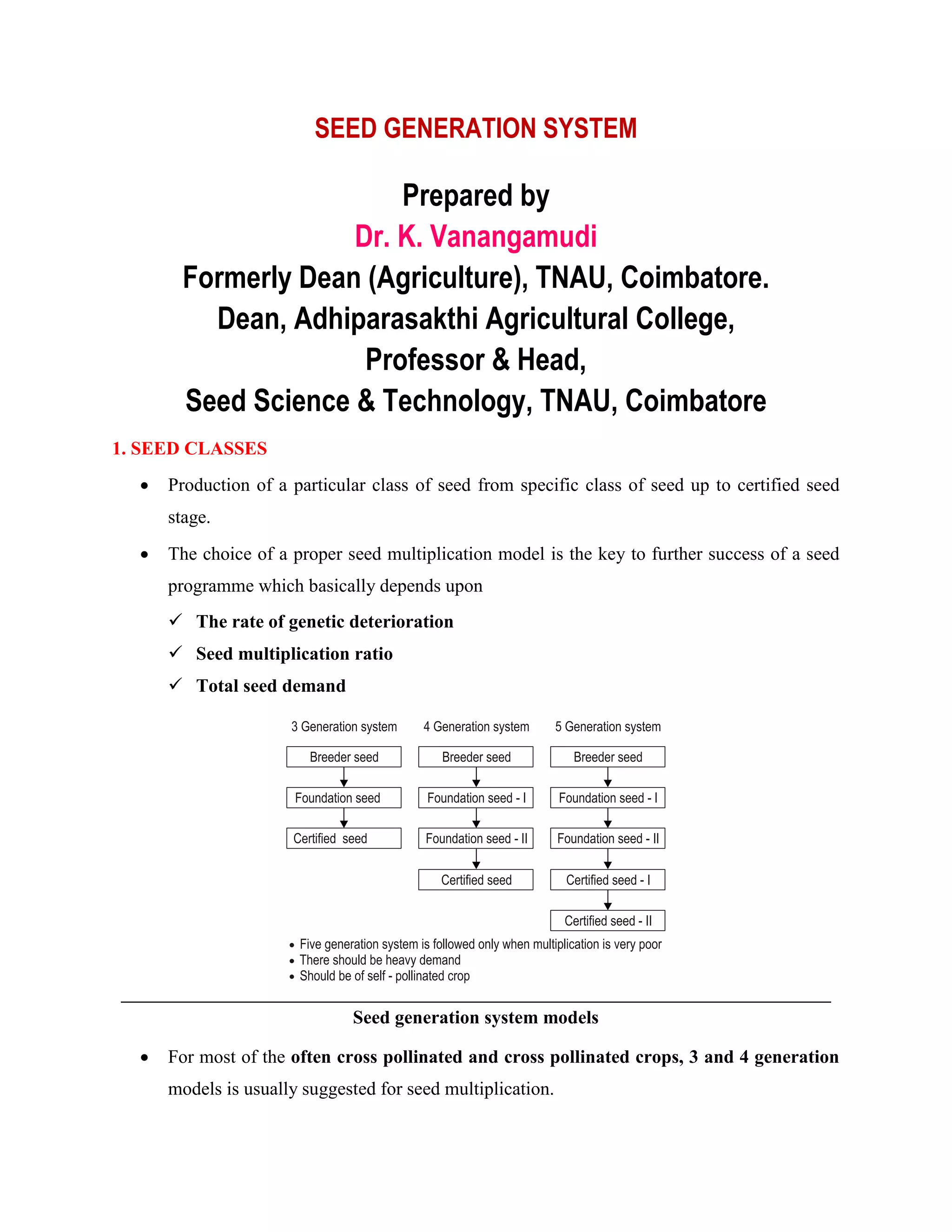
 The choice of a proper seed multiplication model is the key to further success of a seed
programme which basically depends upon
 The rate of genetic deterioration
 Seed multiplication ratio
 Total seed demand
Seed generation system models
 For most of the often cross pollinated and cross pollinated crops, 3 and 4 generation
models is usually suggested for seed multiplication.
 E.g. Castor, redgram, jute, greengram, rape, mustard, sesame, sunflower and most
of the vegetable crops.
 Four generally recognized classes of seeds are breeder seed, foundation seed,
registered seed and certified seed.
1.1. Nucleus seed
 Initial amount of pure seed of improved variety or notified variety or parental lines of
a hybrid produced under supervision of the evolver of that variety.
 Nucleus seed generally 100% pure and does not contain other physical impurities.
 Produced strictly under isolation to avoid both genetical and physical impurities.
 Vigour of the original variety or parental line should be retained in nucleus seed.
1.2. Breeder seed (stage I and stage II)
 Progeny of nucleus seed.
 Generally breeder seed is produced in one stage.
 Can be produced in two stages, viz. breeder stage I and II.
 For stage II, source of seed is stage I.
 Breeder seed can be produced by original breeder, sponsored plant breeder on
Agricultural University farms and rarely on government farms.
 Genetic purity 99.9% or more
 Physical purity 98% or more
 Germination (as per crop) and moisture content less than 12%.
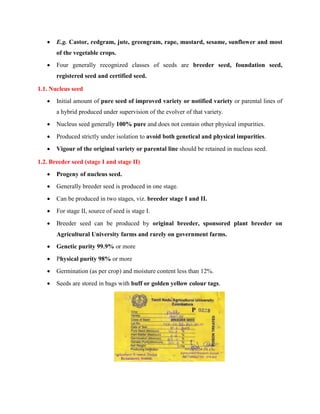
 Seeds are stored in bags with buff or golden yellow colour tags.
1.3. Foundation seed (stage I and stage II)
 Progeny of breeder seed.
 Can be produced in two stages viz. stage I and stage II.
 Foundation seed is produced on the farms of State Agricultural Universities, State
Seed Farms, other Government farms, State Seed Corporations and private seed
companies.
 Genetic purity is 99.5% or more.
 Seeds are stored in bags with white color tags.
1.4. Registered seed
 Progeny of foundation seed.
 Produced by progressive farmers or registered seed growers according to technical
advice and supervision provided by NSC.
 Registered seeds are genetically pure.
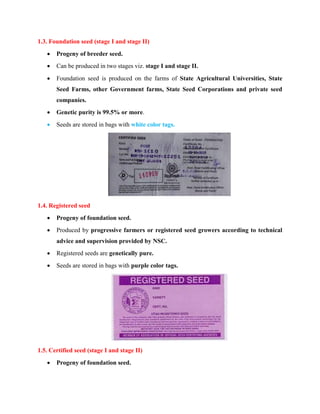
 Seeds are stored in bags with purple color tags.
1.5. Certified seed (stage I and stage II)
 Progeny of foundation seed.
 Genetic purity is 99% or more.
 Normally produced by the State and National Seeds Corporations and private seed
companies on the farms of progressive growers.
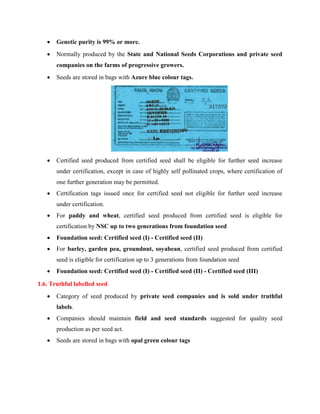
 Seeds are stored in bags with Azure blue colour tags.
 Certified seed produced from certified seed shall be eligible for further seed increase
under certification, except in case of highly self pollinated crops, where certification of
one further generation may be permitted.
 Certification tags issued once for certified seed not eligible for further seed increase
under certification.
 For paddy and wheat, certified seed produced from certified seed is eligible for
certification by NSC up to two generations from foundation seed
 Foundation seed: Certified seed (I) - Certified seed (II)
 For barley, garden pea, groundnut, soyabean, certified seed produced from certified
seed is eligible for certification up to 3 generations from foundation seed
 Foundation seed: Certified seed (I) - Certified seed (II) - Certified seed (III)
1.6. Truthful labelled seed
 Category of seed produced by private seed companies and is sold under truthful
labels.
 Companies should maintain field and seed standards suggested for quality seed
production as per seed act.
 Seeds are stored in bags with opal green colour tags
2. Differences between certified seed and truthful labelled seed
Certified seed Truthful labelled seed
 Certification is voluntary  Labelling is compulsory for notified kind of
varieties
 Applicable to notified kinds only  Applicable to both notified and released
varieties
 It should satisfy both minimum field and
seed standards
 Tested for physical purity and germination
 Seed certification officer, seed inspectors can
take samples for inspection
 Seed inspectors alone can take samples for
checking the seed quality.
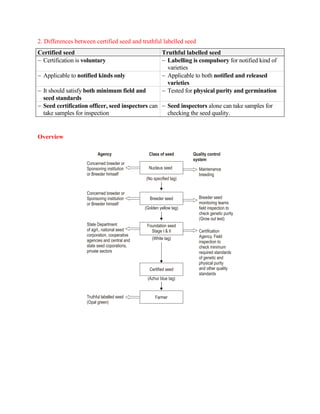
Overview

Seed Generation system.pdf

  • 1.
    SEED GENERATION SYSTEM Preparedby Dr. K. Vanangamudi Formerly Dean (Agriculture), TNAU, Coimbatore. Dean, Adhiparasakthi Agricultural College, Professor & Head, Seed Science & Technology, TNAU, Coimbatore 1. SEED CLASSES  Production of a particular class of seed from specific class of seed up to certified seed stage.  The choice of a proper seed multiplication model is the key to further success of a seed programme which basically depends upon  The rate of genetic deterioration  Seed multiplication ratio  Total seed demand Seed generation system models  For most of the often cross pollinated and cross pollinated crops, 3 and 4 generation models is usually suggested for seed multiplication.
  • 2.
     E.g. Castor,redgram, jute, greengram, rape, mustard, sesame, sunflower and most of the vegetable crops.  Four generally recognized classes of seeds are breeder seed, foundation seed, registered seed and certified seed. 1.1. Nucleus seed  Initial amount of pure seed of improved variety or notified variety or parental lines of a hybrid produced under supervision of the evolver of that variety.  Nucleus seed generally 100% pure and does not contain other physical impurities.  Produced strictly under isolation to avoid both genetical and physical impurities.  Vigour of the original variety or parental line should be retained in nucleus seed. 1.2. Breeder seed (stage I and stage II)  Progeny of nucleus seed.  Generally breeder seed is produced in one stage.  Can be produced in two stages, viz. breeder stage I and II.  For stage II, source of seed is stage I.  Breeder seed can be produced by original breeder, sponsored plant breeder on Agricultural University farms and rarely on government farms.  Genetic purity 99.9% or more  Physical purity 98% or more  Germination (as per crop) and moisture content less than 12%.  Seeds are stored in bags with buff or golden yellow colour tags.
  • 3.
    1.3. Foundation seed(stage I and stage II)  Progeny of breeder seed.  Can be produced in two stages viz. stage I and stage II.  Foundation seed is produced on the farms of State Agricultural Universities, State Seed Farms, other Government farms, State Seed Corporations and private seed companies.  Genetic purity is 99.5% or more.  Seeds are stored in bags with white color tags. 1.4. Registered seed  Progeny of foundation seed.  Produced by progressive farmers or registered seed growers according to technical advice and supervision provided by NSC.  Registered seeds are genetically pure.  Seeds are stored in bags with purple color tags. 1.5. Certified seed (stage I and stage II)  Progeny of foundation seed.
  • 4.
     Genetic purityis 99% or more.  Normally produced by the State and National Seeds Corporations and private seed companies on the farms of progressive growers.  Seeds are stored in bags with Azure blue colour tags.  Certified seed produced from certified seed shall be eligible for further seed increase under certification, except in case of highly self pollinated crops, where certification of one further generation may be permitted.  Certification tags issued once for certified seed not eligible for further seed increase under certification.  For paddy and wheat, certified seed produced from certified seed is eligible for certification by NSC up to two generations from foundation seed  Foundation seed: Certified seed (I) - Certified seed (II)  For barley, garden pea, groundnut, soyabean, certified seed produced from certified seed is eligible for certification up to 3 generations from foundation seed  Foundation seed: Certified seed (I) - Certified seed (II) - Certified seed (III) 1.6. Truthful labelled seed  Category of seed produced by private seed companies and is sold under truthful labels.  Companies should maintain field and seed standards suggested for quality seed production as per seed act.  Seeds are stored in bags with opal green colour tags
  • 5.
    2. Differences betweencertified seed and truthful labelled seed Certified seed Truthful labelled seed  Certification is voluntary  Labelling is compulsory for notified kind of varieties  Applicable to notified kinds only  Applicable to both notified and released varieties  It should satisfy both minimum field and seed standards  Tested for physical purity and germination  Seed certification officer, seed inspectors can take samples for inspection  Seed inspectors alone can take samples for checking the seed quality. Overview