Comparative Analysis of Biochemical
& Physiological Responses of Maize
Genotypes under Waterlogging Stress
Tahmina Akter
Khulna University
Bangladesh
Outline
 Introduction
 Objectives
 Materials and Methods
 Result and Discussion
 Conclusion
 Prospective
 Acknowledgement
2
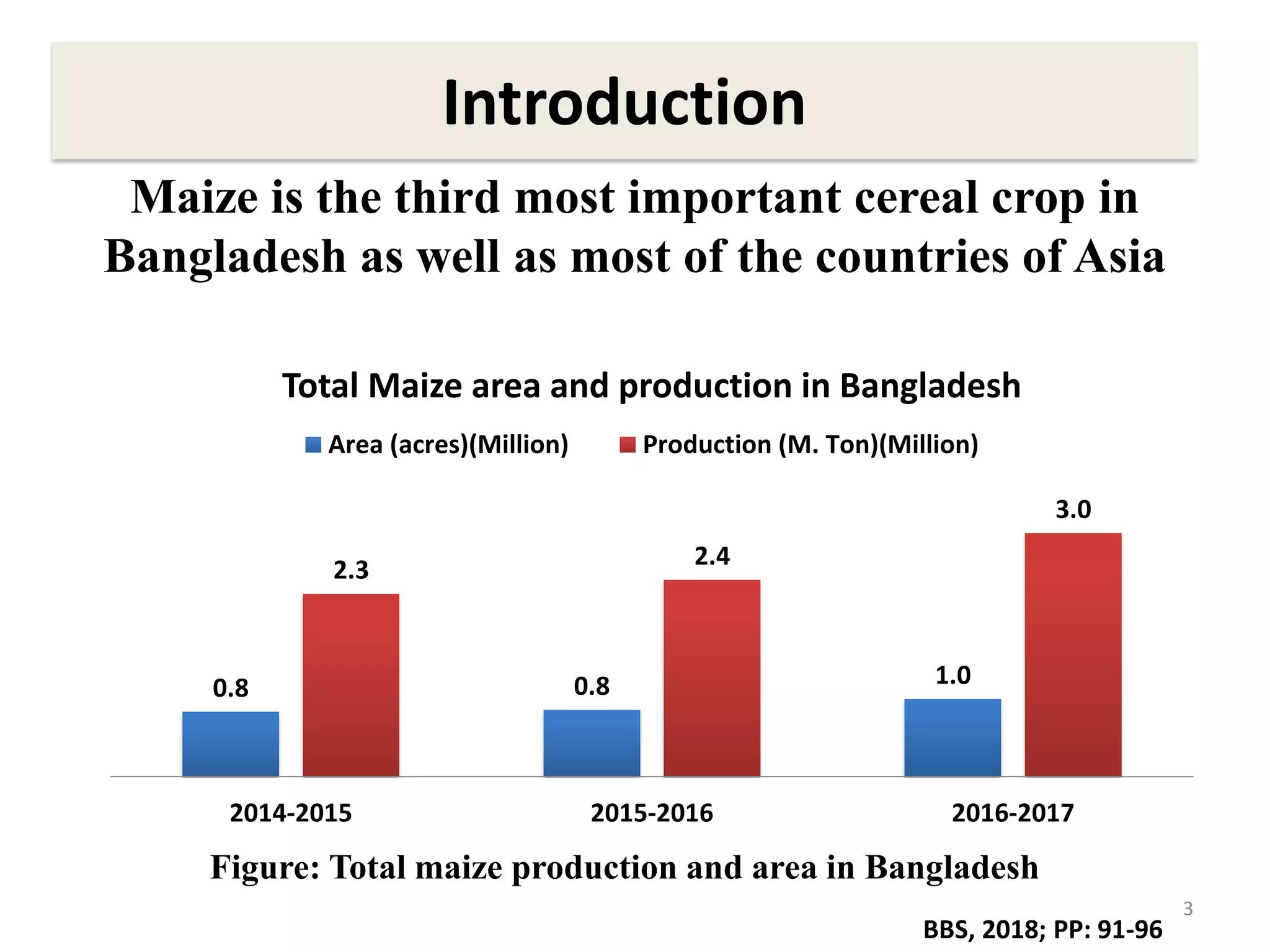
3
Introduction
Figure: Total maize production and area in Bangladesh
Maize is the third most important cereal crop in
Bangladesh as well as most of the countries of Asia
BBS, 2018; PP: 91-96
0.8 0.8 1.0
2.3 2.4
3.0
2014-2015 2015-2016 2016-2017
Total Maize area and production in Bangladesh
Area (acres)(Million) Production (M. Ton)(Million)
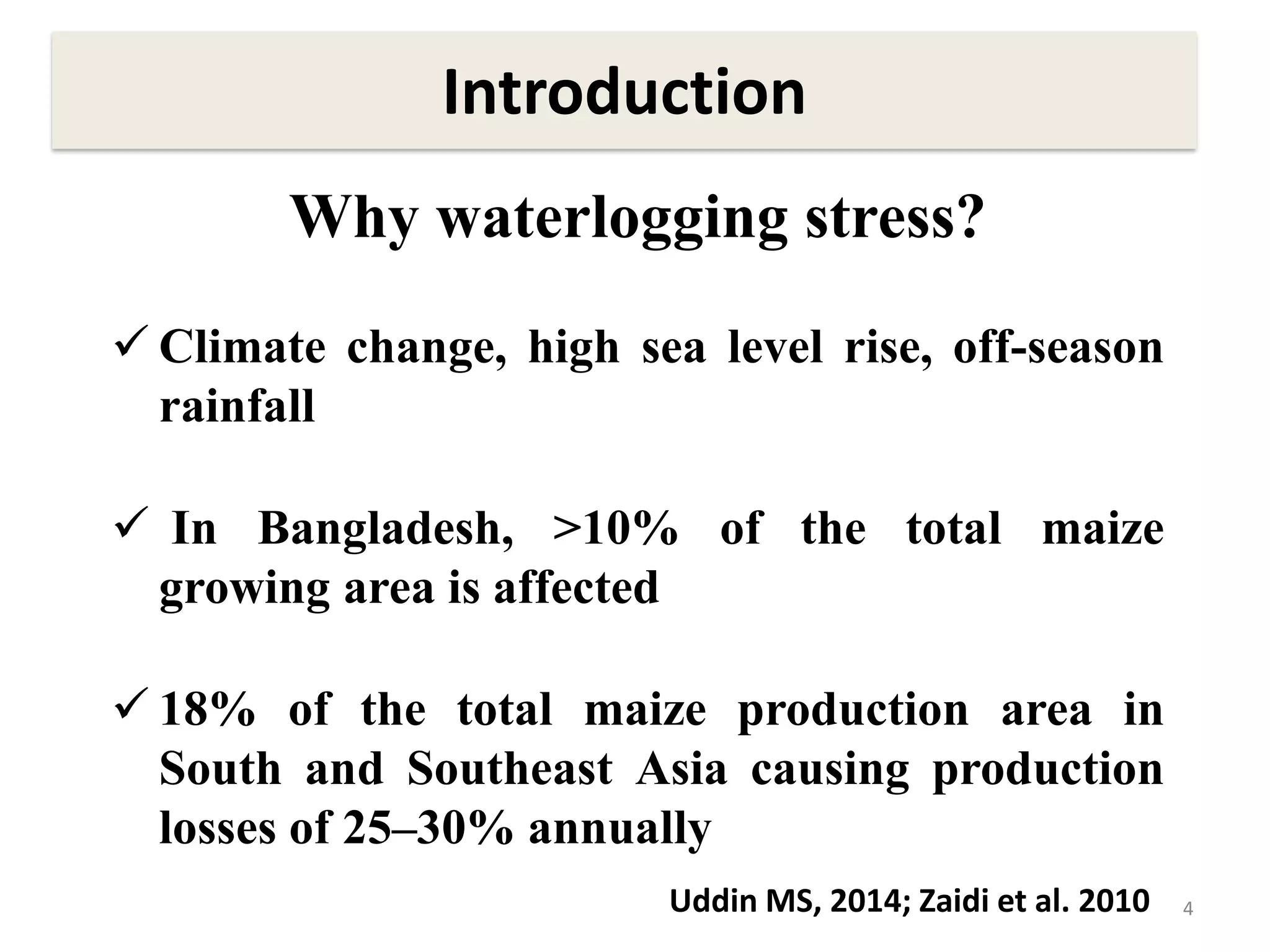
4
Why waterlogging stress?
 Climate change, high sea level rise, off-season
rainfall
 In Bangladesh, >10% of the total maize
growing area is affected
 18% of the total maize production area in
South and Southeast Asia causing production
losses of 25–30% annually
Introduction
Uddin MS, 2014; Zaidi et al. 2010
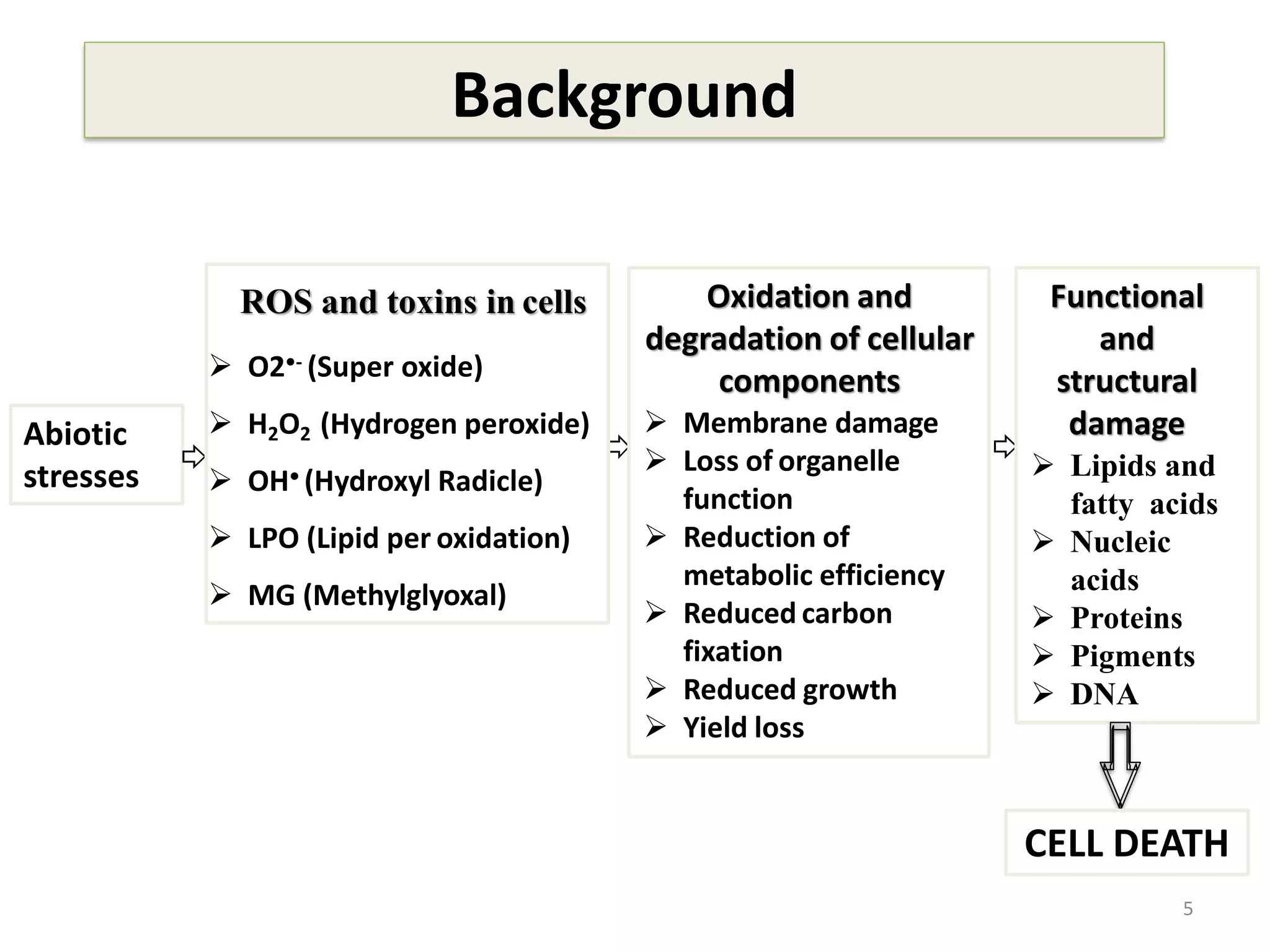
Background
5
Abiotic
stresses
Oxidation and
degradation of cellular
components
 Membrane damage
 Loss of organelle
function
 Reduction of
metabolic efficiency
 Reduced carbon
fixation
 Reduced growth
 Yield loss
Functional
and
structural
damage
 Lipids and
fatty acids
 Nucleic
acids
 Proteins
 Pigments
 DNA
CELL DEATH
ROS and toxins in cells
 O2•- (Super oxide)
 H2O2 (Hydrogen peroxide)
 OH• (Hydroxyl Radicle)
 LPO (Lipid per oxidation)
 MG (Methylglyoxal)
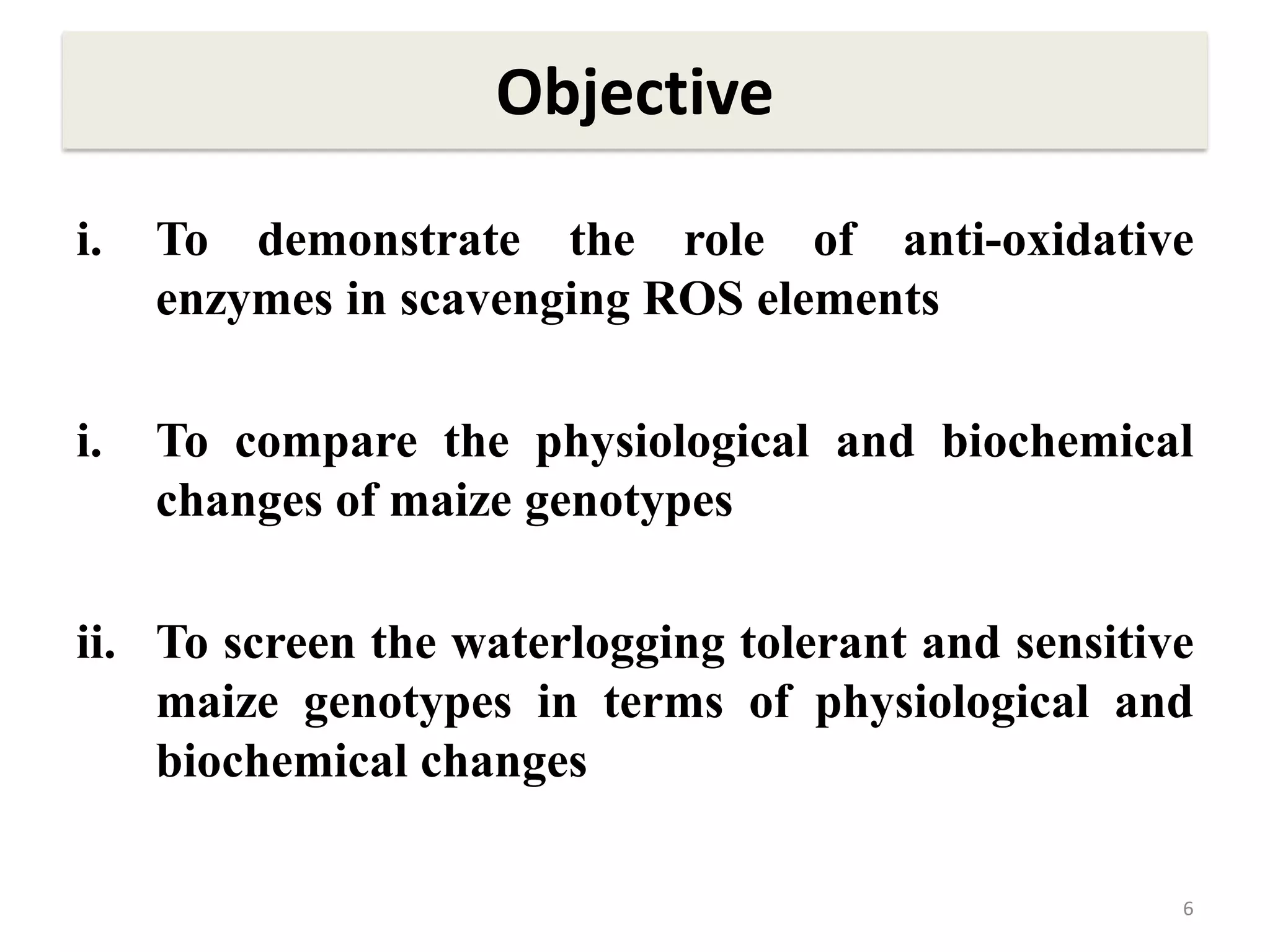
Objective
i. To demonstrate the role of anti-oxidative
enzymes in scavenging ROS elements
i. To compare the physiological and biochemical
changes of maize genotypes
ii. To screen the waterlogging tolerant and sensitive
maize genotypes in terms of physiological and
biochemical changes
6
7
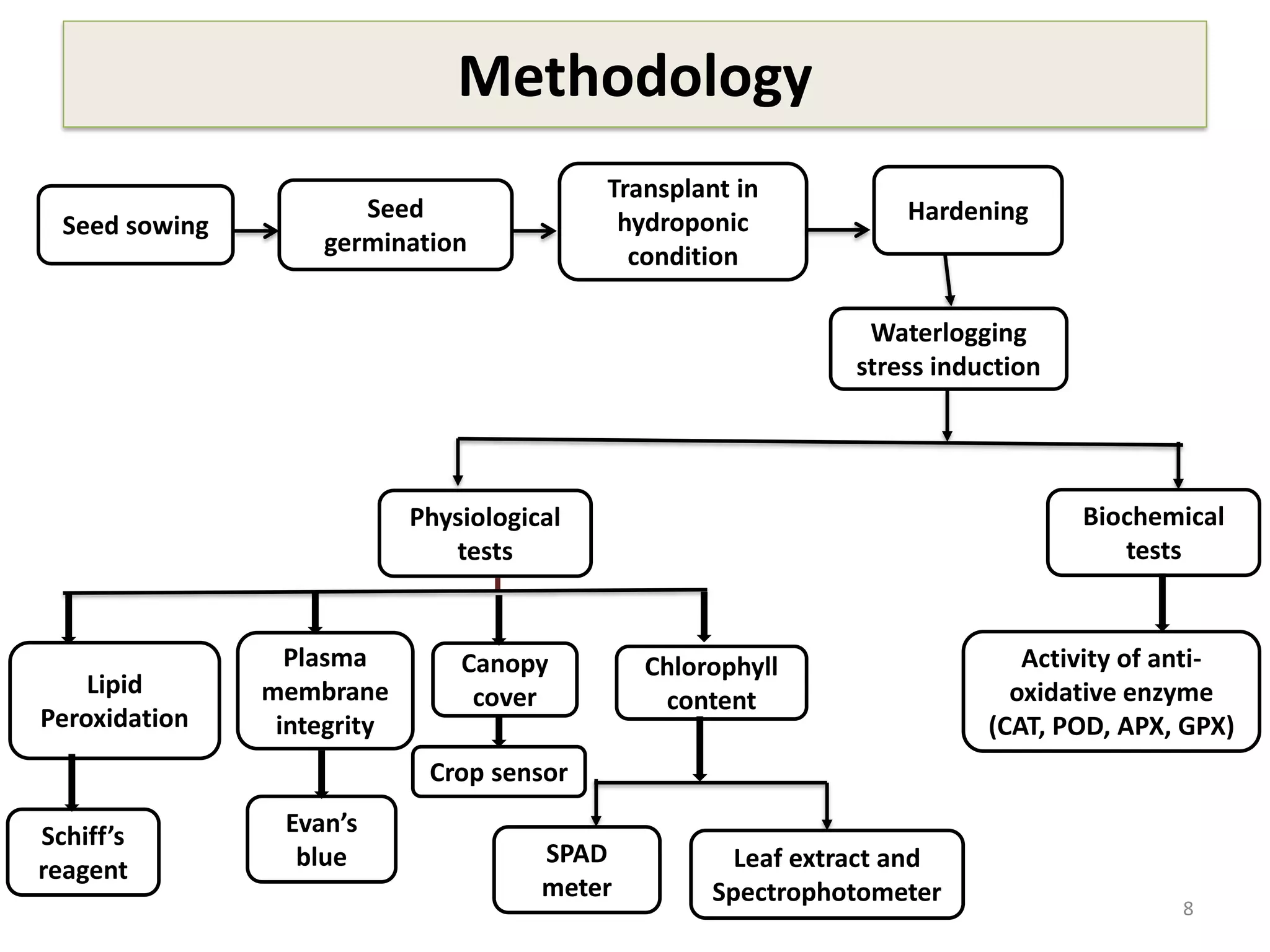
Methodology
8
Seed sowing
Seed
germination
Transplant in
hydroponic
condition
Hardening
Waterlogging
stress induction
Physiological
tests
Biochemical
tests
Plasma
membrane
integrity
Canopy
cover
Chlorophyll
content
Activity of anti-
oxidative enzyme
(CAT, POD, APX, GPX)
Lipid
Peroxidation
Leaf extract and
Spectrophotometer
SPAD
meter
Crop sensor
Evan’s
blue
Schiff’s
reagent
9
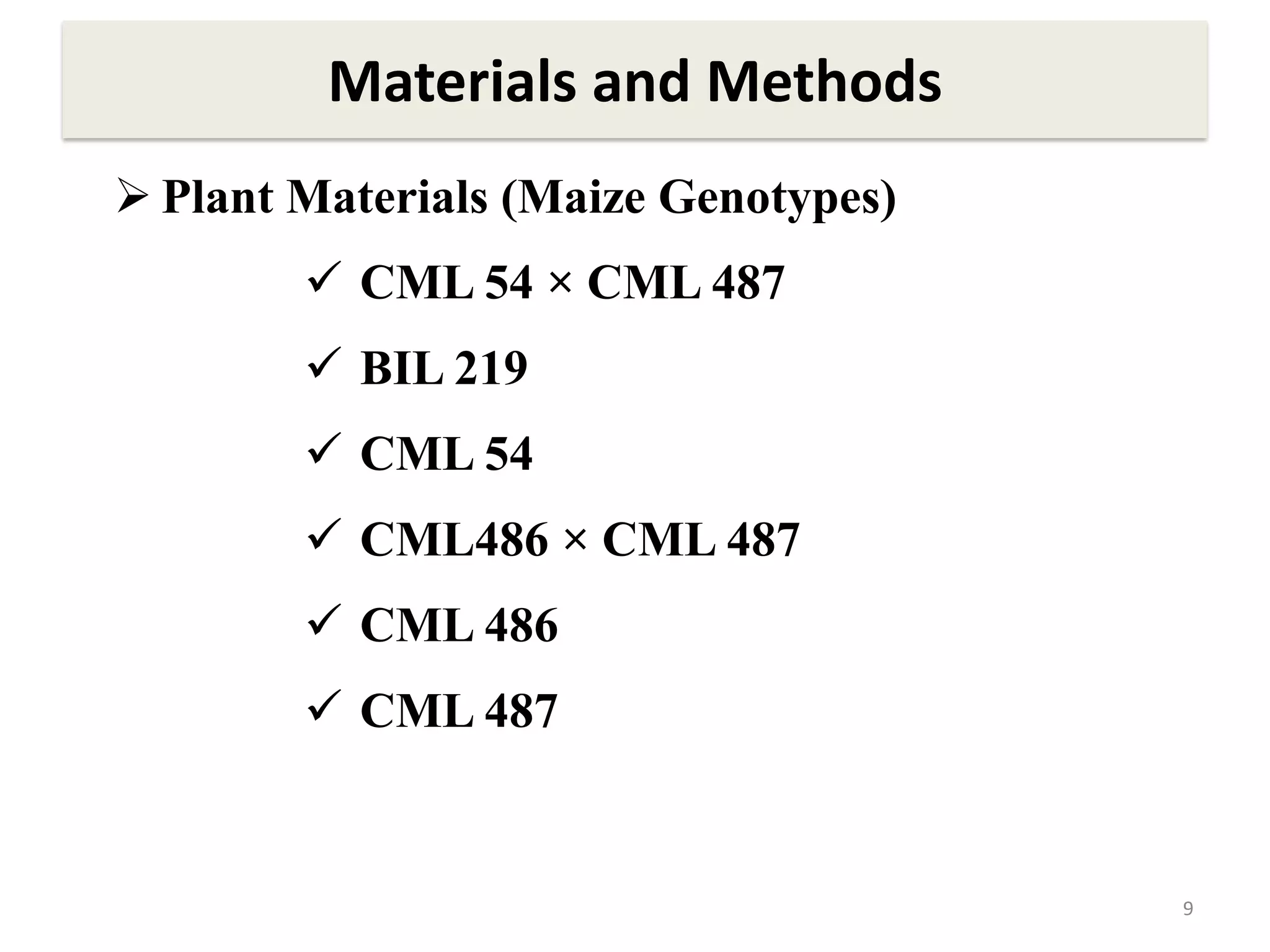
 Plant Materials (Maize Genotypes)
 CML 54 × CML 487
 BIL 219
 CML 54
 CML486 × CML 487
 CML 486
 CML 487
Materials and Methods
10
Materials and Methods
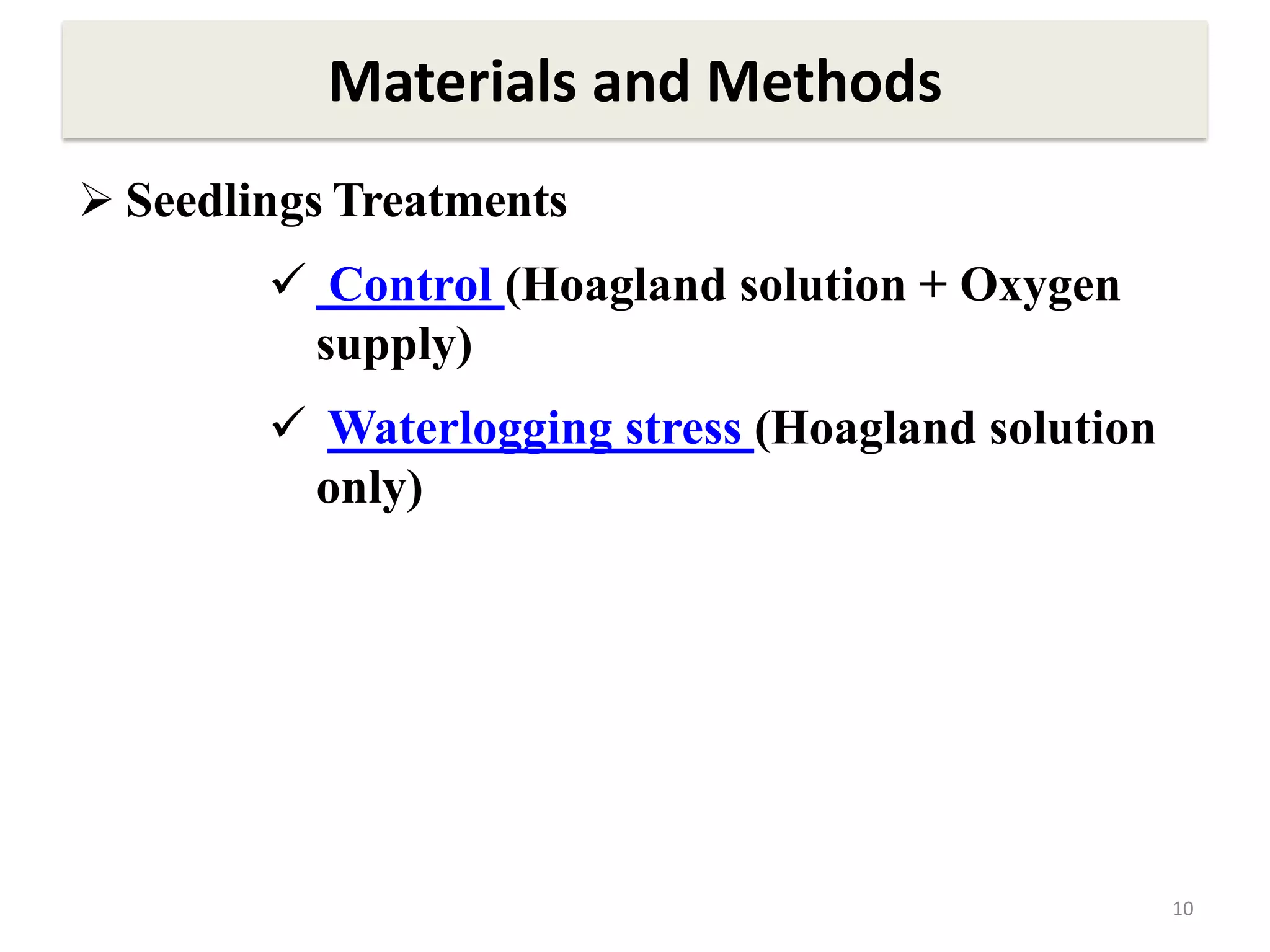
 Seedlings Treatments
 Control (Hoagland solution + Oxygen
supply)
 Waterlogging stress (Hoagland solution
only)
Materials and Methods
11
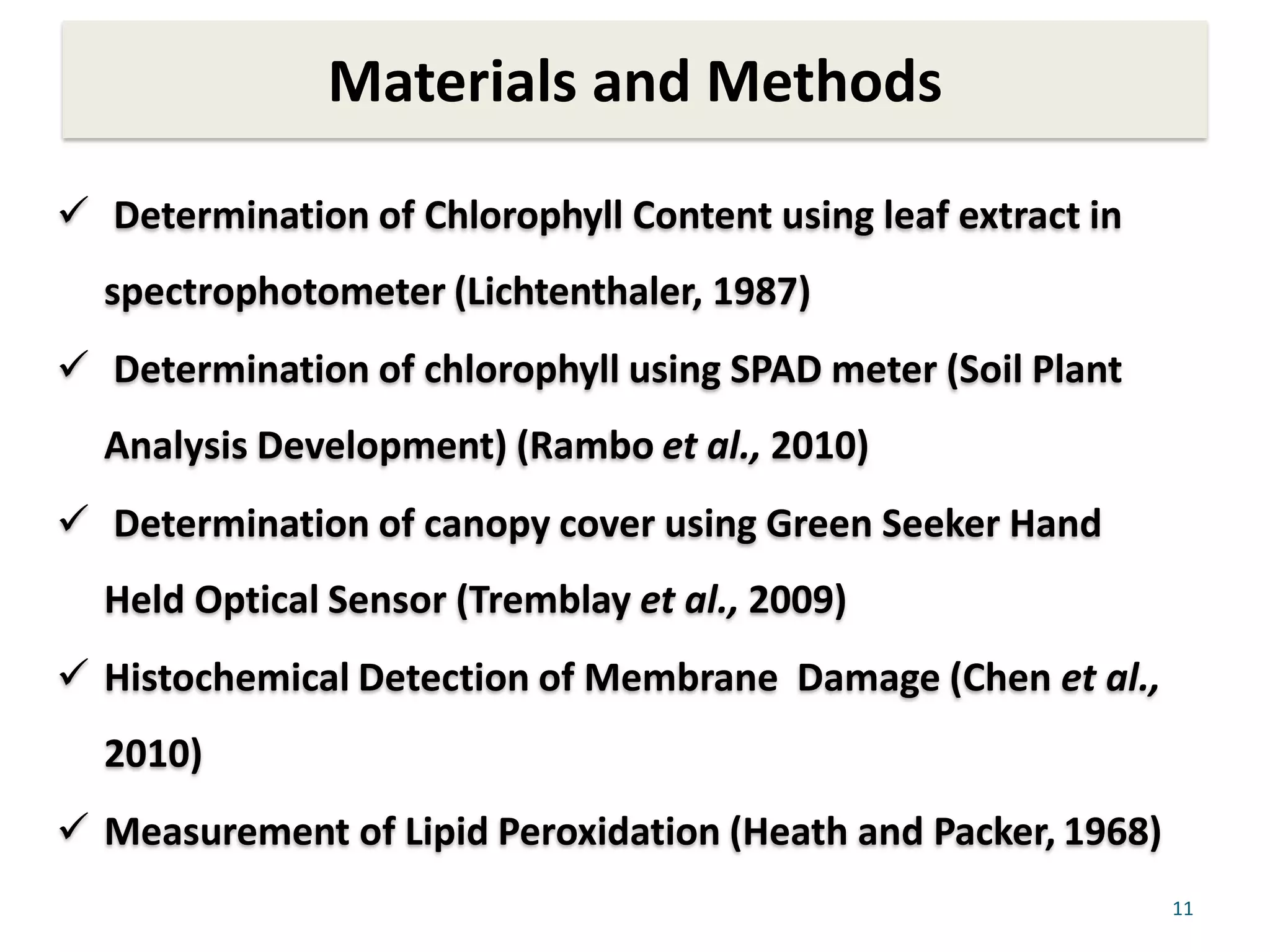
 Determination of Chlorophyll Content using leaf extract in
spectrophotometer (Lichtenthaler, 1987)
 Determination of chlorophyll using SPAD meter (Soil Plant
Analysis Development) (Rambo et al., 2010)
 Determination of canopy cover using Green Seeker Hand
Held Optical Sensor (Tremblay et al., 2009)
 Histochemical Detection of Membrane Damage (Chen et al.,
2010)
 Measurement of Lipid Peroxidation (Heath and Packer, 1968)
Materials and Methods
12
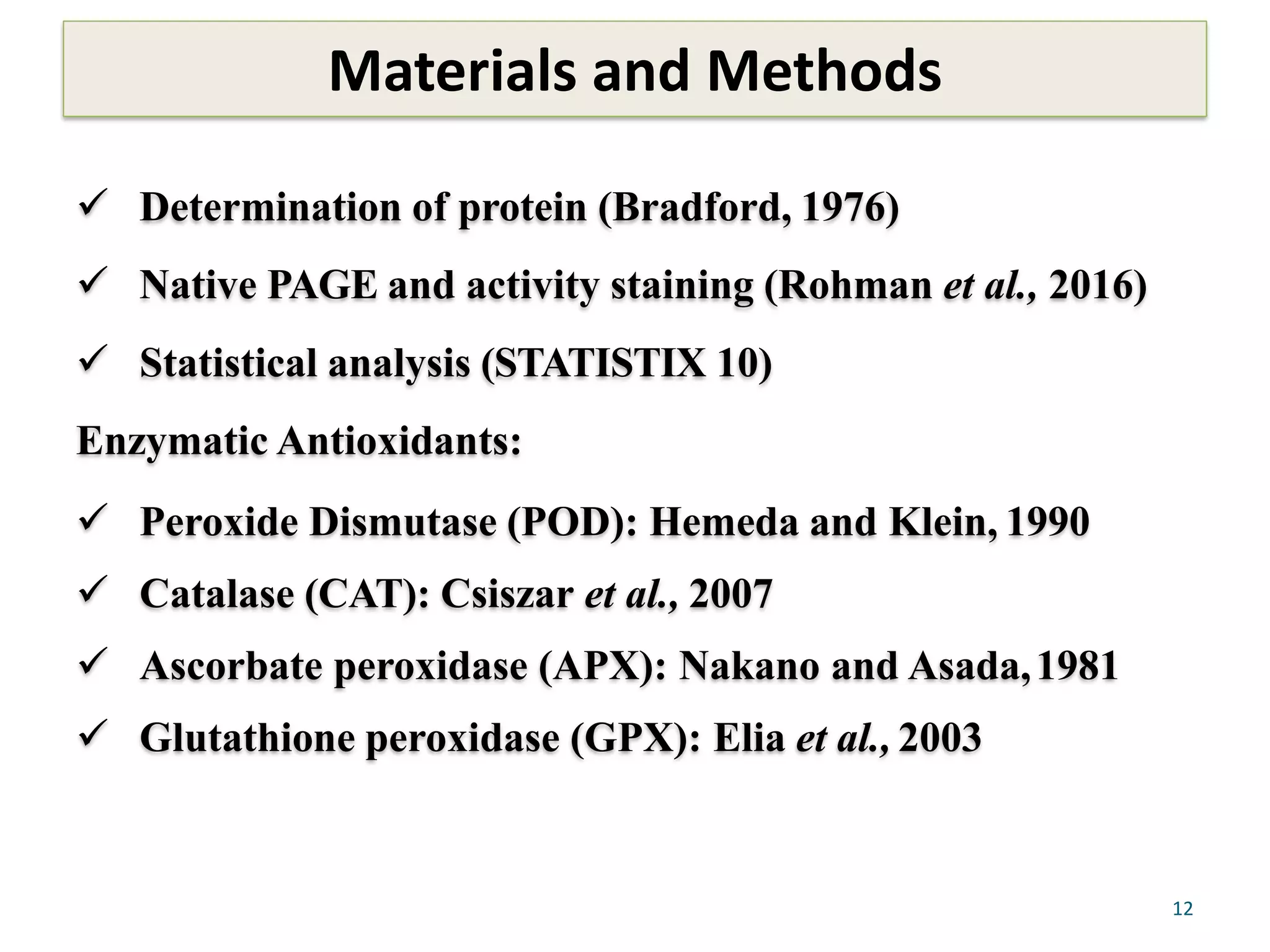
 Determination of protein (Bradford, 1976)
 Native PAGE and activity staining (Rohman et al., 2016)
 Statistical analysis (STATISTIX 10)
Enzymatic Antioxidants:
 Peroxide Dismutase (POD): Hemeda and Klein, 1990
 Catalase (CAT): Csiszar et al., 2007
 Ascorbate peroxidase (APX): Nakano and Asada,1981
 Glutathione peroxidase (GPX): Elia et al., 2003
13
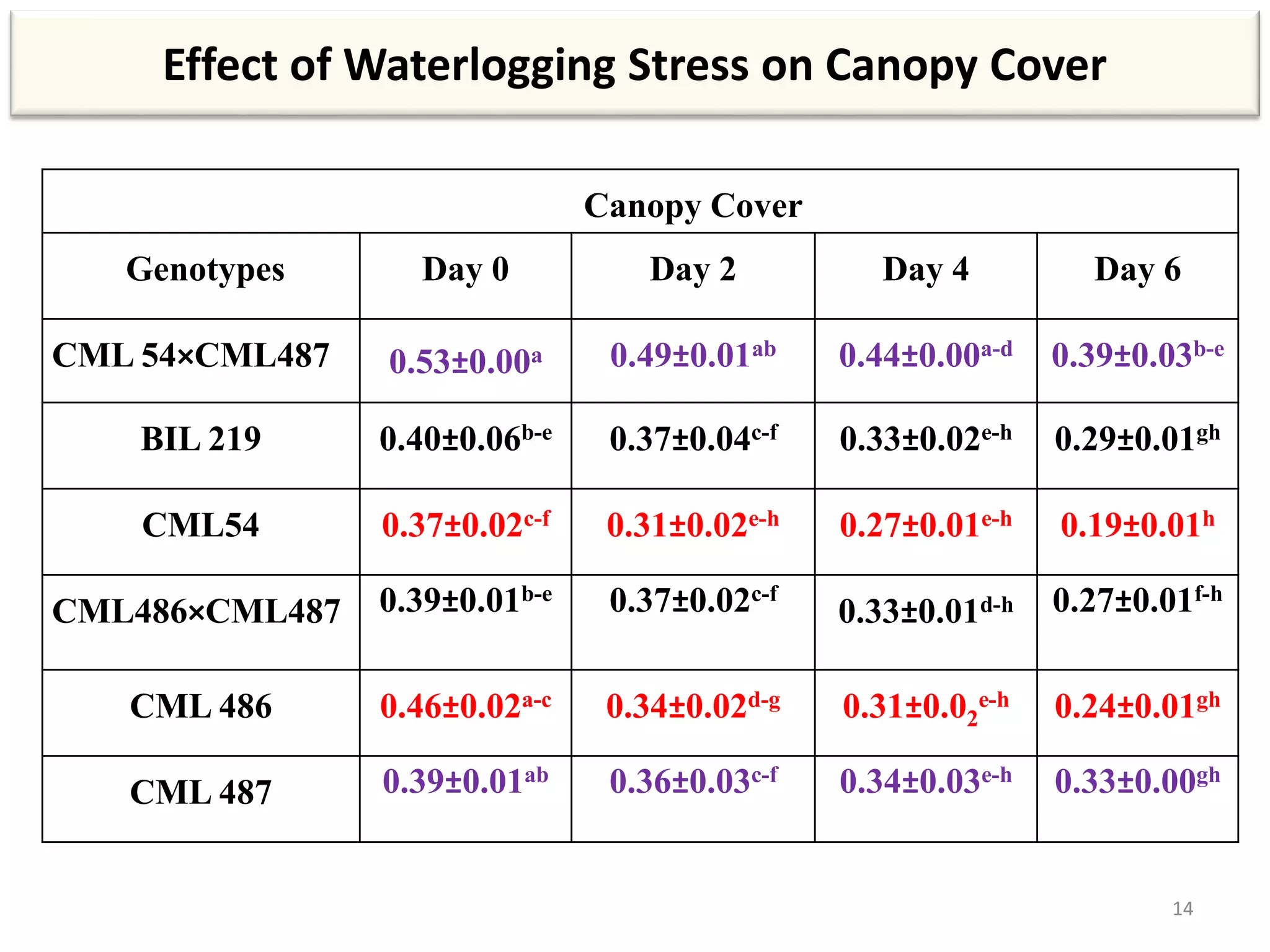
Effect of Waterlogging Stress on Canopy Cover
Canopy Cover
Genotypes Day 0 Day 2 Day 4 Day 6
CML 54×CML487 0.53±0.00a 0.49±0.01ab 0.44±0.00a-d 0.39±0.03b-e
BIL 219 0.40±0.06b-e 0.37±0.04c-f 0.33±0.02e-h 0.29±0.01gh
CML54 0.37±0.02c-f 0.31±0.02e-h 0.27±0.01e-h 0.19±0.01h
CML486×CML487 0.39±0.01b-e 0.37±0.02c-f
0.33±0.01d-h 0.27±0.01f-h
CML 486 0.46±0.02a-c 0.34±0.02d-g 0.31±0.02
e-h 0.24±0.01gh
CML 487 0.39±0.01ab 0.36±0.03c-f 0.34±0.03e-h 0.33±0.00gh
14
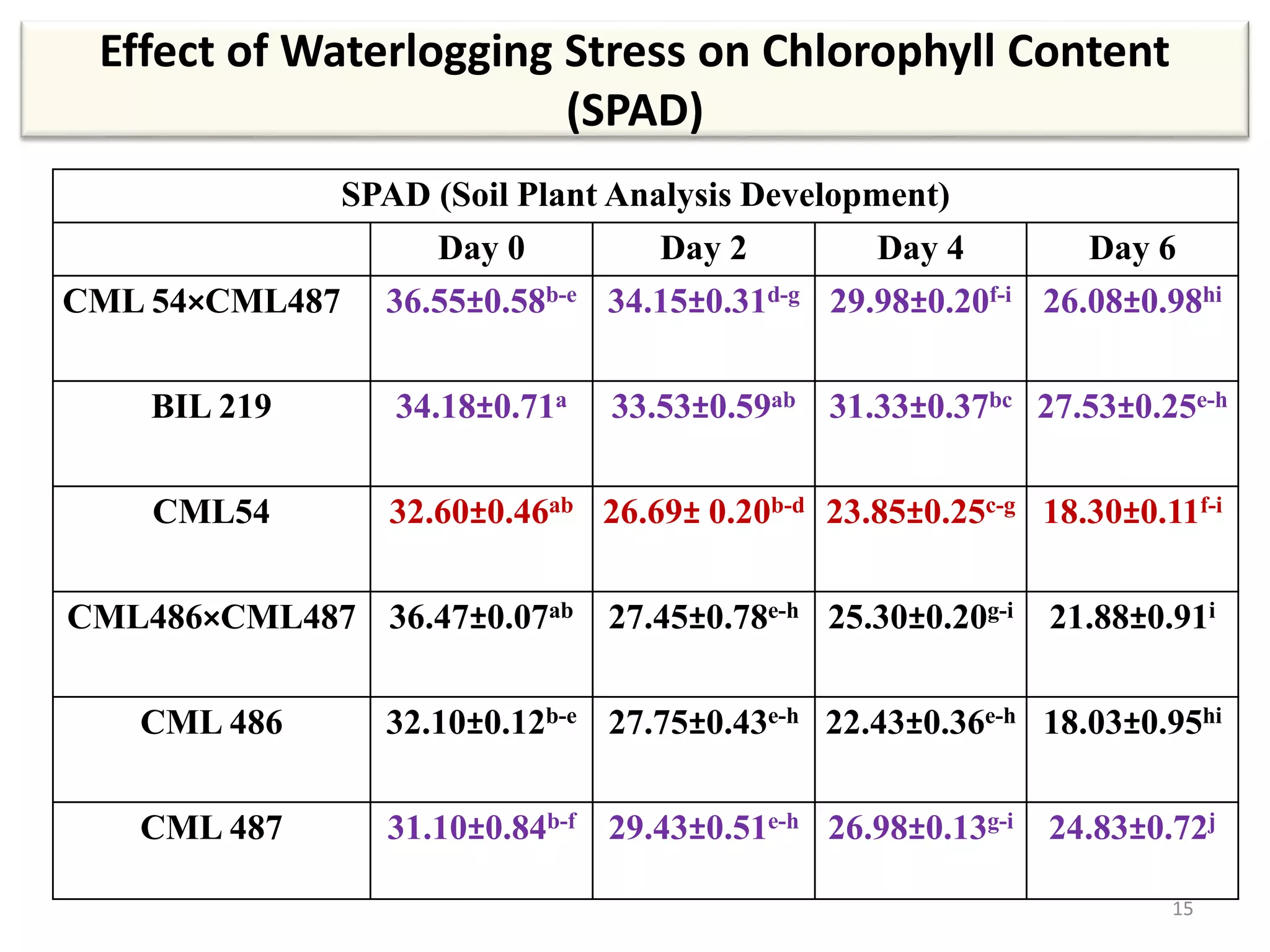
Effect of Waterlogging Stress on Chlorophyll Content
(SPAD)
SPAD (Soil Plant Analysis Development)
Day 0 Day 2 Day 4 Day 6
CML 54×CML487 36.55±0.58b-e 34.15±0.31d-g 29.98±0.20f-i 26.08±0.98hi
BIL 219 34.18±0.71a 33.53±0.59ab 31.33±0.37bc 27.53±0.25e-h
CML54 32.60±0.46ab 26.69± 0.20b-d 23.85±0.25c-g 18.30±0.11f-i
CML486×CML487 36.47±0.07ab 27.45±0.78e-h 25.30±0.20g-i 21.88±0.91i
CML 486 32.10±0.12b-e 27.75±0.43e-h 22.43±0.36e-h 18.03±0.95hi
CML 487 31.10±0.84b-f 29.43±0.51e-h 26.98±0.13g-i 24.83±0.72j
15
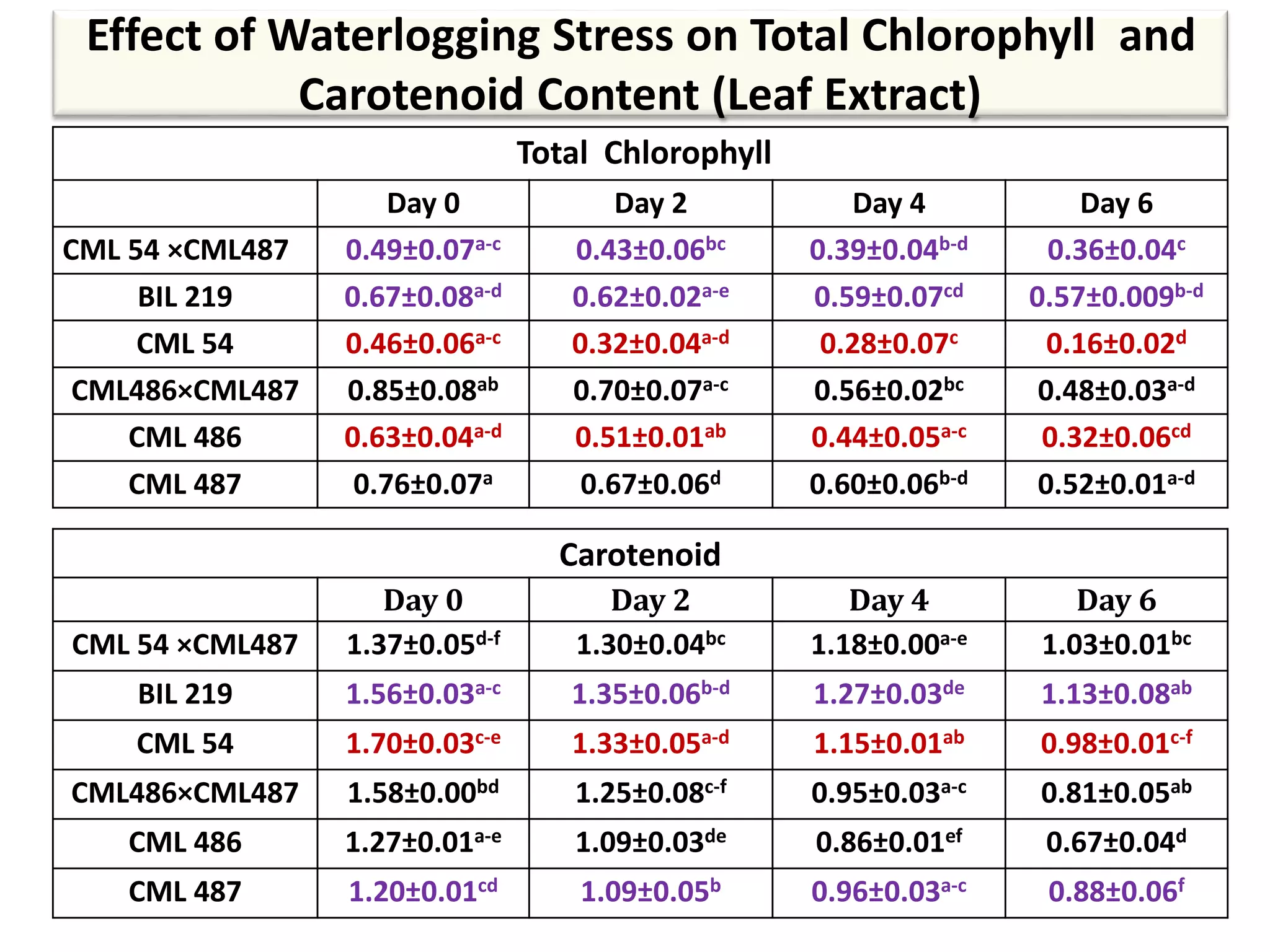
Effect of Waterlogging Stress on Total Chlorophyll and
Carotenoid Content (Leaf Extract)
Total Chlorophyll
Day 0 Day 2 Day 4 Day 6
CML 54 ×CML487 0.49±0.07a-c 0.43±0.06bc 0.39±0.04b-d 0.36±0.04c
BIL 219 0.67±0.08a-d 0.62±0.02a-e 0.59±0.07cd 0.57±0.009b-d
CML 54 0.46±0.06a-c 0.32±0.04a-d 0.28±0.07c 0.16±0.02d
CML486×CML487 0.85±0.08ab 0.70±0.07a-c 0.56±0.02bc 0.48±0.03a-d
CML 486 0.63±0.04a-d 0.51±0.01ab 0.44±0.05a-c 0.32±0.06cd
CML 487 0.76±0.07a 0.67±0.06d 0.60±0.06b-d 0.52±0.01a-d
16
Carotenoid
Day 0 Day 2 Day 4 Day 6
CML 54 ×CML487 1.37±0.05d-f 1.30±0.04bc 1.18±0.00a-e 1.03±0.01bc
BIL 219 1.56±0.03a-c 1.35±0.06b-d 1.27±0.03de 1.13±0.08ab
CML 54 1.70±0.03c-e 1.33±0.05a-d 1.15±0.01ab 0.98±0.01c-f
CML486×CML487 1.58±0.00bd 1.25±0.08c-f 0.95±0.03a-c 0.81±0.05ab
CML 486 1.27±0.01a-e 1.09±0.03de 0.86±0.01ef 0.67±0.04d
CML 487 1.20±0.01cd 1.09±0.05b 0.96±0.03a-c 0.88±0.06f
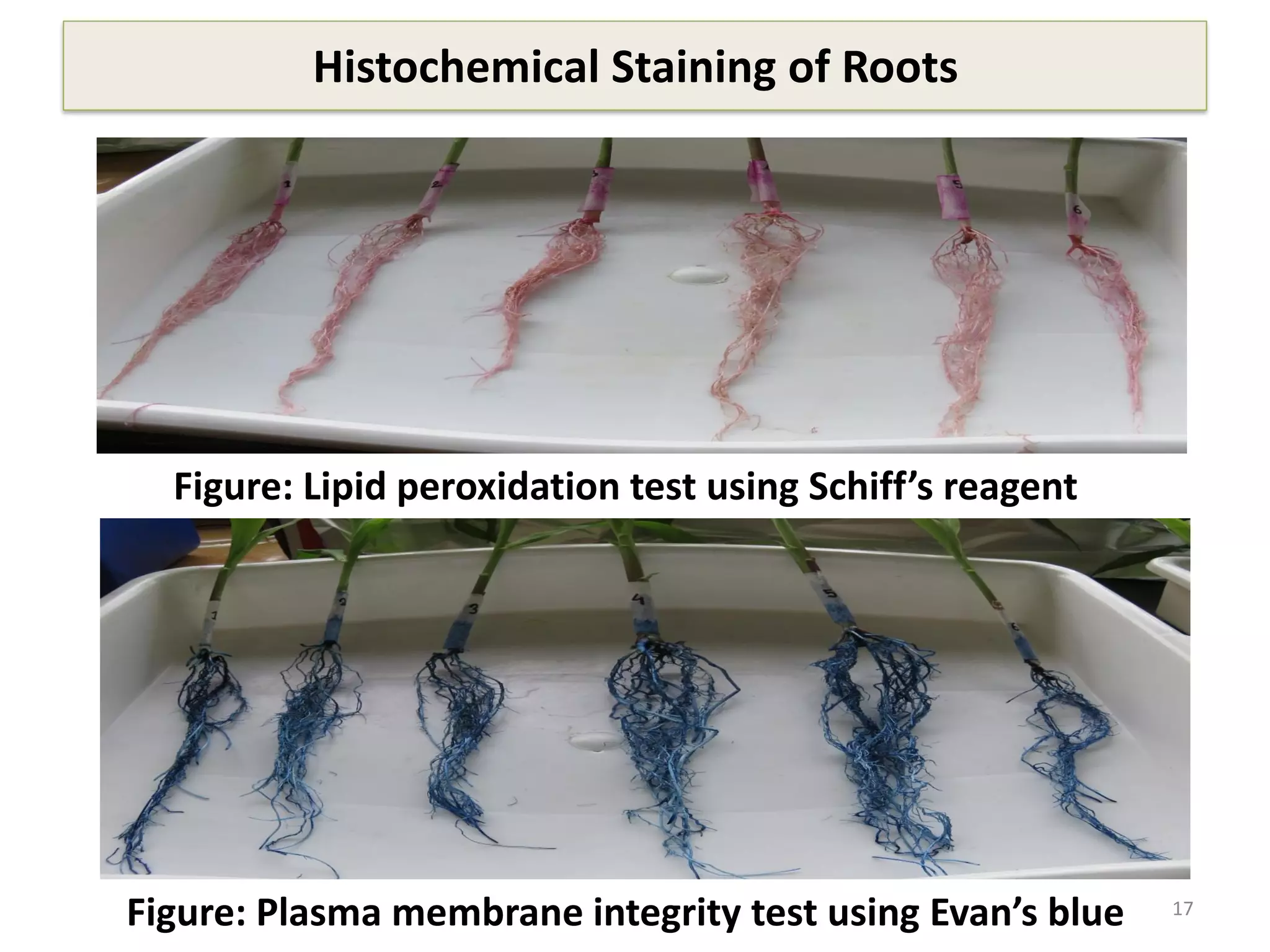
Histochemical Staining of Roots
17
Figure: Lipid peroxidation test using Schiff’s reagent
Figure: Plasma membrane integrity test using Evan’s blue
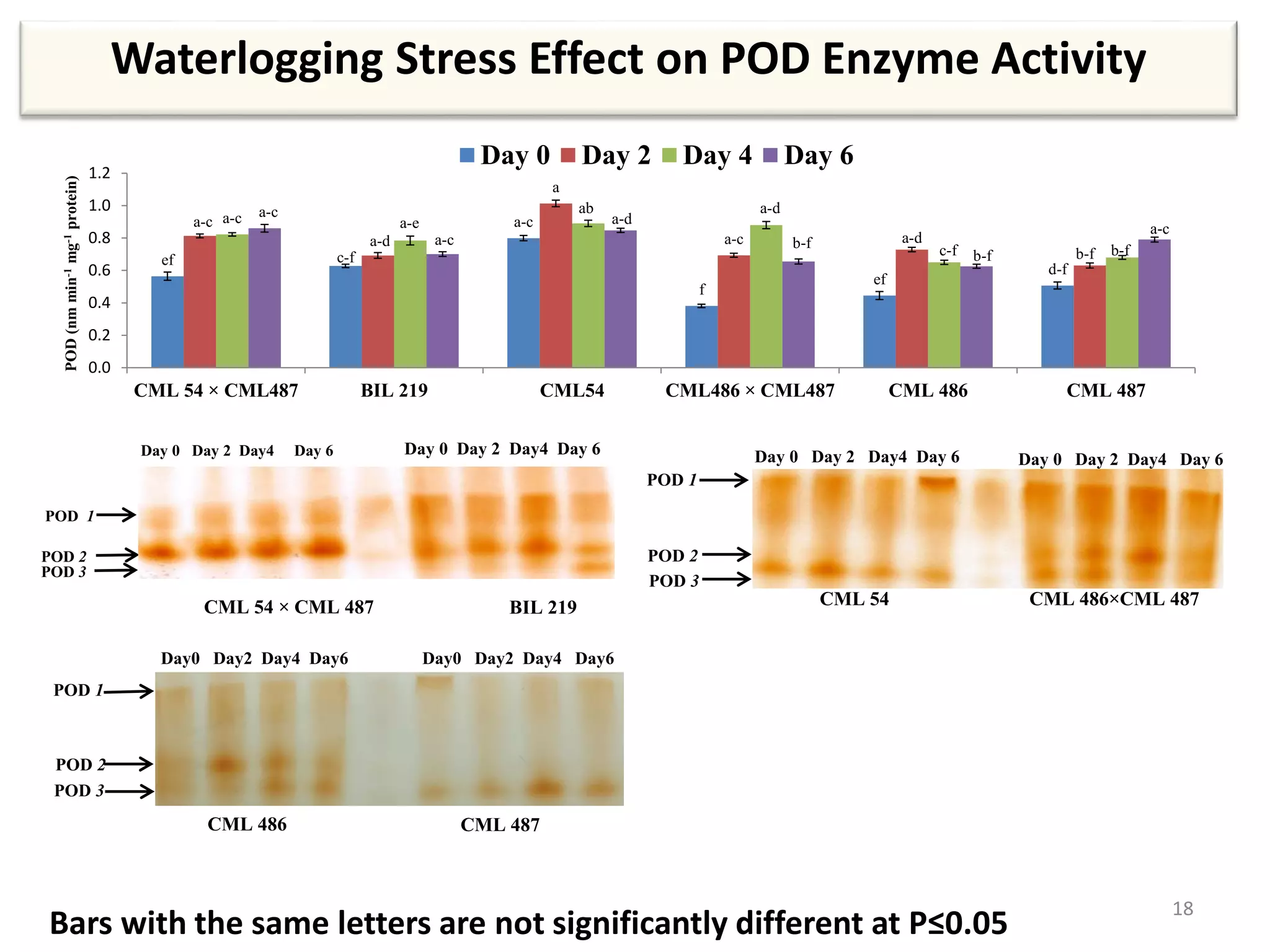
Waterlogging Stress Effect on POD Enzyme Activity
18
Bars with the same letters are not significantly different at P≤0.05
Day 0 Day 2 Day4 Day 6 Day 0 Day 2 Day4 Day 6
CML 54 × CML 487 BIL 219
POD 1
POD 2
POD 3
Day 0 Day 2 Day4 Day 6 Day 0 Day 2 Day4 Day 6
CML 54 CML 486×CML 487
POD 1
POD 2
POD 3
Day0 Day2 Day4 Day6 Day0 Day2 Day4 Day6
CML 486 CML 487
POD 1
POD 2
POD 3
ef c-f
a-c
f
ef
d-f
a-c
a-d
a
a-c a-d
b-f
a-c a-c
a-e a-d
b-f
b-f
a-c
0.0
0.2
0.4
0.6
0.8
1.0
1.2
CML 54 × CML487 BIL 219 CML54 CML486 × CML487 CML 486 CML 487
POD(nmmin-1mg-1protein)
Day 0 Day 2 Day 4 Day 6
a-c
ab
c-f
a-d
b-f
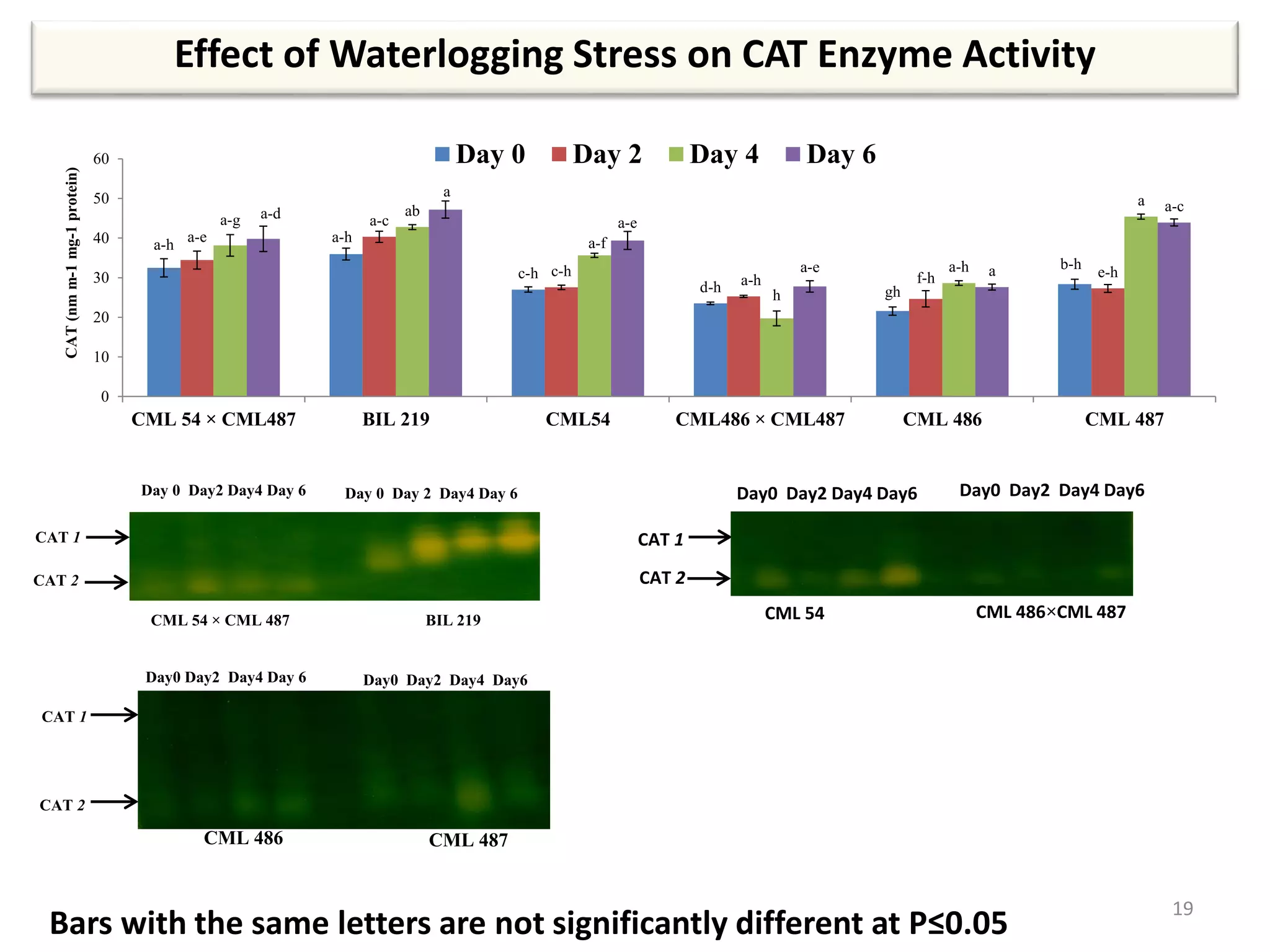
Effect of Waterlogging Stress on CAT Enzyme Activity
19
Day 0 Day2 Day4 Day 6 Day 0 Day 2 Day4 Day 6
CML 54 × CML 487 BIL 219
CAT 1
CAT 2
Day0 Day2 Day4 Day6 Day0 Day2 Day4 Day6
CML 54 CML 486×CML 487
CAT 1
CAT 2
Bars with the same letters are not significantly different at P≤0.05
Day0 Day2 Day4 Day 6 Day0 Day2 Day4 Day6
CML 486 CML 487
CAT 1
CAT 2
a-h a-h
c-h
d-h gh
b-h
a-e
a-c
c-h
a-h f-h e-h
a-g
ab
a-f
h
a-h
a
a-d
a
a-e
a-e a
a-c
0
10
20
30
40
50
60
CML 54 × CML487 BIL 219 CML54 CML486 × CML487 CML 486 CML 487
CAT(nmm-1mg-1protein)
Day 0 Day 2 Day 4 Day 6
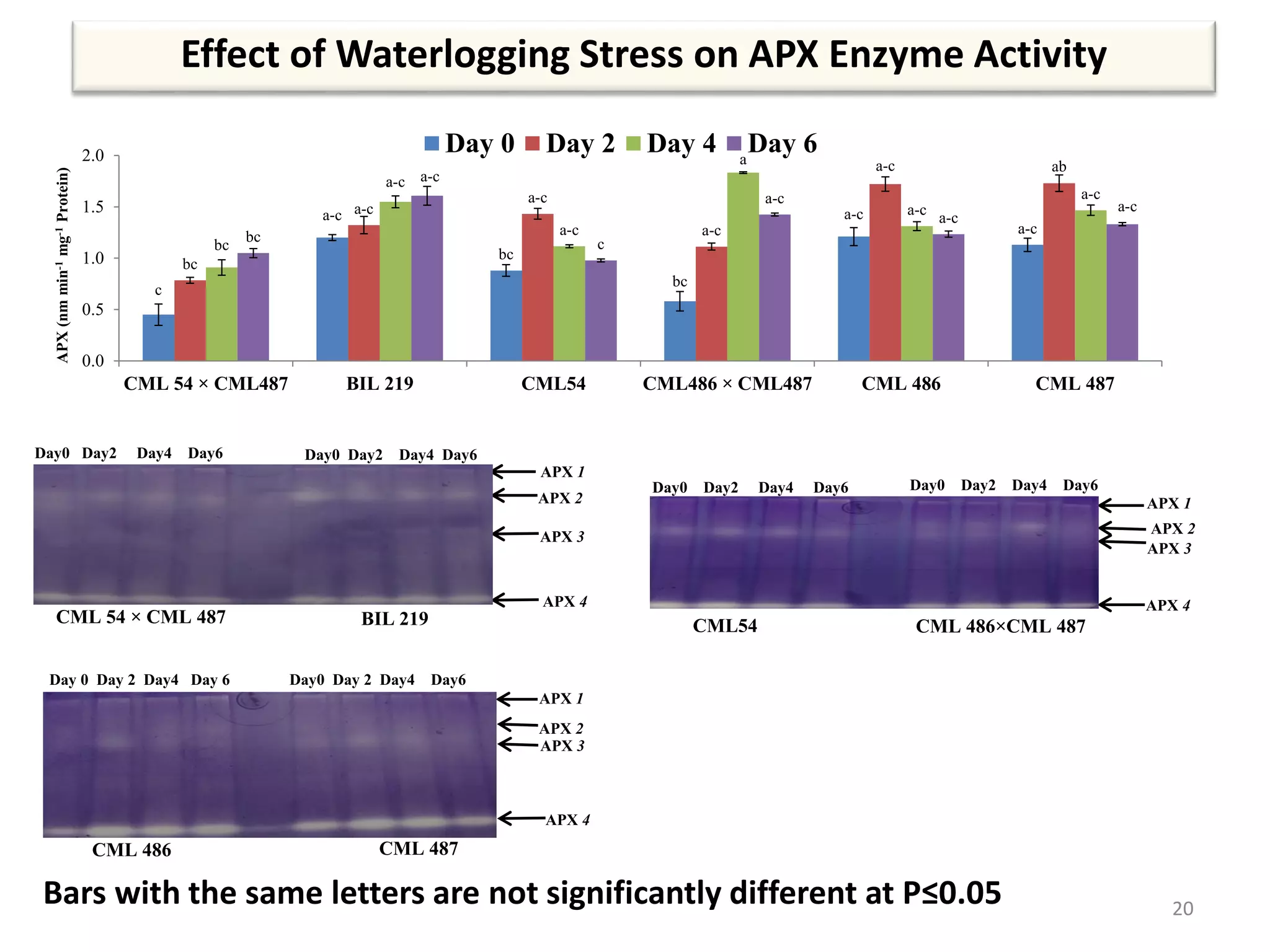
Effect of Waterlogging Stress on APX Enzyme Activity
20
Bars with the same letters are not significantly different at P≤0.05
c
a-c
bc
bc
a-c
a-c
bc
a-c
a-c
a-c
a-c ab
bc
a-c
a-c
a
a-c
a-c
bc
a-c
c
a-c
a-c
a-c
0.0
0.5
1.0
1.5
2.0
CML 54 × CML487 BIL 219 CML54 CML486 × CML487 CML 486 CML 487
APX(nmmin-1mg-1Protein)
Day 0 Day 2 Day 4 Day 6
Day0 Day2 Day4 Day6 Day0 Day2 Day4 Day6
CML54 CML 486×CML 487
APX 1
APX 2
APX 3
APX 4
Day0 Day2 Day4 Day6 Day0 Day2 Day4 Day6
CML 54 × CML 487 BIL 219
APX 1
APX 2
APX 3
APX 4
Day 0 Day 2 Day4 Day 6 Day0 Day 2 Day4 Day6
CML 486 CML 487
APX 1
APX 4
APX 2
APX 3
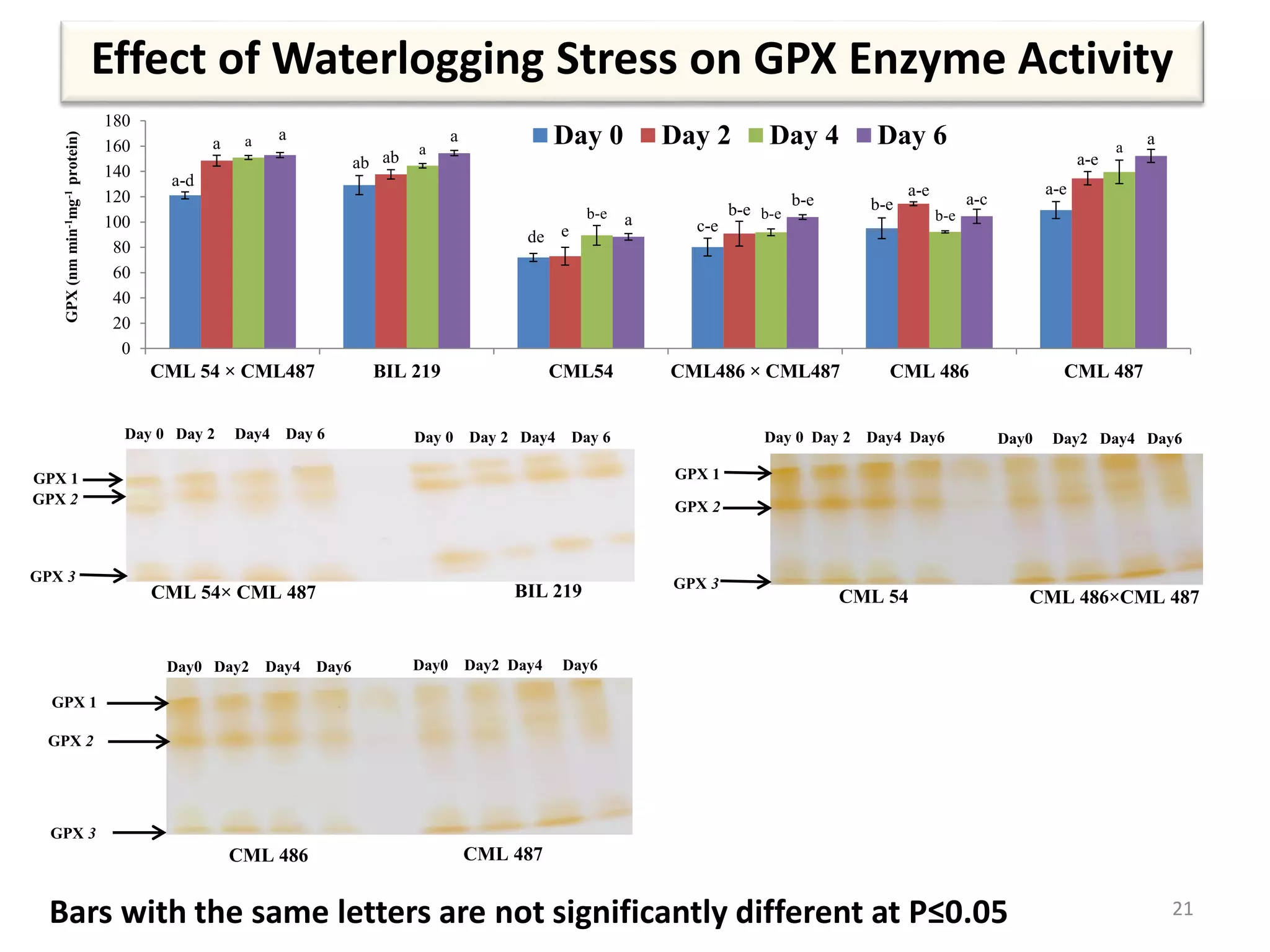
Effect of Waterlogging Stress on GPX Enzyme Activity
21Bars with the same letters are not significantly different at P≤0.05
Day 0 Day 2 Day4 Day 6 Day 0 Day 2 Day4 Day 6
GPX 1
GPX 2
BIL 219CML 54× CML 487
GPX 3
Day 0 Day 2 Day4 Day6 Day0 Day2 Day4 Day6
CML 54
GPX 1
GPX 2
CML 486×CML 487
GPX 3
Day0 Day2 Day4 Day6 Day0 Day2 Day4 Day6
GPX 1
GPX 2
GPX 3
CML 486 CML 487
a-d
ab
de
c-e
b-e
a-e
a
ab
e
b-e
a-e
a-e
a
a
b-e b-e b-e
a
a a
a
b-e a-c
a
0
20
40
60
80
100
120
140
160
180
CML 54 × CML487 BIL 219 CML54 CML486 × CML487 CML 486 CML 487
GPX(nmmin-1mg-1protein)
Day 0 Day 2 Day 4 Day 6
22
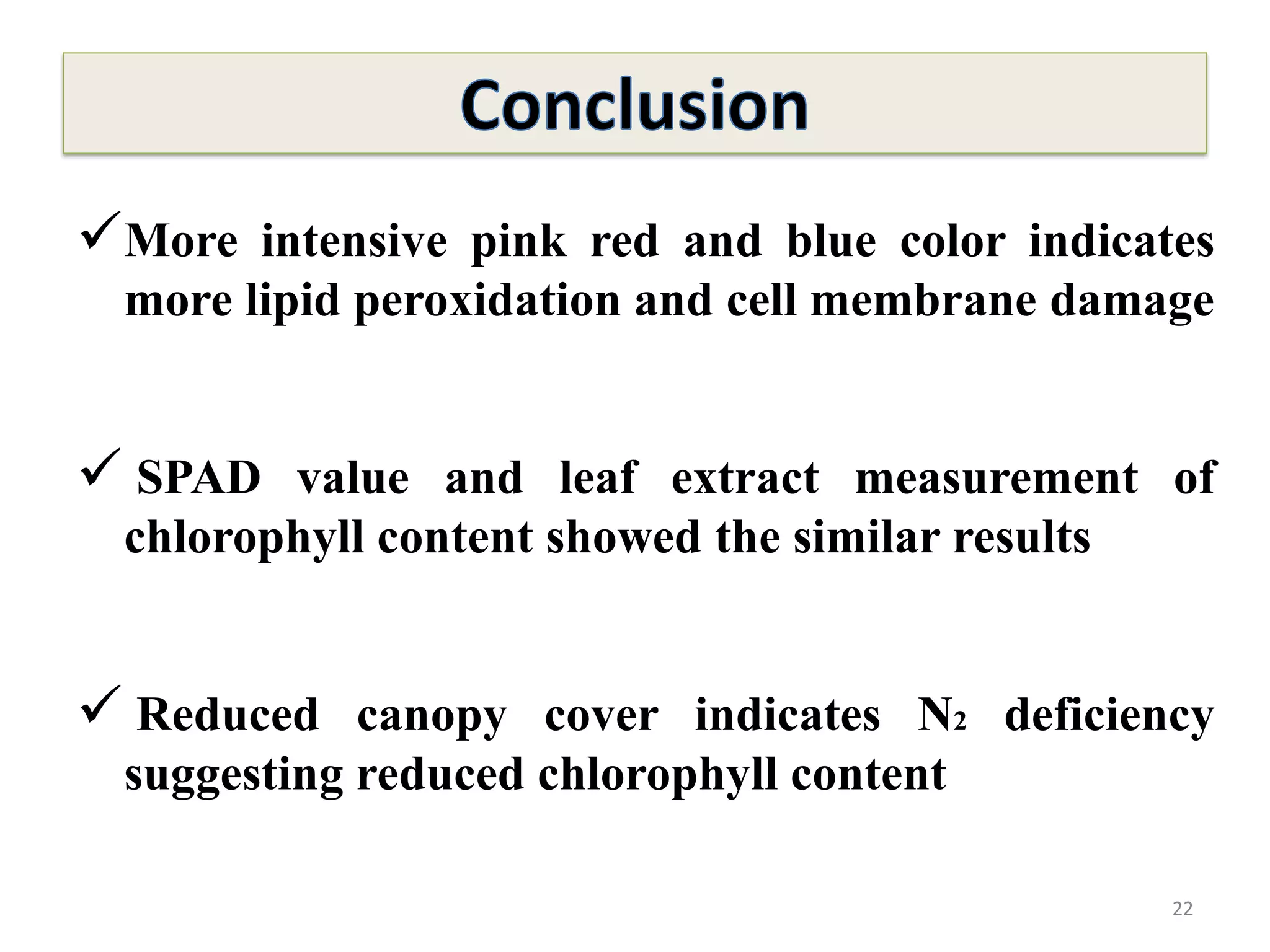
More intensive pink red and blue color indicates
more lipid peroxidation and cell membrane damage
 SPAD value and leaf extract measurement of
chlorophyll content showed the similar results
 Reduced canopy cover indicates N2 deficiency
suggesting reduced chlorophyll content
23
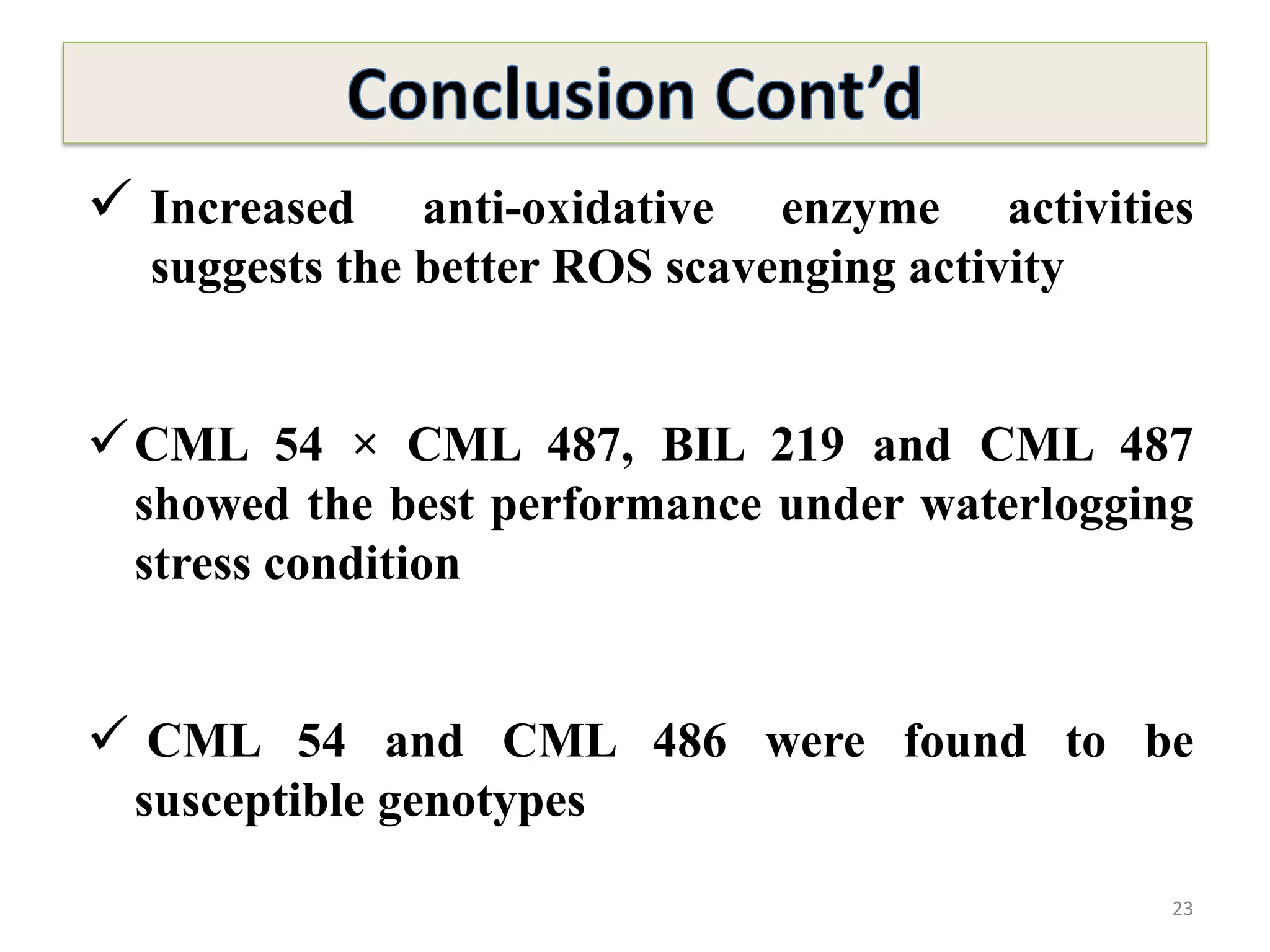
 Increased anti-oxidative enzyme activities
suggests the better ROS scavenging activity
CML 54 × CML 487, BIL 219 and CML 487
showed the best performance under waterlogging
stress condition
 CML 54 and CML 486 were found to be
susceptible genotypes
24
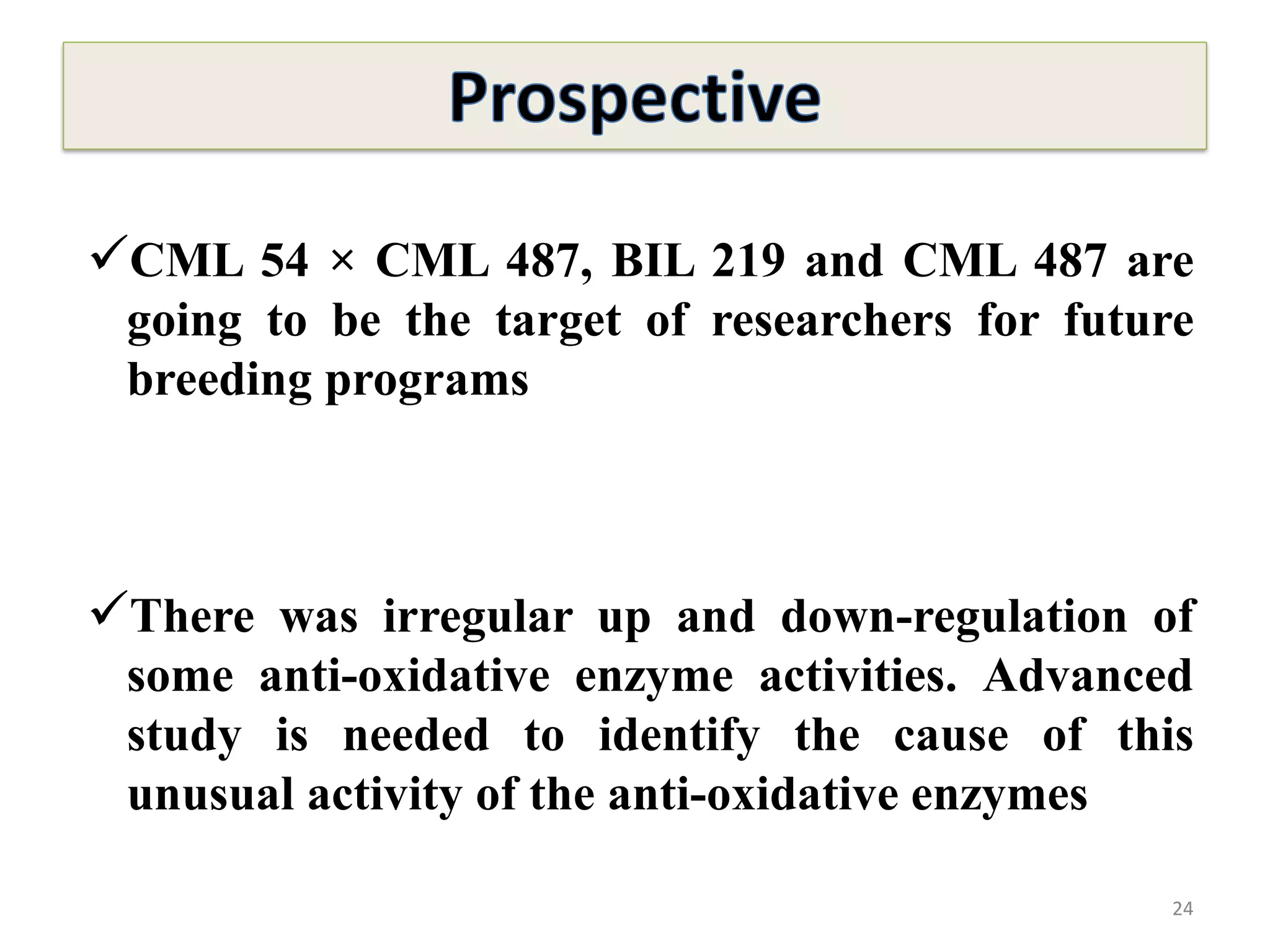
CML 54 × CML 487, BIL 219 and CML 487 are
going to be the target of researchers for future
breeding programs
There was irregular up and down-regulation of
some anti-oxidative enzyme activities. Advanced
study is needed to identify the cause of this
unusual activity of the anti-oxidative enzymes
25
 Biotechnology & Genetic Engineering Discipline,
Khulna University, Bangladesh.
 Molecular Breeding Laboratory, Bangladesh
Agricultural Research Institute (BARI).
 Organizing Committee of 13th Asian Maize
Conference.
26
27
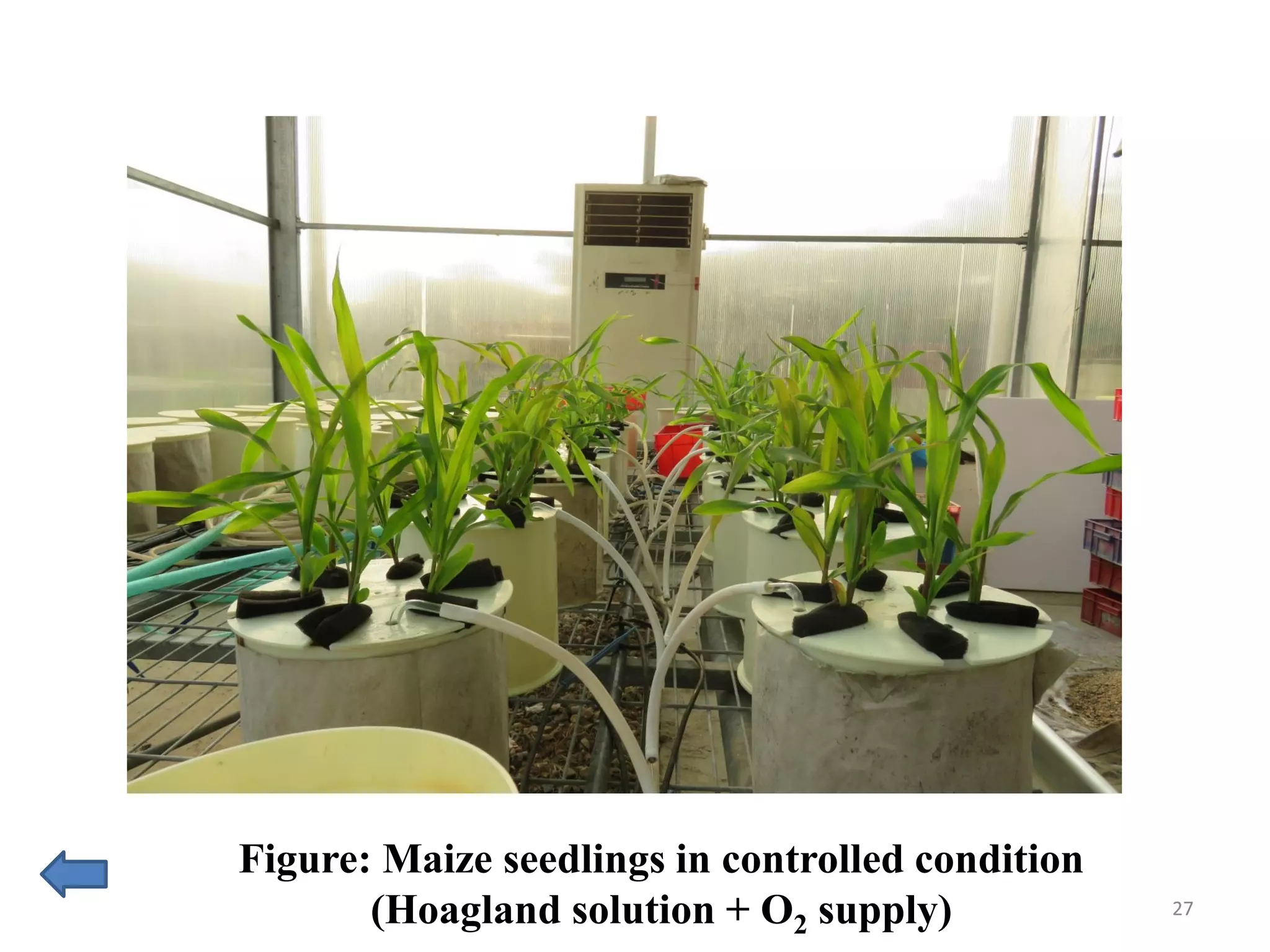
Figure: Maize seedlings in controlled condition
(Hoagland solution + O2 supply)
28
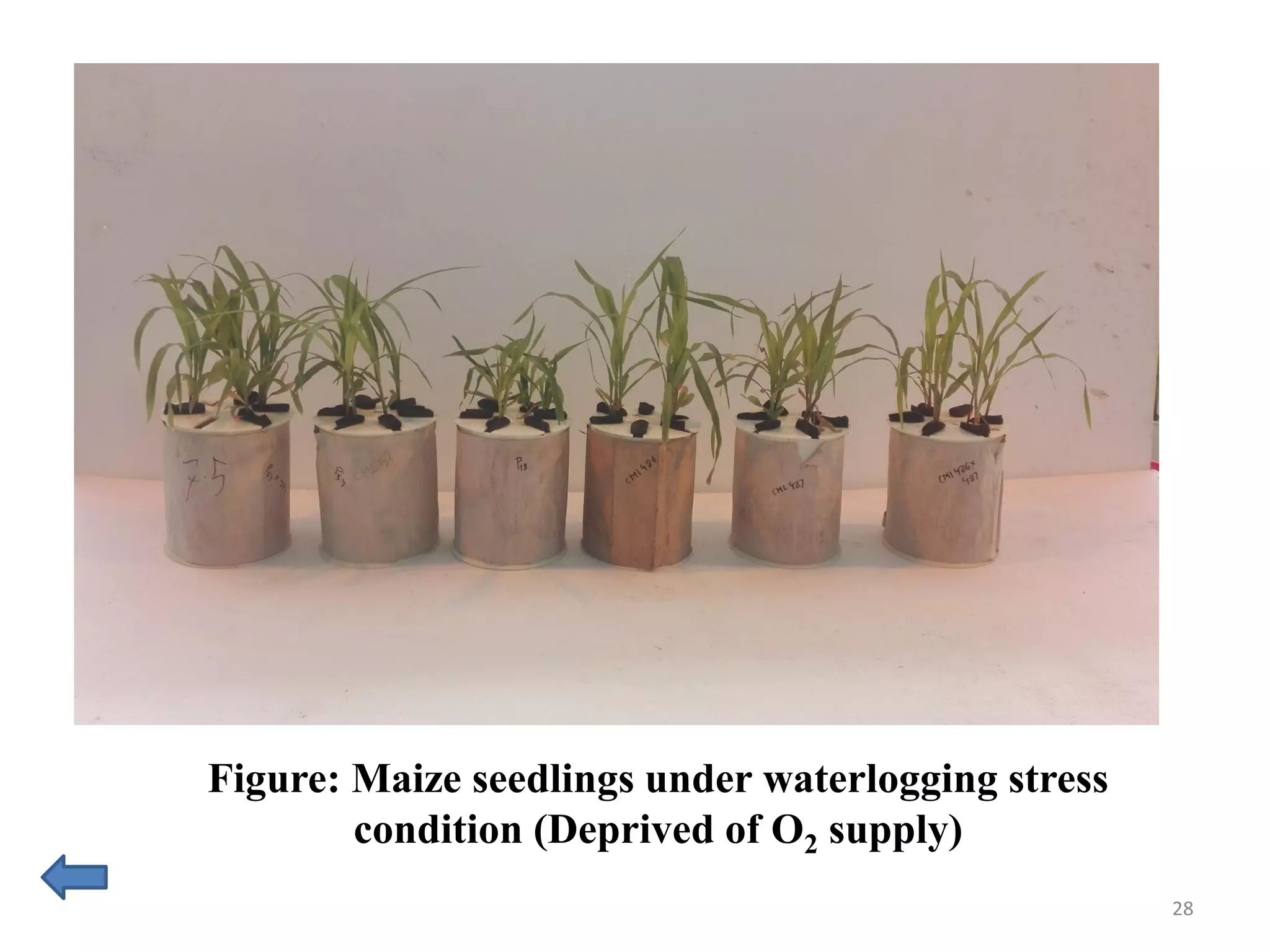
Figure: Maize seedlings under waterlogging stress
condition (Deprived of O2 supply)

Comparative Analysis of Biochemical & Physiological Responses of Maize Genotypes under Waterlogging Stress

  • 1.
    Comparative Analysis ofBiochemical & Physiological Responses of Maize Genotypes under Waterlogging Stress Tahmina Akter Khulna University Bangladesh
  • 2.
    Outline  Introduction  Objectives Materials and Methods  Result and Discussion  Conclusion  Prospective  Acknowledgement 2
  • 3.
    3 Introduction Figure: Total maizeproduction and area in Bangladesh Maize is the third most important cereal crop in Bangladesh as well as most of the countries of Asia BBS, 2018; PP: 91-96 0.8 0.8 1.0 2.3 2.4 3.0 2014-2015 2015-2016 2016-2017 Total Maize area and production in Bangladesh Area (acres)(Million) Production (M. Ton)(Million)
  • 4.
    4 Why waterlogging stress? Climate change, high sea level rise, off-season rainfall  In Bangladesh, >10% of the total maize growing area is affected  18% of the total maize production area in South and Southeast Asia causing production losses of 25–30% annually Introduction Uddin MS, 2014; Zaidi et al. 2010
  • 5.
    Background 5 Abiotic stresses Oxidation and degradation ofcellular components  Membrane damage  Loss of organelle function  Reduction of metabolic efficiency  Reduced carbon fixation  Reduced growth  Yield loss Functional and structural damage  Lipids and fatty acids  Nucleic acids  Proteins  Pigments  DNA CELL DEATH ROS and toxins in cells  O2•- (Super oxide)  H2O2 (Hydrogen peroxide)  OH• (Hydroxyl Radicle)  LPO (Lipid per oxidation)  MG (Methylglyoxal)
  • 6.
    Objective i. To demonstratethe role of anti-oxidative enzymes in scavenging ROS elements i. To compare the physiological and biochemical changes of maize genotypes ii. To screen the waterlogging tolerant and sensitive maize genotypes in terms of physiological and biochemical changes 6
  • 7.
  • 8.
    Methodology 8 Seed sowing Seed germination Transplant in hydroponic condition Hardening Waterlogging stressinduction Physiological tests Biochemical tests Plasma membrane integrity Canopy cover Chlorophyll content Activity of anti- oxidative enzyme (CAT, POD, APX, GPX) Lipid Peroxidation Leaf extract and Spectrophotometer SPAD meter Crop sensor Evan’s blue Schiff’s reagent
  • 9.
    9  Plant Materials(Maize Genotypes)  CML 54 × CML 487  BIL 219  CML 54  CML486 × CML 487  CML 486  CML 487 Materials and Methods
  • 10.
    10 Materials and Methods Seedlings Treatments  Control (Hoagland solution + Oxygen supply)  Waterlogging stress (Hoagland solution only)
  • 11.
    Materials and Methods 11 Determination of Chlorophyll Content using leaf extract in spectrophotometer (Lichtenthaler, 1987)  Determination of chlorophyll using SPAD meter (Soil Plant Analysis Development) (Rambo et al., 2010)  Determination of canopy cover using Green Seeker Hand Held Optical Sensor (Tremblay et al., 2009)  Histochemical Detection of Membrane Damage (Chen et al., 2010)  Measurement of Lipid Peroxidation (Heath and Packer, 1968)
  • 12.
    Materials and Methods 12 Determination of protein (Bradford, 1976)  Native PAGE and activity staining (Rohman et al., 2016)  Statistical analysis (STATISTIX 10) Enzymatic Antioxidants:  Peroxide Dismutase (POD): Hemeda and Klein, 1990  Catalase (CAT): Csiszar et al., 2007  Ascorbate peroxidase (APX): Nakano and Asada,1981  Glutathione peroxidase (GPX): Elia et al., 2003
  • 13.
  • 14.
    Effect of WaterloggingStress on Canopy Cover Canopy Cover Genotypes Day 0 Day 2 Day 4 Day 6 CML 54×CML487 0.53±0.00a 0.49±0.01ab 0.44±0.00a-d 0.39±0.03b-e BIL 219 0.40±0.06b-e 0.37±0.04c-f 0.33±0.02e-h 0.29±0.01gh CML54 0.37±0.02c-f 0.31±0.02e-h 0.27±0.01e-h 0.19±0.01h CML486×CML487 0.39±0.01b-e 0.37±0.02c-f 0.33±0.01d-h 0.27±0.01f-h CML 486 0.46±0.02a-c 0.34±0.02d-g 0.31±0.02 e-h 0.24±0.01gh CML 487 0.39±0.01ab 0.36±0.03c-f 0.34±0.03e-h 0.33±0.00gh 14
  • 15.
    Effect of WaterloggingStress on Chlorophyll Content (SPAD) SPAD (Soil Plant Analysis Development) Day 0 Day 2 Day 4 Day 6 CML 54×CML487 36.55±0.58b-e 34.15±0.31d-g 29.98±0.20f-i 26.08±0.98hi BIL 219 34.18±0.71a 33.53±0.59ab 31.33±0.37bc 27.53±0.25e-h CML54 32.60±0.46ab 26.69± 0.20b-d 23.85±0.25c-g 18.30±0.11f-i CML486×CML487 36.47±0.07ab 27.45±0.78e-h 25.30±0.20g-i 21.88±0.91i CML 486 32.10±0.12b-e 27.75±0.43e-h 22.43±0.36e-h 18.03±0.95hi CML 487 31.10±0.84b-f 29.43±0.51e-h 26.98±0.13g-i 24.83±0.72j 15
  • 16.
    Effect of WaterloggingStress on Total Chlorophyll and Carotenoid Content (Leaf Extract) Total Chlorophyll Day 0 Day 2 Day 4 Day 6 CML 54 ×CML487 0.49±0.07a-c 0.43±0.06bc 0.39±0.04b-d 0.36±0.04c BIL 219 0.67±0.08a-d 0.62±0.02a-e 0.59±0.07cd 0.57±0.009b-d CML 54 0.46±0.06a-c 0.32±0.04a-d 0.28±0.07c 0.16±0.02d CML486×CML487 0.85±0.08ab 0.70±0.07a-c 0.56±0.02bc 0.48±0.03a-d CML 486 0.63±0.04a-d 0.51±0.01ab 0.44±0.05a-c 0.32±0.06cd CML 487 0.76±0.07a 0.67±0.06d 0.60±0.06b-d 0.52±0.01a-d 16 Carotenoid Day 0 Day 2 Day 4 Day 6 CML 54 ×CML487 1.37±0.05d-f 1.30±0.04bc 1.18±0.00a-e 1.03±0.01bc BIL 219 1.56±0.03a-c 1.35±0.06b-d 1.27±0.03de 1.13±0.08ab CML 54 1.70±0.03c-e 1.33±0.05a-d 1.15±0.01ab 0.98±0.01c-f CML486×CML487 1.58±0.00bd 1.25±0.08c-f 0.95±0.03a-c 0.81±0.05ab CML 486 1.27±0.01a-e 1.09±0.03de 0.86±0.01ef 0.67±0.04d CML 487 1.20±0.01cd 1.09±0.05b 0.96±0.03a-c 0.88±0.06f
  • 17.
    Histochemical Staining ofRoots 17 Figure: Lipid peroxidation test using Schiff’s reagent Figure: Plasma membrane integrity test using Evan’s blue
  • 18.
    Waterlogging Stress Effecton POD Enzyme Activity 18 Bars with the same letters are not significantly different at P≤0.05 Day 0 Day 2 Day4 Day 6 Day 0 Day 2 Day4 Day 6 CML 54 × CML 487 BIL 219 POD 1 POD 2 POD 3 Day 0 Day 2 Day4 Day 6 Day 0 Day 2 Day4 Day 6 CML 54 CML 486×CML 487 POD 1 POD 2 POD 3 Day0 Day2 Day4 Day6 Day0 Day2 Day4 Day6 CML 486 CML 487 POD 1 POD 2 POD 3 ef c-f a-c f ef d-f a-c a-d a a-c a-d b-f a-c a-c a-e a-d b-f b-f a-c 0.0 0.2 0.4 0.6 0.8 1.0 1.2 CML 54 × CML487 BIL 219 CML54 CML486 × CML487 CML 486 CML 487 POD(nmmin-1mg-1protein) Day 0 Day 2 Day 4 Day 6 a-c ab c-f a-d b-f
  • 19.
    Effect of WaterloggingStress on CAT Enzyme Activity 19 Day 0 Day2 Day4 Day 6 Day 0 Day 2 Day4 Day 6 CML 54 × CML 487 BIL 219 CAT 1 CAT 2 Day0 Day2 Day4 Day6 Day0 Day2 Day4 Day6 CML 54 CML 486×CML 487 CAT 1 CAT 2 Bars with the same letters are not significantly different at P≤0.05 Day0 Day2 Day4 Day 6 Day0 Day2 Day4 Day6 CML 486 CML 487 CAT 1 CAT 2 a-h a-h c-h d-h gh b-h a-e a-c c-h a-h f-h e-h a-g ab a-f h a-h a a-d a a-e a-e a a-c 0 10 20 30 40 50 60 CML 54 × CML487 BIL 219 CML54 CML486 × CML487 CML 486 CML 487 CAT(nmm-1mg-1protein) Day 0 Day 2 Day 4 Day 6
  • 20.
    Effect of WaterloggingStress on APX Enzyme Activity 20 Bars with the same letters are not significantly different at P≤0.05 c a-c bc bc a-c a-c bc a-c a-c a-c a-c ab bc a-c a-c a a-c a-c bc a-c c a-c a-c a-c 0.0 0.5 1.0 1.5 2.0 CML 54 × CML487 BIL 219 CML54 CML486 × CML487 CML 486 CML 487 APX(nmmin-1mg-1Protein) Day 0 Day 2 Day 4 Day 6 Day0 Day2 Day4 Day6 Day0 Day2 Day4 Day6 CML54 CML 486×CML 487 APX 1 APX 2 APX 3 APX 4 Day0 Day2 Day4 Day6 Day0 Day2 Day4 Day6 CML 54 × CML 487 BIL 219 APX 1 APX 2 APX 3 APX 4 Day 0 Day 2 Day4 Day 6 Day0 Day 2 Day4 Day6 CML 486 CML 487 APX 1 APX 4 APX 2 APX 3
  • 21.
    Effect of WaterloggingStress on GPX Enzyme Activity 21Bars with the same letters are not significantly different at P≤0.05 Day 0 Day 2 Day4 Day 6 Day 0 Day 2 Day4 Day 6 GPX 1 GPX 2 BIL 219CML 54× CML 487 GPX 3 Day 0 Day 2 Day4 Day6 Day0 Day2 Day4 Day6 CML 54 GPX 1 GPX 2 CML 486×CML 487 GPX 3 Day0 Day2 Day4 Day6 Day0 Day2 Day4 Day6 GPX 1 GPX 2 GPX 3 CML 486 CML 487 a-d ab de c-e b-e a-e a ab e b-e a-e a-e a a b-e b-e b-e a a a a b-e a-c a 0 20 40 60 80 100 120 140 160 180 CML 54 × CML487 BIL 219 CML54 CML486 × CML487 CML 486 CML 487 GPX(nmmin-1mg-1protein) Day 0 Day 2 Day 4 Day 6
  • 22.
    22 More intensive pinkred and blue color indicates more lipid peroxidation and cell membrane damage  SPAD value and leaf extract measurement of chlorophyll content showed the similar results  Reduced canopy cover indicates N2 deficiency suggesting reduced chlorophyll content
  • 23.
    23  Increased anti-oxidativeenzyme activities suggests the better ROS scavenging activity CML 54 × CML 487, BIL 219 and CML 487 showed the best performance under waterlogging stress condition  CML 54 and CML 486 were found to be susceptible genotypes
  • 24.
    24 CML 54 ×CML 487, BIL 219 and CML 487 are going to be the target of researchers for future breeding programs There was irregular up and down-regulation of some anti-oxidative enzyme activities. Advanced study is needed to identify the cause of this unusual activity of the anti-oxidative enzymes
  • 25.
    25  Biotechnology &Genetic Engineering Discipline, Khulna University, Bangladesh.  Molecular Breeding Laboratory, Bangladesh Agricultural Research Institute (BARI).  Organizing Committee of 13th Asian Maize Conference.
  • 26.
  • 27.
    27 Figure: Maize seedlingsin controlled condition (Hoagland solution + O2 supply)
  • 28.
    28 Figure: Maize seedlingsunder waterlogging stress condition (Deprived of O2 supply)