“SMART breeding: A non-invasive
biotechnology alternative to
genetic engineering of plant
varieties”
1
Pavan. R
Ph. D Scholar
Department of Genetics and Plant Breeding
University of Agricultural Sciences
Bengaluru-65
2
3
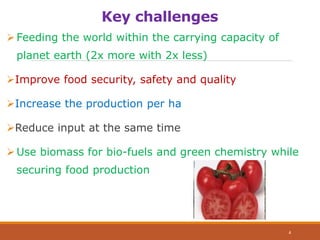
Key challenges
Feeding the world within the carrying capacity of
planet earth (2x more with 2x less)
Improve food security, safety and quality
Increase the production per ha
Reduce input at the same time
Use biomass for bio-fuels and green chemistry while
securing food production
4
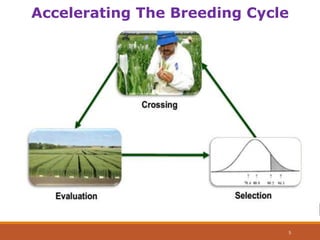
Accelerating The Breeding Cycle
5
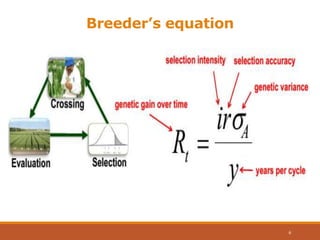
Breeder’s equation
6
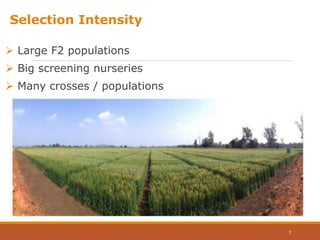
Selection Intensity
 Large F2 populations
 Big screening nurseries
 Many crosses / populations
7
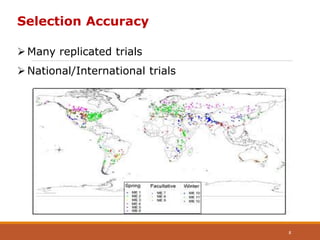
Selection Accuracy
Many replicated trials
National/International trials
8
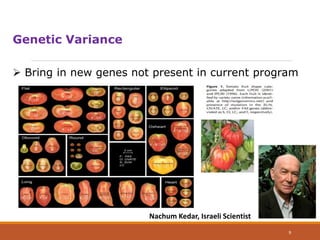
Genetic Variance
 Bring in new genes not present in current program
Nachum Kedar, Israeli Scientist
9
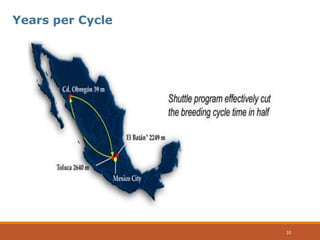
Years per Cycle
10
Running short of time……….!!
11
Use of molecular markers in selection
12
How molecular markers server our purpose?
Simpler than phenotypic screening, which can save
time, resources and effort
Selection can be carried out at the seedling stage
Single plants can be selected
Shortens the breeding cycle
Selection of drought tolerant plant without drought
No question of biosafety and bioethics
13
Defined as DNA sequence with a known location on
a chromosome.
Molecular marker
Qualities of a Suitable molecular marker are:
1) Must be polymorphic
2) Co-dominant inheritance
3) Randomly and frequently distributed throughout the
genome
4) Easy and cheap to detect
5) Easily reproducible
14
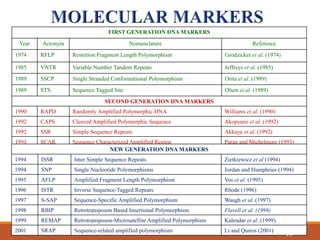
FIRST GENERATION DNA MARKERS
Year Acronym Nomenclature Reference
1974 RFLP Restrition Fragment Length Polymorphism Grodzicker et al. (1974)
1985 VNTR Variable Number Tandem Repeats Jeffreys et al. (1985)
1989 SSCP Single Stranded Conformational Polymorphism Orita et al. (1989)
1989 STS Sequence Tagged Site Olsen et al. (1989)
SECOND GENERATION DNA MARKERS
1990 RAPD Randomly Amplified Polymorphic DNA Williams et al. (1990)
1992 CAPS Cleaved Amplified Polymorphic Sequence Akopyanz et al. (1992)
1992 SSR Simple Sequence Repeats Akkaya et al. (1992)
1993 SCAR Sequence Characterized Amplified Region Paran and Michelmore (1993)
NEW GENERATION DNA MARKERS
1994 ISSR Inter Simple Sequence Repeats Zietkiewicz et al (1994)
1994 SNP Single Nucleotide Polymorphisms Jordan and Humphries (1994)
1995 AFLP Amplified Fragment Length Polymorphism Vos et al. (1995)
1996 ISTR Inverse Sequence-Tagged Repeats Rhode (1996)
1997 S-SAP Sequence-Specific Amplified Polymorphism Waugh et al. (1997)
1998 RBIP Retrotransposon Based Insertional Polymorphism Flavell et al. (1998)
1999 REMAP Retrotransposon-Microsatellite Amplified Polymorphism Kalendar et al. (1999).
2001 SRAP Sequence-related amplified polymorphism Li and Quiros (2001)
1515
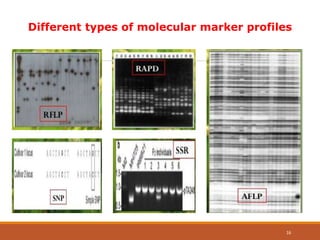
Different types of molecular marker profiles
16
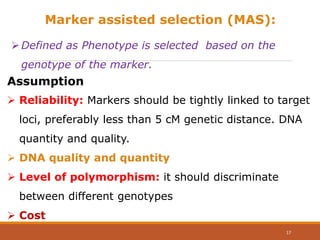
Marker assisted selection (MAS):
Defined as Phenotype is selected based on the
genotype of the marker.
 Reliability: Markers should be tightly linked to target
loci, preferably less than 5 cM genetic distance. DNA
quantity and quality.
 DNA quality and quantity
 Level of polymorphism: it should discriminate
between different genotypes
 Cost
Assumption
17
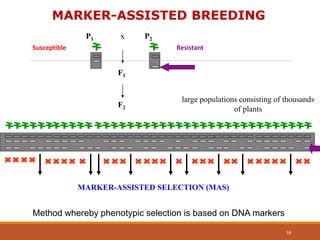
F2
P2
F1
P1 x
large populations consisting of thousands
of plants
ResistantSusceptible
MARKER-ASSISTED SELECTION (MAS)
MARKER-ASSISTED BREEDING
Method whereby phenotypic selection is based on DNA markers
18
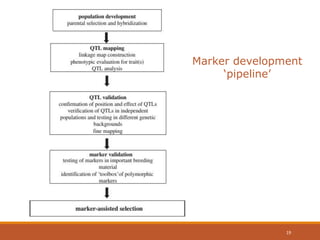
Marker development
‘pipeline’
19
APPLICATIONS OF MAS IN PLANT BREEDING
1. Marker assisted evaluation of breeding material
2. Marker-assisted backcrossing
3. Marker-assisted pyramiding
4. Early generation marker-assisted selection and
5. Combined marker-assisted selection
20
1. Marker-assisted evaluation of breeding material
 Cultivar identity/assessment of ‘purity
 Assessment of genetic diversity and parental selection
 Study of heterosis
 Identification of genomic regions under selection
21
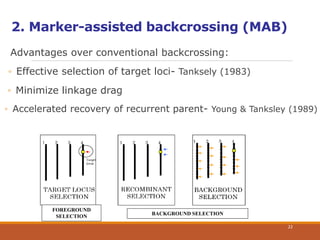
2. Marker-assisted backcrossing (MAB)
Advantages over conventional backcrossing:
◦ Minimize linkage drag
◦ Accelerated recovery of recurrent parent- Young & Tanksley (1989)
◦ Effective selection of target loci- Tanksely (1983)
FOREGROUND
SELECTION
BACKGROUND SELECTION
22
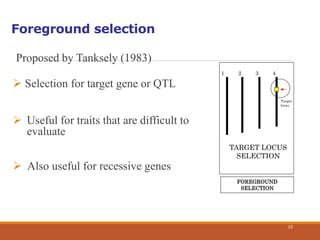
Foreground selection
Proposed by Tanksely (1983)
 Selection for target gene or QTL
 Useful for traits that are difficult to
evaluate
 Also useful for recessive genes
1 2 3 4
Target
locus
TARGET LOCUS
SELECTION
FOREGROUND
SELECTION
23
Donor/F1 BC1
c
BC3 BC10
TARGET
LOCUS
RECURRENT PARENT
CHROMOSOME
DONOR
CHROMOSOME
TARGET
LOCUS
LINKEDDONOR
GENES
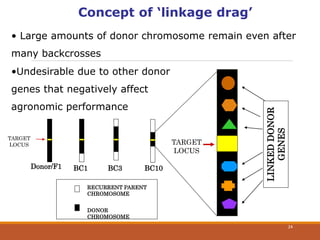
Concept of ‘linkage drag’
• Large amounts of donor chromosome remain even after
many backcrosses
•Undesirable due to other donor
genes that negatively affect
agronomic performance
24
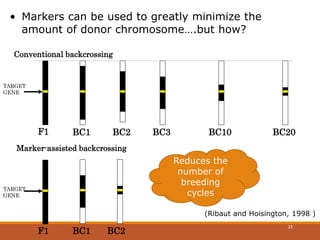
• Markers can be used to greatly minimize the
amount of donor chromosome….but how?
Marker-assisted backcrossing
F1
c
BC1 BC2
TARGET
GENE
Conventional backcrossing
F1 BC1
c
BC2
c
BC3 BC10 BC20
TARGET
GENE
Reduces the
number of
breeding
cycles
(Ribaut and Hoisington, 1998 )
25
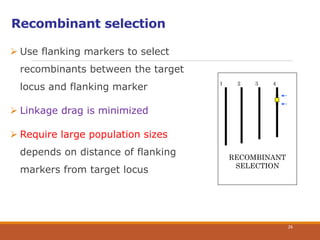
Recombinant selection
 Use flanking markers to select
recombinants between the target
locus and flanking marker
 Linkage drag is minimized
 Require large population sizes
depends on distance of flanking
markers from target locus
RECOMBINANT
SELECTION
1 2 3 4
26
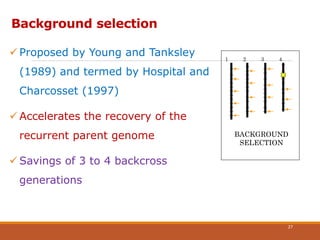
Background selection
 Proposed by Young and Tanksley
(1989) and termed by Hospital and
Charcosset (1997)
 Accelerates the recovery of the
recurrent parent genome
 Savings of 3 to 4 backcross
generations
1 2 3 4
BACKGROUND
SELECTION
27
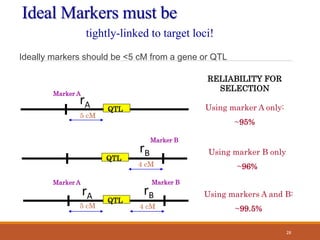
Ideal Markers must be
Ideally markers should be <5 cM from a gene or QTL
tightly-linked to target loci!
Marker A
QTL
5 cM
RELIABILITY FOR
SELECTION
Using marker A only:
~95%
rA
QTL
Marker B
4 cM
Using marker B only
~96%
rB
Marker A
QTL
Marker B
5 cM 4 cM
Using markers A and B:
~99.5%
rA rB
28
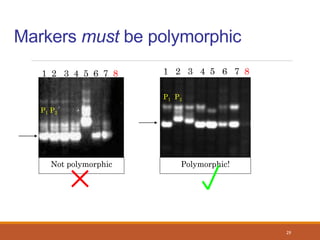
Markers must be polymorphic
1 2 3 4 5 6 7 8 1 2 3 4 5 6 7 8
P1 P2
P1 P2
Not polymorphic Polymorphic!
29
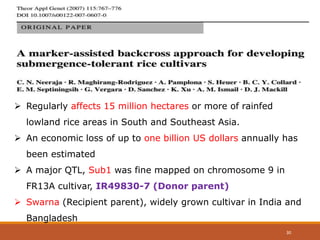
 Regularly affects 15 million hectares or more of rainfed
lowland rice areas in South and Southeast Asia.
 An economic loss of up to one billion US dollars annually has
been estimated
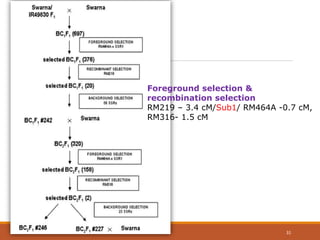
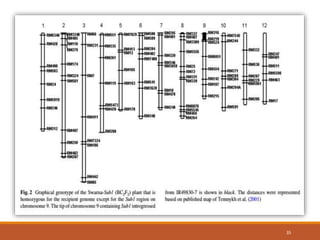
 A major QTL, Sub1 was fine mapped on chromosome 9 in
FR13A cultivar, IR49830-7 (Donor parent)
 Swarna (Recipient parent), widely grown cultivar in India and
Bangladesh
30
Foreground selection &
recombination selection
RM219 – 3.4 cM/Sub1/ RM464A -0.7 cM,
RM316- 1.5 cM
31
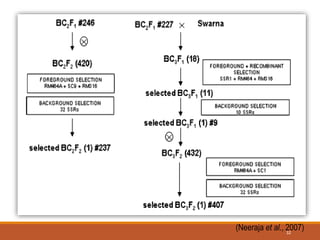
(Neeraja et al., 2007)32
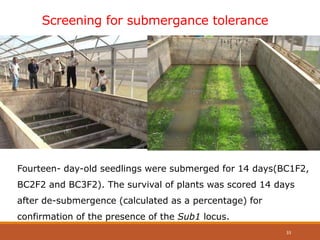
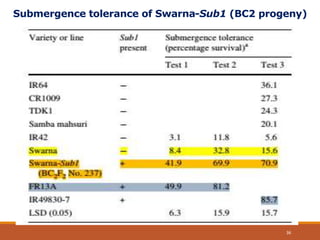
Screening for submergance tolerance
Fourteen- day-old seedlings were submerged for 14 days(BC1F2,
BC2F2 and BC3F2). The survival of plants was scored 14 days
after de-submergence (calculated as a percentage) for
confirmation of the presence of the Sub1 locus.
33
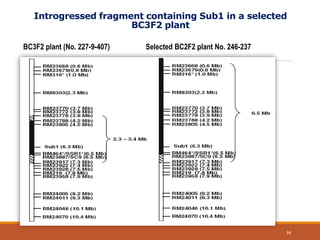
Introgressed fragment containing Sub1 in a selected
BC3F2 plant
BC3F2 plant (No. 227-9-407) Selected BC2F2 plant No. 246-237
34
35
Submergence tolerance of Swarna-Sub1 (BC2 progeny)
36
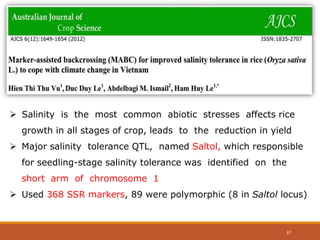
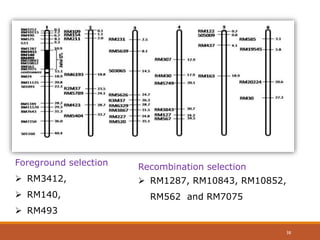
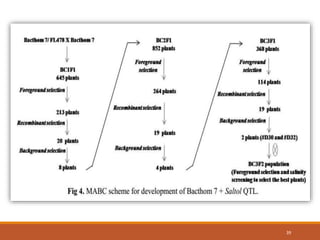
 Salinity is the most common abiotic stresses affects rice
growth in all stages of crop, leads to the reduction in yield
 Major salinity tolerance QTL, named Saltol, which responsible
for seedling-stage salinity tolerance was identified on the
short arm of chromosome 1
 Used 368 SSR markers, 89 were polymorphic (8 in Saltol locus)
37
Foreground selection
 RM3412,
 RM140,
 RM493
Recombination selection
 RM1287, RM10843, RM10852,
RM562 and RM7075
38
39
40
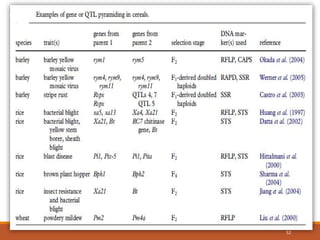
3. Marker-assisted pyramiding
 Widely used for combining multiple disease resistance
genes for specific races of a pathogen
 Pyramiding is extremely difficult to achieve using
conventional methods
 Important to develop ‘durable’ disease resistance
against different races of pathogen
41
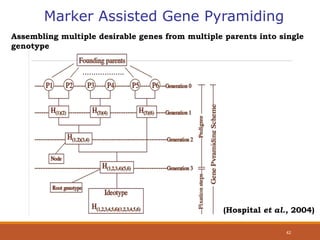
Marker Assisted Gene Pyramiding
Assembling multiple desirable genes from multiple parents into single
genotype
(Hospital et al., 2004)
42
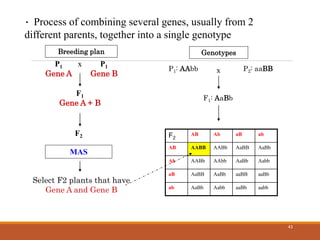
F2
F1
Gene A + B
P1
Gene A
x P1
Gene B
MAS
Select F2 plants that have
Gene A and Gene B
Genotypes
P1: AAbb P2: aaBB
F1: AaBb
F2
AB Ab aB ab
AB AABB AABb AaBB AaBb
Ab AABb AAbb AaBb Aabb
aB AaBB AaBb aaBB aaBb
ab AaBb Aabb aaBb aabb
• Process of combining several genes, usually from 2
different parents, together into a single genotype
x
Breeding plan
43
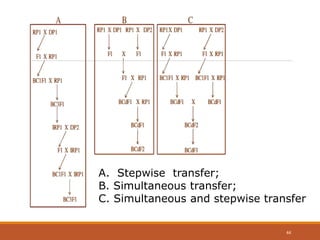
A. Stepwise transfer;
B. Simultaneous transfer;
C. Simultaneous and stepwise transfer
44
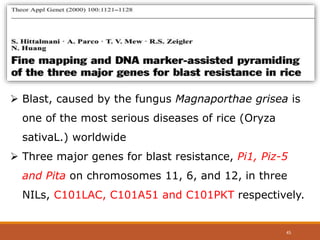
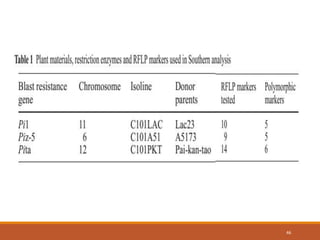
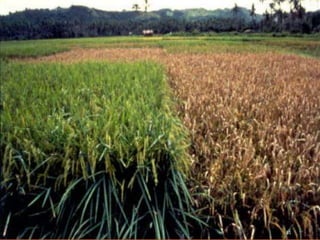
 Blast, caused by the fungus Magnaporthae grisea is
one of the most serious diseases of rice (Oryza
sativaL.) worldwide
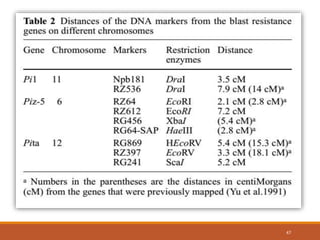
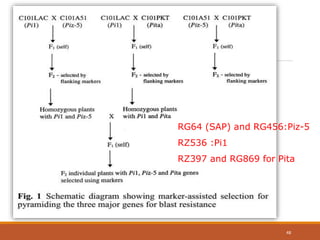
 Three major genes for blast resistance, Pi1, Piz-5
and Pita on chromosomes 11, 6, and 12, in three
NILs, C101LAC, C101A51 and C101PKT respectively.
45
46
47
RG64 (SAP) and RG456:Piz-5
RZ536 :Pi1
RZ397 and RG869 for Pita
48
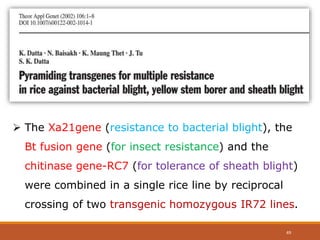
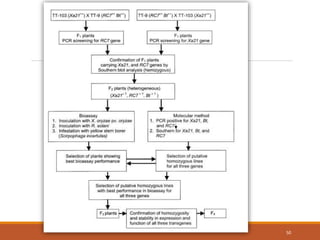
 The Xa21gene (resistance to bacterial blight), the
Bt fusion gene (for insect resistance) and the
chitinase gene-RC7 (for tolerance of sheath blight)
were combined in a single rice line by reciprocal
crossing of two transgenic homozygous IR72 lines.
49
50
51
52
4. Early generation marker-assisted selection
MAS conducted at F2 or F3 stage
Very useful in self pollinated crops to fix alleles in their
homozygous state as early as possible
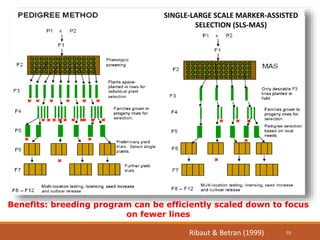
Allows breeders to focus attention on a lesser number of
high-priority lines in subsequent generations
 Linkage between the marker and QTL is not very tight,
 Disadvantage is the cost of genotyping a larger number
of plants.
53
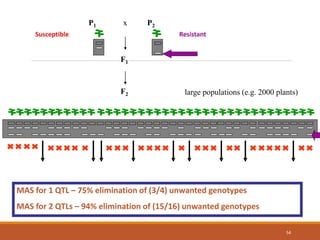
F2
P2
F1
P1 x
large populations (e.g. 2000 plants)
ResistantSusceptible
MAS for 1 QTL – 75% elimination of (3/4) unwanted genotypes
MAS for 2 QTLs – 94% elimination of (15/16) unwanted genotypes
54
Benefits: breeding program can be efficiently scaled down to focus
on fewer lines
Ribaut & Betran (1999)
SINGLE-LARGE SCALE MARKER-ASSISTED
SELECTION (SLS-MAS)
55
5. Combined MAS approaches
In some cases, a combination of phenotypic screening
and MAS approach may be useful
1. To maximize genetic gain (when some QTLs have
remained unidentified)
2. Especially when large population sizes are used and trait
heritability is low
3. Low level of recombination between marker and QTL
4. To reduce population sizes for traits where marker
genotyping is cheaper or easier than phenotypic
screening
56
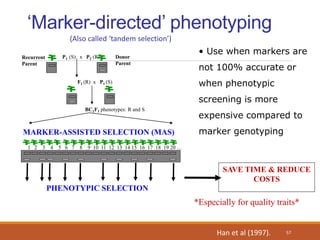
‘Marker-directed’ phenotyping
BC1F1 phenotypes: R and S
P1 (S) x P2 (R)
F1 (R) x P1 (S)
Recurrent
Parent
Donor
Parent
1 2 3 4 5 6 7 8 9 10 11 12 13 14 15 16 17 18 19 20 …
SAVE TIME & REDUCE
COSTS
*Especially for quality traits*
MARKER-ASSISTED SELECTION (MAS)
PHENOTYPIC SELECTION
(Also called ‘tandem selection’)
• Use when markers are
not 100% accurate or
when phenotypic
screening is more
expensive compared to
marker genotyping
Han et al (1997). 57
REASONS TO EXPLAIN THE LOW IMPACT
OF
MARKER-ASSISTED SELECTION
1.Still at the early stages of DNA marker technology
development
Even though SSR markers were developed in 1990’s
the availability is less
58
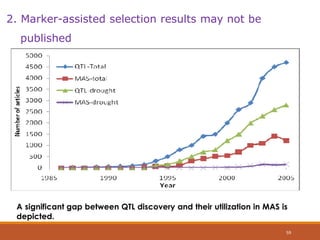
A significant gap between QTL discovery and their utilization in MAS is
depicted.
2. Marker-assisted selection results may not be
published
59
3. Reliability and accuracy of QTL mapping
studies
 No. of replication used to generate phenotypic
data
 Population size
 Sampling bias
 Factors may affect the accuracy of a QTL mapping
60
4. Insufficient linkage between marker and gene/QTL
5. Limited markers and limited polymorphism of
markers in breeding material
6. ‘Application gap’ between research laboratories
and plant breeding institutes
7. ‘Knowledge gap’ among molecular biologists, plant
breeders and other disciplines
61
8. Effects of genetic background
 QTLs identified in a particular mapping population
may not be effective in different backgrounds
(Liao et al.2001)
 Only one of four root length QTLs were effective
when transferred by backcrossing into a new rice
variety.
Steele et al. (2006)
62
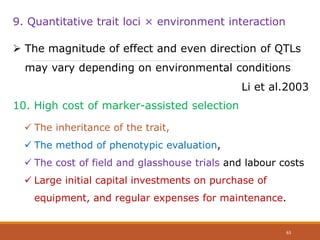
9. Quantitative trait loci × environment interaction
 The magnitude of effect and even direction of QTLs
may vary depending on environmental conditions
Li et al.2003
10. High cost of marker-assisted selection
 The inheritance of the trait,
 The method of phenotypic evaluation,
 The cost of field and glasshouse trials and labour costs
 Large initial capital investments on purchase of
equipment, and regular expenses for maintenance.
63
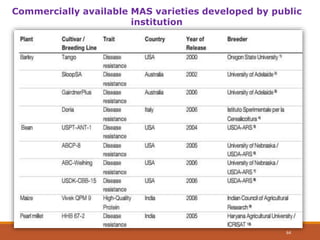
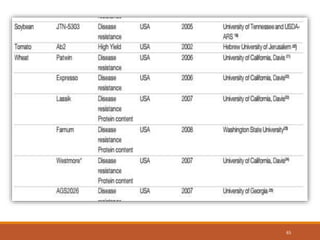
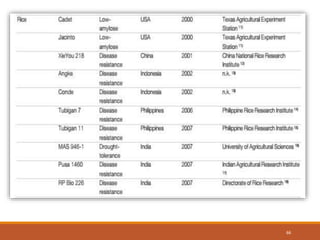
Commercially available MAS varieties developed by public
institution
64
65
66
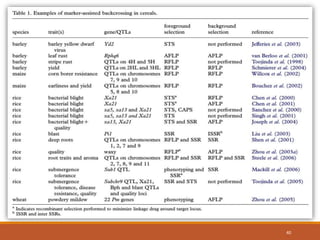
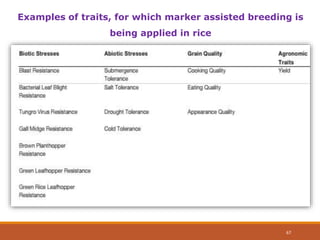
Examples of traits, for which marker assisted breeding is
being applied in rice
67
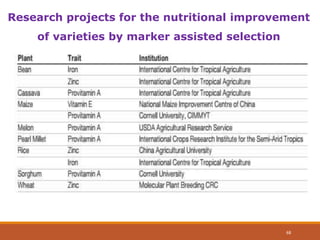
Research projects for the nutritional improvement
of varieties by marker assisted selection
68
69

Smart breeding final

  • 1.
    “SMART breeding: Anon-invasive biotechnology alternative to genetic engineering of plant varieties” 1 Pavan. R Ph. D Scholar Department of Genetics and Plant Breeding University of Agricultural Sciences Bengaluru-65
  • 2.
  • 3.
  • 4.
    Key challenges Feeding theworld within the carrying capacity of planet earth (2x more with 2x less) Improve food security, safety and quality Increase the production per ha Reduce input at the same time Use biomass for bio-fuels and green chemistry while securing food production 4
  • 5.
  • 6.
  • 7.
    Selection Intensity  LargeF2 populations  Big screening nurseries  Many crosses / populations 7
  • 8.
    Selection Accuracy Many replicatedtrials National/International trials 8
  • 9.
    Genetic Variance  Bringin new genes not present in current program Nachum Kedar, Israeli Scientist 9
  • 10.
  • 11.
    Running short oftime……….!! 11
  • 12.
    Use of molecularmarkers in selection 12
  • 13.
    How molecular markersserver our purpose? Simpler than phenotypic screening, which can save time, resources and effort Selection can be carried out at the seedling stage Single plants can be selected Shortens the breeding cycle Selection of drought tolerant plant without drought No question of biosafety and bioethics 13
  • 14.
    Defined as DNAsequence with a known location on a chromosome. Molecular marker Qualities of a Suitable molecular marker are: 1) Must be polymorphic 2) Co-dominant inheritance 3) Randomly and frequently distributed throughout the genome 4) Easy and cheap to detect 5) Easily reproducible 14
  • 15.
    FIRST GENERATION DNAMARKERS Year Acronym Nomenclature Reference 1974 RFLP Restrition Fragment Length Polymorphism Grodzicker et al. (1974) 1985 VNTR Variable Number Tandem Repeats Jeffreys et al. (1985) 1989 SSCP Single Stranded Conformational Polymorphism Orita et al. (1989) 1989 STS Sequence Tagged Site Olsen et al. (1989) SECOND GENERATION DNA MARKERS 1990 RAPD Randomly Amplified Polymorphic DNA Williams et al. (1990) 1992 CAPS Cleaved Amplified Polymorphic Sequence Akopyanz et al. (1992) 1992 SSR Simple Sequence Repeats Akkaya et al. (1992) 1993 SCAR Sequence Characterized Amplified Region Paran and Michelmore (1993) NEW GENERATION DNA MARKERS 1994 ISSR Inter Simple Sequence Repeats Zietkiewicz et al (1994) 1994 SNP Single Nucleotide Polymorphisms Jordan and Humphries (1994) 1995 AFLP Amplified Fragment Length Polymorphism Vos et al. (1995) 1996 ISTR Inverse Sequence-Tagged Repeats Rhode (1996) 1997 S-SAP Sequence-Specific Amplified Polymorphism Waugh et al. (1997) 1998 RBIP Retrotransposon Based Insertional Polymorphism Flavell et al. (1998) 1999 REMAP Retrotransposon-Microsatellite Amplified Polymorphism Kalendar et al. (1999). 2001 SRAP Sequence-related amplified polymorphism Li and Quiros (2001) 1515
  • 16.
    Different types ofmolecular marker profiles 16
  • 17.
    Marker assisted selection(MAS): Defined as Phenotype is selected based on the genotype of the marker.  Reliability: Markers should be tightly linked to target loci, preferably less than 5 cM genetic distance. DNA quantity and quality.  DNA quality and quantity  Level of polymorphism: it should discriminate between different genotypes  Cost Assumption 17
  • 18.
    F2 P2 F1 P1 x large populationsconsisting of thousands of plants ResistantSusceptible MARKER-ASSISTED SELECTION (MAS) MARKER-ASSISTED BREEDING Method whereby phenotypic selection is based on DNA markers 18
  • 19.
  • 20.
    APPLICATIONS OF MASIN PLANT BREEDING 1. Marker assisted evaluation of breeding material 2. Marker-assisted backcrossing 3. Marker-assisted pyramiding 4. Early generation marker-assisted selection and 5. Combined marker-assisted selection 20
  • 21.
    1. Marker-assisted evaluationof breeding material  Cultivar identity/assessment of ‘purity  Assessment of genetic diversity and parental selection  Study of heterosis  Identification of genomic regions under selection 21
  • 22.
    2. Marker-assisted backcrossing(MAB) Advantages over conventional backcrossing: ◦ Minimize linkage drag ◦ Accelerated recovery of recurrent parent- Young & Tanksley (1989) ◦ Effective selection of target loci- Tanksely (1983) FOREGROUND SELECTION BACKGROUND SELECTION 22
  • 23.
    Foreground selection Proposed byTanksely (1983)  Selection for target gene or QTL  Useful for traits that are difficult to evaluate  Also useful for recessive genes 1 2 3 4 Target locus TARGET LOCUS SELECTION FOREGROUND SELECTION 23
  • 24.
    Donor/F1 BC1 c BC3 BC10 TARGET LOCUS RECURRENTPARENT CHROMOSOME DONOR CHROMOSOME TARGET LOCUS LINKEDDONOR GENES Concept of ‘linkage drag’ • Large amounts of donor chromosome remain even after many backcrosses •Undesirable due to other donor genes that negatively affect agronomic performance 24
  • 25.
    • Markers canbe used to greatly minimize the amount of donor chromosome….but how? Marker-assisted backcrossing F1 c BC1 BC2 TARGET GENE Conventional backcrossing F1 BC1 c BC2 c BC3 BC10 BC20 TARGET GENE Reduces the number of breeding cycles (Ribaut and Hoisington, 1998 ) 25
  • 26.
    Recombinant selection  Useflanking markers to select recombinants between the target locus and flanking marker  Linkage drag is minimized  Require large population sizes depends on distance of flanking markers from target locus RECOMBINANT SELECTION 1 2 3 4 26
  • 27.
    Background selection  Proposedby Young and Tanksley (1989) and termed by Hospital and Charcosset (1997)  Accelerates the recovery of the recurrent parent genome  Savings of 3 to 4 backcross generations 1 2 3 4 BACKGROUND SELECTION 27
  • 28.
    Ideal Markers mustbe Ideally markers should be <5 cM from a gene or QTL tightly-linked to target loci! Marker A QTL 5 cM RELIABILITY FOR SELECTION Using marker A only: ~95% rA QTL Marker B 4 cM Using marker B only ~96% rB Marker A QTL Marker B 5 cM 4 cM Using markers A and B: ~99.5% rA rB 28
  • 29.
    Markers must bepolymorphic 1 2 3 4 5 6 7 8 1 2 3 4 5 6 7 8 P1 P2 P1 P2 Not polymorphic Polymorphic! 29
  • 30.
     Regularly affects15 million hectares or more of rainfed lowland rice areas in South and Southeast Asia.  An economic loss of up to one billion US dollars annually has been estimated  A major QTL, Sub1 was fine mapped on chromosome 9 in FR13A cultivar, IR49830-7 (Donor parent)  Swarna (Recipient parent), widely grown cultivar in India and Bangladesh 30
  • 31.
    Foreground selection & recombinationselection RM219 – 3.4 cM/Sub1/ RM464A -0.7 cM, RM316- 1.5 cM 31
  • 32.
  • 33.
    Screening for submergancetolerance Fourteen- day-old seedlings were submerged for 14 days(BC1F2, BC2F2 and BC3F2). The survival of plants was scored 14 days after de-submergence (calculated as a percentage) for confirmation of the presence of the Sub1 locus. 33
  • 34.
    Introgressed fragment containingSub1 in a selected BC3F2 plant BC3F2 plant (No. 227-9-407) Selected BC2F2 plant No. 246-237 34
  • 35.
  • 36.
    Submergence tolerance ofSwarna-Sub1 (BC2 progeny) 36
  • 37.
     Salinity isthe most common abiotic stresses affects rice growth in all stages of crop, leads to the reduction in yield  Major salinity tolerance QTL, named Saltol, which responsible for seedling-stage salinity tolerance was identified on the short arm of chromosome 1  Used 368 SSR markers, 89 were polymorphic (8 in Saltol locus) 37
  • 38.
    Foreground selection  RM3412, RM140,  RM493 Recombination selection  RM1287, RM10843, RM10852, RM562 and RM7075 38
  • 39.
  • 40.
  • 41.
    3. Marker-assisted pyramiding Widely used for combining multiple disease resistance genes for specific races of a pathogen  Pyramiding is extremely difficult to achieve using conventional methods  Important to develop ‘durable’ disease resistance against different races of pathogen 41
  • 42.
    Marker Assisted GenePyramiding Assembling multiple desirable genes from multiple parents into single genotype (Hospital et al., 2004) 42
  • 43.
    F2 F1 Gene A +B P1 Gene A x P1 Gene B MAS Select F2 plants that have Gene A and Gene B Genotypes P1: AAbb P2: aaBB F1: AaBb F2 AB Ab aB ab AB AABB AABb AaBB AaBb Ab AABb AAbb AaBb Aabb aB AaBB AaBb aaBB aaBb ab AaBb Aabb aaBb aabb • Process of combining several genes, usually from 2 different parents, together into a single genotype x Breeding plan 43
  • 44.
    A. Stepwise transfer; B.Simultaneous transfer; C. Simultaneous and stepwise transfer 44
  • 45.
     Blast, causedby the fungus Magnaporthae grisea is one of the most serious diseases of rice (Oryza sativaL.) worldwide  Three major genes for blast resistance, Pi1, Piz-5 and Pita on chromosomes 11, 6, and 12, in three NILs, C101LAC, C101A51 and C101PKT respectively. 45
  • 46.
  • 47.
  • 48.
    RG64 (SAP) andRG456:Piz-5 RZ536 :Pi1 RZ397 and RG869 for Pita 48
  • 49.
     The Xa21gene(resistance to bacterial blight), the Bt fusion gene (for insect resistance) and the chitinase gene-RC7 (for tolerance of sheath blight) were combined in a single rice line by reciprocal crossing of two transgenic homozygous IR72 lines. 49
  • 50.
  • 51.
  • 52.
  • 53.
    4. Early generationmarker-assisted selection MAS conducted at F2 or F3 stage Very useful in self pollinated crops to fix alleles in their homozygous state as early as possible Allows breeders to focus attention on a lesser number of high-priority lines in subsequent generations  Linkage between the marker and QTL is not very tight,  Disadvantage is the cost of genotyping a larger number of plants. 53
  • 54.
    F2 P2 F1 P1 x large populations(e.g. 2000 plants) ResistantSusceptible MAS for 1 QTL – 75% elimination of (3/4) unwanted genotypes MAS for 2 QTLs – 94% elimination of (15/16) unwanted genotypes 54
  • 55.
    Benefits: breeding programcan be efficiently scaled down to focus on fewer lines Ribaut & Betran (1999) SINGLE-LARGE SCALE MARKER-ASSISTED SELECTION (SLS-MAS) 55
  • 56.
    5. Combined MASapproaches In some cases, a combination of phenotypic screening and MAS approach may be useful 1. To maximize genetic gain (when some QTLs have remained unidentified) 2. Especially when large population sizes are used and trait heritability is low 3. Low level of recombination between marker and QTL 4. To reduce population sizes for traits where marker genotyping is cheaper or easier than phenotypic screening 56
  • 57.
    ‘Marker-directed’ phenotyping BC1F1 phenotypes:R and S P1 (S) x P2 (R) F1 (R) x P1 (S) Recurrent Parent Donor Parent 1 2 3 4 5 6 7 8 9 10 11 12 13 14 15 16 17 18 19 20 … SAVE TIME & REDUCE COSTS *Especially for quality traits* MARKER-ASSISTED SELECTION (MAS) PHENOTYPIC SELECTION (Also called ‘tandem selection’) • Use when markers are not 100% accurate or when phenotypic screening is more expensive compared to marker genotyping Han et al (1997). 57
  • 58.
    REASONS TO EXPLAINTHE LOW IMPACT OF MARKER-ASSISTED SELECTION 1.Still at the early stages of DNA marker technology development Even though SSR markers were developed in 1990’s the availability is less 58
  • 59.
    A significant gapbetween QTL discovery and their utilization in MAS is depicted. 2. Marker-assisted selection results may not be published 59
  • 60.
    3. Reliability andaccuracy of QTL mapping studies  No. of replication used to generate phenotypic data  Population size  Sampling bias  Factors may affect the accuracy of a QTL mapping 60
  • 61.
    4. Insufficient linkagebetween marker and gene/QTL 5. Limited markers and limited polymorphism of markers in breeding material 6. ‘Application gap’ between research laboratories and plant breeding institutes 7. ‘Knowledge gap’ among molecular biologists, plant breeders and other disciplines 61
  • 62.
    8. Effects ofgenetic background  QTLs identified in a particular mapping population may not be effective in different backgrounds (Liao et al.2001)  Only one of four root length QTLs were effective when transferred by backcrossing into a new rice variety. Steele et al. (2006) 62
  • 63.
    9. Quantitative traitloci × environment interaction  The magnitude of effect and even direction of QTLs may vary depending on environmental conditions Li et al.2003 10. High cost of marker-assisted selection  The inheritance of the trait,  The method of phenotypic evaluation,  The cost of field and glasshouse trials and labour costs  Large initial capital investments on purchase of equipment, and regular expenses for maintenance. 63
  • 64.
    Commercially available MASvarieties developed by public institution 64
  • 65.
  • 66.
  • 67.
    Examples of traits,for which marker assisted breeding is being applied in rice 67
  • 68.
    Research projects forthe nutritional improvement of varieties by marker assisted selection 68
  • 69.