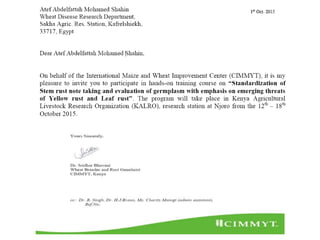
“Standardization of Stem rust note taking and
evaluation of germplasm with emphasis on emerging
threats of Yellow rust and Leaf rust”
Kenya , Njoro from the 12 – 18 October 2015
Training course
on
The annual training course is part of the Durable Rust Resistance in Wheat (DRRW) project
funded by the Bill and Melinda Gates Foundation and the Department for International
Development (DIFD, UK( .
Atef A. Shahin, Ph.D.
Wheat Disease Research Department
Plant Pathology Research Institute
ARC, Egypt
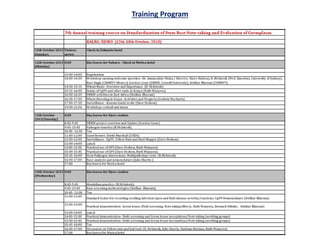
7th Annual training course on Standardization of Stem Rust Note-taking and Evaluation of Germplasm
Kalro, Njoro, Kenya (12th-18th October, 2015)
Course Objective
The course aimed to create awareness of the devastating effects of stem
rust race Ug99 on global wheat production; train wheat researchers to
use new approaches to fight the rust diseases (including genetics,
pathology, breeding, and molecular genetics(; and teach them methods
for identifying, scoring, and evaluating stem rust both in the field and
experimental plots. Practical sessions focused on demonstrating rust
methodologies and giving participants hands-on experience in scoring
the disease both in the greenhouse and the field. “They also evaluated
materials from their own national programs to know the status of
resistance and learned breeding approaches to develop resistant
varieties”
The annual training course is designed to monitor further migration of
Ug99 and its variants; facilitate field screening of international
germplasm; identify new sources of resistance; understand the genetic
basis of resistance; develop durable, targeted breeding programs; and
enhance the capacity of national programs.
Training Program
Training Program
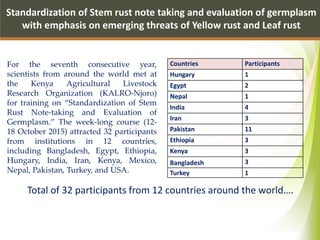
Standardization of Stem rust note taking and evaluation of germplasm
with emphasis on emerging threats of Yellow rust and Leaf rust
Total of 32 participants from 12 countries around the world….
Countries Participants
Hungary 1
Egypt 2
Nepal 1
India 4
Iran 3
Pakistan 11
Ethiopia 3
Kenya 3
Bangladesh 3
Turkey 1
For the seventh consecutive year,
scientists from around the world met at
the Kenya Agricultural Livestock
Research Organization (KALRO-Njoro)
for training on “Standardization of Stem
Rust Note-taking and Evaluation of
Germplasm.” The week-long course (12-
18 October 2015) attracted 32 participants
from institutions in 12 countries,
including Bangladesh, Egypt, Ethiopia,
Hungary, India, Iran, Kenya, Mexico,
Nepal, Pakistan, Turkey, and USA.
Gordon Cisar, Ph.D., (DRRW, Cornell University)
The Durable Rust Resistance in Wheat project and the
Borlaug Global Rust Initiative
• Origin of the project (Sr31 & Ug99)
• Raising awareness and organizing a response
• Funding the project ($ from BMGF & DFID)
• Objectives of the DRRW project
• Rust never sleeps
• GOAL: A durable rust research community
406 page proposal accepted Feb., 2011
DRRW Project
On behalf of the collaborators of the DRRW
project, welcome to the challenges of the
global wheat rust community..
..so welcome to the 7th KARI-Njoro rust
training workshop..
Please ask questions. We will all learn from
the discussion.
Keep in touch: www.globalrust.org
Pathogenicity Surveys and Nomenclature
Pathogen Genetics
Mendelian Genetics
R. McIntosh (Prof. Emeritus, University of Sydney)
HOST : PATHOGEN GENETICS
THE GENE-FOR-GENE CONCEPT
LAWS OF HOST:PARASITE INTERACTION
Basic Experimental Models Used in
Host:Pathogen Genetics
Wheat Rusts- Overview and Importance
Enhancing wheat productivity and sustainability in Asia, Africa and Latin
America by developing and deploying higher yielding, climate resilient and
disease resistant varieties
Ravi P. Singh and Spring Bread Wheat
Improvement Team, Global Wheat Program
Speaking at the end of the training, Ravi Singh, Chief Wheat Breeder and
Distinguished Scientist, CIMMYT, emphasized that global collaboration and
networking are vital in addressing global challenges such as stem rust Ug99.
A Decade of Stem Rust Surveillance: How far have we come and
where are we going?
Dave Hodson, CIMMYT-Ethiopia
2005: What did we need to do?
•Build the surveillance network (surveys + sampling)
•Track the important pathogens – inform breeding programs
•Manage + disseminate information
•Improve impact assessments
•Put some early warning systems in place
Survey Tools: New Technology Options
Data Management: Wheat Rust Toolbox
Wheat Rust Toolbox ICT framework
Public Information Systems:
WWW Rust Tracker.org
Successful Pathogen Tracking Ug99
Race Group
Molecular diagnostics and population
genetics
Emerging Early Warning Systems
Under the guidance of Dave Hodson,
CIMMYT Senior Scientist, participants
acquired hands-on experience using
surveillance tools and GPS for conducting
informed pathogen monitoring and
surveillance, and evaluating and recording
stem rust data.
They also observed CIMMYT-Kenya
shuttle breeding activities aimed at
incorporating Ug99 resistance into
CIMMYT germplasm and progress in
breeding for durable adult plant resistance.
CIMMYT-KARI-DRRW partnership in East Africa: Working
together to beat the threat of Ug99
Sridhar Bhavani
Gene Identification and characterization
Mapping Major genes
Fine mapping
Breeding for resistance to stem rust
Breeding options available
Few in high yielding adapted backgrounds, e.g.
Sr22, Sr25, Sr26,Sr33,Sr45,Sr50,SrNd643,
SrNiini, SrYaye, SrHuw234 .
Stacking/Pyramiding multiple race specific
genes (Sr22, Sr25, Sr26)
Effectiveness of Known Sr genes to
TTKS (Ug99) Lineage
Enrique Autrique Godwin Macharia
Ruth Wanyera
High throughput phenotyping HTP - BW Breeding HTP - BW Breeding
PhenocornSPAD Canopy
HTP for predicting yield
 Accurately predicting yield prior to testing could increase
rates of genetic gain
 Yield prediction accuracies were measured using
HTP Genome-wide markers
(Genomic selection)
Pedigree records
separately and in combination
Training the Next Generation of Rust Researchers to
Combat Stem Rust Race Ug99
Certificate distribution to trainees: Sridhar Bhavani (CIMMYT), Immaculate
Maina (Center Director, KALRO) and Atef Shahin (trainee from Egypt).
Photo: Marianna Myer.
Participants acknowledged the valuable knowledge and experience shared by
rust researchers including Bob McIntosh (University of Sydney), as well as
CIMMYT scientists Ravi Singh, Dave Hodson, Julio Huerta, among others.
Trip to Nakuru National Park
Photo: Marianna Myer.
Acknowledgements
Immaculate Maina, Director, Njoro Station, Kenya
R. McIntosh (Prof. Emeritus, University of Sydney),
Ravi Singh (CIMMYT-Mexico)
Gordon Cesar (DRRW, Cornell University)
Sridhar Bhavani (CIMMYT)
Dave Hodson (CIMMYT-Ethiopia)
Durable Rust Resistance in Wheat (DRRW(
Bill and Melinda Gates Foundation
Department for International Development
(DIFD, UK(
Contact : a.a.shahin@hotmail.com
Thanks to all the people who have contributed to
organizing this training course
7th Annual training course on Standardization of Stem Rust Note-taking and Evaluation of Germplasm
Kalro, Njoro, Kenya (12th-18th October, 2015)

Training coursein kenya

  • 1.
    “Standardization of Stemrust note taking and evaluation of germplasm with emphasis on emerging threats of Yellow rust and Leaf rust” Kenya , Njoro from the 12 – 18 October 2015 Training course on The annual training course is part of the Durable Rust Resistance in Wheat (DRRW) project funded by the Bill and Melinda Gates Foundation and the Department for International Development (DIFD, UK( . Atef A. Shahin, Ph.D. Wheat Disease Research Department Plant Pathology Research Institute ARC, Egypt 7th Annual training course on Standardization of Stem Rust Note-taking and Evaluation of Germplasm Kalro, Njoro, Kenya (12th-18th October, 2015)
  • 4.
    Course Objective The courseaimed to create awareness of the devastating effects of stem rust race Ug99 on global wheat production; train wheat researchers to use new approaches to fight the rust diseases (including genetics, pathology, breeding, and molecular genetics(; and teach them methods for identifying, scoring, and evaluating stem rust both in the field and experimental plots. Practical sessions focused on demonstrating rust methodologies and giving participants hands-on experience in scoring the disease both in the greenhouse and the field. “They also evaluated materials from their own national programs to know the status of resistance and learned breeding approaches to develop resistant varieties” The annual training course is designed to monitor further migration of Ug99 and its variants; facilitate field screening of international germplasm; identify new sources of resistance; understand the genetic basis of resistance; develop durable, targeted breeding programs; and enhance the capacity of national programs.
  • 5.
  • 6.
  • 7.
    Standardization of Stemrust note taking and evaluation of germplasm with emphasis on emerging threats of Yellow rust and Leaf rust Total of 32 participants from 12 countries around the world…. Countries Participants Hungary 1 Egypt 2 Nepal 1 India 4 Iran 3 Pakistan 11 Ethiopia 3 Kenya 3 Bangladesh 3 Turkey 1 For the seventh consecutive year, scientists from around the world met at the Kenya Agricultural Livestock Research Organization (KALRO-Njoro) for training on “Standardization of Stem Rust Note-taking and Evaluation of Germplasm.” The week-long course (12- 18 October 2015) attracted 32 participants from institutions in 12 countries, including Bangladesh, Egypt, Ethiopia, Hungary, India, Iran, Kenya, Mexico, Nepal, Pakistan, Turkey, and USA.
  • 8.
    Gordon Cisar, Ph.D.,(DRRW, Cornell University) The Durable Rust Resistance in Wheat project and the Borlaug Global Rust Initiative • Origin of the project (Sr31 & Ug99) • Raising awareness and organizing a response • Funding the project ($ from BMGF & DFID) • Objectives of the DRRW project • Rust never sleeps • GOAL: A durable rust research community 406 page proposal accepted Feb., 2011 DRRW Project On behalf of the collaborators of the DRRW project, welcome to the challenges of the global wheat rust community.. ..so welcome to the 7th KARI-Njoro rust training workshop.. Please ask questions. We will all learn from the discussion. Keep in touch: www.globalrust.org
  • 9.
    Pathogenicity Surveys andNomenclature Pathogen Genetics Mendelian Genetics R. McIntosh (Prof. Emeritus, University of Sydney) HOST : PATHOGEN GENETICS THE GENE-FOR-GENE CONCEPT LAWS OF HOST:PARASITE INTERACTION Basic Experimental Models Used in Host:Pathogen Genetics Wheat Rusts- Overview and Importance
  • 10.
    Enhancing wheat productivityand sustainability in Asia, Africa and Latin America by developing and deploying higher yielding, climate resilient and disease resistant varieties Ravi P. Singh and Spring Bread Wheat Improvement Team, Global Wheat Program
  • 11.
    Speaking at theend of the training, Ravi Singh, Chief Wheat Breeder and Distinguished Scientist, CIMMYT, emphasized that global collaboration and networking are vital in addressing global challenges such as stem rust Ug99.
  • 12.
    A Decade ofStem Rust Surveillance: How far have we come and where are we going? Dave Hodson, CIMMYT-Ethiopia 2005: What did we need to do? •Build the surveillance network (surveys + sampling) •Track the important pathogens – inform breeding programs •Manage + disseminate information •Improve impact assessments •Put some early warning systems in place Survey Tools: New Technology Options Data Management: Wheat Rust Toolbox Wheat Rust Toolbox ICT framework Public Information Systems: WWW Rust Tracker.org Successful Pathogen Tracking Ug99 Race Group Molecular diagnostics and population genetics Emerging Early Warning Systems
  • 13.
    Under the guidanceof Dave Hodson, CIMMYT Senior Scientist, participants acquired hands-on experience using surveillance tools and GPS for conducting informed pathogen monitoring and surveillance, and evaluating and recording stem rust data. They also observed CIMMYT-Kenya shuttle breeding activities aimed at incorporating Ug99 resistance into CIMMYT germplasm and progress in breeding for durable adult plant resistance.
  • 14.
    CIMMYT-KARI-DRRW partnership inEast Africa: Working together to beat the threat of Ug99 Sridhar Bhavani Gene Identification and characterization Mapping Major genes Fine mapping Breeding for resistance to stem rust Breeding options available Few in high yielding adapted backgrounds, e.g. Sr22, Sr25, Sr26,Sr33,Sr45,Sr50,SrNd643, SrNiini, SrYaye, SrHuw234 . Stacking/Pyramiding multiple race specific genes (Sr22, Sr25, Sr26) Effectiveness of Known Sr genes to TTKS (Ug99) Lineage
  • 15.
    Enrique Autrique GodwinMacharia Ruth Wanyera
  • 16.
    High throughput phenotypingHTP - BW Breeding HTP - BW Breeding PhenocornSPAD Canopy
  • 17.
    HTP for predictingyield  Accurately predicting yield prior to testing could increase rates of genetic gain  Yield prediction accuracies were measured using HTP Genome-wide markers (Genomic selection) Pedigree records separately and in combination
  • 18.
    Training the NextGeneration of Rust Researchers to Combat Stem Rust Race Ug99 Certificate distribution to trainees: Sridhar Bhavani (CIMMYT), Immaculate Maina (Center Director, KALRO) and Atef Shahin (trainee from Egypt). Photo: Marianna Myer.
  • 19.
    Participants acknowledged thevaluable knowledge and experience shared by rust researchers including Bob McIntosh (University of Sydney), as well as CIMMYT scientists Ravi Singh, Dave Hodson, Julio Huerta, among others.
  • 20.
    Trip to NakuruNational Park Photo: Marianna Myer.
  • 21.
    Acknowledgements Immaculate Maina, Director,Njoro Station, Kenya R. McIntosh (Prof. Emeritus, University of Sydney), Ravi Singh (CIMMYT-Mexico) Gordon Cesar (DRRW, Cornell University) Sridhar Bhavani (CIMMYT) Dave Hodson (CIMMYT-Ethiopia) Durable Rust Resistance in Wheat (DRRW( Bill and Melinda Gates Foundation Department for International Development (DIFD, UK( Contact : a.a.shahin@hotmail.com Thanks to all the people who have contributed to organizing this training course 7th Annual training course on Standardization of Stem Rust Note-taking and Evaluation of Germplasm Kalro, Njoro, Kenya (12th-18th October, 2015)