Topic:
DIAGONALIZATION,
EIGEN VALUE,
EIGEN VECTOR,
ORTHOGONAL,
CAYLEY HAMILTON THEORM
By rajesh goswami
 DIAGONALIZATION
 EIGEN VALUE
 EIGEN VECTOR
 ORTHOGONAL
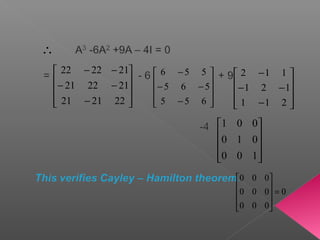
 CAYLEY HAMILTON THEOREM
kshumENGG2013 2
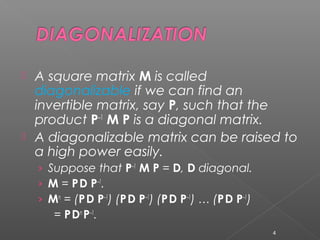
 A square matrix M is called
diagonalizable if we can find an
invertible matrix, say P, such that the
product P–1
M P is a diagonal matrix.
 A diagonalizable matrix can be raised to
a high power easily.
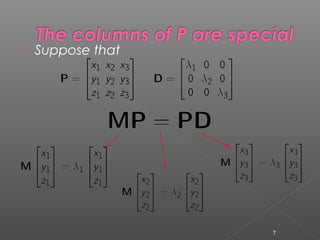
› Suppose that P–1
M P = D, D diagonal.
› M = PD P–1
.
› Mn
= (PD P–1
) (PD P–1
) (PD P–1
) … (PD P–1
)
= PDn
P–1
.
4
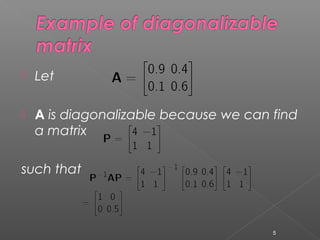
 Let
 A is diagonalizable because we can find
a matrix
such that
5
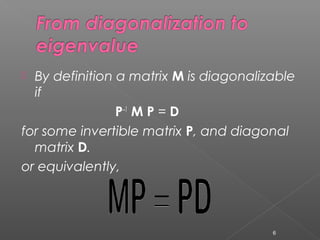
 By definition a matrix M is diagonalizable
if
P–1
M P = D
for some invertible matrix P, and diagonal
matrix D.
or equivalently,
6
 Suppose that
7
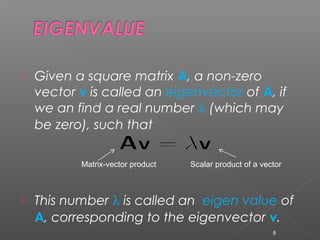
 Given a square matrix A, a non-zero
vector v is called an eigenvector of A, if
we an find a real number λ (which may
be zero), such that
 This number λ is called an eigen value of
A, corresponding to the eigenvector v.
8
Matrix-vector product Scalar product of a vector
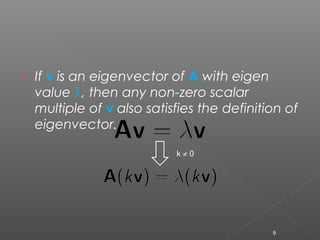
 If v is an eigenvector of A with eigen
value λ, then any non-zero scalar
multiple of v also satisfies the definition of
eigenvector.
9
k ≠ 0
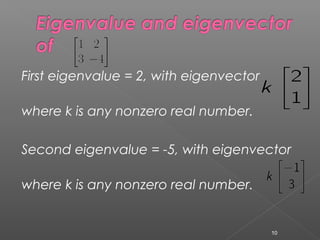
First eigenvalue = 2, with eigenvector
where k is any nonzero real number.
Second eigenvalue = -5, with eigenvector
where k is any nonzero real number.
10
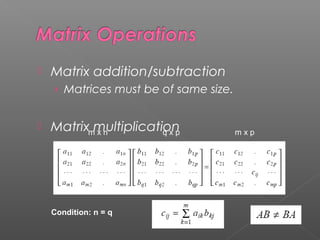
 Matrix addition/subtraction
› Matrices must be of same size.
 Matrix multiplication
Condition: n = q
m x n q x p m x p
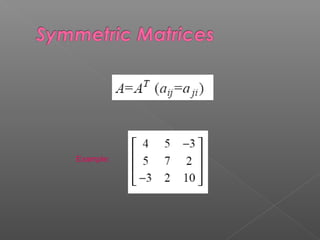
Example:
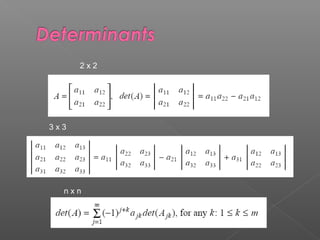
2 x 2
3 x 3
n x n
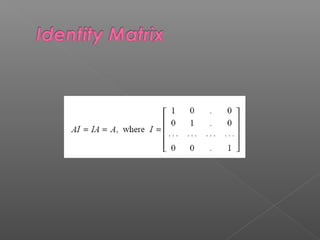
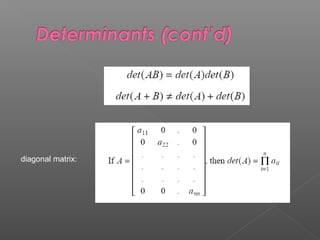
diagonal matrix:
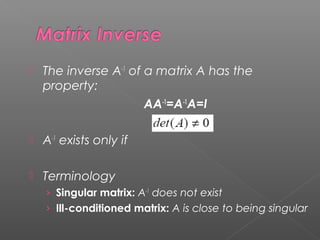
 The inverse A-1
of a matrix A has the
property:
AA-1
=A-1
A=I
 A-1
exists only if
 Terminology
› Singular matrix: A-1
does not exist
› Ill-conditioned matrix: A is close to being singular
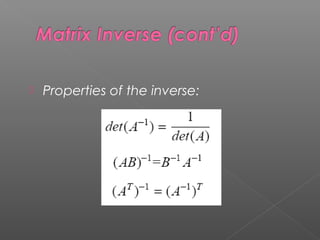
 Properties of the inverse:
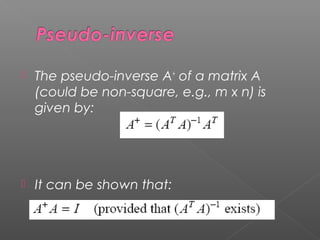
 The pseudo-inverse A+
of a matrix A
(could be non-square, e.g., m x n) is
given by:
 It can be shown that:
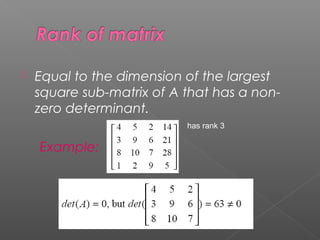
 Equal to the dimension of the largest
square sub-matrix of A that has a non-
zero determinant.
Example:
has rank 3
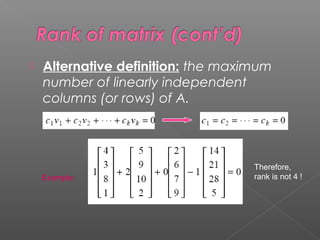
 Alternative definition: the maximum
number of linearly independent
columns (or rows) of A.
Therefore,
rank is not 4 !Example:
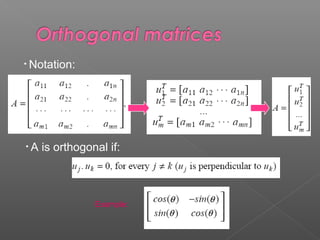
• A is orthogonal if:
• Notation:
Example:
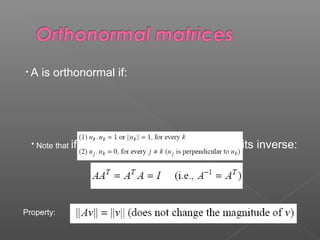
• A is orthonormal if:
• Note that if A is orthonormal, it easy to find its inverse:
Property:
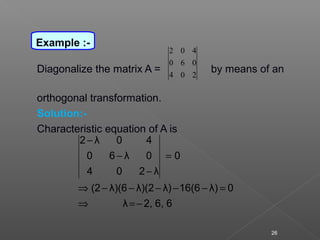
Diagonalize the matrix A = by means of an
orthogonal transformation.
Solution:-
Characteristic equation of A is
204
060
402
66,2,λ
0λ)16(6λ)λ)(2λ)(6(2
0
λ204
0λ60
40λ2
−=⇒
=−−−−−⇒
=
−
−
−
26
Example :-
I
 
 
 
  
     
     
     
          
⇒
∴
 
 ∴  
  
1
1 2
3
1
1
2
3
1 3
2
1 3
1 1 2 3 1
1 1
x
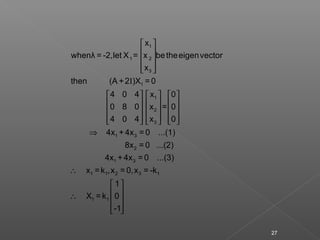
whenλ = -2,let X = x betheeigenvector
x
then (A +2 )X = 0
4 0 4 x 0
0 8 0 x = 0
4 0 4 x 0
4x + 4x = 0 ...(1)
8x = 0 ...(2)
4x +4x = 0 ...(3)
x =k ,x = 0,x = -k
1
X = k 0
-1
27
2
2I
0
 
 
 
  
     
     
     
          
⇒ −
∴
1
2
3
1
2
3
1 3
1 3
1 3 2
2 2 3
x
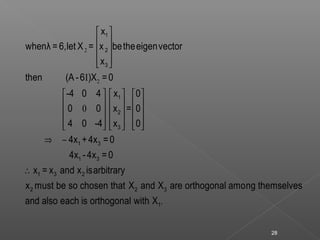
whenλ = 6,let X = x betheeigenvector
x
then (A -6 )X =0
-4 0 4 x 0
0 0 x = 0
4 0 -4 x 0
4x +4x =0
4x -4x =0
x = x and x isarbitrary
x must be so chosen that X and X are orthogonal among th
.1
emselves
and also each is orthogonal with X
28
   
   
   
      
∴
∴
 
 
 
  
∴
2 3
3 1
3 2
3
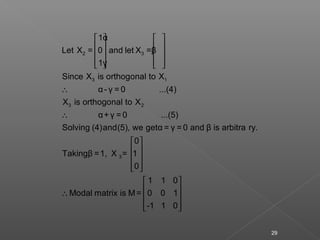
1α
Let X = 0 and let X =β
1γ
Since X is orthogonal to X
α- γ = 0 ...(4)
X is orthogonal to X
α+ γ = 0 ...(5)
Solving (4)and(5), we getα = γ = 0 and β is arbitra ry.
0
Takingβ =1, X = 1
0
1 1 0
Modal matrix is M= 0 0 1
-1 1
 
 
 
  0
29
 
 
 
 
 
 
  
 
  
    
    
    
        
    
 
 
 
  
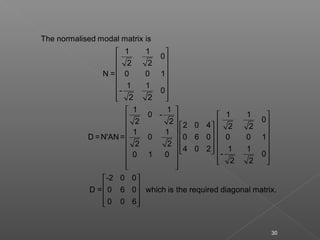
The normalised modal matrix is
1 1
0
2 2
N = 0 0 1
1 1
- 0
2 2
1 1
0 - 1 1
02 2 2 0 4 2 2
1 1
D =N'AN = 0 0 6 0 0 0 1
2 2
4 0 2 1 1
- 00 1 0
2 2
-2 0 0
D = 0 6 0 which is the required diagonal matrix
0 0 6
.
30
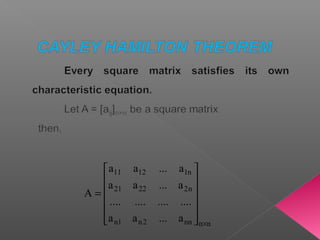
nnnn2n1n
n22221
n11211
a...aa
................
a...aa
a...aa
A
×












=
 
 
 
 
 
 
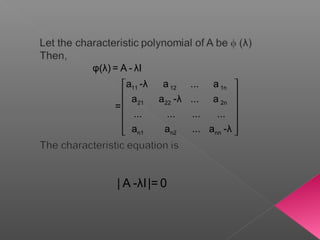
11 12 1n
21 22 2n
n1 n2 nn
φ(λ) = A - λI
a -λ a ... a
a a -λ ... a
=
... ... ... ...
a a ... a -λ
| A -λI|= 0
⇒ n n-1 n-2
0 1 2 n
n n-1 n-2
0 1 2 n
We are to prove that
pλ +p λ +p λ +...+p = 0
p A +p A +p A +...+p I= 0 ...(1)
I
⇒
n-1 n-2 n-3 -1
0 1 2 n-1 n
-1 n-1 n-2 n-3
0 1 2 n-1
n
0 =p A +p A +p A +...+p +p A
1
A =- [p A +p A +p A +...+p I]
p










−
−−
−
211
121
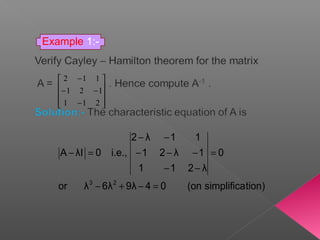
112
tion)simplifica(on049λ6λλor
0
λ211
1λ21
11λ2
i.e.,0λIA
23
=−+−
=
−−
−−−
−−
=−
Example 1:-










−
−−
−−
=










−
−−
−










−
−−
−
=×=










−
−−
−
=










−
−−
−










−
−−
−
=
222121
212221
212222
211
121
112
655
565
556
655
565
556
211
121
112
211
121
112
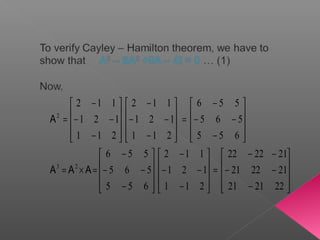
23
2
AAA
A
∴










−
−−
−−
222121
212221
212222










−
−−
−
655
565
556










−
−−
−
211
121
112










100
010
001
0
000
000
000
=










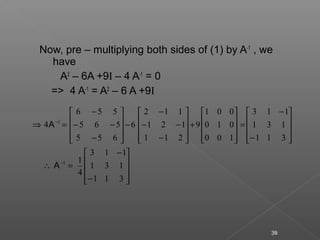
Now, pre – multiplying both sides of (1) by A-1
, we
have
A2
– 6A +9I – 4 A-1
= 0
=> 4 A-1
= A2
– 6 A +9I










−
−
=∴










−
−
=










+










−
−−
−
−










−
−−
−
=⇒
−
−
311
131
113
4
1
311
131
113
100
010
001
9
211
121
112
6
655
565
556
4
1
1
A
A
39
Eigen value , eigen vectors, caley hamilton theorem

Eigen value , eigen vectors, caley hamilton theorem

Editor's Notes

  • #6 \mathbf{A} = \begin{bmatrix} 0.9 & 0.4\\ 0.1 & 0.6 \end{bmatrix}
  • #8 \mathbf{P}=\begin{bmatrix} x_1 & x_2 & x_3\\ y_1 & y_2 & y_3\\ z_1 & z_2 & z_3 \end{bmatrix}