Fuzzy Logic


By Manoj Harsule
Overview

•   A Little History
•   Fuzzy Logic – A Definition
•   Fuzzy set theory
•   Introduction to fuzzy set
•   Fuzzy Relations
A little History
 In the 1960’s Lotfi A. Zadeh Ph.D,. University of
  California, Berkeley, published an obscure paper on
  fuzzy sets . His unconventional theory allowed for
  approximate information and uncertainty when
  generating complex solutions; a process that
  previously did not exist.

 Fuzzy Logic has been around since the mid 60’s but
  was not readily excepted until the 80’s and 90’s.
  Although now prevalent throughout much of the
  world, China, Japan and Korea were the early
  adopters
WHAT IS FUZZY LOGIC?

   Definition of fuzzy
     Fuzzy   – “not clear, distinct, or not precise;
      uncertain”
   Definition of fuzzy logic
    A   form of knowledge representation suitable for
      notions that cannot be defined precisely, but which
      depend upon their contexts.
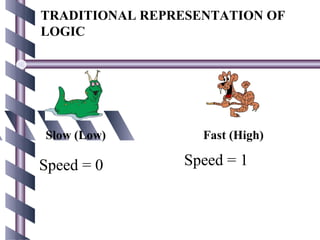
TRADITIONAL REPRESENTATION OF
LOGIC


Slow (Low)         Fast (High)

Speed = 0        Speed = 1
FUZZY LOGIC
REPRESENTATION
                    Slowest
 For every         [ 0.0 – 0.25 ]
  problem           Slow
  must           [ 0.25 – 0.50 ]
  represent in      Fast
  terms of       [ 0.50 – 0.75 ]
  fuzzy sets.       Fastest
                 [ 0.75 – 1.00 ]
Introduction to
Fuzzy Set Theory

Fuzzy Sets
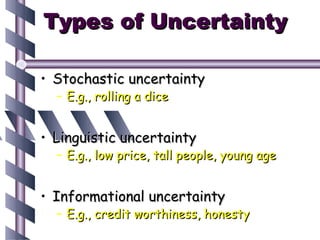
Types of Uncertainty

• Stochastic uncertainty
  – E.g., rolling a dice


• Linguistic uncertainty
  – E.g., low price, tall people, young age


• Informational uncertainty
  – E.g., credit worthiness, honesty
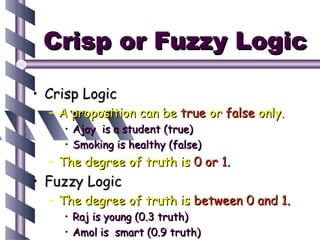
Crisp or Fuzzy Logic

• Crisp Logic
  – A proposition can be true or false only.
    • Ajay is a student (true)
    • Smoking is healthy (false)
  – The degree of truth is 0 or 1.
• Fuzzy Logic
  – The degree of truth is between 0 and 1.
    • Raj is young (0.3 truth)
    • Amol is smart (0.9 truth)
Crisp Sets
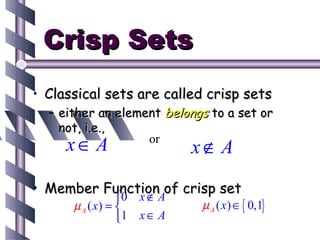
• Classical sets are called crisp sets
  – either an element belongs to a set or
    not, i.e.,
     x∈ A          or
                            x∉ A

• Member Function of crisp set
           0 x∉ A
      µ A ( x) =            µ A ( x) ∈ { 0,1}
                 1 x ∈ A
Crisp Sets
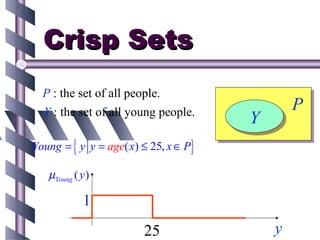
  P : the set of all people.
  Y : the set of all young people.             P
                                       Y
                                       Y
Young = { y y = age( x) ≤ 25, x ∈ P}

   µYoung ( y )

             1
                        25                 y
Crisp sets   µ A ( x) ∈ { 0,1}

Fuzzy Sets

     µ A ( x) ∈ [0,1]
               Example
µYoung ( y )

          1
                                                 y
Definition:
Fuzzy Sets and Membership
Functions
  U : universe of discourse.
If U is a collection of objects denoted generically by x, then
a fuzzy set A in U is defined as a set of ordered pairs:


    A = { ( x, µ A ( x)) x ∈ U }
                       membership
                        function


           µ A : U → [0,1]
Example (Discrete
    Universe)

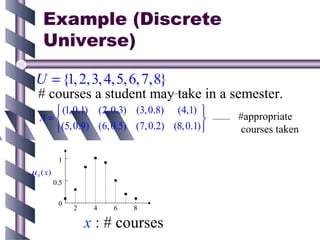
 U = {1, 2,3, 4,5, 6, 7,8}
  # courses a student may take in a semester.
      (1, 0.1) (2, 0.3) (3, 0.8) (4,1) 
   A=                                        #appropriate
      (5, 0.9) (6, 0.5) (7, 0.2) (8, 0.1)     courses taken

            1
µA ( x )
           0.5

            0
                 2    4   6   8

                     x : # courses
Example (Discrete
   Universe)

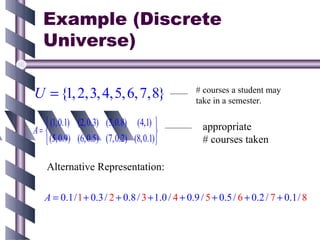
U = {1, 2,3, 4,5, 6, 7,8}                       # courses a student may
                                                take in a semester.

    (1,0.1) (2,0.3) (3,0.8) (4,1)               appropriate
A=                                  
    (5,0.9) (6,0.5) (7,0.2) (8,0.1)             # courses taken

    Alternative Representation:

   A = 0.1/ 1 + 0.3 / 2 + 0.8 / 3 + 1.0 / 4 + 0.9 / 5 + 0.5 / 6 + 0.2 / 7 + 0.1/ 8
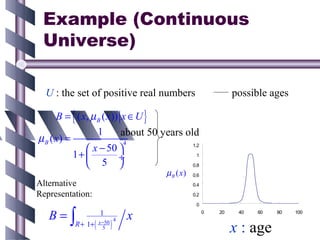
Example (Continuous
 Universe)

  U : the set of positive real numbers                               possible ages

      B = { ( x, µ B ( x)) x ∈U }
                   1       about 50 years old
µ B ( x) =                  4
                x − 50                    1.2

           1+            ÷                   1

                5                         0.8
                                           µ B ( x)   0.6
Alternative                                           0.4

Representation:                                       0.2

                                                       0

   B=∫                 1
                                       x                    0   20    40   60   80   100

                   (           )
                                   4

                                                                     x : age
          R + 1+       x −50
                         5
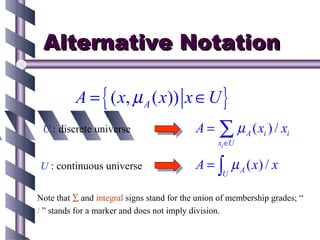
Alternative Notation

          A = { ( x, µ A ( x)) x ∈ U }
 U : discrete universe                      A=    ∑µ
                                                  xi ∈U
                                                          A   ( xi ) / xi

U : continuous universe                     A = ∫ µ A ( x) / x
                                                   U


Note that ∑ and integral signs stand for the union of membership grades; “
/ ” stands for a marker and does not imply division.
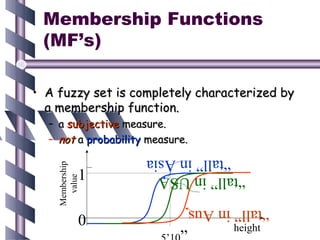
Membership Functions
 (MF’s)

• A fuzzy set is completely characterized by
  a membership function.
  – a subjective measure.
  – not a probability measure.
                       “tall” in Asia
    Membership


             1
      value


                     “tall” in USA

                                 “tall” in Aus
             0                          height
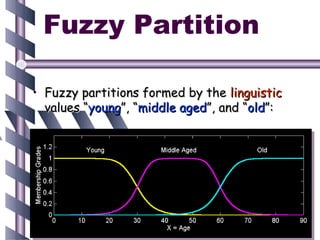
Fuzzy Partition

• Fuzzy partitions formed by the linguistic
  values “young”, “middle aged”, and “old”:
Introduction to
Fuzzy Set Theory

   Set-Theoretic
    Operations
Set-Theoretic
Operations
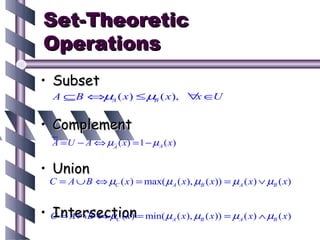
• Subset
  A ⊆B ⇔µA ( x ) ≤ µ ( x ), ∀ ∈
                    B        x U


• Complement
  A = U − A ⇔ µA ( x ) = 1 − µA ( x )


• Union
 C = A ∪ B ⇔ µC ( x ) = max( µA ( x ), µB ( x )) = µA ( x ) ∨ µB ( x )


  Intersection
• C = A ∩ B ⇔ µ ( x) = min( µ
                    C               A   ( x ), µB ( x )) = µA ( x) ∧ µB ( x)
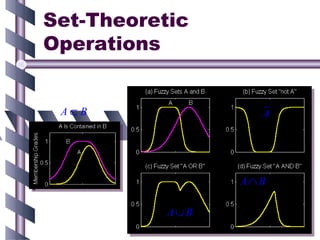
Set-Theoretic
Operations


 A⊂ B                A


                  A∩ B

           A∪ B
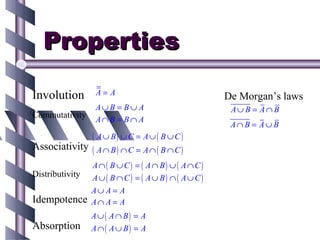
Properties

Involution         A=A
                                                       De Morgan’s laws
                   A∪ B = B ∪ A                         A∪ B = A∩ B
Commutativity      A∩ B = B ∩ A
                                                        A∩ B = A∪ B
               ( A ∪ B) ∪ C = A ∪ ( B ∪ C )
Associativity ( A ∩ B ) ∩ C = A ∩ ( B ∩ C )
               A ∩ ( B ∪ C ) = ( A ∩ B) ∪ ( A ∩ C )
Distributivity A ∪ ( B ∩ C ) = ( A ∪ B ) ∩ ( A ∪ C )
                  A∪ A = A
Idempotence       A∩ A = A
                 A ∪ ( A ∩ B) = A
Absorption       A ∩ ( A ∪ B) = A
Properties

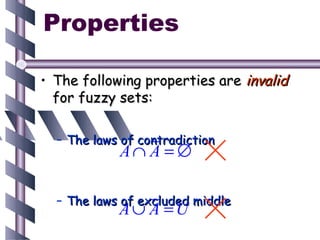
• The following properties are invalid
  for fuzzy sets:

  – The laws of contradiction
            A∩ A = ∅

  – The laws of excluded middle
            A∪ A =U
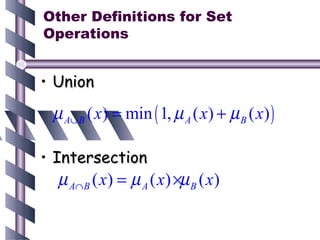
Other Definitions for Set
Operations


• Union
 µ A∪ B ( x) = min ( 1, µ A ( x) + µ B ( x) )

• Intersection
  µ A∩ B ( x) = µ A ( x) ×µ B ( x)
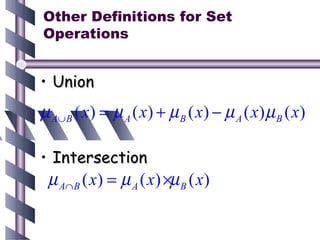
Other Definitions for Set
Operations


• Union
µ A∪ B ( x ) = µ A ( x ) + µ B ( x ) − µ A ( x ) µ B ( x )

• Intersection
 µ A∩ B ( x) = µ A ( x) ×µ B ( x)
Generalized
Union/Intersection
• Generalized Intersection

      t-norm
• Generalized Union

      t-conorm
T-Norm
                           Or called triangular norm.


         T :[0,1] × [0,1] → [0,1]
1. Symmetry        T ( x, y ) = T ( y , x )

2. Associativity   T (T ( x, y ), z ) = T ( x, T ( y, z ))

3. Monotonicity    x1 ≤ x2 , y1 ≤ y2 ⇒ T ( x1 , y1 ) ≤ T ( x2 , y2 )

4. Border Condition T ( x,1) = x
T-Conorm Or called s-norm.

         S :[0,1] × [0,1] → [0,1]
1. Symmetry        S ( x, y ) = S ( y , x )

2. Associativity   S ( S ( x, y ), z ) = S ( x, S ( y, z ))

3. Monotonicity    x1 ≤ x2 , y1 ≤ y2 ⇒ S ( x1 , y1 ) ≤ S ( x2 , y2 )

4. Border Condition      S ( x, 0) = x
Fuzzy Relations


 Review
 Fuzzy Relations
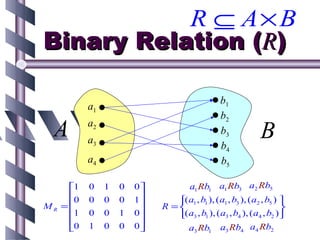
R ⊆ A×B
Binary Relation (R)

                                               b1
         a1
                                               b2
 A       a2
         a3
                                               b3            B
                                               b4
         a4                                    b5

    1   0    1   0   0            a1 Rb1 a1 Rb3 a2 Rb5
    0                1
         0    0   0           ( a1 , b1 ), ( a1 , b3 ), ( a2 , b5 ) 
MR =                     R =                                      
    1   0    0   1   0      ( a3 , b1 ), ( a3 , b4 ), ( a4 , b2 ) 
                      
    0   1    0   0   0            a3 Rb1     a3 Rb4 a4 Rb2
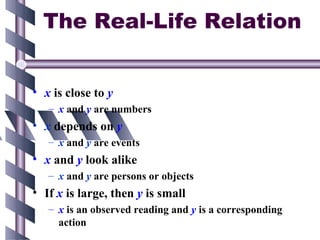
The Real-Life Relation


• x is close to y
   – x and y are numbers
• x depends on y
   – x and y are events
• x and y look alike
   – x and y are persons or objects
• If x is large, then y is small
   – x is an observed reading and y is a corresponding
     action
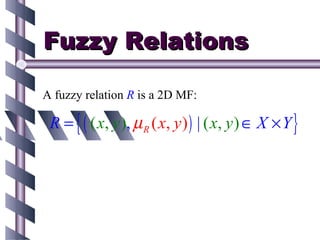
Fuzzy Relations

A fuzzy relation R is a 2D MF:

 R = { ( ( x, y ), µ R ( x, y ) ) | ( x, y ) ∈ X × Y }
R = { ( ( x, y ), µ R ( x, y ) ) | ( x, y ) ∈ X × Y }

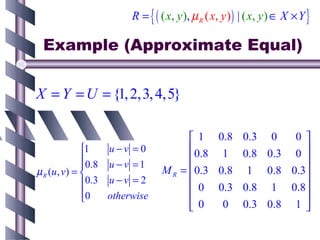
 Example (Approximate Equal)


X = Y = U = {1, 2,3, 4,5}

                                      1 0.8 0.3 0    0 
             1   u−v = 0            0.8 1 0.8 0.3 0 
                                                      
             0.8 u − v = 1    M R =  0.3 0.8 1 0.8 0.3
µ R (u, v) = 
             0.3 u − v = 2                            
             0   otherwise           0 0.3 0.8 1 0.8
                                    0
                                           0 0.3 0.8 1 
                                                        
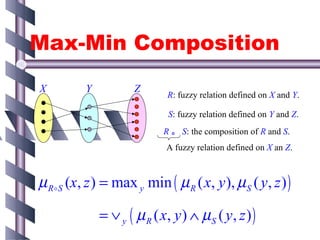
Max-Min Composition
X         Y           Z
                              R: fuzzy relation defined on X and Y.

                              S: fuzzy relation defined on Y and Z.
                             R 。 S: the composition of R and S.
                              A fuzzy relation defined on X an Z.


µ RoS (x, z ) = max y min ( µ R ( x, y ), µS ( y, z ) )

              = ∨ y ( µ R ( x, y ) ∧ µ S ( y , z ) )
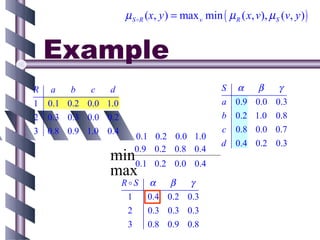
µ S o R (x, y ) = max v min ( µ R ( x, v), µ S (v, y ) )


    Example
R   a   b    c   d                                 S α    β   γ
1   0.1 0.2 0.0 1.0                                a 0.9 0.0 0.3
2   0.3 0.3 0.0 0.2                                b 0.2 1.0 0.8
3   0.8 0.9 1.0 0.4                                c 0.8 0.0 0.7
                           0.1 0.2 0.0 1.0
                                                   d 0.4 0.2 0.3
                           0.9 0.2 0.8 0.4
                 min0.1        0.2 0.0 0.4
                 max
                      RoS    α    β   γ
                       1     0.4 0.2 0.3
                       2     0.3 0.3 0.3
                       3     0.8 0.9 0.8
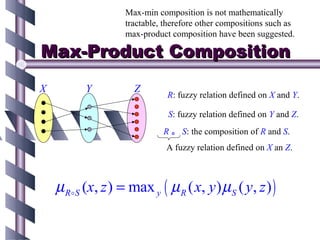
Max-min composition is not mathematically
                    tractable, therefore other compositions such as
                    max-product composition have been suggested.

Max-Product Composition
X          Y          Z
                               R: fuzzy relation defined on X and Y.

                               S: fuzzy relation defined on Y and Z.
                              R 。 S: the composition of R and S.
                               A fuzzy relation defined on X an Z.


    µ RoS (x, z ) = max y ( µ R ( x, y ) µ S ( y, z ) )
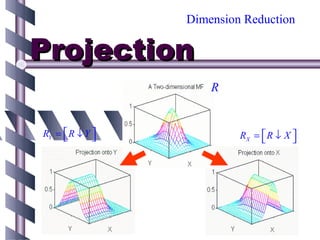
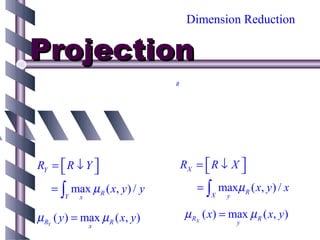
Dimension Reduction

Projection
                     R


RY =  R ↓ Y 
                        RX =  R ↓ X 
                                      
Dimension Reduction

Projection
                                R


RY =  R ↓ Y 
                                  RX =  R ↓ X 
                                                
    = ∫ max µ R ( x, y ) / y           = ∫ maxµ R ( x, y ) / x
       Y    x                             X    y


µ RY ( y ) = max µ R ( x, y )       µ RX ( x) = max µ R ( x, y)
                                                   y
                x
Dimension Expansion

Cylindrical Extension

A : a fuzzy set in X.
C(A) = [A↑X×Y] : cylindrical extension of A.
 C ( A) = ∫        µ A ( x ) | ( x, y )   µC ( A ) ( x , y ) = µ A ( x )
            X ×Y
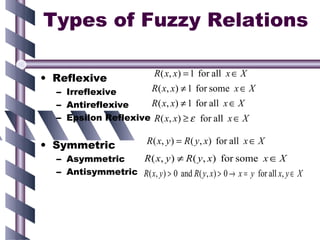
Types of Fuzzy Relations

                              R ( x, x) = 1 for all x ∈ X
• Reflexive
  – Irreflexive      R ( x, x) ≠ 1 for some x ∈ X
  – Antireflexive    R ( x, x) ≠ 1 for all x ∈ X
  – Epsilon Reflexive R ( x, x) ≥ ε for all x ∈ X


• Symmetric                 R ( x, y ) = R ( y, x) for all x ∈ X
  – Asymmetric    R ( x, y ) ≠ R( y, x) for some x ∈ X
  – Antisymmetric R( x, y ) > 0 and R( y, x) > 0 → x = y for all x, y ∈ X
Types of Fuzzy Relations

• Transitive (max-min transitive)
  R ( x, z ) ≥ max min[ R ( x, y ), R ( y , z )] for all x,z ∈X
              y∈Y


  – Non-transitive:
     For some (x,z), the above do not satisfy.
  – Antitransitive:
  R ( x, z ) < max min[ R ( x, y ), R ( y , z )] for all x,z ∈X
               y∈Y


• Example: X = Set of cities, R=“very far”
         Reflexive, symmetric, non-transitive
Types of Fuzzy Relations

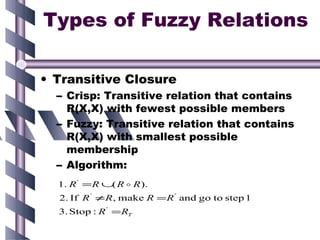
• Transitive Closure
  – Crisp: Transitive relation that contains
    R(X,X) with fewest possible members
  – Fuzzy: Transitive relation that contains
    R(X,X) with smallest possible
    membership
  – Algorithm:
  1. R ' = R ∪ R o R ).
              (
  2. If R ' ≠ R, make R = R ' and go to step 1
  3. Stop : R ' = RT
Types of Fuzzy Relations

• Fuzzy Equivalence or Similarity
  Relation
  – Reflexive, symmetric, and transitive
  – Decomposition:
   R=    ααR
           ⋅
       α∈ ,1]
         [0
   α
    R is a crisp equivalence relation.
   Set of partitions :
       ∏ ={π(αR ) | α∈
        (R)           [0,1]}


  – Partition Tree
Types of Fuzzy Relations

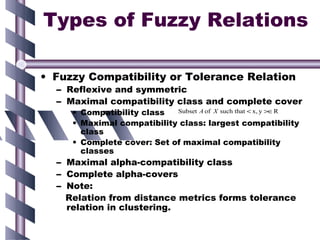
• Fuzzy Compatibility or Tolerance Relation
  – Reflexive and symmetric
  – Maximal compatibility class and complete cover
     • Compatibility class  Subset A of X such that < x, y >∈R

     • Maximal compatibility class: largest compatibility
       class
     • Complete cover: Set of maximal compatibility
       classes
  – Maximal alpha-compatibility class
  – Complete alpha-covers
  – Note:
    Relation from distance metrics forms tolerance
    relation in clustering.
Bibliography
• J. R. Jang, C. Sun, E. Mizutani,
  “Neuro-Fuzzy and Soft Computing: A
  Computational Approach to Learning
  and Machine Intelligence, Prentice
  Hall
• Slides and notes:
  http://equipe.nce.ufrj.br/adriano/fuzzy/bib
Introduction to Artificial Intelligence

Introduction to Artificial Intelligence

  • 1.
  • 2.
    Overview • A Little History • Fuzzy Logic – A Definition • Fuzzy set theory • Introduction to fuzzy set • Fuzzy Relations
  • 3.
    A little History In the 1960’s Lotfi A. Zadeh Ph.D,. University of California, Berkeley, published an obscure paper on fuzzy sets . His unconventional theory allowed for approximate information and uncertainty when generating complex solutions; a process that previously did not exist.  Fuzzy Logic has been around since the mid 60’s but was not readily excepted until the 80’s and 90’s. Although now prevalent throughout much of the world, China, Japan and Korea were the early adopters
  • 4.
    WHAT IS FUZZYLOGIC?  Definition of fuzzy  Fuzzy – “not clear, distinct, or not precise; uncertain”  Definition of fuzzy logic A form of knowledge representation suitable for notions that cannot be defined precisely, but which depend upon their contexts.
  • 5.
    TRADITIONAL REPRESENTATION OF LOGIC Slow(Low) Fast (High) Speed = 0 Speed = 1
  • 6.
    FUZZY LOGIC REPRESENTATION Slowest For every [ 0.0 – 0.25 ] problem Slow must [ 0.25 – 0.50 ] represent in Fast terms of [ 0.50 – 0.75 ] fuzzy sets. Fastest [ 0.75 – 1.00 ]
  • 7.
    Introduction to Fuzzy SetTheory Fuzzy Sets
  • 8.
    Types of Uncertainty •Stochastic uncertainty – E.g., rolling a dice • Linguistic uncertainty – E.g., low price, tall people, young age • Informational uncertainty – E.g., credit worthiness, honesty
  • 9.
    Crisp or FuzzyLogic • Crisp Logic – A proposition can be true or false only. • Ajay is a student (true) • Smoking is healthy (false) – The degree of truth is 0 or 1. • Fuzzy Logic – The degree of truth is between 0 and 1. • Raj is young (0.3 truth) • Amol is smart (0.9 truth)
  • 10.
    Crisp Sets • Classicalsets are called crisp sets – either an element belongs to a set or not, i.e., x∈ A or x∉ A • Member Function of crisp set 0 x∉ A µ A ( x) =  µ A ( x) ∈ { 0,1} 1 x ∈ A
  • 11.
    Crisp Sets P : the set of all people. Y : the set of all young people. P Y Y Young = { y y = age( x) ≤ 25, x ∈ P} µYoung ( y ) 1 25 y
  • 12.
    Crisp sets µ A ( x) ∈ { 0,1} Fuzzy Sets µ A ( x) ∈ [0,1] Example µYoung ( y ) 1 y
  • 13.
    Definition: Fuzzy Sets andMembership Functions U : universe of discourse. If U is a collection of objects denoted generically by x, then a fuzzy set A in U is defined as a set of ordered pairs: A = { ( x, µ A ( x)) x ∈ U } membership function µ A : U → [0,1]
  • 14.
    Example (Discrete Universe) U = {1, 2,3, 4,5, 6, 7,8} # courses a student may take in a semester.  (1, 0.1) (2, 0.3) (3, 0.8) (4,1)  A=  #appropriate  (5, 0.9) (6, 0.5) (7, 0.2) (8, 0.1)  courses taken 1 µA ( x ) 0.5 0 2 4 6 8 x : # courses
  • 15.
    Example (Discrete Universe) U = {1, 2,3, 4,5, 6, 7,8} # courses a student may take in a semester.  (1,0.1) (2,0.3) (3,0.8) (4,1)  appropriate A=    (5,0.9) (6,0.5) (7,0.2) (8,0.1)  # courses taken Alternative Representation: A = 0.1/ 1 + 0.3 / 2 + 0.8 / 3 + 1.0 / 4 + 0.9 / 5 + 0.5 / 6 + 0.2 / 7 + 0.1/ 8
  • 16.
    Example (Continuous Universe) U : the set of positive real numbers possible ages B = { ( x, µ B ( x)) x ∈U } 1 about 50 years old µ B ( x) = 4  x − 50  1.2 1+  ÷ 1  5  0.8 µ B ( x) 0.6 Alternative 0.4 Representation: 0.2 0 B=∫ 1 x 0 20 40 60 80 100 ( ) 4 x : age R + 1+ x −50 5
  • 17.
    Alternative Notation A = { ( x, µ A ( x)) x ∈ U } U : discrete universe A= ∑µ xi ∈U A ( xi ) / xi U : continuous universe A = ∫ µ A ( x) / x U Note that ∑ and integral signs stand for the union of membership grades; “ / ” stands for a marker and does not imply division.
  • 18.
    Membership Functions (MF’s) •A fuzzy set is completely characterized by a membership function. – a subjective measure. – not a probability measure. “tall” in Asia Membership 1 value “tall” in USA “tall” in Aus 0 height
  • 19.
    Fuzzy Partition • Fuzzypartitions formed by the linguistic values “young”, “middle aged”, and “old”:
  • 20.
    Introduction to Fuzzy SetTheory Set-Theoretic Operations
  • 21.
    Set-Theoretic Operations • Subset A ⊆B ⇔µA ( x ) ≤ µ ( x ), ∀ ∈ B x U • Complement A = U − A ⇔ µA ( x ) = 1 − µA ( x ) • Union C = A ∪ B ⇔ µC ( x ) = max( µA ( x ), µB ( x )) = µA ( x ) ∨ µB ( x ) Intersection • C = A ∩ B ⇔ µ ( x) = min( µ C A ( x ), µB ( x )) = µA ( x) ∧ µB ( x)
  • 22.
  • 23.
    Properties Involution A=A De Morgan’s laws A∪ B = B ∪ A A∪ B = A∩ B Commutativity A∩ B = B ∩ A A∩ B = A∪ B ( A ∪ B) ∪ C = A ∪ ( B ∪ C ) Associativity ( A ∩ B ) ∩ C = A ∩ ( B ∩ C ) A ∩ ( B ∪ C ) = ( A ∩ B) ∪ ( A ∩ C ) Distributivity A ∪ ( B ∩ C ) = ( A ∪ B ) ∩ ( A ∪ C ) A∪ A = A Idempotence A∩ A = A A ∪ ( A ∩ B) = A Absorption A ∩ ( A ∪ B) = A
  • 24.
    Properties • The followingproperties are invalid for fuzzy sets: – The laws of contradiction A∩ A = ∅ – The laws of excluded middle A∪ A =U
  • 25.
    Other Definitions forSet Operations • Union µ A∪ B ( x) = min ( 1, µ A ( x) + µ B ( x) ) • Intersection µ A∩ B ( x) = µ A ( x) ×µ B ( x)
  • 26.
    Other Definitions forSet Operations • Union µ A∪ B ( x ) = µ A ( x ) + µ B ( x ) − µ A ( x ) µ B ( x ) • Intersection µ A∩ B ( x) = µ A ( x) ×µ B ( x)
  • 27.
  • 28.
    T-Norm Or called triangular norm. T :[0,1] × [0,1] → [0,1] 1. Symmetry T ( x, y ) = T ( y , x ) 2. Associativity T (T ( x, y ), z ) = T ( x, T ( y, z )) 3. Monotonicity x1 ≤ x2 , y1 ≤ y2 ⇒ T ( x1 , y1 ) ≤ T ( x2 , y2 ) 4. Border Condition T ( x,1) = x
  • 29.
    T-Conorm Or calleds-norm. S :[0,1] × [0,1] → [0,1] 1. Symmetry S ( x, y ) = S ( y , x ) 2. Associativity S ( S ( x, y ), z ) = S ( x, S ( y, z )) 3. Monotonicity x1 ≤ x2 , y1 ≤ y2 ⇒ S ( x1 , y1 ) ≤ S ( x2 , y2 ) 4. Border Condition S ( x, 0) = x
  • 30.
    Fuzzy Relations Review Fuzzy Relations
  • 31.
    R ⊆ A×B BinaryRelation (R) b1 a1 b2 A a2 a3 b3 B b4 a4 b5 1 0 1 0 0 a1 Rb1 a1 Rb3 a2 Rb5 0 1 0 0 0 ( a1 , b1 ), ( a1 , b3 ), ( a2 , b5 )  MR =  R =  1 0 0 1 0 ( a3 , b1 ), ( a3 , b4 ), ( a4 , b2 )    0 1 0 0 0 a3 Rb1 a3 Rb4 a4 Rb2
  • 32.
    The Real-Life Relation •x is close to y – x and y are numbers • x depends on y – x and y are events • x and y look alike – x and y are persons or objects • If x is large, then y is small – x is an observed reading and y is a corresponding action
  • 33.
    Fuzzy Relations A fuzzyrelation R is a 2D MF: R = { ( ( x, y ), µ R ( x, y ) ) | ( x, y ) ∈ X × Y }
  • 34.
    R = {( ( x, y ), µ R ( x, y ) ) | ( x, y ) ∈ X × Y } Example (Approximate Equal) X = Y = U = {1, 2,3, 4,5}  1 0.8 0.3 0 0  1 u−v = 0 0.8 1 0.8 0.3 0     0.8 u − v = 1 M R =  0.3 0.8 1 0.8 0.3 µ R (u, v) =  0.3 u − v = 2   0 otherwise  0 0.3 0.8 1 0.8  0  0 0.3 0.8 1  
  • 35.
    Max-Min Composition X Y Z R: fuzzy relation defined on X and Y. S: fuzzy relation defined on Y and Z. R 。 S: the composition of R and S. A fuzzy relation defined on X an Z. µ RoS (x, z ) = max y min ( µ R ( x, y ), µS ( y, z ) ) = ∨ y ( µ R ( x, y ) ∧ µ S ( y , z ) )
  • 36.
    µ S oR (x, y ) = max v min ( µ R ( x, v), µ S (v, y ) ) Example R a b c d S α β γ 1 0.1 0.2 0.0 1.0 a 0.9 0.0 0.3 2 0.3 0.3 0.0 0.2 b 0.2 1.0 0.8 3 0.8 0.9 1.0 0.4 c 0.8 0.0 0.7 0.1 0.2 0.0 1.0 d 0.4 0.2 0.3 0.9 0.2 0.8 0.4 min0.1 0.2 0.0 0.4 max RoS α β γ 1 0.4 0.2 0.3 2 0.3 0.3 0.3 3 0.8 0.9 0.8
  • 37.
    Max-min composition isnot mathematically tractable, therefore other compositions such as max-product composition have been suggested. Max-Product Composition X Y Z R: fuzzy relation defined on X and Y. S: fuzzy relation defined on Y and Z. R 。 S: the composition of R and S. A fuzzy relation defined on X an Z. µ RoS (x, z ) = max y ( µ R ( x, y ) µ S ( y, z ) )
  • 38.
    Dimension Reduction Projection R RY =  R ↓ Y    RX =  R ↓ X   
  • 39.
    Dimension Reduction Projection R RY =  R ↓ Y    RX =  R ↓ X    = ∫ max µ R ( x, y ) / y = ∫ maxµ R ( x, y ) / x Y x X y µ RY ( y ) = max µ R ( x, y ) µ RX ( x) = max µ R ( x, y) y x
  • 40.
    Dimension Expansion Cylindrical Extension A: a fuzzy set in X. C(A) = [A↑X×Y] : cylindrical extension of A. C ( A) = ∫ µ A ( x ) | ( x, y ) µC ( A ) ( x , y ) = µ A ( x ) X ×Y
  • 41.
    Types of FuzzyRelations R ( x, x) = 1 for all x ∈ X • Reflexive – Irreflexive R ( x, x) ≠ 1 for some x ∈ X – Antireflexive R ( x, x) ≠ 1 for all x ∈ X – Epsilon Reflexive R ( x, x) ≥ ε for all x ∈ X • Symmetric R ( x, y ) = R ( y, x) for all x ∈ X – Asymmetric R ( x, y ) ≠ R( y, x) for some x ∈ X – Antisymmetric R( x, y ) > 0 and R( y, x) > 0 → x = y for all x, y ∈ X
  • 42.
    Types of FuzzyRelations • Transitive (max-min transitive) R ( x, z ) ≥ max min[ R ( x, y ), R ( y , z )] for all x,z ∈X y∈Y – Non-transitive: For some (x,z), the above do not satisfy. – Antitransitive: R ( x, z ) < max min[ R ( x, y ), R ( y , z )] for all x,z ∈X y∈Y • Example: X = Set of cities, R=“very far” Reflexive, symmetric, non-transitive
  • 43.
    Types of FuzzyRelations • Transitive Closure – Crisp: Transitive relation that contains R(X,X) with fewest possible members – Fuzzy: Transitive relation that contains R(X,X) with smallest possible membership – Algorithm: 1. R ' = R ∪ R o R ). ( 2. If R ' ≠ R, make R = R ' and go to step 1 3. Stop : R ' = RT
  • 44.
    Types of FuzzyRelations • Fuzzy Equivalence or Similarity Relation – Reflexive, symmetric, and transitive – Decomposition: R=  ααR ⋅ α∈ ,1] [0 α R is a crisp equivalence relation. Set of partitions : ∏ ={π(αR ) | α∈ (R) [0,1]} – Partition Tree
  • 45.
    Types of FuzzyRelations • Fuzzy Compatibility or Tolerance Relation – Reflexive and symmetric – Maximal compatibility class and complete cover • Compatibility class Subset A of X such that < x, y >∈R • Maximal compatibility class: largest compatibility class • Complete cover: Set of maximal compatibility classes – Maximal alpha-compatibility class – Complete alpha-covers – Note: Relation from distance metrics forms tolerance relation in clustering.
  • 46.
    Bibliography • J. R.Jang, C. Sun, E. Mizutani, “Neuro-Fuzzy and Soft Computing: A Computational Approach to Learning and Machine Intelligence, Prentice Hall • Slides and notes: http://equipe.nce.ufrj.br/adriano/fuzzy/bib