Seminar Series on
Linear Algebra for Machine Learning
Part 4: Eigenvalues, Eigenvectors and
Diagonalization
Dr. Ceni Babaoglu
Data Science Laboratory
Ryerson University
cenibabaoglu.com
Dr. Ceni Babaoglu cenibabaoglu.com
Linear Algebra for Machine Learning: Eigenvalues, Eigenvectors and Diagonalization
Overview
1 Eigenvalues and eigenvectors
2 Some properties of eigenvalues and eigenvectors
3 Similar matrices
4 Diagonalizable matrices
5 Some properties of diagonalizable matrices
6 References
Dr. Ceni Babaoglu cenibabaoglu.com
Linear Algebra for Machine Learning: Eigenvalues, Eigenvectors and Diagonalization
Eigenvalues and Eigenvectors
When a matrix multiplies a vector in general the magnitude
and direction of the vector will change.
There are special vectors where only their magnitude is
changed when multiplied by a matrix.
These special vectors are called eigenvectors. The value by
which the length changes is the associated eigenvalue.
We say that x is an eigenvector of A if
Ax = λx.
λ is called the associated eigenvalue.
Dr. Ceni Babaoglu cenibabaoglu.com
Linear Algebra for Machine Learning: Eigenvalues, Eigenvectors and Diagonalization
Eigenvalues and Eigenvectors
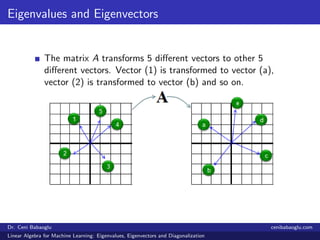
The matrix A transforms 5 different vectors to other 5
different vectors. Vector (1) is transformed to vector (a),
vector (2) is transformed to vector (b) and so on.
Dr. Ceni Babaoglu cenibabaoglu.com
Linear Algebra for Machine Learning: Eigenvalues, Eigenvectors and Diagonalization
Eigenvalues and Eigenvectors
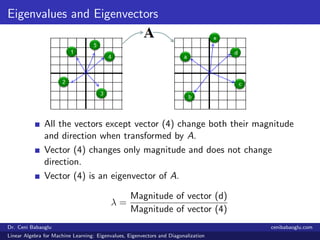
All the vectors except vector (4) change both their magnitude
and direction when transformed by A.
Vector (4) changes only magnitude and does not change
direction.
Vector (4) is an eigenvector of A.
λ =
Magnitude of vector (d)
Magnitude of vector (4)
Dr. Ceni Babaoglu cenibabaoglu.com
Linear Algebra for Machine Learning: Eigenvalues, Eigenvectors and Diagonalization
Eigenvalues and Eigenvectors
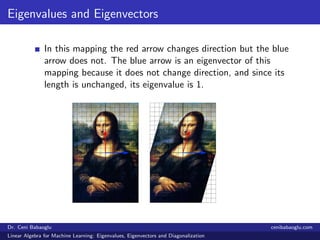
In this mapping the red arrow changes direction but the blue
arrow does not. The blue arrow is an eigenvector of this
mapping because it does not change direction, and since its
length is unchanged, its eigenvalue is 1.
Dr. Ceni Babaoglu cenibabaoglu.com
Linear Algebra for Machine Learning: Eigenvalues, Eigenvectors and Diagonalization
Some properties
If λ1, λ2, · · · , λn are distinct eigenvalues of a matrix, then the
corresponding eigenvectors e1, e2, · · · , en are linearly
independent.
If e1 is an eigenvector of a matrix with corresponding
eigenvalue λ1, then any nonzero scalar multiple of e1 is also
an eigenvector with eigenvalue λ1.
A real, symmetric square matrix has real eigenvalues, with
orthogonal eigenvectors (can be chosen to be orthonormal).
Dr. Ceni Babaoglu cenibabaoglu.com
Linear Algebra for Machine Learning: Eigenvalues, Eigenvectors and Diagonalization
Some properties
The equation Ax = λx can be written in the form
(A − λI)x = 0 (1)
λ is an eigenvalue of A if and only if (1) has a nontrivial
solution.
(1) has nontrivial solution if and only if A − λI is singular, or
equivalently
det(A − λI) = 0 → characteristic equation for A (2)
If (2) is expanded, we obtain an nth degree polynomial in λ,
p(λ) = det(A − λI) → characteristic polynomial
Dr. Ceni Babaoglu cenibabaoglu.com
Linear Algebra for Machine Learning: Eigenvalues, Eigenvectors and Diagonalization
Similar Matrices
A matrix B is said to be similar to a matrix A if there exists a
nonsingular matrix S such that
B = S−1
AS.
For n × n matrices A and B, if A is similar to B, then the two
matrices both have the same characteristic polynomial and,
consequently, both have the same eigenvalues.
Dr. Ceni Babaoglu cenibabaoglu.com
Linear Algebra for Machine Learning: Eigenvalues, Eigenvectors and Diagonalization
Diagonalizable Matrices
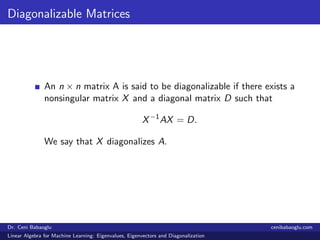
An n × n matrix A is said to be diagonalizable if there exists a
nonsingular matrix X and a diagonal matrix D such that
X−1
AX = D.
We say that X diagonalizes A.
Dr. Ceni Babaoglu cenibabaoglu.com
Linear Algebra for Machine Learning: Eigenvalues, Eigenvectors and Diagonalization
Some Properties
An n × n matrix A is diagonalizable if and only if A has n
linearly independent eigenvectors.
If A is diagonalizable, then the column vectors of the
diagonalizing matrix X are eigenvectors of A and the diagonal
elements of D are the corresponding eigenvalues of A.
The diagonalizing matrix X is not unique. Reordering the
columns of a given diagonalizing matrix X or multiplying them
by nonzero scalars will produce a new diagonalizing matrix.
Dr. Ceni Babaoglu cenibabaoglu.com
Linear Algebra for Machine Learning: Eigenvalues, Eigenvectors and Diagonalization
Some Properties
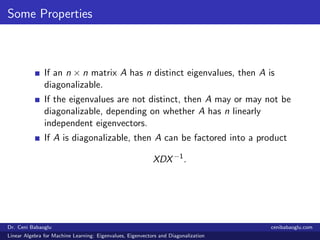
If an n × n matrix A has n distinct eigenvalues, then A is
diagonalizable.
If the eigenvalues are not distinct, then A may or may not be
diagonalizable, depending on whether A has n linearly
independent eigenvectors.
If A is diagonalizable, then A can be factored into a product
XDX−1
.
Dr. Ceni Babaoglu cenibabaoglu.com
Linear Algebra for Machine Learning: Eigenvalues, Eigenvectors and Diagonalization
Some Properties
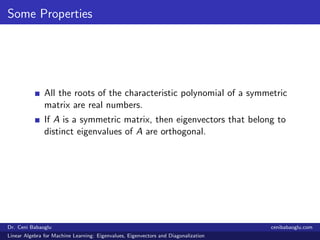
All the roots of the characteristic polynomial of a symmetric
matrix are real numbers.
If A is a symmetric matrix, then eigenvectors that belong to
distinct eigenvalues of A are orthogonal.
Dr. Ceni Babaoglu cenibabaoglu.com
Linear Algebra for Machine Learning: Eigenvalues, Eigenvectors and Diagonalization
Example
Diagonalize the matrix A =


2 −2 3
1 1 1
1 3 −1


We should solve the equation |A − λI| = 0.
|A − λI| =
2 − λ −2 3
1 1 − λ 1
1 3 −1 − λ
R2−R3→R2
−−−−−−−→
2 − λ −2 3
0 −2 − λ 2 + λ
1 3 −1 − λ
= (2 + λ)
2 − λ −2 3
0 −1 1
1 3 −1 − λ
C2+C3→C2
−−−−−−−→ (2 + λ)
2 − λ 1 3
0 0 1
1 2 − λ −1 − λ
= −(2 + λ)
2 − λ 1
1 2 − λ
= −(2 + λ)[(2 − λ)2
− 1] = −(2 + λ)(λ2
− 4λ + 3) = 0.
Eigenvalues: λ1 = 1, λ2 = 3, λ3 = −2.
Dr. Ceni Babaoglu cenibabaoglu.com
Linear Algebra for Machine Learning: Eigenvalues, Eigenvectors and Diagonalization
Example
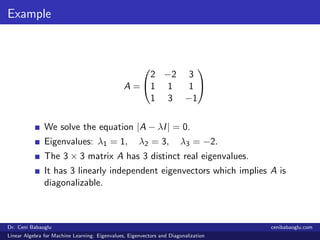
A =


2 −2 3
1 1 1
1 3 −1


We solve the equation |A − λI| = 0.
Eigenvalues: λ1 = 1, λ2 = 3, λ3 = −2.
The 3 × 3 matrix A has 3 distinct real eigenvalues.
It has 3 linearly independent eigenvectors which implies A is
diagonalizable.
Dr. Ceni Babaoglu cenibabaoglu.com
Linear Algebra for Machine Learning: Eigenvalues, Eigenvectors and Diagonalization
Example
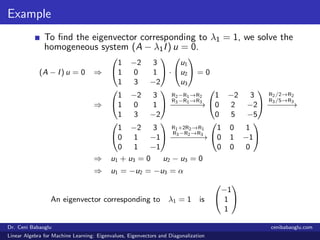
To find the eigenvector corresponding to λ1 = 1, we solve the
homogeneous system (A − λ1I) u = 0.
(A − I) u = 0 ⇒


1 −2 3
1 0 1
1 3 −2

 ·


u1
u2
u3

 = 0
⇒


1 −2 3
1 0 1
1 3 −2


R2−R1→R2
R3−R1→R3
−−−−−−−→


1 −2 3
0 2 −2
0 5 −5


R2/2→R2
R3/5→R3
−−−−−→


1 −2 3
0 1 −1
0 1 −1


R1+2R2→R1
R3−R2→R3
−−−−−−−→


1 0 1
0 1 −1
0 0 0


⇒ u1 + u3 = 0 u2 − u3 = 0
⇒ u1 = −u2 = −u3 = α
An eigenvector corresponding to λ1 = 1 is


−1
1
1


Dr. Ceni Babaoglu cenibabaoglu.com
Linear Algebra for Machine Learning: Eigenvalues, Eigenvectors and Diagonalization
Example
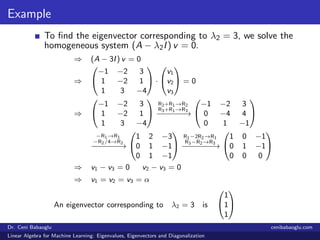
To find the eigenvector corresponding to λ2 = 3, we solve the
homogeneous system (A − λ2I) v = 0.
⇒ (A − 3I) v = 0
⇒


−1 −2 3
1 −2 1
1 3 −4

 ·


v1
v2
v3

 = 0
⇒


−1 −2 3
1 −2 1
1 3 −4


R2+R1→R2
R3+R1→R3
−−−−−−−→


−1 −2 3
0 −4 4
0 1 −1


−R1→R1
−R2/4→R2
−−−−−−−→


1 2 −3
0 1 −1
0 1 −1


R1−2R2→R1
R3−R2→R3
−−−−−−−→


1 0 −1
0 1 −1
0 0 0


⇒ v1 − v3 = 0 v2 − v3 = 0
⇒ v1 = v2 = v3 = α
An eigenvector corresponding to λ2 = 3 is


1
1
1


Dr. Ceni Babaoglu cenibabaoglu.com
Linear Algebra for Machine Learning: Eigenvalues, Eigenvectors and Diagonalization
Example
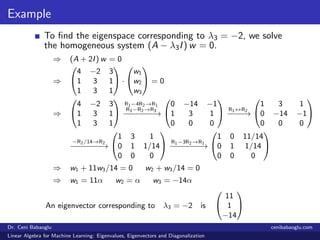
To find the eigenspace corresponding to λ3 = −2, we solve
the homogeneous system (A − λ3I) w = 0.
⇒ (A + 2I) w = 0
⇒


4 −2 3
1 3 1
1 3 1

 ·


w1
w2
w3

 = 0
⇒


4 −2 3
1 3 1
1 3 1


R1−4R2→R1
R3−R2→R3
−−−−−−−→


0 −14 −1
1 3 1
0 0 0

 R1↔R2
−−−−→


1 3 1
0 −14 −1
0 0 0


−R2/14→R2
−−−−−−−→


1 3 1
0 1 1/14
0 0 0

 R1−3R2→R1
−−−−−−−→


1 0 11/14
0 1 1/14
0 0 0


⇒ w1 + 11w3/14 = 0 w2 + w3/14 = 0
⇒ w1 = 11α w2 = α w3 = −14α
An eigenvector corresponding to λ3 = −2 is


11
1
−14


Dr. Ceni Babaoglu cenibabaoglu.com
Linear Algebra for Machine Learning: Eigenvalues, Eigenvectors and Diagonalization
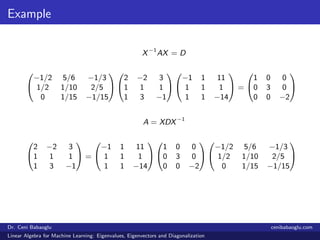
Example
X−1
AX = D


−1/2 5/6 −1/3
1/2 1/10 2/5
0 1/15 −1/15




2 −2 3
1 1 1
1 3 −1




−1 1 11
1 1 1
1 1 −14

 =


1 0 0
0 3 0
0 0 −2


A = XDX−1


2 −2 3
1 1 1
1 3 −1

 =


−1 1 11
1 1 1
1 1 −14




1 0 0
0 3 0
0 0 −2




−1/2 5/6 −1/3
1/2 1/10 2/5
0 1/15 −1/15


Dr. Ceni Babaoglu cenibabaoglu.com
Linear Algebra for Machine Learning: Eigenvalues, Eigenvectors and Diagonalization
References
Linear Algebra With Applications, 7th Edition
by Steven J. Leon.
Elementary Linear Algebra with Applications, 9th Edition
by Bernard Kolman and David Hill.
http://www.sharetechnote.com/html/Handbook_EngMath_Matrix_
Eigen.html
https://en.wikipedia.org/wiki/Eigenvalues_and_eigenvectors
Dr. Ceni Babaoglu cenibabaoglu.com
Linear Algebra for Machine Learning: Eigenvalues, Eigenvectors and Diagonalization

4. Linear Algebra for Machine Learning: Eigenvalues, Eigenvectors and Diagonalization

  • 1.
    Seminar Series on LinearAlgebra for Machine Learning Part 4: Eigenvalues, Eigenvectors and Diagonalization Dr. Ceni Babaoglu Data Science Laboratory Ryerson University cenibabaoglu.com Dr. Ceni Babaoglu cenibabaoglu.com Linear Algebra for Machine Learning: Eigenvalues, Eigenvectors and Diagonalization
  • 2.
    Overview 1 Eigenvalues andeigenvectors 2 Some properties of eigenvalues and eigenvectors 3 Similar matrices 4 Diagonalizable matrices 5 Some properties of diagonalizable matrices 6 References Dr. Ceni Babaoglu cenibabaoglu.com Linear Algebra for Machine Learning: Eigenvalues, Eigenvectors and Diagonalization
  • 3.
    Eigenvalues and Eigenvectors Whena matrix multiplies a vector in general the magnitude and direction of the vector will change. There are special vectors where only their magnitude is changed when multiplied by a matrix. These special vectors are called eigenvectors. The value by which the length changes is the associated eigenvalue. We say that x is an eigenvector of A if Ax = λx. λ is called the associated eigenvalue. Dr. Ceni Babaoglu cenibabaoglu.com Linear Algebra for Machine Learning: Eigenvalues, Eigenvectors and Diagonalization
  • 4.
    Eigenvalues and Eigenvectors Thematrix A transforms 5 different vectors to other 5 different vectors. Vector (1) is transformed to vector (a), vector (2) is transformed to vector (b) and so on. Dr. Ceni Babaoglu cenibabaoglu.com Linear Algebra for Machine Learning: Eigenvalues, Eigenvectors and Diagonalization
  • 5.
    Eigenvalues and Eigenvectors Allthe vectors except vector (4) change both their magnitude and direction when transformed by A. Vector (4) changes only magnitude and does not change direction. Vector (4) is an eigenvector of A. λ = Magnitude of vector (d) Magnitude of vector (4) Dr. Ceni Babaoglu cenibabaoglu.com Linear Algebra for Machine Learning: Eigenvalues, Eigenvectors and Diagonalization
  • 6.
    Eigenvalues and Eigenvectors Inthis mapping the red arrow changes direction but the blue arrow does not. The blue arrow is an eigenvector of this mapping because it does not change direction, and since its length is unchanged, its eigenvalue is 1. Dr. Ceni Babaoglu cenibabaoglu.com Linear Algebra for Machine Learning: Eigenvalues, Eigenvectors and Diagonalization
  • 7.
    Some properties If λ1,λ2, · · · , λn are distinct eigenvalues of a matrix, then the corresponding eigenvectors e1, e2, · · · , en are linearly independent. If e1 is an eigenvector of a matrix with corresponding eigenvalue λ1, then any nonzero scalar multiple of e1 is also an eigenvector with eigenvalue λ1. A real, symmetric square matrix has real eigenvalues, with orthogonal eigenvectors (can be chosen to be orthonormal). Dr. Ceni Babaoglu cenibabaoglu.com Linear Algebra for Machine Learning: Eigenvalues, Eigenvectors and Diagonalization
  • 8.
    Some properties The equationAx = λx can be written in the form (A − λI)x = 0 (1) λ is an eigenvalue of A if and only if (1) has a nontrivial solution. (1) has nontrivial solution if and only if A − λI is singular, or equivalently det(A − λI) = 0 → characteristic equation for A (2) If (2) is expanded, we obtain an nth degree polynomial in λ, p(λ) = det(A − λI) → characteristic polynomial Dr. Ceni Babaoglu cenibabaoglu.com Linear Algebra for Machine Learning: Eigenvalues, Eigenvectors and Diagonalization
  • 9.
    Similar Matrices A matrixB is said to be similar to a matrix A if there exists a nonsingular matrix S such that B = S−1 AS. For n × n matrices A and B, if A is similar to B, then the two matrices both have the same characteristic polynomial and, consequently, both have the same eigenvalues. Dr. Ceni Babaoglu cenibabaoglu.com Linear Algebra for Machine Learning: Eigenvalues, Eigenvectors and Diagonalization
  • 10.
    Diagonalizable Matrices An n× n matrix A is said to be diagonalizable if there exists a nonsingular matrix X and a diagonal matrix D such that X−1 AX = D. We say that X diagonalizes A. Dr. Ceni Babaoglu cenibabaoglu.com Linear Algebra for Machine Learning: Eigenvalues, Eigenvectors and Diagonalization
  • 11.
    Some Properties An n× n matrix A is diagonalizable if and only if A has n linearly independent eigenvectors. If A is diagonalizable, then the column vectors of the diagonalizing matrix X are eigenvectors of A and the diagonal elements of D are the corresponding eigenvalues of A. The diagonalizing matrix X is not unique. Reordering the columns of a given diagonalizing matrix X or multiplying them by nonzero scalars will produce a new diagonalizing matrix. Dr. Ceni Babaoglu cenibabaoglu.com Linear Algebra for Machine Learning: Eigenvalues, Eigenvectors and Diagonalization
  • 12.
    Some Properties If ann × n matrix A has n distinct eigenvalues, then A is diagonalizable. If the eigenvalues are not distinct, then A may or may not be diagonalizable, depending on whether A has n linearly independent eigenvectors. If A is diagonalizable, then A can be factored into a product XDX−1 . Dr. Ceni Babaoglu cenibabaoglu.com Linear Algebra for Machine Learning: Eigenvalues, Eigenvectors and Diagonalization
  • 13.
    Some Properties All theroots of the characteristic polynomial of a symmetric matrix are real numbers. If A is a symmetric matrix, then eigenvectors that belong to distinct eigenvalues of A are orthogonal. Dr. Ceni Babaoglu cenibabaoglu.com Linear Algebra for Machine Learning: Eigenvalues, Eigenvectors and Diagonalization
  • 14.
    Example Diagonalize the matrixA =   2 −2 3 1 1 1 1 3 −1   We should solve the equation |A − λI| = 0. |A − λI| = 2 − λ −2 3 1 1 − λ 1 1 3 −1 − λ R2−R3→R2 −−−−−−−→ 2 − λ −2 3 0 −2 − λ 2 + λ 1 3 −1 − λ = (2 + λ) 2 − λ −2 3 0 −1 1 1 3 −1 − λ C2+C3→C2 −−−−−−−→ (2 + λ) 2 − λ 1 3 0 0 1 1 2 − λ −1 − λ = −(2 + λ) 2 − λ 1 1 2 − λ = −(2 + λ)[(2 − λ)2 − 1] = −(2 + λ)(λ2 − 4λ + 3) = 0. Eigenvalues: λ1 = 1, λ2 = 3, λ3 = −2. Dr. Ceni Babaoglu cenibabaoglu.com Linear Algebra for Machine Learning: Eigenvalues, Eigenvectors and Diagonalization
  • 15.
    Example A =   2 −23 1 1 1 1 3 −1   We solve the equation |A − λI| = 0. Eigenvalues: λ1 = 1, λ2 = 3, λ3 = −2. The 3 × 3 matrix A has 3 distinct real eigenvalues. It has 3 linearly independent eigenvectors which implies A is diagonalizable. Dr. Ceni Babaoglu cenibabaoglu.com Linear Algebra for Machine Learning: Eigenvalues, Eigenvectors and Diagonalization
  • 16.
    Example To find theeigenvector corresponding to λ1 = 1, we solve the homogeneous system (A − λ1I) u = 0. (A − I) u = 0 ⇒   1 −2 3 1 0 1 1 3 −2   ·   u1 u2 u3   = 0 ⇒   1 −2 3 1 0 1 1 3 −2   R2−R1→R2 R3−R1→R3 −−−−−−−→   1 −2 3 0 2 −2 0 5 −5   R2/2→R2 R3/5→R3 −−−−−→   1 −2 3 0 1 −1 0 1 −1   R1+2R2→R1 R3−R2→R3 −−−−−−−→   1 0 1 0 1 −1 0 0 0   ⇒ u1 + u3 = 0 u2 − u3 = 0 ⇒ u1 = −u2 = −u3 = α An eigenvector corresponding to λ1 = 1 is   −1 1 1   Dr. Ceni Babaoglu cenibabaoglu.com Linear Algebra for Machine Learning: Eigenvalues, Eigenvectors and Diagonalization
  • 17.
    Example To find theeigenvector corresponding to λ2 = 3, we solve the homogeneous system (A − λ2I) v = 0. ⇒ (A − 3I) v = 0 ⇒   −1 −2 3 1 −2 1 1 3 −4   ·   v1 v2 v3   = 0 ⇒   −1 −2 3 1 −2 1 1 3 −4   R2+R1→R2 R3+R1→R3 −−−−−−−→   −1 −2 3 0 −4 4 0 1 −1   −R1→R1 −R2/4→R2 −−−−−−−→   1 2 −3 0 1 −1 0 1 −1   R1−2R2→R1 R3−R2→R3 −−−−−−−→   1 0 −1 0 1 −1 0 0 0   ⇒ v1 − v3 = 0 v2 − v3 = 0 ⇒ v1 = v2 = v3 = α An eigenvector corresponding to λ2 = 3 is   1 1 1   Dr. Ceni Babaoglu cenibabaoglu.com Linear Algebra for Machine Learning: Eigenvalues, Eigenvectors and Diagonalization
  • 18.
    Example To find theeigenspace corresponding to λ3 = −2, we solve the homogeneous system (A − λ3I) w = 0. ⇒ (A + 2I) w = 0 ⇒   4 −2 3 1 3 1 1 3 1   ·   w1 w2 w3   = 0 ⇒   4 −2 3 1 3 1 1 3 1   R1−4R2→R1 R3−R2→R3 −−−−−−−→   0 −14 −1 1 3 1 0 0 0   R1↔R2 −−−−→   1 3 1 0 −14 −1 0 0 0   −R2/14→R2 −−−−−−−→   1 3 1 0 1 1/14 0 0 0   R1−3R2→R1 −−−−−−−→   1 0 11/14 0 1 1/14 0 0 0   ⇒ w1 + 11w3/14 = 0 w2 + w3/14 = 0 ⇒ w1 = 11α w2 = α w3 = −14α An eigenvector corresponding to λ3 = −2 is   11 1 −14   Dr. Ceni Babaoglu cenibabaoglu.com Linear Algebra for Machine Learning: Eigenvalues, Eigenvectors and Diagonalization
  • 19.
    Example X−1 AX = D   −1/25/6 −1/3 1/2 1/10 2/5 0 1/15 −1/15     2 −2 3 1 1 1 1 3 −1     −1 1 11 1 1 1 1 1 −14   =   1 0 0 0 3 0 0 0 −2   A = XDX−1   2 −2 3 1 1 1 1 3 −1   =   −1 1 11 1 1 1 1 1 −14     1 0 0 0 3 0 0 0 −2     −1/2 5/6 −1/3 1/2 1/10 2/5 0 1/15 −1/15   Dr. Ceni Babaoglu cenibabaoglu.com Linear Algebra for Machine Learning: Eigenvalues, Eigenvectors and Diagonalization
  • 20.
    References Linear Algebra WithApplications, 7th Edition by Steven J. Leon. Elementary Linear Algebra with Applications, 9th Edition by Bernard Kolman and David Hill. http://www.sharetechnote.com/html/Handbook_EngMath_Matrix_ Eigen.html https://en.wikipedia.org/wiki/Eigenvalues_and_eigenvectors Dr. Ceni Babaoglu cenibabaoglu.com Linear Algebra for Machine Learning: Eigenvalues, Eigenvectors and Diagonalization