













edwinxav@hotmail.com
elapuerta@hotmail.com
CONTENTS
ALGEBRAIC
EXPRESSIONS
TERM (MONOMIAL)
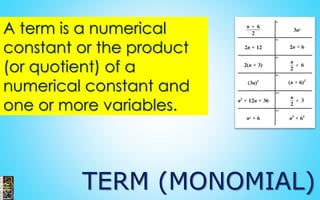
A term is a numerical
constant or the product
(or quotient) of a
numerical constant and
one or more variables.
POLYNOMIALS
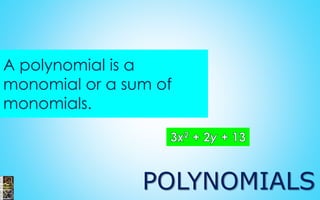
A polynomial is a
monomial or a sum of
monomials.
BINOMIALS AND
TRINOMIALS
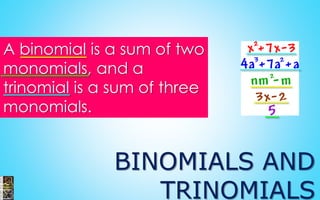
A binomial is a sum of two
monomials, and a
trinomial is a sum of three
monomials.
EVALUATING AN
EXPRESSION
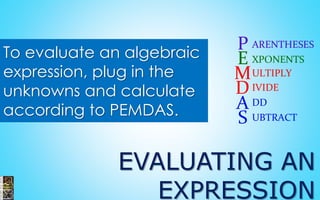
To evaluate an algebraic
expression, plug in the
unknowns and calculate
according to PEMDAS.
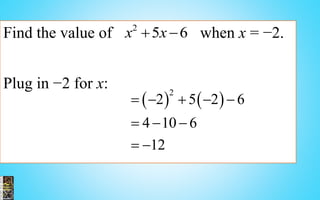
Find the value of when x = −2.
Plug in −2 for x:
2
5 6x x 
   2
2 5 2 6
4 10 6
12
    
  
 
LIKE TERMS
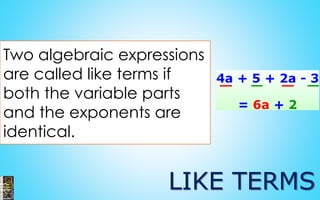
Two algebraic expressions
are called like terms if
both the variable parts
and the exponents are
identical.
ALGEBRAIC
EXPRESSIONS
OPERATIONS
WITH
ALGEBRAIC
EXPRESSIONS
ADDING/SUBTRACTING
MONOMIALS
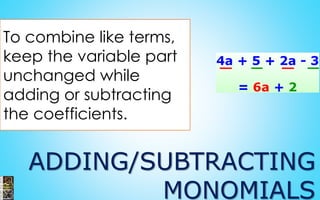
To combine like terms,
keep the variable part
unchanged while
adding or subtracting
the coefficients.
ADDING/SUBTRACTING
POLYNOMIALS
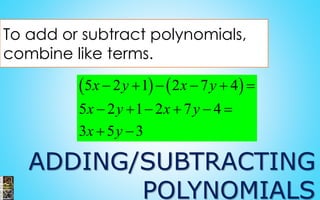
To add or subtract polynomials,
combine like terms.
   5 2 1 2 7 4
5 2 1 2 7 4
3 5 3
x y x y
x y x y
x y
     
     
 
MULTIPLYING
MONOMIALS
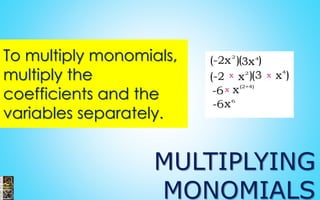
To multiply monomials,
multiply the
coefficients and the
variables separately.
MULTIPLYING
BINOMIALS – FOIL
To multiply binomials,
use FOIL, then add
and combine like
terms.
MULTIPLYING
POLYNOMIALS
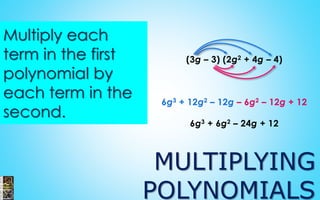
Multiply each
term in the first
polynomial by
each term in the
second.
(3g – 3) (2g2 + 4g – 4)
6g3 + 12g2 – 12g – 6g2 – 12g + 12
6g3 + 6g2 – 24g + 12
 
 
 
 
  
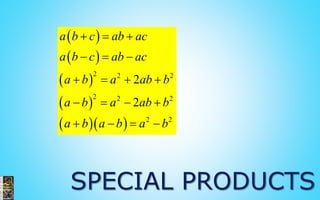
2 2 2
2 2 2
2 2
2
2
a b c ab ac
a b c ab ac
a b a ab b
a b a ab b
a b a b a b
  
  
   
   
   
SPECIAL PRODUCTS
 
 
 
 
  
  
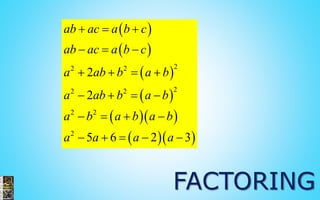
22 2
22 2
2 2
2
2
2
5 6 2 3
ab ac a b c
ab ac a b c
a ab b a b
a ab b a b
a b a b a b
a a a a
  
  
   
   
   
    
FACTORING
 
 
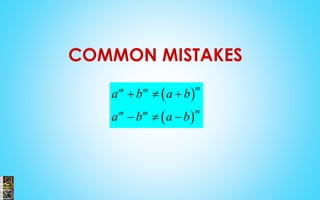
mm m
mm m
a b a b
a b a b
  
  
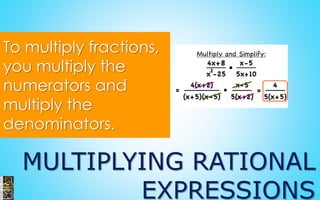
MULTIPLYING RATIONAL
EXPRESSIONS
To multiply fractions,
you multiply the
numerators and
multiply the
denominators.
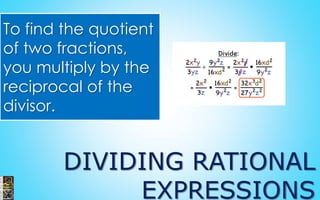
DIVIDING RATIONAL
EXPRESSIONS
To find the quotient
of two fractions,
you multiply by the
reciprocal of the
divisor.
OPERATIONS
WITH
ALGEBRAIC
EXPRESSIONS
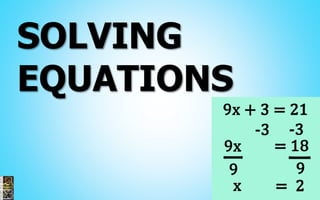
SOLVING
EQUATIONS
SOLVING EQUATIONS
The solutions of an equation or
inequality with one or more
unknowns are those values
that make the equation true.
The solutions of an equation
“satisfy the equation or
inequality”, when they are
substituted for the unknowns of
the equation or inequality.
Solutions  Roots
An equation may have no
solution or one or more
solutions.
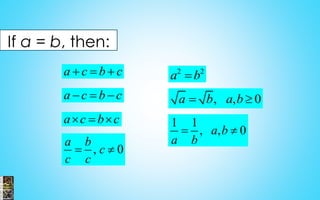
If a = b, then:
a c b c  
a c b c  
a c b c  
, 0
a b
c
c c
 
2 2
a b
, , 0a b a b 
1 1
, , 0a b
a b
 
SOLVING EQUATIONS
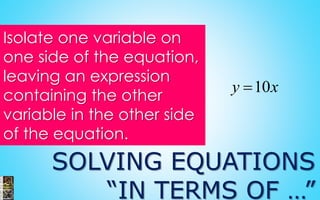
“IN TERMS OF …”
Isolate one variable on
one side of the equation,
leaving an expression
containing the other
variable in the other side
of the equation.
10y x
SOLVING
EQUATIONS
SOLVING
SYETMS OF
EQUATIONS
SOLVING SYSTEMS OF
EQUATIONS
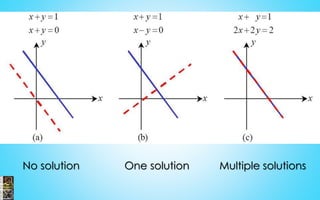
If two or more equations are
to be solved together, the
solutions must satisfy all the
equations simultaneously.
No solution Multiple solutionsOne solution
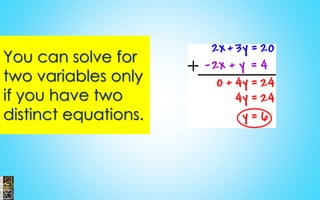
You can solve for
two variables only
if you have two
distinct equations.
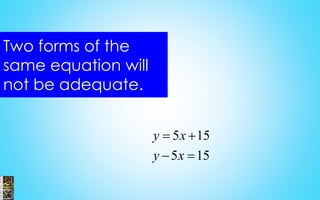
Two forms of the
same equation will
not be adequate.
5 15
5 15
y x
y x
 
 
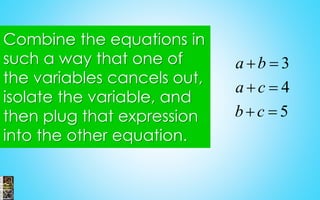
Combine the equations in
such a way that one of
the variables cancels out,
isolate the variable, and
then plug that expression
into the other equation.
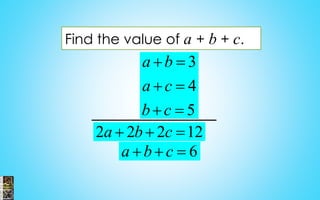
3
4
5
a b
a c
b c
 
 
 
3
4
5
a b
a c
b c
 
 
 
Find the value of a + b + c.
2 2 2 12a b c  
6a b c  
SUSTITUTION
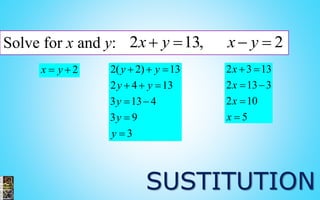
Solve for x and y: 2 13, 2x y x y   
2x y  2( 2) 13
2 4 13
3 13 4
3 9
3
y y
y y
y
y
y
  
  
 


2 3 13
2 13 3
2 10
5
x
x
x
x
 
 


ELIMINATION
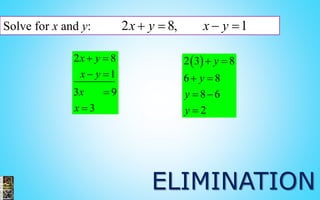
Solve for x and y: 2 8, 1x y x y   
2 8
1
3 9
3
x y
x y
x
x
 
 


 2 3 8
6 8
8 6
2
y
y
y
y
 
 
 

SOLVING A QUADRATIC
FACTORABLE EQUATION
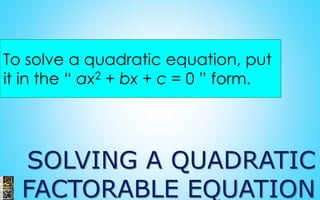
To solve a quadratic equation, put
it in the “ ax2 + bx + c = 0 ” form.
SOLVING A QUADRATIC
FACTORABLE EQUATION
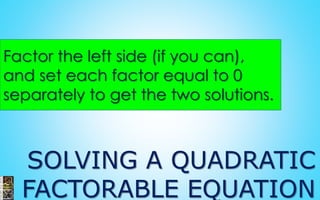
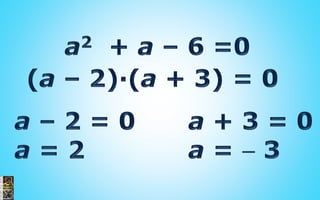
Factor the left side (if you can),
and set each factor equal to 0
separately to get the two solutions.
The solutions of an equation are
also called roots.
Every positive number
has two square roots.
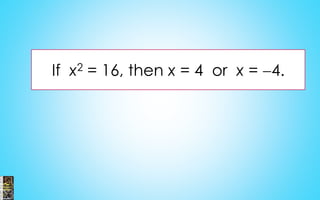
If x2 = 16, then x = 4 or x = 4.
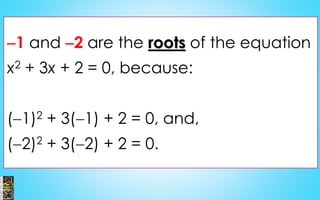
1 and 2 are the roots of the equation
x2 + 3x + 2 = 0, because:
(1)2 + 3(1) + 2 = 0, and,
(2)2 + 3(2) + 2 = 0.
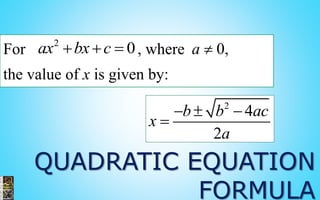
QUADRATIC EQUATION
FORMULA
For , where ,
the value of x is given by:
2
0ax bx c   0a 
2
4
2
b b ac
x
a
  

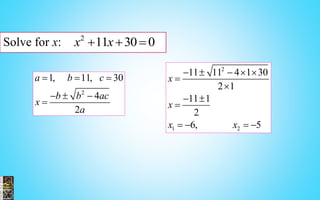
Solve for x: 2
11 30 0x x  
2
1 2
11 11 4 1 30
2 1
11 1
2
6, 5
x
x
x x
    


 

   
2
1, 11, 30
4
2
a b c
b b ac
x
a
  
  

PROPERTIES OF THE
ROOTS
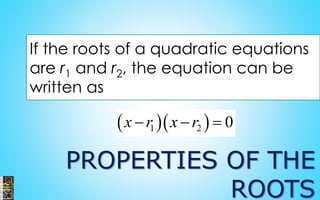
If the roots of a quadratic equations
are r1 and r2, the equation can be
written as
  1 2 0x r x r  
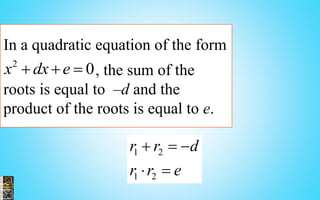
In a quadratic equation of the form
, the sum of the
roots is equal to –d and the
product of the roots is equal to e.
2
0x dx e  
1 2
1 2
r r d
r r e
  
 
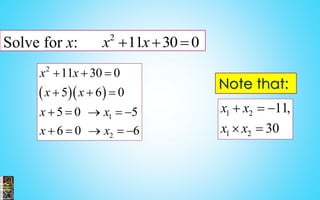
Solve for x: 2
11 30 0x x  
  
2
1
2
11 30 0
5 6 0
5 0 5
6 0 6
x x
x x
x x
x x
  
  
    
    
1 2
1 2
11,
30
x x
x x
  
 
Note that:
To solve an exponential equation,
put both sides of the equation in the
form ax, and make a new equation
using just the exponents.
SOLVING EXPONENTIAL
EQUATIONS
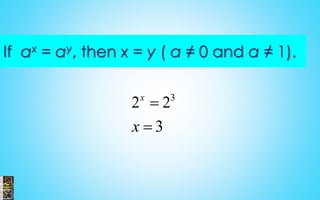
If ax = ay, then x = y ( a ≠ 0 and a ≠ 1).
3
2 2
3
x
x


SOLVING
EQUATIONS
SOLVING
INEQUALITIES
INEQUALITIES
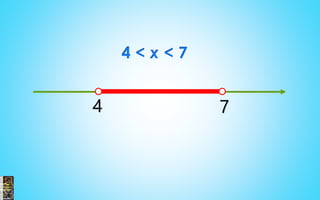
4 7
4 < x < 7
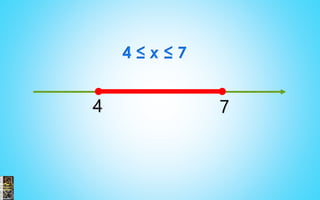
4 ≤ x ≤ 7
4 7
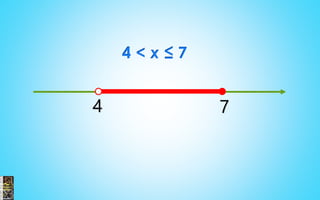
4 < x ≤ 7
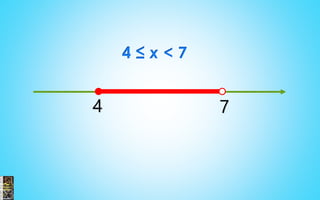
4 7
4 ≤ x < 7
4 7
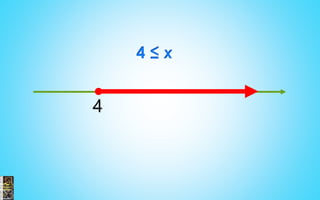
4 ≤ x
4
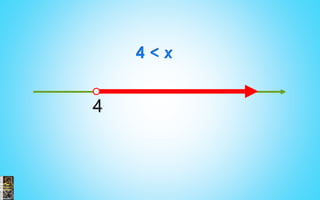
4 < x
4
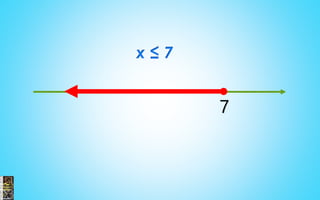
x ≤ 7
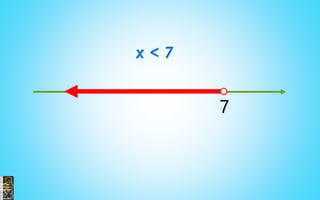
7
x < 7
7
SOLVING INEQUALITIES
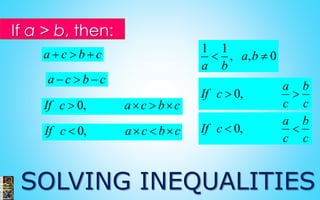
If a > b, then:
a c b c  
a c b c  
0,If c a c b c   
0,
a b
If c
c c
 
1 1
, , 0a b
a b
 
0,If c a c b c    0,
a b
If c
c c
 
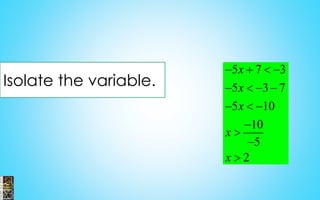
Isolate the variable.
5 7 3
5 3 7
5 10
10
5
2
x
x
x
x
x
   
   
  




 
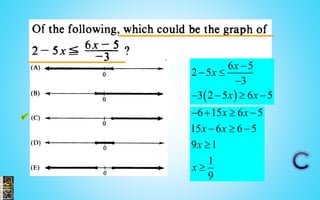
6 5
2 5
3
3 2 5 6 5
x
x
x x

 

   
6 15 6 5
15 6 6 5
9 1
1
9
x x
x x
x
x
   
  


SOLVING
INEQUALITIES
SUMMARY
edwinxav@hotmail.com
elapuerta@hotmail.com
Math for 800   08 algebra

Math for 800 08 algebra