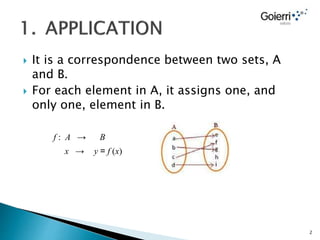
 It is a correspondence between two sets, A
and B.
 For each element in A, it assigns one, and
only one, element in B.
f : A → B
x → y = f (x)
2
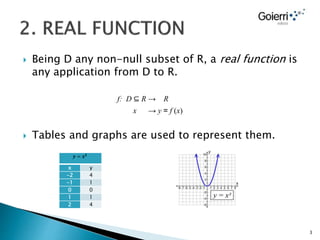
 Being D any non-null subset of R, a real function is
any application from D to R.
 Tables and graphs are used to represent them.
f: D ⊆ R → R
x → y = f (x)
𝒚 = 𝒙 𝟐
x y
-2 4
-1 1
0 0
1 1
2 4
3
 It is a set of independent variables for which a
function is defined.
 There are two kinds of domains:
◦ Continuous: the function f is defined for an interval.
◦ Discrete: the function f is only defined for some
isolated values.
4
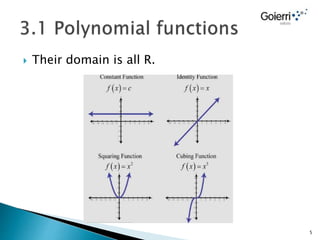
 Their domain is all R.
5
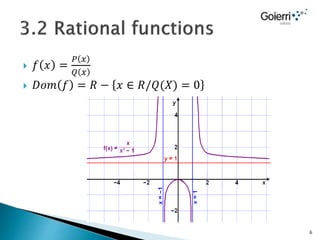
 𝑓 𝑥 =
𝑃 𝑥
𝑄 𝑥
 𝐷𝑜𝑚 𝑓 = 𝑅 − 𝑥 ∈ 𝑅/𝑄(𝑋) = 0
6
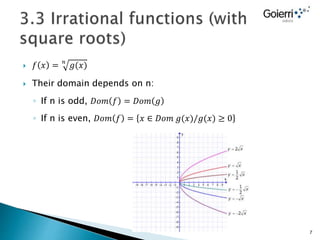
 𝑓 𝑥 = 𝑛
𝑔(𝑥)
 Their domain depends on n:
◦ If n is odd, 𝐷𝑜𝑚 𝑓 = 𝐷𝑜𝑚 𝑔
◦ If n is even, 𝐷𝑜𝑚 𝑓 = 𝑥 ∈ 𝐷𝑜𝑚 𝑔(𝑥)/𝑔(𝑥) ≥ 0
7
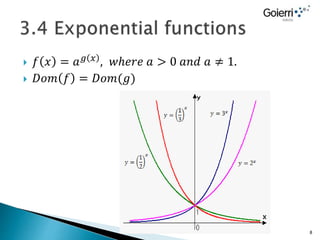
 𝑓 𝑥 = 𝑎 𝑔 𝑥 , 𝑤ℎ𝑒𝑟𝑒 𝑎 > 0 𝑎𝑛𝑑 𝑎 ≠ 1.
 𝐷𝑜𝑚 𝑓 = 𝐷𝑜𝑚(𝑔)
8
 f ( x ) = loga [g ( x )], where a > 0, a ≠1.
 Dom(f )={x ∈Dom(g ) / g( x )> 0}
9
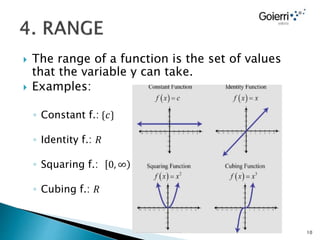
 The range of a function is the set of values
that the variable y can take.
 Examples:
◦ Constant f.: {𝑐}
◦ Identity f.: 𝑅
◦ Squaring f.: 0, ∞
◦ Cubing f.: 𝑅
10
 If 𝑓 𝑥 = 𝑓 −𝑥 for all 𝑥𝜖𝐷𝑜𝑚(𝑓), then the
function is EVEN, symmetric to the Y axis.
 If 𝑓 −𝑥 = −𝑓 𝑥 for all 𝑥𝜖𝐷𝑜𝑚(𝑓), then the
function is ODD, symmetric to the origin.
 It can also be symmetric to the X axis.
11
 Continuous function: a function without gaps.
◦ Polynomial functions
◦ Exponential functions
◦ …
 Non continuous function: a function with
gaps.
◦ Rational functions
◦ …
12
 Essentially increasing:
𝑓 𝑥1 − 𝑓(𝑥2)
𝑥1 − 𝑥2
> 0
 Increasing:
𝑓 𝑥1 − 𝑓(𝑥2)
𝑥1 − 𝑥2
≥ 0
13
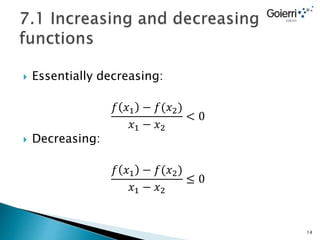
 Essentially decreasing:
𝑓 𝑥1 − 𝑓(𝑥2)
𝑥1 − 𝑥2
< 0
 Decreasing:
𝑓 𝑥1 − 𝑓(𝑥2)
𝑥1 − 𝑥2
≤ 0
14
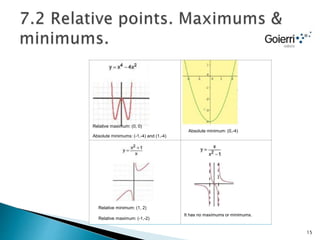
Relative maximum: (0, 0)
Absolute minimums: (-1,-4) and (1,-4)
Absolute minimum: (0,-4)
Relative minimum: (1, 2)
Relative maximum: (-1,-2)
It has no maximums or minimums.
15
16
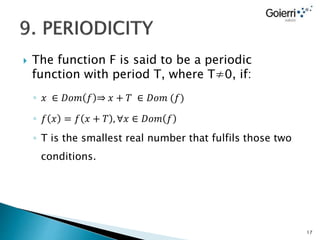
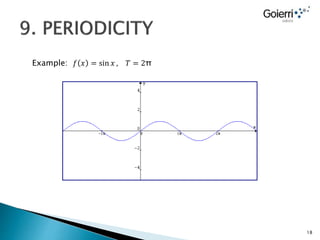
 The function F is said to be a periodic
function with period T, where T≠0, if:
◦ 𝑥 ∈ 𝐷𝑜𝑚 𝑓 𝑥 + 𝑇 ∈ 𝐷𝑜𝑚 (𝑓)
◦ 𝑓 𝑥 = 𝑓 𝑥 + 𝑇 , ∀𝑥 ∈ 𝐷𝑜𝑚 𝑓
◦ T is the smallest real number that fulfils those two
conditions.
17
Example: 𝑓 𝑥 = sin 𝑥 , 𝑇 = 2π
18
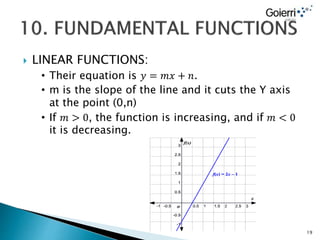
 LINEAR FUNCTIONS:
• Their equation is 𝑦 = 𝑚𝑥 + 𝑛.
• m is the slope of the line and it cuts the Y axis
at the point (0,n)
• If 𝑚 > 0, the function is increasing, and if 𝑚 < 0
it is decreasing.
19
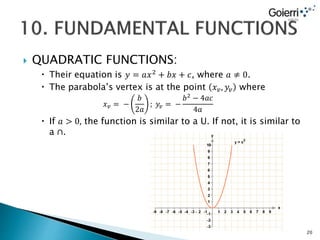
 QUADRATIC FUNCTIONS:
 Their equation is 𝑦 = 𝑎𝑥2
+ 𝑏𝑥 + 𝑐, where 𝑎 ≠ 0.
 The parabola’s vertex is at the point 𝑥 𝑣, 𝑦𝑣 where
𝑥 𝑣 = −
𝑏
2𝑎
; 𝑦𝑣 = −
𝑏2 − 4𝑎𝑐
4𝑎
 If 𝑎 > 0, the function is similar to a U. If not, it is similar to
a ∩.
20
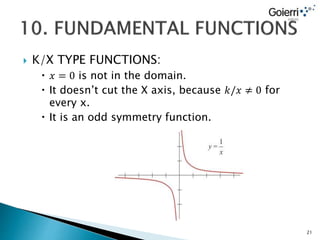
 K/X TYPE FUNCTIONS:
 𝑥 = 0 is not in the domain.
 It doesn’t cut the X axis, because 𝑘/𝑥 ≠ 0 for
every x.
 It is an odd symmetry function.
21
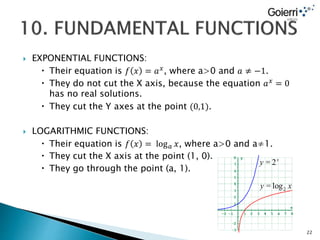
 EXPONENTIAL FUNCTIONS:
 Their equation is 𝑓 𝑥 = 𝑎 𝑥, where a>0 and 𝑎 ≠ −1.
 They do not cut the X axis, because the equation 𝑎 𝑥
= 0
has no real solutions.
 They cut the Y axes at the point (0,1).
 LOGARITHMIC FUNCTIONS:
 Their equation is 𝑓 𝑥 = log 𝑎 𝑥, where a>0 and a≠1.
 They cut the X axis at the point (1, 0).
 They go through the point (a, 1).
22
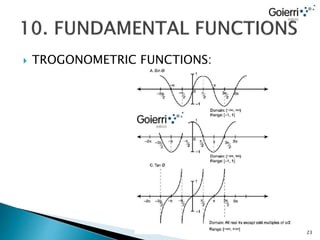
 TROGONOMETRIC FUNCTIONS:
23
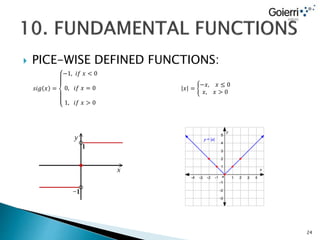
 PICE-WISE DEFINED FUNCTIONS:
𝑠𝑖𝑔 𝑥 =
−1, 𝑖𝑓 𝑥 < 0
0, 𝑖𝑓 𝑥 = 0
1, 𝑖𝑓 𝑥 > 0
𝑥 =
−𝑥, 𝑥 ≤ 0
𝑥, 𝑥 > 0
24
 𝑓 + 𝑔 𝑥 = 𝑓 𝑥 + 𝑔 𝑥 ∀𝑥 ∈ [𝐷𝑜𝑚 𝑓 ∩ 𝐷𝑜𝑚 𝑔 ]
 −𝑓 𝑥 = −𝑓(𝑥)
 𝑓 − 𝑔 𝑥 = 𝑓 𝑥 + −𝑔 𝑥 , ∀𝑥 ∈ [𝐷𝑜𝑚 𝑓 ∩ 𝐷𝑜𝑚 𝑔 ]
 𝑓 · 𝑔 𝑥 = 𝑓 𝑥 · 𝑔 𝑥
 (1/𝑓) 𝑥 =1/𝑓(𝑥)
 (f/g) 𝑥 = 𝑓 𝑥 ·1/𝑔 𝑥 = 𝑓(𝑥)/𝑔(𝑥)
25
 Being 𝑓 and 𝑔 two functions of real variables
with domains 𝐷1 and 𝐷2 domains
respectively, and with 𝑓(𝐷1) ≤ 𝐷2; the
compose function is:
𝑔°𝑓 𝑥 = 𝑔[𝑓 𝑥 ]
26
27

Du5 functions

  • 2.
     It isa correspondence between two sets, A and B.  For each element in A, it assigns one, and only one, element in B. f : A → B x → y = f (x) 2
  • 3.
     Being Dany non-null subset of R, a real function is any application from D to R.  Tables and graphs are used to represent them. f: D ⊆ R → R x → y = f (x) 𝒚 = 𝒙 𝟐 x y -2 4 -1 1 0 0 1 1 2 4 3
  • 4.
     It isa set of independent variables for which a function is defined.  There are two kinds of domains: ◦ Continuous: the function f is defined for an interval. ◦ Discrete: the function f is only defined for some isolated values. 4
  • 5.
     Their domainis all R. 5
  • 6.
     𝑓 𝑥= 𝑃 𝑥 𝑄 𝑥  𝐷𝑜𝑚 𝑓 = 𝑅 − 𝑥 ∈ 𝑅/𝑄(𝑋) = 0 6
  • 7.
     𝑓 𝑥= 𝑛 𝑔(𝑥)  Their domain depends on n: ◦ If n is odd, 𝐷𝑜𝑚 𝑓 = 𝐷𝑜𝑚 𝑔 ◦ If n is even, 𝐷𝑜𝑚 𝑓 = 𝑥 ∈ 𝐷𝑜𝑚 𝑔(𝑥)/𝑔(𝑥) ≥ 0 7
  • 8.
     𝑓 𝑥= 𝑎 𝑔 𝑥 , 𝑤ℎ𝑒𝑟𝑒 𝑎 > 0 𝑎𝑛𝑑 𝑎 ≠ 1.  𝐷𝑜𝑚 𝑓 = 𝐷𝑜𝑚(𝑔) 8
  • 9.
     f (x ) = loga [g ( x )], where a > 0, a ≠1.  Dom(f )={x ∈Dom(g ) / g( x )> 0} 9
  • 10.
     The rangeof a function is the set of values that the variable y can take.  Examples: ◦ Constant f.: {𝑐} ◦ Identity f.: 𝑅 ◦ Squaring f.: 0, ∞ ◦ Cubing f.: 𝑅 10
  • 11.
     If 𝑓𝑥 = 𝑓 −𝑥 for all 𝑥𝜖𝐷𝑜𝑚(𝑓), then the function is EVEN, symmetric to the Y axis.  If 𝑓 −𝑥 = −𝑓 𝑥 for all 𝑥𝜖𝐷𝑜𝑚(𝑓), then the function is ODD, symmetric to the origin.  It can also be symmetric to the X axis. 11
  • 12.
     Continuous function:a function without gaps. ◦ Polynomial functions ◦ Exponential functions ◦ …  Non continuous function: a function with gaps. ◦ Rational functions ◦ … 12
  • 13.
     Essentially increasing: 𝑓𝑥1 − 𝑓(𝑥2) 𝑥1 − 𝑥2 > 0  Increasing: 𝑓 𝑥1 − 𝑓(𝑥2) 𝑥1 − 𝑥2 ≥ 0 13
  • 14.
     Essentially decreasing: 𝑓𝑥1 − 𝑓(𝑥2) 𝑥1 − 𝑥2 < 0  Decreasing: 𝑓 𝑥1 − 𝑓(𝑥2) 𝑥1 − 𝑥2 ≤ 0 14
  • 15.
    Relative maximum: (0,0) Absolute minimums: (-1,-4) and (1,-4) Absolute minimum: (0,-4) Relative minimum: (1, 2) Relative maximum: (-1,-2) It has no maximums or minimums. 15
  • 16.
  • 17.
     The functionF is said to be a periodic function with period T, where T≠0, if: ◦ 𝑥 ∈ 𝐷𝑜𝑚 𝑓 𝑥 + 𝑇 ∈ 𝐷𝑜𝑚 (𝑓) ◦ 𝑓 𝑥 = 𝑓 𝑥 + 𝑇 , ∀𝑥 ∈ 𝐷𝑜𝑚 𝑓 ◦ T is the smallest real number that fulfils those two conditions. 17
  • 18.
    Example: 𝑓 𝑥= sin 𝑥 , 𝑇 = 2π 18
  • 19.
     LINEAR FUNCTIONS: •Their equation is 𝑦 = 𝑚𝑥 + 𝑛. • m is the slope of the line and it cuts the Y axis at the point (0,n) • If 𝑚 > 0, the function is increasing, and if 𝑚 < 0 it is decreasing. 19
  • 20.
     QUADRATIC FUNCTIONS: Their equation is 𝑦 = 𝑎𝑥2 + 𝑏𝑥 + 𝑐, where 𝑎 ≠ 0.  The parabola’s vertex is at the point 𝑥 𝑣, 𝑦𝑣 where 𝑥 𝑣 = − 𝑏 2𝑎 ; 𝑦𝑣 = − 𝑏2 − 4𝑎𝑐 4𝑎  If 𝑎 > 0, the function is similar to a U. If not, it is similar to a ∩. 20
  • 21.
     K/X TYPEFUNCTIONS:  𝑥 = 0 is not in the domain.  It doesn’t cut the X axis, because 𝑘/𝑥 ≠ 0 for every x.  It is an odd symmetry function. 21
  • 22.
     EXPONENTIAL FUNCTIONS: Their equation is 𝑓 𝑥 = 𝑎 𝑥, where a>0 and 𝑎 ≠ −1.  They do not cut the X axis, because the equation 𝑎 𝑥 = 0 has no real solutions.  They cut the Y axes at the point (0,1).  LOGARITHMIC FUNCTIONS:  Their equation is 𝑓 𝑥 = log 𝑎 𝑥, where a>0 and a≠1.  They cut the X axis at the point (1, 0).  They go through the point (a, 1). 22
  • 23.
  • 24.
     PICE-WISE DEFINEDFUNCTIONS: 𝑠𝑖𝑔 𝑥 = −1, 𝑖𝑓 𝑥 < 0 0, 𝑖𝑓 𝑥 = 0 1, 𝑖𝑓 𝑥 > 0 𝑥 = −𝑥, 𝑥 ≤ 0 𝑥, 𝑥 > 0 24
  • 25.
     𝑓 +𝑔 𝑥 = 𝑓 𝑥 + 𝑔 𝑥 ∀𝑥 ∈ [𝐷𝑜𝑚 𝑓 ∩ 𝐷𝑜𝑚 𝑔 ]  −𝑓 𝑥 = −𝑓(𝑥)  𝑓 − 𝑔 𝑥 = 𝑓 𝑥 + −𝑔 𝑥 , ∀𝑥 ∈ [𝐷𝑜𝑚 𝑓 ∩ 𝐷𝑜𝑚 𝑔 ]  𝑓 · 𝑔 𝑥 = 𝑓 𝑥 · 𝑔 𝑥  (1/𝑓) 𝑥 =1/𝑓(𝑥)  (f/g) 𝑥 = 𝑓 𝑥 ·1/𝑔 𝑥 = 𝑓(𝑥)/𝑔(𝑥) 25
  • 26.
     Being 𝑓and 𝑔 two functions of real variables with domains 𝐷1 and 𝐷2 domains respectively, and with 𝑓(𝐷1) ≤ 𝐷2; the compose function is: 𝑔°𝑓 𝑥 = 𝑔[𝑓 𝑥 ] 26
  • 27.