LINEAR ALGEBRA II
Chapter one
Characteristic Equation
1
by shimelis Ayele
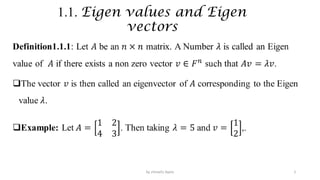
1.1. Eigen values and Eigen
vectors
2
by shimelis Ayele
Cont…
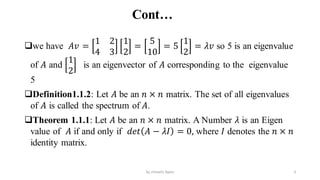
we have 𝐴𝑣 =
1 2
4 3
1
2
=
5
10
= 5
1
2
= 𝜆𝑣 so 5 is an eigenvalue
of 𝐴 and
1
2
is an eigenvector of 𝐴 corresponding to the eigenvalue
5
Definition1.1.2: Let 𝐴 be an 𝑛 × 𝑛 matrix. The set of all eigenvalues
of 𝐴 is called the spectrum of 𝐴.
Theorem 1.1.1: Let 𝐴 be an 𝑛 × 𝑛 matrix. A Number 𝜆 is an Eigen
value of 𝐴 if and only if 𝑑𝑒𝑡 𝐴 − 𝜆𝐼 = 0, where 𝐼 denotes the 𝑛 × 𝑛
identity matrix.
3
by shimelis Ayele
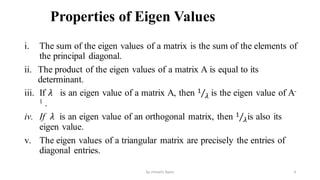
Properties of Eigen Values
i. The sum of the eigen values of a matrix is the sum of the elements of
the principal diagonal.
ii. The product of the eigen values of a matrix A is equal to its
determinant.
iii. If 𝜆 is an eigen value of a matrix A, then Τ
1
𝜆 is the eigen value of A-
1 .
iv. If 𝜆 is an eigen value of an orthogonal matrix, then Τ
1
𝜆is also its
eigen value.
v. The eigen values of a triangular matrix are precisely the entries of
diagonal entries.
4
by shimelis Ayele
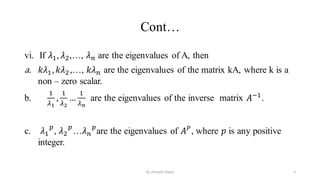
Cont…
vi. If 𝜆1, 𝜆2,…, 𝜆𝑛 are the eigenvalues of A, then
a. 𝑘𝜆1,𝑘𝜆2,…, 𝑘𝜆𝑛 are the eigenvalues of the matrix kA, where k is a
non – zero scalar.
b.
1
𝜆1
,
1
𝜆2
…
1
𝜆𝑛
are the eigenvalues of the inverse matrix 𝐴−1
.
c. 𝜆1
𝑝
, 𝜆2
𝑝
…𝜆𝑛
𝑝
are the eigenvalues of 𝐴𝑃
, where 𝑝 is any positive
integer.
5
by shimelis Ayele
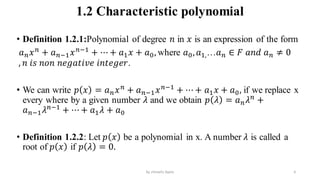
1.2 Characteristic polynomial
• Definition 1.2.1:Polynomial of degree 𝑛 in 𝑥 is an expression of the form
𝑎𝑛𝑥𝑛
+ 𝑎𝑛−1𝑥𝑛−1
+ ⋯ + 𝑎1𝑥 + 𝑎0, where 𝑎0,𝑎1,…𝑎𝑛 ∈ 𝐹 𝑎𝑛𝑑 𝑎𝑛 ≠ 0
, 𝑛 𝑖𝑠 𝑛𝑜𝑛 𝑛𝑒𝑔𝑎𝑡𝑖𝑣𝑒 𝑖𝑛𝑡𝑒𝑔𝑒𝑟.
• We can write 𝑝 𝑥 = 𝑎𝑛𝑥𝑛
+ 𝑎𝑛−1𝑥𝑛−1
+ ⋯ + 𝑎1𝑥 + 𝑎0, if we replace x
every where by a given number 𝜆 and we obtain 𝑝 𝜆 = 𝑎𝑛𝜆𝑛
+
𝑎𝑛−1𝜆𝑛−1
+ ⋯ + 𝑎1𝜆 + 𝑎0
• Definition 1.2.2: Let 𝑝 𝑥 be a polynomial in x. A number 𝜆 is called a
root of 𝑝 𝑥 if 𝑝 𝜆 = 0.
6
by shimelis Ayele
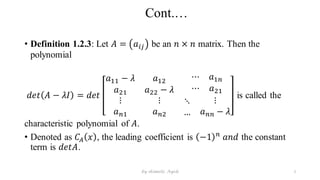
Cont.…
• Definition 1.2.3: Let 𝐴 = 𝑎𝑖𝑗 be an 𝑛 × 𝑛 matrix. Then the
polynomial
𝑑𝑒𝑡 𝐴 − 𝜆𝐼 = 𝑑𝑒𝑡
𝑎11 − 𝜆 𝑎12
⋯ 𝑎1𝑛
𝑎21 𝑎22 − 𝜆 ⋯ 𝑎21
⋮
𝑎𝑛1
⋮
𝑎𝑛2
⋱
…
⋮
𝑎𝑛𝑛 − 𝜆
is called the
characteristic polynomial of 𝐴.
• Denoted as 𝐶𝐴 𝑥 , the leading coefficient is −1 𝑛
𝑎𝑛𝑑 the constant
term is 𝑑𝑒𝑡𝐴.
7
by shimelis Ayele
Cont…
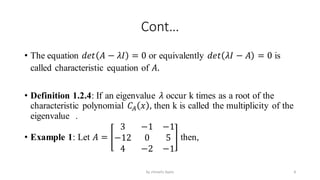
• The equation 𝑑𝑒𝑡 𝐴 − 𝜆𝐼 = 0 or equivalently 𝑑𝑒𝑡 𝜆𝐼 − 𝐴 = 0 is
called characteristic equation of 𝐴.
• Definition 1.2.4: If an eigenvalue 𝜆 occur k times as a root of the
characteristic polynomial 𝐶𝐴 𝑥 , then k is called the multiplicity of the
eigenvalue .
• Example 1: Let 𝐴 =
3 −1 −1
−12 0 5
4 −2 −1
then,
8
by shimelis Ayele
Cont.
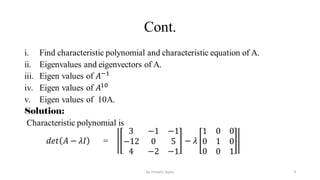
i. Find characteristic polynomial and characteristic equation of A.
ii. Eigenvalues and eigenvectors of A.
iii. Eigen values of 𝐴−1
iv. Eigen values of 𝐴10
v. Eigen values of 10A.
Solution:
Characteristic polynomial is
𝑑𝑒𝑡 𝐴 − 𝜆𝐼 =
3 −1 −1
−12 0 5
4 −2 −1
− 𝜆
1 0 0
0 1 0
0 0 1
9
by shimelis Ayele
Cont.
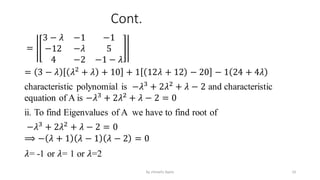
=
3 − 𝜆 −1 −1
−12 −𝜆 5
4 −2 −1 − 𝜆
= 3 − 𝜆 𝜆2
+ 𝜆 + 10 + 1 12𝜆 + 12 − 20 − 1 24 + 4𝜆
characteristic polynomial is −𝜆3
+ 2𝜆2
+ 𝜆 − 2 and characteristic
equation of A is −𝜆3
+ 2𝜆2
+ 𝜆 − 2 = 0
ii. To find Eigenvalues of A we have to find root of
−𝜆3
+ 2𝜆2
+ 𝜆 − 2 = 0
⟹ − 𝜆 + 1 𝜆 − 1 𝜆 − 2 = 0
𝜆= -1 or 𝜆= 1 or 𝜆=2
10
by shimelis Ayele
Cont.
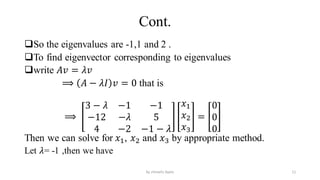
So the eigenvalues are -1,1 and 2 .
To find eigenvector corresponding to eigenvalues
write 𝐴𝑣 = 𝜆𝑣
⟹ 𝐴 − 𝜆𝐼 𝑣 = 0 that is
⟹
3 − 𝜆 −1 −1
−12 −𝜆 5
4 −2 −1 − 𝜆
𝑥1
𝑥2
𝑥3
=
0
0
0
Then we can solve for 𝑥1, 𝑥2 and 𝑥3 by appropriate method.
Let 𝜆= -1 ,then we have
11
by shimelis Ayele
Cont.
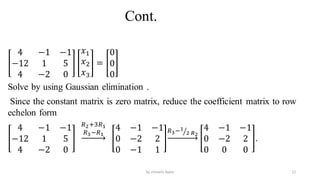
4 −1 −1
−12 1 5
4 −2 0
𝑥1
𝑥2
𝑥3
=
0
0
0
Solve by using Gaussian elimination .
Since the constant matrix is zero matrix, reduce the coefficient matrix to row
echelon form
4 −1 −1
−12 1 5
4 −2 0
𝑅2+3𝑅1
𝑅3−𝑅1
4 −1 −1
0 −2 2
0 −1 1
𝑅3− ൗ
1
2 𝑅2
4 −1 −1
0 −2 2
0 0 0
.
12
by shimelis Ayele
Cont.
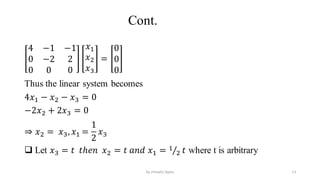
4 −1 −1
0 −2 2
0 0 0
𝑥1
𝑥2
𝑥3
=
0
0
0
Thus the linear system becomes
4𝑥1 − 𝑥2 − 𝑥3 = 0
−2𝑥2 + 2𝑥3 = 0
⇒ 𝑥2 = 𝑥3,𝑥1 =
1
2
𝑥3
 Let 𝑥3 = 𝑡 𝑡ℎ𝑒𝑛 𝑥2 = 𝑡 𝑎𝑛𝑑 𝑥1 = Τ
1
2 𝑡 where t is arbitrary
13
by shimelis Ayele
Cont.
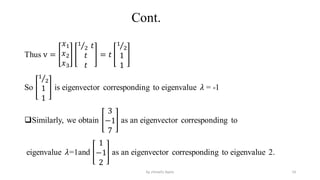
Thus v =
𝑥1
𝑥2
𝑥3
Τ
1
2 𝑡
𝑡
𝑡
= 𝑡
Τ
1
2
1
1
So
Τ
1
2
1
1
is eigenvector corresponding to eigenvalue 𝜆 = -1
Similarly, we obtain
3
−1
7
as an eigenvector corresponding to
eigenvalue 𝜆=1and
1
−1
2
as an eigenvector corresponding to eigenvalue 2.
14
by shimelis Ayele
Cont.
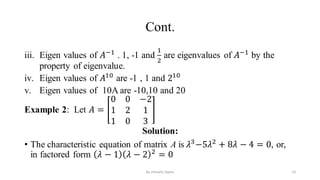
iii. Eigen values of 𝐴−1
. 1, -1 and
1
2
are eigenvalues of 𝐴−1
by the
property of eigenvalue.
iv. Eigen values of 𝐴10
are -1 , 1 and 210
v. Eigen values of 10A are -10,10 and 20
Example 2: Let 𝐴 =
0 0 −2
1 2 1
1 0 3
Solution:
• The characteristic equation of matrix A is 𝜆3
−5𝜆2
+ 8𝜆 − 4 = 0, or,
in factored form 𝜆 − 1 𝜆 − 2 2
= 0
15
by shimelis Ayele
Cont.
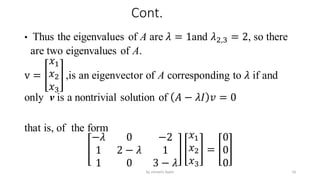
• Thus the eigenvalues of A are 𝜆 = 1and 𝜆2,3 = 2, so there
are two eigenvalues of A.
v =
𝑥1
𝑥2
𝑥3
,is an eigenvector of A corresponding to 𝜆 if and
only v is a nontrivial solution of 𝐴 − 𝜆𝐼 𝑣 = 0
that is, of the form
−𝜆 0 −2
1 2 − 𝜆 1
1 0 3 − 𝜆
𝑥1
𝑥2
𝑥3
=
0
0
0
16
by shimelis Ayele
cont.
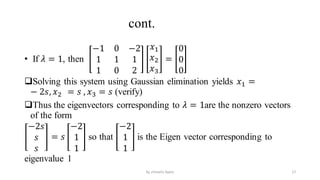
• If 𝜆 = 1, then
−1 0 −2
1 1 1
1 0 2
𝑥1
𝑥2
𝑥3
=
0
0
0
Solving this system using Gaussian elimination yields 𝑥1 =
− 2𝑠, 𝑥2 = 𝑠 , 𝑥3 = 𝑠 (verify)
Thus the eigenvectors corresponding to 𝜆 = 1are the nonzero vectors
of the form
−2𝑠
𝑠
𝑠
= 𝑠
−2
1
1
so that
−2
1
1
is the Eigen vector corresponding to
eigenvalue 1
17
by shimelis Ayele
Cont.
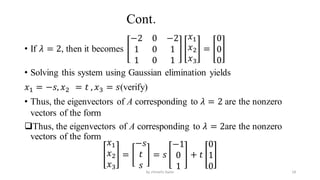
• If 𝜆 = 2, then it becomes
−2 0 −2
1 0 1
1 0 1
𝑥1
𝑥2
𝑥3
=
0
0
0
• Solving this system using Gaussian elimination yields
𝑥1 = −𝑠, 𝑥2 = 𝑡 , 𝑥3 = 𝑠(verify)
• Thus, the eigenvectors of A corresponding to 𝜆 = 2 are the nonzero
vectors of the form
Thus, the eigenvectors of A corresponding to 𝜆 = 2are the nonzero
vectors of the form
𝑥1
𝑥2
𝑥3
=
−𝑠
𝑡
𝑠
= 𝑠
−1
0
1
+ 𝑡
0
1
0 18
by shimelis Ayele
Cont…
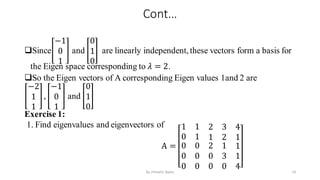
Since
−1
0
1
and
0
1
0
are linearly independent,these vectors form a basis for
the Eigen space corresponding to 𝜆 = 2.
So the Eigen vectors of A corresponding Eigen values 1and 2 are
−2
1
1
,
−1
0
1
and
0
1
0
Exercise 1:
1. Find eigenvalues and eigenvectors of
A =
1 1 2 3 4
0 1 1 2 1
0
0
0
0
0
0
2
0
0
1
3
0
1
1
4 19
by shimelis Ayele
Cont.
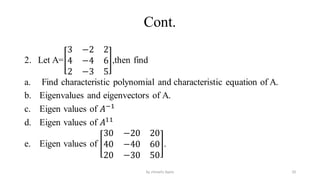
2. Let A=
3 −2 2
4 −4 6
2 −3 5
,then find
a. Find characteristic polynomial and characteristic equation of A.
b. Eigenvalues and eigenvectors of A.
c. Eigen values of 𝐴−1
d. Eigen values of 𝐴11
e. Eigen values of
30 −20 20
40 −40 60
20 −30 50
.
20
by shimelis Ayele
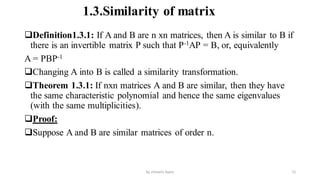
1.3.Similarity of matrix
Definition1.3.1: If A and B are n xn matrices, then A is similar to B if
there is an invertible matrix P such that P-1AP = B, or, equivalently
A = PBP-1
Changing A into B is called a similarity transformation.
Theorem 1.3.1: If nxn matrices A and B are similar, then they have
the same characteristic polynomial and hence the same eigenvalues
(with the same multiplicities).
Proof:
Suppose A and B are similar matrices of order n.
21
by shimelis Ayele
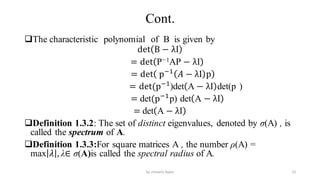
Cont.
The characteristic polynomial of B is given by
det B − λI
= det P−1AP − λI
= det p−1
𝐴 − λI p
= det(p−1
)det A − λI det(p )
= det(p−1
p) det A − λI
= det A − λI
Definition 1.3.2: The set of distinct eigenvalues, denoted by σ(A) , is
called the spectrum of A.
Definition 1.3.3:For square matrices A , the number ρ(A) =
max 𝜆 , λ∈ σ(A)is called the spectral radius of A.
22
by shimelis Ayele
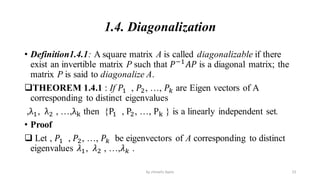
1.4. Diagonalization
• Definition1.4.1: A square matrix A is called diagonalizable if there
exist an invertible matrix P such that 𝑃−1
𝐴𝑃 is a diagonal matrix; the
matrix P is said to diagonalize A.
THEOREM 1.4.1 : If 𝑃1 , 𝑃2, …, 𝑃𝑘 are Eigen vectors of A
corresponding to distinct eigenvalues
,λ1, λ2 , …,λk then {P1 , P2, …, Pk } is a linearly independent set.
• Proof
 Let , 𝑃1 , 𝑃2, …, 𝑃𝑘 be eigenvectors of A corresponding to distinct
eigenvalues 𝜆1, 𝜆2 , …,𝜆𝑘 .
23
by shimelis Ayele
Cont.
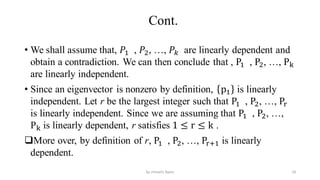
• We shall assume that, 𝑃1 , 𝑃2, …, 𝑃𝑘 are linearly dependent and
obtain a contradiction. We can then conclude that , P1 , P2, …, Pk
are linearly independent.
• Since an eigenvector is nonzero by definition, p1 is linearly
independent. Let r be the largest integer such that P1 , P2, …, Pr
is linearly independent. Since we are assuming that P1 , P2, …,
Pk is linearly dependent, r satisfies 1 ≤ r ≤ k .
More over, by definition of r, P1 , P2, …, Pr+1 is linearly
dependent.
24
by shimelis Ayele
Cont.
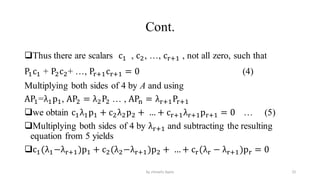
Thus there are scalars c1 , c2, …, cr+1 , not all zero, such that
P1c1 + P2c2+ …, Pr+1cr+1 = 0 (4)
Multiplying both sides of 4 by A and using
AP1=λ1p1, AP2 = λ2P2 … , APn = λr+1Pr+1
we obtain c1λ1p1 + c2λ2p2 + … + cr+1λr+1pr+1 = 0 … (5)
Multiplying both sides of 4 by λr+1 and subtracting the resulting
equation from 5 yields
c1(λ1−λr+1)p1 + c2(λ2−λr+1)p2 + … + cr(λr − λr+1)pr = 0
25
by shimelis Ayele
Cont.
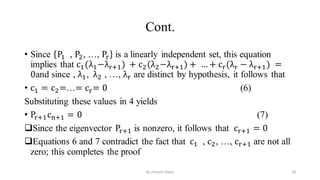
• Since P1 , P2, …, Pr is a linearly independent set, this equation
implies that c1(λ1−λr+1) + c2(λ2−λr+1) + … + cr(λr − λr+1) =
0and since , λ1, λ2 , …, λr are distinct by hypothesis, it follows that
• c1 = c2=…= cr= 0 (6)
Substituting these values in 4 yields
• Pr+1cn+1 = 0 (7)
Since the eigenvector Pr+1 is nonzero, it follows that cr+1 = 0
Equations 6 and 7 contradict the fact that c1 , c2, …, cr+1 are not all
zero; this completes the proof
26
by shimelis Ayele
Cont.
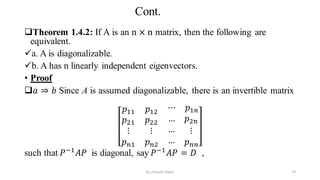
Theorem 1.4.2: If A is an n × n matrix, then the following are
equivalent.
a. A is diagonalizable.
b. A has n linearly independent eigenvectors.
• Proof
𝑎 ⇒ 𝑏 Since A is assumed diagonalizable, there is an invertible matrix
𝑝11 𝑝12
⋯ 𝑝1𝑛
𝑝21 𝑝22 … 𝑝2𝑛
⋮
𝑝𝑛1
⋮
𝑝𝑛2
…
…
⋮
𝑝𝑛𝑛
such that 𝑃−1
𝐴𝑃 is diagonal, say 𝑃−1
𝐴𝑃 = 𝐷 ,
27
by shimelis Ayele
Cont.
where D =
𝜆1 0 ⋯ 0
0 𝜆2 … 0
⋮
0
⋮
0
…
…
⋮
𝜆𝑛
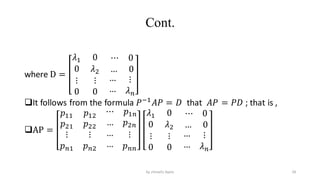
It follows from the formula 𝑃−1
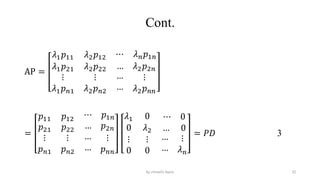
𝐴𝑃 = 𝐷 that 𝐴𝑃 = 𝑃𝐷 ; that is ,
AP =
𝑝11 𝑝12
⋯ 𝑝1𝑛
𝑝21 𝑝22 … 𝑝2𝑛
⋮
𝑝𝑛1
⋮
𝑝𝑛2
…
…
⋮
𝑝𝑛𝑛
𝜆1 0 ⋯ 0
0 𝜆2 … 0
⋮
0
⋮
0
…
…
⋮
𝜆𝑛
28
by shimelis Ayele
Cont.
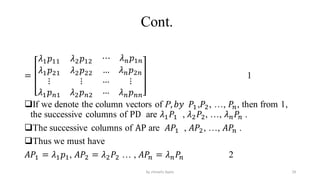
=
𝜆1𝑝11 𝜆2𝑝12 ⋯ 𝜆𝑛𝑝1𝑛
𝜆1𝑝21 𝜆2𝑝22 … 𝜆𝑛𝑝2𝑛
⋮
𝜆1𝑝𝑛1
⋮
𝜆2𝑝𝑛2
…
…
⋮
𝜆𝑛𝑝𝑛𝑛
1
If we denote the column vectors of P,𝑏𝑦 𝑃1,𝑃2, …, 𝑃𝑛, then from 1,
the successive columns of PD are 𝜆1𝑃1 , 𝜆2𝑃2, …, 𝜆𝑛𝑃𝑛 .
The successive columns of AP are 𝐴𝑃1 , 𝐴𝑃2, …, 𝐴𝑃𝑛 .
Thus we must have
𝐴𝑃1 = 𝜆1𝑝1, 𝐴𝑃2 = 𝜆2𝑃2 … , 𝐴𝑃𝑛 = 𝜆𝑛𝑃𝑛 2
29
by shimelis Ayele
Cont.…
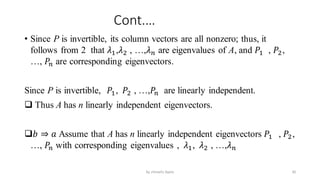
• Since P is invertible, its column vectors are all nonzero; thus, it
follows from 2 that 𝜆1,𝜆2 , …,𝜆𝑛 are eigenvalues of A, and 𝑃1 , 𝑃2,
…, 𝑃𝑛 are corresponding eigenvectors.
Since P is invertible, 𝑃1, 𝑃2 , …,𝑃𝑛 are linearly independent.
 Thus A has n linearly independent eigenvectors.
𝑏 ⇒ 𝑎 Assume that A has n linearly independent eigenvectors 𝑃1 , 𝑃2,
…, 𝑃𝑛 with corresponding eigenvalues , 𝜆1, 𝜆2 , …,𝜆𝑛
30
by shimelis Ayele
Cont.…
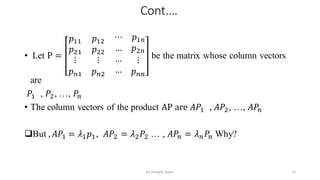
• Let P =
𝑝11 𝑝12
⋯ 𝑝1𝑛
𝑝21 𝑝22 … 𝑝2𝑛
⋮
𝑝𝑛1
⋮
𝑝𝑛2
…
…
⋮
𝑝𝑛𝑛
be the matrix whose column vectors
are
𝑃1 , 𝑃2, …, 𝑃𝑛
• The column vectors of the product AP are 𝐴𝑃1 , 𝐴𝑃2, …, 𝐴𝑃𝑛
But ,𝐴𝑃1 = 𝜆1𝑝1, 𝐴𝑃2 = 𝜆2𝑃2 … , 𝐴𝑃𝑛 = 𝜆𝑛𝑃𝑛 Why?
31
by shimelis Ayele
Cont.
AP =
𝜆1𝑝11 𝜆2𝑝12 ⋯ 𝜆𝑛𝑝1𝑛
𝜆1𝑝21 𝜆2𝑝22 … 𝜆2𝑝2𝑛
⋮
𝜆1𝑝𝑛1
⋮
𝜆2𝑝𝑛2
…
…
⋮
𝜆2𝑝𝑛𝑛
=
𝑝11 𝑝12
⋯ 𝑝1𝑛
𝑝21 𝑝22 … 𝑝2𝑛
⋮
𝑝𝑛1
⋮
𝑝𝑛2
…
…
⋮
𝑝𝑛𝑛
𝜆1 0 ⋯ 0
0 𝜆2 … 0
⋮
0
⋮
0
…
…
⋮
𝜆𝑛
= 𝑃𝐷 3
32
by shimelis Ayele
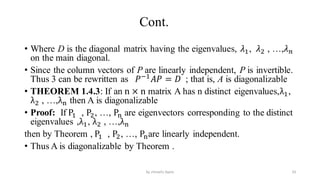
Cont.
• Where D is the diagonal matrix having the eigenvalues, 𝜆1, 𝜆2 , …,𝜆𝑛
on the main diagonal.
• Since the column vectors of P are linearly independent, P is invertible.
Thus 3 can be rewritten as 𝑃−1
𝐴𝑃 = 𝐷 ; that is, A is diagonalizable
• THEOREM 1.4.3: If an n × n matrix A has n distinct eigenvalues,λ1,
λ2 , …,λn then A is diagonalizable
• Proof: If P1 , P2, …, Pn are eigenvectors corresponding to the distinct
eigenvalues ,λ1, λ2 , …,λn
then by Theorem , P1 , P2, …, Pnare linearly independent.
• Thus A is diagonalizable by Theorem .
33
by shimelis Ayele
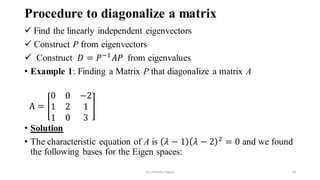
Procedure to diagonalize a matrix
 Find the linearly independent eigenvectors
 Construct P from eigenvectors
 Construct 𝐷 = 𝑃−1
𝐴𝑃 from eigenvalues
• Example 1: Finding a Matrix P that diagonalize a matrix A
A =
0 0 −2
1 2 1
1 0 3
• Solution
• The characteristic equation of A is 𝜆 − 1 𝜆 − 2 2
= 0 and we found
the following bases for the Eigen spaces:
34
by shimelis Ayele
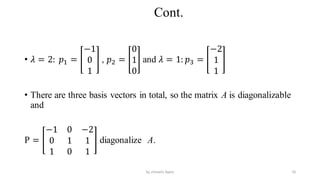
Cont.
• 𝜆 = 2: 𝑝1 =
−1
0
1
, 𝑝2 =
0
1
0
and 𝜆 = 1: 𝑝3 =
−2
1
1
• There are three basis vectors in total, so the matrix A is diagonalizable
and
P =
−1 0 −2
0 1 1
1 0 1
diagonalize A.
35
by shimelis Ayele
Cont.
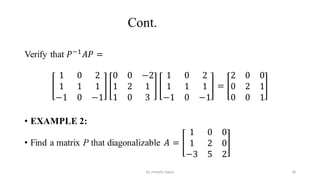
Verify that 𝑃−1
𝐴𝑃 =
1 0 2
1 1 1
−1 0 −1
0 0 −2
1 2 1
1 0 3
1 0 2
1 1 1
−1 0 −1
=
2 0 0
0 2 1
0 0 1
• EXAMPLE 2:
• Find a matrix P that diagonalizable 𝐴 =
1 0 0
1 2 0
−3 5 2
36
by shimelis Ayele
Cont.
Solution
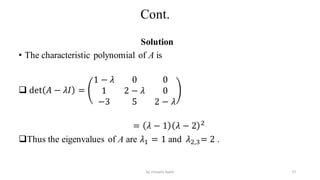
• The characteristic polynomial of A is
 det 𝐴 − 𝜆𝐼 =
1 − 𝜆 0 0
1 2 − 𝜆 0
−3 5 2 − 𝜆
= 𝜆 − 1 𝜆 − 2 2
Thus the eigenvalues of A are 𝜆1 = 1 and 𝜆2,3= 2 .
37
by shimelis Ayele
Cont.
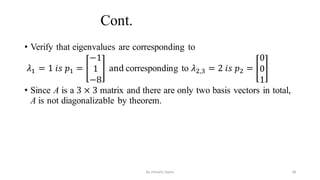
• Verify that eigenvalues are corresponding to
𝜆1 = 1 𝑖𝑠 𝑝1 =
−1
1
−8
and corresponding to 𝜆2,3 = 2 𝑖𝑠 𝑝2 =
0
0
1
• Since A is a 3 × 3 matrix and there are only two basis vectors in total,
A is not diagonalizable by theorem.
38
by shimelis Ayele
1.5.Cayley-Hamilton Theorem
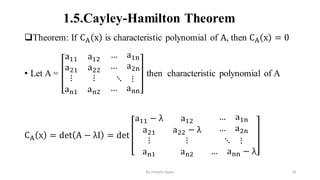
Theorem: If CA x is characteristic polynomial of A, then CA x = 0
• Let A =
a11 a12
… a1n
a21 a22
… a2n
⋮
an1
⋮
an2
⋱ ⋮
… ann
then characteristic polynomial of A
CA x = det A − λI = det
a11 − λ a12 … a1n
a21 a22 − λ … a2n
⋮
an1
⋮
an2
⋱ ⋮
… ann − λ
39
by shimelis Ayele
Cont.
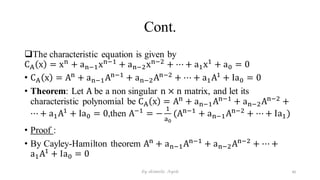
The characteristic equation is given by
CA x = xn
+ an−1xn−1
+ an−2xn−2
+ ⋯ + a1x1
+ a0 = 0
• CA x = An
+ an−1An−1
+ an−2An−2
+ ⋯ + a1A1
+ Ia0 = 0
• Theorem: Let A be a non singular n × n matrix, and let its
characteristic polynomial be CA x = An
+ an−1An−1
+ an−2An−2
+
⋯ + a1A1
+ Ia0 = 0,then A−1
= −
1
a0
(An−1
+ an−1An−2
+ ⋯ + Ia1)
• Proof :
• By Cayley-Hamilton theorem An
+ an−1An−1
+ an−2An−2
+ ⋯ +
a1A1
+ Ia0 = 0
40
by shimelis Ayele
Cont.
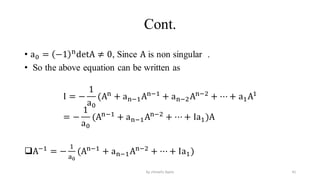
• a0 = −1 n
detA ≠ 0, Since A is non singular .
• So the above equation can be written as
I = −
1
a0
(An
+ an−1An−1
+ an−2An−2
+ ⋯ + a1A1
= −
1
a0
(An−1
+ an−1An−2
+ ⋯ + Ia1)A
A−1
= −
1
a0
(An−1
+ an−1An−2
+ ⋯ + Ia1)
41
by shimelis Ayele
Cont.…
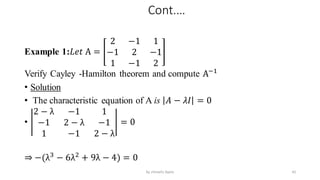
Example 1:𝐿𝑒𝑡 A =
2 −1 1
−1 2 −1
1 −1 2
Verify Cayley -Hamilton theorem and compute A−1
• Solution
• The characteristic equation of A is 𝐴 − 𝜆𝐼 = 0
•
2 − λ −1 1
−1 2 − λ −1
1 −1 2 − λ
= 0
⇒ −(λ3
− 6λ2
+ 9λ − 4) = 0
42
by shimelis Ayele
Cont.
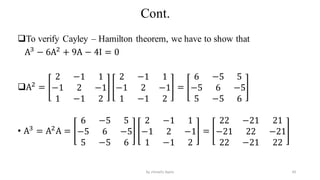
To verify Cayley – Hamilton theorem, we have to show that
A3
− 6A2
+ 9A − 4I = 0
A2
=
2 −1 1
−1 2 −1
1 −1 2
2 −1 1
−1 2 −1
1 −1 2
=
6 −5 5
−5 6 −5
5 −5 6
• A3
= A2
A =
6 −5 5
−5 6 −5
5 −5 6
2 −1 1
−1 2 −1
1 −1 2
=
22 −21 21
−21 22 −21
22 −21 22
43
by shimelis Ayele
Cont.
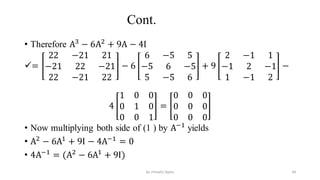
• Therefore A3
− 6A2
+ 9A − 4I
=
22 −21 21
−21 22 −21
22 −21 22
− 6
6 −5 5
−5 6 −5
5 −5 6
+ 9
2 −1 1
−1 2 −1
1 −1 2
−
4
1 0 0
0 1 0
0 0 1
=
0 0 0
0 0 0
0 0 0
• Now multiplying both side of (1 ) by A−1
yields
• A2
− 6A1
+ 9I − 4A−1
= 0
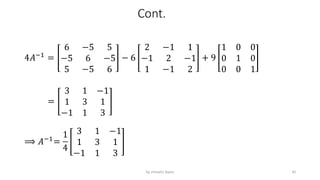
• 4A−1
= (A2
− 6A1
+ 9I)
44
by shimelis Ayele
Cont.
4𝐴−1
=
6 −5 5
−5 6 −5
5 −5 6
− 6
2 −1 1
−1 2 −1
1 −1 2
+ 9
1 0 0
0 1 0
0 0 1
=
3 1 −1
1 3 1
−1 1 3
⟹ 𝐴−1
=
1
4
3 1 −1
1 3 1
−1 1 3
45
by shimelis Ayele
Cont.
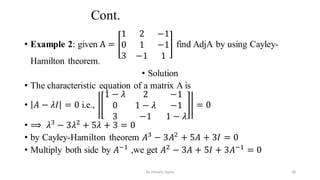
• Example 2: given A =
1 2 −1
0 1 −1
3 −1 1
find AdjA by using Cayley-
Hamilton theorem.
• Solution
• The characteristic equation of a matrix A is
• 𝐴 − 𝜆𝐼 = 0 i.e.,
1 − 𝜆 2 −1
0 1 − 𝜆 −1
3 −1 1 − 𝜆
= 0
• ⟹ 𝜆3
− 3𝜆2
+ 5𝜆 + 3 = 0
• by Cayley-Hamilton theorem 𝐴3
− 3𝐴2
+ 5𝐴 + 3𝐼 = 0
• Multiply both side by 𝐴−1
,we get 𝐴2
− 3𝐴 + 5𝐼 + 3𝐴−1
= 0
46
by shimelis Ayele
Cont.
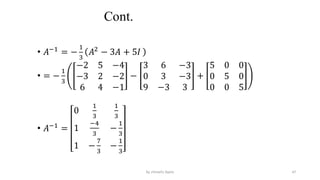
• 𝐴−1
= −
1
3
𝐴2
− 3𝐴 + 5𝐼
• = −
1
3
−2 5 −4
−3 2 −2
6 4 −1
−
3 6 −3
0 3 −3
9 −3 3
+
5 0 0
0 5 0
0 0 5
• 𝐴−1
=
0
1
3
1
3
1
−4
3
−
1
3
1 −
7
3
−
1
3
47
by shimelis Ayele
Cont.
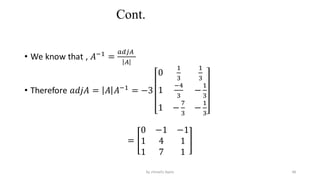
• We know that , 𝐴−1
=
𝑎𝑑𝑗𝐴
𝐴
• Therefore 𝑎𝑑𝑗𝐴 = 𝐴 𝐴−1
= −3
0
1
3
1
3
1
−4
3
−
1
3
1 −
7
3
−
1
3
=
0 −1 −1
1 4 1
1 7 1
48
by shimelis Ayele
Cont.
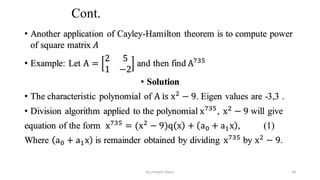
• Another application of Cayley-Hamilton theorem is to compute power
of square matrix 𝐴
• Example: Let A =
2 5
1 −2
and then find A735
• Solution
• The characteristic polynomial of A is x2
− 9. Eigen values are -3,3 .
• Division algorithm applied to the polynomial x735
, x2
− 9 will give
equation of the form x735
= (x2
− 9)q x + a0 + a1x , (1)
Where a0 + a1x is remainder obtained by dividing x735
by x2
− 9.
49
by shimelis Ayele
Cont.
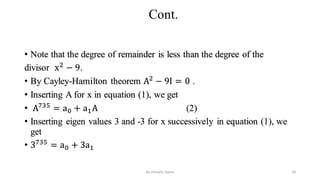
• Note that the degree of remainder is less than the degree of the
divisor x2
− 9.
• By Cayley-Hamilton theorem A2
− 9I = 0 .
• Inserting A for x in equation (1), we get
• A735
= a0 + a1A (2)
• Inserting eigen values 3 and -3 for x successively in equation (1), we
get
• 3735
= a0 + 3a1
50
by shimelis Ayele
Cont.…
• −3 735
= a0 − 3a1
• This gives a0 = 0, a1 = 3734
.
• Then A735
= a0 + a1A
• gives
• A735
= 3735
A.
51
by shimelis Ayele
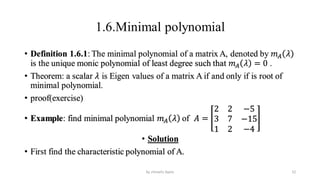
1.6.Minimal polynomial
• Definition 1.6.1: The minimal polynomial of a matrix A, denoted by 𝑚𝐴 𝜆
is the unique monic polynomial of least degree such that 𝑚𝐴 𝜆 = 0 .
• Theorem: a scalar 𝜆 is Eigen values of a matrix A if and only if is root of
minimal polynomial.
• proof(exercise)
• Example: find minimal polynomial 𝑚𝐴 𝜆 of 𝐴 =
2 2 −5
3 7 −15
1 2 −4
• Solution
• First find the characteristic polynomial of A.
52
by shimelis Ayele
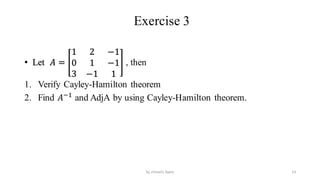
Exercise 3
• Let 𝐴 =
1 2 −1
0 1 −1
3 −1 1
, then
1. Verify Cayley-Hamilton theorem
2. Find 𝐴−1
and AdjA by using Cayley-Hamilton theorem.
53
by shimelis Ayele
Cont.
•
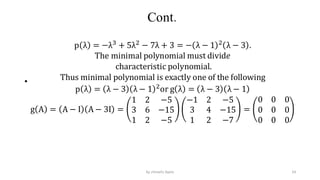
p λ = −λ3
+ 5λ2
− 7λ + 3 = − λ − 1 2
λ − 3 .
The minimal polynomial must divid𝑒
characteristic polynomial.
Thus minimal polynomial is exactly one of the following
p λ = λ − 3 λ − 1 2
or g λ = λ − 3 λ − 1
g A = A − I A − 3I =
1 2 −5
3 6 −15
1 2 −5
−1 2 −5
3 4 −15
1 2 −7
=
0 0 0
0 0 0
0 0 0
54
by shimelis Ayele
Cont.
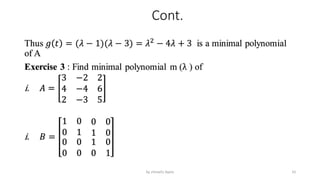
Thus 𝑔 𝑡 = (𝜆 − 1)(𝜆 − 3) = 𝜆2
− 4𝜆 + 3 is a minimal polynomial
of A
Exercise 3 : Find minimal polynomial m (λ ) of
i. 𝐴 =
3 −2 2
4 −4 6
2 −3 5
i. 𝐵 =
1 0 0 0
0 1 1 0
0
0
0
0
1 0
0 1
55
by shimelis Ayele

Note.pdf

  • 1.
    LINEAR ALGEBRA II Chapterone Characteristic Equation 1 by shimelis Ayele
  • 2.
    1.1. Eigen valuesand Eigen vectors 2 by shimelis Ayele
  • 3.
    Cont… we have 𝐴𝑣= 1 2 4 3 1 2 = 5 10 = 5 1 2 = 𝜆𝑣 so 5 is an eigenvalue of 𝐴 and 1 2 is an eigenvector of 𝐴 corresponding to the eigenvalue 5 Definition1.1.2: Let 𝐴 be an 𝑛 × 𝑛 matrix. The set of all eigenvalues of 𝐴 is called the spectrum of 𝐴. Theorem 1.1.1: Let 𝐴 be an 𝑛 × 𝑛 matrix. A Number 𝜆 is an Eigen value of 𝐴 if and only if 𝑑𝑒𝑡 𝐴 − 𝜆𝐼 = 0, where 𝐼 denotes the 𝑛 × 𝑛 identity matrix. 3 by shimelis Ayele
  • 4.
    Properties of EigenValues i. The sum of the eigen values of a matrix is the sum of the elements of the principal diagonal. ii. The product of the eigen values of a matrix A is equal to its determinant. iii. If 𝜆 is an eigen value of a matrix A, then Τ 1 𝜆 is the eigen value of A- 1 . iv. If 𝜆 is an eigen value of an orthogonal matrix, then Τ 1 𝜆is also its eigen value. v. The eigen values of a triangular matrix are precisely the entries of diagonal entries. 4 by shimelis Ayele
  • 5.
    Cont… vi. If 𝜆1,𝜆2,…, 𝜆𝑛 are the eigenvalues of A, then a. 𝑘𝜆1,𝑘𝜆2,…, 𝑘𝜆𝑛 are the eigenvalues of the matrix kA, where k is a non – zero scalar. b. 1 𝜆1 , 1 𝜆2 … 1 𝜆𝑛 are the eigenvalues of the inverse matrix 𝐴−1 . c. 𝜆1 𝑝 , 𝜆2 𝑝 …𝜆𝑛 𝑝 are the eigenvalues of 𝐴𝑃 , where 𝑝 is any positive integer. 5 by shimelis Ayele
  • 6.
    1.2 Characteristic polynomial •Definition 1.2.1:Polynomial of degree 𝑛 in 𝑥 is an expression of the form 𝑎𝑛𝑥𝑛 + 𝑎𝑛−1𝑥𝑛−1 + ⋯ + 𝑎1𝑥 + 𝑎0, where 𝑎0,𝑎1,…𝑎𝑛 ∈ 𝐹 𝑎𝑛𝑑 𝑎𝑛 ≠ 0 , 𝑛 𝑖𝑠 𝑛𝑜𝑛 𝑛𝑒𝑔𝑎𝑡𝑖𝑣𝑒 𝑖𝑛𝑡𝑒𝑔𝑒𝑟. • We can write 𝑝 𝑥 = 𝑎𝑛𝑥𝑛 + 𝑎𝑛−1𝑥𝑛−1 + ⋯ + 𝑎1𝑥 + 𝑎0, if we replace x every where by a given number 𝜆 and we obtain 𝑝 𝜆 = 𝑎𝑛𝜆𝑛 + 𝑎𝑛−1𝜆𝑛−1 + ⋯ + 𝑎1𝜆 + 𝑎0 • Definition 1.2.2: Let 𝑝 𝑥 be a polynomial in x. A number 𝜆 is called a root of 𝑝 𝑥 if 𝑝 𝜆 = 0. 6 by shimelis Ayele
  • 7.
    Cont.… • Definition 1.2.3:Let 𝐴 = 𝑎𝑖𝑗 be an 𝑛 × 𝑛 matrix. Then the polynomial 𝑑𝑒𝑡 𝐴 − 𝜆𝐼 = 𝑑𝑒𝑡 𝑎11 − 𝜆 𝑎12 ⋯ 𝑎1𝑛 𝑎21 𝑎22 − 𝜆 ⋯ 𝑎21 ⋮ 𝑎𝑛1 ⋮ 𝑎𝑛2 ⋱ … ⋮ 𝑎𝑛𝑛 − 𝜆 is called the characteristic polynomial of 𝐴. • Denoted as 𝐶𝐴 𝑥 , the leading coefficient is −1 𝑛 𝑎𝑛𝑑 the constant term is 𝑑𝑒𝑡𝐴. 7 by shimelis Ayele
  • 8.
    Cont… • The equation𝑑𝑒𝑡 𝐴 − 𝜆𝐼 = 0 or equivalently 𝑑𝑒𝑡 𝜆𝐼 − 𝐴 = 0 is called characteristic equation of 𝐴. • Definition 1.2.4: If an eigenvalue 𝜆 occur k times as a root of the characteristic polynomial 𝐶𝐴 𝑥 , then k is called the multiplicity of the eigenvalue . • Example 1: Let 𝐴 = 3 −1 −1 −12 0 5 4 −2 −1 then, 8 by shimelis Ayele
  • 9.
    Cont. i. Find characteristicpolynomial and characteristic equation of A. ii. Eigenvalues and eigenvectors of A. iii. Eigen values of 𝐴−1 iv. Eigen values of 𝐴10 v. Eigen values of 10A. Solution: Characteristic polynomial is 𝑑𝑒𝑡 𝐴 − 𝜆𝐼 = 3 −1 −1 −12 0 5 4 −2 −1 − 𝜆 1 0 0 0 1 0 0 0 1 9 by shimelis Ayele
  • 10.
    Cont. = 3 − 𝜆−1 −1 −12 −𝜆 5 4 −2 −1 − 𝜆 = 3 − 𝜆 𝜆2 + 𝜆 + 10 + 1 12𝜆 + 12 − 20 − 1 24 + 4𝜆 characteristic polynomial is −𝜆3 + 2𝜆2 + 𝜆 − 2 and characteristic equation of A is −𝜆3 + 2𝜆2 + 𝜆 − 2 = 0 ii. To find Eigenvalues of A we have to find root of −𝜆3 + 2𝜆2 + 𝜆 − 2 = 0 ⟹ − 𝜆 + 1 𝜆 − 1 𝜆 − 2 = 0 𝜆= -1 or 𝜆= 1 or 𝜆=2 10 by shimelis Ayele
  • 11.
    Cont. So the eigenvaluesare -1,1 and 2 . To find eigenvector corresponding to eigenvalues write 𝐴𝑣 = 𝜆𝑣 ⟹ 𝐴 − 𝜆𝐼 𝑣 = 0 that is ⟹ 3 − 𝜆 −1 −1 −12 −𝜆 5 4 −2 −1 − 𝜆 𝑥1 𝑥2 𝑥3 = 0 0 0 Then we can solve for 𝑥1, 𝑥2 and 𝑥3 by appropriate method. Let 𝜆= -1 ,then we have 11 by shimelis Ayele
  • 12.
    Cont. 4 −1 −1 −121 5 4 −2 0 𝑥1 𝑥2 𝑥3 = 0 0 0 Solve by using Gaussian elimination . Since the constant matrix is zero matrix, reduce the coefficient matrix to row echelon form 4 −1 −1 −12 1 5 4 −2 0 𝑅2+3𝑅1 𝑅3−𝑅1 4 −1 −1 0 −2 2 0 −1 1 𝑅3− ൗ 1 2 𝑅2 4 −1 −1 0 −2 2 0 0 0 . 12 by shimelis Ayele
  • 13.
    Cont. 4 −1 −1 0−2 2 0 0 0 𝑥1 𝑥2 𝑥3 = 0 0 0 Thus the linear system becomes 4𝑥1 − 𝑥2 − 𝑥3 = 0 −2𝑥2 + 2𝑥3 = 0 ⇒ 𝑥2 = 𝑥3,𝑥1 = 1 2 𝑥3  Let 𝑥3 = 𝑡 𝑡ℎ𝑒𝑛 𝑥2 = 𝑡 𝑎𝑛𝑑 𝑥1 = Τ 1 2 𝑡 where t is arbitrary 13 by shimelis Ayele
  • 14.
    Cont. Thus v = 𝑥1 𝑥2 𝑥3 Τ 1 2𝑡 𝑡 𝑡 = 𝑡 Τ 1 2 1 1 So Τ 1 2 1 1 is eigenvector corresponding to eigenvalue 𝜆 = -1 Similarly, we obtain 3 −1 7 as an eigenvector corresponding to eigenvalue 𝜆=1and 1 −1 2 as an eigenvector corresponding to eigenvalue 2. 14 by shimelis Ayele
  • 15.
    Cont. iii. Eigen valuesof 𝐴−1 . 1, -1 and 1 2 are eigenvalues of 𝐴−1 by the property of eigenvalue. iv. Eigen values of 𝐴10 are -1 , 1 and 210 v. Eigen values of 10A are -10,10 and 20 Example 2: Let 𝐴 = 0 0 −2 1 2 1 1 0 3 Solution: • The characteristic equation of matrix A is 𝜆3 −5𝜆2 + 8𝜆 − 4 = 0, or, in factored form 𝜆 − 1 𝜆 − 2 2 = 0 15 by shimelis Ayele
  • 16.
    Cont. • Thus theeigenvalues of A are 𝜆 = 1and 𝜆2,3 = 2, so there are two eigenvalues of A. v = 𝑥1 𝑥2 𝑥3 ,is an eigenvector of A corresponding to 𝜆 if and only v is a nontrivial solution of 𝐴 − 𝜆𝐼 𝑣 = 0 that is, of the form −𝜆 0 −2 1 2 − 𝜆 1 1 0 3 − 𝜆 𝑥1 𝑥2 𝑥3 = 0 0 0 16 by shimelis Ayele
  • 17.
    cont. • If 𝜆= 1, then −1 0 −2 1 1 1 1 0 2 𝑥1 𝑥2 𝑥3 = 0 0 0 Solving this system using Gaussian elimination yields 𝑥1 = − 2𝑠, 𝑥2 = 𝑠 , 𝑥3 = 𝑠 (verify) Thus the eigenvectors corresponding to 𝜆 = 1are the nonzero vectors of the form −2𝑠 𝑠 𝑠 = 𝑠 −2 1 1 so that −2 1 1 is the Eigen vector corresponding to eigenvalue 1 17 by shimelis Ayele
  • 18.
    Cont. • If 𝜆= 2, then it becomes −2 0 −2 1 0 1 1 0 1 𝑥1 𝑥2 𝑥3 = 0 0 0 • Solving this system using Gaussian elimination yields 𝑥1 = −𝑠, 𝑥2 = 𝑡 , 𝑥3 = 𝑠(verify) • Thus, the eigenvectors of A corresponding to 𝜆 = 2 are the nonzero vectors of the form Thus, the eigenvectors of A corresponding to 𝜆 = 2are the nonzero vectors of the form 𝑥1 𝑥2 𝑥3 = −𝑠 𝑡 𝑠 = 𝑠 −1 0 1 + 𝑡 0 1 0 18 by shimelis Ayele
  • 19.
    Cont… Since −1 0 1 and 0 1 0 are linearly independent,thesevectors form a basis for the Eigen space corresponding to 𝜆 = 2. So the Eigen vectors of A corresponding Eigen values 1and 2 are −2 1 1 , −1 0 1 and 0 1 0 Exercise 1: 1. Find eigenvalues and eigenvectors of A = 1 1 2 3 4 0 1 1 2 1 0 0 0 0 0 0 2 0 0 1 3 0 1 1 4 19 by shimelis Ayele
  • 20.
    Cont. 2. Let A= 3−2 2 4 −4 6 2 −3 5 ,then find a. Find characteristic polynomial and characteristic equation of A. b. Eigenvalues and eigenvectors of A. c. Eigen values of 𝐴−1 d. Eigen values of 𝐴11 e. Eigen values of 30 −20 20 40 −40 60 20 −30 50 . 20 by shimelis Ayele
  • 21.
    1.3.Similarity of matrix Definition1.3.1:If A and B are n xn matrices, then A is similar to B if there is an invertible matrix P such that P-1AP = B, or, equivalently A = PBP-1 Changing A into B is called a similarity transformation. Theorem 1.3.1: If nxn matrices A and B are similar, then they have the same characteristic polynomial and hence the same eigenvalues (with the same multiplicities). Proof: Suppose A and B are similar matrices of order n. 21 by shimelis Ayele
  • 22.
    Cont. The characteristic polynomialof B is given by det B − λI = det P−1AP − λI = det p−1 𝐴 − λI p = det(p−1 )det A − λI det(p ) = det(p−1 p) det A − λI = det A − λI Definition 1.3.2: The set of distinct eigenvalues, denoted by σ(A) , is called the spectrum of A. Definition 1.3.3:For square matrices A , the number ρ(A) = max 𝜆 , λ∈ σ(A)is called the spectral radius of A. 22 by shimelis Ayele
  • 23.
    1.4. Diagonalization • Definition1.4.1:A square matrix A is called diagonalizable if there exist an invertible matrix P such that 𝑃−1 𝐴𝑃 is a diagonal matrix; the matrix P is said to diagonalize A. THEOREM 1.4.1 : If 𝑃1 , 𝑃2, …, 𝑃𝑘 are Eigen vectors of A corresponding to distinct eigenvalues ,λ1, λ2 , …,λk then {P1 , P2, …, Pk } is a linearly independent set. • Proof  Let , 𝑃1 , 𝑃2, …, 𝑃𝑘 be eigenvectors of A corresponding to distinct eigenvalues 𝜆1, 𝜆2 , …,𝜆𝑘 . 23 by shimelis Ayele
  • 24.
    Cont. • We shallassume that, 𝑃1 , 𝑃2, …, 𝑃𝑘 are linearly dependent and obtain a contradiction. We can then conclude that , P1 , P2, …, Pk are linearly independent. • Since an eigenvector is nonzero by definition, p1 is linearly independent. Let r be the largest integer such that P1 , P2, …, Pr is linearly independent. Since we are assuming that P1 , P2, …, Pk is linearly dependent, r satisfies 1 ≤ r ≤ k . More over, by definition of r, P1 , P2, …, Pr+1 is linearly dependent. 24 by shimelis Ayele
  • 25.
    Cont. Thus there arescalars c1 , c2, …, cr+1 , not all zero, such that P1c1 + P2c2+ …, Pr+1cr+1 = 0 (4) Multiplying both sides of 4 by A and using AP1=λ1p1, AP2 = λ2P2 … , APn = λr+1Pr+1 we obtain c1λ1p1 + c2λ2p2 + … + cr+1λr+1pr+1 = 0 … (5) Multiplying both sides of 4 by λr+1 and subtracting the resulting equation from 5 yields c1(λ1−λr+1)p1 + c2(λ2−λr+1)p2 + … + cr(λr − λr+1)pr = 0 25 by shimelis Ayele
  • 26.
    Cont. • Since P1, P2, …, Pr is a linearly independent set, this equation implies that c1(λ1−λr+1) + c2(λ2−λr+1) + … + cr(λr − λr+1) = 0and since , λ1, λ2 , …, λr are distinct by hypothesis, it follows that • c1 = c2=…= cr= 0 (6) Substituting these values in 4 yields • Pr+1cn+1 = 0 (7) Since the eigenvector Pr+1 is nonzero, it follows that cr+1 = 0 Equations 6 and 7 contradict the fact that c1 , c2, …, cr+1 are not all zero; this completes the proof 26 by shimelis Ayele
  • 27.
    Cont. Theorem 1.4.2: IfA is an n × n matrix, then the following are equivalent. a. A is diagonalizable. b. A has n linearly independent eigenvectors. • Proof 𝑎 ⇒ 𝑏 Since A is assumed diagonalizable, there is an invertible matrix 𝑝11 𝑝12 ⋯ 𝑝1𝑛 𝑝21 𝑝22 … 𝑝2𝑛 ⋮ 𝑝𝑛1 ⋮ 𝑝𝑛2 … … ⋮ 𝑝𝑛𝑛 such that 𝑃−1 𝐴𝑃 is diagonal, say 𝑃−1 𝐴𝑃 = 𝐷 , 27 by shimelis Ayele
  • 28.
    Cont. where D = 𝜆10 ⋯ 0 0 𝜆2 … 0 ⋮ 0 ⋮ 0 … … ⋮ 𝜆𝑛 It follows from the formula 𝑃−1 𝐴𝑃 = 𝐷 that 𝐴𝑃 = 𝑃𝐷 ; that is , AP = 𝑝11 𝑝12 ⋯ 𝑝1𝑛 𝑝21 𝑝22 … 𝑝2𝑛 ⋮ 𝑝𝑛1 ⋮ 𝑝𝑛2 … … ⋮ 𝑝𝑛𝑛 𝜆1 0 ⋯ 0 0 𝜆2 … 0 ⋮ 0 ⋮ 0 … … ⋮ 𝜆𝑛 28 by shimelis Ayele
  • 29.
    Cont. = 𝜆1𝑝11 𝜆2𝑝12 ⋯𝜆𝑛𝑝1𝑛 𝜆1𝑝21 𝜆2𝑝22 … 𝜆𝑛𝑝2𝑛 ⋮ 𝜆1𝑝𝑛1 ⋮ 𝜆2𝑝𝑛2 … … ⋮ 𝜆𝑛𝑝𝑛𝑛 1 If we denote the column vectors of P,𝑏𝑦 𝑃1,𝑃2, …, 𝑃𝑛, then from 1, the successive columns of PD are 𝜆1𝑃1 , 𝜆2𝑃2, …, 𝜆𝑛𝑃𝑛 . The successive columns of AP are 𝐴𝑃1 , 𝐴𝑃2, …, 𝐴𝑃𝑛 . Thus we must have 𝐴𝑃1 = 𝜆1𝑝1, 𝐴𝑃2 = 𝜆2𝑃2 … , 𝐴𝑃𝑛 = 𝜆𝑛𝑃𝑛 2 29 by shimelis Ayele
  • 30.
    Cont.… • Since Pis invertible, its column vectors are all nonzero; thus, it follows from 2 that 𝜆1,𝜆2 , …,𝜆𝑛 are eigenvalues of A, and 𝑃1 , 𝑃2, …, 𝑃𝑛 are corresponding eigenvectors. Since P is invertible, 𝑃1, 𝑃2 , …,𝑃𝑛 are linearly independent.  Thus A has n linearly independent eigenvectors. 𝑏 ⇒ 𝑎 Assume that A has n linearly independent eigenvectors 𝑃1 , 𝑃2, …, 𝑃𝑛 with corresponding eigenvalues , 𝜆1, 𝜆2 , …,𝜆𝑛 30 by shimelis Ayele
  • 31.
    Cont.… • Let P= 𝑝11 𝑝12 ⋯ 𝑝1𝑛 𝑝21 𝑝22 … 𝑝2𝑛 ⋮ 𝑝𝑛1 ⋮ 𝑝𝑛2 … … ⋮ 𝑝𝑛𝑛 be the matrix whose column vectors are 𝑃1 , 𝑃2, …, 𝑃𝑛 • The column vectors of the product AP are 𝐴𝑃1 , 𝐴𝑃2, …, 𝐴𝑃𝑛 But ,𝐴𝑃1 = 𝜆1𝑝1, 𝐴𝑃2 = 𝜆2𝑃2 … , 𝐴𝑃𝑛 = 𝜆𝑛𝑃𝑛 Why? 31 by shimelis Ayele
  • 32.
    Cont. AP = 𝜆1𝑝11 𝜆2𝑝12⋯ 𝜆𝑛𝑝1𝑛 𝜆1𝑝21 𝜆2𝑝22 … 𝜆2𝑝2𝑛 ⋮ 𝜆1𝑝𝑛1 ⋮ 𝜆2𝑝𝑛2 … … ⋮ 𝜆2𝑝𝑛𝑛 = 𝑝11 𝑝12 ⋯ 𝑝1𝑛 𝑝21 𝑝22 … 𝑝2𝑛 ⋮ 𝑝𝑛1 ⋮ 𝑝𝑛2 … … ⋮ 𝑝𝑛𝑛 𝜆1 0 ⋯ 0 0 𝜆2 … 0 ⋮ 0 ⋮ 0 … … ⋮ 𝜆𝑛 = 𝑃𝐷 3 32 by shimelis Ayele
  • 33.
    Cont. • Where Dis the diagonal matrix having the eigenvalues, 𝜆1, 𝜆2 , …,𝜆𝑛 on the main diagonal. • Since the column vectors of P are linearly independent, P is invertible. Thus 3 can be rewritten as 𝑃−1 𝐴𝑃 = 𝐷 ; that is, A is diagonalizable • THEOREM 1.4.3: If an n × n matrix A has n distinct eigenvalues,λ1, λ2 , …,λn then A is diagonalizable • Proof: If P1 , P2, …, Pn are eigenvectors corresponding to the distinct eigenvalues ,λ1, λ2 , …,λn then by Theorem , P1 , P2, …, Pnare linearly independent. • Thus A is diagonalizable by Theorem . 33 by shimelis Ayele
  • 34.
    Procedure to diagonalizea matrix  Find the linearly independent eigenvectors  Construct P from eigenvectors  Construct 𝐷 = 𝑃−1 𝐴𝑃 from eigenvalues • Example 1: Finding a Matrix P that diagonalize a matrix A A = 0 0 −2 1 2 1 1 0 3 • Solution • The characteristic equation of A is 𝜆 − 1 𝜆 − 2 2 = 0 and we found the following bases for the Eigen spaces: 34 by shimelis Ayele
  • 35.
    Cont. • 𝜆 =2: 𝑝1 = −1 0 1 , 𝑝2 = 0 1 0 and 𝜆 = 1: 𝑝3 = −2 1 1 • There are three basis vectors in total, so the matrix A is diagonalizable and P = −1 0 −2 0 1 1 1 0 1 diagonalize A. 35 by shimelis Ayele
  • 36.
    Cont. Verify that 𝑃−1 𝐴𝑃= 1 0 2 1 1 1 −1 0 −1 0 0 −2 1 2 1 1 0 3 1 0 2 1 1 1 −1 0 −1 = 2 0 0 0 2 1 0 0 1 • EXAMPLE 2: • Find a matrix P that diagonalizable 𝐴 = 1 0 0 1 2 0 −3 5 2 36 by shimelis Ayele
  • 37.
    Cont. Solution • The characteristicpolynomial of A is  det 𝐴 − 𝜆𝐼 = 1 − 𝜆 0 0 1 2 − 𝜆 0 −3 5 2 − 𝜆 = 𝜆 − 1 𝜆 − 2 2 Thus the eigenvalues of A are 𝜆1 = 1 and 𝜆2,3= 2 . 37 by shimelis Ayele
  • 38.
    Cont. • Verify thateigenvalues are corresponding to 𝜆1 = 1 𝑖𝑠 𝑝1 = −1 1 −8 and corresponding to 𝜆2,3 = 2 𝑖𝑠 𝑝2 = 0 0 1 • Since A is a 3 × 3 matrix and there are only two basis vectors in total, A is not diagonalizable by theorem. 38 by shimelis Ayele
  • 39.
    1.5.Cayley-Hamilton Theorem Theorem: IfCA x is characteristic polynomial of A, then CA x = 0 • Let A = a11 a12 … a1n a21 a22 … a2n ⋮ an1 ⋮ an2 ⋱ ⋮ … ann then characteristic polynomial of A CA x = det A − λI = det a11 − λ a12 … a1n a21 a22 − λ … a2n ⋮ an1 ⋮ an2 ⋱ ⋮ … ann − λ 39 by shimelis Ayele
  • 40.
    Cont. The characteristic equationis given by CA x = xn + an−1xn−1 + an−2xn−2 + ⋯ + a1x1 + a0 = 0 • CA x = An + an−1An−1 + an−2An−2 + ⋯ + a1A1 + Ia0 = 0 • Theorem: Let A be a non singular n × n matrix, and let its characteristic polynomial be CA x = An + an−1An−1 + an−2An−2 + ⋯ + a1A1 + Ia0 = 0,then A−1 = − 1 a0 (An−1 + an−1An−2 + ⋯ + Ia1) • Proof : • By Cayley-Hamilton theorem An + an−1An−1 + an−2An−2 + ⋯ + a1A1 + Ia0 = 0 40 by shimelis Ayele
  • 41.
    Cont. • a0 =−1 n detA ≠ 0, Since A is non singular . • So the above equation can be written as I = − 1 a0 (An + an−1An−1 + an−2An−2 + ⋯ + a1A1 = − 1 a0 (An−1 + an−1An−2 + ⋯ + Ia1)A A−1 = − 1 a0 (An−1 + an−1An−2 + ⋯ + Ia1) 41 by shimelis Ayele
  • 42.
    Cont.… Example 1:𝐿𝑒𝑡 A= 2 −1 1 −1 2 −1 1 −1 2 Verify Cayley -Hamilton theorem and compute A−1 • Solution • The characteristic equation of A is 𝐴 − 𝜆𝐼 = 0 • 2 − λ −1 1 −1 2 − λ −1 1 −1 2 − λ = 0 ⇒ −(λ3 − 6λ2 + 9λ − 4) = 0 42 by shimelis Ayele
  • 43.
    Cont. To verify Cayley– Hamilton theorem, we have to show that A3 − 6A2 + 9A − 4I = 0 A2 = 2 −1 1 −1 2 −1 1 −1 2 2 −1 1 −1 2 −1 1 −1 2 = 6 −5 5 −5 6 −5 5 −5 6 • A3 = A2 A = 6 −5 5 −5 6 −5 5 −5 6 2 −1 1 −1 2 −1 1 −1 2 = 22 −21 21 −21 22 −21 22 −21 22 43 by shimelis Ayele
  • 44.
    Cont. • Therefore A3 −6A2 + 9A − 4I = 22 −21 21 −21 22 −21 22 −21 22 − 6 6 −5 5 −5 6 −5 5 −5 6 + 9 2 −1 1 −1 2 −1 1 −1 2 − 4 1 0 0 0 1 0 0 0 1 = 0 0 0 0 0 0 0 0 0 • Now multiplying both side of (1 ) by A−1 yields • A2 − 6A1 + 9I − 4A−1 = 0 • 4A−1 = (A2 − 6A1 + 9I) 44 by shimelis Ayele
  • 45.
    Cont. 4𝐴−1 = 6 −5 5 −56 −5 5 −5 6 − 6 2 −1 1 −1 2 −1 1 −1 2 + 9 1 0 0 0 1 0 0 0 1 = 3 1 −1 1 3 1 −1 1 3 ⟹ 𝐴−1 = 1 4 3 1 −1 1 3 1 −1 1 3 45 by shimelis Ayele
  • 46.
    Cont. • Example 2:given A = 1 2 −1 0 1 −1 3 −1 1 find AdjA by using Cayley- Hamilton theorem. • Solution • The characteristic equation of a matrix A is • 𝐴 − 𝜆𝐼 = 0 i.e., 1 − 𝜆 2 −1 0 1 − 𝜆 −1 3 −1 1 − 𝜆 = 0 • ⟹ 𝜆3 − 3𝜆2 + 5𝜆 + 3 = 0 • by Cayley-Hamilton theorem 𝐴3 − 3𝐴2 + 5𝐴 + 3𝐼 = 0 • Multiply both side by 𝐴−1 ,we get 𝐴2 − 3𝐴 + 5𝐼 + 3𝐴−1 = 0 46 by shimelis Ayele
  • 47.
    Cont. • 𝐴−1 = − 1 3 𝐴2 −3𝐴 + 5𝐼 • = − 1 3 −2 5 −4 −3 2 −2 6 4 −1 − 3 6 −3 0 3 −3 9 −3 3 + 5 0 0 0 5 0 0 0 5 • 𝐴−1 = 0 1 3 1 3 1 −4 3 − 1 3 1 − 7 3 − 1 3 47 by shimelis Ayele
  • 48.
    Cont. • We knowthat , 𝐴−1 = 𝑎𝑑𝑗𝐴 𝐴 • Therefore 𝑎𝑑𝑗𝐴 = 𝐴 𝐴−1 = −3 0 1 3 1 3 1 −4 3 − 1 3 1 − 7 3 − 1 3 = 0 −1 −1 1 4 1 1 7 1 48 by shimelis Ayele
  • 49.
    Cont. • Another applicationof Cayley-Hamilton theorem is to compute power of square matrix 𝐴 • Example: Let A = 2 5 1 −2 and then find A735 • Solution • The characteristic polynomial of A is x2 − 9. Eigen values are -3,3 . • Division algorithm applied to the polynomial x735 , x2 − 9 will give equation of the form x735 = (x2 − 9)q x + a0 + a1x , (1) Where a0 + a1x is remainder obtained by dividing x735 by x2 − 9. 49 by shimelis Ayele
  • 50.
    Cont. • Note thatthe degree of remainder is less than the degree of the divisor x2 − 9. • By Cayley-Hamilton theorem A2 − 9I = 0 . • Inserting A for x in equation (1), we get • A735 = a0 + a1A (2) • Inserting eigen values 3 and -3 for x successively in equation (1), we get • 3735 = a0 + 3a1 50 by shimelis Ayele
  • 51.
    Cont.… • −3 735 =a0 − 3a1 • This gives a0 = 0, a1 = 3734 . • Then A735 = a0 + a1A • gives • A735 = 3735 A. 51 by shimelis Ayele
  • 52.
    1.6.Minimal polynomial • Definition1.6.1: The minimal polynomial of a matrix A, denoted by 𝑚𝐴 𝜆 is the unique monic polynomial of least degree such that 𝑚𝐴 𝜆 = 0 . • Theorem: a scalar 𝜆 is Eigen values of a matrix A if and only if is root of minimal polynomial. • proof(exercise) • Example: find minimal polynomial 𝑚𝐴 𝜆 of 𝐴 = 2 2 −5 3 7 −15 1 2 −4 • Solution • First find the characteristic polynomial of A. 52 by shimelis Ayele
  • 53.
    Exercise 3 • Let𝐴 = 1 2 −1 0 1 −1 3 −1 1 , then 1. Verify Cayley-Hamilton theorem 2. Find 𝐴−1 and AdjA by using Cayley-Hamilton theorem. 53 by shimelis Ayele
  • 54.
    Cont. • p λ =−λ3 + 5λ2 − 7λ + 3 = − λ − 1 2 λ − 3 . The minimal polynomial must divid𝑒 characteristic polynomial. Thus minimal polynomial is exactly one of the following p λ = λ − 3 λ − 1 2 or g λ = λ − 3 λ − 1 g A = A − I A − 3I = 1 2 −5 3 6 −15 1 2 −5 −1 2 −5 3 4 −15 1 2 −7 = 0 0 0 0 0 0 0 0 0 54 by shimelis Ayele
  • 55.
    Cont. Thus 𝑔 𝑡= (𝜆 − 1)(𝜆 − 3) = 𝜆2 − 4𝜆 + 3 is a minimal polynomial of A Exercise 3 : Find minimal polynomial m (λ ) of i. 𝐴 = 3 −2 2 4 −4 6 2 −3 5 i. 𝐵 = 1 0 0 0 0 1 1 0 0 0 0 0 1 0 0 1 55 by shimelis Ayele